The role of quasi-clusters (systems of a small number of nucleons) in the photodisintegration of light atomic nuclei of the 1p -shell is considered. In these nuclei, there is a strong supermultiplet splitting of levels due to the prominent role of the Majorana forces. It is manifested in the excitation and decay of the Giant Dipole Resonance (GDR), leading to its large-scale configurational splitting. Nucleon quartets, formed inside the nucleus, have a powerful effect on the properties of the GDR of 1p-shell nuclei. The preservation or decay of such quartets during nuclear photoabsorption leads to the formation of various GDR regions. Experimental data confirming this phenomenon are presented.
## I. INTRODUCTION
As is known, the photoabsorption cross section of atomic nuclei has a dominant maximum, called Giant Dipole Resonance (GDR), caused by the absorption of electric dipole (E1) photons. In heavy nuclei, it is located in the region of 10–20 MeV, and in light nuclei – in the area of 15–30 MeV.
Excitation of GDR usually occurs by transferring the energy of the E1-photon to an individual nucleon of the nucleus. Then this nucleon either escapes from the nucleus (semi-direct mechanism of GDR decay) or exchanges energy with other nucleons with their subsequent emission from a nucleus in pre-equilibrium decay or decay at the stage of a compound nucleus.
The study of the GDR has played an outstanding role in the formation of modern concepts of the structure and dynamics of the atomic nucleus [1]. The mechanism of the formation of collective states from the initial particle-hole configurations was discovered within the framework of the shell model [2,3], and it was shown that due to this mechanism that a collective dipole state is formed in medium and heavy nuclei, which reproduces the experimentally observed GDR. At the same time, it was shown that in medium and heavy nuclei, the GDR is determined not by an individual (structural) but by the averaged characteristics of the nuclei. Indeed, the collective particle-hole $(ph)$ dipole state underlying GDR is in massive nuclei, a coherent superposition of many $ph$ -configurations, and its properties vary slightly from nucleus to the nucleus.
Further, the decay properties of GDR in these nuclei are associated with the fragmentation of the dipole state over a considerable number of $2p2h$ and more complex configurations and, therefore, reflect only the averaged characteristics of the nuclei.
On the contrary, in light nuclei, the properties of the GDR are primarily determined by the individuality of the nucleus. In this regard, the most indicative is the $1p$ -shell nuclei (from lithium isotopes to oxygen isotopes). In contrast to medium and heavy nuclei in $1p$ -shell nuclei, GDR excitation occurs not through the transfer of E1-photon energy to individual nucleons but to systems of a small number of additionally bound nucleons that form quasi-clusters inside the nucleus. The specific features of this type of excitation and decay of the GDR of $1p$ -shell nuclei are dictated by their supermultiplet structure. The purpose of this review is to consider the manifestation of this structure in nuclear photodisintegration.
## II. DIPOLE PHOTODISINTEGRATION OF $1p$ -SHELL NUCLEI For $1p$ -shell nuclei, the self-consistent average potential strongly depends on the quantum number of the "Young scheme," which characterizes the permutation symmetry of the spatial variables of the shell configurations. In fact, under these conditions, it is convenient to indicate the shell configuration and its Young scheme. The splitting of configurations, according to Young schemes, reaches 15-16 MeV in the nuclei of the $1p$ -shell, which leads to a strong "configurational splitting of the GDR" of nuclei in this region [4].
Let us first touch upon those features of the configurational splitting of the GDR in the $1p$ -shell nuclei, which are due to a deep (1s) hole. We will use the most advanced approach based on direct diagonalization of a particular basis and neglecting the one-particle continuum. This approach is called the Bound Shell Model (BSM). Figure 1 shows the total GDR cross sections calculated in the framework of this approach for ${}^{7}\mathrm{Li}, {}^{9}\mathrm{Be}, {}^{11}\mathrm{B}, {}^{12-14}\mathrm{C}, {}^{14,15}\mathrm{N},$ and ${}^{16}\mathrm{O}$ nuclei [5]. The dotted line intersecting the figure separates the dipole transitions from different shells. The transitions A (to the left of the line) are due to nucleons of the outer $(1p)$ shell, and the transitions B (to the right of the line) are due to nucleons of the inner (1s) shell.
Groups A and B of dipole excitations in the $1p$ -shell nuclei are due to $1s \rightarrow 1p$ and $1p \rightarrow 1d2s$ nucleon transitions, respectively:
$$
1 s ^ {4} 1 p ^ {A - 4} \rightarrow \left\{\begin{array}{l l}1 s ^ {4} 1 p ^ {A - 5} (1 d 2 s) ^ {1},&\mathrm {A}\\1 s ^ {3} 1 p ^ {A - 3},&\mathrm {B}\end{array}\right.
$$
Analyzing Figure 1, we note that the transitions A and B in the nuclei of the $1p$ -shell are mixed insignificantly, and a single dipole state is not formed. The dipole-resonance states are greatly affected by the supermultiplet character of the structure of low-lying states and will be considered below. B-transitions play the most crucial role in nuclei where the $1p$ -shell is just beginning to be populated, i.e., in $^{7}\mathrm{Li}$ and $^{9}\mathrm{Be}$ nuclei. Calculations by the BSM method qualitatively correctly reproduce the main feature of the GDR in these nuclei – its strong broadening. For example, in $^{9}\mathrm{Be}$, the GDR extends up to 50 MeV (Figure 6). The strengths of the transitions A and B are compared in $^{7}\mathrm{Li}$ and $^{9}\mathrm{Be}$, and in heavier nuclei, B-transitions play a subordinate role, forming the 30-MeV and higher energy GDR region.
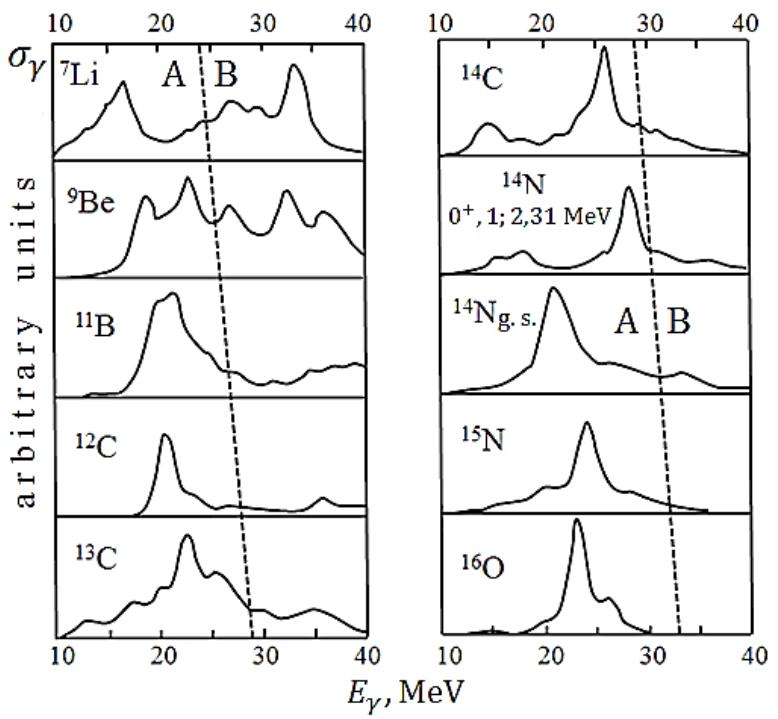 Figure 1: Total cross sections for the photoabsorption of the $1p$ -shell nuclei calculated in the BSM approach [5]. The columns obtained in the calculations are "broadened" according to the Breit-Wigner formula with a width $\Gamma = 2$ MeV. The dotted line intersecting the figure separates transitions A (left) and B (right)
## III. SUPERMULTIPLT STRUCTURE OF THE $1p$ -SHELL NUCLEI
The states of light nuclei of the $1p$ -shell can be described in the LS-coupling scheme using the so-called supermultiplet structure of the nucleus, characterized by Young schemes defining the symmetry of the spatial part of the wave function of the nucleus. The prerequisites for the existence of such a structure are the smallness of spin-orbit splitting and the prominent role of Majorana space-exchange nucleon-nucleon forces. The structure of the A-branch of the GDR in $1p$ -shell nuclei strongly depends on the supermultiplet symmetry, i.e., the spin-isospin group $\mathrm{SU}_4$ of the $1p$ -shell nuclei. Due to the antisymmetry of the nuclear wave function, $\mathrm{SU}_4$ supermultiplets can be specified using the Young scheme of the permutation symmetry of the spatial part of the wave function. This Young scheme is the Young conjugate scheme of the $\mathrm{SU}_4$
group. It is given by a set of quantum numbers $\{f\} LSTJ$ where $L,S,T,J$ are the orbital, spin, isospin, and total angular momenta of the state under consideration and $\{f\} = [f_1,f_2,\dots,f_n]\quad \mathrm{c}\quad f_1\geq f_2\geq \dots \geq f_n,f_i\leq 4$ and $\sum_{i}f_{i} = A$, where $A$ is the number of nucleons in the nucleus. The structure of the 1p-shell nuclei is discussed in these terms below.
The effects of supermultiplet symmetry - supermultiplet splitting of the levels of light nuclei - arise due to the prominent role of Majorana forces, i.e., pair forces of the type $\hat{V}_{12} = -V(r)\hat{P}_{12}^{X}$, where $\hat{P}_{12}^{X}$ is the Majorana operator of permutation of spatial coordinates nucleons, $V(r)$ is a radial function that sets the interaction intensity and its radial dependence.
We will assume first that the energies of the levels can be estimated in the "diagonal" approximation, that is, as the average values of the nuclear Hamiltonian over fixed shell configurations. Denoting $\bar{V}$ the average intensity of pair interaction in a given configuration, we obtain for the operator $\widehat{M}$ of the total Majorana interaction $\widehat{M} = -\bar{V}\sum_{i < j}\hat{P}_{ij}^{X}$.
It is easy to see that the operator $\sum_{i < j} \hat{P}_{ij}^{X}$ is an invariant of the group of permutations of the spatial coordinates of nucleons (more precisely, the Casimir operator of this group). The eigenvalues of this operator for the representation (supermultiplet) $\{f\}$ are given by the formula
$$
\langle \{f \} \left| \sum_ {i < j} \hat {P} _ {i j} ^ {X} \right| \{f \} \rangle = \frac {1}{2} [ f _ {1} (f _ {1} - 1) + f _ {2} (f _ {2} - 3) + \dots ].
$$
Hence it follows that the states belonging to different Young schemes should be separated by a wide energy gap. Let us illustrate this with the example of the $^6 \mathrm{Li}$ and $^7 \mathrm{Li}$ nuclei. In $^6 \mathrm{Li}$, the levels with the scheme $\{42\}$ and the $1s^41p^2$ -configuration, and in $^7 \mathrm{Li}$ with the scheme $\{43\}$ and the $1s^41p^3$ -configuration, are, as shell calculations show, in the energy range below 10 MeV (the energy is measured from the ground state). The levels $^6 \mathrm{Li}$ and $^7 \mathrm{Li}$ with Young schemes $\{411\}$ and $\{421\}$ are in the region of 10–20 MeV. A similar situation takes place in other nuclei of the $1p$ -shell.
As a result of the action of Majorana exchange forces, the lowest state of the supermultiplet has the most symmetric Young scheme with the maximum possible number of rows $f_{i} = 4$, which allows us to speak of the effect of "quarteting" (the formation of quartets of nucleons) in the ground state of the nucleus \[6,7\](non-quarteting nucleons, if any, correspond to the valence shell). In the case of E1-excitation of such a nucleus, the Majorana forces can lead to a significant difference in the average energies of the transition groups associated with a substantial change in the symmetry of the spatial part of the wave function of the nucleus. In this case, the most substantial and most stable effects of supermultiplet splitting arise with such changes in Young schemes when the number of the nucleon four-groups (quartets) in them decreases. Let us illustrate the existence of the "quarteting" effect by the example of $^8\mathrm{Be}$ and $^{12}\mathrm{C}$ nuclei. The ground state of these nuclei belongs to Young schemes {44} and {444}. The isospin of these states should be zero (all nucleons are quarteted). The states arising in the breaking of the nucleon four-groups, i.e., the states with Young schemes {431} and {4431}, can have an isospin $T = 1$ and, as spectroscopy shows, are at energies $E = 15 - 16$ MeV. This number (15-16 MeV) is the typical "quarteting energy" in all nuclei of the $1p$ -shell.
## IV. SUPERMULTIPLT SYMMETRY EFFECTS IN THE GDR OF LITHIUM ISOTOPES
Let us now trace how the effects of supermultiplet splitting manifest themselves in the GDR. Let's start again with the lightest $1p$ -shell nuclei $-^{6}\mathrm{Li}$ and
$^{7}$ Li. In these nuclei, the GDR is formed by the following configurations:
$$
{ } ^ { 6 } \mathrm { L i } : 1 s ^ { 4 } 1 p ( 1 d 2 s ) \{ 4 1 1 \} ,
$$
$$
1 s ^ {3} 1 p ^ {3} \{3 3 \},
$$
$$
1 s ^ {3} 1 p ^ {3} \{3 2 1 \},
$$
$$
^ 7 \mathrm {L i}: 1 s ^ {4} 1 p ^ {2} (1 d 2 s) \{4 3 \}, \{4 2 1 \},
$$
$$
1 s ^ {3} 1 p ^ {4} \{4 3 \},
$$
$$
1 s ^ {3} 1 p ^ {4} \{3 3 1 \}.
$$
According to what was said above, the energies of the configurations $1s^31p^3\{33\}$ in ${}^{6}\mathrm{Li}$ and $1s^31p^4\{331\}$ in ${}^{7}\mathrm{Li}$ should be significantly ( $\approx 10$ MeV) higher than the energies of the configurations $1s^41p(1d2s)\{411\}$, $1s^41p^2(1d2s)\{43\},\{421\}$ and $1s^31p^4\{43\}$ (a 1.5-fold decrease in the energy of quarteting in comparison with the previously indicated one is due to the fact that here the "quarteted" nucleons are in different shells). Some additional spread in the energies of configurations for ${}^{6}\mathrm{Li}$ is associated with the fact that two Young schemes, $\{321\}$ and $\{33\}$, operate. As a result, one should expect that in the Li isotopes, the absorption of $\gamma$ -quanta should be concentrated in the energy intervals shown in Table 1.
Table 1: Energies and Young schemes for the excited configurations of Li isotopes
<table><tr><td>Energy intervals, MeV</td><td>Young schemes</td></tr><tr><td>5–15</td><td>{411},{43}</td></tr><tr><td>15–20</td><td>{33},{421}</td></tr><tr><td>25–40</td><td>{321},{331}</td></tr></table>
Since the decay properties of GDR in light nuclei are largely determined by the configurations directly excited by $\gamma$ -quanta, the multiplication rules for Young schemes dictate the following preferred types of GDR decays in lithium isotopes ( $\mathbf{d} \equiv {}_{1}^{2}\mathbf{H}, \mathbf{t} \equiv {}_{1}^{3}\mathbf{H}$ ):
$$
1 s ^ {4} 1 p (1 d 2 s) \{4 1 1 \} \rightarrow \alpha + \mathrm {p + n},
$$
$$
1 s ^ {3} 1 p ^ {3} \{3 3 \} \rightarrow \mathrm {t} + _ {2} ^ {3} \mathrm {H e},
$$
$$
1 s ^ {3} 1 p ^ {3} \{3 2 1 \} \left\{ \begin{array}{c} \mathrm {t + d + p ,} \\ _ {2} ^ {3} \mathrm {H e + d + n ,} \end{array} \right.
$$
$$
1 s ^ {3} 1 p ^ {4}, 1 s ^ {4} 1 p ^ {2} (1 d 2 s) \{4 3 \} \rightarrow \alpha + \mathsf {t},
$$
$$
1s^{4}1p^{2}(1d2s)\{421\} \to \left\{ \begin{array}{c} ^{5}_{2}\mathrm{He} + \mathrm{d} \to \alpha + \mathrm{d} + \mathrm{n}, \\^{6}_{3}\mathrm{Li}^{*}\{42\} + \mathrm{n} \to \left\{ ^{6}_{3}\mathrm{Li} + \mathrm{n} + \gamma , \\\alpha + \mathrm{d} + \mathrm{n} \end{array} \right. \right\}
$$
$$
1 s ^ {3} 1 p ^ {4} \{3 3 1 \} \to \left\{ \begin{array}{l} t + t + p, \\ t + _ {2} ^ {3} H e + n. \end{array} \right.
$$
For greater clarity, the scheme of excitation and decay of the GDR of the $^6$ Li nucleus is shown in Figure 2.
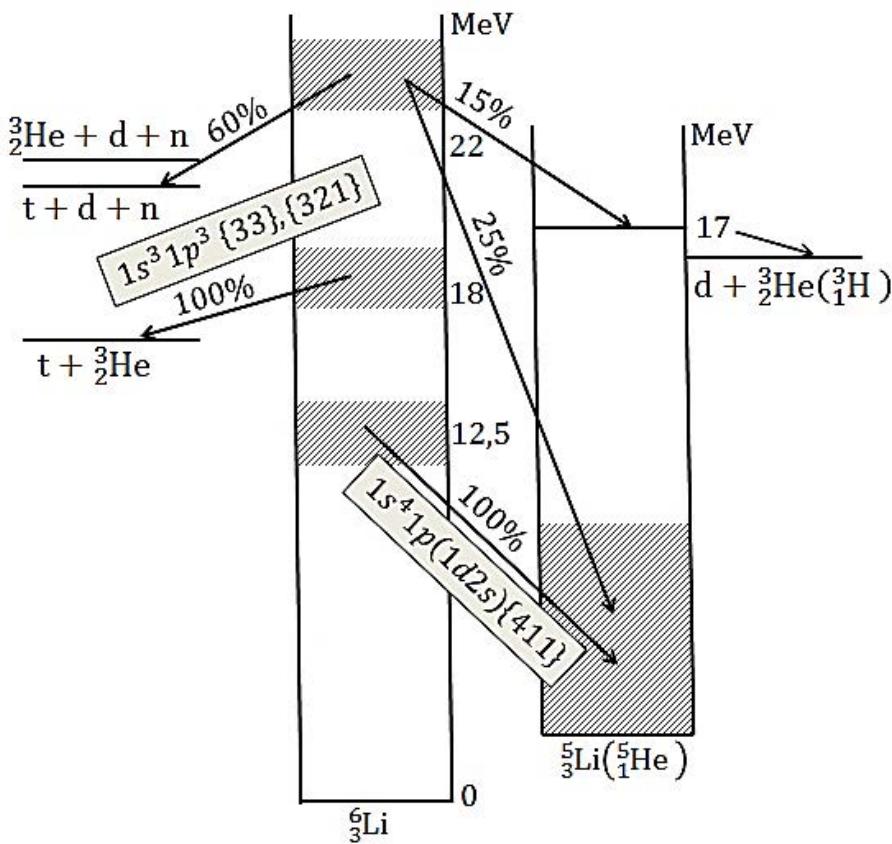 Figure 2: The scheme for excitation and decay of $^6\mathrm{Li}$ as a result of the absorption of $\gamma$ -quanta, predicted by the theory in diagonal approximation [4].
Figure 3 shows the photoabsorption cross section for $^6\mathrm{Li}$ [8] and Young schemes that form the central maximum of the GDR and the maximum in the low-energy region (pygmy resonance).
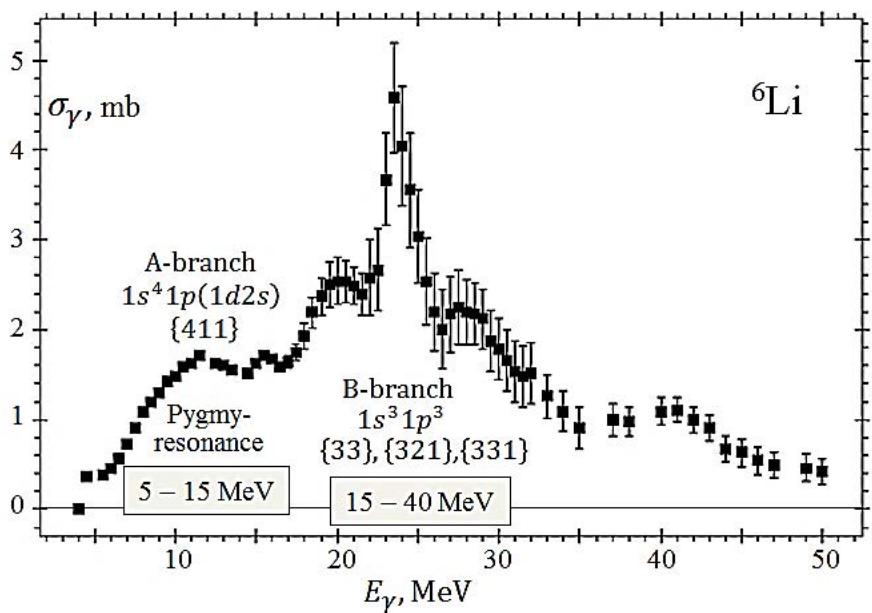 Figure 3: Photoabsorption cross section of the $^6\mathrm{Li}$ [8] and Young schemes forming different energy regions of this cross section
Figure 4 shows a diagram of nucleon E1-transitions of the $^7$ Li nucleus, indicating the corresponding Young schemes, nucleon quartets, and energies. Figure 5 shows the photoabsorption cross section in $^7$ Li [8] and Young schemes for different regions of this cross section.
### 7Li
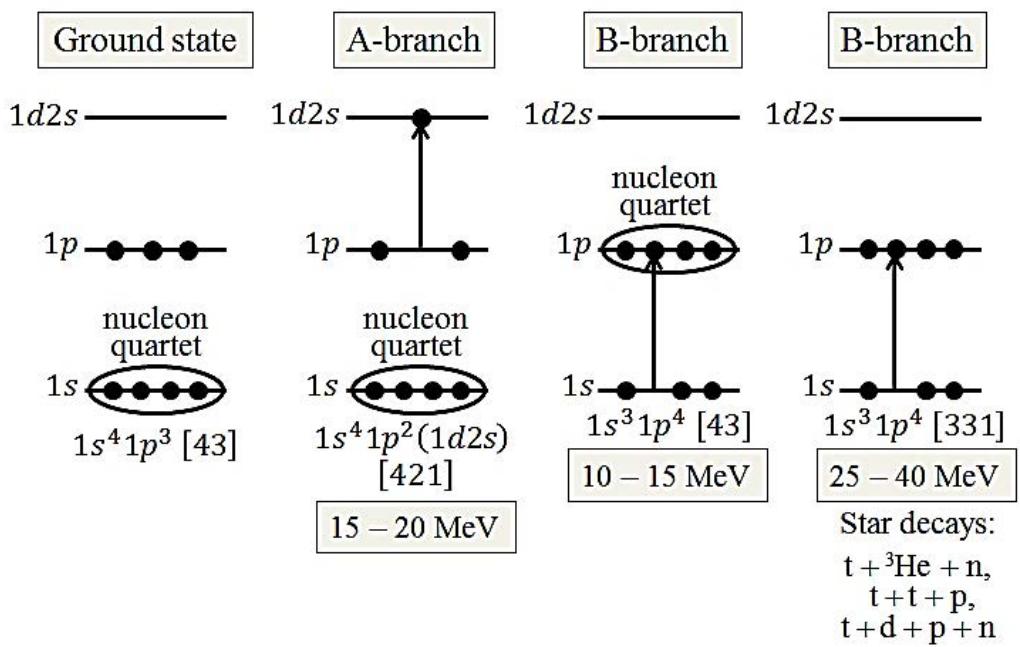
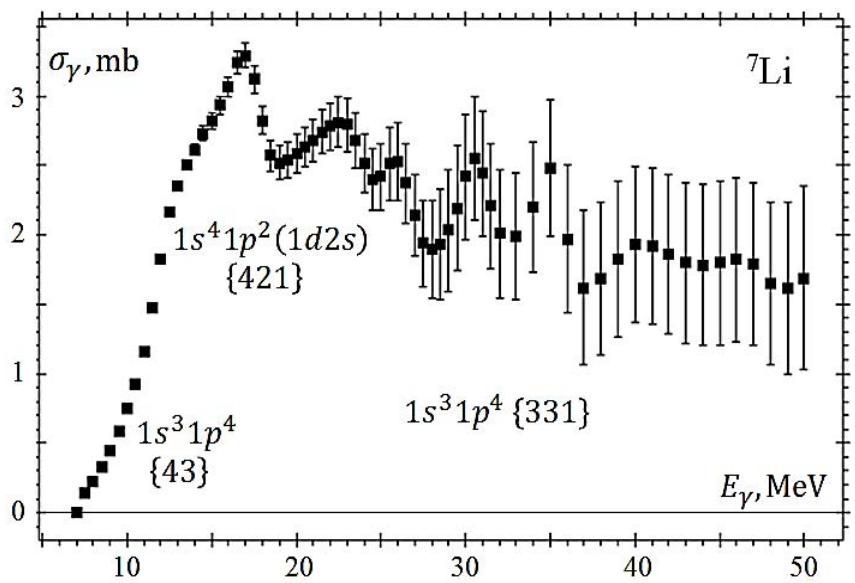 Figure 4: Nucleon transitions and Young schemes are forming the GDR in $^7\mathrm{Li}$ Figure 5: Photoabsorption cross section of $^7$ Li [8] nucleus and Young schemes forming different energy regions of this cross section
The most striking property of the GDR in $^{6,7}\mathrm{Li}$ nuclei should be a high probability of decay through channels $\alpha$ -t, $^3\mathrm{He}$ -t, and "star-like" channels, i.e., many-particle channels, which correspond to different parts of the dipole absorption band. Experimental data confirm this [9-19].
## V. PHOTO DISINTEGRATION OF $^9\mathrm{BE}$ AND $^{13}\mathrm{C}$
Photodisintegration of the $^9\mathrm{Be}$ nucleus can be a good test of the theory under consideration. The ground state of this nucleus has the configuration $1s^41p^5\{441\}$. In transitions of type A, configurations $1s^41p^4 (1d2s)$ with
Young schemes {441} and {432}, {4311} are excited. According to the above, states with Young schemes {441} and {432}, {4311} are separated by an energy gap of approximately 15–16 MeV (quarteting effect). Accordingly, the set of states with Young schemes {432} and {4311} forms the main GDR maximum in $^9\mathrm{Be}$, located in the region of 15-25 MeV \[20\](Figure 6), and states with Young scheme {441} give a pygmy-resonance, clearly visible in the channel $(\gamma,\mathfrak{n})$ \[21,22\](Figure 7). The pygmy-resonance, naturally, lies at much lower energies.
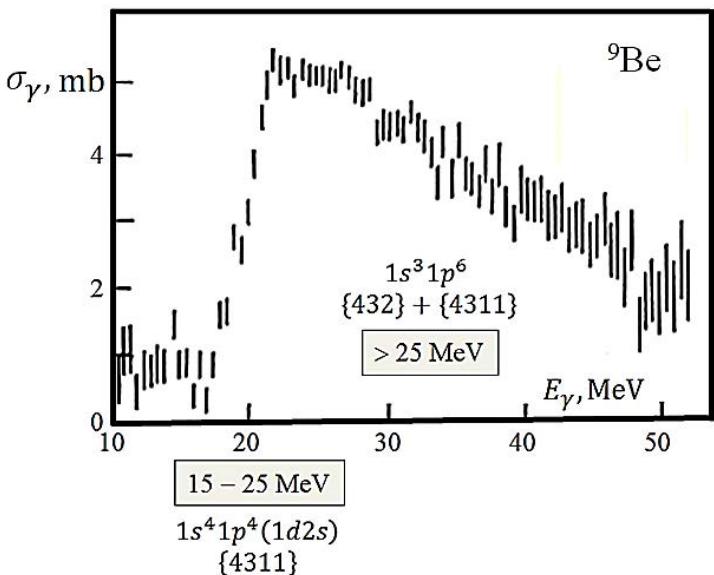 Figure 6: Photoabsorption cross section of $^9\mathrm{Be}$ nucleus [20] and Young schemes, forming different energy regions of this cross section
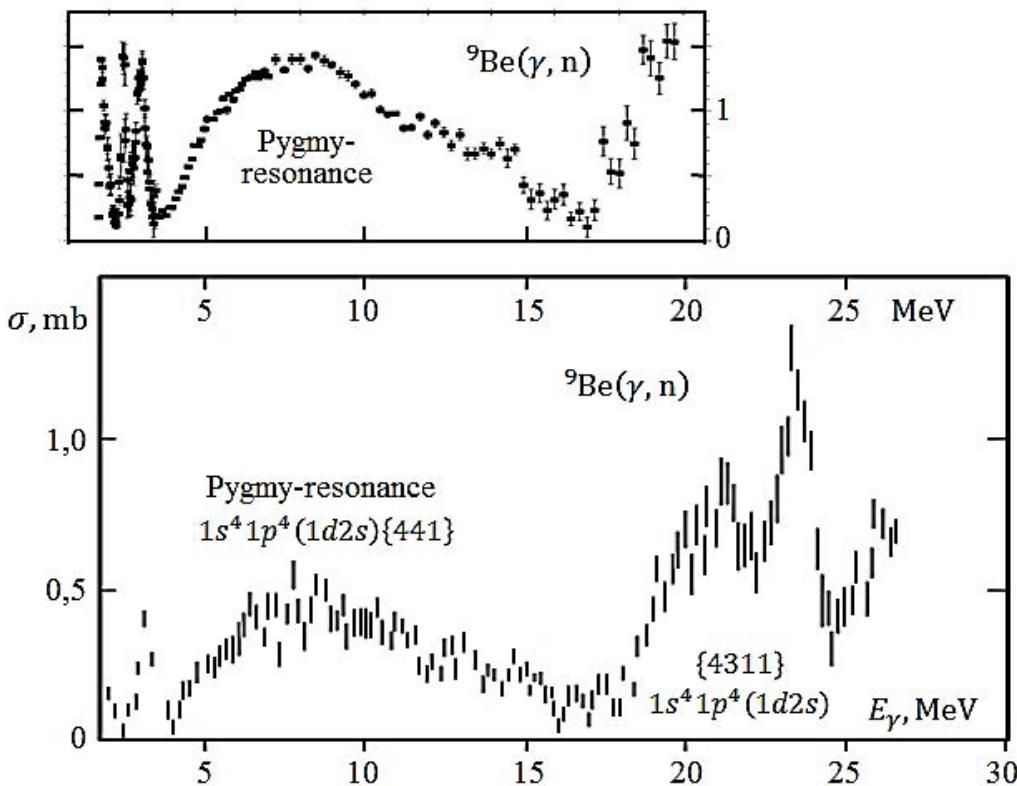 Figure 7: Pigmy resonance in the cross section of the reaction ${}^{9}\mathrm{{Be}}\left( {\gamma,n}\right)$ according to works [21](bottom) and [22](top)
The $^{13}\mathrm{C}$ nucleus is very close in its supermultiplet properties to the $^9\mathrm{Be}$ nucleus under consideration. Everything that has been said about $^9\mathrm{Be}$ is also true about this nucleus. The only thing that needs to be changed formally is to make a substitution in Young schemes $\{441\} \rightarrow \{4441\}$, etc. Therefore, a pygmy resonance should exist in the $^{13}\mathrm{C}$ nucleus, as well as in $^{9}\mathrm{Be}$. It is seen experimentally both in the $(\gamma,\mathfrak{n})$ channel \[23\](Figure 8) and in the photoabsorption cross section [24].
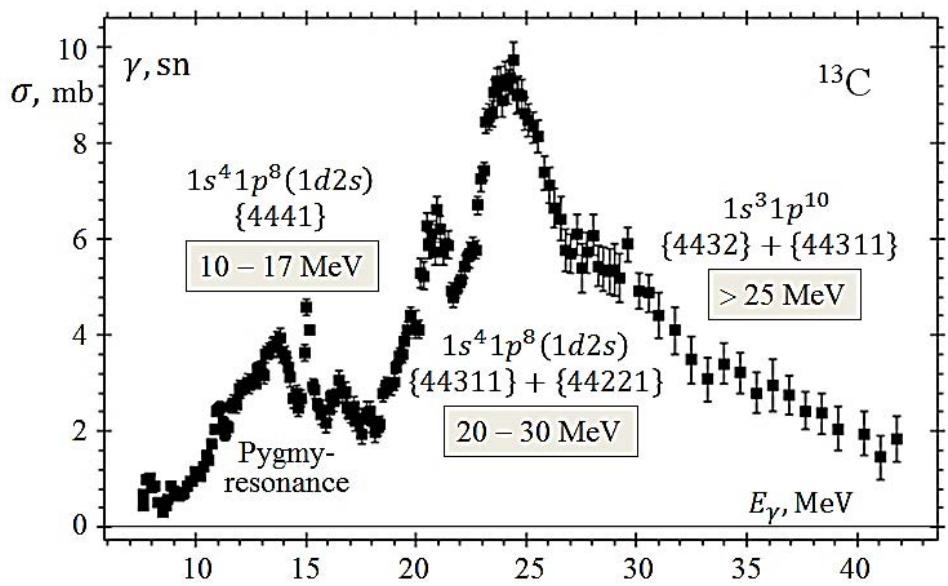 Figure 8: The cross section for the photoneutron reaction of the $^{13}\mathbf{C}$ nucleus [23] and Young scheme, forming different energy regions of this cross section
Pigmy resonance is also found in $^{11}\mathrm{B},$ $^{14}\mathrm{C},$ and $^{15}\mathrm{N}$ nuclei, which contain non-quarteting nucleons (see details in [4]). A pygmy resonance could also exist in $^{14}\mathrm{N}$. Still, because the quarteting effect in this nucleus is much less pronounced than in neighboring odd nuclei, the residual interaction mixes the configurations so that a single broad absorption maximum is formed.
## VI. CONCLUDING REMARKS
So far, we have neglected the residual interaction and considered the supermultiplet properties of the GDR in the diagonal approximation. The residual interaction will naturally destroy, to a certain extent, the supermultiplet structure of nuclear states. However, numerous calculations of the GDR in $1p$ -shell nuclei in the BSM $(1\hbar \omega)$ approximation have shown that the supermultiplet gross structure of the GDR is nevertheless retained. Table 2 shows the weights of the dominant components of the wave functions of the ground states of the $1p$ -shell nuclei. As seen, we can speak with reasonable accuracy of the manifestation of a supermultiplet structure.
Table 2: Weights of the dominant components in the wave function of the ground state of the $1p$ -shell nuclei in the LS-representation (a variant of the Hamiltonian with Rosenfeld forces)
<table><tr><td>Nucleus</td><td>Dominant component \(\{f\}^{2T+1 2S+1}L_J\)</td><td>Weight,%</td><td>Nucleus</td><td>Dominant component \(\{f\}^{2T+1 2S+1}L_J\)</td><td>Weight,%</td></tr><tr><td>\(^7Li \)</td><td>\(\{43\}^{22}P_{3/2}\)</td><td>97</td><td>\(^{12}C \)</td><td>\(\{444\}^{11}S_0\)</td><td>71</td></tr><tr><td>\(^8Be \)</td><td>\(\{44\}^{11}S_0\)</td><td>97</td><td>\(^{13}C \)</td><td>\(\{4441\}^{22}P_{1/2}\)</td><td>64</td></tr><tr><td>\(^9Be \)</td><td>\(\{441\}^{22}P_{3/2}\)</td><td>81</td><td>\(^{14}N \)</td><td>\(\{4442\}^{13}D_1\)</td><td>90</td></tr><tr><td>\(^{10}B \)</td><td>\(\{442\}^{13}D_3\)</td><td>64</td><td>\(^{14}C \)</td><td>\(\{4442\}^{31}S_0\) \(\{4433\}^{33}P_0\)</td><td>5644</td></tr><tr><td>\(^{11}B \)</td><td>\(\{443\}^{22}P_{3/2}\)\(\{443\}^{22}D_{3/2}\)</td><td>4132</td><td>\(^{15}N \)</td><td>\(\{4443\}^{22}P_{1/2}\)</td><td>100</td></tr></table>
In conclusion, we note that in the nuclei of the $1d2s$ -shell, the supermultiplet effects of the GDR are significantly reduced, and they can no longer be clearly distinguished. This is due to both an increase in the role of the spin-orbit interaction and a decrease in the intensity of the monopole part of the Majorana forces.
Generating HTML Viewer...
References
24 Cites in Article
B Ishkhanov,I Kapitonov (2021). Giant dipole resonance of atomic nuclei. Prediction, discovery, and research.
J Elliott,B Flowers (1957). The odd-parity states of 16 O and 16 N.
G Brown,M Bolsterli (1959). Dipole State in Nuclei.
R Eramzhyan,B Ishkhanov,I Kapitonov,V Neudatchin (1986). The giant dipole resonance in light nuclei and related phenomena.
N Goncharova,H Kissener,R Eramzhyan (1985). Photodisintegration of 1p-shell nuclei.
V Neudachi,V Shevchenko,N Yudin (1964). The orbital young diagram as a shell model quantum number in light nuclei and some cluster phenomena in nuclear reactions.
V Neudatchin,V Shevchenko (1964). Monopole part of Majorana forces and giant dipole resonance in the 1d-2s shell nuclei.
V Varlamov,V Surgutanov,A Chernyaev,N Efimkin,Photonuclear Data (1986). Photodisintegration of lithium. Evaluated cross sections of channells and reactions.
Evans Hayward,Tannie Stovall (1965). Photoneutron production by Li6, Li7, B10, B11 and O16.
V Denisov,L Кul′chitskiy (1967). Photodisintegration of Li 7 with emission of protons, deuterons, and tritons.
V Denisov,A Коmаr,L Кul′chitskiy,E Маkhnovskiy (1967). Photodisintegration of Li 6.
Sorokin Yu,. Shardanov,А Kh,V Shevchenko,B Yur′ev (1969). Photodisintegration of Li 6 and Li 7 by bremsstrahlung gamma-beam with end-point energy 𝐸𝐸 𝛾𝛾 𝑚𝑚𝑚𝑚𝑚𝑚 = 12 MeV.
A Murakami (1968). 6Li(γ, t)3He and6Li(γ, pd)3H reactions.
Akira Murakami (1970). <sup>6</sup>Li(γ, <i>t</i>)<sup>3</sup>He and <sup>6</sup>Li(γ, <i>p</i><i>d</i>)<sup>3</sup>H Reactions.
V Denisov,L Кul′chitskiy,I Chubukov,Ya (1973). Photonuclear reactions on Li 6 with charged-particles emission.
E Коtiкоv,E Маkhnovskiy (1974). Reaction Li 7 (γ,p+t)H 3 at E γ < 27 MeV.
E Коtiкоv,E Маkhnovskiy (1985). Mechanism of reaction Li 6 (γ,p+d+t).
E Коtiкоv,E Маkhnovskiy (1987). The investigation of mechanism of the reaction 7 Li(γ,p+t+t) at E γ < 27 MeV.
J Ahrens,H Borchert,K Czock,H Eppler,H Gimm,H Gundrum,M Kröning,P Riehn,G Sita Ram,A Zieger,B Ziegler (1975). Total nuclear photon absorption cross sections for some light elements.
R Hughes,R Sambell,E Muirhead,B Spicer (1975). The photoneutron cross section of 9 Be.
A Goryachev,G Zalesnyy,I Pozdnev (1992). Be 9 (γ,n) reaction cross section in the energy range from threshold to 20 MeV.
No ethics committee approval was required for this article type.
Data Availability
Not applicable for this article.
How to Cite This Article
Igor Kapitonov. 2026. \u201cQuasi-Clusters in Nuclear Photodisintegration in the Giant Dipole Resonance Region\u201d. Global Journal of Science Frontier Research - A: Physics & Space Science GJSFR-A Volume 22 (GJSFR Volume 22 Issue A7).
Explore published articles in an immersive Augmented Reality environment. Our platform converts research papers into interactive 3D books, allowing readers to view and interact with content using AR and VR compatible devices.
Your published article is automatically converted into a realistic 3D book. Flip through pages and read research papers in a more engaging and interactive format.
Our website is actively being updated, and changes may occur frequently. Please clear your browser cache if needed. For feedback or error reporting, please email [email protected]
Thank you for connecting with us. We will respond to you shortly.