
I. INTRODUCTION
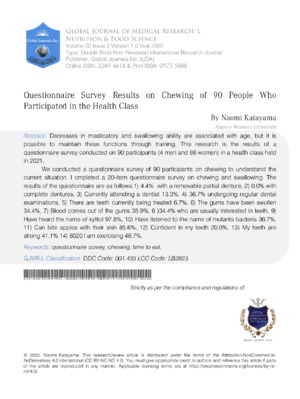
In Japan, the 8020 campaign has been widely publicized by peoples. This campaign is that you should have 20 teeth and chew your teeth to eat enough to maintain your nutrition and health. If we finish eating in a shorter time than the signal reaches the satiety center, you may overeat. And our blood sugar level will rise sharply, and excess sugar will accumulate in our body as fat, resulting in obesity.
II. MATERIALS AND METHODS
a) Participants
Participants were informed about the study, signed a consent form, and voluntarily participated in this study. A chewing questionnaire Survey was conducted on 90 people who participated in the health class. Participants voluntarily participated in the chewing questionnaire.
b) Chewing questionnaire survey
Participants completed a self-administered questionnaire about twenty items related to chewing. Table 1 shows the contents of each item.
| 20-item |
| Using removable partial dentures |
| Using full dentures |
| Currently attending a dentist |
| Have regular dental examinations |
| Have a tooth that is currently being treated |
| Have swollen gums |
| Blood comes out of the gums |
| Always interested in teeth |
| Heard the name of xylitol, which usually chews gum |
| Heard the name of Mutans bacteria, which usually chews gum |
| Can bite an apple with its skin |
| Have confidence in teeth |
| Think teeth are strong |
| Know the 8020 movement |
| There is a tooth that is an insert tooth |
| Think I am chewing on food |
| Chew a bite of food more than 30 times |
| Do you brush your teeth after a snack? |
| Did you do fluoridation of your teeth when you were in elementary school? |
| habit of chewing gum |
c) Questionnaire survey results regarding time spent on meals
- Participants filled in a self-administered questionnaire for the time spent on the three meals.
d) Ethical review board
This study was conducted with the approval of the Ethical Review Board (Nagoya women's university 'hito wo mochii ta kennkyuu nikansuru iinnkai'). The approval number is 2020-26.
III. RESULTS
a) Participant results
There were 90 participants, fourmales and 86 females. The age distribution is shown in Table 2.
| 10s | 20s | 30s | 40s | 50s | 60s | |
| Maie | 0 | 2 | 0 | 1 | 1 | 0 |
| Female | 25 | 42 | 4 | 7 | 6 | 2 |
Show the basic information of the participants in Table 3. The Average standard deviation of age for 86 females is . The Average standard deviation of the age for four males is .
| Female (n=86) | Male (n=4) | |||||
| Age | Height | Weight | Age | Height | Weight | |
| Average | 26.8 | 157.0 | 50.7 | 35.8 | 172.0 | 66.3 |
| Atandard diviation | 12.3 | 5.4 | 6.8 | 18.3 | 5.7 | 5.3 |
| Median | 20 | 157.75 | 50 | 34.5 | 173.5 | 66.5 |
| Maximum | 69 | 169.6 | 80 | 54 | 177 | 72 |
| Minimum | 12 | 147 | 39 | 20 | 164 | 60 |
b) Questionnaire survey results
Table 4 shows the results of a questionnaire survey on mastication for 90 participants. Of the participants, had partial dentures, and none had complete dentures. of the participants went to the dentist regularly. Of the participants, knew the name of Xylitol, and knew the 8020 campaign (keeping 20 teeth at age 80). Among the participants, felt they could chew food well, and felt that their teeth were strong. Among the participants, had their teeth treated with fluoride in elementary school, and had the habit of chewing gum.
c) Questionnaire survey results regarding time spent on meals results
Most the participants spent 10 minutes on breakfast, 15 minutes on lunch, and 20 or 30 minutes on dinner.
The average time of participants was 12.8 minutes for breakfast, 18.6 minutes for lunch, and 24.8 minutes for dinner.
IV. DISCUSSION
Most participants who attended the health class this time did not have a habit of chewing gum. However, almost everyone knew the word xylitol. But about half of the participants knew the talk of the 8020 campaign. Participants could bite the apple with the skin, but were less confident in the teeth. Participants replied that they chew food, but did not chew 30 times. If participants can prevented by eating the food bite little over time, the blood glucose level after a meal can moderate. Many researchers have reported the relationship between rumination and cognition/dementia risk , and other effects on brain functions . Masticatory force is measured by device development and computational model , and research to clarify occlusal orifice reports. Studies have also reported that chewing gum increases bite force . The authors reported that high school students, university students, and middle-aged adults ate a meal less than 30 minutes per meal . In addition, the authors reported the results of training chewing power by chewing gum every day before meals for 30 days9). Furthermore, the authors reported whether or not chewing gum improves masticatory strength10). We want to convey the importance of chewing through these educational activities.
V. CONCLUSIONS
We reported the results of a self-administered questionnaire survey on mastication performed on 90 participants who voluntarily consented to the study. As a result, less than half of the participants answered that they consciously had solid teeth and could chew food well. The average time taken by the participants to eat every three meal was less than 30 minutes. Many of the participants had no habit of chewing gum.
ACKNOWLEDGEMENTS
This study was supported by the Japanese Society of Taste Technology, 2019.