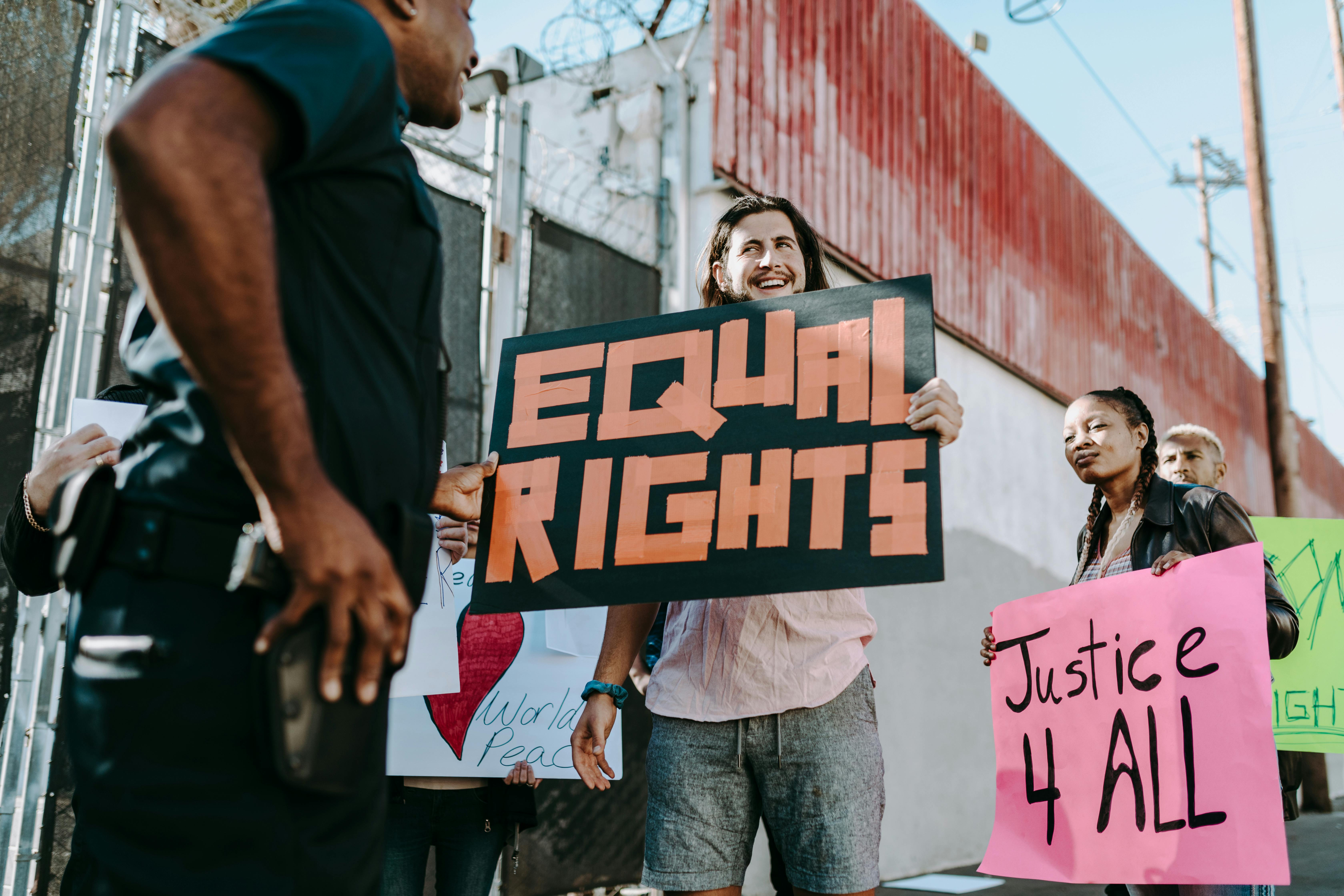
The purpose of this article is to discuss the human rights of Afro-descendants and it’s evolution in Brazil, especially with regard to the historical, political and social structure. The characterization of information from the colonial period to current Brazil is analyzed, making considerations about the contrast of racism and the rights conquered among Afro-descendant individuals. Within this concept, the work proposes to present a critical study with the purpose of exposing discrimination and social inequality within society and how those supported by State law aim at effective public policies to combat in an attempt to mitigate or end these problems that affect the development of about 56.2% of the Brazilian population.
## I. INTRODUÇAO
No Brasil, há dados que evidenciam a discriminação racial que ocorre no País como reflexo do periodo colonial e da escravidão de afredescentes. De acordo com Lusci e Araujo (2005, apud VIANA, 2014, n.p), a discriminação racial é "a manifestação do preconceito, sua materialização em atitudes que efetivamente impedem ou limitam o grupo discriminado".
Ao observar os dados sobre pessoas pretas no Brasil, observa-se dados alarmantes quando a desigualdade social, sendo esta reflexo da discriminação racial. Segundo uma coisa do Instituto Locomotiva em parceria com a Data Favela e a CUFA (Centro Único de Favelas), as favelas são habitadas por $67\%$ de pessoas negras, quando na società, estas representam $55\%$ da populateção nacional (SALLES, 2021). quando olhamos para os dados referentes a classe social, temos que dos $10\%$ da populateção com maior rendimento per capita, apenas $27.7\%$ são pessoas pretas; enquanto nos $10\%$ de menor rendimento, o mesmo grupoétrico representa $75.2\%$ (MADEIRO, 2019).
Segundo o $14^{\circ}$ Anuário Brasileiro de Segança Pública, dos 657,8 mil presos no Brasil, $66.7\%$ destes se identificavam como pessoas pretas. Os dados referentes a Educação no País también possuem grande disparidade, como exemple, dos analfabetos ema negra chega a quase $9\%$ quando naa branca é de, aproximamente, $3.9\%$ (OLIVEIRA, 2020).
Assim, estima-se a necessidade da participação do Estado brasileiro para mitigar as consequências do racismo e suasestruturas estruturantes,assim como, de fornecer pleno desenvolvimento e proteção para afrodescendentes a fim de emancipar o grupo majoritariamente marginalizo. Portanto,este tralho serapresentado ocontexto historico de afrodescendentes no Brasil, a fim de observar as intervenções que o Estado tem feito ao longo do tempo e como ele se emancipa na contemporaneidade.
## II. A RELAÇÂO RACIAL NO BRAJIL ATÉ O SÉC. XIX
O Brasil, instituído a partir da colonização de páises europeus assim como a maioria dos País da América Latina, obtinha como forca central de trabalho a escrivação, sobretudo de pessoas trazidas à forca do continente africano. Essa população, que resistiu ao longo de cinco séculos diversas tentativas de exterminio, hoje compoê a sociedade brasilária majoritariamente, e esta experiência vivida diariamente pela cultura negra no País é comprehendida, de acordo com Ortegal (2018), como parte da chamada diaspora africana. Compreender a diaspora permite identificar as particulidades da experiência racializada das relações sociais, mesmo que tratando-se deroupos de uma mesma classe social.
O sociólogo Renato Ortiz, retrata que os europeus eram tidos como evoluidos e, portanto, tem maior poder e são superiores, influenciados pelo evoluccionismo de Spencer que de acordo com o escrirter tal teoria "se propunha a encontrar um nexo entre as differentes sociedades humanas ao longo da historia; [...] procurava-se estabelecer as leis que presidiriam o progresso das civilizações" (p. 14, 1985).
Ao analisar mais atentamente a historia brasaire é possivel perseber como as relações entre europeus, africanos e indígenas foram definidas por distinguções de cunho racial. Utilizando de argumentos "biológicos", "médicos" e até espiritualais, negros e indígenas eram categorizados de forma racializada, não somente como forma de hierarquização, mas quando de maneira a classificar o que era ou não considerado humano. Essa classificação abria espaço para uma isença moral para explorar, excavizar e exterminar determinadoroupo, e não teve seu efelitos cessados por "decretos" como a promulgação da Lei Àurea.
A Lei Áurea, estabelecida em 13 de maio de 1888, aboliu legalmente a escrivação do Brasil, no entanto, não assegurou circunstências reais de participação na sociedade para a população negra no País, ou seja, os negros continuaram excluídos doprocesso social. No momento em que foi abolda oficialmente a escrivação, não foram criadas condições para que o povo escrivazado pudesse de fato ser inserido na sociedade e até o já escasso espaço no mercado de trabalho passou a ser destinado aetrabalhadores brancos ou estrangeiros.
A coisa da necessidade de prover um recurso a popULAção saída dessas condições, de acordo com a ex-ministra da Secretaria de Política de Promoção da Igualdade Racial Luiza Barros (2014), não são tão convençada, como os senhores foram dispensados de qualquer responsabilité sobre a segança dos libertos, e o Estado ou qualquer outras instituição não assumiram o encargo de preparar esta popULAÇÃO para o novo regime de organização de vida e trabalho. De acordo com Barros (n.p., 2014):
"Ainda estamos tentando recuperar a forma traumática como esta abolição aconteceu, deixando a popULAÇÃO negra à suaitye. Como os negros partiram de um patamar muito bajo, teremos que acelerar esseprocesso com ações affirmativas, para que possamos encontrar uma diminuição mais significativa das desigualdades" (n.p., 2014).
Évio tem�o salientar que a promulgacao da Lei Aurea e as leis anteriores que a culminaram não ocorreram por conta do sentido de justica social que o Estado buscava cumprir, e sim porque o mesmo sofria pressoes externas e internas para uma mudanca no tipo de forca de trabalho realizada na producao. As pressoes externas vinham, sobretudo, da Inglaterra, principal mediadora no processo de independencia do Brasil: devido ao seu interesse por mercado para seu produits manufaturados e fontes baratas de materiaiasprimas, os ingleses pressionaram a Coroa portuguesa e, logo antes, o Brasil por melhores condições commerciais. As pressoes internas, por sua vez, eram provenrientes dos propietários rurais, que ao investir na compra de forca de trabalho tornavam-se devedores dos commerciantes de escravos, e esta sujeção econômica trazia insatisuição aos produtores.
## III. TEORIA EUGENISTA E OS EFEITOS NO BRASIL DURANTE O SEC.XX
A eugenia foi um conceito criado em 1883, na Inglaterra, que acabou sendero difundida em diversos países pelo mundo. O movimento eugenista era essentiallymente social a fim de excludir os indesejados e de melhorar a genética da população. Inspirado pelos estudos de Charles Darwin, Jean-Baptiste de Lamark e outros pesquisadores influentes criou a até quando não como ciência eugenista, uma maneira de seleção natural para indentar os membros ideais e exemplares na sociedade para reprodução, de acordo com Declerq (n.p., 2020).
No Brasil, a corrente ideológica foi credibilizada no inizio daicana de 1920 por médicos,cientistas, jornalistas e intelectuales da epoca. Estes, por sua vez, apoiavam prácticas para "melhorar" a nao brasilira. A corrente foi muito defendida e propagated por Monteiro Lobato, conhecido por suasopenhagenes pensamento racista. A ideologia era contra a miscigenacao, oucka, eram contra a reproducao entre pessoas de grupos etnicos differentes.No periodo, intensificou a imigraao de europeus no Brasil que, aio, eram pessoas a procura de trabalho e melhor condiço de vida.Contudo, como aponta Formiga (2017), o incentivo a imigraao era resultado da eugenia com intuito de branqueamento populacional.
O médico Renato Kehl, defensor radical da eugenia negativa, accreditava ser necessário uma segregação entre brancos e negros, assim como, a esterilização de pretos e indígenas. Embora esta LINHA não tivesse sido adotada, quando o eugenia positiva que defendia a miscigenação seletiva como uma forma de melhoria populacional, que acabou por gerar o branqueamento com intuito de apagar os genéticos e fenções de pretos e indígenas. Com isso, inclusive, surge o mito da democracia racial no Brasil como aponta a historiadora Pietra Diwan na matória realizada por Marie Declercq (n.p., 2020).
No centro desse debate, há a dificência de raça e de etnia, sentido a primeira correspondente a uma hierarquia racial, que induz a superioridade de outros povos em comparação a outros. A teoria eugenista partia dessse precedo, onde brancos e pessoas com fenólico europeu eram superiores aos negros e indígenas. Tal conceção era presente no Holocauste e nos crimes nazistas - que acreditavam na superioridade da raça ariana e causou milhões de mortes -, logo après o acontecimiento historico houve o declínio da ideologia eugenista. Na comprehensão atual, a etnia tem como conceito o Conjunto de elementos que determinam e identificam um grupo spécifique, tamb como sua cultura, lingua, tradições etc.
## IV. HISTORICO DOS DIREITOS DE AFRODESCENDENTES NO BRAISIL
O termo Constituição Federal, segundo Queiroz (2018), se define como a lei maior de um País, queakra os parâmetros doSYSTEMa jurídico e define os princípios e diretrizes que regem uma sociedade. Ou seja, ela organize e sistematiza um Conjunto de preceitos, normas, prioridades e preferências que a sociedade acordou. É um pacto social constitativo de uma coisa. Logo, no Brasil, diante de seu longo período historico, organizou-se a sociedade diante de oito constituções federais, nos quais são citadas apenasTRS.
A primaire constituted, outorgada em 1824, deu inico a primaira Lei Fundamental do Estado, funcionalizando a forma do exercicio de poder e organização da sociedade, quando o Brasil se define como não independente. Nesse primeiro momento, pondo em destaque a analise da questionão racial, trazia um tratamento ambiguo ao negro, referindo sua existência como propriedade e pessoas ao mesmo tempo, com nenhuma referencia explicita ao mesmo. Segundo Campello (2013), por se tratar de uma constituição enviesada nos preceitos libertais, esta não poderia utilizear os termos "escravo", como eratrotado ou negro dentro da sociedade, poised iria contra o resguardo das libertades individuais. Assim, aunjica forma de desviaressa contradicaoera inserti-los de forma implicita dentro da Carta Magna.
Por consiguito, après um movimento de discussões acerca do escravismo e algunos Marcos de cidadania, como a Reforma Eleitoral em 1881, Lei dos Sexagenários em 1885 e, por fim, a Lei Áurea de 1888, marcaram o inicial de um novo cenáriopolitical na sociedade Brasileira: a quaida do imperio e formação da republica. Logo, em 1891, entra-se em vigor a segunda Constituiçãobrasileira e apesar de fundada(after movimentos que foram grandes Marcos para a liberdade de pessoas pretas, não garantiu de fato sua insercção igualitária no regimento da sociedade.
Ao tratar da questione de citizenaria, os negros eram encaixados, de forma inespecifica, no Art. 70, que retrata a impossibilidade de mendigos e analfabetos de votarem pela inexistência de qualquer política de auxílio para esse pessoico, visto que eram a maioria dentro da sociedade. Observa-se assim a existência das vezes amarras indiretas anteriores a esta constituição, que impediam pessoas pretas de serem inseridas dentro da sociedade. Aanalise de Hilton Costa (2016) demonstra, no segunte trecho de suaória, o porque de não terem sido postas qualquera de reinserçao na sociedade:
"A elaboração e a efetivização deunisticas espécicas de auxílio (ou de segregação) para as pessoas egressas do catibeiro foram, em grande medida, interpretadas como uma ação posta a fazer a escravidão 'viva' no presente e a escravidão era algo que queria 'apagar'. De outrasagem a ausência deunisticas espécicas (de auxílio ou de segregação) para a população egressa do catibeiro pode ser lida numa chave racialista: deleixar esta população à sua)... propria parte 'na luta pela sobrevivência do mais apto'. A expectativa era que esta população desapareceisse 'naturalmente'." (p. 16, 2016)
Após quase um século de evolução, formula-se a oitava e vigente constituiçãobrasileira, conheça como "Constituição Cidadá", pela mudança de direcionamento em comparação as anteriores. As primeiras cartas magnas tinham comoAGO a question do Estado e organização de poder, enquanto a atual tem como tema a preocupaçao com os direitosfundamentais (VIANA, 2014). Essa mudança de direcionamento veio pela influência da Carta de Declaração de Direitos Humanos ao longo do século XX, a qual trazia em seu corpo que as naçõesdeeriam providenciariesianasquegarissem o combate—as desigualdades sociais, incluindo oracismo.
Com esse foco, impera-se.nessa constituição o princípio da isonomia, a qual dentro do direito, é a igualdade no exercimento de normas e procedimentos entre pessoas, com a garantia de que a lei está aplicada de forma igualitária (PROJURIS, 20--).Dento da Carta Magna, pode-se observar esse princípio no Art. $5^{\circ}$..
"Todo são iguais perante a lei, sem distação de qualquer natureza, garantindo-se aos brasiliros e aos estrangeiros residentes no País a inviolabilité do direito à vida, à libertade, à igualdade, à segança e à propriedade." (BRASIL, 1988, p. 1)
A partir desse, finalmente abriu-se esque para o estabelecimento de políticas Púbicas efetivas para a populacao preta, por colocar explicitamente que todos, igualmente, devem ter accesos aos requisitos basicos para a vivencia na sociedade Brasileira.
## V. MECANISMOS DE DEFESA DO ESTADO PARA PESSOAS PRETAS E SUA REAL EFETIVIDADE
Dento da esfera jurídica do Brasil, um dos mecanismos de defesa e proteção de pessoas pretas é a Lei $\mathbf{N}^{\mathrm{o}}$ 7.716, que criminaliza e penaliza os crimes resultantes de discriminação ou preconceito de raça, cor, etnia ou religião. Em conjunto, observa-se também a inserção do Brasil no Accordo da Convenção Interamericana Contra o Racismo, Discriminação Racial e Formas Correlatas de Intolerância. No texto base esta, reitera-se o que é abordado na Declariação Universal dos Direitos Humanos para garantir que os Estados-membro contribuem com a erradacao completeness do racismo e todas as forma de intolerância existentes, a partir da ação de políticasVNzonais e regionais para oe. Além disso, os cofiladores serao monitorados e devem se comprometer enviar relatórios com dados do desenvolvimento dessasunisticas.
Entretanto, mesmo com esses mecanismos que supostamentedeeriamcombater de forma eficiente oracismo,estas não tem muitoado seuresultado por completeness.Pode-se observar,a partir dacoleta de dados realizada,entre 2007 e 2008,pelo Laboratorio de Analises Economicas,Sociais eEstatisticadas Relacoes Raciais da UFRJ,que apenas $30\%$ doscasosde injurialracialouracismo foramganhospela vitima.Alémdisso,segundo oFórumBrasiliero de Segunca Publica, em 2018,cerca de $75,4\%$ das pessoasafetadaspelletalidadepolicaisao pretas ou pardas.
Portanto, a partir dos dados observados, pode constar a ineficácia do Estado ao lidar com o combate do racismo. Apasar de ter existente um aparato jurídico que teoricamente tem poder de combater a problemaática, na pratica, a estruturaética e econômica vigente no Brasil impede sua dissipação efetiva dentro da société, remetendo-se às os tempos do periodo escrivocrata. Segundo Ortegal apud Fernández (2018), os País da América Latina não se desenvolveram socialmente como os País da Europa, devo a relação de dependência e subordinação, que foi reaproveitada do periodo colonial, adaptada e mantida até hjoe, dificuldando a superação dos problemas sociais.
## VI. RACISMO ESTRUTURAL E VELADO
O livre Racismo Estrutural de Silvio Almeida (2018), um dos pensadores mais importantes da atualidade sobre o tema, examina como as relacoes sociais serviram como base de sustentacao para todas as instituções da sociedade. O autorDIFFERencia o racismo individual, o instituicao e o estrutural. Tendo carater multiplo, cada qual possuem differs impactos analíticos e políticos com classificações de dimensores especialicas do racismo.
O enfoque está no racismo estrutural, nele, o autor revela que as instituições são abenas a materialização de uma estrutura social ou de um modo de socialização que tem o racismo como um de seu componentes orgânicos: as instituições são racistas porque a sociedade é racista. Segundo Almeida (2018), a estrutura social é constituição por various conflitos (de classes, racias,sexuals,entreouts),assim,as instituições podem atuar em conflito dentro do conflito, estas não criam o racismo,mas o reproduzem. As relações do cotidiano, no interior das instituições, não reproducir prácticas sociais corriqueiras, dentre as quais, o racismo na forma de violência explicita ou de micro agressões, como piadas, silenciamento, isolamento etc. Acresça-se,already,que o racismo não se limita à representatividade. Ainda que essential, a mera presence de pessoas negras e outras minorias em espécOs de poder e decidão não significica que a instituição deleixa para atuar de forma racista.Aaque do individuos é orientada e,muitas vezes,so é possivel por meio das instituições, sempre tendo como plano de fundo os principípios estruturais da sociedade, como as questionés de ordem politica,economica e juridica.
Por fim, o racismo é uma decorrência daia estrutura social, ou está, do modo "normal" com que se constituem as relaçõesológicas, econômicas, jurídicas e até famílias, não sendou uma patologia social e nem um desarranjo institucional, mas sim estrutural (ALMEIDA, 2018). Comportamentos individuais e processos institutionais são derivados de uma sociedade cujo racismo é regra e não excedo, se expressando como desigualdadeática, econômica e juridica.
"O racismo, como processo historico e politico,cria as condições sociais para que, direta ou indiretamente, grupos racialmente identificados sejam discriminados de forma sistémática. Ainda que os individuos que cometam atos racistas sejam responsabilizados, o olhar estrutural sobre as relações racias nos leva a conclusir que a responsabalização jurídica não é suficiente para que a sociedade deixe de ser uma boaquina produtora de desigualdade racial" (ALMEIDA, p. 35-36, 2018).
Aênciafase da analise estrutural do racismo não exclui os sujeitos racializados, masos concede como parte integrante e ativa de umsystema que, ao mesmo tempo que torna possíveis suas ações, é por eles criado e recriado a todo momento, não retirando a responsabilité individual sobre a pratica de conduitas racistas e não seando um alibi para racistas. Dessa forma, Almeida (2018) revela que a mudança da sociedade não se faz apenas com denúncias ou com o repúdio moral do racismo, depende tambem da tomada de posturas e da adoção de praticas antirracistas. Pode-se inferir que o racismo, sob a perspectiva estrutural, pode ser desdobrado em processo politico eprocesso historico.
## VII. Os REFLEXOS DO RACISMO NOS ÍNÍDICES DE VIOLÊNCIA POLICIAL NO BRAISIL
A violência policial contra determinados individuos eroupos é algo que assola as sociedades contemporâneas. No entanto, a intensidade com que esta violência acontece varia de acordo com o grau de tolerância,do Estado e da sociedade, frete a esta violação.Nesse sentido,Machado e Noronha (2002,p. 188) esclarecem que, em determinados locais maltratar/martirizar um individuo pertencente a um grupo etnico ou social discriminado é suficiente para provocar um debate publico intenso, enquanto, emculos, "fatos dessa ordem ou mais graves não despertam igual interesse na mídia ou na popULAÇÃO como um todo".
Ao se pensar dentro desses termos, a violência oficial, como también é chamada a violência POLICIAL, possui forte ligação com a violência estrutural, que se manifesta nas desigualdades SOCIO-raciais. A forma como o aparecido policial atua como reprodutor e mantendor da ordem social e a maneira como tratata a popULAÇÃO negra e pobre depende de res institucionais externos e internos ao aparecido POLICIAL (MACHADO; NORONHA, 2002).
Nocontextobrasileiro,essaviolenciarefletedadosalarmpantes.Segundopesquisa realizadepelofFórum Brasileiro de Segurancapublica e o Nucleo deEstudos daViolênciada USP,78% dos mortos pelapolíciasanegros.Essepercentualrefere-seasvitimasdasforçaspolicaiscivil emilitar eexpressaque,no anode 2020,em torno de quatroacada cinco pessoasmortaspelaviolênciapolicialeram pessoaspretas oupardas.O estado teve como base de dados osconfrontoscom civisoulesõesnão naturaiscomintencionalidadeenvolvendopolicais ematividade.
Essa violência también possui relacion com os números da popULAÇÃO carcerária no Brasil. Em um período de 15 anos, a proporcão de negros no Sistema carcerário cresceu $14\%$, quando a de brancos diminuiu $19\%$. Atualmente, de cadaTRS presos, dois são negros. Esses dados foram divulgados em outubro de 2020, pelo $14^{\circ}$ Anuário Brasileiro de Segança Pública, no Fórum Brasileiro de Segança Pública. Além disso, o Anuário también destacou que, dos 657,8 mil presos em que consta a informação da cor/raça disponible, 438,7 mil são negros - um percentual de $66,7\%$ (dados referentes a 2019).
A divulgação de tais dados revela como a violência policial tem uma dinária propria, fundada em conceções e políticas social e racialmente discriminatórias. Diente desseseros alarmantes, é possivel observar que um policiamentoviolento não é a solução contra o crime. Estudos recentes evidenciam um paradoxo que se aparece{nesse cenario: apesar de ser amplamente composta por homens negros, a policia militar aparece um comportamento racista, injusto e violento contra a populatione negra (BRITO, 2003, p.97 apud FRENCH, 2017).
Uma realizade que, infelizmente, exemplifica esse paradoxo ocorre no policiamento do Rio de Janeiro. De acordo com alya "Elemento Suspeito", estudo das autoras Silvia Ramos e Leonarda Musumeci de 2005, a policia militar no Rio de Janeiro é altamente desacreditada e constantlye atacada com rigor por membros do proprietary goveno do Estado. Segundo as autoras, joga sobre a policia uma estigmatização racial, que, por consuência, estigmatiza a popULAção negra (FRENCH, 2017).
## VIII. POLITICAS DE COTA RACIAL COMO FERRAMENTA DE TRANSFORMAÇAO SOCIAL
O direito à Educação é essential ao ser humano e a formação da pessoa. O acesso universal a umsystema educacional dequality,alemde fomentar a formação de cidadaoconscientesde seuiredireitos e deveres,contribui para odesenvolvimento social,economico e cultural de um paws. Por seruma eficiente e valiosa ferramenta de crescimento e desenvolvimento pessoal,a educatedo assume umstatus de Direito Humano,pois é uma das partes que constitui a dignidade humana e contribui para amplia-la, com acontecimiento,saber e discernimento (NOVO, 2021).
Em vista disso, a Constituicao Federal de 1988 trouxe grande destaque a esse direito, elencando a educatedo no rol dos direitos sociais elencados em seu artigo $60^{\circ}$.Por consquencia e objetivando a universalização do ensino no Brasil,ha uma gama de leis{nacionais que visam dar efetividade e concretizar o direito fundamental à educatedo, dentre elas pode-se destacar o Estatuto da Crianca e do Adolescente - ECA (Lei $\mathsf{n}^{\mathrm{o}}$ 8069/1990);a Lei de Diretrizes e Bases da Educacao-LDB (Lei $\mathsf{n}^{\mathrm{o}}$ 9.394/1996);a lei que regulamenta o Fundo de Manutenção e Desenvolvimento da Educacao Básica e de Valorização dos Profisionais da Educacao-FUNDEB (Lei $\mathsf{n}^{\mathrm{o}}$ 14.113/2020); o Plano Nacional de Educacao-PNE (Lei $\mathsf{n}^{\mathrm{o}}$ 13.005/2014), entre outras.
No entanto, apesar de todos os esforços empreendidos para oferecer uma Educação de qualidade no Brasil, os dados de diversas pesquisas revelam que há muito a ser melhorado. Os índices educacionais sobre o acesso de pessoas pretas e pardas à educação, embora tenha crescido na última década, as dificuldades raciais nos índices ainda são recorrentes.
De acordo com dados divulgados peloultimate Censo Escalar do Ministerio da Educacao (MEC) e pelo IBGE, quando a evasao escolar, a proportao de jovens de 15 a 29 anos que nao conclusuirm o ensino medio e nao estudavam em 2019 era maior entre pretos e pardos $(55,4\%)$ do que entre brancos $(43,4\%)$. No tocante acos anos de estudo, pretos e pardos temiros anos de estudo (8,6), em media, se comparado aos brancos (10,4). O indices de reprovaao revela que e menor a proportao de pretos e pardos que estudam na série correta de acordo com a idade $(85,8\%)$; entre alunos brancos, o percentual é de $90,4\%$. Em relationa taxa de analfabetismo, a falta de acesso à educacao é mais frequnte entre negros. O indices daqueles que nao sabem ler e escrever e maior na population negra $(8,9\%)$, do que na branca $(3,6\%)$. Esses dados sao do Instituto Brasileiro de Geografia e Estatistica (IBGE) e foram divulgados pelo portal G1 (OLIVEIRA, 2020).
A fim de reverter esses números não discrepantes, faz-se necessário a intervenção do Estado na tentativa de equilibrar as oportunidades sociais entre a população negra e branca e reduzir as desigualdades sociais que, muitas vezes, resultam em casos de discriminação. Assim, foram instituídas as ações afirmativas, que são iniciativas públicas desenvolvidas pelo Estado ou pela iniciativa privada com o objetivo de reparar "as desigualdades raciais acumuladas ao longo dos anos, contrarrestando os excluídos por motivos de raça, gênero, idade, aparência física, religião", na busca por ampliar a participação dessas populações no acesso à Educação, política, saúde, emprego, bens materiais e reconhecimento cultural(BENTO et al., 2016, p. 69-70).
No Brasil, a Lei $n^0$ 12.288/2010, Estatuto da Igualdade Racial, reconheceu ao Estado odeer de se envolver no Conjunto de ações affirmativas, que representam medidas espécicas a fim de minimizar as desigualdades provocadas pelo pertencimento racial dos indivíduos (BRASIL, 2010). Nessa esteira, foicriada a Lei $n^0$ 12.711/2012, denominada de "Lei das Cotas", que estabelaceu aresherva de vagas para pessoas autodeclaradas negras, pretas, pardas ou indígenas nos processos seleiros para ingresso noseusculos oferecidos pelas Instituções Federais de Ensino (BRASIL, 2012). Posterioramente, a Lei $n^0$ 12.990/2014 designou aresherva de vagas para candidados autodeclarados negros nos concursos Públicos para provimento de cargos e empgros Públicos na Administração Pública Federal (BRASIL, 2014).
Antes do exposto, é evidente a importância de programas de inclusão da população negra no mercado de trabalho, nas instituições de ensino e em concursos públicos, para reduzir as discriminações oriundas de um passado preconceituoso de minha sociedade. Conforme explicam Carvalho e Lima(2021), a política de cotas não é um privilégio como pensam
Muitas pessoas. Não há como se falar em privilégio, uma vez que nem todos alcançam as oportunidades, como é revelado através dos dados do IBGE anteriormente citados. Nem tampouco pode-se falar em meritocracia quanto ao ingresso em universidades ou concursos públicos. Pois, segundo os autores e os índices divulgados, nossa sociedade padece de desigualdades sociais, em que nem todos possuem acesso a uma educação de qualidade.
Outro ponto que merece destaque é a discussão em torno da constitucionalidade ou não do programa de cotas. Para encontrar esse embate, o Supremo Tribunal Federal (STF), no julgamento da Arguição de Descumprimento de Preceito Fundamental (ADPF) no 186, decidiu que as ações afirmativas, instituídas por meio das políticas de cotas raciais, não contrariam o princípio da igualdade material. Ao contrário disso, o Ministro Ricardo Lewandowski explicou que essas políticas abrangem grupos sociais determinados, por tempo limitado, possibilitando a essas pessoas a superação de desigualdades advindas de distorções sociais historicamente consolidadas.
Nesse sentido, observa-se que as cotas racias se aparecem como uma importante ferramenta de transformação da realizade social da populatione negra. Em estudo recente divulgado pelo IPEA (Instituto de Pesquisa Economica Aplicada), conduito pela pesquisadora Tatiana Dias Silva, "o percentual de ingressos por meio de vagas reservadas passou de $13\%$ para mais de $39\%$ entre 2012 e 2017". Segundo Silva (2020), em 2001, os estudantes negros representavam $22\%$ dos alunos em instituções de ensino, já em 2015 esta participação alcancou $44\%$. Esse incremento considera muito $17\%$ de aumento no total de pessoas que se autodeclararam pretas ou pardas, ao sair de $46,1\%$ para $53,9\%$. Na graduação Pública, o salto{nessa frequência foi de $31,5\%$ para $45,1\%$ no mesmoo.
## IX. CONSIDERATIONS FINAIS
No Brasil, por muito tempo, a discriminação e o preconceito racial foram predominantes, acarretando a segregação social, política e historica da população negra. Tais atitudes exclentes, inflízmente, não são praticadas por uma grande parcela da sociedade contra os afrodescendentes,cka naos mais variados estratos sociais e instituições.
Esse racismo estrutural também traz reflexos para a segurança pública. Não à toa, a violência policial, ou oficial, revela índices alarmantes de abusos policiais racistas. Os dados citados nesse artigo destacam que é preciso que o Estado, quando formulador de políticas públicas, aloque esforços para contrarrestar a violência policial, entendendo que esta violação é um produto da desigualdade racial presente em nossa sociedade e não a causa. É preciso que haja debates envolvendo os maisas atores sociais e que sejam pensadas ações affirmativas que fomentem a igualdade social e redução da repressão judicial, entre outros.
Em outras plano, como ferramenta de coerção àessa praticada discriminária no País, a Constituição Federal de 1988, baseada nas diretrizes da Declariação Universal dos Direitos Humanos, passou a considerar o racismo como crime, atr Ibuito a ele as caractéricas de inafiançabilitad e imprescritibildade. Ademais, a CF/88 expressa em seu texto os princípios da isonomia e da igualdade, em que "todos são iguales perante a lei, sem distinguho de qualquer natureza [...]".
Qualquer forma de discriminação é considerada uma violação aos direitos humanos e, como tal, a discriminação racial acarreta a desigualdade racial. Essa desigualdade apareça-se como umentrave à democracia e ao pleno desenvolvimento da sociedade. Em decorrência disso, é desuma importantia o investimento em políticas Púbicas que implementem praticas antirracistas efetivas,atravésde politicas internas cuja prioridade sera promover a igualdade e diversidade, bem como o acolhimento e possivel composicao de conflitos racialis e de gencero.
Diente o expo, entende-se que as ações affirmativas objetivam a construção de uma sociedade mais juste e igualitária, exemplo disso são os sistemas de cotas racias. No entanto, cabe ressaltar que apenas a ação das cotas para ingressos em instituições de ensino ou em concursos Públicos não é suficiente para superar uma desigualdade social de séculos.
Além disso, faz-se necessário investimentos nacriação de um Modelo educacional cada vez mais universal e de. Assim, comprehende-se a necessidade de romper com o racismo estrutural e sua reprodução estruturante na sociedade, mas quando de tornar visível o racismo velado. Por consiguito, formase uma sociedade que pensa e repensa ações e prácticas que reproducem o racismo, independente de gravidade e frequência.
Generating HTML Viewer...
References
36 Cites in Article
Cíntia Acayaba,Thiago Reis (2020). G1: proporção de negros nas prisões cresce 14% em 15 anos, enquanto a de brancos cai 19%, mostra anuário de segurança pública.
Andréa Bento,Aparecida (2016). POLÍTICAS DE COTAS RACIAIS: conceitos e perspectivas.
Marcelo Brandão (2014). Lei Áurea não é motivo de comemoração, afirmam movimento negro e Seppir.
Brasil (1989). Decreto nº 119-A, de 7 de janeiro de 1890.
Convenção Interamericana Contra O Racismo,A Discriminação Racial E Formas Correlatas De (1989). Unknown Title.
Brasil (1985). 228 de 20 de julho de 2010. Institui o Estatuto da Igualdade Racial.
(2012). Parecer A de “A atuação dos arquivistas frente à Lei Geral de Proteção de Dados Pessoais nas universidades federais do Brasil”.
Mauriceia Carvalho Nascimento,Kettrin Maracajá (2014). Estrutura de Governança das Empresas Públicas e das Sociedades de Economia Mista do Controle Direto da União a partir da Regulação da Lei das Estatais n° 13.303/2016.
Med Brasil,Caut (2022). Em Arguição de descumprimento de preceito fundamental 186-2 Distrito Federal.
André Campello,Batista Emmanuel,Barreto (2013). A ESCRAVIDÃO NO IMPÉRIO DO BRASIL: PERSPECTIVAS JURÍDICAS.
Endrio Carvalho,Thales Gabriel,; Pereira De,Heider Lima,Política De Cotas Raciais No Brasil E Seus Costa,Desdobramentos (2021). Unknown Title.
Elida Oliveira (2020). G1: acesso de negros a escolas cresceu na última década, mas ensino da cultura e história afro-brasileira ainda é desafio. Acesso de negros a escolas cresceu na última década, mas ensino da cultura e história afro-brasileira ainda é desafio.
Leonardo Ortegal (2018). Relações raciais no Brasil: colonialidade, dependência e diáspora.
Renato Ortiz (1986). Cultura brasileira e identidade nacional.
Júlia Pereira (2021). 78% dos mortos pela polícia são negros.
Silvio Quem,De Almeida (2021). autor do livro 'Racismo Estrutural.
Brasil Racismo Unknown Title.
S (2020). Unknown Title.
Suelen Azevedo (2008). Leis que não pegam : o caso da Lei 10.216/01 em Brasília.
Jussara Simmer Bravin,Magno Maciel-Magalhães,Yasmin Da Silva Gomes Pinheiro,Miguel Ângelo Brück Gonçalves,Fausto Klabund Ferraris,Fábio Coelho Amendoeira (2021). Importância da inserção de grupo controle em ensaios utilizando animais de laboratório.
Tatiana Silva,Dias (2020). A POLÍTICA PÚBLICA DE COTA PARA ACESSO A INSTITUIÇÕES FEDERAIS DE EDUCAÇÃO SUPERIOR DESTINADA A ESTUDANTES DE BAIXA RENDA: UMA AVALIAÇÃO DE RESULTADO DA IMPLEMENTAÇÃO DA AÇÃO AFIRMATIVA NA UNIVERSIDADE FEDERAL DO ESTADO DO RIO DE JANEIRO - UNIRIO.
João Viana,Henrique Ferreira Direitos humanos: a questão afro-descendente no tratamento da Constituição Federal de 1988.
No ethics committee approval was required for this article type.
Data Availability
Not applicable for this article.
How to Cite This Article
Alisson Fabricio. 2026. \u201cRacism in Brazil: The State Autonomy of Mitigating Social Inequalitys\u201d. Unknown Journal GJHSS-C Volume 23 (GJHSS Volume 23 Issue C1): .
Explore published articles in an immersive Augmented Reality environment. Our platform converts research papers into interactive 3D books, allowing readers to view and interact with content using AR and VR compatible devices.
Your published article is automatically converted into a realistic 3D book. Flip through pages and read research papers in a more engaging and interactive format.
Authors:
Alisson Fabricio da Silva, Bianca Maria Duarte Bezerra, Letícia Teles Bezerra Fernandes do Nascimento, Victor Soares da Silva, Lorena Correia Pinheiro (PhD/Dr. count: 0)
The purpose of this article is to discuss the human rights of Afro-descendants and it’s evolution in Brazil, especially with regard to the historical, political and social structure. The characterization of information from the colonial period to current Brazil is analyzed, making considerations about the contrast of racism and the rights conquered among Afro-descendant individuals. Within this concept, the work proposes to present a critical study with the purpose of exposing discrimination and social inequality within society and how those supported by State law aim at effective public policies to combat in an attempt to mitigate or end these problems that affect the development of about 56.2% of the Brazilian population.
Our website is actively being updated, and changes may occur frequently. Please clear your browser cache if needed. For feedback or error reporting, please email [email protected]
Thank you for connecting with us. We will respond to you shortly.