I. INTRODUCTION
The world's dry land areas are estimated to cover of the earth surface (Huang et al., 2017; Stewart & Peterson, 2014; Zeng et al., 2021). Pastoralism is considered the most viable production system in these areas and supports over 100 million people globally. This system of production over the years has evolved in areas of the planet, which are harsh and remote on earth (Mingxia et al., 2015). These regions receive rain fall ranging from to , which varies in quantity. With these conditions, it is clear pastoralists are exposed to a lot of risks as compared to those living in arable lands. The infrastructure in these areas are entirely dilapidated. Nevertheless, these pastoralists have well developed risk-management and adaptation strategies Svejcar & Kildisheva 2017).
In the Greater Horn of Africa (GHA), including the East African Countries, pastoralism is the most upheld economic activity in which millions of people eke out their living (Oluokye, 2003). Pastoralists in these regions build their wealth in number of livestock held. Pastoralists' populations in Horn of Africa countries are estimated to be about in Somalia; in Eritrea;
25% in Djibouti; 20% in Sudan and 12% in Ethiopia (Coppock, 1994, quoted in Ahmed et al., 2001) and Sudan, 80% (Adegoke & Abioye, 2016). Pastoralists regard livestock keeping as source of livelihood, food, financial capital and the basis of wealth. However, this method of livestock production faces challenges such as social, economic, and environmental problems that obstruct their capacity to trap the opportunities.
In the Kenyan arid lands, livestock migration by herders in search of pasture implies the onset of drought. Mothers, children and the elderly who remain behind, forced to rely on charcoal burning, wild fruits, and relief food from aid agencies and governments for survival. Due to shortage of water and pasture herders who had moved with their livestock face the threat of cattle rustling (Nkedenye et al., 2011). Pastoral economy in dry land areas of Kenya constitutes of family income and of all employment opportunities (Kenya ASAL Policy 2012). Due to changing global climate and expected increase in evapotranspiration because of high temperatures, the dry lands are exposed to recurrent climatic extremes such as aridity, water stress and low yields from rain-fed agriculture coupled by severe food insecurity including malnutrition (Thornton and Lipper 2014). Therefore, adequate pasture management strategies crucial to lessen the susceptibility of pastoralists to drought also to prepare them for any future eventualities.
In response to the deteriorating ecology, Maasai pastoralists in Kajiado County have developed mechanisms for survival besides their traditional mechanisms, these included mobility of livestock for forage and water resources, feeding their animals with twigs and branches from trees such as acacia, involving in herd splitting to areas with different ecological zones, livelihood diversification; herd diversification in order to gain from the diverse drought and disease tolerance varieties and promoting formal education for their children through sending them to school as a long term investment in form of income gained from employment, practice of traditional pasture conservation through rotation/deferment from grazing lands according to (Julius et al., 2011).
II. MATERIALS AND METHODS
a) Area of study
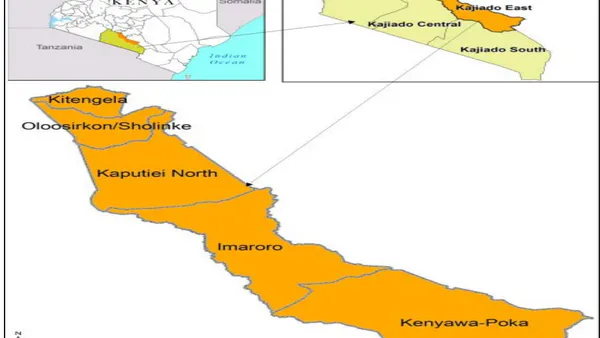
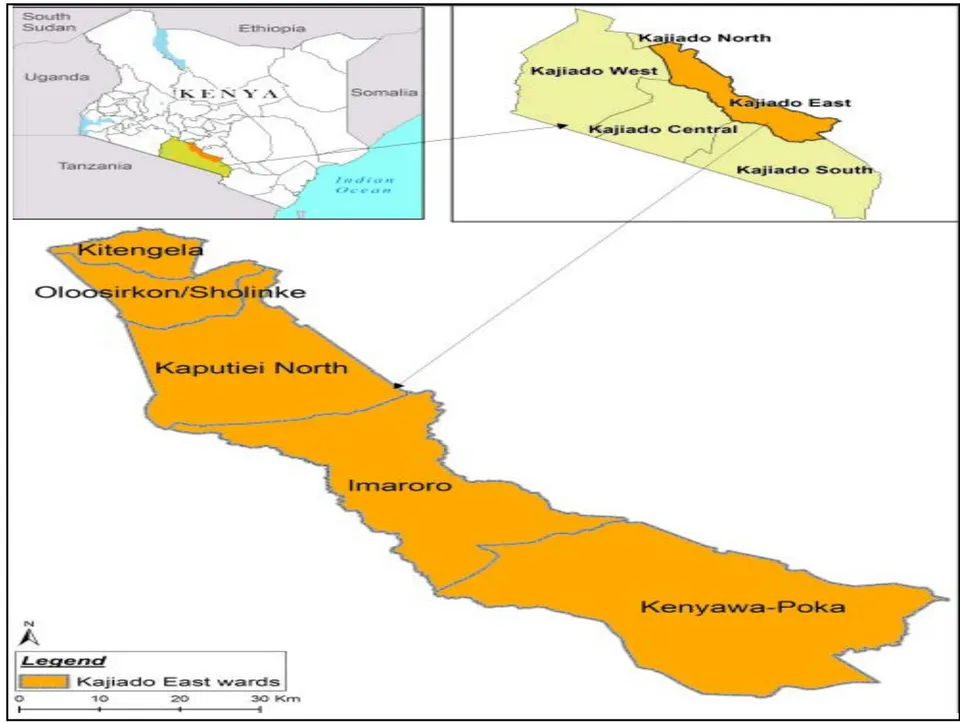
The research study was conducted in Kajiado County which has approximately 687,312 households spread across the five wards. It has an area of 19,600 (CBS, 2009). Most of Kajiado County lies in dry land zones of Kenya. Only of the County's land is potential for rain fed cropping. The region experiences mean annual rainfall which ranges from 300 to per annum. With a distribution of bimodal, "short rains" from October to December and "long rains" from March to May. The distribution of rainfall between the two seasons vary gradually (Sombroek et al 1982).The county is semi-arid with temperature range between Figure 1 indicates physical location of Kajiado East Subcounty. The county has five wards as shown in the figure which includes: Kitengela, Sholinke, Kaputie North, Imaroro and Kenyawa-Poka.sholinke is the most populated ward with population density of 34,175 (KNBS, 2012).The county headquarters based at Kajiado town where administrative functions and offices are located.
The Kajiado County community practice pastoralism as a source of livelihood. The indigenous inhabitants (mainly Maasai ethnic community) have lived in the area for a long period of time to identify with the effects of changing climatic and environmental conditions. In the recent past, drought has been a frequent phenomenon in the region, yet these pastoralist groups have not abandoned their livelihood strategies to adopt other means of survival. Therefore, it was significant to assess the underlying pasture management strategies practiced by the community to cope and recover from persistent drought effects.
b) Research Design
The study was carried out using cross-sectional survey design. The rural communities who depend on pastoralism were the target population for the study. Kajiado East Sub County has a population of 136,482 persons (KNBS, 2012). For the purpose of this research 385 households were selected randomly from the 5 wards namely: Imaroro, Kitengela, Kenyawa-Poka, Oloosirkon and Kaputiei North to form the sample size.
Quantitative and qualitative data were collected using pre-tested questionnaires administered by trained enumerators at the household level. Biophysical characteristics such as vegetation type, sources of water, water use and management and communal practices employed to manage pasture during drought were collected. Qualitative data on effect of drought on pastoralists, pasture management strategies and coping strategies was collected from five focus group discussions (FGD) in each ward. This was carried out with older herders who have wide range of knowledge on animal feed management, having experienced several droughts and great ideas on what the community has always done to manage their pasture and ensure their survival.
c) Sample Site and Size determination
The sample site were Imaroro, Kitengela, Kenya-Poka, Oloosirkon and Kaputiei North. This was because, the locations were inhibited by pastoralists who have lived in the area for over ten years and were best place to provide objective result for study.
The sample size was determined using the formula for maximum error of estimates as proposed by Mugenda and Mugenda (2013) and Amugune (2014).
Where:
n is the sample size
Refers to the normal distribution at confidence level,
E is the standard error. E is 0.1 so the sample mean is outside the population mean. However, using confidence level, it is assumed that the sample mean fell within the population mean. This formula was used because there was no assumed mean of the population and therefore the sample mean was only calculated using the maximum error estimates that allowed the sample size to fall within the population mean. With formula above, a sample size of 385 was identified.
Table 3.1: Sample distribution in selected wards in Kajiado East Sub-county
| County wards | Number of households | Percentage of total | Sample distribution |
| Kaputie Ward | 29,989 | 20.3 | 78 |
| Kitengela | 30,663 | 20.8 | 80 |
| Oloosirkon/Sholinke | 34,175 | 20 | 77 |
| KenyawaPoka | 24,559 | 19.5 | 75 |
| Imaroro | 17,096 | 19.5 | 75 |
| Total | 136,482 | 100 | 385 |
d) Data Collection and Analysis
i. Data collection
The study collected primary and secondary data.
- Focus Group discussions (FGD); Five focused group discussions were done with representatives from animal herders, women groups, community elders and representatives of community-based organizations, to acquire useful and detailed information on drought effects in the area, pasture management strategies during drought and coping strategies used by the pastoral community.
- Administration of Questionnaires; Quantitative and qualitative primary data were gathered using pretested questionnaires administered to the pastoralists. Enumerators from the local community were identified and trained on how to administer the questionnaires on the basis that they could speak the local language and understand the geographical area. After training, the enumerators, pretested questionnaire were pretested in the neighboring Kajiado West sub county. Thereafter, necessary modifications were made on the
question-naires before the actual data collection began. The semi-structured questionnaires were used to collect information on household size, demographic structure, literacy level, and marital status, pasture management strategies, effects of drought on livelihood and animals, drought coping strategies and pasture recovery mechanisms.
ii. Data Analysis
The completed questionnaires were cross-checked for completeness and consistency before analysis. SPSS (Statistical package for social science Version21.o) Microsoft Excel was used to generate descriptive charts and graphs and other functions. Microsoft word processing tools were used to analyze Qualitative data. Processed data was presented using tables, graphs and pie charts to give visual display of findings. Descriptive statistics was used to analyze the data gathered for development of indices from the raw data and included frequencies and percentages. The data from FGDs for proper understanding and confirmation to the quantitative data collected from the community, was organized into themes and sub-themes.
III. RESULTS AND DISCUSSION
a) Results and Discussion
i. Socio-economic and demographic characteristics of the respondents Socio-economic and demographic characteristics of the respondents varied as shown in Table 4.1).
Table 4.1: Household socio-economic and demographic characteristics of respondents
| Socioeconomic factors | Characteristic | Percentage |
| Marital Status | Married | 65 |
| Divorced | 4 | |
| Widowed | 21 | |
| Single | 10 | |
| 100 | ||
| Type of Household | Male headed | 75 |
| Female headed | 25 | |
| 100 | ||
| Number of people per household | 0-5 | 26 |
| 6-10 | 61 | |
| 11-15 | 10 | |
| Over 15 | 3 | |
| 100 | ||
| Literacy status | Did not attend school | 77 |
| Lower primary (1-4) | 8.8 | |
| Upper primary (5-8) | 8 | |
| Secondary school | 4 | |
| College (diploma/Certificate) | 1 | |
| University | 1.6 | |
| 100 | ||
| Source of Family income | Formal employment | 2 |
| Pastoralist | 57 | |
| Hired herdsman | 2 | |
| Farming | 7 | |
| Housewife | 17 | |
| Unemployed | 2 | |
| Businessman/woman | 13 | |
| 100 | ||
| Livestock herders during drought | Children/boys | 13.3 |
| Youth/Moran | 43.6 | |
| Men aged 30 and above | 43.1 | |
| 100 | ||
| Number of Years lived in the area | <5yrs | 8.2 |
| 5-10yrs | 43.9 | |
| >10yrs | 47.9 | |
| 100 |
The results showed that (75%) of the households were male headed and 25% female headed. About 65% of the respondents in the study area were married, widowed, single, and divorced. Slightly over 60% of the households have relatively medium family size (6-10 members) while less than 30% have small family size (0-5 members), and 13% of the households had a large family size (over 11 household members). The results revealed that literacy level in the study area was low as the majority (76%) of the respondents had informal education relative to only 24% of the respondents who had attained formal education.
There were diverse economic activities in the region (Table 4.1). The respondents being pastoralists, their main economic activity was pastoralism .
Crop production (farming), taunted as the upcoming economic activity was , while hired herdsman contributed of the economic activities of the study area. Both formal employment and unemployment were very low . The majority of the unemployed were women of them were housewives. On the other hand, it was found that almost half of the residents had lived in the study area for more than 10 years, while slightly over had lived between 5-10 years while only a few people had stayed for less than 5 years. The result also indicates that adults attended to the herds during the drought period as opposed to children .
Socio-economic attributes of a population are important in understanding the behavior of the people.
The study revealed that the majority of the pastoralist are married thus implies that they are family-oriented. Nonetheless, the pastoralists are conservative and have strict on gender roles hence the female headed households was attributed to death of husband, divorce or single parenthood. Gender is important in access to resources and participation in community affairs in pastoralist communities. Similar studies have reported effect of gender on resources access and access to education in Tanzania (Campbell, 2021; Lusasi & Mwaseba, 2020). Gender inequality could explain the low economic development in the study area. Altuzarra et al. (2021) found positive correlation between gender inequality and low economic growth in developing countries.
This study found low level of literacy within the study area which could be ascribed to the economic status of the pastoralists, value placed on livestock and gender bias in access to education (Kaul, 2015). The low literacy level could also explain the few people informed in formal employment (Table 4.1). The findings of this study resonates with the results of Lowe et al. (2021) who found that young pastoralists' girls are denied access to basic education as they are married at a very tender age. The low education level could possess a significant impact on development and technology uptake by the community (Abu-Shanab, 2011; Riddell & Song, 2017). About women in
Kajiado are housewives which could be associated with cultural conservation of the pastoralists. Other scholars have opined that this could be attributed to fear on power dynamics among the communities and a hinder women career choice and growth (Ford et al., 2021; Mtey, 2020; Olga et al., 2020).
b) Effects of drought on pastoral areas of Kajiado East Sub-county
i. Effects of drought on pasture production and management
Drought occurrences have several effects on pasture production in Kajiado County as shown in Table 4.2. The majority of the respondents (60%) opined that droughts lead to loss of pasture while slightly over (23%) of the interviewees suggested that the climatic event causes death of their livestock. Other respondents (8%) reported that an occurrence of drought lowers their selling price while others felt that droughts cause loss of family income (5%). However, only a few respondents (4%) associated drought to tribal conflicts. On pasture management strategies, they proposed a range of pasture management strategies. Slightly above 40% of the respondents suggested training on pasture management while rain water harvesting and use of irrigation were proposed by (30%) and (25%) of the respondents, respectively.
Table 4.2.1: Effects of drought on pasture production and management
| Characteristic | Parameter | Percentage (%) |
| Effects of drought experienced | Loss of pasture | 60.2 |
| Death of livestock | 23.5 | |
| Low selling price | 7.6 | |
| Loss of family income | 4.5 | |
| Total | Tribal conflict | 4.2 |
| 100 | ||
| Measures to manage pasture during drought | Water harvesting | 30.0 |
| Practice of irrigation | 24.6 | |
| Training on pasture management | 41.4 | |
| Total | 100 |
The study found diverse ways in which drought affects pastoralists in Kajiado County. The effect ranges from economic to social vices. This could be attributed to the fact that livestock is the mainstay of the community as depicted in Table 4.1. This finding is in agreement with the results of Frank et al. (2014) who found that drought increased the need for more income and reduced mobility of the pastoralists. Furthermore, the finding can be ascribed to Kajiado being situated in the ASAL parts of Kenya and which is most vulnerable to effect of prolonged droughts as a result of climate change (Mogotsi et al., 2013). The pastoralist community depend on natural resources and therefore inadequate water and pasture due to drought translates into huge effect on pastoralist's livestock production which could often lead to conflicts. Similar results have been reported among pastoral communities in Somalia, Ethiopia and Kenya (Africa, 2021; Fava et al., 2021; Jibat & Abashula, 2020). Other researchers have also found a positive correlation between drought severity and livestock losses in pastoral region (Huho and Mugalavi, 2010; Nkedienye et al., 2010).
c) Pasture management strategies by pastoralists in Kajjado Sub-county
i. Household pasture management strategies
There are numerous pasture management strategies adopted by pastoralist's community in Kajiado County as shown in Table 4.3.
Table 4.3.1: Household pasture management strategies
| Characteristic | Parameter | Percentage |
| Have animal feed reserves during drought | Yes | 24.9 |
| No | 75.1 | |
| 100 | ||
| Strategies used to manage pasture by the pastoralist | Herding | 29.7 |
| Paddock grazing | 42.2 | |
| Buy hay | 28. | |
| 100 | ||
| Most considered method of pasture management during drought | Paddocking | 68.3 |
| Herd splitting | 21.8 | |
| Rotational grazing | 8.5 | |
| Migration | 1.4 | |
| 100 | ||
| Sources of feed during drought | Natural forage | 81.3 |
| Use of concentrates | 5.1 | |
| Buy Hay | 13.6 | |
| 100 |
Paddock grazing accounted for , herding of animals while buying of hay was (Table 4.1. The majority of community emphasized that they move (mobility) with their livestock during droughts. Although most pastoralists own land) hay making has not been taken up seriously with majority of the pastoralists' reliance on natural resources. The results of this study found that paddocking is the most preferred method of pasture management by the Kajiado pastoralists. This could be attributed to the flexibility of the method to accommodate the herds throughout the year. This assertion is supported by other researchers who reported the same results elsewhere (Tawe, 2018; Korir, 2020). The adoption of rotational grazing by the pastoralists probably was because of its ability to allow vegetation and soil a resting time to recover, and to improve vegetation conditions hence enhancing conservation and production goals (Roche et al., 2015). In addition, Vecchio et al. (2019) found that rotational grazing improved conditions of grassland containing halophytic steppe as opposed to continuous grazing. On the other hand, Augustine et al. (2020) found that rotational grazing method is an adaptive strategy and improves the performance of both pasture and livestock.
Herding was also practiced as a pasture management strategy by of the respondents. Probably this method is practiced because often herd mobility is restricted during droughts hence abled men move with the livestock in search of water and pasture. Similarly, herders in Northern Norway adopted herding as pasture management and adaptive strategy (Risvoll & Hovelsrud, 2016). Moreover, the preference for herding by the community could be attributed to the advantages of the herding which include; low expenses for fencing or water supply, one herdsperson looks after hundreds of animals which reduces the cost of labor, uncontrolled livestock movement so they enjoy plenty of exercise and browse a variety of forages thus maintaining high nutrition and production level of animals, and provision of the livestock a stress-free environment. The method could have also favored people with limited land size. The findings of this study are in agreement with the results of other researchers who found increased advantages of herding like improved management of pasture species (Molnár et al., 2020), better management of biodiversity (UNESCO, 2016), and improves sustainability and resilience of the pasture ecosystems (Riseth et al., 2016).
It was noted that buying hay was unpopular among the pastoralists and this was attributed to the fact that they do not conserve pasture before droughts and during rainy seasons. Furthermore, this could be as a result of the community over relying on natural resources as was also noted in a study conducted in the same County (Yala et al., 2020). This finding resonates with that of the study conducted in the Great Plains where buying hay was found to depict preparedness of the pastoral communities but which was adopted to a lesser extent (Haigh et al., 2019). Buying hay offers perfect opportunity to pastoral communities to cope and adapt to droughty situations (Salmoral et al., 2020). The pastoralist community in Kajiado could greatly benefit in storing hay and forage as a coping strategy during droughts as was noted Mongolia (Hansson, 2020).
ii. Relationship between pasture management and establishing feed reserves
The relationship between pasture management and establishing feed reserves is shown in Table 4.4.
Table 4.3.2: Relationship between pasture management and establishing feed reserves
| Understanding pasture management | Have established feed reserve | x2 | P | |
| Yes | No | |||
| Yes | 33 (9%) | 117 | 1.196a | .166 |
| No | 55 (21%) | 148 | ||
There was no significant association between understanding pasture management and establishment of feed reserves. This finding could be explained by the fact that the majority of the pastoralists did not reserve feeds as they depend heavily on natural grassland (Yala et al., 2020).
iii. Pastoralists sources of information on pasture management
The respondents obtain information on pasture management from different sources (Fig. 4.1). Television
(TV) was the most preferred (37% source of pasture management information. The respondents also obtained information from mobile phones, radios, extension officers and NGO training (30, 16, 14 and 3%, respectively).
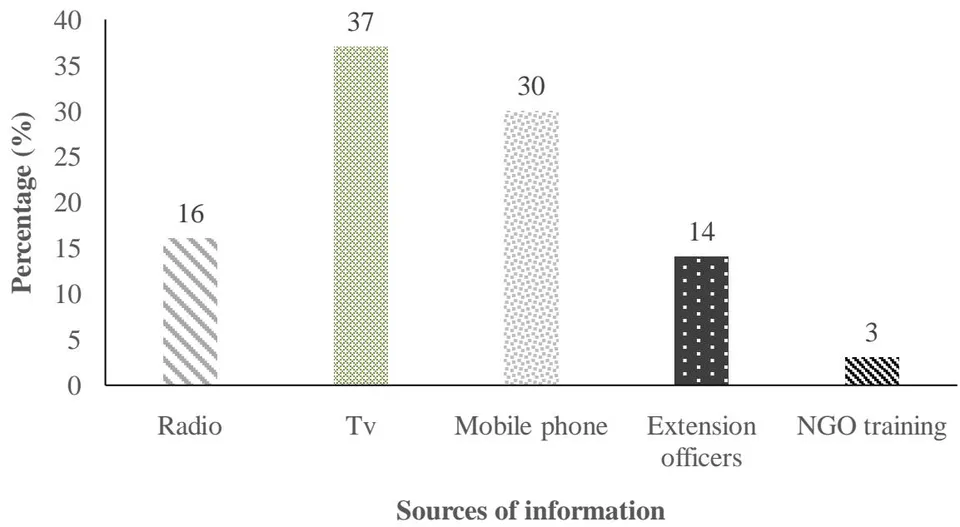
Pastoralists in Kajiado obtain pasture management information from both electronic sources and training from extension officers and NGOs. This could be attributed to improved infrastructure like network and electric connectivity in the County (Annemiek, 2018; Schrijver, 2019). Also, this could be associated with the improved accessibility of the County agricultural extension officers (Edwin et al., 2018). Given that Kajiado is among the vulnerable communities, the involvement of NGO in training farmers could have been supported by improved partnership between the Kajiado County Government and development partners (Haan et al., 2016). NGOs play critical role in institutional development and shaping policy framework in pastoral regions (Ofoegbu et al., 2018).
d) Drought coping strategies in Kajiado East Sub-county i. Pastoralists drought coping strategies
Pastoralists in Kajiado County have various coping strategies towards the effect of drought as explained in Table 4.4.1. The most popular coping strategy was varying livestock numbers to correspond with the diminishing forage (81%). The respondents suggested that this strategy is used to cope with effects of drought. Only a few (19%) did not regard this as a coping strategy but felt it is a result of the changing reproduction rate (8%). The other popular strategy was breeding replacement stock (79%) as only 21% of the respondents viewed buying of herds after occurrence of drought as a coping strategy. The pastoralists use different sources of water which include boreholes, tap water (26%), and dam (73%), (26%) and (1%), respectively. The study found preference of forage types during droughty periods. The community most preferred pasture was Brachariahumidicola during the drought while Pennisetum purpureum Schumach is only preferred by a few respondents .
Table 4.4.1: Household drought coping strategies
| Characteristics | Parameter | Percentage |
| Varied herd numbers to correspond with diminishing forage | Yes | 81.3 |
| No | 18.7 | |
| 100 | ||
| Replenished/Restocked herd after drought | Bought | 21.2 |
| Bred the replacement stock | 78.8 | |
| 100 | ||
| Sources of water for domestic use | Boreholes | 73.4 |
| Tap water | 25.5 | |
| Dam | 1.1 | |
| 100 | ||
| Most preferred pasture species | Brachiariahumidicola | 96.6 |
| Pennisetum purpureum Schumach | 3.4 | |
| 100 | ||
| Migration | Yes | 29.7 |
| No | 70.3 | |
| 100 | ||
| Sustenance of female-dominated herds | Yes | 68 |
| No | 32 | |
| 100 | ||
| Keeping different types of animals | Yes | 56 |
| No | 44 | |
| 100 | ||
| Rotational grazing | Yes | 71 |
| No | 29 | |
| 100 | ||
| Diversification to crops: | Maize | 34.9 |
| Pearl millet | 12.2 | |
| Finger millet | 11.4 | |
| Sorghum | 15.1 | |
| Cowpeas | 9.2 | |
| Beans | 17.2 | |
| 100 |
Pastoralists in Kajiado practice a number of coping strategies ranging from change in herd structure and management to diversification of livelihood which entails crop farming. These diverse coping strategies could be associated to deliberate efforts by the pastoral communities to build resilience and reduce vulnerability to effects of climate change (Fava et al., 2021; Guye et al., 2019; Ndiritu, 2020; Ndungu et al., 2021). The migration with the herds could be associated with the desire by the pastoralists to sustain carrying capacity before they reach the place. According to Guye et al. (2019), herd mobility enables strategic use of resources and helps to reduce the effect of drought and dry spells. As suggested by Mcguirk & Nunn (2021), migration probably ensures that the households retain the productivity of their livestock and security of the family. The pastoralists probably prefer keeping female herds during droughts because of production of milk for domestic consumption and an indicator of wealth. Similar results were reported by who pastoralists in
Kenya not only keeps female herds during drought but also as an approach to meeting market demands (Mcguirk & Nunn, 2021). The results also showed that the community diversified into crop production with focus being on drought tolerant crop varieties. These crops require minimal water resources and in agreement with studies done byWilk et al. (2013) and Ncube and Lagardien (2015).
e) Variation in pastoralists' uptake of drought coping strategies
The study sought to determine how much variation in pastoralists' uptake of drought coping strategies could be explained by some socio-economic factors through linear regression analysis. The used were the number of animals owned, land ownership and understanding pasture management. The coefficients of parameters used to determine variation in pastoralists' uptake of drought coping strategies are shown in Table 4.4.2.
Table 4.4.2: Coefficients of Parameters Used to Determine Variation in Pastoralists' Uptake of Drought Coping Strategies
| Model | Unstandardized Coefficients | Standardized Coefficients | T | Sig. | |
| B | Std. Error | Beta | |||
| (Constant) | 0.475 | 0.177 | 2.688 | 0.008 | |
| Number of animals owned | 0.130 | 0.070 | 0.166 | 1.861 | 0.015 |
| Land ownership | 0.108 | 0.097 | 0.096 | 1.112 | 0.026 |
| Understanding pasture management | 0.184 | 0.070 | 0.236 | 2.615 | 0.010 |
From the table 4.4.2, the coefficients of the established regression equation are:
Where: a - Number of animals owned
- b - Land ownership in acres
- c - Understanding pasture management
- € - Error term
Table 4.4.2 shows that the three variables are important factors in enhancing pastoralists' uptake of drought coping strategies. The regression equation revealed that the number of animals owned, land ownership and understanding pasture management to a constant zero, pastoralists' uptake of drought coping strategies would be 0.475. However, understanding pasture management (0.184) has greater effect on pastoralists' uptake of drought coping strategies followed by number of animals owned (0.130) and lastly land ownership (0.108). This implies that embarking on either of the variations would improve pastoralists' uptake of drought coping strategies and hence minimize drought associated losses among pastoralists.
Table 4.4.3. indicates that (61%) of the variation in pastoralists' uptake of drought coping strategies could be attributed to number of animals owned, land ownership and understanding pasture management strategies implying that the model is a good fit for the data.
Table 4.4.3: Model Summary
| Model | R | R Square | Adjusted R Square | Std. Error of the Estimate |
| 1 | 0.653a | 0.611 | 0.608 | 10.63 |
From the ANOVA statistics in table 4.4.4, statistically, the overall relationship was very significant with significant value, value ,
Table 4.4.4: ANOVA
| Model | Sum of Squares | Df | Mean Square | F | Sig. | |
| 1 | Regression | 2.254 | 3 | 0.751 | 5.690 | 0.001b |
| Residual | 15.843 | 120 | 0.132 | |||
| Total | 18.097 | 123 |
IV. GENERAL DISCUSSION, CONCLUSIONS AND RECOMMENDATIONS
a) General Discussion
This chapter gives summary of study from introduction to data analysis. The research study sought to evaluate pastoralists pasture management strategies during drought with main focus areas Kajiado County in Kenya. The chapter presents a summary of study objectives, research methodology and findings. The various discussion topics were based on research objectives: To describe socio economic and demographic characteristics of pastoralists in Kajiado County. To evaluate the effects of drought on pastoral areas of Kajiado County. To assess pasture management strategies of pastoralists in kajiado County. To determine drought coping strategies of pastoralist in Kajiado County.
b) Conclusions
The general study objective was to evaluate rangeland pasture management strategies during drought among pastoralists in Kajiado County with main focus Kajiado East Sub County. The following were the results (i) The study findings showed the semi-arid region was inhabited by pastoralism and mixed economy. Whereas mixed economy included rain fed and irrigated agriculture, agro pastoralism, tourism related activities, small businesses based on dryland products like beading.(ii) Marriage was highly regarded and most households were male headed, education uptake was low with majority of studied population recording no formal education. In addition, studied nuclear families consisted averagely of 6 family members. The findings showed family size determined responsibilities and exposure significantly. It was further analysed that the community under study kept livestock such as Goats, Sheep, Cattle and donkey the least reared was poultry.
The study also found the areas were frequently hit by drought and water scarcity subjecting pastoralist community to livestock deaths, decreased livestock production, low selling price, loss of family income and tribal conflict during migration and scramble for pasture. From study it was evident existing water resources were dams, bore holes few rivers and tapped water implying that the community lacked adequate water source to cushion them during droughts. It was evident most of pastoralists within the study area did not have enough knowledge on pasture management and this contributed to the low level of pasture conservation during periods of excess pasture. The frequently practiced pasture management strategies were traditional methods of herd tethering and migration. Other pasture management systems such as Paddocking, Zero grazing and use of other supplementary feeds including hay were practiced by few pastoralists. The study also showed pastoralists lacked adequate skills on pasture management strategies sighting lack of local trainings on best practices to enable establishment of strong buffer for their livestock during drought.
Recommendations
In line with the study findings and conclusions drawn, the following recommendations were made.
The pastoralists needed to be equipped with trainings on modern range pasture management to enable them effectively preserve the excess forage as hay making and silage making strategies were not actively taken up during rainy season to reduce the effect of drought as a result of limited pasture.
The community should adopt modern water harvesting technologies to reduce possibility of rivalry and conflict between and within communities arising from limited water supply especially during drought.
The community should Partner with local government and NGOs to provide financial support to the herders during drought in terms of mass
purchase of their livestock to reduce losses experienced when animals die due to insufficient water and forage.
- There was need to strengthen community traditional pasture management strategies by sensitization of pastoralists on modern practices.