

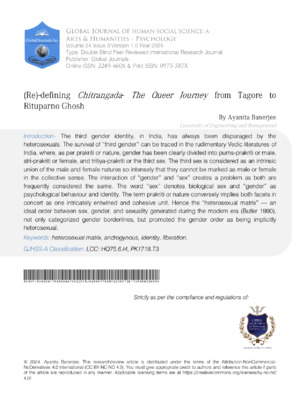

(Re)-defining Chitrangada- The Queer Journey from Tagore to Rituparno Ghosh

1
Ayanita Banerjee
Ayanita Banerjee PROFESSOR

Send Message

To: Author

GJHSS Volume 24 Issue A3

Article Fingerprint

ReserarchID

GF1LK

(Re)-defining Chitrangada- The Queer Journey from Tagore to Rituparno Ghosh Banner
  • English
  • Afrikaans
  • Albanian
  • Amharic
  • Arabic
  • Armenian
  • Azerbaijani
  • Basque
  • Belarusian
  • Bengali
  • Bosnian
  • Bulgarian
  • Catalan
  • Cebuano
  • Chichewa
  • Chinese (Simplified)
  • Chinese (Traditional)
  • Corsican
  • Croatian
  • Czech
  • Danish
  • Dutch
  • Esperanto
  • Estonian
  • Filipino
  • Finnish
  • French
  • Frisian
  • Galician
  • Georgian
  • German
  • Greek
  • Gujarati
  • Haitian Creole
  • Hausa
  • Hawaiian
  • Hebrew
  • Hindi
  • Hmong
  • Hungarian
  • Icelandic
  • Igbo
  • Indonesian
  • Irish
  • Italian
  • Japanese
  • Javanese
  • Kannada
  • Kazakh
  • Khmer
  • Korean
  • Kurdish (Kurmanji)
  • Kyrgyz
  • Lao
  • Latin
  • Latvian
  • Lithuanian
  • Luxembourgish
  • Macedonian
  • Malagasy
  • Malay
  • Malayalam
  • Maltese
  • Maori
  • Marathi
  • Mongolian
  • Myanmar (Burmese)
  • Nepali
  • Norwegian
  • Pashto
  • Persian
  • Polish
  • Portuguese
  • Punjabi
  • Romanian
  • Russian
  • Samoan
  • Scots Gaelic
  • Serbian
  • Sesotho
  • Shona
  • Sindhi
  • Sinhala
  • Slovak
  • Slovenian
  • Somali
  • Spanish
  • Sundanese
  • Swahili
  • Swedish
  • Tajik
  • Tamil
  • Telugu
  • Thai
  • Turkish
  • Ukrainian
  • Urdu
  • Uzbek
  • Vietnamese
  • Welsh
  • Xhosa
  • Yiddish
  • Yoruba
  • Zulu

The third gender identity, in India, has always been disparaged by the heterosexuals. The survival of “third gender” can be traced in the rudimentary Vedic literatures of India, where, as per prakriti or nature, gender has been clearly divided into pums-prakriti or male, stri-prakriti or female, and tritiya-prakriti or the third sex. The third sex is considered as an intrinsic union of the male and female natures so intensely that they cannot be marked as male or female in the collective sense. The interaction of “gender” and “sex” creates a problem as both are frequently considered the same. The word “sex” denotes biological sex and “gender” as psychological behaviour and identity. The term prakriti or nature conversely implies both facets in concert as one intricately entwined and cohesive unit. Hence the “heterosexual matrix” -an ideal order between sex, gender, and sexuality generated during the modern era (Butler 1990), not only categorized gender borderlines, but promoted the gender order as being implicitly heterosexual.

Funding

No external funding was declared for this work.

Conflict of Interest

The authors declare no conflict of interest.

Ethical Approval

No ethics committee approval was required for this article type.

Data Availability

Not applicable for this article.

Ayanita Banerjee. 2026. \u201c(Re)-defining Chitrangada- The Queer Journey from Tagore to Rituparno Ghosh\u201d. Global Journal of Human-Social Science - A: Arts & Humanities GJHSS-A Volume 24 (GJHSS Volume 24 Issue A3): .

Download Citation

Diverse Queer Journey from Tagore to Rituparno Ghosh.
Issue Cover
GJHSS Volume 24 Issue A3
Pg. 11- 14
Journal Specifications

Crossref Journal DOI 10.17406/GJHSS

Print ISSN 0975-587X

e-ISSN 2249-460X

Keywords
Classification
Not Found
Version of record

v1.2

Issue date

July 13, 2024

Language

English

Experiance in AR

The methods for personal identification and authentication are no exception.

Read in 3D

The methods for personal identification and authentication are no exception.

Article Matrices
Total Views: 948
Total Downloads: 16
2026 Trends
Research Identity (RIN)
Related Research

Published Article

The third gender identity, in India, has always been disparaged by the heterosexuals. The survival of “third gender” can be traced in the rudimentary Vedic literatures of India, where, as per prakriti or nature, gender has been clearly divided into pums-prakriti or male, stri-prakriti or female, and tritiya-prakriti or the third sex. The third sex is considered as an intrinsic union of the male and female natures so intensely that they cannot be marked as male or female in the collective sense. The interaction of “gender” and “sex” creates a problem as both are frequently considered the same. The word “sex” denotes biological sex and “gender” as psychological behaviour and identity. The term prakriti or nature conversely implies both facets in concert as one intricately entwined and cohesive unit. Hence the “heterosexual matrix” -an ideal order between sex, gender, and sexuality generated during the modern era (Butler 1990), not only categorized gender borderlines, but promoted the gender order as being implicitly heterosexual.

Our website is actively being updated, and changes may occur frequently. Please clear your browser cache if needed. For feedback or error reporting, please email [email protected]
×

This Page is Under Development

We are currently updating this article page for a better experience.

Request Access

Please fill out the form below to request access to this research paper. Your request will be reviewed by the editorial or author team.
X

Quote and Order Details

Contact Person

Invoice Address

Notes or Comments

This is the heading

Lorem ipsum dolor sit amet, consectetur adipiscing elit. Ut elit tellus, luctus nec ullamcorper mattis, pulvinar dapibus leo.


High-quality academic research articles on global topics and journals.

(Re)-defining Chitrangada- The Queer Journey from Tagore to Rituparno Ghosh

Ayanita Banerjee
Ayanita Banerjee

Research Journals




























































