




1. Introduction
In 2018, the United States began to restrict the export of advanced process chip manufacturing equipment and technology to China. In 2019, the Trump administration included Chinese companies such as Huawei on the "Entity List" and banned American companies from selling advanced chips to them. In 2022, the Biden administration released a new policy on semiconductor export controls, expanding the scope of restrictions to the entire semiconductor industry and its manufacturing equipment, and implementing controls in conjunction with its allies.
However, the export value of Chinese chips increased from 84.6 billion US dollars in 2018 to 2019 billion US dollars in 2025, a 1.4-fold increase in seven years. In the first quarter of 2026, China’s chip exports reached 72.5 billion US dollars, a significant year-on-year increase of 77.5%.
In terms of military technology, Western countries suspended military technology exports to China in 1989 and have not lifted the arms embargo to this day. However, it is puzzling that on December 26, 2024, China’s sixth generation fighter jet successfully made its maiden flight, and no similar aircraft has appeared in other countries so far.
The more sanctions imposed by the West, the more successful China will be? People curiously ask, why is this?
Professor Cao Shixiong from Central University for Nationalities attributed this success to an institutional innovation called "shared property rights" rather than markets and plans. He believes that this new model may represent a third property rights model different from private and public ownership systems. He said, "Today’s China has entered a society of ’shared property rights’, but the Western world still views China with outdated or even’ Cold War mentality ’
2. Undervalued Chinese Reforms
In 1978, Deng Xiaoping announced that China would open up to the world and transform its economic development model from a single state plan to a market-oriented mixed economy model. On December 11, 2001, China joined the WTO, marking its official membership in the global market economy cluster. Many people believe that China will abandon the socialist path and move towards capitalism.
However, the Chinese government still does not acknowledge that it has abandoned the direction of socialist development. In order to distinguish between today’s China and the Mao Zedong era, on September 1, 1982, Deng Xiaoping proposed the construction of socialism with Chinese characteristics at the 12th National Congress of the Communist Party of China Central Committee.
What is’ Socialism with Chinese Characteristics’? Deng Xiaoping did not make it clear. Until Professor Cao Shixiong’s research team published an article in Futures in 2022 titled ’Is China evolving a new model for civilization?’ The rise of China can only be reasonably explained by defining the "socialism with Chinese characteristics" system as the "shared property rights" system.
Shared ownership is defined as a novel profit sharing model where knowledge workers invest their expertise in companies and receive dividends in addition to their salaries. These ’technology shares’ differ from traditional capital shares in two key aspects: firstly, they cannot be transferred or inherited, and secondly, they automatically become invalid upon employee departure. This means that workers are rewarded for their continuous dynamic intellectual contributions rather than static capital investments. For the first time in human society, the immeasurable output of mental labor (such as ideas, creativity, and problem-solving abilities) was regarded as an economic asset.
3. China in the Mist
The shared property rights system has rethought how value is created and distributed within a company. It does not limit ownership to capital investors, but allows knowledge workers to become technology shareholders and invest in their intellectual labor. This explains well the social phenomenon of Chinese knowledge workers working more than 9 hours a day. Because they are no longer working for capitalists, on the contrary, they are working for themselves.
The Western world does not understand China, not only because economists did not recognize that China had created a new property rights model before 2022, but also because the Chinese government has continued the political wisdom that China has been using for thousands of years - "keeping a low profile". The core of this wisdom is to conceal one’s strength and avoid being kicked out by competitors too early.
How does China ’hide its strength and bide its time’?
Firstly, the Chinese government always shows great cowardice when dealing with international disputes, in order to mislead competitors into thinking that it is weak and incompetent. For example, on May 8, 1999, the United States bombed the Chinese Embassy in Yugoslavia, but the Chinese government did not retaliate in the same way. This move is very effective. At least before 2018, the Western world accepted China in the economic field. In the wave of globalization that began at the end of the last century, the whole world welcomed China to join, rather than disliking China as it does today.
Secondly, China has successfully concealed its economic strength by falsifying statistical data. For example, the National Bureau of Statistics of China says that China’s GDP in 2025 will be 19.6 trillion US dollars, which is only 63.6% of the 30.8 trillion US dollars in the United States. This data is clearly severely underestimated. Let’s take a look at another set of data: China’s total power generation in 2025 will be 10.5 trillion kilowatt hours, which is 2.3 times that of the United States! The total industrial added value of China in 2025 is 5.84 trillion US dollars, which is 1.6 times that of the United States.
Where has the electricity produced in China gone? Has it been consumed by residents? But by 2025, the total retail sales of consumer goods in China will reach 6.92 trillion US dollars, close to the level of 7.05 trillion US dollars in the United States. According to the "electricity consumption for urban and rural residents" indicator that can be found in statistical data, the electricity consumption of Chinese residents accounts for only 14.5% of the total electricity consumption in society, while the proportion in the United States is as high as 37.3%. It is estimated that China’s electricity consumption in the production sector is 3.1 times that of the United States.
The Chinese government and scholars have repeatedly explained that these contradictory data are due to the low efficiency of the Chinese economy or the low prices of products produced in China. Is that so? Of course not! GDP is a cost accounting, not a profit accounting, so these claims are obviously deceptive. The only explanation is that the statistical data is being falsified!
4. We Need to Rediscover China
Unlike Western statistical standards, China’s GDP statistics do not include social expenditures from government departments such as government work, military, education, and scientific research, which precisely account for the majority of the operating costs of China’s planned economy.
Inconsistent statistical standards are not a big deal, the bigger issue of data falsification is the annual economic figures released. After completing the monthly statistics, the statistics bureau is required to report the data to the central government. The highest authority of the country needs to revise this real data and inform the statistical bureau of how much data should be disclosed to the public. That is to say, the data released by the news media every year is the data revised by the central government according to political needs.
In the second year, when the news media shifted their attention to a new year, the National Bureau of Statistics revised the previous year’s data based on the economic data revised by the central government, multiplied by the actual change rate of the annual statistical data, and then published a statistical yearbook. Chinese scholars know that the absolute value of statistical data published each year is false, but the annual change data is true. This magical way of expression can deceive news media and present real results to scholars’ academic research.
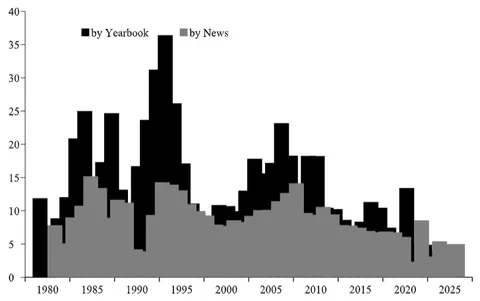
For example, the China Statistical Yearbook published in 2026 shows that China’s GDP growth rate in 1994 was 36.4%. However, the data reported by the news media is 13.1% (Figure 1). The average annual growth rate of China’s GDP reported by news media from 1980 to 2025 is 11.3%, which is 44.2% lower than the data from the China Statistical Yearbook. Obviously, the Chinese government intentionally suppressed these data, leading the world to mistakenly believe that China has always been a backward developing country.
Statistics show that the ratio of GDP to disposable income in China is 2.3:1, while in the United States it is 1:1. Based on this, we can roughly estimate using production electricity consumption and social consumption statistics. If the statistical standards of China and the United States are consistent, China’s total economic output (such as GDP) in 2025 will be about 2 to 3 times that of the United States! If readers are willing to live in cities of the same size in China and the United States for a few months each, they may feel that the living standards of Chinese people are higher than those of Americans.
5. Who Are the Future Winners?
During Trump’s visit to China from November 8 to November 10, 2017, Chinese and American companies signed 34 cooperation projects with a total amount of 253.5 billion US dollars. When Trump visited China again from May 13 to 15, 2026, the two sides did not sign any similar commercial contracts. The Chinese government said to the US government, "No!" Obviously, China has the confidence to say "No!" to Americans. Now, China says "No" to all unfriendly countries. This is the biggest political change for the Chinese government in 2026.
The essence of innovation is collective breakthroughs in multiple fields, such as institutional innovation, management innovation, cultural innovation, and so on. There is no country in the world that can complete multiple iterations and upgrades of its industries in a very short period of time like China. It has not only become a leader in the world’s industrial economy in traditional industries, but also in many high-tech industries. In addition to the United States, which other countries in the world can compete with China in the Internet, aerospace, semiconductor and intelligent industries?
Recently, Huang Renxun, the founder and CEO of NVIDIA, visited China and saw the shortcomings of China in the field of scientific and technological innovation. Therefore, he judged that China would lose the future. This is a common mistake made by Western scholars and politicians, who mistakenly believe that scientific and technological innovation is the only driving force for human social progress. They clearly overlooked the importance of institutional innovation and innovation in other fields.
Professor Cao Shixiong believes that China has surpassed the Western world in terms of institutional innovation, but unfortunately, Westerners are still in the dark. He further emphasized that every progress in human society is not a denial of the old world, but a transcendence of the old world. In the new stage of civilization, those well functioning old systems (such as markets, plans, etc.) will continue to exist and play an important role. He defined it as follows: "The new stage of civilization is not the end of capitalism, but the transcendence of capitalism [2].”
Intellectual labor is the new capital. With economic development, society must design new systems to reward creative and cognitive contributions. China’s shared property rights system provides a new model and framework for the world. Professor Cao Shixiong further stated in his book A New Stage of Civilization: Striving for the Great Harmony, "Human society is entering a new stage of development, and cooperation and knowledge sharing have become the main driving forces for progress
As many people have seen, there are still many problems in China today, such as backward education, weak scientific and technological innovation, wealth inequality, official corruption, and so on. However, it is evident that the world does not fully understand China. It has already taken the lead in innovating its property rights system, which is the institutional guarantee for China to win the future.
It’s time to get to know China again!
Acknowledgments
I thank Geoffrey Hart of Montréal, Canada, for his help in writing this paper. I am also grateful for the comments and criticisms of an early version of this manuscript by our colleagues and the journal’s reviewers.


