This converted HTML version may contain rendering inconsistencies. Please refer to the PDF for the authoritative version, or click here to provide feedback.
Report an Issue
Abstract
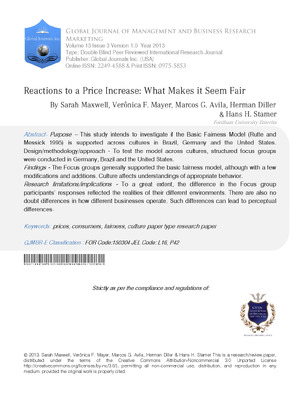
Purpose – This study intends to investigate if the Basic Fairness Model (Rutte and Messick 1995) is supported across cultures in Brazil, Germany and the United States. Design/methodology/approach – To test the model across cultures, structured focus groups were conducted in Germany, Brazil and the United States. Findings – The Focus groups generally supported the basic fairness model, although with a few modifications and additions. Culture affects understandings of appropriate behavior. Research limitations/implications – To a great extent, the difference in the Focus group participants’ responses reflected the realities of their different environments. There are also no doubt differences in how different businesses operate. Such differences can lead to perceptual differences. Practical implications – Power affects the impact of different industries on price fairness judgments. When an industry is more powerful, as in the case of healthcare insurance, consumers are sensitized to fairness concerns. They are, however, reluctant to react because the alternatives are not good. The result may be capitulation: purchasing the product despite being angry. The result however, may also be explosive anger. Originality/value – Despite the limitations of the research instruments, the Focus groups did provide clear support for the basic fairness model. How people react to unfairness appears to be universal.
References
21 Cites in Article
1.Anonymous (2011). Em meio ao caos, produtos somem das lojas e preços disparam na Região Serrana do Rio. [Eletronic version], Jornal O Globo. , from
2. 2.
3.Lisa Bolton,Luk Warlop,Joseph Alba (2003). Consumer Perceptions of Price (Un)Fairness. Journal of Consumer Research, 29(4), 474-491.
5.Morton Deutsch (1985). Distributive Justice: A Social-Psychological Perspective.
6.Christian Homburg,Wayne Hoyer,Nicole Koschate (2005). Customers' Reactions to Price Increases: Do Customer Satisfaction and Perceived Motive Fairness Matter?. Academy of Marketing Science Journal, 33(1), 36-50.
7.Daniel Kahneman,Jack Knetsch,Richard Thaler (1986). Fairness as a Constraint on Profit Seeking: Entitlements in the Market. American Economic Review, 76(4), 728-741.
8.Sarah Maxwell (1995). What Makes a Price Increase Seem `Fair'?.
9.Sarah Maxwell (2002). Rule-based price fairness and its effect on willingness to purchase. Journal of Economic Psychology, 23(2), 191-212.
10.Sarah Maxwell (2008). The Price Is Wrong: Understanding What Makes a Price Seem Fair and the True Cost of Unfair Pricing.
11.Veronica Mayer,Marcos Avila (2004). A Qualitative Investigation about Community Standards of Fairness in the Brazilian Market: Inferences, Emotions and Culture. Fordham Pricing Conference, New York City NY
12.Veronica Mayer,Marcos Avila (2011). Perceptions of Unfairness in Price Increase: An Experimental Study. Balas Annual Conference, Santiago, Chile
13.David Messick,Keith Sentis (1983). Fairness, Preference and Fairness Biases. Equity Theory
14.David Morgan (1996). Focus Groups. Annual Review of Sociology, 22(1), 129-152.
18.P. Sapienza,L. Zingales (2012). Financial Trust Index. The Results: Wave 13. Chicago Booth / Kellog School. , from tswave 13.htm
19.John Thibaut,Laurens Walker (1975). Procedural Justice: A Psychological Analysis, Lawrence Erlbaum Associates : Hillsdale NY.
20.Lan Xia,Kent Monroe,Jennifer Cox (2004). The Price is Unfair! A Conceptual Framework of Price Fairness Perceptions. Journal of Marketing, 68(4), 1-15.
No ethics committee approval was required for this article type.
Data Availability
Not applicable for this article.
How to Cite This Article
Marcos G. Avila, Sarah Maxwell, Verônica F. Mayer, Hans H. Stamer, Herman Diller. 1969. "Reactions to a Price Increase: What Makes it Seem Fair". Global Journal of Management and Business Research - E: Marketing GJMBR-E Volume 13 (GJMBR Volume 13 Issue 32 (E9)).
Explore published articles in an immersive Augmented Reality environment. Our platform converts research papers into interactive 3D books, allowing readers to view and interact with content using AR and VR compatible devices.
Your published article is automatically converted into a realistic 3D book. Flip through pages and read research papers in a more engaging and interactive format.