
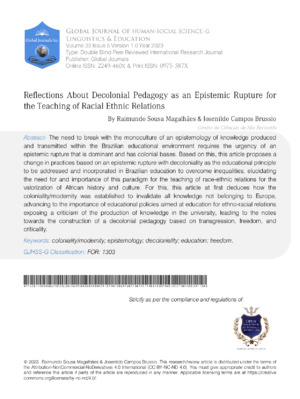
Reflections About Decolonial Pedagogy as an Epistemic Rupture for the Teaching of Racial Ethnic Relations

Article ID

JN92G

Ethnic education and scholarly research on ethnic-related pedagogy in teaching and learning.

Reflections About Decolonial Pedagogy as an Epistemic Rupture for the Teaching of Racial Ethnic Relations

Raimundo Sousa Magalhães
Josenildo Campos Brussio
DOI

Abstract

The need to break with the monoculture of an epistemology of knowledge produced and transmitted within the Brazilian educational environment requires the urgency of an epistemic rupture that is dominant and has colonial bases. Based on this, this article proposes a change in practices based on an epistemic rupture with decoloniality as the educational principle to be addressed and incorporated in Brazilian education to overcome inequalities, elucidating the need for and importance of this paradigm for the teaching of race-ethnic relations for the valorization of African history and culture. For this, this article at first deduces how the coloniality/modernity was established to invalidate all knowledge not belonging to Europe, advancing to the importance of educational policies aimed at education for ethno-racial relations exposing a criticism of the production of knowledge in the university, leading to the notes towards the construction of a decolonial pedagogy based on transgression, freedom, and criticality.The need to break with the monoculture of an epistemology of knowledge produced and transmitted within the Brazilian educational environment requires the urgency of an epistemic rupture that is dominant and has colonial bases. Based on this, this article proposes a change in practices based on an epistemic rupture with decoloniality as the educational principle to be addressed and incorporated in Brazilian education to overcome inequalities, elucidating the need for and importance of this paradigm for the teaching of race-ethnic relations for the valorization of African history and culture. For this, this article at first deduces how the coloniality/modernity was established to invalidate all knowledge not belonging to Europe, advancing to the importance of educational policies aimed at education for ethno-racial relations exposing a criticism of the production of knowledge in the university, leading to the notes towards the construction of a decolonial pedagogy based on transgression, freedom, and criticality.

Reflections About Decolonial Pedagogy as an Epistemic Rupture for the Teaching of Racial Ethnic Relations

The need to break with the monoculture of an epistemology of knowledge produced and transmitted within the Brazilian educational environment requires the urgency of an epistemic rupture that is dominant and has colonial bases. Based on this, this article proposes a change in practices based on an epistemic rupture with decoloniality as the educational principle to be addressed and incorporated in Brazilian education to overcome inequalities, elucidating the need for and importance of this paradigm for the teaching of race-ethnic relations for the valorization of African history and culture. For this, this article at first deduces how the coloniality/modernity was established to invalidate all knowledge not belonging to Europe, advancing to the importance of educational policies aimed at education for ethno-racial relations exposing a criticism of the production of knowledge in the university, leading to the notes towards the construction of a decolonial pedagogy based on transgression, freedom, and criticality.The need to break with the monoculture of an epistemology of knowledge produced and transmitted within the Brazilian educational environment requires the urgency of an epistemic rupture that is dominant and has colonial bases. Based on this, this article proposes a change in practices based on an epistemic rupture with decoloniality as the educational principle to be addressed and incorporated in Brazilian education to overcome inequalities, elucidating the need for and importance of this paradigm for the teaching of race-ethnic relations for the valorization of African history and culture. For this, this article at first deduces how the coloniality/modernity was established to invalidate all knowledge not belonging to Europe, advancing to the importance of educational policies aimed at education for ethno-racial relations exposing a criticism of the production of knowledge in the university, leading to the notes towards the construction of a decolonial pedagogy based on transgression, freedom, and criticality.

Raimundo Sousa Magalhães
Josenildo Campos Brussio

No Figures found in article.

Raimundo Sousa Magalhães. 2026. “. Global Journal of Human-Social Science – G: Linguistics & Education GJHSS-G Volume 23 (GJHSS Volume 23 Issue G5): .

Download Citation

Journal Specifications

Crossref Journal DOI 10.17406/GJHSS

Print ISSN 0975-587X

e-ISSN 2249-460X

Issue Cover
GJHSS Volume 23 Issue G5
Pg. 75- 84
Classification
GJHSS-G Classification: FoR: 1303
Keywords
Article Matrices
Total Views: 1247
Total Downloads: 8
2026 Trends
Research Identity (RIN)
Related Research
Our website is actively being updated, and changes may occur frequently. Please clear your browser cache if needed. For feedback or error reporting, please email [email protected]

Request Access

Please fill out the form below to request access to this research paper. Your request will be reviewed by the editorial or author team.
X

Quote and Order Details

Contact Person

Invoice Address

Notes or Comments

This is the heading

Lorem ipsum dolor sit amet, consectetur adipiscing elit. Ut elit tellus, luctus nec ullamcorper mattis, pulvinar dapibus leo.


High-quality academic research articles on global topics and journals.

Reflections About Decolonial Pedagogy as an Epistemic Rupture for the Teaching of Racial Ethnic Relations

Raimundo Sousa Magalhães
Josenildo Campos Brussio

Research Journals






























































