I. INTRODUCTION
Ceramic industry is an important global segment of the economy with several applications. There are different properties in ceramic materials that characterize their use and one of them is the refractoriness. A refractory material has the property of resisting the heat, the mechanical stress and/or chemical attacks, it means, not abrupt changes in its chemical and physical properties in a wide temperature range and hostile environments, being a great raw material for applications in heat-processing industries as glass and metal industries [1].
The correct way of classifying a refractory must consider the sum of different factors. Regarding chemical composition, there are several names found in the refractory market: siliceous; silica-alumina; high-alumina; magnesian; chromitic-magnesian; chromic; graphite; zirconia-magnesia; and silicon carbide refractories; among several others. Formerly, the refractories are classified in acidic, basic, neutral or special by their chemical content and suitable environment of application, however it is not so useful nowadays due to the raw material combination in the refractory formulation. As for the shape, the refractory can be divided into shaped (bricks and cast shapes) and unshaped (monolithics), and it can still be classified as porous or dense according to the porosity level .
During the formulation of a refractory, close attention must be given to the selection of the refractory aggregate and the bonding system. Thus, refractories used in an iron-making process will differ from that of a steel-making process, since the nature of the metal and slag is different in these cases. In iron making, the metal and liquid slag are primarily neutral or slightly acidic in nature, whereas the slag is distinctively basic in the steel-making process. In summary, refractories chosen for iron making are based on alumina and silica, whereas magnesia-based refractories are the choice for steel making, because of their acidity and basicity, respectively .
Generally, the high-alumina refractories are marketed in terms of alumina content in intervals of 10%, ranging from 50% to higher than 90% [5]. According to the alumina content, Table 1 shows the possible raw materials and final predominant mineralogy of the refractory.
| Alumina content | Raw material | Mineralogy predominant of refractory |
| 50% | Fireclay | Mullite, glass/free silica |
| 50%-60% | Alumina minerals & fireclay; bauxite and clay | Mullite, glass and free silica |
| 70% | Bauxitic clay; calcined bauxite and clay | Mullite, corundum and glass |
| 80%-85% | Calcined bauxite | Corundum, mullite and glass. |
| Above 90% | Tabular or fused alumina aggregates | Corundum, mullite and glass. |
For this class of refractories, the alumina-silica phase equilibrium diagram, shown in Figure 1, can explain much of the mineralogy of the final product after sintering [4]. However, some impurities such as iron oxide, titanium oxide and alkalis react in high temperatures and can form other phases not shown in this diagram, as tialite, rutile and hematite. These impurities come from the raw materials used to make the refractory and it is in accordance with the mineralogy of the resources [5].
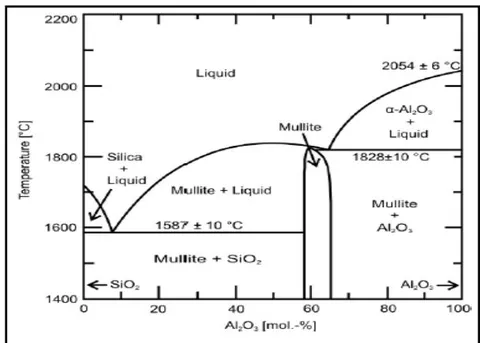
As a note on phase equilibria diagram, refractories are usually not at thermo chemical equilibrium and the commercial refractories present some impurities. This means non-equilibrium phases may be present. An example might be a fireclay brick containing calcined bauxite aggregate (added for composition adjustment) with an overall composition of 50% . This fired brick will contain corundum even though the phase diagram says it should not be present [4].
Globally, above 85% of the processed bauxite is destined to alumina production through Bayer Process and 94% of all this alumina is processed by Hall-Héroult process, to turn alumina to metal aluminum [2][6][7]. The remaining bauxite, or non-metallurgical bauxite, is destined for some other segments. Among them, it is inserted the refractory products, which iron and steelmakers consume more than 70% of the world production [6].
Guyana pioneered the manufacturing of RGB since 1940's. China began supplying only in the 1970's. Afterwards, Brazil started to produce some quantities [8]. According to the Ministry of Natural Resources of Guyana [6], 1.88 Mt of worldwide bauxite were directed to RGB production in 2015, being the main consumers China, Russia and India, existing only two significant worldwide suppliers: China and Guyana. According to the same source, Guyana was responsible for of world's RGB supply in 2015, while China takes the remainder. These numbers are close to the ones published by other sources, showing China currently with of the world market share [9][10].
While bauxite ore from Brazil, Guyana and other areas with tropical climate tends to be gibbsitic whose aluminum hydroxide is trihydrate, Chinese one is mainly diasporic ( -AlO(OH)), a monohydrate [11]. In general, bauxite ores from these countries exhibit different mineralogy and physicochemical characteristics that promote different properties on the RGBs manufactured [12]. Traditionally, the mineralogy of RGB is composed by a combination among three or more phases, hereinafter referred: corundum ( phase), mullite ( phase), tialite, rutile and/or hematite. Table 2 shows some properties of each phase mentioned [13][14][15][16][17].
| Phase | Corundum | Mullite | Tialite | Hematite | Rutile |
| Melting Temperature (°C) | 2050 | 1828 | 1860 | 1595 | 1668 |
| Density (g/cm3) | 4.0 | 3.2 | 3.7 | 5.2 | 4.5 |
| Thermal Conductivity (W/m.K) | 33 | 3.9-6.3 | 1.5-2.5 | 7.85-9.03 | 7.4 |
| Thermal Expansion (x 10-6K-1) | 4.6 | αa3.1-4.1 | αa11.8 | 11.8 | 8.5-9.5 |
| αb5.6-7.0 | αb19.4 | ||||
| αc5.6-6.1 | αc(-2.6) |
Considering thermal process, the diaspore from raw bauxite is straightly converted to -alumina during the firing, without metastable transition alumina [18], assuring the crystal growth and inhibiting the reaction with silica in the liquid phase to form mullite [12]. Furthermore, the higher grade of titanium oxide in Chinese bauxite favors the tialite formation ( ) above which can be an issue considering the mechanical strength due to its highly anisotropic thermal expansion (Table 2) and an eutectoid transformation during the cooling, decomposing it into its precursors, alumina and titania, in a wide range of intermediate temperature ( ) [14]. When gibbsite is the main mineral as per Brazilian and Guyanese bauxites, there are many phase transformations until corundum formation [18]. The slower grain growth facilitates the reaction between alumina and silica, increasing the mullite amount in the final product.
Recently, a Brazilian RGB produced with a gibbsitic bauxite was characterized and presented 19.4% (by weight) in mullite (acicular-shaped), while a Chinese RGB produced with a diasporic bauxite showed 15.4% in mullite (not acicular-shaped) and 4.4% in tialite (small crystallites). Bricks made with these RGBs using a conventional castable formulation showed the impact of those mineralogies in the thermo mechanical behavior, where the bricks made with Brazilian RGB withstood the hot load test (25 psi at 1600°C) and the bricks made with Chinese RGB failed under the same conditions [12].
Another work compared the difference between two processing ways of calcined bauxite: calcining from run of mine (ROM) bauxite, and calcining a bauxite after an ore processing, composed of size reduction, mixing and agglomeration. Processed bauxite showed the best results in the stress-strain test conducted under compression load in air. Moreover, the grains spatial distribution was remarkably more homogenous, demonstrating the importance of the processing in the final product properties and performance [19].
In a study which the aim was comparing four different forming processes (uniaxial pressing, extruding, lamination and slip casting) on sintered clay properties, the highest densification in the green body was obtained by pressing technique and it promoted larger quantity of mullite . Japanese researchers studying forming processes of a porous ceramic (SiC) showed that compression molding (or uniaxial pressing) led to higher strength and homogeneity of the ceramic matrix, while extrusion led to lower strength and higher apparent porosity .
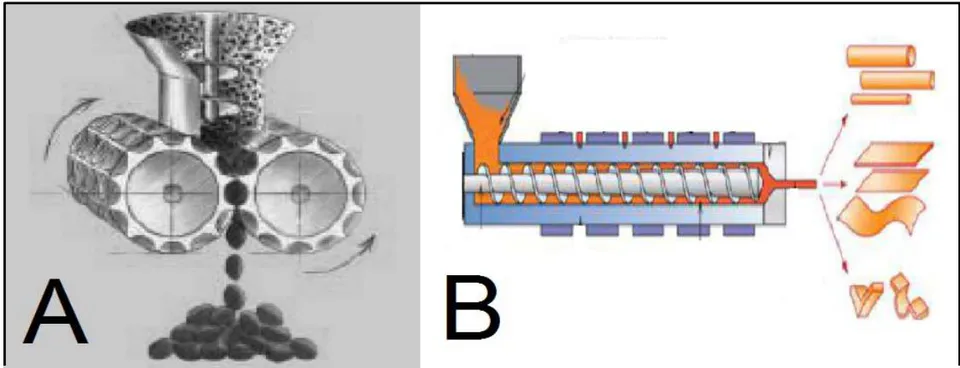
In an industrial scale, there are different technologies employed for the forming operations like briquetting or extrusion. Briquetting is a technique for agglomeration of fine particles under stresses like compression. The briquetting can be performed by a roller press (or briquette machine), in which a pressure is used to shape the material through its molds in the rolls surface. In this machine, the feedstock is forced to pass between two rolls that will produce the geometrical form of the material . As for the industrial extruders, these can be manufactured with a single-screw, twin-screw or piston. The feed of this equipment needs to be done with a material having an optimum level of plasticity and flowability. The equipment, by screw rotation or piston pushing, will shape the product according its nozzle or die. Figure 2 shows a diagram for both equipment.
To improve the quality of briquettes, organic binders can be added to the raw materials before the forming process. Outstanding results were found by adding low percentages of corn starch or lignosulfonates into refractory grade bauxites, increasing the resistance of the green bodies formed .
In this work, the authors present a comparison between the technical properties of different refractory grade bauxites from China, Guyana and Brazil. For the case of Chinese RGBs, two classes were evaluated according to their alumina content (86% and 88%
). For Brazilian RGBs, two forming process were taken into account (extrusion and briquetting).
II. MATERIALS AND METHODS
Five samples of RGB in four size fractions as described in Table 3 were selected for this work: two Brazilian ones (MC A and MC B), one from Guyana (G) and two from China (CH86 and CH88). Figure 3 shows the samples and their size fractions.
| Size Fractions | Description | |||
| -6.70 | +2.36 mm | Particles predominantly smaller than 6.70 mm (opening diameter of a sieve = 0.265") and larger than 2.36 mm (8 mesh). | |||
| -2.36 | +0.85 mm | Particles predominantly smaller than 2.36 mm (8 mesh) and larger than 0.85 mm (20 mesh). | |||
| -0.85 mm | Particles predominantly smaller than 0.85 mm (20 mesh). | |||
| -0.075 mm | Particles predominantly finer than 0.075 mm (200 mesh). | |||
| RGB | -6.70|+2.36 mm | -2.36|+0.85 mm | -0.85 mm | -0.075 mm |
| MC A(Brazilian) | 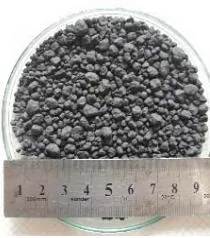 | 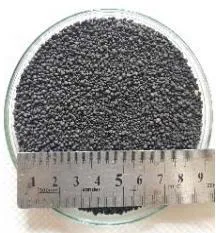 | 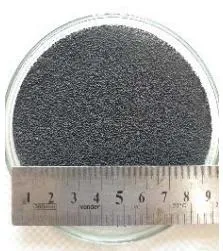 | 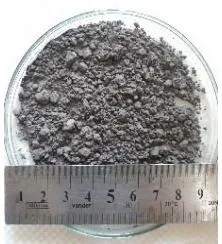 |
| MC B(Brazilian) | 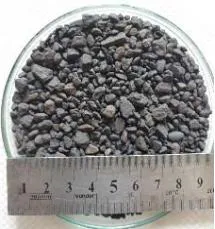 | 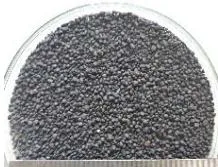 | 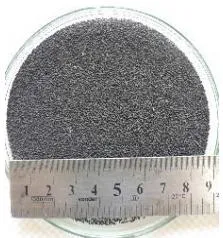 | 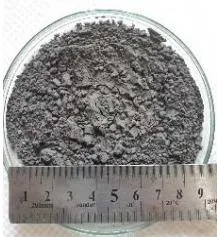 |
| G(Guyanese) | 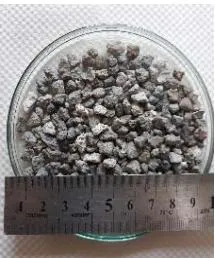 | 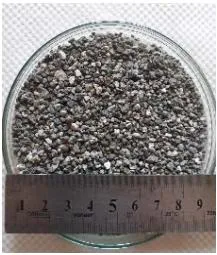 | 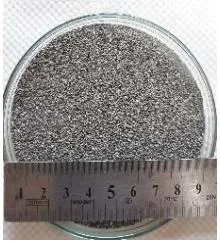 | 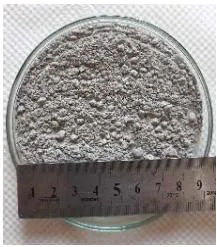 |
| CH86(Chinese) | 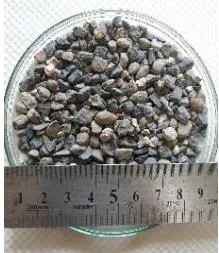 | 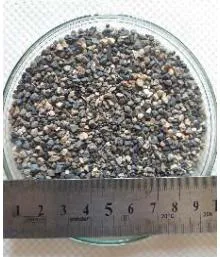 | 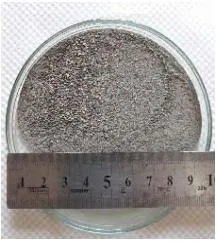 | 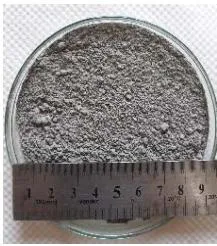 |
| CH88(Chinese) | 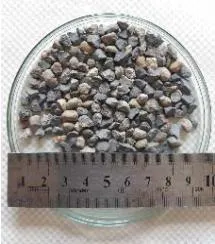 | 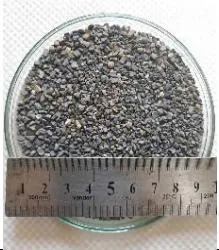 | 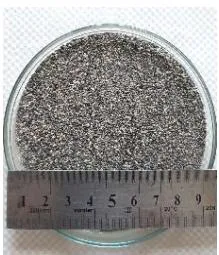 | 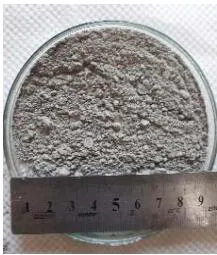 |
For Brazilian RGBs, the processing sequence began with a selection of bauxite ores as raw materials for an initial blending. The chemical composition for the crude bauxite blend was checked aiming to achieve an iron oxide content lower than 3.5% and a titanium oxide content lower than 1.0%. Additionally, a special attention is taken to ensure the low alkaline oxides content. Such analysis result by X-Ray Fluorescence Spectrometry is shown in Table 4.
Afterwards, the right bauxite blend was dried and the material went through homogenization, milling and water addition for adjusting the moisture, until achieve an optimum plasticity to assure the forming processes.
| RO* | LOI** | |||||
| 59.0 | 5.03 | 3.29 | 0.75 | 0.06 | 0.09 | 31.5 |
| *RO = CaO + MgO | ||||||
| **LOI = Loss on ignition at 1100°C/2h | ||||||
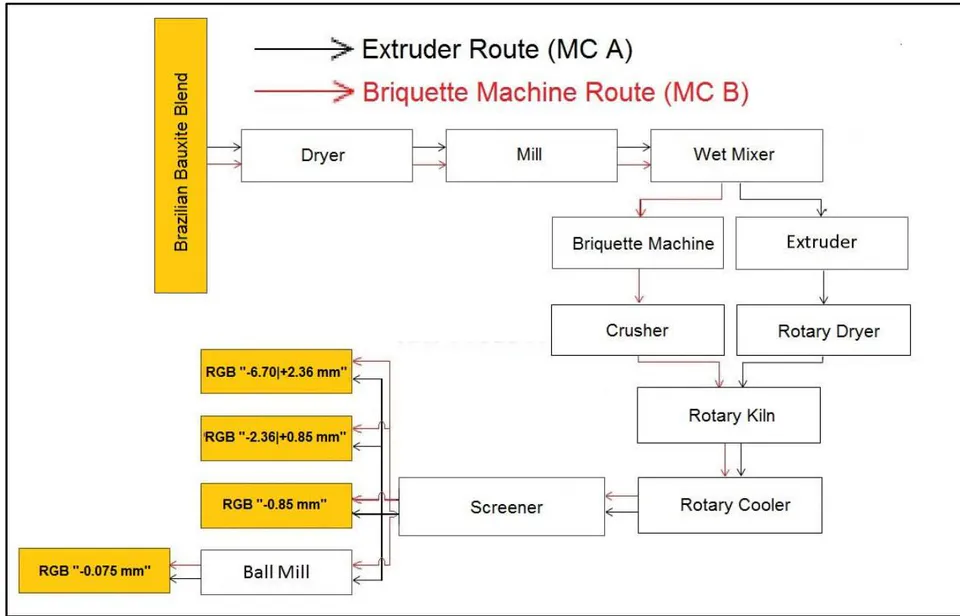
Regarding the forming processes, two different routes were considered. MC A was produced using a single-screw-extruder and MC B was manufactured with a briquette machine. After conformation, MC B went through a lump crusher to reduce the size of the briquettes and, only after this crushing, the material was transferred to a rotary kiln for sintering. As for MC A route, the extruded material was straightly directed to a rotary kiln, eliminating the physical comminution step. Both materials were sintered over 1700 °C, and the run of kiln product was cooled through a rotary cooler and sized into the fractions "-6.70 | +2.36 mm", "-2.36 | +0.85 mm" and "-0.85 mm" by vibratory screening. Lastly, the fraction "-0.075 mm" was obtained by ball milling. Figure 4 presents a concise flowchart of the Brazilian RGB with its two forming processing routes.
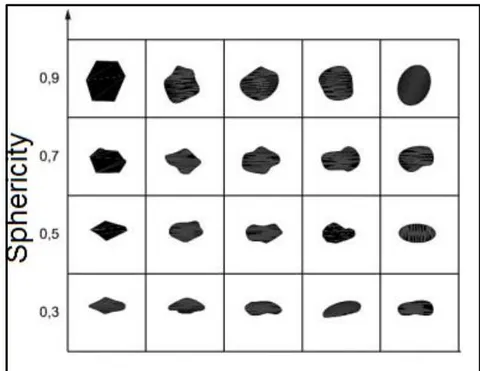
All RGBs were analyzed for particle-size distribution (PSD) in terms of retained weight on ASTM Standard sieves, and the "-6.70|+2.36 mm", "-2.36|+0.85 mm" and "-0.85 mm" size range shad also their particles shape evaluated in terms of sphericity. The sieves used for each size range are listed in Table 5 and the pattern for visual estimation of sphericity based on Krumbein Index is presented in Figure 5. Particularly for the fraction "-0.075 mm", due to their fineness, the PSD of the samples in terms of volume were obtained by laser diffraction (Malvern Mastersizer 2000).
| Size Range | Sieves ASTM Standard Number(and opening diameter in millimeter) | |||||
| -6.70 | +2.36 mm | 0.265" (6.70) | #4 (4.75) | #6 (3.35) | #8 (2.36) | #10 (2.00) | |
| -2.36 | +0.85 mm | #6 (3.35) | #10 (2.00) | #18 (1.00) | #20 (0.85) | ||
| -0.85 mm | #16 (1.18) | #18 (1.00) | #20 (0.85) | #30 (0.60) | ||
All the samples were chemically analyzed by X ray fluorescence technique in a sequential wavelength dispersive spectrometer (XRF 1800, Shimadzu) after sample preparation by fusion method in a high frequency induction machine (HA-HF 16/2, Herzog).
The RGB mineralogy for the "-6.70|+2.36 mm" size range was evaluated by X-ray diffractometry in a vertical \theta -2 \theta diffractometer (XRD 6000, Shimadzu), operating with a source of CuK \alpha radiation (power = 40 kV, 30 mA) in a step scan mode (step = 0.02° 2 \theta, time = 2 s, scan range = 15 to 80° 2 \theta). After mineralogical phases identification, the Rietveld method was applied for quantitative phases analysis [26][27].
The apparent porosity, water absorption and specific gravity of the solid fraction for "-6.70|+2.36 mm" samples were evaluated through the Archimedes Principle by hot water intrusion pycnometry [28]. For the remaining fractions, the specific gravity was obtained as real density by helium gas intrusion pycnomety.
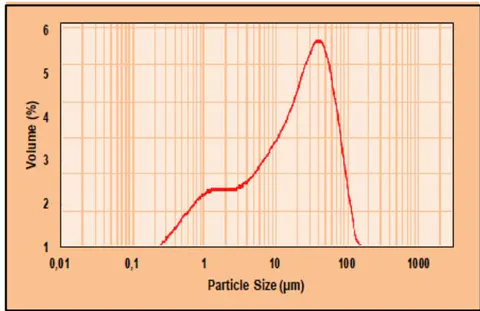
Performance tests were conducted in a convention castable formulation with 82% aggregates (RGBs) and 18% high-purity calcium aluminate cement (HP-CAC). For this test, a pre-mix of different sizes of RGB was prepared according to the following composition: 30%wt. "-6.70|+2.36 mm"; 30%wt. "-2.36|+0.85 mm"; 30%wt. "-0.85 mm"; 10%wt. "-0.075 mm". The PSD and the chemical composition of the HP-CAC are presented in Figure 6 and Table 6, respectively.
| CaO | ||||||
| 69.5 | 24.3 | 3.23 | 2.31 | 0.24 | 0.16 | 0.04 |
The castables were prepared with a water to concrete ratio in 9%wt. After 24 hours of curing time at room temperature, the castables were dried in a stove for 24 hours/110°C. The determination of the hot modulus of rupture (HMoR) was performed at 1200°C after five-hour of soaking time using the three-point bending technique [29]. The workability of the castables was also evaluated, and the phase identifications for the fired concretes were performed by X-ray diffractometry, aiming to evaluate the new phases formation under firing.
Flowability tests were performed for the castables with Brazilian RGBs as aggregate (MC A and MC B), aiming to evaluate the morphology effect on it. In this special case, the aggregates fraction used was the "-6.70|+2.36 mm" size only.
III. RESULTS AND DISCUSSION
The chemical composition for each RGB size is presented in Table 7. The RGB G samples presented the highest aluminum oxide content on average ( ), followed by CH88 ( ), CH86 ( ), MC A ( ) and MC B (85%). The impurities varied with the samples, where Brazilian RGBs showed a considerable content of iron oxide (4-5%) and a low content of titanium, the Guyanese and Chinese RGBs showed a high content of titanium oxide (3-4%). These impurities can promote the formation of deleterious phases for refractories, specially tialite formation due to titanium presence.
| RGB | Size Range | RO* | |||||
| MCA | -6.70|+2.36 mm | 85.2 | 8.18 | 4.80 | 1.20 | 0.15 | 0.17 |
| -2.36|+0.85 mm | 85.4 | 8.04 | 4.81 | 1.20 | 0.13 | 0.14 | |
| -0.85 mm | 85.2 | 8.26 | 4.67 | 1.27 | 0.13 | 0.13 | |
| -0.075 mm | 84.5 | 8.22 | 5.20 | 1.33 | 0.08 | 0.30 | |
| MCB | -6.70|+2.36 mm | 86.1 | 7.37 | 4.70 | 1.19 | 0.12 | 0.18 |
| -2.36|+0.85 mm | 85.0 | 8.06 | 5.06 | 1.26 | 0.10 | 0.16 | |
| -0.85 mm | 83.5 | 10.1 | 4.60 | 1.06 | 0.14 | 0.27 | |
| -0.075 mm | 85.1 | 7.81 | 5.15 | 1.28 | 0.08 | 0.24 | |
| G | -6.70|+2.36 mm | 89.2 | 6.02 | 1.24 | 2.97 | 0.00 | 0.10 |
| -2.36|+0.85 mm | 90.3 | 5.17 | 1.26 | 2.81 | 0.00 | 0.04 | |
| -0.85 mm | 90.0 | 5.17 | 1.33 | 3.04 | 0.00 | 0.02 | |
| -0.075 mm | 89.4 | 5.48 | 1.67 | 2.93 | 0.00 | 0.04 | |
| CH86 | -6.70|+2.36 mm | 86.9 | 7.05 | 1.37 | 3.49 | 0.14 | 0.44 |
| -2.36|+0.85 mm | 87.9 | 6.05 | 1.27 | 3.33 | 0.26 | 0.59 | |
| -0.85 mm | 84.9 | 8.39 | 1.97 | 3.27 | 0.17 | 0.70 | |
| -0.075 mm | 85.5 | 8.11 | 1.50 | 3.28 | 0.33 | 0.61 | |
| CH88 | -6.70|+2.36 mm | 88.3 | 5.77 | 1.22 | 3.32 | 0.25 | 0.49 |
| -2.36|+0.85 mm | 89.0 | 5.27 | 1.10 | 3.27 | 0.27 | 0.48 | |
| -0.85 mm | 85.8 | 8.19 | 1.36 | 3.48 | 0.19 | 0.36 | |
| -0.075 mm | 85.2 | 8.31 | 1.39 | 3.67 | 0.15 | 0.62 |
The silica content decreased with the increasing of the particle size for Chinese RGBs. For instance, in the RGB CH88, silica content was 8.31% in the fraction "-0.075 mm", whereas for the fraction "-2.36| +0.85 mm", the lowest result was encountered (5.27%).
The higher content of alkalis and earth-alkaline oxides ( and RO in Table 7) can configure another source of concerns for Chinese RGBs, because these oxides are related to the lowering of the softening point of the material.
Table 8 shows a statistic treatment considering the variation on chemical composition of the RGBs. The highest standard deviations were also encountered for
the Chinese RGBs, mainly for the silica content. RGB MC A has the most homogeneous chemical composition. For MC A route, the feeding of the extruder demands a finer milling, ensuring a more effective mixture and preventing a chemical segregation during the process. The processes of milling, mixing and agglomerating work against the natural heterogeneity of the mineral resources of bauxite. Heterogeneity is connected with the aspect of the aggregate, in which the Chinese ones are colorful (i.e. singular grains in black, grey and brown), denoting a chemical and mineralogical heterogeneity.
| RGB | RO* | Sum | |||||
| MC A | 0.39 | 0.10 | 0.23 | 0.06 | 0.03 | 0.08 | 0.89 |
| MC B | 1.07 | 1.21 | 0.27 | 0.10 | 0.03 | 0.05 | 2.73 |
| G | 0.51 | 0.40 | 0.20 | 0.10 | 0.00 | 0.03 | 1.24 |
| CH86 | 1.36 | 1.07 | 0.31 | 0.10 | 0.09 | 0.11 | 3.03 |
| CH88 | 1.86 | 1.59 | 0.13 | 0.18 | 0.06 | 0.11 | 3.92 |
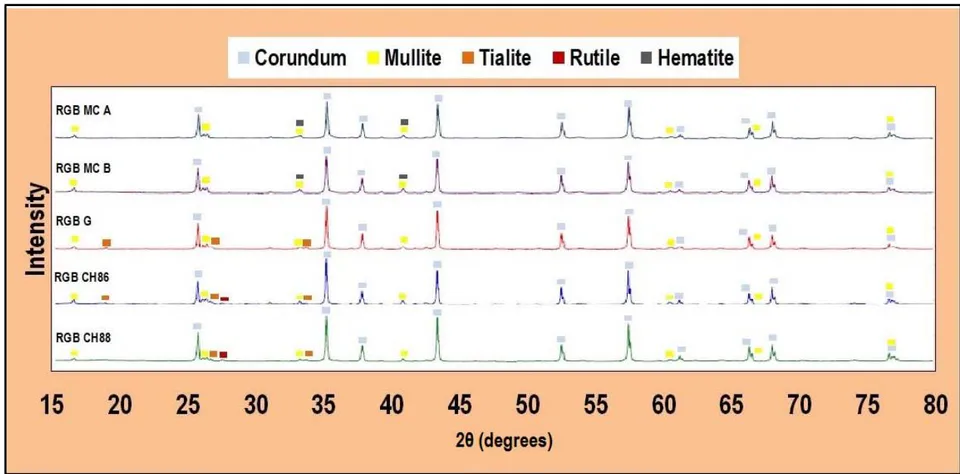
The diffractogram and mineralogical composition of the RGBs are presented in Figure 7 and Table 9, respectively. Chinese RGBs presented the highest content of corundum, while the Brazilian ones the lowest. Corundum is the major phase of the calcined bauxites, and the most refractory phase in high-alumina refractories (Table 2).
Brazilian RGBs contain hematite in a low content, what can reduce the refractoriness of the system (Table 2). Both Guyanese and Chinese RGBs presented tialite, but only the Chinese RGBs showed a small quantity of rutile, due to a eutectoid reaction of decomposition of tialite and/or lack of energy, temperature or homogenization for the reaction of all the titanium oxide with the aluminum oxide. The tialite phase brings some concerns because its formation is not irreversible and the refractory integrity can be impaired due to its highly anisotropic thermal expansion (Table 2).
Mullite is the secondary phase for all RGBs, having the greatest amounts for RGB MC A (20%) and RGB G (19%). The highest alumina content in RGB G ( ) suggests a mullite richer in alumina to , Fig. 1). This higher grade of alumina in the stoichiometry of the mullite is caused by a substitution of a cation and a removal of an oxygen ion from a tetrahedron in its crystal structure, enriching the alumina content [13].
| Phase | Chemical Formula | MC A | MC B | G | CH86 | CH88 |
| Corundum | 76.4 | 80.5 | 75.7 | 76.6 | 90.0 | |
| Mullite | 20.0 | 16.6 | 19.0 | 16.9 | 5.20 | |
| Tialite | - | - | 5.30 | 5.70 | 4.20 | |
| Rutile | - | - | - | 0.80 | 0.60 | |
| Hematite | 3.60 | 2.90 | - | - | - |
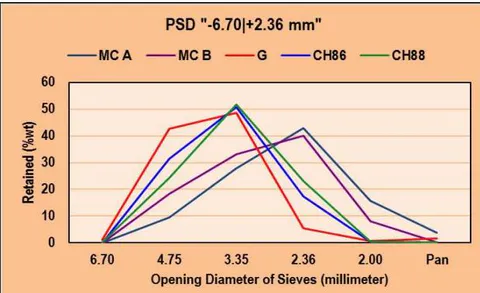
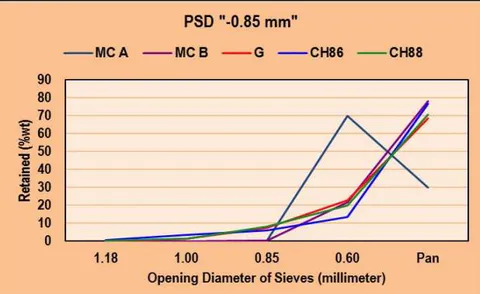
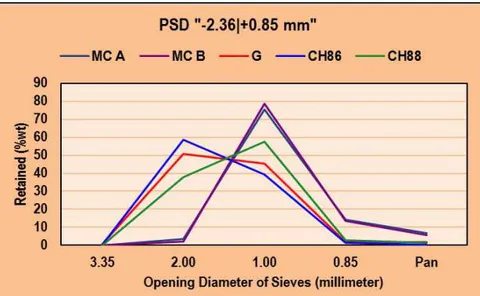
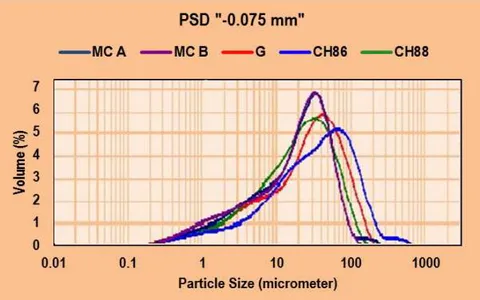
Figure 8 shows the particle size distribution (PSD) for all the RGBs studied in this work. In general, the samples were within the size range specified (at least 80%wt. of the particles between the reference screens). Regarding the fraction "-6.70|+2.36 mm", Brazilian RGBs diverged from the other bauxites, presenting a higher quantity for finer particles, and a wider curve with maximum retention on sieve 2.36 mm. Chinese and Guyanese RGBs had a narrower distribution and the maximum retention on sieve 3.35 mm. For fraction "-2.36|+0.85 mm" the opposite occurred, the Brazilian RGBs had a narrower distribution, but continuing finer than the other bauxites.
Comparing the forming processes (MC A x MC B), Brazilian RGBs presented the same behavior about the size distribution for all fractions, except for "-0.85 mm" samples, where MC A sample had 70%wt. of retention on 0.60 mm opening screen, in comparison with the other samples which had more than 70%wt. of the particles passing by that same screen. It's remarkable the influence of the forming process on the particle size, being the extrusion method responsible for the generation of a "-0.85mm" fraction with the most part of the particles distributed in -0.85 mm| +0.60 mm screens.
For "-0.075 mm" fractions analyzed by laser diffraction, the Brazilian RGBs showed the same behavior and intensity due to the ball milling operation, common for all samples.
The sphericity of the three coarser fractions for all the RGB samples is presented by Table 10. The products from the extruder were rounded granules, while the briquette machine formed irregular-shaped particles, setting the main physical difference among those samples. Depending on the type of application, rounded grains can facilitate pumping operations and reduce the power employed to transport the material. Likewise, spherical grains play in favor of self-flow.
| RGB | Sphericity | |||
| -6.70 | +2.36 mm | -2.36 | +0.85 mm | -0.85 mm | Average | |
| MC A | 0.8 | 0.9 | 0.9 | 0.9 |
| MC B | 0.6 | 0.7 | 0.7 | 0.7 |
| G | 0.5 | 0.6 | 0.6 | 0.6 |
| CH86 | 0.6 | 0.5 | 0.6 | 0.6 |
| CH88 | 0.6 | 0.5 | 0.6 | 0.6 |
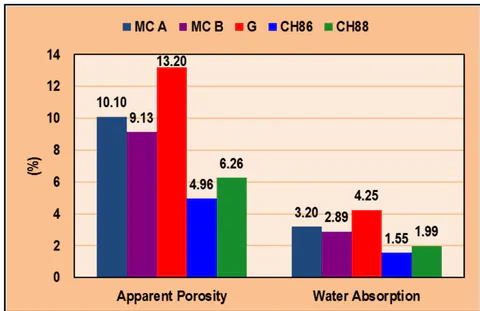
Regarding the apparent porosity and water absorption, results for all RGBs are presented in Figure 9. Apparent porosity of the Chinese RGBs are the lowest, whereas for the Guyanese RGB is the highest. Despite the Guyanese RGB chemical composition is the richest in aluminum oxide, its high porosity can be detrimental to the mechanical performance of the refractory. The Brazilian RGBs have a high apparent porosity, however the RGB MC B is lower than RGB MC A due to a higher compression in the briquette machine, if compared with an extruder. Water absorption is directly proportional to apparent porosity.
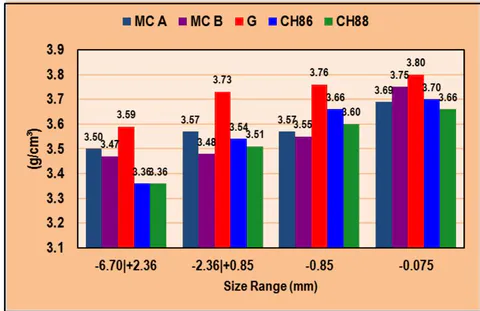
The specific gravities of all samples are presented in Figure 10. In general, the specific gravities increase with the decreasing of the particle sizes. It shows that, the reduction on number of closed pores in the particles, is proportional to the decreasing of the size of particles. That is, coarser particles have a higher number of closed pores, resulting in a lower weight per volume of material. The Guyanese RGB has the highest values in this property, what is good for a refractory because specific gravity relates with mechanical performance. The Brazilian RGBs have a specific gravity higher than the Chinese ones for the "-6.70|+2.36 mm" fraction, but lower for the "-0.85 mm" one. It can be related to the firing conditions, since the materials are sintered during the same run of kiln.
The hot modulus of rupture (HMoR) at C of the castables measured through the three-point bending technique and the sum of the standard deviation on chemical composition (SDoCC) of the RGBs are shown in Figure 11. This performance test contemplates the effect of all properties discussed. In statistical terms, the results are in a same magnitude, being possible to infer that the crack propagation occurred through the cement matrix, and not throughout the aggregate grains (Figure 12). However, there is a noticeable correlation between the HMoR and the SDoCC of RGBs. The lower the chemical variability (deviation sum), the higher the mechanical strength (HMoR). In absolute terms, RGB MC A presented the best flexure strength (5.12 MPa) and RGB G the second one (5.04 MPa). In spite of having 90% of corundum (Table 9), the heterogeneity of RGB CH88 aggregates may have been a decisive factor of its worst thermo mechanical performance. Isolated grains rich in phases as tialite or poorer in alumina can be harmful for refractory resistance. However, all the castables presented a good workability and the working time achieved for each castable is shown in Figure 13.
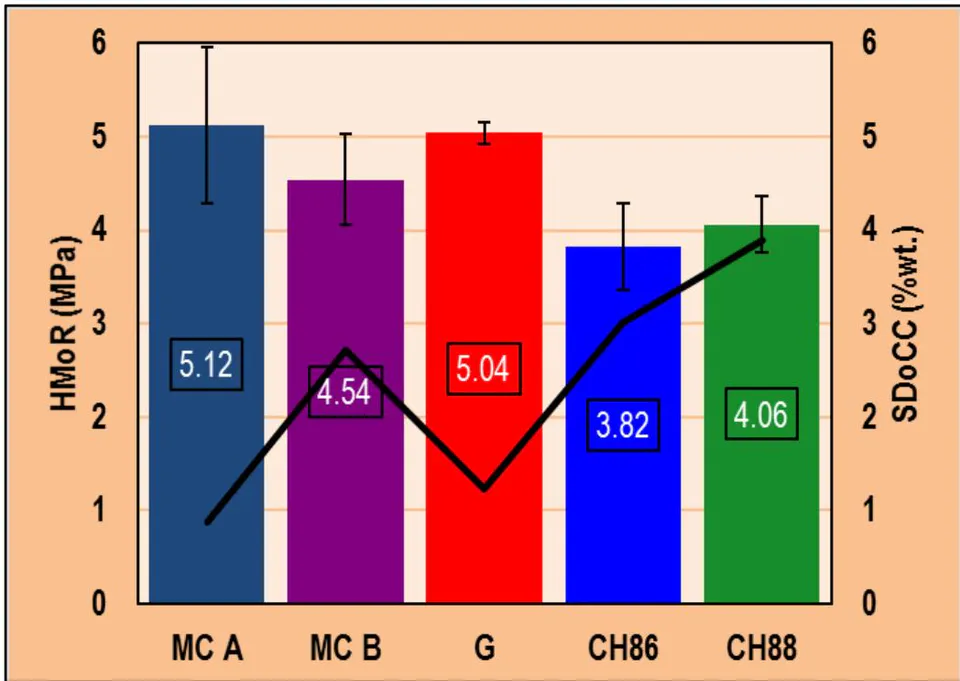
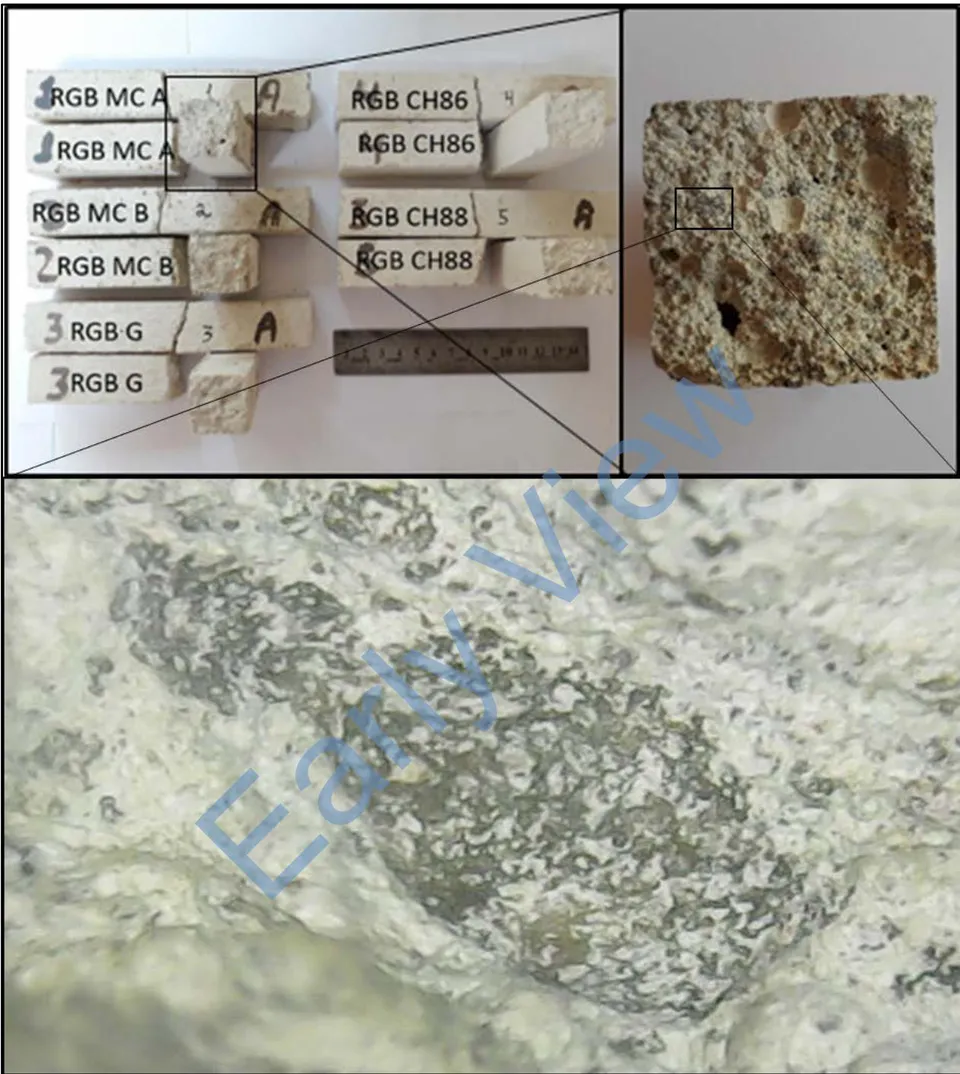
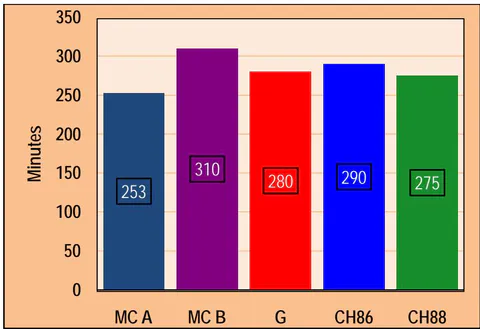
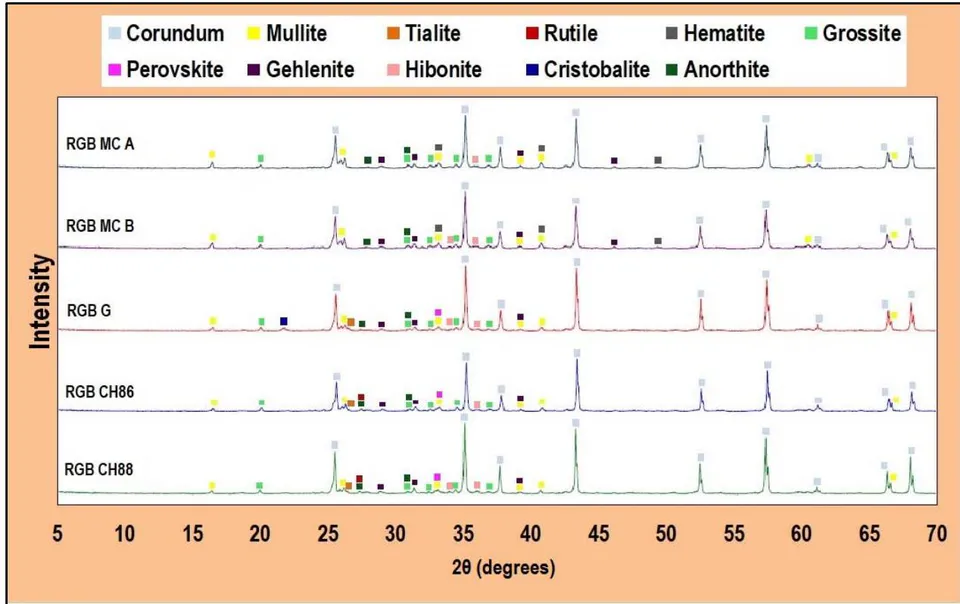
Figure 14 shows the diffractograms of the castables after HMoR test, and the Table 11 lists the phases identified for each one, pointing them out in colored blocks. In addition to RGB phases, CAC phases such as grossite, gehlenite and hibonite were found.
Anorthite was found in all castables, result of a thermal reaction between the CAC binder and the RGB matrix. Especially for RGB G, a cristobalite peak was found, what can be related to silica crystallization from liquid phase cooling.
| Phase | MC A | MC B | G | CH86 | CH88 |
| Corundum ( ) | |||||
| Mullite ( ) | |||||
| Tialite( ) | Not | Not | |||
| Rutile( ) | Not | Not | Not | ||
| Hematite( ) | Not | Not | Not | ||
| Grossite ( ) | |||||
| Perovskite ( ) | Not | Not | |||
| Gehlenite( ) | |||||
| Hibonite ( ) | |||||
| Cristobalite ( ) | Not | Not | Not | Not | |
| Anorthite ( ) |
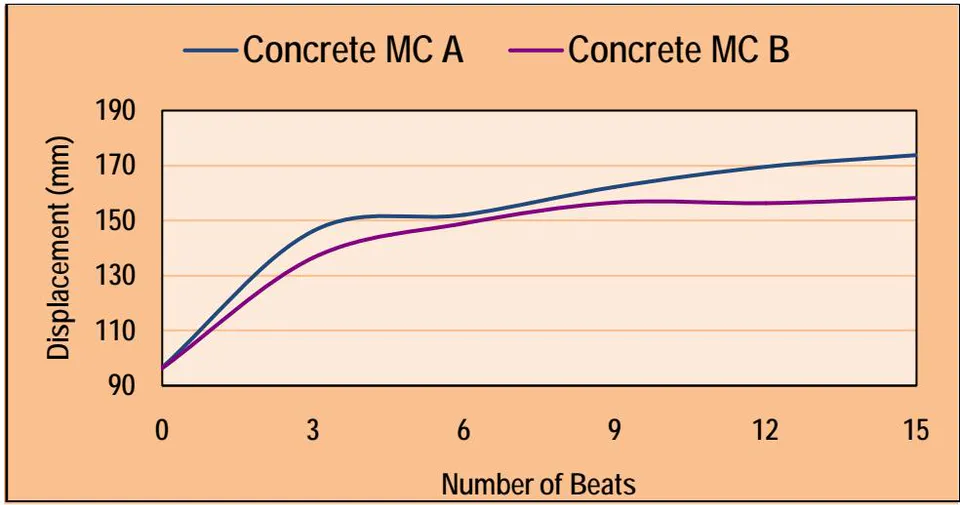
The flowability test of the castable varying the type of forming process for Brazilian RGBs showed the influence of particle morphology. The results are shown in Figure 15. The higher the displacement, the higher the flowability. The castable with RGB MC A as aggregate presented a higher flowability when compared to the
IV. CONCLUSIONS
Refractory properties are a correlation between characteristics of raw material and the processing employed. Mineralogy, chemical composition, firing temperature, particle size, forming process and porosity index will define the performance of the refractory. Thermo mechanical tests presented a relationship with the variability of the chemical composition among the size fractions for the same RGB. The Brazilian RGB processed in an extruder (MC A), with the lowest standard variation on chemical composition (SDoCC = 0.88%) and tialite absence in its composition, promoted a castable with the highest hot modulus of rupture value (HMoR at 1200°C = 5.12 MPa). Guyanese RGB also got a great result (HMoR = 5.04 MPa), whereas the Chinese
RGBs were the least resistant (HMoR: CH86 = 3.82 MPa; CH88 = 4.06 MPa), in accordance with their higher heterogeneity represented by the standard deviation on chemical composition (SDoCC: CH86 = 3.03%; CH88 = 3.92%).
All the refractory grade bauxites presented a high aluminum oxide content ( ), corundum and mullite as main phases, and a suitable working time (over 250 minutes) in a conventional castable formulation.
Despite of the highest alumina content ( ) of the Guyanese RGB, it has exhibited the lowest corundum content (75.7%), what can be related to a formation of a mullite richer in alumina (19.0%). The Chinese sample "RGB CH88" presented the highest corundum content (90%), however their impurities enabled tialite formation (4.20%) which may have impaired the high temperature strength. Brazilian RGBs (MC A and MC B) presented high mullite content (20.0% and 16.6%) and low hematite content (3.60% and 2.90%), in a good balance with corundum (76.4% and 80.5%), promoting highly homogeneous grains and proper physical indexes for refractory applications as dense granulated materials.
The size and the morphology of the RGBs is affected by the processing route, and the shape of the grains impacted the flowability. Two different forming process for Brazilian RGBs showed that the briquetting operation produced angular-shaped grains (MC B: sphericity = 0.7) due to a briquettes fragmentation, whereas the extrusion mechanism produced rounded grains (MC A: sphericity = 0.9) which induced the flowability of the castables, comparing the displacement of both castables (MC A x MC B) on a flow table.