Relationship between Climatic Variables and Incidence of Malaria and Asthma in Keffi Local Government Area of Nasarawa State

Article ID

526GW

High-quality alt text describing research on climate variables and disease correlation.

Relationship between Climatic Variables and Incidence of Malaria and Asthma in Keffi Local Government Area of Nasarawa State

Iliyasu Mamman Anzaku
Iliyasu Mamman Anzaku Bayero University, Kano
DOI

Abstract

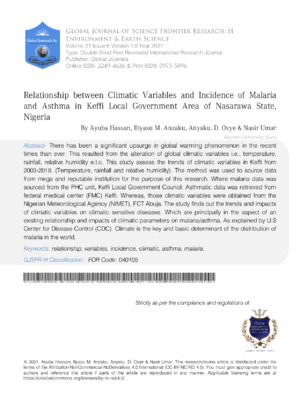
There has been a significant upsurge in global warming phenomenon in the recent times than ever. This resulted from the alteration of global climatic variables i.e., temperature, rainfall, relative humidity e.t.c. This study assess the trends of climatic variables in Keffi from 2003-2018. (Temperature, rainfall and relative humidity). The method was used to source data from mega and reputable institution for the purpose of this research. Where malaria data was sourced from the PHC unit, Keffi Local Government Council. Asthmatic data was retrieved from federal medical center (FMC) Keffi. Whereas, those climatic variables were obtained from the Nigerian Meteorological Agency (NIMET), FCT Abuja. The study finds out the trends and impacts of climatic variables on climatic sensitive diseases. Which are principally in the aspect of an existing relationship and impacts of climatic parameters on malaria/asthma. As explained by U.S Center for Disease Control (CDC). Climate is the key and basic determinant of the distribution of malaria in the world. Explains “climate can influence all three components of the life cycle. It is thus, a key determinant in a geographic distribution and seasonality of malaria (U.S Center for Disease Control 2017). It added that, “even if malaria has been eliminated from an area, if rainfall, humidity and temperature persist, there is danger that the disease can be reintroduced (U.S CDC 2017). The work also reviews that, “climate change are altering patterns of temperature and precipitation, potentially affecting the regions of malaria” (Olson et’ al 2009). Findings has also revealed that, logging of trees from massive agricultural practices and timber traders contribute to rising of temperature over the years. Findings analyzed from the retrieved data revealed that, rising temperature, relative humidity and declination in rainfall poses impacts on malaria and asthma in Keffi and the world-over, over the years. Marking a clear relationship between the two. The research wholesomely concluded by reiterating some abative measures to ravaging impacts of climatic variables on malaria/asthma and also on human health and comfort has been in the heart of the people. But unfortunately this has been the ultimate focus on government and people living in Keffi over the years. Thus, this calls for concerted effort and more commitment from both government and individual. Not putting down a lend of helping hand from NGOs, elites and stake-holders to win the fight.

Relationship between Climatic Variables and Incidence of Malaria and Asthma in Keffi Local Government Area of Nasarawa State

There has been a significant upsurge in global warming phenomenon in the recent times than ever. This resulted from the alteration of global climatic variables i.e., temperature, rainfall, relative humidity e.t.c. This study assess the trends of climatic variables in Keffi from 2003-2018. (Temperature, rainfall and relative humidity). The method was used to source data from mega and reputable institution for the purpose of this research. Where malaria data was sourced from the PHC unit, Keffi Local Government Council. Asthmatic data was retrieved from federal medical center (FMC) Keffi. Whereas, those climatic variables were obtained from the Nigerian Meteorological Agency (NIMET), FCT Abuja. The study finds out the trends and impacts of climatic variables on climatic sensitive diseases. Which are principally in the aspect of an existing relationship and impacts of climatic parameters on malaria/asthma. As explained by U.S Center for Disease Control (CDC). Climate is the key and basic determinant of the distribution of malaria in the world. Explains “climate can influence all three components of the life cycle. It is thus, a key determinant in a geographic distribution and seasonality of malaria (U.S Center for Disease Control 2017). It added that, “even if malaria has been eliminated from an area, if rainfall, humidity and temperature persist, there is danger that the disease can be reintroduced (U.S CDC 2017). The work also reviews that, “climate change are altering patterns of temperature and precipitation, potentially affecting the regions of malaria” (Olson et’ al 2009). Findings has also revealed that, logging of trees from massive agricultural practices and timber traders contribute to rising of temperature over the years. Findings analyzed from the retrieved data revealed that, rising temperature, relative humidity and declination in rainfall poses impacts on malaria and asthma in Keffi and the world-over, over the years. Marking a clear relationship between the two. The research wholesomely concluded by reiterating some abative measures to ravaging impacts of climatic variables on malaria/asthma and also on human health and comfort has been in the heart of the people. But unfortunately this has been the ultimate focus on government and people living in Keffi over the years. Thus, this calls for concerted effort and more commitment from both government and individual. Not putting down a lend of helping hand from NGOs, elites and stake-holders to win the fight.


Iliyasu Mamman Anzaku
Iliyasu Mamman Anzaku Bayero University, Kano

No Figures found in article.

iliyasu_mamman_anzaku. 2022. “. Global Journal of Science Frontier Research – H: Environment & Environmental geology GJSFR-H Volume 21 (GJSFR Volume 21 Issue H6): .

Download Citation

Journal Specifications

Crossref Journal DOI 10.17406/GJSFR

Print ISSN 0975-5896

e-ISSN 2249-4626

Issue Cover
GJSFR Volume 21 Issue H6
Pg. 53- 69
Classification
GJSFR-H Classification: FOR Code: 040105
Keywords
Article Matrices
Total Views: 1642
Total Downloads: 761
2026 Trends
Research Identity (RIN)
Related Research
Our website is actively being updated, and changes may occur frequently. Please clear your browser cache if needed. For feedback or error reporting, please email [email protected]

Request Access

Please fill out the form below to request access to this research paper. Your request will be reviewed by the editorial or author team.
X

Quote and Order Details

Contact Person

Invoice Address

Notes or Comments

This is the heading

Lorem ipsum dolor sit amet, consectetur adipiscing elit. Ut elit tellus, luctus nec ullamcorper mattis, pulvinar dapibus leo.

High-quality academic research articles on global topics and journals.

Relationship between Climatic Variables and Incidence of Malaria and Asthma in Keffi Local Government Area of Nasarawa State

Iliyasu Mamman Anzaku
Iliyasu Mamman Anzaku Bayero University, Kano

Research Journals