
I. INTRODUCTION
The sabre squirrelfish Sargocentron spiniferum (Forsskal, 1775) is a member of the family Holocentridae, which is mainly distributed in the Indo-Pacific from the Red Sea and East Africa to the Hawaiian Islands and Ducie Islands extending south to Australia. It is also distributed in New Caledonia, north to southern Japan and the Ogasawara Islands (Randall, 1998; Randall and Greenfield, 1999). This species inhabits different reef areas between reef flats in lagoons and seaward reefs at a depth of . This fish occurs under ledges during the day (Lieske and Myers, 1994), and when smaller in size, this fish inhabits shallow protected areas. It is a nocturnal fish that feeds on crabs, shrimp, and small fishes (Kuiter and Tonozuka, 2001).
Many researchers have been focusing on the study age and growth of fishes due to the clear and distinct growth rings of sagittal otoliths. Otolith has calcified structures and located at the right and left inner ears of fishes and it is useful in the study of fish biology, ecology, and fisheries science (Lecomte-Finiger, 1999; Tuset et al., 2003; Jawad et al., 2017; Mehanna et al., 2019; Serdar and Derya, 2020). Also, the otoliths are used to estimate movement, varied habitat, population dynamics, and trophic ecological level of ecosystem for fish species (Campana and Casselman, 1993; Tuset et al., 2003a; Cardinale et al., 2004; Rooker et al., 2008; Zorica et al., 2010; Morat et al., 2012; Yilmaz et al., 2014; Osman et al., 2020).
Otolith shape and dimension are used to identify fish species or stocks. However, a recent study showed that the directional asymmetry between right and left otoliths within individuals could affected the results from the otolith shape analysis as tool to identify the stocks (Mahé et al., 2018b). So, the aim of the present work was to estimate the relationship between fish size and otolith size (length, width, weight, form factor, and aspect ratio) to identify this species from the Egyptian water of the Red Sea.
II. MATERIALS AND METHODS
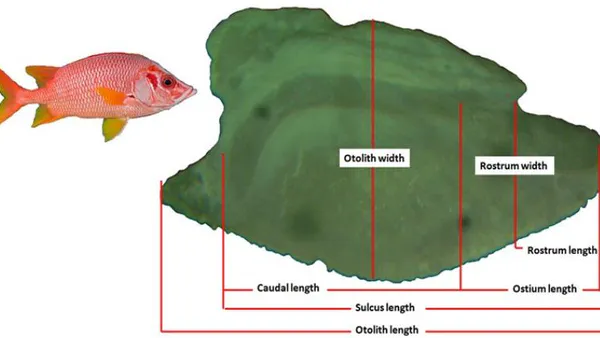
Fish species were randomly collected from the southern Red Sea at the Shalateen fishing port, which is located 520 km south of Hurghada (Fig. 1), Egypt, during March 2018 to February 2019. The fish were obtained from the commercial catch of the hook and line fishery at Shalateen fishing ground. In the laboratory, total fish length (TL) was measured to the nearest 0.1 mm, and fish weight (W) was recorded to the nearest 0.01 g. Then, the sex was determined. The total length and body weight of the species ranged between 17.7 and 45.8 cm and 101.5 and 1632 g respectively. Sagittal otoliths (370 left and right otoliths) were extracted from the inner ear of 185 S. spiniferum, cleaned and dried. Otolith weight (OW) for each head side was measured using a digital balance AS220 k/1 to the nearest 0.0001 g. Otolith outlines were realised using a Euromex-CMEX- 10 PRO camera with a stereomicroscopic. Otolith length (OL, mm), otolith area (OA, mm2), otolith perimeter (OP, mm), sulcus (SU), ostuim (OS), Form factor (FF), Aspect ratio (AR), circularity (CI) rectangularity (RE), Round (RO), Ellipticity (EL), Compactness (C), and Squaresness (SQ) were extracted using Image J analysis software (Rohlf, 2006) (detailed descriptions is in table 1 and Figure 2). The shape index factors (FF, C, AR, CI, RO, RE, EL, and SQ) were calculated according to different formulae (Table 1) (Russ, 1990; Tuset et al., 2003b; Pavlov et al., 2015; Mahe et al., 2016; Zischke et al., 2016; Jawad et al.,
2017; Kabakli and Ergüden, 2018; Mahé et al., 2018a; Osman et al., 2020). The main step was modelled the relationship of body length with the otolith outline indices according to the side (S):
Statistical analyses were performed in the statistical environment R (Fox and Weisberg, 2011) stats package (R Development Core Team 2016).
The otoliths of S. spiniferum, shape of the sulcus acusticus, sulcus type, ostium, the caudal, dorsal and ventral marginal have similar descriptions, and the characteristics of an otolith of S. spiniferum were detailed descriptions are in Table 2). A general pattern of S. spiniferum sagittae can be recognized in adult individuals.
Otolith shape of S. spiniferum is ovate with sinuate margins and the otolith is very thick. The sulcus acousticus is ostial with the Heterosulcus and ostium formed by a short funnel-like ostium that opens to the anterior margin and closed tubular cauda at least two times larger than the ostium (Figure 2 and Table 2). The statistical description and paired t-test results for left and right otoliths of S. spiniferum are given inTable 3.
The analysis of the relationship between fish length and fourteen otolith shape descriptors using a generalized linear model showed that there is a significant relationship between eight otolith parameters (ostium, cauda, otolith area, otolith perimeter, compactness, form factor, circularity, and squareeness), with the total length of fish. Only the relationship of body length with the otolith length, cauda and squareness was significant for right and left otolith (Table 4).
The correlation between fish total length and otolith morphology showed that with the increase of the total length, the otolith morphology such as otolith length, width, sulcus, ostum cauda, area, and perimeter also increase (Figure 3). These relationships between body length and otolith measurements (left and right) were best fitted as linear regression. On the other hand, the relationship between body length and the aspect ratio was close to 1; confirming that the otolith of S. spiniferum was oval. There is a positive relationship between total length and the aspect ratio. The same was noticed for the compactness and circularity values where they increased as the TL increased. The form factor, rectangularity, roundness, ellipticity, and squatness values decreased as the TL decreased.
III. DISCUSSION
The sabre squirrelfish Sargocentron spiniferum (Forsskål, 1775) contribute to important fisheries, specially the small artisanal fisheries at Shalatin fishing ground, Red Sea, Egypt. Form this point, basic data on the biology and dynamics of the species are essential for successful stock assessment and consequently in fisheries management.
The observed fish length and shape of the otolith in this study should encourage more research to verify the essential role of otolith morphometric measurements in fish stock identification. The strong correlation between the somatic length and otolith size suggests that somatic growth has a significant influence on the otolith growth (Jockusch, 1997; Cardinale et al., 2004). The results of this study were not similar to those previously obtained for the redcoat S. rubrum (Kabakli and Ergüden, 2018), where the present study have max otolith length, weight and hight than S. rubrum. Previous studies have focused mainly on the relationship between otolith measurements and fish length (Harvey et al., 2000; Fossen et al., 2003; Lychakov et al., 2006; Morat et al., 2008; Pavlov, 2016; Mehanna et al., 2016; Osman et al., 2020). In our study, the results of generalized linear model showed the relationship among these parameters as the otolith length could be affected by the choice of the otolith (significant asymmetry between right and left otoliths). Based on the present data, the relationship between TL and AR, CO, and CI was determined as a linear relationship, despite the relationship among TL and FF, RE, RO, EL, and SQ being determined as a nonlinear relationship.
On the other hand, the shape of otolith from different geographical areas is influenced by abiotic ecological parameters (e.g. salinity, temperature) and biotic parameters for examples prey availability, and depends on individual genotype (Cardinale et al. 2004; Gagliano and McCormick, 2004; Swan and Palmer, 2006; Vignon and Morat, 2010). So, an interaction of environmental and genetic fluctuation generates the morphological variance in shape of otolith that may allow the differentiation of stock units. However, the factors that affects the shapes are not fully understood and have not been investigated deeply yet (Burke et al., 2008). An on-going recent work displayed that the ontogenetic trajectory of otolith shape could be impacted by the environmental disturbance during early life stage (Vignon, 2018).
The relationships between fish size and otolith shape indices demonstrate the high variability in fish length and morphometric parameters, indicating that the otolith of S. spiniferum is rectangular to oval. As results in the current study, the fish size and otolith morphometric parameters are useful for further research on verifying the role of otoliths identification, discrimination and taxonomic classification of fish. Also, the results showed that the otolith shape indices significantly differed from species to species, although the indices indicate a similar pattern for otoliths. The results are reliable with that illustrated that otoliths are widely used for the discrimination and variation of fish species because of their form, diet, weight, and growth (Tuset et al., 2008; Bacha et al., 2010).
Finally, the estimation of the generalized linear model supposed in the present work may be good tool to study the relationship between fish and otolith morphometric features used to fish population dynamics, stomach contents of piscivorous predators, paleontological composition, and yield estimates.
IV. CONCLUSION
Finally, the estimation of the generalized linear model supposed in the present work may be good tool to study the relationship between fish and otolith morphometric features used to fish population dynamics, stomach contents of piscivorous predators, paleontological composition, and yield estimates.