
I. INTRODUCTION
Sharing Economy term is widely used to describe all market transactions of under usage assets among people through online platform (Durden 2017). Various business models exist under it such as on-demand (Uber), gig (Task Rabbit), access (Spotify), collaboration (WeWork), platform (Amazon), rental (AirBnb) and peer-to-peer (Lufax). As a consequence of it, Sharing Economy is frequently referenced as Collaborative Economy, Gig Economy, Access Economy and On-Demand Economy. However, apart from its definition, Sharing Economy is real now and will keep growing significantly in future days.
Key concept behind Sharing Economy is to open value potency of unused or less used asset (idle capacity) and business model shifting from "heavy asset" to "light asset" ones (Durden 2017). Technology matches buyer/demand and seller/supply to lessen market inefficiency. For example, Uber with no cars, Airbnb with no hotels, Amazon with group of conventional stores and eBay that doesn't handle supply chain.
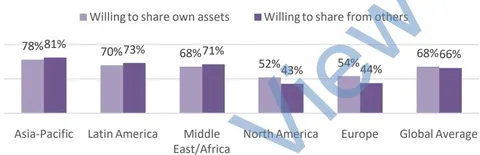
Charts released by Nielsen in 2013, shows that communities from various part of the world have been opened to Sharing Economy concept. The interesting part is, consumers in development countries seems more open for sharing comparing to them which reside in Europe or North America. The charts are based on Polling distributed over thirty-thousand Internet users over sixty countries. More than two third (68%) of the respondents state their interest in sharing financial profit. Same thing happened to 66% respondents related to their interest in using or renting goods or services in sharing community. First place comes to respondents in Asia Pacific, followed by South America and Middle East/Africa, and last is by half of Europe respondents and North America. If counting is done based on countries, the first three are China, Indonesia and Slovenia.
| Region | Willing to Share Own Assets | Willing to Share from Others |
| Global Average | 68% | 66% |
| Asia Pacific | 78% | 81% |
| Latin America | 70% | 73% |
| Middle East/Africa | 68% | 71% |
| Europe | 54% | 44% |
| North America | 52% | 43% |
| Country | Willing to Share from Others |
| China | 94% |
| Indonesia | 87% |
| Slovenia | 86% |
| Philippines | 85% |
| Thailand | 84% |
| Mexico | 79% |
| Bulgaria | 79% |
| Hong Kong | 78% |
| India | 78% |
| Brazil | 78% |
More and more Indonesian millennials choose to work as Gig Workers. Bloomberg data show out that one third of 127 million workers in Indonesia, categorized as Gig Worker or work less than 35 hours per week in 2017. Aligned to it, service provider for job seeker and company that is looking for workers (on-demand worker) grows up to 26% in last year (Setyowati 2018).
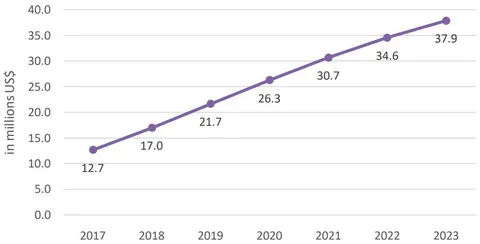
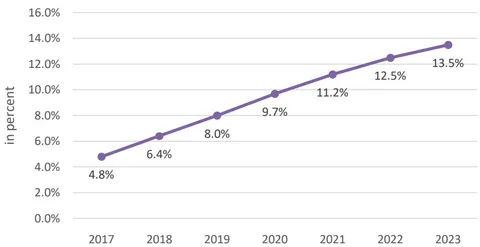
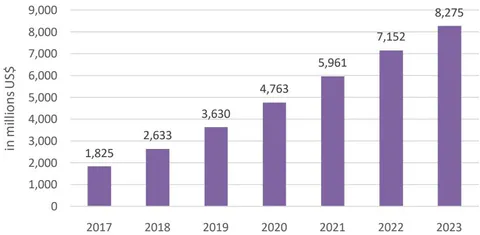
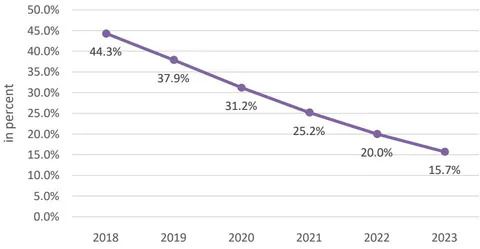
2019). Growth of Ride Hailing service in big cities also being part of global growth trend known as "gig", "sharing" and "on-demand" economy. By now, Ride Hailing is still the fastest growing segment on the Online Mobility Services market in Indonesia. In 2019, there are 21.7 million drivers (penetration rate at 8%) with total revenue at 8,275 million (https://www.statista.com/outlook/368/120/ride-hailing/indonesia, 2019).
Purpose of this research is trying to discover if Employee Engagement of freelancer workers or driver partners that has been tested previously (Nawaz et al. 2019) is applicable in Ride Hailing industry in general.
By knowing Employee Engagement of working partners in Ride Hailing industry, Ride Hailing platforms are expected to have a better understanding about their partners, so they can make better decisions and develop more suitable strategies ahead. By having a better partnership level, they are expected to have a better competitive advantage among competitors.
II. LITERATURE REVIEW
a) Worker
Gig Worker is a term that is frequently used to define worker who is working under the Gig Economy industry. There are a lot of definitions for the Gig Economy, the one that is commonly used to described is a field of work in which customer is given a short-term task to an individual, through an online independent platform (Schafer & Schwarzkopf,2019). Hence, those who works under that situation is referred as Gig Worker. Gig Worker definition itself is relatively variessince the terms is relatively new. There are several characteristicsthat definesGig Worker, a flexible working arrangement based on client request; worker provides their own working place; the job is given through platform that connects the worker, customer and platform intermediates (Steward & Standford, 2017). Furthermore, Gig Worker is bound by the location, in which in order to finished the task given both worker and customer have to be in the same geography location.
Some of the known example of Gig Worker is those who works under the Ride Hailing apps. such as Uber, Grab or Go-jek. Furthermore, those who works in food delivery service such as Ubereats, Go-food, Grab Food and Food panda is also included as Gig Worker. Bothjobs have the same characteristics which describes gig worker in general.
b) Freelancer Engagement
Employee engagement is a concept that is used to define employee involvement and commitment to their job. Employee engagement is a form of employee retention (Schmidt era k., 1993). Employee who is disengagewill show relatively lower working performance in which they work is not satisfactory, effortless, automatic and robotic (Pandey and David, 2013).
Based on Khan (1990, 1992) definition, there are three physiological conditions that increase employee engagement level: meaningfulness, safety and availability. Meaningfulness is described as intrinsic value that employee attached to his/her job (May et al., 2004). Safety is defined as situation in which employee can freely express themselves authentically in their job, mostly determined by their interpersonal interaction to other employees (Pandey and David 2013). Last, availability talks about employee feeling on how they can be fully supported in terms of physical, cognitive and emotional resource to finish their job (Pandey and David, 2013). Maslach et al (2001) furthermore stated that workload, control, rewards and recognition, community and social support, perceived fairness and values arefactors that are in associated to employee engagement. Proper fulfillment related to those factors will increase employee engagement to his or her job.
In same way, freelancer engagement can be defined as freelancer involvement and commitment to profession. Contrast to what literatures above talk, Barlage et al (2019) argues that employee engagement concept can be applied to freelancer, especially for those who work in Gig Economy. This is due to the same logic applied between both employee and freelancer, in order to execute their job.
c) Social Exchange Theory
Social exchange theory tries to explain social interactions between human and it's society. In general, human is interacting with his or her society based on has-to-docost-benefit analysis, depends on their own preferences and perception. Human evaluates the cost and benefit either subconsciously or not. Human will prolong those relationship that perceived has maximum values (Edyardsson et al., 2011)
d) Freelancer Value Proposition
Freelancer value proposition is a term that is used to describe values that freelance received by working in the freelance platform as a return from fulfilling certain task or service (Nawaz, Zhang, Mansoor, dan Ilmudeed, 2019). Freelancer Value Proposition (FVP) is a concept that is based on the Employee Value Proposition Concept (EVP). EVP is traditionally used to describe tools that mostly used to improve interrelationship between company and its employee, in which company is able to figure out what kind of values is employee longed and searched for and employee can also understand whether the company is fitting for them. EVP is also tools that can be used to strategically to improve business outcome, in which values that is offered or given are aligned with what employee is looking for. If the values aligned, then the relationship will be beneficial for both parties, in which the relationship will be strong, for the long term and beneficial (Marriot Jr, 2001b).
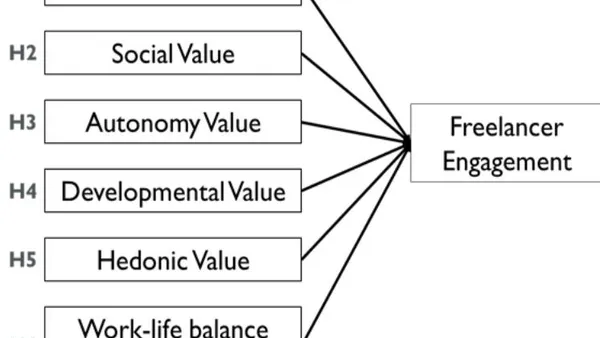
In order to get attributes that construct the Employee Value Proposition need to be formed through continues improvement. Usually the attributes are identify through listening and observation employee at work (Nawaz et al., 2019). Attributes for Employee Value Propositionis varies in different industry (Pratibha, 2015). Nawaz, Zhang, Mansoor and Ilmudeed identify that the employee value proposition is also applicable for the freelancer, hence they coined the term Freelancer Value Proposition. Referring to their journal, they identify six values that attribute to the Freelancer Value Proposition which are, Economic Value, Social Value, Autonomy Value, Developmental Value, Hedonic Value and Work Life Balance Value.
e) Economic Value
Economic value in this context refer to the compensation received by the employee once they have finished a task. Wang (2004) stated that economic factors in form of reward hava a huge part in building and maintaining employee and company sustainability. Bratton and Gols (1994) stated that reward included all form financial benefit that is received by the employee as form of relationship between company and its employee. Mostazz (1988) stated that when an individu enter an organization they have skills, desires and goal, hence they also expect that the company is able to fully maximized their skills, fulfilled their desires and help them to achieve their goal. Employee feel sense of attachment to the company and better performance if they received reward and recognition. Reward is proven to increase level of efficiency and performance of employee in doing their work (Jehanzeb et al., 2012).
In the gig worker context, most of the primary motivation to work in the platform is to fulfill their economy needs, either as primary or supplementary income (Schewellnuss et al., 2019). Nawaz (2019) also stated that economic value play a big part as the main motivation for worker to join the Gig Economy. Hence from the above mentioned fact we can hypothesized that
H1: Economic Value as part of Freelancer Value Proposition contributes positively to Freelancer Engagement.
f) Social Value
In general, human is a social being. Hence, it's undeniable that social value plays a big part as a motivation for decision making in daily life. Social value is defined as set of beliefs and principles that accepted by majority, and being applied in order to ensure continuity of society (Soykan, 2007). Those values held are part of criteria and opinions of what society is expected (Türkkahramana, 2013). Having a job is one of method used to elevate one's societal status (Nawaz et al., 2019). Having a job will increase individual reputation in its peer group. Furthermore, research suggests an individual to utilizes online platform to gain recognition from its peer group (Carrillo & Gaimon, 2004).
H2: Social Value as part of Freelancer Values Proposition contributes positively to Freelancer Engagement.
g) Autonomy Value
Nowadays autonomy is defined to explain some ones ability to self-govern and decide their own conduction. Autonomy value in job is defined as condition in which an individual has the ability to self-govern and being free from external excessive control (van Hoorn, 2018). Autonomy value itself is one of the most important intrinsic factor that increase knowledge sharing in organization (Foss et al., 2009). On top of that, at traditional organization, autonomy is scored as one factor that increase employee commitment to organization (Aube et al., 2007). The project based works and temporary organizations have a very high level of autonomy, hence it is becoming one motivation for the workers (Hanis et al., 2016).
H3: Autonomy Value as part of the Freelancer Value Proposition contributes positively to Freelancer Engagement.
h) Development Value
Developmental value is defined as value that attracts employee because company gives recognition, self-worthiness and confidence to its employees. Furthermore, the attraction can be resulted from company supports for employee career enhancing experience that may lead to development of employee capability and competitiveness in market (Biswa and Suar, 2013). Developmental value is scored as one of the most important dimension which employees are looking for in a company. Employee values company that give chances for employee development (Jian and Iles, 2011). Lack of chance of personal development at company will lead to high turn over rate at company (Hausknecht et al., 2009). Freelancer in general has the flexibility to pick variety of projects, exposures and challengesthat will supportemployee development (Nawaz et al., 2019).
H4: Developmental Value as part of the Freelancer Value proposition contributes positively to Freelancer Engagement.
i) Hedonic Value
Hedonic values merupakan kombinasi dari enjoyment, fun, pleasure, Excitement dan precieved benefit yang dirasakan seseorang ketika menggunakan produk, serviceat atupun aktivitas. Enjoyment merupakan salah satu faktor kuat yang mengkontribusi user dalamsharing economy, dimana platfrom economy ada di dalamnya (Nawaz et al., 2019).
Hedonic values are combination of enjoyment, fun, pleasure, excitement and perceived benefit that is felt by user of the service, product or activity. Enjoyment is known to be one of the strongest factor that motivate user in sharing economy, where economical platform resides (Nawaz et al., 2019).
H5: Hedonic Values as part of the Freelancer Value proposition contributes positively to freelancer engagement.
j) Work Life Balance Value
Work life balance values defines as one's capability to combine job and it's personal responsibility successfully (Greenhaus et al., 2003). A lot of research shows that work life balance is one of the most important aspect for employees. Work life balance proven to boost employee performance I terms of productivity, creativity, satisfaction and commitment employee to his or her job (Nawaz et al., 2019).
H6: Work life balance Values as part of the Freelancer Value Proposition contributes positively to freelancer engagement.
a) Research Model
III. METHODOLOGY
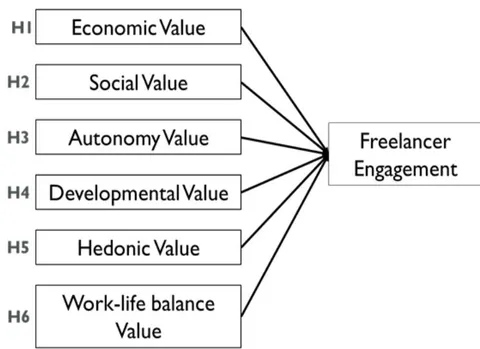
In order to find out relationship between six Gig Worker values and a Gig Working platform, a model is built for the research. Model of conceptual framework above illustrates tendency of Economic Value, Social Value, Autonomy Value, Development Value, Hedonic Value and Work-Life Balance Value toward the Freelancer Engagement of Gig Working platform. Six Gig Worker values as independent variables are examined for the significance toward Freelancer Engagement which is the independent variable. This model is central of this research in context of Ride Hailing industry in Indonesia.
b) Instrument Design and Measurement of Construct
The research was initiated by interviewing some Gig Workers in order to gain insights about values which influence their level of engagement for a Gig Working platform. Interview questions refer to literature review on Freelancer Value proposition (Nawaz et al, 2017). Twelve Ride Hailing drivers were interviewed. It is found out that their values and level of engagement indicate six values that influence the level of commitment and motivations: Economic Values, Social Value, Autonomy Value, Development Value, Hedonic Value and Work-life Balance Value. The scale of measurement for each construct are developed using literature review and qualitative interview
Economic value of Gig Workers is measured by three questions which are adapted from Alniaçık et al (2012) and Lee et al (2018)
(1) I am getting an above average basic salary.
(2) I save more money because of participating in this freelancing platform.
(3) I can find good deals in freelancing platform.
Social value of Gig Workersis measured by three questions which are adapted from i Sweeney & Soutar (2001) and T. C. Zhang, Jahromi, & Kizildag (2018)
(1) This freelancing platform would make a good impression on other people.
Work-life Balance Value of Gig Worker are measured by three questions which are adapted from Wu et al (2013)
Autonomy value of the Gig Workers are measured by two questions which are adapted from Spanuth & Wald (2017)
Development value of Gig Workers is measured by three questions which are adapted from Reis et al (2017) and Ronda et al (2018)
(1) Feeling more self-confident as a result of working for a particular freelancing platform.
(2) I am gaining career-enhancing experience in my freelancing platform.
(3) Freelancing platform is springboard for future employment.
Hedonic value of Gig Workers is measured by two questions adapted from Hamari et al., (2016)
(1) I think freelancing is enjoyable
(2) I think freelancing is fun
Freelancer engagement of Gig Workers are measured by four questions which are adapted from Fletcher, Bailley, Robinson, Alfes (2014)
(1) I find the work that I do full of meaning and purpose
(2) I am enthusiastic about my job
(3) I am proud on the work that I do
(4) At my work I always persevere, even when things do not go well
c) Sample and Data Collection Procedures
The research was continued by distributing online questionnaire via google form to the Gig Workers in greater Jakarta. The number of Ride Hailing drivers (4 wheel) are approximately one thousand drivers in
Jabodetabek area for Grab and GoJek platform. There are 238 surveys returned from the drivers and 220 of them are used for data analysis. Each item used five-point Likert scale in which 1 representing "Strongly disagree" to 5 representing "Strongly agree".
IV. ANALYSIS
a) Demography Information
Demographic information was examined, such as age, gender, duration of work in organization, marital status, and educational level. With a total of 238 samples, TABLE: IV-I shows sample's demographic details of responses. Majority respondents were around 35 until 44 years old those are 103 respondents (43.28%) followed by 77 respondents were around 25-34 years old (32.35%) and 51 respondents were around 45-54 years old (21.43%). Based on gender variable, it can be concluded that Ride Hailing industry were dominated by men with 235 respondents (98.74%). For other variables: duration of work in organization were 2-3 years with 114 respondents (47.9%), marital status was married with 219 respondents (92.02%), and educational level were high school degree with 133 respondents (55.88%).
| Variable | Description | Frequency | Percentage |
| Age | 18-24 Years | 4 | 1.68% |
| 25-34 Years | 77 | 32.35% | |
| 35-44 Years | 103 | 43.28% | |
| 45-54 Years | 51 | 21.43% | |
| >54 Years | 3 | 1.26% | |
| Gender | Male | 235 | 98.74% |
| Female | 3 | 1.26% | |
| Duration of Work in Organization | 0-1 Years | 104 | 43.70% |
| 2-3 Years | 114 | 47.90% | |
| 4-5 Years | 18 | 7.56% | |
| >5 Years | 2 | 0.84% | |
| Marital Status | Single | 19 | 7.98% |
| Married | 219 | 92.02% | |
| Educational Level | Elementary School | 17 | 7.14% |
| Middle School | 41 | 17.23% | |
| High School | 133 | 55.88% | |
| Associate's Degree | 26 | 10.92% | |
| Bachelor | 20 | 8.40% | |
| Graduate | 1 | 0.42% | |
| Post Graduate | 0 | 0.00% |
b) Validity and Reliability Analysis
This study uses six constructs that were analyzed using validity and reliability test. Validity test was done with Kaiser-Meyer-Olkin Measure of Sampling Adequacy (KMO) with expected value above 50%, and the factor loading above 30%. Reliability test was done with Cronbach's Alpha test with expected value above for this exploratory research. Both tests were conducted using SPSS software. From 238 responses,
18 were unused and taken out from the analysis. Table: Iv-li Shows the result details of validity and reliability tests for each construct statement.
Table: IV-II Validity and Reliability Test Result
| Construct | Construct Value Statement | Loading Factor | KMO | Cronbach's Alpha |
| Economic Value (EV) | I am getting an above average basic salary | 0.768 | 0.699 | 0.832 |
| I save more money because of participating in this freelancing platform | 0.81 | |||
| I can find good deals in freelancing platform | 0.674 | |||
| Social Value (SV) | This freelancing platform would make a good impression on other people | 0.751 | 0.691 | 0.772 |
| Freelancing platform help me make new friends | 0.655 | |||
| This freelancing platform is recommended by my friends | 0.686 | |||
| Work Life Balance Value (WV) | There is a good fit between my job and my personal gain | 0.768 | 0.717 | 0.854 |
| I have enough time for my family or other important people in my life because of freelancing | 0.829 | |||
| My work offers schedule flexibility | 0.738 | |||
| Autonomy Value (AV) | I had the opportunity to set my own priorities at work | 0.825 | 0.5 | 0.786 |
| I have autonomy in setting my income per hour rate | 0.825 | |||
| Developmental Value (DV) | Feeling more self-confident as a result of working for a particular freelancing platform | 0.739 | 0.618 | 0.687 |
| I am gaining career-enhancing experience in my freelancing platform | 0.749 | |||
| Freelancing platform is springboard for future employment | 0.445 | |||
| Hedonic Value (HV) | I think freelancing is fun | 0.951 | 0.5 | 0.947 |
| I think freelancing is interesting | 0.951 | |||
| Employee Engagement (EE) | I find the work that I do full of meaning and purpose | 0.703 | 0.799 | 0.896 |
| I am enthusiastic about my job | 0.833 | |||
| I am proud on the work that I do | 0.842 | |||
| At my work I always persevere, even when things do not go well | 0.702 |
The result shows that all the data set had KMO above 50%, factor loading above 30% and Cronbach's Alpha above 70%, this indicates all data set were valid and reliable.
c) Descriptive Analysis
The descriptive analysis methods such as mean and standard deviation were conducted using SPSS software. Mean level of 3.00 was used as an average scale for the five-point Likert scale used in this research questionnaire. The mean obtained for Freelancer Engagement was 4.5, this indicates that the respondents had an engagement to the company and high probability to stay within the company. The
Table: IV-III Overall Means for each Construct
| Construct | Mean |
| Economic Value (EV) | 3.96 |
| Social Value (SV) | 4.48 |
| Work Life Balance Value (WV) | 4.08 |
| Autonomy Value (AV) | 4.49 |
| Developmental Value | 4.04 |
| Hedonic Value (HV) | 4.35 |
| Employee Engagement (EE) | 4.52 |
d) Correlation Analysis
For further information correlation analysis was also conducted to test correlation for each construct. Results with the highest correlation were Economic Value and Work Life Balance Value with 0.755 point. This indicates that in the Ride Hailing industry, respondents were able to get decent to above average income while maintaining their work life balance. Table: IV-IV shows the correlation between each construct.
Table: IV-IV Correlation Between Construct
| Economic Value | Social Value | Work Life Balance Value | Autonomy Value | Developmental Value | Hedonic Value | |
| Economic Value | 1 | |||||
| Social Value | 0.575 | 1 | ||||
| Work Life Balance Value | 0.755 | 0.582 | 1 | |||
| Autonomy Value | 0.639 | 0.655 | 0.737 | 1 | ||
| Developmental Value | 0.737 | 0.583 | 0.718 | 0.674 | 1 | |
| Hedonic Value | 0.703 | 0.641 | 0.753 | 0.676 | 0.707 | 1 |
e) Regression Analysis
Regression test were conducted to see correlation between independent variables and dependent variable. The research model has six independent variables: Economy Value, Social Value, Work Life Balance Value, Autonomy Value, Developmental Value and Hedonic Value. They are expected to affect the independent variable, Freelancer Engagement.
Results in Table: Iv-V shows that Economic Value has a negative relationship toward Freelancer Engagement. This indicates that there was no effect from Economic Value toward Freelancer Engagement. Other constructs have positive relationships to ward Freelancer Engagement which indicates the positive effect from each construct to Freelancer Engagement.
Table: IV-V Regression Result
| Hypothesis | Beta | t | Sig | Result | |
| Economic Value | → Freelancer Engagement | -0.172 | 3.091 | 0.002 | Supported |
| Social Value | → Freelancer Engagement | 0.302 | 6.523 | 0.000 | Supported |
| Work Life Balance Value | → Freelancer Engagement | 0.015 | 0.251 | 0.802 | Not Supported |
| Autonomy Value | → Freelancer Engagement | 0.076 | 1.415 | 0.159 | Not Supported |
| Developmental Value | → Freelancer Engagement | 0.147 | 2.697 | 0.008 | Supported |
| Hedonic Value | → Freelancer Engagement | 0.595 | 10.603 | 0.000 | Supported |
V. DISCUSSION AND IMPLICATION
This study is aimed to understand correlation between Freelancer Value Proposition (FVP) and Employee (freelancer) Engagement toward Ride Hailing Platform apps in Indonesia. It is expected that based on findings in this study, platform company could build a better relationship program in correlation to the freelancers and improve the platform service level. Researcher proposes to use six dimensions of FVP: Economic Value (EV), Social Value (SV), Autonomy Value (AV), Developmental Value (DV), Hedonic Value (HV), and Work-life Balance Value (WV) in order to find its correlation to freelancer engagement to the platform. Unfortunately, data for Work Life Balance Value (WV) and Autonomy Value (AV) are not sufficient to explain correlation toward Freelancer Engagement. Apart from EV, all other FVP have strong positive correlation with freelancer engagement. The strongest correlation FVP was Hedonic Value, followed by Social Value, and Developmental Value.
EV itself based on an article by Tomas Chamorro-Premuzic published by Harvard Business Review (HBR), titled Does Money Really Affect Motivation? A Review of the Research (2013), pay is a psychological symbol and the meaning of money is largely subjective, and for this case the economic value has negative correlation with freelancer engagement. Ride Hailing industry itself in Indonesia is monopolized by two companies: GOJEK and Grab, causing a tight competition among those two. The competition created price-war that not only for winning end-customer but also to attract driver partners (freelancer) to join the platforms. ABI Research, as quoted on Sindonews.com, stated that Grab won 63.6% of Ride Hailing market share in Indonesia, while GOJEK 35.3% . Indonesian government sets Regional Minimum Salary (UMR) to ensure people get enough paid and this standard is also used by Ride Hailing platforms to set incentive schemes for its driver partners. These schemes make drivers income become hygienic.
Top two strongest correlations are HV and SV, according to Nawaz, Zhang, Mansoor, and Ilmudeen (2019). It is stated that "hedonic value is a combination of enjoyment, fun, pleasure, excitement and perceived benefits which a person experience while using product, service or performing any activity." So, the more enjoyment on what freelancers do as Ride Hailing driver partners, the better engagement rate it brought toward the platform. Still according to Nawaz, Zhang, Mansoor, and Ilmudeen (2019), "Social interaction and networking is basic instinct of human being." It means when people belong to a group or community that fit with their purpose and goals, they will become more engage to the organization, or in this case the platform.
a) Limitation and Future Directions
This study was still the first step to understand correlation between FVP and Freelancer Engagement to the platform. Further deep interview is required to have better understanding. Especially, for the Ride Hailing platform that expect to reduce incentives cost at certain level. Further study probably can focus on other freelancers in different industry (i.e. e-commerce merchants) and demographics.
APPENDIX 1- SURVEY INSTRUMENT
| Construct | Item | Measures | Source |
| Economic Value (EV) | EV1 | I am getting an above average basic salary | Alniaçık et al (2012) and Lee et al (2018) |
| EV2 | I save more money because of participating in this freelancing platform | Alniaçık et al (2012) and Lee et al (2018) | |
| EV3 | I can find good deals in freelancing platform | Alniaçık et al (2012) and Lee et al (2018) | |
| Social Value (SV) | SV1 | This freelancing platform would make a good impression on other people | i Sweeney &Soutar (2001) and T. C. Zhang, Jahromi, &Kizildag (2018) |
| SV2 | Freelancing platform help me make new friends | i Sweeney &Soutar (2001) and T. C. Zhang, Jahromi, &Kizildag (2018) | |
| SV3 | This freelancing platform is recommended by my friends | i Sweeney &Soutar (2001) and T. C. Zhang, Jahromi, &Kizildag (2018) | |
| Work Life Balance Value | WV1 | There is a good fit between my job and my personal gain | Wu et al (2013) |
| (WV) | I have enough time for my family or other important people in my life because of freelancing | Wu et al (2013) | |
| WV2 | |||
| WV3 | My work offers schedule flexibility | Wu et al (2013) | |
| Autonomy Value (AV) | AV1 | I had the opportunity to set my own priorities at work | Spanuth& Wald (2017) |
| AV2 | I have autonomy in setting my income per hour rate | Spanuth& Wald (2017) | |
| Developmental Value | DV1 | Feeling more self-confident as a result of working for a particular freelancing platform | Reis et al (2017) and Ronda et al (2018) |
| DV2 | I am gaining career-enhancing experience in my freelancing platform | Reis et al (2017) and Ronda et al (2018) | |
| DV3 | Freelancing platform is springboard for future employment | Reis et al (2017) and Ronda et al (2018) | |
| Hedonic Value (HV) | HV1 | I think freelancing is fun | Hamari et al., (2016) |
| HV2 | I think freelancing is interesting | Hamari et al., (2016) | |
| EE1 | I find the work that I do full of meaning and purpose | Fletcher, Bailley, Robinson, Alfes (2014) | |
| Employee Engagement (EE) | EE2 | I am enthusiastic about my job | Fletcher, Bailley, Robinson, Alfes (2014) |
| EE3 | I am proud on the work that I do | Fletcher, Bailley, Robinson, Alfes (2014) | |
| EE4 | At my work I always persevere, even when things do not go well | Fletcher, Bailley, Robinson, Alfes (2014) |
16 Dec. 2019.https://www.zerohedge.com/news/2017-07-24/primer-global-sharing-economy-20-charts
Fletcher, Luke and Robinson, Dilys and Bailey, Catherine and Alfes, Kerstin and Holmes, Jenny and Madden, Adrian and Buzzeo, Jonathan and Currie, Graeme, Measuring Employee Engagement and Interpreting Survey Results, 2014.
IMF, World Bank, UN, and Eurostat, "Ride Hailing Indonesia," Statista, Nov. 2019, 16 Dec. 2019, https://www.statista.com/outlook/368/120/ride-hailing/indonesia
K. Jehanzeb, M. Rasheed, and A. Rasheed, "Impact of Rewards and Motivation on Job Satisfaction in Banking Sector of Saudi Arabia," International Journal of Business and Social Science, 3(21), 272-278, 2012. http://www.ijbssnet.com/journals/Vol_3_No_21_November_2012/29.pdf
Zubair Nawaz, Jing Zhang, Rafiq Mansoor, and Aboobuckerllmudeen, "Gig workers in sharing economy: Conceptualizing Freelancer Value Proposition (FVP) in e-lancing platforms," vol.
51-75, 2019.