





1. Introduction
According to the special theory of relativity (STR), the following relation holds between the energy and momentum of a body moving in free space [1].
Here, is the rest mass energy of the body. And is the relativistic energy.
Also, Einstein and Sommerfeld defined the relativistic kinetic energy as follows [2].
The “re” subscript of stands for “relativistic.”
Now, Formula (1) is rewritten as follows.
Comparing Formulas (2) and (3), the relativistic momentum can be defined as follows.
Also, Formula (4) can be written as follows.
Hence,
Based on the above discussion, it was found that the relativistic kinetic energy of a body moving in isolated systems in free space can be described with Formulas (2) and (6).
However, Einstein’s energy-momentum relationship is not applicable in a hydrogen atom, where potential energy is present.
Formula (1) holds when the energy absorbed by a body is all converted to kinetic energy of that body.
However, an electron in an atom acquires kinetic energy through emission of photon energy. Therefore, Einstein’s relationship (1) cannot be applied to an electron in an atom.
Thus, section 2 reviews the energy-momentum relationship applicable to the electron in a hydrogen atom previously derived by the author.
2. The Energy-Momentum Relationship for a Bound Electron in a Hydrogen Atom
Consider the case where an electron at rest in an isolated system in free space is attracted by the electrostatic attraction of the proton (hydrogen atom nucleus), and forms a hydrogen atom.
The electron at rest has a rest mass energy of . When this electron is taken into the region of the hydrogen atom, it acquires an amount of kinetic energy equivalent to the emitted photon energy.
Now, the following relationship holds if the energy of a photon emitted from an electron is taken to be .
Here, is the Planck constant.
In classical quantum theory, the total mechanical energy of a hydrogen atom is defined as the sum of the potential energy and kinetic energy of the electron. That is,
Here, is the principal quantum number.
Now, if is used to represent the photon energy emitted when an electron placed an infinite distance away from the atomic nucleus (proton) of the hydrogen atom is taken into the hydrogen atom, then the following law of energy conservation holds for the electron.
Here, the “ph” subscript of stands for “photon.”
Normally, the energy of a photon is written as , but when multiple photons are emitted, indicates the total energy of those photons.
Formula (9) shows that the energy source for the kinetic energy acquired by an electron and the photon energy emitted by the electron is the potential energy of the electron.
The relationship between the rest mass energy of the electron and the relativistic energy of the electron is as follows.
Also, is the sum of the residual part of the rest mass energy of the electron and the relativistic kinetic energy . are the relativistic energy levels of a hydrogen atom [3].
The relationship between and other energy is as follows.
The relativistic energy of a bound electron in a hydrogen atom becomes smaller than the rest mass energy. That is,
Now, referring to Formula (2), it is natural to define the relativistic kinetic energy of an electron in a hydrogen atom as follows.
Next, the relativistic kinetic energy of an electron in a hydrogen atom is defined as follows by referring to Formula (6).
In this way, two formulas have been obtained for the relativistic kinetic energy of the electron in a hydrogen atom (Formulas (13) and (14)).
The following equation can be derived from Formulas (13) and (14).
Rearranging this, the following relationship can be derived.
Formula (16) is the energy-momentum relationship applicable to the electron in a hydrogen atom.
The author has previously derived Formula (16) using five methods [4, 5, 6, 7, 8, 9].
3. Solution of Formula (16)
In the past, Dirac derived the following negative solution from Formula (1).
If the same logic is applied to Formula (16), then the following formula can be derived.
However, Formula (18) does not incorporate the discontinuity peculiar to the micro world.
Therefore, Formula (18) must be rewritten into a relationship where energy is discontinuous.
The author has previously derived the following relationship as a new quantum condition to replace the quantum condition of Bohr [10, 11, 12]. (see Appendix)
Here, is the following fine-structure constant.
Incidentally, there are positive and negative solutions to Einstein’s relationship (1). In the same way, Formula (16) also has the following positive and negative solutions [13].
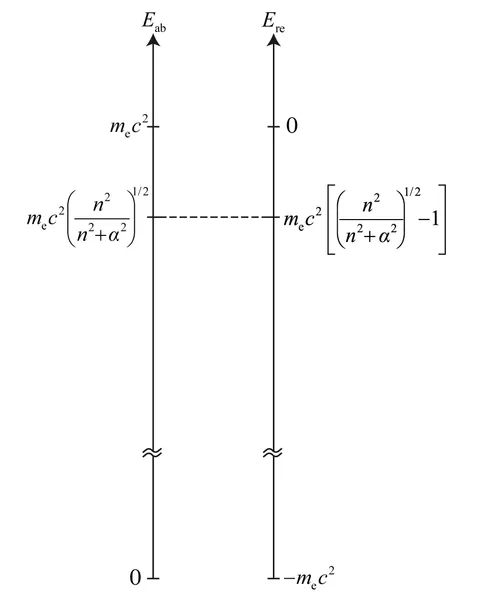
This paper defines as the relativistic energy of an electron. takes into account the existence of the rest mass energy of the electron. The “ab” subscript of stands for “absolute.”
It has already been pointed out that a state with exists in the energy levels of a hydrogen atom [14, 15].
These energies can be illustrated as follows (see Fig. 1).
Incidentally, Formula (16) can be written as follows when Formula (21) is taken into account:
Thus, the momentum of the electron can be expressed with the following formula.
Also, taking Formula (21) into account, can be written as follows.
Next, when the part of Formula (25) in parentheses is expressed as a Taylor expansion,
Incidentally, the nonrelativistic energy levels of a hydrogen atom, derived by Bohr, are given by the following formula.
The “BO” subscript of stands for “Bohr.”
However, when discussing the energy levels of a hydrogen atom, it is best if the rest mass energy of the electron is included in the formula. Thus Formula (27) is rewritten as follows.
From this, it is evident that Formula (27) is an approximation of Formula (25).
Next, the following table summarizes the energies of a hydrogen atom obtained from Formulas (25) and (27) (see Table 1).
| Bohr’s Energy Levels, | This Paper, | |
|---|---|---|
| 0 | MeV | |
| 1 | eV | eV |
| 2 | eV | eV |
| 3 | eV | eV |
Next, if the electron orbital radii corresponding to the energy levels in Formulas (21) and (22) are taken to be, respectively, and [16].
Here, the subscript “re” is attached to for consistency with .
Here, is the classical electron radius, defined as follows.
In Formula (30), the electron approaches toward as increases.
In the classical model, the orbital radius of the electron is defined as the distance from the center of the atomic nucleus to the electron. However, it must be understood that the ordinary region of the hydrogen atom begins from .
The author has previously pointed out that the heretofore unknown state of the hydrogen atom formed from the hydrogen nucleus (proton) and an electron with negative energy existing near the nucleus is a plausible candidate for dark matter, an unknown substance whose true nature is currently unknown [16, 17].
4. Previously Unknown Formulas for and
According to Maxwell’s electromagnetism, the following relationship holds between the momentum and energy of light.
Also, Einstein asserted, based on consideration of the photoelectric effect, that light has a particle nature, although it had previously been regarded as a wave.
If a photon as a single particle is assumed to have a frequency , Einstein concluded it has the following energy [18].
Formula (33) can be written as follows using the angular frequency .
is defined as follows.
The following formula can be derived from Formulas (32) and (33).
Also, the wavenumber is defined as follows.
de Broglie applied Formula (36) to matter. In classical physics, the following relation holds between momentum and kinetic energy .
Here, if Formulas (34), (36), and (37) are used,
Therefore,
The phase velocity and group velocity of a material wave are defined as follows (in the following, these may be abbreviated as , ). Velocity and vibration frequency are easily confused, so to be on the safe side, velocity will be indicated henceforth with a capital letter .
In light of the above, the phase velocity of the wave is as follows.
Also, the group velocity of the wave is as follows.
de Broglie thought that, if light—previously thought to be a wave—has a particle nature, then perhaps the electron—thought to be a particle—has a wave nature. Thus, he applied Formula (36) to matter.
Incidentally, the electron’s phase velocity is given by the following formula.
Here, is the phase velocity of the electron wave when the principal quantum number is in the state. Also, and are the wavelength and frequency of the electron wave.
Formula (44) can be written as follows using the relationship of Formulas (33) and (36).
Due to the above, the formula for the relativistic kinetic energy of the electron corresponding to Formula (32) is as follows [19].
The energy of a photon is found as the product of the photon’s momentum and the speed of light. The kinetic energy of an electron, in contrast, is determined by the product of the electron’s momentum and its phase velocity.
Next, the following relationship can be derived from Formula (45) by using Formula (14).
Hence,
The following new formula for momentum can be derived from Formula (49).
The following formula for kinetic energy can be derived from Formulas (46) and (50).
5. Relativistic Energy Levels of a Hydrogen Atom Derived from a Wave Standpoint
The energy levels of a hydrogen atom cannot be calculated from Formulas (47) and (51) derived in section 4 if the formulas are used as is. Thus formulas enabling calculation of energy will be derived from these formulas.
Now, the momentum of an electron in a hydrogen atom can be expressed with the following formula.
Incidentally, the group velocity of the electron wave corresponds to the velocity of the electron treated as a particle.
The group velocity of an electron as a wave can be indicated with the following formula when Formula (19) is taken into account.
The relationship of the phase velocities and of the electron wave is as follows based on Formula (48).
Next, part of the right side of Formula (54) is changed to a formula in and as follows.
Therefore, the following relationship holds.
Consequently, Formula (54) can be written as follows.
From this, the phase velocity of the electron can be expressed with the following formula.
Now it was possible here to find and , so the following formula was obtained by substituting Formulas (53) and (58) into Formula (47).
The energy levels of a hydrogen atom can be described not only with Formula (25) but also with Formula (59).
The energy levels of a hydrogen atom can also be derived from the following formula.
If in Formula (58) is substituted into Formula (60), the result is as follows.
Reusing the relationship in Formula (21) here, Formula (61) becomes as follows.
Rearranging, the following formula can be derived.
Now, for the third case, a formula for the energy levels of the hydrogen atom will be derived using , a formula for energy that exemplifies quantum mechanics. First, the kinetic energy of the electron can be described as follows.
Here, is the vibration frequency of the phase wave of the electron.
The wavelength of the phase wave of the electron can be conceived as follows.
Also, there is the following relationship between and the phase velocity of the electron.
If here Formula (58) is also used,
Rearranging, the following formula can be derived.
There is also the following relationship between the electron’s Compton wavelength and the Planck constant [20].
Based on this, the energy levels of the hydrogen electron are as follows.
Rearranging, the following energy levels can be derived.
With the above considerations, the same formula can be derived for the three formulas (Formulas (47), (51), and (64)) for the energy levels of a hydrogen atom derived by treating the electron as a wave. Combining these yields the following.
Next, the relationship is confirmed between the two energy level formulas, Formulas (25) and (72).
First, the right sides of Formulas (25) and (72) are linked with an equals sign.
The left side, when rewritten, becomes as follows.
Clearing the denominators on both sides yields the following.
Thus,
With this, it is evident that Formula (25) and Formula (72) have different forms, but give the same energy.
The following relationship holds due to the above considerations.
Extracting part of Formula (77) yields the following.
However, the nature of on both sides of Formula (78) is not the same.
On the right side, is mass that does not exist in current physics. The true nature of this mass has been discussed in another paper, so a discussion will be omitted here [8, 9, 21, 22].
Incidentally, the relativistic energy levels of the hydrogen atom can also be derived from the following relationship.
Here, is the wavelength of a photon whose momentum is .
From Formula (79), the following relationship holds.
Formula (25) can thus be written as follows.
The formulas for energy levels of the hydrogen atom including only the principal quantum number can be summarized in the following table (see Table 2).
| A | B |
|---|---|
6. Conclusion
The author has previously derived the following formula as an energy-momentum relationship applicable to the electron in a hydrogen atom.
The following relationship was used to extract the discrete energy levels characteristic of quantum theory from the formula.
Then the following relativistic energy levels of a hydrogen atom were derived.
Formula (84) is a formula derived by treating the electron as a particle.
After that, the author derived the following formula by taking the electron into account based on its wave aspect.
However, these formulas could not, as is, calculate the energy levels of a hydrogen atom.
Thus, in this paper Formulas (85) and (86) were rewritten as the following formula enabling energy to be calculated.
Formula (87) was derived by treating the electron as a wave.
This paper has shown that Formulas (84) and (87) differ in form, but give the same energy values.
It was found that for the relativistic energy levels of a hydrogen atom, the same formula can be derived by regarding the electron as a particle, or as a wave.
Formula (87) can be written as follows.
Formula (87) includes the electron’s rest mass energy, and Formula (88) includes the electron’s momentum.
However, this does not mean that all of the energy levels of the hydrogen atom can be derived from Formulas (84) and (87). To derive all of the energy levels would require solution of the relativistic wave equation previously derived by the author [5, 23].
Appendix
In classical quantum theory, the total mechanical energy of the hydrogen atom can be expressed as the sum of the electron’s kinetic energy and its potential energy , so the energy can be written with the following formula.
According to the Virial theorem, the formula holds in the case of a circular orbit, and the total mechanical energy of a hydrogen atom can be expressed with the following formula. (Here, the circular orbit is treated as a special form of an elliptical orbit.)
The total mechanical energy of a hydrogen atom is equal to the electron’s kinetic energy with its sign changed. It is also equal to of the potential energy.
Now the following orbital radius is derived by substituting the value for Formula (28) for in Formula (A2).
The on the left-hand side was likewise given the subscript to correspond with the on the right-hand side.
Incidentally, when deriving the energy levels of the hydrogen atom, Bohr assumed the following quantum condition.
This is Bohr’s famous quantum condition.
Now, calculating here yields the following.
In this way it is possible to define the fine-structure constant as follows.
Next, the following is obtained when in Formula (69) and in Formula (A3) are substituted into Formula (A4).
Also, using the relationship in Formula (A5), Formula (A7) can be written as follows.
The following relationship can be derived from this.
The physical meaning of Formula (A9) has been explained in another paper [24].


