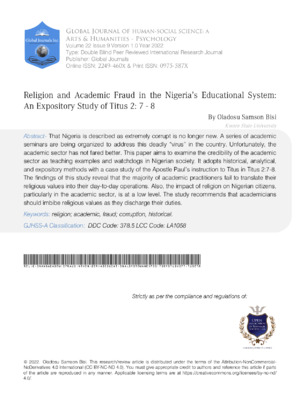
Religion and Academic Fraud in the Nigeria s Educational System An Expository Study of Titus 2 7 8

α
Oladosu Samson Bisi
Oladosu Samson Bisi
α Kwara State University Kwara State University

Send Message

To: Author

Religion and Academic Fraud in the Nigeria s Educational System An Expository Study of Titus 2 7 8

Article Fingerprint

ReserarchID

V8M88

Religion and Academic Fraud in the Nigeria s Educational System An Expository Study of Titus 2 7 8 Banner

AI TAKEAWAY

Connecting with the Eternal Ground
  • English
  • Afrikaans
  • Albanian
  • Amharic
  • Arabic
  • Armenian
  • Azerbaijani
  • Basque
  • Belarusian
  • Bengali
  • Bosnian
  • Bulgarian
  • Catalan
  • Cebuano
  • Chichewa
  • Chinese (Simplified)
  • Chinese (Traditional)
  • Corsican
  • Croatian
  • Czech
  • Danish
  • Dutch
  • Esperanto
  • Estonian
  • Filipino
  • Finnish
  • French
  • Frisian
  • Galician
  • Georgian
  • German
  • Greek
  • Gujarati
  • Haitian Creole
  • Hausa
  • Hawaiian
  • Hebrew
  • Hindi
  • Hmong
  • Hungarian
  • Icelandic
  • Igbo
  • Indonesian
  • Irish
  • Italian
  • Japanese
  • Javanese
  • Kannada
  • Kazakh
  • Khmer
  • Korean
  • Kurdish (Kurmanji)
  • Kyrgyz
  • Lao
  • Latin
  • Latvian
  • Lithuanian
  • Luxembourgish
  • Macedonian
  • Malagasy
  • Malay
  • Malayalam
  • Maltese
  • Maori
  • Marathi
  • Mongolian
  • Myanmar (Burmese)
  • Nepali
  • Norwegian
  • Pashto
  • Persian
  • Polish
  • Portuguese
  • Punjabi
  • Romanian
  • Russian
  • Samoan
  • Scots Gaelic
  • Serbian
  • Sesotho
  • Shona
  • Sindhi
  • Sinhala
  • Slovak
  • Slovenian
  • Somali
  • Spanish
  • Sundanese
  • Swahili
  • Swedish
  • Tajik
  • Tamil
  • Telugu
  • Thai
  • Turkish
  • Ukrainian
  • Urdu
  • Uzbek
  • Vietnamese
  • Welsh
  • Xhosa
  • Yiddish
  • Yoruba
  • Zulu

Abstract

That Nigeria is described as extremely corrupt is no longer new. A series of academic seminars are being organized to address this deadly “virus” in the country. Unfortunately, the academic sector has not fared better. This paper aims to examine the credibility of the academic sector as teaching examples and watchdogs in Nigerian society. It adopts historical, analytical, and expository methods with a case study of the Apostle Paul’s instruction to Titus in Titus 2:7-8. The findings of this study reveal that the majority of academic practitioners fail to translate their religious values into their day-to-day operations. Also, the impact of religion on Nigerian citizens, particularly in the academic sector, is at a low level. The study recommends that academicians should imbibe religious values as they discharge their duties.

References

16 Cites in Article
  1. Memory Elvin-Lewis (1986). The State of Medicinal Plants Research in Nigeria.
  2. Muritala Dauda (2013). Curbing Corruption in Nigeria: Prayers or Behaviour Change?.
  3. Idowu Akinlotan (2017). What a Nigeria.
  4. Kenneth Barker,R John,Iii Kolilenberger (1994). Titus" in the Expositor Bible Commentary.
  5. Donald Guthrie (1984). The Pastoral Epistles.
  6. D Hiebert (1994). Titus.
  7. D Hiebert,Edmond (1994). Titus" in Expositors Bible commentary.
  8. T Lea,H Griffin (1992). Timothy & Titus.
  9. Emmanuel Malomo (2016). Christianity and politics in Nigeria context, Ilorin: Amazing Grace Print Media.
  10. Eugene Nida (1968). Religion across cultures. A study in the communication of Christian faith.
  11. Yomi Odunuga (2017). Are we really alright.
  12. Olusegun Olawoyin (2017). Fantastically corrupt.
  13. Thompson Onyenechelue (2008). Rethinking Christianity in Africa.
  14. Lawrence Richards (2002). Life for Women During New Testament Times.
  15. Yusufu Turaki (1999). Christianity and African Gods.
  16. Christopher Wintle (2003). Oxford Dictionary of Musical Terms, Ed. by Alison Latham. pp. 214. (Oxford University Press, Oxford and New York, 2004, £7.99. ISBN 0-19-860698-2.) Oxford Dictionary of Musical Works. Ed. by Alison Latham. pp. 218. (Oxford University Press, Oxford and New York, 2004, £7.99. ISBN 0-19-861020-3.).

Funding

No external funding was declared for this work.

Conflict of Interest

The authors declare no conflict of interest.

Ethical Approval

No ethics committee approval was required for this article type.

Data Availability

Not applicable for this article.

How to Cite This Article

Oladosu Samson Bisi. 2026. \u201cReligion and Academic Fraud in the Nigeria s Educational System An Expository Study of Titus 2 7 8\u201d. Global Journal of Human-Social Science - A: Arts & Humanities GJHSS-A Volume 22 (GJHSS Volume 22 Issue A9): .

Download Citation

Research on Nigeria's education fraud.
Issue Cover
GJHSS Volume 22 Issue A9
Pg. 39- 43
Journal Specifications

Crossref Journal DOI 10.17406/GJHSS

Print ISSN 0975-587X

e-ISSN 2249-460X

Keywords
Classification
GJHSS-G Classification: DDC Code: 378.5 LCC Code: LA1058
Version of record

v1.2

Issue date

November 1, 2022

Language
en
Experiance in AR

Explore published articles in an immersive Augmented Reality environment. Our platform converts research papers into interactive 3D books, allowing readers to view and interact with content using AR and VR compatible devices.

Read in 3D

Your published article is automatically converted into a realistic 3D book. Flip through pages and read research papers in a more engaging and interactive format.

Article Matrices
Total Views: 1705
Total Downloads: 49
2026 Trends
Related Research

Published Article

That Nigeria is described as extremely corrupt is no longer new. A series of academic seminars are being organized to address this deadly “virus” in the country. Unfortunately, the academic sector has not fared better. This paper aims to examine the credibility of the academic sector as teaching examples and watchdogs in Nigerian society. It adopts historical, analytical, and expository methods with a case study of the Apostle Paul’s instruction to Titus in Titus 2:7-8. The findings of this study reveal that the majority of academic practitioners fail to translate their religious values into their day-to-day operations. Also, the impact of religion on Nigerian citizens, particularly in the academic sector, is at a low level. The study recommends that academicians should imbibe religious values as they discharge their duties.

Our website is actively being updated, and changes may occur frequently. Please clear your browser cache if needed. For feedback or error reporting, please email [email protected]

Request Access

Please fill out the form below to request access to this research paper. Your request will be reviewed by the editorial or author team.
X

Quote and Order Details

Contact Person

Invoice Address

Notes or Comments

This is the heading

Lorem ipsum dolor sit amet, consectetur adipiscing elit. Ut elit tellus, luctus nec ullamcorper mattis, pulvinar dapibus leo.

High-quality academic research articles on global topics and journals.

Religion and Academic Fraud in the Nigeria s Educational System An Expository Study of Titus 2 7 8

Oladosu Samson Bisi
Oladosu Samson Bisi Kwara State University

Research Journals