Religion as a Resilience Tool to Manage Stress in Adolescents: Islamic Approach

§ West Virginia University/ Tripoli Medical Center

Send Message

To: Author

Religion as a Resilience Tool to Manage Stress in Adolescents: Islamic Approach

Article Fingerprint

ReserarchID

TL6O2

Religion as a Resilience Tool to Manage Stress in Adolescents: Islamic Approach Banner

AI TAKEAWAY

Connecting with the Eternal Ground
  • English
  • Afrikaans
  • Albanian
  • Amharic
  • Arabic
  • Armenian
  • Azerbaijani
  • Basque
  • Belarusian
  • Bengali
  • Bosnian
  • Bulgarian
  • Catalan
  • Cebuano
  • Chichewa
  • Chinese (Simplified)
  • Chinese (Traditional)
  • Corsican
  • Croatian
  • Czech
  • Danish
  • Dutch
  • Esperanto
  • Estonian
  • Filipino
  • Finnish
  • French
  • Frisian
  • Galician
  • Georgian
  • German
  • Greek
  • Gujarati
  • Haitian Creole
  • Hausa
  • Hawaiian
  • Hebrew
  • Hindi
  • Hmong
  • Hungarian
  • Icelandic
  • Igbo
  • Indonesian
  • Irish
  • Italian
  • Japanese
  • Javanese
  • Kannada
  • Kazakh
  • Khmer
  • Korean
  • Kurdish (Kurmanji)
  • Kyrgyz
  • Lao
  • Latin
  • Latvian
  • Lithuanian
  • Luxembourgish
  • Macedonian
  • Malagasy
  • Malay
  • Malayalam
  • Maltese
  • Maori
  • Marathi
  • Mongolian
  • Myanmar (Burmese)
  • Nepali
  • Norwegian
  • Pashto
  • Persian
  • Polish
  • Portuguese
  • Punjabi
  • Romanian
  • Russian
  • Samoan
  • Scots Gaelic
  • Serbian
  • Sesotho
  • Shona
  • Sindhi
  • Sinhala
  • Slovak
  • Slovenian
  • Somali
  • Spanish
  • Sundanese
  • Swahili
  • Swedish
  • Tajik
  • Tamil
  • Telugu
  • Thai
  • Turkish
  • Ukrainian
  • Urdu
  • Uzbek
  • Vietnamese
  • Welsh
  • Xhosa
  • Yiddish
  • Yoruba
  • Zulu
Font Type
Font Size
Font Size
Bedground

Abstract

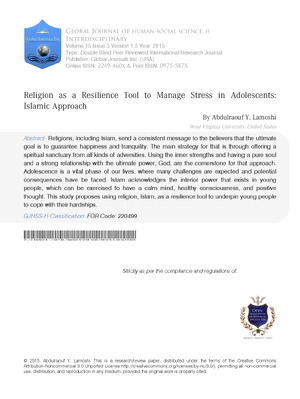
Religions, including Islam, send a consistent message to the believers that the ultimate goal is to guarantee happiness and tranquility. The main strategy for that is through offering a spiritual sanctuary from all kinds of adversities. Using the inner strengths and having a pure soul and a strong relationship with the ultimate power, God, are the cornerstone for that approach. Adolescence is a vital phase of our lives, where many challenges are expected and potential consequences have be faced. Islam acknowledges the interior power that exists in young people, which can be exercised to have a calm mind, healthy consciousness, and positive thought. This study proposes using religion, Islam, as a resilience tool to underpin young people to cope with their hardships.

References

15 Cites in Article
  1. A Al-Qarni (2005). Don't be sad.
  2. M Areefi (2008). Enjoy your life.
  3. S Banks (1998). Future of Fisheries: Perspectives for Emerging Professionals.
  4. M Bin Al-Hajjaj,A Siddiqi (1981). Sahih Muslim.
  5. Mihaly Csikszentmihalyi (1999). If we are so rich, why aren't we happy?.
  6. T Kelley (2004). Positive psychology and adolescent mental health: false promise or true breakthrough?.
  7. A Kneier,E Rosenbaum,I Rosenbaum (2006). Coping with cancer: 10 steps towards emotional well-being.
  8. Sumaya Laher,Sumayyah Khan (2011). Exploring the Influence of Islam on the Perceptions of Mental Illness of Volunteers in a Johannesburg Community-based Organisation.
  9. J Osteen,V Osteen (2008). God's promises for a new beginning.
  10. Julio Peres,Alexander Moreira-Almeida,Antonia Nasello,Harold Koenig (2007). Spirituality and Resilience in Trauma Victims.
  11. Ryan Ritter,Jesse Preston,Ivan Hernandez (2013). Happy Tweets.
  12. Mustaffa F.Y. (1997). Needs and Preferences of Qur‟anic Arabic Vocabulary Learners Regarding Learning through Qur‟anic Arabic Mobile Applications.
  13. J Sedgeman (2005). Health Realization/Innate Health: Can a quiet mind and a positive feeling state be accessible over the lifespan without stress-relief techniques?.
  14. Cydney Van Dyke,David Glenwick,John Cecero,Se-Kang Kim (2009). The relationship of religious coping and spirituality to adjustment and psychological distress in urban early adolescents.
  15. Nicole Zarrett,Jacquelynne Eccles (2006). The passage to adulthood: Challenges of late adolescence.

Funding

No external funding was declared for this work.

Conflict of Interest

The authors declare no conflict of interest.

Ethical Approval

No ethics committee approval was required for this article type.

Data Availability

Not applicable for this article.

How to Cite This Article

Abdulraouf Lamoshi. 2015. "Religion as a Resilience Tool to Manage Stress in Adolescents: Islamic Approach". Global Journal of Human-Social Science, Global Journal of Human-Social Science - H: Interdisciplinary GJHSS-H Volume 15 (GJHSS Volume 15 Issue H3).

Download Citation

Journal Specifications

Crossref Journal DOI 10.17406/GJHSS

Print ISSN 0975-587X

e-ISSN 2249-460X

Keywords
Classification
GJHSS-H Classification FOR Code: 220499
Version of record

v1.2

Issue date
April 23, 2015

Language
English
Experiance in AR

Explore published articles in an immersive Augmented Reality environment. Our platform converts research papers into interactive 3D books, allowing readers to view and interact with content using AR and VR compatible devices.

Read in 3D

Your published article is automatically converted into a realistic 3D book. Flip through pages and read research papers in a more engaging and interactive format.

Article Matrices
Total Views: 1.6K
Total Downloads: 96
All Trends

Request Access

Please fill out the form below to request access to this research paper. Your request will be reviewed by the editorial or author team.
X

This is the heading

Lorem ipsum dolor sit amet, consectetur adipiscing elit. Ut elit tellus, luctus nec ullamcorper mattis, pulvinar dapibus leo.


High-quality academic research articles on global topics and journals.

Religion as a Resilience Tool to Manage Stress in Adolescents: Islamic Approach

Abdulraouf Lamoshi
Abdulraouf Lamoshi West Virginia University/ Tripoli Medical Center