Introduction: Human Self-objectification through religious historicity
[...] religion is a solemn revelation of man's hidden treasures, the confession of his innermost thoughts, the public manifestation of his secrets of love. [...] that is why religion precedes philosophy everywhere, both in the history of humanity and in the history of the individuum. Man first transports his essence outside himself before finding it within himself. [...] The historical progression of religions is simply that what was considered by older religions to be objective is now considered subjective [...] it is now known to be human. Earlier religion is idolatry to later religion: man worshipped his own essence. Man objectified himself, but did not recognise the object as his essence; the later religion takes this step; all progress in religion is, therefore, a deeper knowledge of oneself. [...] But in return, the thinker contemplates the essence of religion hidden from itself, for which religion is an object, which it cannot be for itself.
U ntil now, every known society has adopted some form of religion as a coherent set of rituals for relating to beings that were originally superhuman. Evidence of this can be found even where cultural traces are scarce, in the ritual disposal of corpses, devotional paintings or manufactured divine objects (Johnson, 1982), and magnificent buildings (UNESCO, 2025) that reveal religious influences predating agricultural activities, which surprised the current archaeological assumption that agriculture preceded religions (Childe, 1960).
According to Ludwig Feuerbach (1804-1872),1 human history itself is religious, as religions notoriously transitioned from characteristically naturalistic (deifying aspects of inhuman nature) to polytheistic, whose profusion of deities reached a maximum, from that point they were reduced or at least began to highlight some among their religious pantheon, until they narrowed or were replaced by an increasingly comprehensive deity, even superior to nature, such as that of the Abrahamic tradition (mainly since its inflection by Christians), making the word (replacing the image that predominated in other traditions) a religious characteristic corresponding to a completely abstract single deity. With the same notoriety, this religious evolution was pari passu with population changes within their territorial boundaries, in other words transitioning from patriarchal to despotic political regimes and from these to constitutional monarchies. Religions would express the sparse collective self-awareness of populations about their social configurations in general, including political ones, which remain partially unconscious as long as they do not yet perceive human unity or the nature to which they belong as unitary (Feuerbach, 2009, p. 165–170).
For this reason, Feuerbach's reflections2 have always been influenced, at least to some extent, by criticism of theologies in general, but with the aim to identify ethical values in religions that both religious and atheist people could recognise as inherently human among themselves and with indistinct nature, whereby humanity would become a community as conscious of its unlimited communal vocation as it is deliberately preferential of alliances with the nature on which it depends. These are themes directly addressed in his texts (indirectly in all others) Thoughts on Death and Immortality (1830), The Essence of Christianity (1841), The Essence of Faith According to Luther (1844), The Essence of Religion (1846), The Question of Immortality from the standpoint of Anthropology (1847), Lectures on the Essence of Religions (1851), Theogony according to the Sources of Classical, Hebrew and Christian Antiquity (1857), Spiritualism and Materialism: Especially in Relation to the Freedom of the Will (1866), On Moral Philosophy (1868), and even in the letter he sent to his professor Hegel in 1828, from whom he had studied philosophy but questioned his claim that history would be concluded by Christianity (Feuerbach apud. Serrão, 2019).
For the study of religions, he formulated the genetic-critical method, in which any phenomenon must be understood by detecting its origins, whether as causes or merely as bases for its phenomenal configuration. This methodology was first applied to the Catholic and Protestant branches of Christianity, as they defined Feuerbach's own European historical context. Feuerbach thoroughly analysed both religions, in which he found the fundamental conflict to be resolved by humanity in the future: the medieval conflict because of Catholic community belonging without individuality versus the modern conflict because of Protestant non-community individuality (Feuerbach, 1974; 1967a, p. 21–31). This will only be settled, by the human community without any exclusion of human beings connected through artistic, scientific, and democratic cultural intermediaries between themselves and with nature (Feuerbach, 2008, p. 70–73).
The unity of humans and humanity with nature is commonly proclaimed by religions, each in its own doctrinal manner and with greater or lesser emphasis on one or the other of the two realities in which we live. This is also evident in human sensitivity itself, unlike its counterpart in other creatures, which is the only one diffuse to the point that our senses simultaneously think and are not limited to specific environmental focuses. As opposed to other terrestrial beings, as immediately as repeatedly, our sensitivity (Sinnlichkeit) formulates thoughts through feelings with senses whose mere inherently human exercise refers immediately to the dual objective belonging to humanity and nature as indisputably unified realities (Feuerbach, 2008).
Therefore, any deities can be perceived, as long as there is human candour, as possessors of the qualities most valued by the populations that generate religions, such as theological doctrines fine-tuned to their objective needs (bedurfnis), as historically compelling as they are mutable. Throughout the course of historical religious changes, however, Feuerbach highlights Christianity as being the religious and therefore historical moment in which it spread from enslaved people in ancient Rome to its imperial adoption, and also through the population centres that emerged with the fall of Rome, endowing us with the essential human quality of love that distinguishes us from other creatures governed solely by instinct (Feuerbach, 2022, p. 93–120).
While plant sensitivity detects water where its roots extend into the soil or sunlight where its leaves extend to absorb it, animal sensitivity focuses on mortal dangers or essential food sources in the surrounding environment. However, human sensitivity spreads, attached to nothing within or without, making us susceptible to a myriad of environmental elements to the extent that human instincts are unable to provide adequate individual guidance. This results in the incessant formulation, during our individual existence, of beneficial desires directed toward objects outside ourselves or within us: respectively, aiming to exercise love or self-love that drives us forward (Feuerbach, 2008, p. 54–56).
Essentially, being human means acting with compassion toward the unknown, whether it means love for another being (not only human), a thing, or even a certain activity toward which one is willing to direct one’s life; or being compassionate toward oneself, ranging from vital self-preservation to social self-advancement. Love is the human foundation upon which all other sensations - intrinsically as emotional as they are rational - form and dissolve, because love arises from every human being’s objective need to connect (or reconnect) with the differences they require to fulfil themselves, since these differences are found both in other human beings and in non-human nature. Through self-love, we consume beings and things different from ourselves, and through love we give ourselves and we are consumed by beings, things, or activities, which always belong to humanity or nature, loving in both directions (Feuerbach, 2008, p. 61, 65–66).
Feuerbach considers the global spread of Christianity to be historically positive as the self-objectification of love, as it is directed toward communal life by Catholicism and toward individualized life by Protestantism, although not fully corresponding to its historical importance: Catholics resist the erotic dimension, reducing sexuality to procreation, and Protestants resist the communal dimension of individuality, often opposing the science that flows from it. Each found what was missing in the other: Catholic love without individual pleasures, though with many communal aspects, and Protestant self-love without social progress, though individually stimulating (Feuerbach, 1967a, p. 21–31).
Non-Christian ancient religions are discussed throughout the text accompanied by Feuerbach’s comments. Although Feuerbach wrote only one book (Feuerbach, 1857) comparing the Jewish, Hindu, and ancient Greek (Olympian) religions, he commented on other non-Christian religions. The method is being applied by considering the current expression of these religions in today’s world and their global reach.
While acknowledging their human significance, such Christian traditions fragmented love without endowing it with the self-aware plenitude indispensable to the necessary human community in nature as its preferred ally; yet both pointed to humanity’s historical maturity to finally embrace its dual objective belonging (to the community and to nature) in the future:
assuming love as morality because it is a human necessity: “If, therefore, the supreme principle of Christian morality states: ‘Do good for god’s sake,’ [...] the supreme principle of morality grounded in humanity states: ‘Do good for humanity’s sake’” (Feuerbach, 1967b, p. 375).
assuming nature as a preferred ally because it is fundamental to the historical human condition: “Man owes his existence not to the first causes, from which everything proceeds, but to the ultimate causes closest to him; he owes his existence not to the earth as it once was, but to the earth as it is” (Feuerbach, 1967c, p. 7-8).
Love as human sense in other global Religions
Although some religions, outside the Christian tradition, were studied by Feuerbach, who even offered significant theological insights into them, it was only to the main branches of Christianity that he systematically applied his genetic-critical method, revealing the prosaic love underlying Catholic sacraments and the specific cult of Mary, as well as self-love underlying Luther’s reformist themes (Feuerbach, 2022; 1967b).
Given the limitations of length in a scholarly article and looking forward to survey contemporary religions with a global reach regardless of the number of followers this analysis will focus on certain rites or doctrinal formulations within them. Nevertheless, this work relies on the earlier Feuerbachian thesis that Christian doctrine emphasises love as an alienated human attribute, although still limited in its human dimensions, yet its variable presence within them allows us to establish its fundamental human meaning as a characteristic of humanity whose self-objectification was historically and objectively necessary. Moreover, even in extinct and predominantly warlike religions - widespread and predating the emergence of Christianity - love for others held some prominence, as seen in the Orphic interpretation of the Olympian (Greco-Roman) pantheon or in the resurrection of the divine Baldur and his wife following the demise of the Norse (Asgardian) pantheon.3
The genetic-critical approach, which will henceforth be adopted in the analysis of the following religions with a global scope, as mapped by region in the World Religion Database in September 2025 (Mapscaping, 2025). Therefore, the focus is on identifying the primary traditional function of love, according to the Feuerbachian perspective of the benevolent human will directed toward an external or internal object - be it a being, a thing, or an activity - provided that it is determined by one’s subjective affection. To this end, we will examine - though not exhaustively - religions that are no longer confined to the territory or population group in which they originated: Indian Vedism (or Brahmanism), Orthodox Catholicism, Chinese Taoism and Confucianism, Indian Jainism, Japanese Shintoism, Hebrew Judaism, Asian Buddhism, Muslim Islam, Kardecist Spiritism, Wicca, and African religions (both traditional and diasporic). I also include Freemasonry, whose religious orientation I will postulate, despite its denial of a religious character and due to its well-known global reach (The Grand Lodge of Ohio, 2026). Still, I do not include others such as Sikhism, which remains largely confined to its place of origin, or the Bahá’í Faith due to its Islamic alignment, even though both have millions of followers.
From love to nature
(Vedic, Taoist, Jain, Shinto, and Wiccan)
Throughout history, the perception of nature - as part of the dual reality (natural and communal) that constitutes humanity - has preceded even that of human unity, while its distinction as something inhuman or separate from us is immediately and repeatedly grasped by our sensibility. That’s the reason why the earliest religions perceived natural phenomena as endowed with personalities with whom we could communicate, thereby appeasing our fear; yet this does not fully explain religion in general, since such phenomena remained significant during periods of religious polytheism, even as the profusion of deities became contained within a hierarchical pantheon. Such religious formulations arose among sedentary human communities and, therefore, no longer subject to nature once it became minimally predictable through agriculture and animal husbandry. Their devaluation by later monotheisms, which conceived them as mere creations of a being as unique as the one who bestowed them upon humanity, led to increasing human arbitrary treatment of inhuman nature. Feuerbach defined the religious sentiment, throughout its historically variable expression, as a dependence on nature in general due to a diffuse sensibility within us (Feuerbach, 1967c).
The anthropocentric approach of supposed human superiority over nature corresponds to a divine father figure, whose creative omnipotence would justify racist, colonialist, ecological, and even sexist abuses, since these merely express humanity’s likeness to the arbitrary creator of the world: “I have complete ownership only of what I produce, of what I make. Only rights of authorship are followed by property rights. My son is mine, because I am his father.” (Feuerbach, 1967c, p. 49).
The rise of Judeo-Christian monotheism emphasised the anthropocentric tradition, already present in earlier Greco-Roman polytheism, whose Olympian pantheon linked its deities to their respective peoples, thereby establishing in the West, more than in other parts of the world, the anthropocentric bias regarding nature to hypocritically deny the continuity of the sense of dependence on it: “Need is, therefore, god-fearing, humble, religious, but enjoyment is proud, god-forgetful, irreverent, frivolous” (Feuerbach, 1967c, p. 32). His omnipresence in the environment was not denied by the East: “How can one explain that the East does not have a history as vivid and lively as that of the West? Because in the East, man does not forget nature for the sake of man; he does not forget, for the sake of the splendor of the human eye, the splendor of the stars and precious stones […]. Compared to the Westerner, the Easterner is in the same position as a country dweller is to a city dweller. The former depends on nature, the latter on man; the former is guided by the barometer’s readings, the latter by the stock market’s fluctuations; the former, by the signs of the zodiac, which remain ever constant; the latter, by the ever-changing signs of honor, fashion, and public opinion” (Feuerbach, 1967c, p. 46).
In the following religions - which are naturalistic in the Feuerbachian understanding of nature as a central religious aspect (Feuerbach, 2009, p. 102) we will examine how love of nature generally serves as a foundational element:
In the Vedic religion (founded on the four ancient Vedas) or Hinduism, as it is commonly known in the West, the inhuman nature is loved because it prescribes vegetarianism as the preferred dietary choice, or supports an ovo-lacto-vegetarian diet; the protection of the cow in its daily physical well-being; purely animal deities such as the monkey Hanuman or partially elephant-like figures such as Ganesha, among the principal deities of its innumerable pantheon; the final ritual phases of retreat to the forest and renunciation of family life (following a period of studious youthful asceticism and a patriarchal life with grandchildren) by the closest caste (Brahmins) to subjective reintegration into the universal core of nature or Brahman, during their next post-mortem rebirth according to the traditional hierarchy of the Indian population (Johnson, 1960, p. 103–127; Bulfinch, 2004, p. 303–307; Vallet, 2001, p. 135–143). Traditional yoga (union) exercises are ostensibly available means for the progressive merging of individuality into the universal substrate of natural existence: “Just as the man who has scaled the cliff sees those who are [...] on the plain, even so the man [...] who has risen to the calm [...] of insight [...] contemplates all creatures” (Patanjali apud. Johnson, 1960, p. 107–108).
In the Taoist religion, where the totality of existence is conceived as the Tao (the Way) encompassing both natural laws and the hierarchy among deities - becoming one with the universe is the goal of its most important rites (all notably cosmic), including the solitary practices of individual psychophysical alchemy, and even guiding its ancient arts of Tai Ji Quan and Feng Shui toward physical and spatial adjustments (Granet, 1968, p. 314–315; Irwin, 2004; Chuang Tzu, 1964, p. 112–113). “Noble is the one who surrenders his body to the world. To him the world can surrender itself. He who loves makes the world his body. In him the world can place its trust” (Lao Tzu, 1999, p. 38–39).
In the religion of Jainism, the nonviolence prescribed by the founder Jina (meaning “conqueror of passions”) extends to the well-being of all animals, including even the tiniest insects, as required by the 24 deities (tirthankaras, including Jina himself) who serve as bridges for the faithful’s individual spiritual journeys after death. Through twelve levels of intensifying asceticism, they progress from fasting to ultimate starvation sometimes, offering their lives for the benefit of other beings, including plants. It is these degrees of asceticism toward natural creatures that distinguish the 88 religious sects of Jainism (Vallet, 2001, p. 149, 152, 158, 161, 163–164).
In the Shinto religion, a myriad of Japanese deities form a polytheistic system that is currently closer to animism, as the vast majority of them correspond directly to aspects of the inhuman nature. Although limited to the Japanese population, its divine worship of natural environmental elements - as naturally superhuman beings (Kami) and often confined to their territorial scope - implies a distinct human devotion to nature: all members of the mineral, plant, or animal kingdoms can be enshrined, in addition to waters, mountains, and even the fire of immortal deification. The traditional construction of torii gates near the sites where such natural elements are found highlights the Shinto objective of transition from the human to the distinct natural realm (Vallet, 2001, p. 270, 271, 273, 279).
In the Wiccan religion - or Wicca, rooted in European “pagan” or naturalist (pre-Christian) traditions and formulated in the 1950s by Gerald Garner (1884–1964) - the earth, moon, sun, forests, and animals are conceived as encompassing deities, feminine and masculine, respectively. In ancient Celtic matriarchal traditions, femininity is held as a constant divine principle that embraces, rather than disregards, a masculinity defined by its cycle of decay and rebirth after each fertilization. Their followers (gathered in covens) celebrate more than 10 natural cycles (lunar and seasonal) throughout the year and perform, in solitude, rituals of natural magic involving the elements of air, earth, fire, and water through herbs, other plants, crystals, and stones, recording them in a personal journal (Book of Shadows). Wiccans are reincarnationists, they envision a Summerland as a privileged spiritual habitat granted to deserving souls - a spiritual habitat where the soul prepares for its eventual return to the physical world (Buckland, 2003).
From love to family
(Orthodox, Jewish, Confucian, Muslim, and Mormon)
Since our lives are received from other human lives, the family continuum - primarily from ancestors to descendants, but also horizontally - highlights why it unites both fundamental aspects of humanity: the loving and the historical. It is the communal aspect of human unity that directly confers continuity upon it by making individuals part of it from the moment of their birth. In and of itself, this communal need for collective memory implies that human beings are aware that only the living can provide a posthumous existence for the dead. Their burials - though framed by funeral rites asserting an afterlife - unconsciously affirm the necessity of the living representing the dead4 (Feuerbach, 2023, p. 36–38).
While in polytheistic religions we encounter divine pantheons under male dominion, such as Odin in Asgard or Yuan Shang Ti in the Celestial Palace (Bullfinch, 2004, p. 313; Lao Tzu, 1999, p. 25), it is in the religions that are absolutely opposed to polytheism among those currently practiced globally that love for the family - by highlighting its patriarchs (especially when they are ancestors) - is structurally superior to other expressions of love, even though the family is important in various religions, due to the considerations of collective memory outlined above.
The love for the family foundation is structurally dominant:
In the Jewish religion - whose Hebrew formulation was the first monotheistic one, historically established in opposition to polytheistic territorial enemies (primarily the Philistines) who worshipped local animal deities - a divine father, though of a nature akin to humanity, chose the Hebrews for his exclusive worship. By calling themselves the children of Israel - the name given to their common ancestor Jacob by the one god - the nominal element Ben (“son of”) in the male names of one of his twelve sons, from whom the respective confederated tribes descended, already attests to the patriarchal foundation of the Israelite community. Whenever a Hebrew leader, as an Israelite son, committed an act deemed reprehensible by the divine father, the Hebrew population was subjugated by a neighbouring people until his error was rectified. From this arose the religious notoriety historically attributed to King Solomon’s wisdom due to the unparalleled profusion of neighbouring queens and their respective offspring; and the ritual marking the entry of young people (bar and bat mitzvah) into the reading of ancestral laws, while religion is transmitted through the maternal womb (Vallet, 2001, p. 25, 28, 45).
In the Orthodox (non-Roman Catholic) religion that emerged from the East-West Schism against Roman Catholicism in 1054, the third divine person (the Holy Spirit) in the Christian Trinity has been theologically interpreted as proceeding from the divine father, just as Christ proceeds from the father. This theological interpretation highlights the Christian paternal divinity within the divine Trinity, at least almost as much as its centrality during the creation of the world. From this divine creativity, the other two divinities arise in communion with it, both playing roles that inspire humanity in the world created for it. The paternal predominance within the divine communion - as the second person or divine sonship does not give rise to the sacred spirit - expresses a patriarchal tendency evident from the traditional designation of its autocephalous institutional leaders as patriarchs of the Churches (Burgess, 1989), to the masculinity of the Cossacks, whose warrior role was traditionally exercised through the systematic repression of other religions (primarily Islamic and Catholic) and of social structures in general, wherever Christian Orthodox churches were found or were being built in the process, as their “warriors of the faith” - including under Tsarism (Plokhy, 2001).
In Confucianism, through the teachings of the scholar Kung (Fu) Tzu (551–479 BCE), his philosophy responded to the traditional Taoist religious preference for nature in general by emphasizing a “Tao of Man,” which was as relevant as - or even more relevant than - the celestial or planetary Tao, and which did not involve the customary Chinese polytheism. For Confucius, education is an eminently paternal function, as the transmission of communal knowledge is a strictly disciplinary exercise to align the community - from the family to the political sphere - in the face of external natural processes. Whether through the predominant role of the eldest son in mortuary rites or the execution (and subsequent remembrance) of the control of the Yellow River’s course by the engineer Yu (entitled the Great), just as Confucius’s journey among the Chinese kingdoms was pedagogical during the widespread wartime period in which he taught (Cheng, 2008, p. 73–80): “A young man must be respectful: at home toward his parents, in society toward his elders. [...] And if he still has time to spare, he may devote it to learning culture” (Confucius apud. Cheng, 2008, p. 69).
In the Muslim religion, its monotheistic formulation by Muhammad (570–632 CE), although referring to the same creator deity as both Judaism and Christianity, reacted to both religions with even greater aversion to any polytheistic tendencies, admitting within it no appreciation for femininity - not even the purely maternal aspect of the Christian Mary - nor any fragmentation of its divine aspects, such as the 99 Jewish names or the Christian Trinity. Islamic monotheism conceives the creation of the first man from a drop of semen from the one god, Allah, whose teachings are such that only men, as his sons, are entitled to either gratitude for obedience or ungrateful disobedience. Following his divine paternal example, Muslim customs (which are radically patriarchal) include male polygamy, mandatory veils for women, and flogging for adultery of both sexes. The historical corollary of its predominant doctrinal emphasis on paternity was the division between Sunnis and Shiites as the main religious branches, due to the founder having fathered only daughters: the Shiite minority follows the descendants of his cousin and son-in-law Ali, while the Sunni majority, characterized by continuous internal divisions, follows the descendants of two fathers-in-law or another son-in-law, stemming from a battle between those led by Ali and by Muhammad’s favorite wife (Aisha), among the 11 wives of the founder of Islam (Vallet, 2001, p. 94, 95, 98, 101, 104).
In the Mormon religion formulated by Joseph Smith (1805–1844) in 1830 a theological critique of Christian traditions in general—the doctrine both rejects the concept of the Trinity and drives the expansion of its missionary organisation both within (the founding of Utah’s capital) and outside the United States. As Mormons conceive of the preservation of family ties in Christian celestial eternity, the patriarchal family structure is a precept so strongly emphasised that it led to male polygamy until 1890 (when it was banned by most Mormon churches, though still practiced by some), the bearing of as many children as possible in large families, strict community punishments for premarital sex or drug use, and also the baptism of the dead through their physical representation by descendants, as preparatory measures for a greater and better reception of Jesus Christ at his second (and imminent) apocalyptic coming to humanity (Parrish, 2000).
From love to oneself
(Buddhist, Spiritist, Masonic, and traditional or diasporic African religions)
In the following four religious traditions, the universe is spiritualized as it is permeated by the movement of incorporeal spirits: bodhisattvas, spiritual communities, individual post-mortem lights, and divine spiritual guides.
They emphasise the observance, as living human beings, of the universal natural processes in their individual lives, without their spiritual evolution being enhanced, as through alchemical techniques (of Taoists) or special births (such as Brahmins), to attain Buddhist Nirvana, Spiritist purification, Masonic subjective righteousness, and direct communion with the African divinity inherent to their spiritual belonging.
As Feuerbach observed in his study of Lutheran thought, self-love - or love of one’s own self - as part of the loving nature intrinsic to humanity corresponds to the exercise of human sensibility. This sensibility, being widely diffused, also constitutes the very essence of the human being and enables it - just as it does any sentient being by virtue of its life, since even the most limited sensibility includes the self - to become the object of its own loving will. Feuerbach understood the Protestant self-objectification of this human aspect, which emphasises individualization in divine favor, as a fundamental historical shift within this Christian tradition (Feuerbach, 2019, p. 44–49; 1967b).
However, self-love also plays a central structural role in Buddhism, Spiritism (Kardecism), Freemasonry, and traditional or diaspora African religions, serving as a common thread among them, although with less emphasis on material prosperity than in Protestant Christianity:
In the Buddhist religion as formulated by Siddhartha Gautama (563–483 BCE), the inevitability of the suffering inherent in natural life - arising from the cycle of birth, illness, aging, and death - requires individual training that enables human beings to practice systematic detachment and a subjective relativization of the importance attached to material possessions, through the practice of compassion toward oneself and others in the various aspects of universal life’s decline. Buddhism is divided between followers of one or more Buddhas (individuals whose subjectivity or soul has become immune to the illusions of desire, though not to desire itself) - whether fictional or historical; believers in the attainment of the spiritual state of Buddhic subjectivity by some or in the universal capacity to attain it after several successive incarnations, though Nichiren did so during an ordinary mortal life (Soka Gakkai, 2016, p. 26–28). But there is consensus on the need for mandalas as devotional objects, in addition to meditative techniques and bodhisattvas (souls close to becoming buddhas, who postpone their entry into Nirvana, as an immutable universal dimension) to aid the progress of other suffering souls (Bulfinch, 2004, p. 307–308). Feuerbach considered Buddhism to be an expression of an impulse toward happiness inherent in the human condition, but, like Botany and Chemistry, limited to its negative aspect of dealing with suffering, whereas its positive aspect - even through passions, provided they were all embraced in alignment with the subject’s inner self - would make life blissful (Feuerbach, 2019, p. 52, 53, 89–90).
In the Spiritist religion systematized by Hippolite Rivail or Allan Kardec (1804–1869), in which incorporeal beings move freely throughout the universe and also interact with it when incarnated in bodies to which they impart intelligent life, they communicate with intelligent living beings while in a disembodied state - whether not yet reborn or residing in spiritual colonies of purer souls or spirits - self-love is distinguished by its internal charitable practices. All are therapies of the perispirit or fluidic link that prevails in the body while inhabited by the soul, and in which adherents considered mediumistic - due to their ability to communicate with spiritual realms (of souls more or less purified and, therefore, intelligent) - intervene in the emotional suffering of others, as individual purification is a constant inner transformation by the souls, incarnate or not, becoming more intelligent because intelligence is an attribute of the universal divinity from which they emanated (Kardec, 2009; 1954). Feuerbach vehemently criticised beliefs in immortal souls as a mere hypocritical denial of death and as something not inherent to humanity, since such beliefs had never been a source of joy in any historical context, even though the afterlife was proclaimed to be a life free from human limitations (Feuerbach, 2023, p. 35–36).
In Freemasonry, although it has traditionally rejected the notion of being a religious organisation and places no restrictions on the individual religious beliefs of its members, membership is based on belief in a deity distinct from those worshipped in other religions—a deity who is said to have formulated universal natural laws, and whose internal veneration implies a brotherhood that is sectarian in nature and referred to as the Masonic brotherhood (The Grand Lodge of Ohio, 2026). I therefore consider it to be a religion as its internal collective rites, external individual relationships, and expressed values (Liberty, Equality, and Fraternity, for which Freemasons were politically active against absolute monarchies), at least since the 18th century, are grounded in the divine exemplification of the cosmic works of the Great Architect of the universe. Stemming from this universal dedication is a system of fraternal support that facilitates advancement through the Masonic degrees - apprentice, fellow craft, and master - while simultaneously informing the member’s external life and professional duties. (Jacob, 2005).
In traditional or diasporic African religions - originating, respectively, on the African continent or through the reintroduction of enslaved people outside of it - their various forms, ranging from those with the strongest traditional continuity (such as Vodum, which is deeply rooted in the Caribbean) to the most innovative African-based traditions (such as Candomblé and Umbanda in Brazil), followers have their divine guides revealed by priests, in such way that they are both open to spiritual possession through dance (set to the rhythm of drums as sacred as the ground upon which they stand) and are otherwise assisted by the deities of their spiritual lineage (Johnson, 2015). Whether male or female, these deities constantly demand proof of love from those who belong to their spiritual lineage; they are, therefore, divine examples of the joyful self-love that should also govern human relationships, just as it does in the relationship between their divine guides (Santos, 2019, p. 6, 7, 241).
The table below classifies the religious orientations of the religions listed above, including the two already analysed by Feuerbach in 1841 (Catholic) and 1844 (Protestant):
| Current Global Theisms | Monotheism | Polytheism | Pantheism | Animism | Deism | Shamanism |
|---|---|---|---|---|---|---|
| Monotheism | Orthodox Islamic Jewish Mormon | |||||
| Polytheism | Roman Catholic Protestant | Taoist | ||||
| Pantheism | Vedic | Buddhist | Jainist | Wiccan | ||
| Animism | Shintoist | Confucianist | ||||
| Deism | Freemasonry | |||||
| Shamanism | African (continental and diasporic) | Spiritism (Kardecist) |
Source: Prepared by the author.
Among the 16 divinatory traditions - which are now global in scope, except for of those of African origin or influence, of which there are dozens, and with Freemasonry not being classified as a religion - six can be classified as monotheistic (Jewish, Catholic, Orthodox, Muslim, all Protestant denominations, and Mormon), three as polytheistic (Vedic, Shinto, and those of African origin or matrix), two as pantheistic (Taoist and Buddhist), 1 animistic (Jainist), one as shamanistic (Wiccan), and three as deistic (Confucian, Freemasonry despite its rejection of religious connotations, and Kardecist Spiritism). However, some have hybrid theological characteristics, although one of them predominates, according to Feuerbachian definitions:
Roman Catholicism and Protestantism: Polytheistic monotheisms that adopt the Christian Trinity as a divine trinitarian equivalence in the composition of the one deity. In this system, the paternal and maternal deities are mediated by the spiritual deity, through which they are unified, despite being distinct; Feuerbach interpreted their multiple unity as the historical self-objectification of communal love (Catholic) and self-love (Protestant) as aspects of the intrinsic sense of love, but finally at least highlighted during religious evolution (Feuerbach, 2022, p. 111–115): “The Trinity was the supreme mystery [...]. But its secret [...] is the secret of common and social life - the secret of the need of the ‘you’ for the ‘I’ - the truth that no being [...] is, by itself alone, a true, perfect, and absolute being, and that only the connection, the unity of beings of identical essence, constitutes truth and perfection” (Feuerbach, 2008, p. 74).
Orthodox Catholicism, Islam, Judaism, and Mormonism each represent distinct monotheisms: while Islam and Judaism proclaim a solitary deity, Orthodox and Mormon interpretations relativize the Trinity by positioning the Father as the ultimate foundation. As [Author] observes: “Here, only god is real, active, and a doer. Islam expressed this thought with all the energy and fervor of the Eastern imagination. [...] Or rather: this conception according to which everything could be other than it is, that there is no necessary nature of things, it is merely the consequence of the belief that god can do anything, that everything is possible for god, and that, consequently, no natural necessity stands before the will of god. [...] No image can be conceived of the Jewish god; but who can conceive of a corporeal image of the spirit, of the will, of the word?” (Feuerbach, 2009, p. 168-169, 216–217).
Brahmanism or Vedism (formerly known as Hinduism in the West): Pantheistic polytheism, in which a multitude of deities are immediately invoked, yet all consist of aspects of the undifferentiated Brahman, or some are avatars or incarnations of a component of the Vedic trinity (Brahma, Vishnu, or Shiva) in one of the Yugas or phases in which existence unfolds, generally already divine “To become one with god, to be god himself, is therefore the ambition of the Brahmin in his renunciations and self-denial [...] like the ancient peoples who [...] made a natural, generative process the prototype and the creative principle of the world in their religious doctrines [...], in which, just as plants arose from seeds, animals from animals, and man from man, so too did everything in nature arise from a natural being [...]” (Feuerbach, 2009, p. 89, 198–199).
Shintoism: Animistic polytheism, characterized by its myriad of deities and divine spirits that are directly invoked, yet precisely correspond to specific and mostly local manifestations of nature. “All strange and extraordinary phenomena [...] everything that captivates and enchants the human eye, that inflames the imagination, provokes astonishment, and affects the emotions in a special, unusual, and inexplicable way—all of this must be considered in the emergence of religion [...]” (Feuerbach, 2009, p. 60).
African religions or religions of African origin: Shamanic polytheisms, as their relationships within the divine pantheon are as significant as the individual bonds between mortals and their specific deities. For such relationships, various techniques are provided for communication with divine or semi-divine entities, each under priestly supervision, so that the aiye (material world) and the orun (spiritual world) may communicate. “[...] the polytheist transforms the separate forms and bodies of nature into gods and, precisely for this reason, takes as his prototype and standard the sensory, real, individual essence of man, [...] according to which his imagination deifies and humanises natural phenomena. Just as man is a corporeal individual, so are the gods of the polytheist corporeal and individual [...]” (Feuerbach, 2009, p. 215).
Taoism: Polytheistic pantheism, because no existence - not even that of multiple deities - resides outside the Tao, or the universally encompassing path, that permeates everything, and is consequently subject to its strict and permanent existential conditioning. During his pantheistic period, Feuerbach defined unified nature as comprising inherently multiple purposes: “In the heavens, nature spreads its power outward; it demonstrates its intensity not in intensive realities, but in extensive realities. Where nature withdraws inward, where it withdraws and concentrates, and expresses its power in the form of power and intensity, [. . .] it becomes quality, species, animation, earth. [. . .] Since every purpose is conditioned by an infinite multiplicity of means and appearances, since every purpose has a history behind it, a process of mediating preparation, and since every purpose lies beyond and outside of sensible existence, you must recognise, from the very multiplicity of the stars, by their enormous size, that [. . .] this small earth is the fruit of the great cosmos” (Feuerbach 1980 [1830], p. 70).
Buddhism: Pantheism, because it perceives the universe as permeated by the same universal Law of change, to which living beings must adapt as they navigate the sufferings caused by inevitable changes. Through continuous subjective adjustments, throughout life or successive reincarnations, human experiences serve to bring about ever greater individual preparation until Buddhic or universal subjectivity (already inherent, but sublimated) that supersedes the illusions provided by desires. “Theism, which, as a position regarding god, is at the same time the negation of god, or, conversely, as the negation of god is simultaneously its affirmation, is pantheism. [...] All determinations of god [...] are determinations of reality, or of nature, or of man, or of both together. Therefore, pantheistic determinations; for everything that does not distinguish god from nature or from man is pantheism” (Feuerbach, 2008, p. 21)5.
Jainism: Pantheistic animism due to the sacralization of the natural world in general, which stems from the all-encompassing nature in which human beings possess the same dignity as every other animal. After mentioning the Jains, Feuerbach noted that “[...] just as nature in general has become an object of religion as the fundamental principle of human existence, in the same way animal nature could and should also become an object of religious worship.” (Feuerbach, 2009, p. 56).
Confucianism: Animistic deism, being deistic because “[…] the first cause of deism is merely the personified concept of cause; the essence of god is merely the essence of sensory things abstracted from their essential qualities; and the existence of god is merely the generic concept of existence” (Feuerbach, 2009, p. 156). But it also perceives natural phenomena as endowed with specifically inherent senses, without deities superior to them, as in a Confucian complement to the I Ching (an ancient text dating back much earlier, of which Confucius became one of the principal interpreters): “God refers to the creator of the wonders of ten thousand beings. In Him, to move the ten thousand beings, nothing is faster than thunder; to bend the ten thousand beings, nothing is more efficient than the wind; to dry up the ten thousand beings, nothing is more pervasive than fire; to bring joy to the ten thousand beings, nothing is more communicative than the lake; [...]. Therefore, water and fire stimulate each other, thunder and wind remain inseparable, the same breath connects the mountain and the lake, allowing for transformations and the accomplishment of the ten thousand beings” (Confucius apud. Cherng, 2003, p. 61–62).
Freemasonry: Deism to the extent that the deist philosopher Voltaire embraced it, although already in his old age, and he also regarded Confucianism in this light (Vallet, 2001, p. 261), literally to the degree that his belief in an architectural divinity of the universe made Freemasons into followers of the macrocosmic or natural laws instituted by it, and as a Masonic choice, because it was the most rational. Cosmic architecture had granted man free will through individual reason, to grasp the inherited universal laws, the observation of which in life would still convert the Masonic soul into light (a key foundation of universal divine construction) after death. “Deists themselves clearly distinguish in god between power and will or reason” (Feuerbach, 2009, p. 124).
Spiritism: Shamanic deism, since its doctrinally deistic characterization of the one deity distinguishes it both from the universal creation it made and from a providence that respects the free will of souls, having established Jesus solely to exemplify an inspiring human model of individual self-improvement and rejecting spiritual stagnation within and between incarnations (Kardec, 1954, p. 32–48, 217, 273, 321). However, it also has shamanic characteristics, as evidenced by the religious significance attached to mediumistic communication with the souls of deceased human beings, which Spiritists regularly organize (Kardec, 2009). Strictly speaking, Spiritists are, therefore, shamanic Christians: “Thus, Christian deists [...] attributed the cause of nature’s movement (since they regarded nature as a lifeless mass or matter) to divine power or omnipotence. [...] they in fact denied that god set matter in motion through an impact, [...] he is a spirit; he achieved this through his mere will. [...] But it is not only shamanism that has its roots in the belief in ghosts [...]” (Feuerbach, 2009, p. 173, 223).
Wicca: Pantheistic shamanism, because its deities, with a predominance of the feminine, are merely inseparable aspects of our planet, which include its cosmic surroundings. Its constituent elements play fundamental roles within this framework - both natural and human - by which the religion is guided, respectively, through masculine forest and animal exuberance, terrestrial and lunar femininity as the pillars of the soil and the tides, and through the magical manipulation of the elements air, fire, earth, and water in spells. “Yes! Man is not merely a spatial being in general, but also an essentially earthly being, inseparable from the earth. [...] The earth never allows anyone to escape its dominion. [...] But [...] I certainly raise my gaze to the farthest heavens, yet I see all things in the light and according to the criteria of the earth. In short, the fact that I am an earthly being, that I am not an inhabitant of Venus, Mercury, or Uranus, constitutes my substance, realises my fundamental essence [...]” (Feuerbach, 2009, p. 27, 110).
Conclusions:Toward the Intangible Cultural Heritage of Humanity through love’s meanings
Of himself, of nature, of the world, man knows and understands only the present; and of the past, only to the extent that it has left traces - signs that are still present in the present.\
Posthumous Aphorisms (Feuerbach, 1874).
No human being needs to be Catholic to love others; Protestant, Buddhist, Spiritist, Freemason, or a follower of traditional or Afro-Brazilian religions to love themselves; Jewish, Confucian, Orthodox, Muslim, or Mormon to love their ancestors, even when they are family ancestors; Vedic, Taoist, Jain, Shinto, or Wiccan to love nature - whether inhuman or in general. But deciphering love, as highlighted in one of these religions - whether one follows any of them, or in all of them if one follows no religion (whether or not one is an atheist) - brings any human being closer to the self-knowledge of humanity. Generally speaking, the meaning of all human life is love, and consequently, the standard for a good - or at least a better - society enables each person to practice, above all passionately, what they love.
Furthering Feuerbach's intellectual endeavour to decipher religion, allowing humanity to finally harness its imaginative and practical talents - still bound to religion - to the two realities upon which human happiness (both individual and universal) depends, I began with his historical identification of love in the Christian formulation, followed by an exploration of his anthropological comparison of other religions - distinct from Catholicism and Protestantism, in which Feuerbach had already identified the dichotomy of love for others versus self-love - whose significance extends beyond the region of the world where they originated.
By applying Feuerbach’s genetic-critical method - a method that identifies the human core or moral foundation of religious convergence underlying each theological framework, which defines the meaning specifically attributed to a religion as prevailing love - it was possible to compare their ritual roles in each, since they all consist of rites concerning the deities (monotheistic, polytheistic, deistic, animistic, shamanistic, or pantheistic) in which their followers believe. Feuerbach’s comparison of Catholic and Protestant traditions centres on the role of love, a focal point that mirrors my own findings across diverse world religions.
The loving core of a religion, once revealed, immediately becomes incompatible with the theological framework in which it is both expressed and concealed (since it is the human reality that gives rise to it as a historical phenomenon). Since a specific anthropology underlies the theology of any religious institution, simply exposing that human foundation is enough to collapse the theological structure, revealing the undeniable human love it obscures.
In line with Feuerbach’s hope, as expressed in his classic analyses of the two major branches of Christianity, I have also sought to contribute to humanity’s loving self-awareness, so that it may foster both community unity and preferential alliances with nature in general, in the very near future. This could be achieved through, according to the Feuerbachian perspective, the loving transformation of religions or humanity’s self-awareness of its communal needs within an inhuman nature.
It is a matter of refraining both from humanizing an inhuman nature - as monotheistic, polytheistic, and deistic religions do by framing natural manifestations as supernatural - and from naturalizing humanity, as seen in animistic, shamanistic, and pantheistic traditions that regard humans as mere extensions of nature. That is why atheism only serves to avoid exacerbating religious profusion, but does not offer an effective alternative, since it is merely a denial of divinity or divinities. What is required of us is to be naturalists with nature and humanists with humanity, simply following our sensibility in (literally) every sense (Feuerbach, 2009, p. 256):
1) Assuming that nature is not goal-oriented, that it does not contain pre-established ends, but rather consists solely of reciprocal interactions among multiple elements, in which everything that can occur does so when the conditions for what is possible are met. This reality is all-encompassing yet far from omnipotent. To be truly naturalistic is to simply acknowledge it as our immediate and unchanging external condition - which is the only option for the human condition (whether individual or collective) - rather than denying nature, as certain religions do, sometimes partially (polytheists and deists), sometimes even entirely (monotheists): “While I need it, I am a servant; while I enjoy it, a master; in need I place myself below, in enjoyment above the object; there, I experience it as a being that exists in and of itself, independently of me; here, as a being that exists for me” (Feuerbach, 1967c, p. 32).
2) Assuming that humanity is communal, composed of culturally established ends, it is the second reality in which our lives unfold; yet its unity presupposes our individual differences within a dynamic or historical process that can be absolutely inclusive of diverse human beings and desires, since we are not reduced to our animal instincts. This communal vocation, without exclusions, depends solely on whether or not we deny human differences, as certain religions do, sometimes partially (pantheists and shamans), sometimes even totally (animists): “The greatest moral evils arise [...] from the fact that man extinguishes, in identity, the difference between himself and the other. It is true that we are both human beings, but this is the bare minimum; it is obvious. Equality must simply be emphasised in the face of the arrogance that does not allow the other to be human, that places itself above the other as a being endowed with privileges, [...] as the nobility once did in relation to the commoners, to the bourgeoisie; [...] in relation to artificial difference.” (Feuerbach, 1874, p. 312–313).
The following figure summarises the historical evolution of religion, up to its future overcoming—which is as naturalistic as it is humanistic, according to Feuerbach:
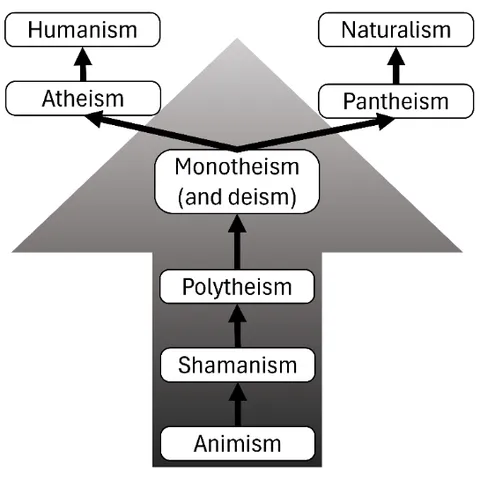
Feuerbachian religious evolution.
Humanity conceived: natural phenomena endowed with a spirit of their own when our diffuse sensibility was impacted by the dynamics of nature (animistic); an invisible world upon which nature was founded and which some human beings could perceive (shamanistic); and distinct forces (polytheistic) within the natural universe as its regularity became evident. But when human expansion into nature matched that of human sensibility, humanity became more attuned to itself than to the natural environment. It began to conceive of it as a divine gift - either total (monotheistic) or partial (deistic).
Therefore, from a Feuerbachian perspective, the contemporary era must be understood as one of a crisis in monotheistic civilization: as Catholicism stagnates, with a relative expansion of Protestant-Evangelical Christianity and the exponential growth of Islam (Mapscaping, 2025); conflicts emerge between human differences (especially LGBT+) that are made more visible by social media or channeled through expansive, pluralistic supranational structures (Lopes, 2024a; 2024b) and generally monolithic patriarchal or national traditions (Lopes, 2025b); apocalyptic versions of Judeo-Christian and Muslim monotheisms clash militarily, as in the recent U.S./Israeli attacks on Shiite Iran. Overcoming this challenge requires more than just articulating the communal and individualistic aspects of religion - as seen in the Catholic and Protestant traditions. Instead, we must embrace the diverse facets of love that these religions embody, especially in the modern era that Feuerbach defined by the ascent of Protestantism over Western christian monotheism (Lopes, 2025a, p. 2).
Since deities are imagined human desires (Feuerbach, 1857, p. 201), the anthropological revelation of love - from which they emanate - collides directly with religious fantasy, since to love is to realize a necessary human potential. The need for love implies a corresponding reality, even disregarding imaginary religious desires for immortality, omnipotence, and omniscience, for every human being grows weary of everything at some point and wants only a blissful life; no human being wants to have power or know everything, but only about objects of their preference (Feuerbach, 2009, p. 259–262).
Therefore, atheism6 (the denial of divinity) or pantheism7 (the deification of reality) are not viable alternatives to the monotheistic (and deistic) view that disregards nature, nor to the earlier (polytheistic) fragmentation of human communities. Both must be transformed into humanism and naturalism, respectively, whose union is inseparable as long as the various aspects of love poetically embodied by religions and embraced by humanity - make them the intangible heritage of an effective diversity of human identity upon which a unified community without exclusions can be built.
In accordance with the diagram presented on religious evolution, as each human being’s love or passion becomes self-aware, Feuerbach argues that each person who follows a religion would naturally come to regard their religion as a cultural heritage of their personal identity and also as a cultural heritage of humanity - one that is important both to their own personal identity and to human identity in general. Atheists would come to view all religions as cultural heritage of humanity, since religious people see their religion in two ways - as their own and as belonging to humanity - while atheists come to regard all religions as cultural heritage of humanity.
Footnotes
Excerpt from Feuerbach (2022, p. 52–53) work: “A essência do Cristianismo” (The essence of Christianity). ↩
Through his study of religions, Feuerbach explored various topics, some of which are still relevant today (Lopes, 2025a). ↩
The loving will of the mortal Orpheus enabled him to seek out his wife Eurydice in the underworld of the dead (Hades), influencing the deities and entities active there, just as the divine Baldur the Good returns from his death -brought about by the schemes of the envious god of deceit (Loki) and with his wife from the realm of the dead without a struggle (Hella), to restore the Universe shattered by the battles (Ragnarok) between the gods and their enemies. The principal Greco-Roman and Norse deities were located, together and respectively, on the Greek Mount Olympus and in Asgard, at the end of a rainbow bridge (Bulfinch, 2004, p. 183–186, 328–330). ↩
The burial of the dead was adopted by Homo sapiens (and by our closest human relatives, Homo neanderthalensis) hundreds of thousands of years ago. Ritual practices began to formalize roughly 100,000 to 40,000 years ago, a time of profound symbolic expansion that anthropologists call the creative revolution (Neves, 2006, p. 275). ↩
Feuerbach wrote on Buddhism to counter the interpretation offered by Arthur Schopenhauer (1788–1860), who drew suicidal and moral conclusions from it. The interpretation of Buddhism by Feuerbach, unlike Schopenhauer’s, regards it as guided by happiness, as the human ideal, but limited to the aspect of one’s own and others’ suffering. Therefore, Buddhist compassion is a form of kindness that is restricted to the relief or even the overcoming of suffering. However, Feuerbach considers passion to be fundamental for happiness, to the extent that it is not a transitory love but a permanent impulse whose fulfillment overtakes any frustrations, whereas any Buddhist orientation condemns it as illusory (Feuerbach, 2023; 2019). ↩
“Even today, physicists and physiologists cannot explain a large part of the phenomena of organic and inorganic nature. But does that mean that these phenomena do not also have their own physical and physiological foundations, just like the other phenomena we can explain?” (Feuerbach, 2009, p. 175). ↩
“Is one part of nature physical and the other hyperphysical? Isn’t nature a unity - nature everywhere, always nature? [...] In short, is this doctrine, like all theology, a reversal, a contradiction? It deifies nature, corporeality, and then abandons it again; it denies once more what makes that corporeality a true corporeality” (Feuerbach, 2009, p. 181). ↩