Remittances and Income Mobility in the Rural Areas of Nigeria

Olatomide Waheed Olowa
Omowumi Ayodele Olowa
Federal College of Education (Technical) Asaba

Send Message

To: Author

Remittances and Income Mobility in the Rural Areas of Nigeria

Article Fingerprint

ReserarchID

C: FINANCE82D30

Remittances and Income Mobility in the Rural Areas of Nigeria Banner

AI TAKEAWAY

Connecting with the Eternal Ground
  • English
  • Afrikaans
  • Albanian
  • Amharic
  • Arabic
  • Armenian
  • Azerbaijani
  • Basque
  • Belarusian
  • Bengali
  • Bosnian
  • Bulgarian
  • Catalan
  • Cebuano
  • Chichewa
  • Chinese (Simplified)
  • Chinese (Traditional)
  • Corsican
  • Croatian
  • Czech
  • Danish
  • Dutch
  • Esperanto
  • Estonian
  • Filipino
  • Finnish
  • French
  • Frisian
  • Galician
  • Georgian
  • German
  • Greek
  • Gujarati
  • Haitian Creole
  • Hausa
  • Hawaiian
  • Hebrew
  • Hindi
  • Hmong
  • Hungarian
  • Icelandic
  • Igbo
  • Indonesian
  • Irish
  • Italian
  • Japanese
  • Javanese
  • Kannada
  • Kazakh
  • Khmer
  • Korean
  • Kurdish (Kurmanji)
  • Kyrgyz
  • Lao
  • Latin
  • Latvian
  • Lithuanian
  • Luxembourgish
  • Macedonian
  • Malagasy
  • Malay
  • Malayalam
  • Maltese
  • Maori
  • Marathi
  • Mongolian
  • Myanmar (Burmese)
  • Nepali
  • Norwegian
  • Pashto
  • Persian
  • Polish
  • Portuguese
  • Punjabi
  • Romanian
  • Russian
  • Samoan
  • Scots Gaelic
  • Serbian
  • Sesotho
  • Shona
  • Sindhi
  • Sinhala
  • Slovak
  • Slovenian
  • Somali
  • Spanish
  • Sundanese
  • Swahili
  • Swedish
  • Tajik
  • Tamil
  • Telugu
  • Thai
  • Turkish
  • Ukrainian
  • Urdu
  • Uzbek
  • Vietnamese
  • Welsh
  • Xhosa
  • Yiddish
  • Yoruba
  • Zulu
Font Type
Font Size
Font Size
Bedground

Abstract

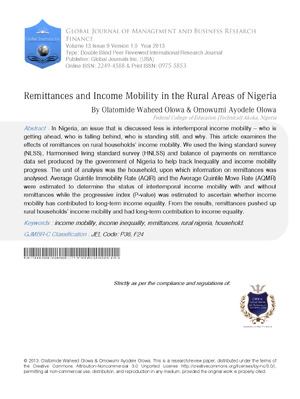
In Nigeria, an issue that is discussed less is intertemporal income mobility -who is getting ahead, who is falling behind, who is standing still, and why. This article examines the effects of remittances on rural households’ income mobility. We used the living standard survey (NLSS), Harmonised living standard survey (HNLSS) and balance of payments on remittance data set produced by the government of Nigeria to help track Inequality and income mobility progress. The unit of analysis was the household, upon which information on remittances was analysed. Average Quintile Immobility Rate (AQIR) and the Average Quintile Move Rate (AQMR) were estimated to determine the status of intertemporal income mobility with and without remittances while the progressive index (P-value) was estimated to ascertain whether income mobility has contributed to long-term income equality. From the results, remittances pushed up rural households’ income mobility and had long-term contribution to income equality.

References

49 Cites in Article
  1. Zehan Pan,Wei Xu,Guixin Wang,Sen Li,Chuankai Yang (2020). Will remittances suppress or increase household income in the migrant-sending areas? Modeling the effects of remittances in rural China.
  2. T Addison,G Cornia (2001). Income Distribution Policies for Faster Poverty Reduction.
  3. A Alesina,R Tella,R Macculloch (2004). Inequality and happiness: are Europeans and Americans different.
  4. T Awoyemi,A Adeoti (2004). The Decomposition of Income Inequality by Sources of Income: The Rural Nigerian Experience.
  5. Sudharshan Canagarajah,Saji Thomas,John Ngwafon (1985). The Evolution of Poverty and Welfare in Nigeria, 1985-92.
  6. S Chakravarty (1985). Ethical indices of income mobility.
  7. Nnaemeka Chukwuone,Ebele Amaechina,Sunday Enebeli-Uzor,Evelyn Iyoko,Benjamin Okpukpara (2007). Analysis of Impact of Remittance on Poverty in Nigeria.
  8. F Cowell,C Schluter (1998). Income Mobility: A Robust Approach.
  9. F Cowell,C Schluter (1998). Measuring Income Mobility with Dirty Data.
  10. A Deaton (1997). The Analysis of Household Surveys.
  11. S Dercon,P Krishnan (2000). Vulnerability, Seasonality, and Poverty in Ethiopia.
  12. F (1999). Poverty Profile for Nigeria. 1980-1996.
  13. Roger Blench (2006). Nigeria, Federal Republic of.
  14. G Fields (2007). Does Income Mobility Equalize Longer-Term Incomes?.
  15. Gary Fields (2001). Distribution and Development.
  16. Gary Fields (1998). Accounting for Income Inequality and its Change: A New Method, with Application to the Distribution of Earnings in the United States.
  17. G Fields,P Cichello,S Freije,M Menendez,D Newhouse (2002). For richer or for poorer? Evidence from Indonesia, South Africa, Spain and Venezuela.
  18. G Fields,E Ok (1999). The Measurement of Income Mobility: An introduction to the literature.
  19. (2003). Forthcoming Events.
  20. M Friedman (1962). Capitalism and Freedom.
  21. M Friedman (1962). Capitalism and Freedom.
  22. Peter Gottschalk (1997). Inequality, Income Growth, and Mobility: The Basic Facts.
  23. J Jalan,M Ravallion (2000). Is Transient Poverty Different? Evidence for Rural China.
  24. S Jarvis (2004). Do the poor stay poor? New evidence about income dynamics from the British household panel survey.
  25. P Justino,J (2002). Poverty Dynamics in Rural Vietnam: Winners and Losers during Reform.
  26. R Kanbur,N Lustig (1999). Annual World Bank Conference on Development Economics 2003.
  27. D Kihangire,M Katarikawe (2008). The impact of remittances on macroeconomic stability and financial sector deepening: opportunities and challenges for Uganda.
  28. E Maasoumi,M Trede (2001). Comparing income mobility in Germany and the United States using generalized entropy mobility measures.
  29. S Maimbo,D Ratha (2005). Remittances.
  30. L Dragoset,G Fields (2007). Validating U. S. earnings mobility measures.
  31. Neil Mcculloch,Michele Calandrino (2002). Vulnerability and Chronic Poverty in Rural Sichuan.
  32. (2005). Nigeria Living Standard Survey.
  33. Viktor Nee (1994). The Emergence of a Market Society: Changing Mechanisms of Stratification in China.
  34. John Odozi,Taiwo Awoyemi,Timothy Omonona,Bolarin Titus (2010). Household poverty and inequality: the implication of migrants.
  35. O Olowa,A Shittu (2012). Remittances and income inequality in rural Nigeria.
  36. M Orozco,B Millis (2007). Remittances, competition and fair financial access opportunities in Nigeria.
  37. M Orozco (2003). Worker Remittances in an International Scope.
  38. Una Osili (2004). Migrants and Housing Investments: Theory and Evidence from Nigeria.
  39. Abayomi Oyekale,Adetola Adeoti,Tolulope Oyekale (2006). Measurement and Sources of Income Inequality Among Rural and Urban Households in Nigeria.
  40. G Peter,M Huynh (2006). Impact of Non-Classical Measurement Error on Measures of Earnings Inequality and Mobility.
  41. P Quartey (2006). The impact of migrant remittances on household welfare in Ghana.
  42. D Ratha (2005). Workers' Remittances: An Important and Stable Source of Foreign Development Finance.
  43. C Scott (2000). Mixed Fortunes: A Study of Poverty Mobility among Small Farm Households in Chile.
  44. Anthony Shorrocks (1978). Income inequality and income mobility.
  45. A Shorrocks (1982). Inequality decomposition by factor components.
  46. Quentin Wodon (2001). Income mobility and risk during the business cycle: Comparing adjustments in labour markets in two Latin‐American countries.
  47. (2004). Global Development Finance 2004: Harnessing Cyclical Gains for Development.
  48. (2003). Striving for Stability in Development Finance.
  49. Shlomo Yitzhaki,Quentin Wodon (2004). MOBILITY, INEQUALITY, AND HORIZONTAL EQUITY.

Funding

No external funding was declared for this work.

Conflict of Interest

The authors declare no conflict of interest.

Ethical Approval

No ethics committee approval was required for this article type.

Data Availability

Not applicable for this article.

How to Cite This Article

. 2013. \u201cRemittances and Income Mobility in the Rural Areas of Nigeria\u201d. Global Journal of Management and Business Research - C: Finance GJMBR-C Volume 13 (GJMBR Volume 13 Issue C9).

Download Citation

Journal Specifications

Crossref Journal DOI 10.17406/GJMBR

Print ISSN 0975-5853

e-ISSN 2249-4588

Version of record

v1.2

Issue date
September 18, 2013

Language
en
Experiance in AR

Explore published articles in an immersive Augmented Reality environment. Our platform converts research papers into interactive 3D books, allowing readers to view and interact with content using AR and VR compatible devices.

Read in 3D

Your published article is automatically converted into a realistic 3D book. Flip through pages and read research papers in a more engaging and interactive format.

Article Matrices
Total Views: 4818
Total Downloads: 2520
2026 Trends
Related Research
Our website is actively being updated, and changes may occur frequently. Please clear your browser cache if needed. For feedback or error reporting, please email [email protected]

Request Access

Please fill out the form below to request access to this research paper. Your request will be reviewed by the editorial or author team.
X

Quote and Order Details

Contact Person

Invoice Address

Notes or Comments

This is the heading

Lorem ipsum dolor sit amet, consectetur adipiscing elit. Ut elit tellus, luctus nec ullamcorper mattis, pulvinar dapibus leo.


High-quality academic research articles on global topics and journals.

Remittances and Income Mobility in the Rural Areas of Nigeria

Olatomide Waheed Olowa
Olatomide Waheed Olowa <p>Federal College of Education (Technical) Asaba</p>
Omowumi Ayodele Olowa

Research Journals