
I. INTRODUCTION AND BACKGROUND
Rapid increase in digitization and the corresponding trend of leveraging Artificial Intelligence Technologies (AIT) has been reshaping the business landscape. The amalgamation of Information Technologies and Human Resource Management (HRM) has brought forth improved efficiency, impacted service delivery, provided standardization, empowered managers, and transformed HR functions (Parry and Tyson, 2011; Bondarouk and Brewster, 2016). AI and related technologies, be it Machine Learning (ML), Robotic Process Automation (RPA), or Natural Language Processing (NLP), have influenced and revolutionized the very foundation of business models (Heric, 2018). The transformation of HR technologies has also revolutionized HRM practices by introducing functionalities of e-recruitment, e-training, or e-competence management (Stone et al., 2015). AI enabled digital technologies have impacted HR functioning approaches such as resource planning, candidate sourcing, talent acquisition, attrition prediction, performance evaluation, succession planning, employee engagement, compensation, and learning and development (Kovach & Cathcart, 1999; Falletta, 2013; Rogers, 2018; Fallucchi et al., 2020; Kaur et al., 2021). HR function has transitioned from being considered a support function, to being acknowledged as a strategic partner to the business (Park, 2018; Zehir et al., 2020). Therefore, in the current context of rapid digitalization, the expectation is to adopt contemporary technological advances to build additional digital and cognitive HRM competencies that will enhance business performance. HR is envisaged to be a 'key transformation player' in the adoption of technologies and in reducing resistance to change (Thite, 2018).
Literature indicates the growing importance of AI tools for HRM activities. These technologies have enabled new functionalities in HRM, such as, data mining, cloud computing, application of HRM for mobile technologies, Social Media, Analytics, Clouds (SMAC), and big data (Bondarouk, 2014). A conceptual framework of AI in HRM is proposed in a study by Jia et al. (2018), which consists of aspects of HRM related to talent acquisition, learning, HR strategy, performance management, compensation, and employee engagement along with related AI technology applications. AI strengthens HRM functionality to identify actual performers and future leaders by eliminating bias (Buck and Morrow, 2018). Another key aspect is contribution of AI in enhancing employee experience (Smith, 2019). AI applications em powers HR teams to make better talent decisions in analysing, predicting, and diagnosing, thus providing a strategic advantage (Nicastro, 2020).
Work and the HR function are going through a period of rapid change and are getting transformed by technological advancements (Bondarouk et al., 2017, Connelly et al., 2020). The innovation and related disruptions in business processes require continuous up-skilling of employees. As a function, HR has needed to reimagine how work needs to be done differently with AI and the related technologies (Manuti and Palma, 2018; Maity, 2019). The digitization of HR has been referred to by many terms – online HRM, E- HRM, and digital HRM (Crawshaw et al., 2020). On challenges of AI in HR, Tambe et al. (2019) emphasize the challenges related to limitations imposed by small data sets, the intricacy of HR phenomena, aspects of fairness, ethical, legal, and accounting aspects in the adoption of AI in HR. There are various challenges ranging from empirical to conceptual, which can be attributed to the adoption of AI in HRM (Kaur et al., 2021).
Thus, AI has become progressively of great interest to scholars and practitioners. The impact of AI on HRM has necessitated the need for conducting an exhaustive study of the research landscape of this critical domain. It appears from the literature that the research on applications of AI in HRM is receiving a greater focus and many related relevant areas remain unexplored. The current study has attempted to provide insights to the following research questions (RQs):
- RQ1: What are the research trends of publications in terms of source types, citations, document types etc. related to AI in HRM?
- RQ2: What are the key themes of research in the domain of AI in HRM?
- RQ3: Which are the areas/domains that require additional and focused examination in the future related to AI in HRM?
This study was conducted using bibliometrics analysis to provide reference, insights, and inputs for future research and to share in-depth insights into aspects of AI-HRM research trends with the Scopus database as the base.
This paper is arranged into five sections. The following section briefs the methods, data and the search strategy used in this study. Then we present the analysis and findings of the study. After that we provide a detailed discussion on major research themes identified and the future research directions followed by concluding remarks.
II. METHODOLOGY
a) Method
Bibliometric analysis has been widely recognized as one of the significant methods to determine and forecast the research trends of specific topics (Zupic and Cater, 2015). Bibliometric analysis-based studies include methods for understanding the global trends in research within a particular field using a database of scholarly literature and presents findings and discussions on the evolution and intellectual structure of knowledge base in that field. In this study, we conducted a bibliometric analysis using citation analysis, co-citation analysis, keyword co-occurrence analysis, and clustering (Ellegaard and Wallin, 2015; Linnenluecke et al., 2020; Donthu et al., 2021). The following section presents the data source and search strategy applied in this study.
b) Data Source
Scopus is a detailed database with adequate inbuilt search filters (Oliveira et al., 2019). Thus, we have earmarked Scopus as the data repository to pull out relevant results related to the research. All related studies published and indexed in Scopus till the end of the year 2020 has been reviewed to document and analyse key trends since the emergence of research related to AI in HRM.
c) Search Strategy
Systematic methods were deployed in the research by adopting the Preferred Reporting Items for Systematic reviews and Meta-Analyses (PRISMA) guidelines to make the article selection process to be objective and systematic (Priyashantha et al., 2021). As represented in the flow diagram (Figure 1), we have followed a search protocol and inclusion/exclusion criteria through the four steps of identification, screening, eligibility and inclusion for arriving at the list of articles to be analysed as mentioned in Meline (2006) and Pahlevan-Sharif (2019). The study integrated an extensive range of document types, indexed by Scopus, including books, chapters/ sections of books, journal articles, and conference papers published by 2020 on the topic. As there was no specific start date being referenced for the Scopus search in the literature, thus it facilitated the search engine to identify the earliest studies related to this topic. After the initial screening of documents from a relevant perspective, the final database reflected a total of 247 documents, resultant of query results by using keywords "Human Resource" OR "HRM" OR "Talent" OR "Personnel Management" OR "HRD" AND "AI" OR "Artificial Intelligence" OR "Machine Learning" OR "Deep Learning" OR "Neural Network" OR "Fuzzy" OR "ANN" OR "Genetic Algorithm" OR "Predict". Additionally, all available metadata related to the title, abstract, keyword, and related research studies were downloaded and analysed. Additional data editing was conducted for specific fields of the search, which included instances wherein synonyms were merged (e.g., 'Human Resource Management', 'Human Resources Management' and 'HRM'). The quantitative review aimed to examine the present status of literature related to AI in HRM and to recognize, identify, and trace clusters and integrated research.
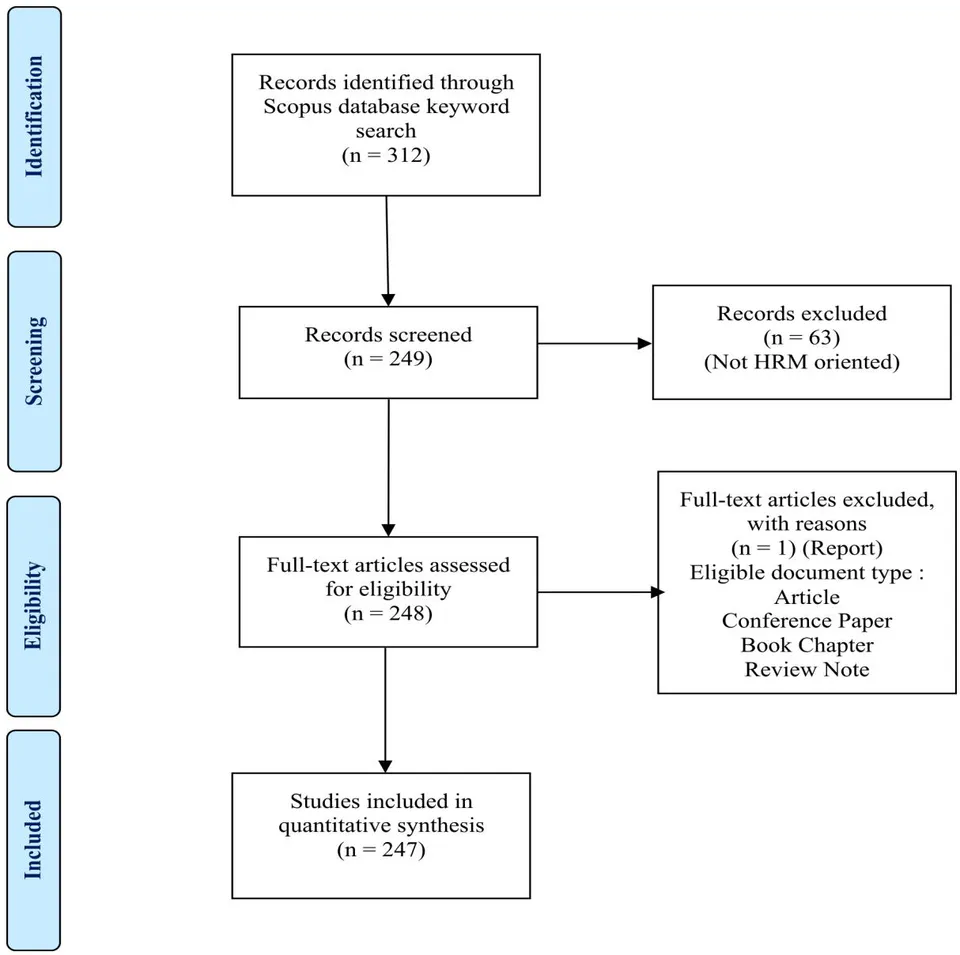
Source: Moher et al., (2009)
III. ANALYSIS AND FINDINGS
On the research question (RQ1), we analysed the key attributes of the literature and research trends currently on AI in HRM. A total of 247 Scopus-indexed documents spanning the last 25 years represent a rapidly increasing foundation of knowledge related to AI in HRM. The source type represented in Table 1 reflect that journal papers contributed to of the published documents on AI research in the HRM domain, while conference papers contributed and book series . Table 2 represents citation metrics, and it shows that there is an average of 68 citations per year.
| Source Type | Total Publications (TP) | Percentage (%) |
| Journal | 123 | 49.80% |
| Conference Proceeding | 98 | 39.68% |
| Book Series | 24 | 9.72% |
| Book | 1 | 0.40% |
| Trade Journal | 1 | 0.40% |
| Total | 247 | 100% |
| Metrics | Data |
| Publication years | 1993-2020 |
| Citation years | 27 (1993-2020) |
| Papers | 247 |
| Citations | 1859 |
| Citations/year | 68 |
| Citations/paper | 7 |
| Citations/author | 708 |
| Papers/author | 120 |
| h-index | 2 |
| g-index | 23 |
| Language | Total Publications (TP) | % |
| English | 239 | 96.76% |
| Chinese | 5 | 2.02% |
| German | 1 | 0.40% |
| Portuguese | 1 | 0.40% |
| Spanish | 1 | 0.40% |
| SI | Country | TP | % |
| 1 | China | 106 | 42.74% |
| 2 | Taiwan | 17 | 6.85% |
| 3 | India | 14 | 5.65% |
| 4 | Iran | 13 | 5.24% |
| 5 | United States | 11 | 4.44% |
| 6 | Turkey | 9 | 3.63% |
| 7 | United Kingdom | 9 | 3.63% |
| 8 | Germany | 7 | 2.82% |
| 9 | Brazil | 6 | 2.42% |
| 10 | Malaysia | 6 | 2.42% |
Figure 2 traces the growth trajectory of the number of publications related to the area of AI in HRM till October 2020. During the period from 1993 to 2010, of contributions of the total publications were made, while during the last decade, i.e., during the period 2010 to 2020, of the publications were made. The sharp increase reflected in publications from the year 2018 contributing to of the total publications since 1993, indicates the increasing focus on the application of AI in the HRM function. The analysis of the language of research publication is reflected in Table 3, with English contributing to the majority , followed by as Chinese, and German, Portuguese and Spanish at respectively. Table 4 represents the countrywide distribution of research indicating that of the documents are published in China, followed by Taiwan with and India with of the contribution. The figures suggest that there is an upward swing reflected, with swiftly emerging literature since 2018.
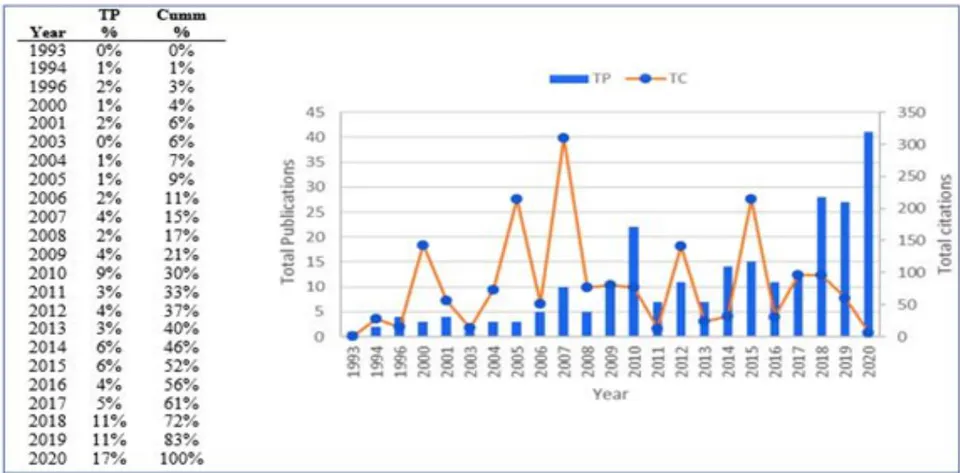
Figure 2: Total Publications by Year Notes: TP=total publications; TC=total citations. TP%=percentage of publications; Cumm%=cumulative percentage of publications.
Source: Generated by the Authors using VOS Viewer
| Author Keywords | Total Publications (TP) | Percentage (%) |
| Human Resource | 96 | 38.87% |
| Artificial Intelligence | 47 | 19.03% |
| Fuzzy Logic | 43 | 17.41% |
| Decision Making | 42 | 17.00% |
| Resource Allocation | 37 | 14.98% |
| Neural Networks | 25 | 10.12% |
| Analytic Hierarchy Process | 22 | 8.91% |
| Artificial Neural Network | 16 | 6.48% |
| Optimization | 14 | 5.67% |
| Personnel Training | 14 | 5.67% |
| Genetic Algorithms | 12 | 4.86% |
| Hierarchical Systems | 12 | 4.86% |
| Performance Evaluation | 12 | 4.86% |
| Enterprise Human Resource | 10 | 4.05% |
| Recruitment | 10 | 4.05% |
| Deep Learning | 9 | 3.64% |
| Fuzzy Evaluation | 9 | 3.64% |
| Genetic Algorithm | 9 | 3.64% |
| Talent Management | 8 | 3.24% |
| Decision Support Systems | 7 | 2.83% |
| Decision Theory | 7 | 2.83% |
| Fuzzy Systems | 7 | 2.83% |
| Human Resource Allocation | 7 | 2.83% |
| Innovation | 7 | 2.83% |
| Machine Learning | 7 | 2.83% |
| Membership Functions | 7 | 2.83% |
| Neural Network | 7 | 2.83% |
| Project Management | 7 | 2.83% |
| Analytical Hierarchy Process | 6 | 2.43% |
| Big Data | 6 | 2.43% |
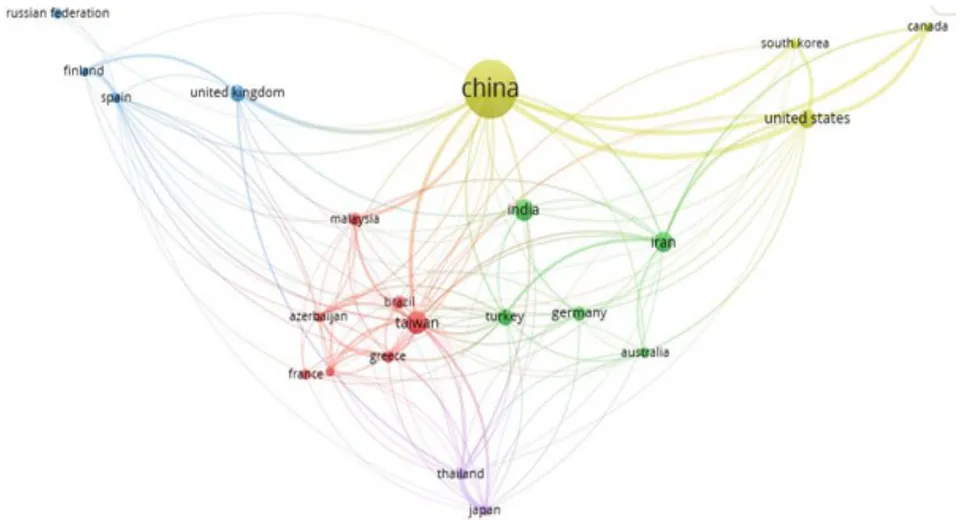
Figure 3 represents country-based bibliometric coupling, indicating that the countries presented therein cite similar literature in their publications. Higher bibliometric coupling indicates that the studies deal with related subject matter (Martyn, 1964). The figure shows that strongest bibliometric coupling exists between China and the United States, indicating that the studies originated from China and the United States have common citations more frequently. Table 5 is representative of the main keywords related to AI in
HRM, which indicate the functionalities and technologies associated with AI in the HRM field that is currently being referenced in research. These keywords related to functionalities are - "decision making", "resource allocation", "optimisation", "personnel training", "performance evaluation", "talent management". The corresponding keywords related to AI technologies are - "neural networks", "genetic algorithms", "deep learning", "fuzzy support systems".
| Research on HRM Functionality/Al Technique | Research Sources |
| Demand forecasting, Allocation of resources, Prediction tasks, Neural Networks applications, Analytic Hierarchy Process, Fuzzy Mathematics | Aviso et al.(2018);Andalib et al.(2020);Apornak etal.(2021);Coelho et al.(2019);Chang (2010); Ivanov et al. (2020); Kieling et al.(2019); Khanizad & Montazer (2018); Kwak & Jung, (2003); Markevich & Sidorenko (2019); Xu et al.(2019) |
| Prioritization of resource demands, Resource optimization | Daojin (2010); Guenole & Feinzig (2019); Hsu et al. (2019); Lin & Gen (2008) |
| Reverse candidate profiling, Ideal Fit for role, Balanced Job descriptions, AI Algorithms | Gikopoulos(2019); Guenole & Feinzig (2019); Rogers (2018); Leem (1996) |
a) Term Co-Occurrence Analysis
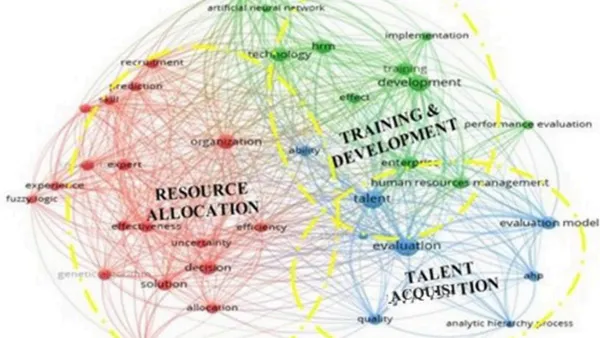
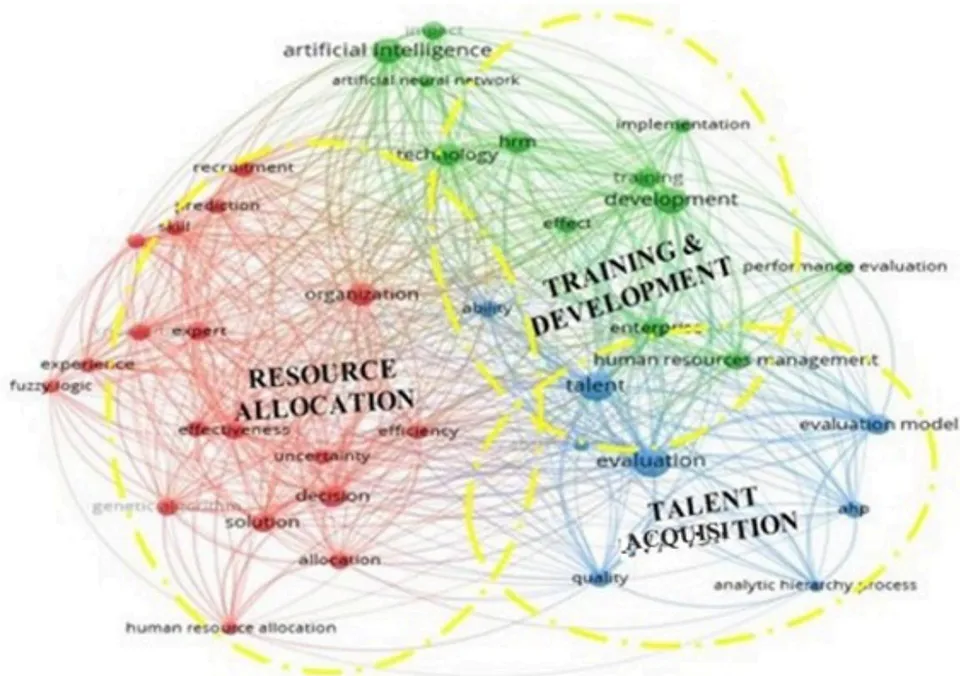
In order to identify the research focus, a co-occurrence analysis was conducted of all keywords, including author keywords and index keywords, using VOS viewer software (Van Eck and Waltman, 2010). As reflected in Figure 5, areas of maximum focus in the research related to AI in HRM literature are talent acquisition for recruitment and selection, resource allocation, and personnel training. The analysis also reflects the related AI technologies that support these functionalities: machine learning, data mining, big data, deep learning, neural network, and fuzzy logic.
Co-occurrence network (Figure 5), based on title and abstract fields, indicates that the significant overlapping areas in AI in HRM research are resource allocation, training & development, talent acquisition, and related aspects of efficiency and effectiveness in decision-making. It is also indicative that the methods and techniques focussed include analytic hierarchy process, artificial neural network, fuzzy logic, and evaluation models. Resource allocation function is facilitated by the application of AI in HRM, as it contributes in an optimal, effective, and budgeted manner, the process of assigning and scheduling available resources, including the workforce. The talent evaluation function is objectively developed and driven by neural networks and the analytic hierarchy process, which brings forth a method of organizing and analysing complex decisions related to talent. Training and development are another key area that is reflected in the co-occurrence network.
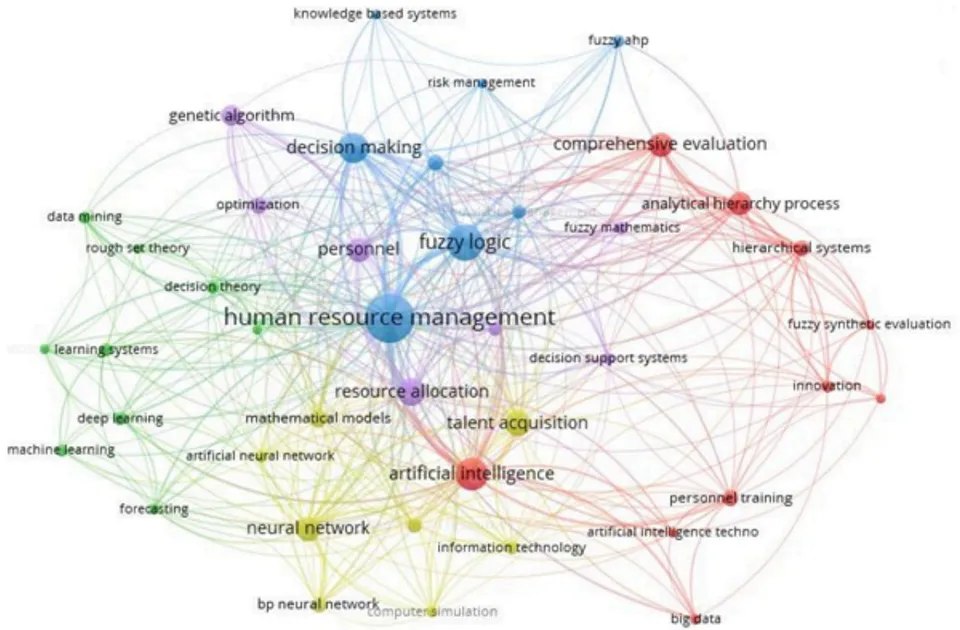
The second research question (RQ2) focussed on the areas of research in the domain of AI in HRM. As indicated in the VOS viewer visualization of term co-occurrence network based on title and abstract (Figure 5) suggests that the research in AI in HRM predominantly focuses on talent acquisition, resource allocation, and training and development. Top keyword analysis, as reflected in Figure 4 shows the prominent keywords used in the publications, bigger a circle, the more frequently the keyword appears in the publication set from Scopus. The top three keywords as per the analysis are Human Resources , AI , and Fuzzy Logic . A brief overview of the literature on the three key areas identified, namely, resource allocation, talent acquisition, and training and development is reflected in Tables 7, 8 and 9.
Source: Created by Authors
| Research on HRM Functionality/Al Technique | Research Sources |
| Demand forecasting, Allocation of resources, Prediction tasks, Neural Networks applications, Analytic Hierarchy Process, Fuzzy Mathematics | Aviso et al.(2018); Andalib et al.(2020); Apornak etal.(2021); Coelho et al.(2019); Chang (2010); Ivanov et al. (2020); Kieling et al.(2019); Khanizad & Montazer (2018); Kwak & Jung, (2003); Markevich & Sidorenko (2019); Xu et al.(2019) |
| Prioritization of resource demands, Resource optimization | Daojin (2010); Guenole & Feinzig (2019); Hsu et al. (2019); Lin & Gen (2008) |
| Reverse candidate profiling, Ideal Fit for role, Balanced Job descriptions, AI Algorithms | Gikopoulos(2019); Guenole & Feinzig (2019); Rogers (2018); Leem (1996) |
| Research on HRM Functionality/Al Technique | Research Sources |
| Sourcing candidates. Predictive tool algorithms for programmatic recruitment advertising | Esch & Black (2019); Schweyer (2018) |
| Candidate engagement through chatbots on the web, mobile, socially enabled by natural language processing | Ernst & Young (2018); Meister (2019a); Nunn, (2019); Sheikh et al.(2019); Upadhyay & Khandelwal(2019) |
| Candidate profiling by applying computational linguistics | Charlier & Kloppenburg (2017); Walford-Wright & Scott-Jackson (2018) |
| Profile matching, Automation of resume/job description, Optical character recognition (OCR), Advanced application tracking systems, Inclusive AI algorithms for unbiased screening of profiles | Barboza (2019); Cohen (2019); Esch & Black (2019); Gikopoulos (2019); Guenole & Feinzig (2019); Kaplan & Haenlein (2019); Meister (2018b); Nunn (2019); Rogers (2018); Sivathanu & Pillai (2018); Strohmeier & Piazza (2015) |
| Talent selection techniques, Neural network, Fuzzy Systems, Data mining techniques,Gaming techniques for selection, AI chatbots – interpretation/Validation of candidate response | Bersin (2017); Huang et al. (2001,2004); Ranjan et al. (2008); Sivathanu & Pillai (2018); Ernest & Young (2018); Meister (2018b); Mentzelopoulos & Economou (2020); Johnson et al. (2020); Jimenez et al. (2018); Qin et al. (2020); Ye et al. (2019) |
| Interview methods with Unconscious bias reduced -AI tools "listen"/prompt question, Robotic Process Automation (RPAs) | Cohen (2019); Gikopoulos (2019); Guenole & Feinzig 2019); HRPA (2017) |
| Onboarding, Natural language processing, for chatbot-agnostic technology and text-based conversational interface of Chatbots as an online buddy, customization, and automation, and core business functions, AI algorithms to map team fit, learning needs on Day 1 | Barboza (2019); Gikopoulos (2019); Upadhyay & Khandelwal (2019) |
| Research on HRM Functionality | Research Source |
| AI tagging of learning content through metadata, AI-enabled tutoring systems, intelligent agents embedded | Barboza (2019); Guenole & Feinzig (2019); Meister (2019a); Niehueser & Boak (2020); Schweyer (2018); Qiong et al. (2018) |
| Individual Development Plan, Succession Planning Smart data matching and AI-enabled Individual profile analysis to identify the right talent for key roles | Barboza (2019); Bersin (2017); Nunn (2019) |
| Career mobility through digital coaching Virtual assistant-datafor personalized career counselling. | Bersin (2017); Ernest & Young (2018); HRPA (2017); IBM (2019);Kiron & Spindel (2019) |
| Skill gap analysis, Gaming techniques for Deep Learning, Current analytics, and predictive analytics of skills required | Barboza (2019); Guo & Li (2020); Nunn, (2019a); Mentzelopoulos & Economou (2020); |
The effectiveness of HR function is greatly enhanced by the adoption of AI and the associated technologies. The third research question (RQ3) addresses the areas/domains that require additional and focused research in the future related to AI in HRM. There has been a steady pace of development of applications related to AI technologies for the HRM function, which have been covered with adequate research.
IV. DISCUSSION AND FUTURE RESEARCH DIRECTIONS
The analysis shows that a significant portion of the research was published during the last decade, with a sharp increase since 2018. In the country-wise publication output, China is leading with more than of documents published in the area of AI in HRM. As pointed out in (Demchak, 2019; Li et al., 2021), China is abundant with the two critical assets needed in the AI era, i.e., data and engineering talent, which could be the reason behind its prominence in this field. The keyword and term co-occurrence analysis were conducted to explore the prevailing themes in the research related to AI in HRM. Three clusters emerged from the term co-occurrence analysis based on title and abstract is represented in Figure 5. A brief discussion on these clusters is presented in the following sub sections.
a) Cluster 1 - Resource Allocation
The logical allocation of human resources plays an important role for the organization's development and is considered a challenge by many organizations. The term co-occurrence network showed that workforce planning and resource management are a key research area in AI and HR. Literature suggests that AI technology and applications enable organizations for efficient workforce management and optimization. For example, a variation of unsupervised Competitive Learning neural networks algorithm was proposed by Leem (1996) to overcome the obstacles that conventional analyses face. The deployment of Analytic Hierarchy Process (AHP) and Fuzzy Mathematics systems ensures appropriate management decisions for employees' most suitable role assignments (Subramanian and Ramanathan, 2012; Saaty et al., 2007). A fuzzy input-output optimization method was proposed by Aviso et al. (2018) for HR allocation during a crisis.
AI enables a comprehensive evaluation of human resource allocation and continuous improvement. The ability of AI to analyze a large amount of data and draw inferences and detect patterns assist in resource planning optimally (Lengnick-Hall et al., 2018). It also enables multi-criteria human resource allocation, which involves allocating limited availability human resources among many demands by optimizing current objectives (Lin & Gen, 2008). Data related to employee performance and succession and analysis of it provides insights on employee engagement and related challenges (Smith, C. 2019). Resource efficiency can be enhanced by forecasting, which is critical in decision making, based on which the financial costs of the workforce can be optimized.
b) Cluster 2 - Talent Acquisition
Literature shows that AI enhances recruitment efficiency through balanced job descriptions, job requisition prioritization, profile databases, programmatic recruitment advertising based on machine learning, attracting potentially suitable candidates (Albert, 2019; Upadhyay and Khandelwal, 2018). A human resource selection system constructed using FNN is discussed in Huang et al. (2004). AI assistants support the engagement of candidates through digital platforms (Van and Black, 2019). Specialized chatbots can be used for candidate attraction and to have an insightful conversation to engage candidates in deeper conversation and recommend jobs relevant to their skills and experience (Leong, 2018). The chat topics provide informative answers about aspects related to the organization - compensation, vacation guidelines, culture, locations, dress code, business, and assessment process. It enhances the scope of converting prospective candidates into active job seekers. Thus, creating a positive recruiting experience and facilitates accepting a job offer by the right candidate. Selection efficiency is improved by proper candidate identification with data analysis (Bongard, 2019). Predictive analysis helps forecast the future performance of a prospective candidate, basis the profile and information collated and analysed during the automated aspects of the job application process.
Profile matching, Optical Character Recognition (OCR), CV Parsing are key applications enabled by AI (Singh and Finn, 2003; Bizer et al., 2005). Initial screening can be automated by neural networks, data mining techniques, and AI chatbots by conducting interpretation/Validation of candidate responses. Intelligent interviews are conducted with reduced unconscious bias, assisted by AI tools to "listen"/prompt questions and Robotic Process Automation (RPAs) (Madakam, 2019; Nawaz, 2019). Background checks are automated, based on different reviews required, basis the profile of the candidate. From the literature it can be seen that the digitally enabled on boarding process focuses on two aspects. One is to automate, and the second is to personalize. Functionalities like Chatbots support new hires in knowing relevant details about their new role, team hierarchy, and overall organizational landscape (Ernst & Young, 2018; Nunn, 2019). The efficiency of the on boarding process improves by the collection of employee information, joining forms completion, and assistance in online registration. Another key aspect is that through digitally enabled on boarding, the new hires have access to tools facilitating them to connect and socialize in their new organization, which positively impacts their learning, productivity, and engagement, as they settle in their new roles (Sheikh et al., 2019; Upadhyay & Khandelwal, 2019).
c) Cluster 3 - Training and Development
Cluster 3 focuses on training and development applications of AI. Literature suggests that AI-based tools provide more personalized and enhanced digital learning experience (Ong and Ramachandran, 2003; Maity, 2019). An employee can access their skill profiles, to build their skill journey helping to have ownership in building their skills path and their career path and thereby supporting the acceleration of skill development (Wang and Lin, 2020). The search engine capabilities in the Learning tools architecture helps in making intelligent recommendations, for the learning road map, for an employee. Through metadata, AI tagging of all content in the learning modules supports user-friendly interfaces through content channels (Guenole and Feinzig, 2019). Intelligent data matching and AI-enabled individual profile analysis provide insights that help identify the right talent for key roles and succession planning (Barboza, 2019; Bersin, 2017; Nunn, 2019). Interactions with employees for growth and future opportunities are enabled by AI tools, which can act as a personalized digital career advisor, allowing employees to advance their careers within the organization. This allows in creating meaningful work experiences for employees, better growth assistance, and building more robust pipelines for critical businesses. The interactive user interface uses natural language processing to engage in active discussion with the employees (Littman, 2016). This is integrated with precisely the employee's historical information about various aspects. Literature also suggests that AI-enabled job-opportunity match functionality will be of use in suggesting suitable roles for employees, based on their profiles (Tambe, 2019; Nocker and Sena, 2019). Employee queries can be resolved by the AI tools. Provision of built-in alerts on job opportunities help employees to know about internal opening matching to their current profiles and tailored to their aspirational roles.
We can see that majority of research related to AI in HRM focuses on talent acquisition, resource allocation, and training and development. Very few studies have explored the adoption of AI in other HR functions such as employee retention, compensation and separation. Additional research is needed on different aspects of AI in HRM, including adoption challenges, impact studies, new skill requirements etc. In the following section, we discuss the future research directions based on the findings.
d) Implications and Future Research Directions
As indicated by the findings, despite continual research progress is being made related to AI technologies for the HRM function, there are areas which need further attention and in-depth understanding.
The study findings indicate possible follow-on ideas and future studies. For example, research is required on how AI and related technologies in the HRM function have impacted vital aspects of employee engagement, retention, growth, compensation, reward, and recognition. There have been very few studies conducted related to these aspects. How this phase of HR transformation and the strategic development of HR has impacted business performance is a key area that has not been investigated.
The transformation of HR function by the adoption of AI technologies is an emergent field of focus. Despite the benefits of AI adoption, there is a huge variance in terms of adoption of AI. Research needs to be conducted on what are the influencing factors that impact adoption. Though AI adoption is key aspect of technology adoption in organizations, there is lack of technology adoption model-based research, related to adoption of AI across all domains of HR. Further, detailed research work is recommended to be conducted on the design and implementation of change management in adoption. Another good avenue for future research would be industry-specific and cross-industry comparisons to support further research.
Many areas merit additional investigation, even though a significant work on AI in HRM has been conducted, especially in the last decade. AI in HR has enabled the HRM function to be transformed and acknowledged as a strategic partner of the business. For example, technological advancements have created opportunities in the talent acquisition domain that links strategic HR management with business strategy (Walford and Scott, 2018). By enabling digital engagement, HR provides a competitive advantage to the organizations (Jesuthasan, 2017). There is a lack of research, as to what is the impact of HR's transformation by leveraging AI and how does this contribute to enabling organizations to achieve business success and leverage strategic advantage for hiring and retaining key talent. Further, in the domain of strategic HRM, cognitive enabled insights can facilitate drawing optimal outcomes. While humans contribute to a more thorough and intuitive approach to managing uncertainty and complexity in organizations (Jarrahi, 2018), AI can enhance humans' cognition when handling complex problems. There is a dearth of research and detailed studies on this aspect.
The use of AI tools/applications has led to questions related to the authenticity of people/talent decisions made basis AI algorithms and logic. Especially in the talent acquisition domain, the fairness and objectivity of hiring decisions based on the logic of an AI based algorithm or an AI based decision rule is questioned, as to whether these decisions are objective (Bogen, 2019). Aspects regarding the authenticity of employee data – both current and potential, are a cause of concern, as its validity is questionable. The authenticity of algorithms designed based on the data could be imperfect, as it could reflect society's ingrained prejudices and biases. Also, the aspect of inherent or unconscious bias which could be part of the logic of the algorithm or seeded in the decision rule and driving biased decision related to hiring needs further exploration. Data sets could be structured in advance to be aligned with historical precedents and patterns, which could even be part of an organization's culture and can be hardwired into code (Gulliford and Dixon, 2019). Questions regarding talent decisions made basis this data, whether it further strengthens exclusions and existing biases, is imperative to be researched, as these are sensitive topics to be addressed. Also, interlinked to this, there is a requirement for more comprehensive insights and counsel in the form of additional research to help address ethical concerns and acceptance of talent decisions based on applications of AI in the human resources functions.
Concerns related to the security and privacy of employee sensitive information also needs deeper exploration. Capelli (2019) has highlighted some of the drawbacks of data science being applied in HR, including concerns related to infringing on privacy, usage of social media posts as a determinant factor for hiring, which may lead to discriminative impacts on minorities/diversity. Democratizing data, transparency, and providing data and insights to employees is another aspect that needs further exploration (Hirsch, 2019).
Practical implication of the findings is related to the skill development of HR practitioners. There is lack of research regarding a key aspect, which is related to the expectations of new skills and competencies that HR professionals need to be proficient in, to adopt and apply AI and leverage its benefits. The skills of present and future HR practitioners will need to be developed to manage today's AI applications and future advancements. HR practitioners need to learn how to use AI-enabled analytical tools. They also need to be able to interpret and take action basis the analysis, thus developing numerical analysis and reasoning skills will also be required (Davenport, 2019). HR professionals need to have the competence to utilize technology to provide insights that support business, which necessitates the skill development of HR professionals (Wang and Lin, 2020). There are hardly any studies conducted on this key aspect of AI in HRM, which is the new skills and competencies that HR professionals need to be proficient in adopting and applying AI applications in HRM and leveraging all the benefits. Recent studies indicate that COVID-19 may accelerate the adoption of AI in HRM (Hamouche, 2021; Vahdat, 2021; Khalifa, 2022). There is also research gap related to actual impact studies providing insights on the adoption of AI and related technologies on the transformation of HR, which can be potentially leveraged for future growth and advancement of the HR function.
V. CONCLUSION
The adoption of AI in HRM has resulted in the effectiveness of HR processes, service delivery, and enhanced employee experience. It is imperative to study and interpret the further trends and opportunities of AI as applied to HRM. This work provides an exhaustive study of the emergence and accelerated growth of research on AI in HRM. We have evaluated the current status of research in the domain of AI in HRM and demonstrated the research gaps. In general, studies directly addressing AI in HRM in the abstract, title, or keywords has been continuously growing since 2010. The growth trajectory of literature indicates that it has more than doubled in size over the past decade. Analysis related to various aspects of research, be it types of documents and volume of documents, conceptual coherence, and citation impact, reveals that the most prevalent research areas are talent acquisition, resource allocation, and training and development in applying AI in HRM. Other predominant areas of research highlighted are neural networks, fuzzy logic, and evaluation models. Various future research implications are also discussed. Though this study has limitations in that it has considered only the publications indexed by Scopus, the comparatively small amount of research articles directly addressing the field suggest that further research is needed, focusing on areas of systematic theory development as well as conceptual and empirical studies. AI in HRM, being a rapidly developing area, there is substantial literature and research in the form of white papers and industry reports, which may lead to a lack of requisite bibliographic control.