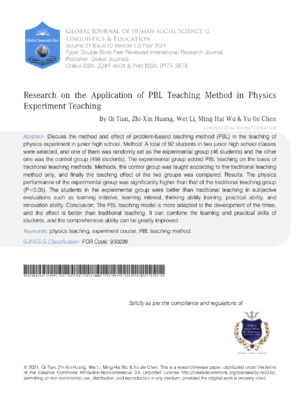
Research on the Application of PBL Teaching Method in Physics Experiment Teaching

α
Qi Tian
Qi Tian
σ
Zhi-Xin Huang
Zhi-Xin Huang
ρ
Wei Li
Wei Li
Ѡ
Ming-Hai Wu
Ming-Hai Wu
¥
Yu-Jie Chen
Yu-Jie Chen
α Central China Normal University

Send Message

To: Author

Research on the Application of PBL Teaching Method in Physics Experiment Teaching

Article Fingerprint

ReserarchID

2P9QH

Research on the Application of PBL Teaching Method in Physics Experiment Teaching Banner

AI TAKEAWAY

Connecting with the Eternal Ground
  • English
  • Afrikaans
  • Albanian
  • Amharic
  • Arabic
  • Armenian
  • Azerbaijani
  • Basque
  • Belarusian
  • Bengali
  • Bosnian
  • Bulgarian
  • Catalan
  • Cebuano
  • Chichewa
  • Chinese (Simplified)
  • Chinese (Traditional)
  • Corsican
  • Croatian
  • Czech
  • Danish
  • Dutch
  • Esperanto
  • Estonian
  • Filipino
  • Finnish
  • French
  • Frisian
  • Galician
  • Georgian
  • German
  • Greek
  • Gujarati
  • Haitian Creole
  • Hausa
  • Hawaiian
  • Hebrew
  • Hindi
  • Hmong
  • Hungarian
  • Icelandic
  • Igbo
  • Indonesian
  • Irish
  • Italian
  • Japanese
  • Javanese
  • Kannada
  • Kazakh
  • Khmer
  • Korean
  • Kurdish (Kurmanji)
  • Kyrgyz
  • Lao
  • Latin
  • Latvian
  • Lithuanian
  • Luxembourgish
  • Macedonian
  • Malagasy
  • Malay
  • Malayalam
  • Maltese
  • Maori
  • Marathi
  • Mongolian
  • Myanmar (Burmese)
  • Nepali
  • Norwegian
  • Pashto
  • Persian
  • Polish
  • Portuguese
  • Punjabi
  • Romanian
  • Russian
  • Samoan
  • Scots Gaelic
  • Serbian
  • Sesotho
  • Shona
  • Sindhi
  • Sinhala
  • Slovak
  • Slovenian
  • Somali
  • Spanish
  • Sundanese
  • Swahili
  • Swedish
  • Tajik
  • Tamil
  • Telugu
  • Thai
  • Turkish
  • Ukrainian
  • Urdu
  • Uzbek
  • Vietnamese
  • Welsh
  • Xhosa
  • Yiddish
  • Yoruba
  • Zulu

Abstract

Discuss the method and effect of problem-based teaching method (PBL) in the teaching of physics experiment in junior high school. Method: A total of 92 students in two junior high school classes were selected, and one of them was randomly set as the experimental group (46 students) and the other one was the control group (456 students). The experimental group added PBL teaching on the basis of traditional teaching methods. Methods, the control group was taught according to the traditional teaching method only, and finally the teaching effect of the two groups was compared. Results: The physics performance of the experimental group was significantly higher than that of the traditional teaching group (P

References

19 Cites in Article
  1. Mervi Risto Leinonen,Pekka Asikainen,Hirvonen (2017). Peer discussions in lecture-based tutorials in introductory physics.
  2. Zhu Hong,Ma Liping,Xiong Yu (2016). Study on the Effect of "Lecture in Large Class and Seminar in Small Class.
  3. B Tomkinson,I Hutt (2012). Online PBL: A route to sustainability education? Campus-Wide Inform Syst.
  4. Y Suzuki,M Niwa,T Shibata,Y Takahashi,K Chirasak,A Ariyawardana,J Ramesh,P Evans (2007). Internet -based problem -based learning: international collaborative learning experiences.
  5. Maggi Savin-Baden (2007). A Practical Guide to Problem-Based Learning Online.
  6. Manwa Ng,Susan Bridges,Sam Law,Tara Whitehill (2014). Designing, implementing and evaluating an online problem-based learning (PBL) environment – A pilot study.
  7. K Hofgaard Lycke,H Strømsø,P Grøttum (2006). Tracing the tutor role in problem-based learning and PBL online.
  8. Diana Dolmans,Willem De Grave,Ineke Wolfhagen,Cees Van Der Vleuten (2005). Problem‐based learning: future challenges for educational practice and research.
  9. D Dolmans,H Schmidt (2010). The problem-based learning process.
  10. W Grave,D Dolmans,C Van Der Vleuten (1999). Profiles of effective tutors in problem-based learning: scaffolding student learning.
  11. H Al-Azri,S Ratnapalan (2014). Problem-based learning in continuing medical education: review of randomized controlled trials.
  12. Esther Chng,Elaine Yew,Henk Schmidt (2011). Effects of tutor-related behaviours on the process of problem-based learning.
  13. M Abrandt-Dahlgren,Dahlgren Lo (2002). Portraits of PBL: Students' experiences of the characteristics of problem-based learning in physiotherapy, computer engineering and psychology.
  14. Samy Azer (2011). Problem-based learning: Where are we now? Guide supplement 36.1 – Viewpoint.
  15. R Beri (2011). Problem-based learning: Where are we now? Guide supplement 36.2 – Viewpoint.
  16. Kenneth Oja (2010). Using Problem-Based Learning in the Clinical Setting to Improve Nursing Students’ Critical Thinking: An Evidence Review.
  17. Lap Chan,Nivritti Patil,Julie Chen,Jamie Lam,Chak Lau,Mary Ip (2010). Advantages of video trigger in problem-based learning.
  18. Lisa Hartling,Carol Spooner,Lisa Tjosvold,Anna Oswald (2010). Problem-based learning in pre-clinical medical education: 22 years of outcome research.
  19. M Smith,W Wood,W Adams,C Wieman,J Knight,N Guild,T Su (2009). Why Peer Discussion Improves Student Performance on In-Class Concept Questions.

Funding

No external funding was declared for this work.

Conflict of Interest

The authors declare no conflict of interest.

Ethical Approval

No ethics committee approval was required for this article type.

Data Availability

Not applicable for this article.

How to Cite This Article

Qi Tian. 2021. \u201cResearch on the Application of PBL Teaching Method in Physics Experiment Teaching\u201d. Global Journal of Human-Social Science - G: Linguistics & Education GJHSS-G Volume 21 (GJHSS Volume 21 Issue G10): .

Download Citation

Exploring teaching methods in physics education for improved research techniques.
Issue Cover
GJHSS Volume 21 Issue G10
Pg. 39- 42
Journal Specifications

Crossref Journal DOI 10.17406/GJHSS

Print ISSN 0975-587X

e-ISSN 2249-460X

Keywords
Classification
GJHSS-G Classification: FOR Code: 930299
Version of record

v1.2

Issue date

August 14, 2021

Language
en
Experiance in AR

Explore published articles in an immersive Augmented Reality environment. Our platform converts research papers into interactive 3D books, allowing readers to view and interact with content using AR and VR compatible devices.

Read in 3D

Your published article is automatically converted into a realistic 3D book. Flip through pages and read research papers in a more engaging and interactive format.

Article Matrices
Total Views: 2093
Total Downloads: 968
2026 Trends
Related Research

Published Article

Discuss the method and effect of problem-based teaching method (PBL) in the teaching of physics experiment in junior high school. Method: A total of 92 students in two junior high school classes were selected, and one of them was randomly set as the experimental group (46 students) and the other one was the control group (456 students). The experimental group added PBL teaching on the basis of traditional teaching methods. Methods, the control group was taught according to the traditional teaching method only, and finally the teaching effect of the two groups was compared. Results: The physics performance of the experimental group was significantly higher than that of the traditional teaching group (P

Our website is actively being updated, and changes may occur frequently. Please clear your browser cache if needed. For feedback or error reporting, please email [email protected]

Request Access

Please fill out the form below to request access to this research paper. Your request will be reviewed by the editorial or author team.
X

Quote and Order Details

Contact Person

Invoice Address

Notes or Comments

This is the heading

Lorem ipsum dolor sit amet, consectetur adipiscing elit. Ut elit tellus, luctus nec ullamcorper mattis, pulvinar dapibus leo.

High-quality academic research articles on global topics and journals.

Research on the Application of PBL Teaching Method in Physics Experiment Teaching

Qi Tian
Qi Tian Central China Normal University
Zhi-Xin Huang
Zhi-Xin Huang
Wei Li
Wei Li
Ming-Hai Wu
Ming-Hai Wu
Yu-Jie Chen
Yu-Jie Chen

Research Journals