
I. INTRODUCTION AND BACKGROUND
The digital revolution has been enhancing communication and living conditions in African cities (Moyo, Musakwa and Gumbo, 2020; Guma, 2020), intended to be innovative in the management of urban planning, transportation, land usage planning and so on. This societal revolution is gradually transforming the configuration of urban space into a smart space through the availability, accessibility and use of digital technology in the daily lives of city dwellers. According to CONNECT (2018),
Many cities around the world have effectively deployed traffic management infrastructure that allows both the monitoring and management of street networks in real time. Recent innovation has begun to incorporate wireless communication networks and mobile device applications to yield better information and to support more options for travelers of all modes. The emerging trend of "Smart Transportation" relies on more distributed and scalable technologies that offer potential for a greater range of benefits at lower cost.
These technologies convert traditional roads into digital information flows that interconnect users with each other and with their environment via the Internet, social media and mobile terminals, including the smartphone to overcome urban challenges in a transition to a smart city model in developed and developing countries (Moyo, Musakwa and Gumbo, 2020; Mahmood 2018). Indeed, for Aurigi (2017), the smart city narrative has recently become closely associated with the concept of urban ecosystem sustainability. In the developing countries, it is related to an urban ecosystem that comprises all components of emerging cities, including their populations, food and transport systems, industry and commerce (Meier, 1976; Mahmood 2018; Lindley, 2018).
In this context of digital revolution and sustainable city aims, African cities are disrupting with the growing integration of digital technologies in the urban traffic, transportation, energy management, communication support, which is obvious in many metropolitan cities like Cape Town, Nelson Mandela Bay, Akwaba City. In these various cities, the dramatic change in the behavior of their citizens who use smartphones in daily mobility, energy planning, communication activities questions the transition of Africa traditional urban centers to smart sustainable city patterns (Savithramma, Ashwini and Sumathi, 2022; Mahmood 2018). In such new city designs, mobile terminals improve the urban life and give new perspectives for well-being in the urban environment whatever the current challenges in terms of building a sustainable town are (Vainio and Sankala 2022; Zavratnik 2020; Guma 2020).
a) Objectives
This article is part of our qualitative and interpretative descriptive research. The objective of this study is to analyze digital communication technologies in urban usages, reconceptualizing a sustainable African city as a smart one by outlining the new mobility and urbanity communication practices adopted in Abidjan. In other words, the above means to rethink urban life, smart mobility and communication for a sustainable city constructed on the determinism smartness urban development basis with regard to "living in the city" with smart mobile terminals and connected objects mediation (Mahmood 2018).
b) Research questions
The significance of digital technology integration in urban experience as for moving towards sustainable development has become reconfigured with the smart cities movement (Vainio and Sankala 2022). It has been noted that the problem is unprecedented in metropolitan cities that have witnessed an exponential spatial growth and urban challenges related to the environment, city governance, energy, transportation, economy, communication and so on (Mahmood 2018); Moyo, Musakwa and Gumbo, 2020). As a result, there appears a transformation of the urban paradigm in practices of city inhabitants through their various usages of digital entities. Therefore, the research issue we have been dealing with is how socio-digital technologies applied in citizen practices transform daily urban experience for a sustainable city in Africa? This question has led to our reflecting on the impact of integrating digital revolution technologies in the urbanization of developing countries as in the case of Tanzania and Cote d'Ivoire (Ivory Coast).
c) Problem Statement
In the world disrupted by the digital revolution, governments, development agencies, researchers, professionals and all stakeholders of the urban and non-urban planning development are concerned by the question of smart technologies integration in order to support a sustainable development of the society (Zavratnik, 2020; Mahmood, 2018). Moreover, in Africa, many urban challenges such as traffic jams, pollution, weather catastrophes (for instance, floods), overpopulation in poor slums, effective economic and societal growth affect sustainability planning to a considerable extent (Vainio and Sankala 2022; Guma 2020). These environmental, economic and political situations are challenging factors from the point of view of building a sustainable city. In this respect, the technological adoption in transportation and urban planning seeks to enhance connectivity and digital communication at key points of interest in the city influenced by the growth of the Internet of Things (IoT). Thus, this societal disruption modifies the modalities of sociability and urban living with the utilization of digital technologies, transforming urban life from traditional practices to a smart city perspective (Moyo, Walter Musakwa and Gumbo, 2020). This disruption enriches citizens' daily experience through a smart spatial and social integration of the smartphone in transportation, energy planning and sociability (Mahmood 2018). This transformation results in rethinking the sustainability of a new city model that wants to be connected and to smartly provide solutions to quotidian challenges in transportation, communication, environment, energy and similar things. Implicitly, this calls to involve technological aspirations to achieve both smart and sustainable urban development and governance, dealing with the drawbacks and debates about this possibility (Madsen 2018; Guma 2020). Consequently, our study concentrates on the usage of smartphones and mobile applications to ameliorate urban life planning and sustainable ways (Guma 2020; Zavratnik 2020) to rethink the mobility, urbanity and city experience in developing countries, presenting the case study of Abidjan.
d) Theoretical Lens
In this paper, reconceptualizing African city sustainability through digital socio-technology refers to an in-depth understanding of the major concept linked to the predictive development of the next generation of cities based on the smart city and smart mobility models.
In this regard, Manville (2016) states that a Smart City is one with at least one initiative addressing one or more of the following six characteristics: Smart Governance, Smart People, Smart Living, Smart Mobility, Smart Economy and Smart Environment (Angelakis et al., 2017. According to Nam and Pardo (2020), a smarter city infuses information into its physical infrastructure to improve conveniences, facilitate mobility. In a city connected with socio-digital devices (smartphones, mobile applications, networking platforms), urban mobility is becoming a smart mobility. This is a paradigm shift referring to the usage of digital technologies integrated with urban navigation and mobility devices through intelligent transportation system (ITS) applications to optimize the daily travel of city dwellers.
In the book titled Smart Cities Development and Governance Frameworks, Mahmood (2018) gives an illustration of the components of a smart city.
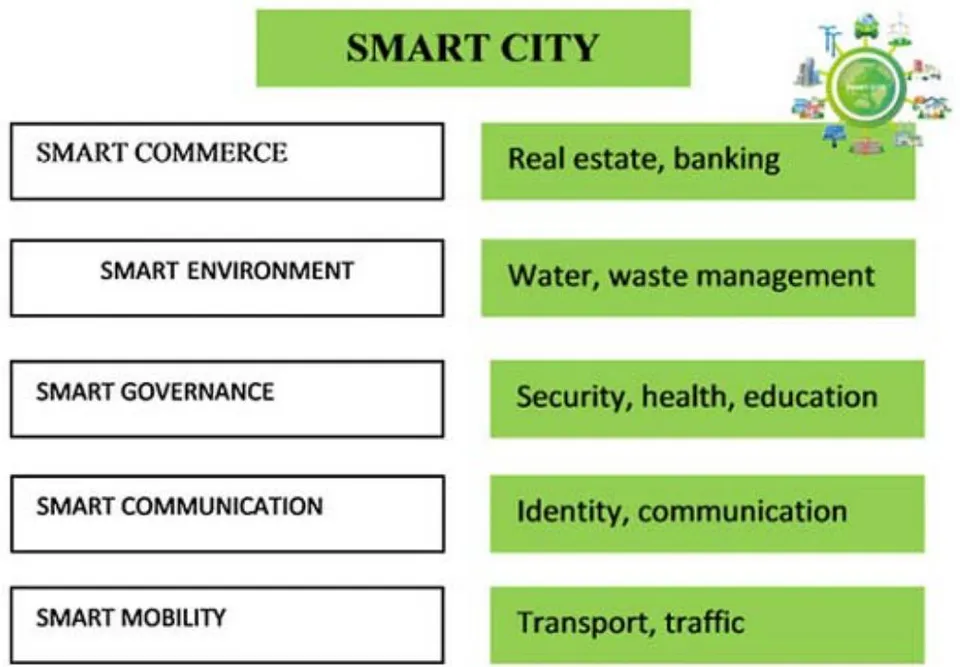
This figure represents a smart city with five main dimensions: smart commerce, smart environment, smart governance, smart communication, and smart mobility. All these components are related to urban sustainability by optimizing the above various aspects of city life to provide all citizens in the current and next generations with wellbeing and prosperity. This figure is very important in our research because it shows a descriptive brief of the key features of smart cities as a sustainable conception of integrating digital technologies for the sake of urban space sustainable development.
The article by Zavratnik (2020) highlights the need for us to rethink and re-conceptualize the already existing universally accepted concepts of smart cities and villages by shifting attention from technology and technological solutions towards understanding the significance of communities and sustainability. In this light, the paper analyzes the basic three dimensions of smart living (energy, mobility, waste) through the prism of rural-urban linkages and the role of ICT. For the author, the core principles and recommendations are calm technology, community size, and identification of community leaders, surveillance, control issues, and community building for designing sustainable development as smart cities and villages, regarding a new community-centered approach. The community centered approach and digital flexibility lens are the core of this interdisciplinary research, combining humanities.
For that matter, the aim of the study by Vainio and Sankala (2022) is to analyze a smart city initiative in Finland as an urgent need for urban sustainability, regarding the rapid urbanization, technological development, and climate change. For the authors, the digital revolution trends and climate change are influencing the perspective of designing cities for citizens' wellbeing. They use a literature review to establish relations between smart city development and sustainable development. For them, smart governance and mobility are the key issues in smart city initiatives for sustainable urban development. At the same time, this article limitation is related to the number of documents analyzed in the review and the Finnish environment as a case study. These facts lead to our exploiting smart mobility as an important part of our current research. We have opted for leaving the government aspect for further reflections to rethink African city sustainability within the smartness approach framework.
In the article Smart City: A Mobility Technology Adoption Framework Incorporating Surface-Level Technical Analysis Jazlan et al., (2022) claims that growing urban population, aging infrastructure, and increasing capital maintenance costs call for a more efficient employment of limited available resources. To address these concerns, the use of technology for urban infrastructure management and operational efficiency comes naturally with emerging technological advancements. Reconceptualizing a traditional city infrastructure usage as a smart one is also a crucial aspect for a sustainable African City through integrating digital technologies. Moreover, digital technologies determine a different way of thinking about urban mobility based on connected lifestyles, especially since the functional emergence of smart mobility system applications via the smartphone or connected vehicles that allow users to be linked to the urban space, to organize their activities and facilitate their travel in a hybrid space (physical and virtual) in real time (Gougou and Paschal 2022). Indeed, the digital transformation has been changing urban practices with the adoption of digital mobility assistance tools for sharing the choice of transport modalities in both physical and virtual space. Therefore, smart mobility stems from a smart city logic, which is presented as a way to optimize travel patterns and regulate mobility in real time (Zavratnik 2020). In this study, we believe that smart mobility uses all the resources of information and communication technologies to optimize the experience of users when they move from one place to another geographically, socio-technical devices being the core.
The scope of our article is smart communication (identity, communication) and smart mobility (transport traffic as a sustainable city theory lens to rethink African city sustainability by the adoption of socio-digital technology in citizens' daily life (Mahmood 2018). Our research is based on the paradigms of smart urbanization. For Guma (2020), smart urbanism refers to a mode of urban development produced by the application of digital platforms, automated processes, data-driven and central control responses to the management and supply of urban services and infrastructure for the improvement of urban life (Luque-Ayala and Marvin, 2015; Kitchin, 2015; Marvin et al., 2016; Shelton et al. 2015). The integration of digital technology in city daily routines and citizens' experience is a transformative fact that leads the African city model to a disrupted connected urban platform for the sustainable wellbeing of city residents. In brief, this introductory background and the different theoretical lens explicated lead us to research the African city subject-matter (Guma, 2020), considering the smart model in smart mobility and urban daily experience in order to rethink the sustainability of African cities through digital socio-technology usages evaluated in an empiric case study.
II. METHODOLOGY
a) Research design
This research is a case study to describe and interpret the process of integrating digital technology tools for smart mobility and smart communication in the urban context as a disruption for sustainable African cities and their citizens' daily life.
According to Guma (2020), case studies are a good way to plan and provide various perspectives in social science research as qualitative methods, in research focused on urbanization issues related to global urban studies (Satgé and Watson, 2018). In the present article, we use the case study of Abidjan as, according to the World Bank data, it is a metropolis city where there are around 5 million citizens (2019) and where the daily mobility engages around 10 million of circulation in the city traffic area. This fact causes many challenges such as traffic jams, a lower accessibility of a better urban experience and more correlative questions. Consequently, the choice of Abidjan, the main digital city of Cote d'Ivoire, as a location for us to study is completely justified in terms of testing and evaluating smart practices of its citizens, users of smartphones and digital platforms in their daily activities, including Smart mobility and Smart communication citizens' behaviors (Mahmood, 2018). These factors are incorporated in such three dimensions of sustainable development goal taking as economy, environment and society to provide viable wellbeing to the current generation without any threats for the future generations. With relevance to this, the aim of our study is to rethink the city life in Africa regarding the smart city model by the application of technologies to support sustainable mobility and citizens' experience. For this reason, the present case study is applied in order to better understand this social transformation through multisite ethnography (Hine, 2000). Therefore, this interpretative qualitative research explores the urban spatial and social representations of digital technology in citizens' daily lives as an insight way to plan the future African city to be sustainable and smart.
b) Sample and sampling techniques
In this case study, we use convenience-sampling method to recruit participants and collect necessary data. This method has proved to be appropriate in a situation where it is difficult to select participants in a probabilistic approach due to lack of statistics. The researchers identify participants by getting information from smartphone and social media users in the nearest area. Then, they identify those using both smartphones and smart mobility applications to communicate, move in the city and get sustainable positive urban life experience. Their practice must be disruptive facts regarding the habits and traditional behaviors of the majority of people in the African city. The target audience has been found both in grammar schools and in one WhatsApp group (Projet stage 2.0, 42 members). There are also selected users of connected vehicles (Smart cars, Smart taxi), depending on their proximity and digital transformation from a traditional communication to a smart strategy. According to the convenience sampling, for interviews we chose 15 participants (pupils, students, drivers of connected vehicles or Yango, professionals) irrelevant of their gender and socio-professional categories. It is using smartphones, mobility applications (Yango, GPS, Google Maps) and chat platforms (WhatsApp) in their daily urban practices that was the main relevant selection criterion to constitute a sample in the city of Abidjan.
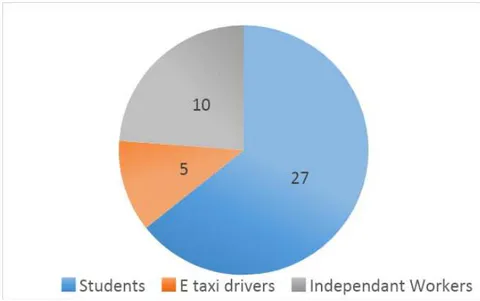
In this study, the investigation was carried out both online and off line to collect a cumulative insight from the practice of the target audience, involved in the smart city behavior context with an emphasis on their attitude, values and perception of daily life activities supported by smartphones and mobility applications. In brief, the research was initially conducted in 67 participants who were engaged in the usage of smartphones, social media and mobility applications (google map, GPS, Linus map, Yango) to live their urban life digitally, the age range being 18-62. Our convenience sample is made up of these respondents, irrelevant of their social category, gender, age or digital skills.
c) Data collection
The present study relies on three methods of data collection to build our corpus.
The first method is a four-month ethnographic observation both online and offline (June – September, 2022) to collect research data on WhatsApp. For this purpose, we asked the citizens we knew to share the urban-oriented content they received or sent, first by inbox message; we joined the WhatsApp group Projet stage 2.0, then opting for creating a WhatsApp group dedicated to the above collection. This monitoring took into account publications (images, texts, videos, sounds, hyperlinks, emoticons) related to daily life, as well as social and spatial representations, translating this experience of urban life into physical and virtual space.
The second method implied semi-structured interviews with six participants using an interview guide to collect their stories of daily life and mobility and communication experience in Abidjan through the application of digital socio-technologies. We began with a pretest questionnaire for four participants in order to improve the quality of the experiment. Next, we adopted each participant's life story with regard to their choice of technologies, platforms and perceptions according to their daily experience, including smart mobility and smart communication.
The third method of focus groups consisted in facilitating a discussion group with the aim of enriching the results of the semi-structured interview to collect and document the attitudes and opinions of the participants regarding their collective perceptions of mobility, sociability and representation of the urban reality augmented by the application of socio-technical devices to the participants' daily life.
d) Data analysis areas
This study focuses on social representations (sets of beliefs, knowledge and opinions) that are produced and shared by individuals of one and the same group. This set concerns a smart urbanization transformation of traditional city life to smart city through socio digital technologies and platforms. Using content analysis (Sacks, 1992: 339; Bloor, 2006) and the Sphinx lexica module, the data collected was processed qualitatively according to the modalities of urban mobility and digital urbanity, based on the participants' situations of smartphone usage, social representations and forms of belonging.
This analysis focused on the practices, perceptions and daily experience of citizens in Abidjan, relying on smart phones and smart applications to move around, communicate and socialize in the spatial and social dimensions of urbanity. The corpus allowed us to reflect upon and to draw conclusions as for the corresponding communication processes in order to identify the new forms of urbanity and reality to rethink the sustainability of cities through models of transition to a smart city pattern for citizens' well-being.
III. FINDINGS AND ANALYSIS
The results are articulated in terms of smart urban mobility and smart communication modalities in the daily practices of the respondent participants.
a) Socio-digital technology in urban mobility
The choice of digital technologies is very important for citizens' urban mobility.
Verbatim 1: In my daily mobility, I use Google Maps when I don't know the place or when I get the geolocation from a friend on WhatsApp. It's also useful to get around and circulate easily in the urban environment crossed the buildings and infrastructures.
Verbatim 2: One day, I was returning from Dabou (a suburban city) to Abidjan. There was a traffic jam. I checked the virtual map and a new route was found. We followed it, crossed a plantation and came out directly on the highway (to Abidjan). It was a really great experience.
Verbatim 3: I am a Yango taxi driver and I use geolocation to get customers and drive them to their destination. GPS and google map are very good tools to avoid traffic jams and get to the destination, to have customers nearby, to make the fare and to report. It's good to circulate in the streets of Abidjan by following the virtual map.
Verbatim 4: Geolocation is great! When I need to move in Abidjan, I just have to put my position and destination on the virtual map to see the route. There are roads that appear on Google Maps that do not exist on the real map. What I like is that the smartphone gives the travel duration for walkers, motorists and motorcyclists, cars. In my job, I use the smartphone and geolocation to build maps and propose routes for the internal operation plan of companies and the online map is very very important.
In Abidjan, the observations show digital cameras and trackers used to regulate the mobility and transportation on the roads. The smartphone proves to be an important tool to order, follow and pay transportation fees in many taxis, buy tickets in some wooden boats and recharge the transportation card, energy and water counter, and to do even more tasks. It enables us to reduce pollution, save time and improve the effectiveness of communication between citizens and governors through digital virtual infrastructural communication with real infrastructures. Smart urban mobility assisted by digital socio-technology is a crucial communication factor in the daily life of citizens in a new city in its transition to a smart city. This transformation of urban life experience provides a better transportation management and reduces many challenges encountered by urban residents. Indeed, Abidjan, like many other metropolises, is a cosmopolitan city whose urban mobility faces major difficulties because of the large number of people moving simultaneously on its traffic areas. However, the urban mobility in Abidjan, as experienced by the participants of this study, is carried out simultaneously both in physical and virtual spaces through socio-digital technologies (smartphones, tablets, connected vehicles, etc.) and mobility applications (GPS, Google Maps, Tango, geolocation, etc.). It is a transformation of traditional urban practices through digital communication devices that create smart city experience in transitioning the city through a multi-modality of transportation means and personalized itineraries to enrich the urban mobility experience in real time contexts. Smart mobility develops new practices like time monitoring, reduction of energy waste, transportation regulation for a sustainable traffic management useful for both citizens and urbanization planning. Such physical mobility assisted by socio-digital technologies makes the circulation in the city smart by means of multifunctional ties and multimodilities of transportation offered. Therefore, the smartphone has turned out to be the main tool that gives access to communication platforms and supports smart urban mobility including smart traffic management, smart transportation experience and smart payment. These results attest that African cities are transitioning to smart city models in terms of their integrating digital technologies supported by smartphones for better city daily experience for truly sustainable mobility.
b) Sociability and smart communication
The experiment participants have shared their modality of belonging through the following corpus, revealing a transition from traditional citizenship to smart communities:
Verbatim 5: I have a tablet for my work. There are several apps like WhatsApp, Yango, Lotusmap that I also use to exchange and move around.
Verbatim 6: I use my smartphone a lot to get around the city. It helps me a lot to communicate, exchange and stay in touch. I can prepaid my transportation fees, electricity and buy my needs online.
Verbatim 7: The smartphone and apps for getting around the city, help a lot in my job. This is good for navigating, finding clients, and communicating easily. GPS and geolocation are provided in the app and I communicate easily.
Verbatim 8: I feel very comfortable with my friends online and in real life. For me, it's the same because the people I know online are people I hang out with at school and elsewhere. Thanks to the smartphone, I feel connected every day and I have many friends.
Verbatim 9: Today, the city is not reduced to geographical boundaries. I have a WhatsApp and Facebook group of young people from our region. Some are in Abidjan and others elsewhere. Consequently, life on this group is like living in the city. We do everything together.
Verbatim 10: For me, there is nothing to discuss. WhatsApp and my smartphone are my life. Everyone I work with and exchange with is online. Therefore, I belong to our online city and at the same time to the city of Abidjan. With the advent of social networks and online platforms, I keep in touch with my family and acquaintances. Online, they are closer to me. Thus, there are many of us communicating together.
Thus, the respondents find it useful to frequently participate in communication exchanges and maintain their ongoing relationship with others through regular usage of smartphones and virtual community based on social media (WhatsApp, Facebook, and so on) in their day-by-day activities, which results in a smart community behavior. For Mahmood (2018), this social component of the smart city allows citizens to reconfigure their daily urban environment by sharing instantly information, recommendations, suggestions, experience to enrich their virtual and real urban life. According to the participants, this co-presence creates a hybrid urbanity within virtual and real community life. Hence, there is this need for peer-to-peer interaction and interactivity with the smartphone and mobile applications to communicate in groups for various individual or group activities consistent with their social aspirations. These users of the corresponding relational platforms feel the necessity to connect to them regularly in order to access and participate in informational, relational, and conversational exchanges, sometimes giving meaning to their daily existence through this participatory culture. As a result, socio-technical devices have become symbols of spatial and social representations through instant connectivity seen as an expression of belonging to a hybrid, hyper-connected society for users of the "constant contact generation". The virtual architectural representation of the city of Abidjan, its places, streets and infrastructures on online maps is a communication medium of the new city. This functionality of connected mobility devices offers an enriched experience of living together. This transformation reinvents the communicative uses of socio-technical devices to plan, manage and optimize urban mobility.
IV. CONCLUSION
In this article, we have turned to a qualitative descriptive case study in order to analyze digital communication technologies in urban usages to rethink sustainable African city as smart through describing the new mobility matrix and urbanities adopted in Abidjan, a West African metropolitan city. Under the existing continuous reality conditions, we have considered smart urbanism paradigms with regard to citizens' practices of switching to the mode of urban development as a result of employing digital platforms, automated processes, data-driven and central control responses to the management and supply of urban services and infrastructure for the improvement of urban life. We have used the ethnography approach to substantiating the modalities of smart mobility and smart communication adopted by the citizens under consideration individually and collectively in the perspective of smart communities living in a city in transition to smart models. Our findings have revealed that even if Abidjan is not built according to the smart city model, its citizens' behaviors and the digitalization of many urban activities allow us to consider digital technologies as a city sustainability lever by applying mobile terminals and platforms as a way to overcome the pressing urban challenges. As a limitation, our qualitative study is characterized by a short sampling and is not focused on analyzing all the five components of a smart city (Mahmood, 2018). A recommendation is also required in order to provide our scientific contribution in this discussion about the sustainable urban model in today's changing world and digital revolution trends.
V. RECOMMENDATIONS
At the end of our analytical reflection, it would be useful to provide some solutions for sustainability of African cities through the integration of socio-digital technologies. It also means to rethink urbanization according to the smart urbanism model. In our context, planning a sustainable city is not limited to the idea of building a new city that meets all the requirements of smart cities. The conceptual approach suggested presupposes reconsidering daily experience of citizens with the adoption of smartphones, mobile terminals and platforms to enrich and ameliorate the key aspects of urban life. According to the World Bank, sustainable development incorporates such three aspects as environment, society and economy. Therefore, rethinking the sustainability of cities in African countries as developing ones calls for an engagement in favor of digitalization and reinventing the usage of smartphones, social media, mobility apps and virtual platforms (CONNECT, 2018; Guma, 2020). For that matter, urbanism designers should definitely include digital technologies in their city conceptualization in order to reduce environmental challenges (climate change, pollution, energy and water accessibility), social issues (citizenship, belonging, identity), economic trends (web marketing, e-commerce, digital payments and similar things). This choice is also a serious call to take into account the five above mentioned components of a smart city for smart urban experience in developing countries.
a) Smart commerce
In the context of uncertainty and the twenty-first century continuous urban transformation, socio-digital technologies do support the implementation of smart business or intelligent market approaches for a sustainable economy (Mahmood, 2018). In Africa, this fact is very important as we have seen it within the Covid 19 framework. In cities, the accessibility and availability of the Internet and mobile terminals is an important lever to develop smart commerce through digital platforms and big data exploration in order to provide more employment options, business growth, clients' satisfaction and resource exploitation sustainability in industry business through Web marketing, ROPO, and similar things.
b) Smart environment
Diffusing updated maps of green areas, parks and recreation spots make educational resources to secure a good sustainable city behavior. The question of smart environment in African towns and cities has encountered many challenges such as pollution, climate, water accessibility, etc. Through digital technologies, the environment smart management offers many opportunities for citizens to preserve their daily environment and benefit from city spaces saved and distributed online via urban design platforms and communication digital tools (Mahmood, 2018). In Abidjan, for example, the project Philadelphia App as an urban app helps to enhance designing urban sustainability through digital social technologies.
c) Smart governance
Supporting the integration of smartphone multifunctional ties into daily urban life communication does allow a smart governance (Mahmood, 2018) to provide effective interactions, sustain business and social belonging. These aspects are very important to maintain social, economy and politics strategies of citizens' wellbeing by providing appropriate means of communication through social media, smartphones and virtual communication platforms (Gougou and Paschal, 2022; Zavratnik et al 2020). It requires taking collective intelligence initiatives for a better city design via cultivating smart communities where citizens can talk to each other and exchange information in groups, which is a clear manifestation of the fact that smart cities are made on the grounds of smart communities. In addition, numerous initiatives maintaining interactions through fast and easily accessible information by means of the Internet should be taken into account. In addition, citizens of smart cities can actively participate in the governance and management of their city. Citizens' role is so imperative that they can influence the success or failure of any project. The engagement of all citizens and smart community development is necessary. It is not just about a group of people who are enthusiasts (Zavratnik et al 2020). It touches upon all daily chores and everyday life of all citizens. Social media also play their part in smart city initiatives (Mouftah et al, 2019; Mahmood, 2018). Such a smart governance through socio-digital technologies has been helping to address any problems and share opinions and solutions with the corresponding community or on a larger platform, for instance in a group of intellectuals striving to reach solutions, both in face-to-face and in remote situations, using data, models, and scenarios all made available by the contemporary ICT. All these initiatives take into account big data exploration to provide collective solutions to the urbanization and citizens' challenge experience related to the economy, social, environment trends.
d) Smart communication
Rethinking sustainable communication in African cities calls us to use smartphones, sociodigital technologies and platforms to ameliorate citizens' participation in city governance. It results in their engagement for a smarter environment preservation, supporting the smart economy approach, cultivating smart mobility practices, contributing to smart community growth in the process of the transition of traditional cities to smart city models (Moyo, Musakwa and Gumbo, 2020; Mahmood 2018). Social media, digital platforms and sociodigital technology innovations allow us to design novel platforms through commune data exploration, testing new solutions to overcome urban life challenges, sensitizing the audience and maintaining collective intelligence scopes. According to Mahmood (2018), the engagement of all citizens is necessary. It is not about a group of people who are enthusiasts. It concerns all citizens' daily chores and everyday life. Social media also have their parts to play in smart city initiatives. As smart cities are about to get down to rebuilding enhanced facilities, communication is a critical factor in engaging people by showing them the enormous value of data. In particular, the smartphone and the WhatsApp application offer an extension of the relational self in an augmented reality, another hybrid space-time location where various relational circles of inhabitants of new cities are maintained and evolve (Thulin, Vilhelmson, and Schwanen, 2020). These tools are useful for pedagogical continuity, the integration of the 21-st century skills (Paschal and Gougou, 2022), and an effective education system able to reach the world top or one of the tops in the world.
e) Smart mobility
In Abidjan, its digital communication media offer a multitude of usages depending on users' activities. This spatial and architectural reconfiguration of the urban mobility modalities is transforming roads into virtual information, and data flows freely, accessible to citizens to move easily in the city through their smartphone, virtual and relational platforms of digitally assisted mobility (Nam and Pardo, 2020). This situation of using digital communication devices in urban mobility is a useful perspective for the mediation of an improved, flexible urban traffic, responding to the needs of a new city. These socio-technical mobility assistance devices (smartphones, WhatsApp, geolocation applications) establish real-time dialogues between city dwellers and urban transport infrastructures (roads, vehicles, buildings) for the sake of fluidity of travel both in physical and virtual spaces (Porru, 2020). It means to leverage new technology tools for a new communication, promoting virtual rather than physical travel management, reducing congestion. Such smart mobility through sociodigital technologies consists in using sensors facilitating real time road traffic flow, online payments and time management for a lower cost transformation for every citizen (Savithramma, 2022; Zavratnik, 2020).
For Andrés, Luque-Ayala, Marvin and Harriet Bulkeley (2018), this approach allows to reduce oil waste, to protect the environment and provide an array of modern, affordable, accessible mobility options that allow to move quickly toward complete, connected customized mobility systems changing ways of thinking about sustainable urbanism based on digital appropriation. In the context of urban mobility, geolocation and connected mobility tools play a very important role in the spatial representation and choice of travel modes of users in the city of Abidjan. These sociotechnical applications enrich the experience of mobility and living in the city for the realization of their different activities. The spatial and architectural reconfiguration of urban mobility modalities transforms roads into virtual information and data flows freely accessible to citizens to move easily in the city through the smartphone, virtual and relational platforms of digitally assisted mobility (Zavratnik, 2020). This situation of using digital communication devices in urban mobility is a beneficial perspective for the mediation of an improved, flexible urban traffic, responding to the needs of a new city in developed and developing countries (Moyo, Musakwa and Gumbo, 2020; Mahmood 2018). These sociotechnical mobility assistance devices (Smartphone, WhatsApp, geolocation application, GPS) establish a real-time dialogue between city dwellers and urban transport infrastructures (roads, vehicles, buildings), for a fluidity of travel in physical and virtual space (CONNECT, 2018).
In sum, these are some suggestions to rethink the sustainability in African cities, inspired by the positive outcomes of integrating socio-digital technologies in urban population's daily activities. In all these recommendations, digital technologies and applications are innovation tools that have a great potential in terms of planning a sustainable urbanization in both developing and developed contexts.