## I. INTRODUCTION
Fragile states consistently struggle to deliver essential public services, such as healthcare, education, infrastructure, and security, due to a combination of internal vulnerabilities and external pressures that collectively erode the government's capacity, legitimacy, and authority. The research, therefore, investigates and analyses the state fragility, the social traps and rethinking political fragility through the search for sustainable peace in fragile states. The traps and vulnerabilities of African states' fragilities, as well as the search for permanent peace, necessitate a robust rethinking and philosophical understanding of a new paradigm shift in governance and social cohesion. Political fragility threats have consequently entrenched the delivery of good governance, socio-economic dividends, and the building of social infrastructures and capitals (UNDP, 2023).
Fragility and its associated vulnerabilities have contributed to political instability, weak governance, socio-economic constraints, and the prolonged suffering of humanity in fragile African states, leading to stagnation in the poverty cycle. Most fragile states are plagued by poor governance and service delivery outlooks. As forecasted by the International Futures forecasting system, it is likely that "ten countries will remain in fragility traps beyond 2050 (Cilliers & Sisk, 2013)." Countries such as Comoros, Central African Republic, Democratic Republic of Congo, Republic of the Congo, Guinea-Bissau, Madagascar, Somalia, Sudan, South Sudan, and Togo are the most affected states by perpetual and prevalent conflict and fragile political transitions.
The perpetually unfolding discourse of political fragility needs rethinking and remains to be explored through peacebuilding, good governance, service delivery, and state leadership. The search for permanent peace underscores that displacement, destruction, lawlessness, and corrupted social capital have far-reaching consequences, continually trapping the transitioning of fragile states from the cyclical continuum of political vulnerability shocks (Bereketeab, 2017).
Political fragility emerges as a shocking consequence of the adverse effects of failing to implement a constitutionally based peace agreement, adopted as the roadmap constitution to establish governance and perform the duties of state sovereignty (De'Nyok & Adea, 2024). The contextualisation of African political fragility affects the development of states' social infrastructures and capitals. The fragility and its vulnerabilities have far-reaching consequences and severe underdevelopment that jeopardise the economic outlook and hinder social infrastructures, such as schools, healthcare facilities, roads, information and communication technology, electricity, and housing. The fragility and its vulnerabilities also affect social capital, encompassing trust, networks, and shared norms, leading to conflict, instability, and weak governance (Lennox, 2024).
The state's fragility impacts are the causes that weaken social cohesion, which is essential for building the fabric of social goods among the state's citizens, including civility, good governance, and accountability. For instance, social infrastructure investment improves access to basic education, healthcare, and clean drinking water (The Global Economy, 2025). More importantly, strengthening governance by establishing effective governance structures and building social cohesion between citizens and the state creates positive social inclusion to address social inequalities, promote social justice, strengthen social capital and establish resilient communities (De'Nyok, 2025).
Fragile states are bogged down by multiple constraints resulting from the fragility of conflict-affected situations (FCS). The multiplicities of FCS pose risks to socio-economic development, sustainable peace, and national governance pillars. Persistent high economic downturn characterises the FCS states, declining human capital capacities, and widespread vulnerabilities associated with limited institutional capacity, political instability, and widespread displacement (Cillier & Sisks, 2013). Scholars have projected that by 2030, 59 per cent of the world's poorest people will live in countries affected by fragility and conflict. These impacts result from severe food insecurity, vulnerability to climate change, corruption, bad governance, socio-economic deficiencies, limited social infrastructure, human capital, and social cohesion (World Bank, 2024).
In furtherance to the attestation of the fragile state, rethinking through the search for sustainable peace, good governance, social accountability, state stability, infrastructural investment, social capital, and human capital remains a limitation. Africa's fragile state has enormous marathon work to do. The catalyst for rethinking permanent peace and political stability lies in building and establishing social capital, investing in infrastructural development, and fostering social cohesion. Therefore, the research provides a conceptual framework to rethink how the conflict-prone, fragile state can achieve positive social, economic, political, and environmental well-being trajectories to obtain the authority, capacity, and legitimacy to build sustainable peace and effective governance (De'Nyok, 2023).
## II. RESEARCH METHODOLOGY
The research review synthesises existing literature with no specific methodology detailing data collection or analysis procedures. The methodological approach involves reviewing relevant literature from academic journals, books, reports, and other scholarly sources. The review process includes searching databases using specific keywords related to state fragility, governance, social infrastructures, social capital, state and leadership, trap and vulnerability, and theoretical context.
To ensure the inclusion of diverse perspectives, the search criteria are inclusive, and the review Researcher is a diverse and interdisciplinary Scholar. Articles and documents that provide insights into the conceptual frameworks, theoretical perspectives, empirical studies, case analyses, and practical implications on rethinking the search for permanent peace in Africa's fragile states and the governance and service delivery outlook were analysed.
The methodology follows a systematic approach to identify key themes, trends, and gaps in the literature. Data synthesis involves organising and summarising findings from the selected sources to develop a coherent narrative that addresses the review's objectives. The methodological review ensures that a careful selection of sources, critical analysis of their relevance and quality, and transparent reporting of findings are quality assured. The research methodology is firmly rooted in the guidelines for conducting literature reviews and synthesising evidence, producing credible and insightful interpretations of the literature on state fragility, governance, social infrastructures, social capital, state and leadership, trap and vulnerability, and theories.
## III. LITERATURE REVIEW
### a) Overview of the Key Terminologies
State fragility, as described in political science discourse, refers to a state's governance system's inability to cope with shocks and vulnerabilities (Bertocchim & Guerzoni, 2011). This includes the state's weakness in functioning and delivering services, maintaining legitimacy, and having a deficient capacity and authority to govern. The lack of good governance functions is a cause of state instability, and the inability to deliver tangible goods and intangible services (De'Nyok, 2023).
The state's key indicators can identify deficiencies in state governance and the resulting instability. These include the state's inability to enforce the rule of law to protect its citizens, its capacity to provide essential services such as healthcare, education, infrastructure, and social welfare, and its legitimacy in inspiring political confidence in its governance and adherence to the rule of law. These indicators contribute to dissatisfaction and weak governance (Fund for Peace, 2019).
The repercussions of state fragility led to adverse consequences, such as economic decline, social unrest, political instability, and armed conflict, characterising the state as a failed state that has failed to perform its core functions, including maintaining statehood and a semblance of governance. Rosvadoskida-Silva et al. (2021) argue that it is paramount to differentiate the view of state fragility from a one-dimensional to a comprehensive, multidimensional approach. The authors state that fragility encompasses authority, legitimacy, and capacity as key dimensions, allowing for an evolutionary view of such conditions in relation to the necessities of right to legal sovereignty, territorial integrity, and constitutional statehood (De'Nyok, 2023).
In the context of a political transition, moving away from fragility to state stability and functional government, the apparatus of good governance becomes the foundation for political confidence to restore and strengthen the core policy functions of the transitional government. These apparatuses include the elements of inclusive and accountable governance, building resilient economies, providing social infrastructures, and fundamental social capital through a peace agreement, which is a constitutionalised peace agreement based on the mutual political interests of the negotiating elites (Fook, 2012; De'Nyok, 2024).
The presence of good governance enables the adaptation to build resilience against the shocks and vulnerabilities of conflict and state instability, thereby establishing a more stable, secure, and prosperous environment for citizens' civility (UNDP, 2025). Studies have revealed that by 2030, 80 percent of the population in Sub-Saharan Africa will live in a fragile state. This is due to a lack of good governance, characterised by weak institutions that do not execute or provide essential services and infrastructure to citizens, and pervasive poverty that will continue exacerbating living standards.
Social capital refers to the networks, trust, and cooperation between citizens within a community. These social capitals are categorised as structural, cognitive, and relational, building connectivity through trust-building, networking, and bonding. Social capital involves individuals' relationships, networks, and trust within a community or society. The bonds connect people, facilitating collaboration, sharing resources, and building mutual support. Therefore, having substantial social capital is linked to better community health and social benefits (Claridge, 2014).
However, the fragile state struggles from the social fabrics of structures, cognition, and interrelations within the communities of the transitional government implementing the peace agreement. Of course, during the periods of political fragility, the community's social network, trust, cognitive, and relational aspects are eroded by the conflict, leading to the spread of social evils among citizens, depriving them of economic benefits, connectivity, and community engagement (Claridge, 2024).
Social infrastructures refer to the physical assets that facilitate an institution's service delivery, including road networks, telecommunications, electricity, health and education facilities, and government offices. For instance, fragile states suffer from a lack of space to deliver essential services to their citizens. Social capital plays a significant role in fostering and maintaining social standards by creating space for interaction and interrelationships (Nelson et al., 2022).
The state and leadership are intertwined terms. A state refers to a political unit with defined boundaries and authority, while leadership involves the control and direction of individuals within that state, executing crucial roles for the state's stability, economic development, and building international relations with other states (Seashore Louis et al., 2008). Countries trapped in political fragility experience shocks from human-made circumstances or unbearable leadership crises, and coping mechanisms are designed to detect and formulate strategies and policies to address the causes of political fragility. On the other hand, vulnerability is a weakness or flaw in a system's resistance and resiliency to coping mechanisms, particularly in governance (OECD, 2025).
In the long run, political fragility leads to a 'conflict-vulnerable state,' a condition that perpetuates political instability, undermines institutional and administrative capacity, and renders physical infrastructures non-functional. It also hampers human development, leading to demographic instabilities characterised by large cohorts of youth without access to livelihoods, abject poverty, and reduced life expectancy or high infant mortality rates (OECD, 2025).
### b) Philosophy behind African Conflicts in Fragile States
The philosophical thinking behind political fragility in the Sub-Saharan African state context is closely tied to power dynamics, political identity, resource scarcity, and systemic inequalities. These factors limit and exacerbate the capacity to deliver primary services, authority to govern, and legitimacy to gain recognition. Consequently, the theory's analysis provides a comprehensive understanding of the political economy, social contract, conflict, peace, and political identity, as well as the consequences resulting from political fragility.
## i. Political Economy Theory
Political economy theory is a social science that deals with the complexities of the interrelationship between the political system of governance, institutions, economic development, and power transactions. The transaction of power and political decisions has a far-reaching influence on the development and outcome of the state's economic outlook (Adam & Dercon, 2009). This is, conversely, confirmed by the power of decision-making based on the pragmatism of state elites, social accountability, and national sovereignty interests, both domestically and internationally.
The renowned political economy scientists, like Adam Smith and David Ricardo, argue that "Political Economy belongs to no nation; it is of no country: it is the science of the rules for the production, the accumulation, the distribution, and the consumption of wealth" (McLoughlin, 2014). The argument postulates the intricate interaction between politics and economics through establishing government policies, institutional mandates, and the power of influence to establish an economic system, fair wealth distribution, resource allocation, and better societal well-being (Frieden, 2020). For instance, most scholars in the discipline of political economy have a comprehensive understanding that political economy is not just the interaction between politics and economics but also involves the production, distribution, and consumption of resources.
Nevertheless, the application of political economy replicates a pessimistic approach in the conflict-affected states. The drivers of conflict always deter the fairness and accountability of governance associated with the distribution of wealth, production, and the transaction of power and influence, under the custodian of state elites who are the leaders of the transitional government implementing resource distribution and governance reforms. Political fragility affects the pathway to economic development of the sub-Saharan African countries (Adam & Dercon, 2009).
Why is that so? The state elites in the transitional governments of fragile states often focus on embodying self-interest and gaining legitimacy to exercise authority and capacity to dominate the political and economic scene. This embodiment of self-interest mainly exploits the factors of production, such as land, labour, and capital, to be controlled by the state elites in power. Thus, this results in an orthodoxy of poor governance and marginalisation of participatory citizenry by undermining egalitarianism (Frieden, 2020).
Consequently, sub-Saharan African states face challenges in the political economy that impede their efforts to tackle the factors contributing to their political fragility. These challenges could be addressed by effectively utilising resources to build a state's social infrastructure, social capital, and governance principles. The limitations of state-building through available resources often create a trap and vulnerability in fragile states. Stakeholders excluded from the state elites' rules experience systemic malpractice stemming from the misappropriation of resources, thereby leading to the prevalence of conflict and violence. It can be concluded that the political economy theory has a minimal effect on fragile states in Sub-Saharan Africa (McLoughlin, 2014). This minimal effect is surpassed by the control of resources by state elites in decision-making power.
## ii. Social Contract
Social Contract Theory is a political philosophy derived from an explicit or implicit agreement between the people and government officials, organised through a secret ballot or consensual agreement. It is the basis on which electorates elect their representatives to the government to represent the citizens of their respective constituencies. The fundamental principle of representative democracy, rooted in the social contract, is that a few individuals are entrusted with government decision-making on behalf of their electorates (De'Nyok, 2023).
Thomas Hobbes reveals that the historical view of the Social Contract is primarily due to his principal work, Leviathan, published in 1651, which posits that "man's life in the state of nature" is one in which man "voluntarily surrendered all their rights and freedoms to some authority by this contract, who must command obedience" (Lasker, 2017). According to Hobbes, "the legality of the social contract was for man to have self-preservation and self-protection". The ideology emphasises the sovereignty of citizens' rights and authority, and freedom discourages individualism, materialism, utilitarianism, and absolutism.
Therefore, discussants linking social contract to state fragility and social contract theory originated from the "state of nature," where citizens live under lawlessness with no subduing authority, humans are anarchists with limited justice and sovereignty are besieged by anarchism through the state of nature (De'Nyok, 2023). For instance, as a result, the state of nature leads to the acceptability and foresee ability of social contract theory, where individuals submit voluntarily to the authority.
In contemporary systemic governance, social contract theory represents a form of governance contractualism between citizens and elite power holders chosen through an electoral process, where in powerholders are entrusted with the legitimacy and authority to govern. In contrast, political fragility also actualised state formation through the state of nature, while the social contract matched the political transitions where functional and structured governance principles are established (De'Nyok, 2023).
## iii. Political Identity Theory
Scholars argue that political identity is a multidisciplinary study that encompasses and explores individuals' sense of belonging, shaping their political, social, economic, ideological, and constructive views toward social well-being (Koehler, 2024). The theory has complexities with varying dynamics, as individuals experience and practice evolving political development and social contexts.
The complexities of political identity involve identifying and polarising individuals into three key categories: social categorisation - people identified as members of the same ideology or political party; social identification - people adopt an identity as a political grouping by internalising norms, values, and behaviours; and social comparison - people compare their political group with others, resulting in discrimination. Political identity theory aggravates individual polarisation and hostility between political groups, particularly regarding ideology, governance, and social and economic interests. For instance, in a fragile state, state elites possessing the power of decision-making dominate politics, economics, and hold high social status (Koehler, 2024)
The political identity categorises citizens into ethnicities and political interests, leading to ethnographic conflict and resource misappropriation by the influential blended association of their respective ethnic affiliations. Political analysts assert that the root causes of conflict and violence in fragile states are primarily linked to political identity, resulting from social categorisation, identification, and polarisation of specific political group members, particularly in fragile states of Sub-Saharan Africa (UNDP, 2025). To contextualise, in fragile states of Sub-Saharan Africa, conflict and violence revolve around the ideology of ethnicities, creating marginalisation, favouritism, social inequalities, and governance issues due to the preference of one ruling ethnic group over others (OECD, 2025). Consequently, this ideology has intensified political fragility and increased service delivery deficiencies, failing to ensure and maintain security, good governance, social equity, and address systemic inequalities.
## IV. DISCUSSIONS
With a consciousness of the exploratory and analytical research, it is paramount to review why fragile states failed. Fragile states struggle persistently to deliver essential public goods and services, such as healthcare, education, infrastructure, and security (Mony Masterpiece, 2023). The failure to deliver essential services has been linked to internal vulnerabilities and external pressures that affected the government's capacity, legitimacy, and authority. Fragile states are commonly trapped in a vicious cycle of conflict and violence, resulting from weak institutions, political instability, widespread corruption, and severe financial burdens, which leads to systemic governance failure and a decline in public trust (Lennox, 2024).
The failure of fragile states is associated with a severe lack of institutional capacity. For instance, in fragile states, public institutions experience dysfunctional roles or non-existence. Government ministries and agencies function with minimal human and financial resources. Typically, staff lack professional training, obsolete operational systems, and compromised internal control system policies (Cillier & Sisks, 2013). As a result, governments are inept at formulating coherent policies, allocating resources effectively, or ensuring basic accountability. The planning and implementation of public goods and services are disorganised, and monitoring systems are inadequate to track performance or outcomes (Fooks, 2012).
State instability is a central factor that undermines service delivery and governance. In a fragile context, the contestation of political power is often perceived as unstable and violent, rather than through democratic or constitutional processes. Additionally, Civil wars, insurgencies, coups, and internal political conflicts can deconstruct or disassemble the bureaucratic apparatus and create ubiquitous insecurities (OECD, 2025). In such disorganised environments, the priority of the ruling state elites shifts from serving citizens to securing their own political survival, legitimacy, and authority. To emphasise further, in a fragile state, most public resources are diverted toward military spending, elite patronage networks, and regime protection, rather than being invested in building infrastructure, funding schools, or maintaining public health systems (De'Nyok, 2025).
Corruption is prevalent and deeply embedded in the institutions of fragile states. This lack of adequate resource management and weak rule of law enables state political elites and public officials to siphon off public resources with unrestrained fear of consequences. For example, funds predetermined for hospitals, schools, roads, and clean water projects are regularly misappropriated. To illustrate and externalise, government positions are assigned based on favouritism, and public servants allegedly demand informal payments from citizens in exchange for services (UNDP, 2025). As a result, access to primary services becomes a privilege reserved for the dominant ethnic or political affiliates; hence, this action weakened the social contract between the government and its citizens, reinforcing disillusionment and deepening fragility.
Furthermore, a heavy reliance on foreign aid has contributed to the fragility of states and their poverty, as well as government abdications of responsibilities in delivering services. Although international assistance is vital for immediate humanitarian relief, it also inadvertently weakens the government in prioritising its resources carefully (OECD, 2025). For instance, total reliance on external donors depresses domestic revenue collection and lessens the government's accountability to its population. Nevertheless, donor-driven agendas fragment public policy, leading to unpredictable programs and replicated efforts. Fragile states cannot generate adequate and predictable revenues to finance sustainable development and maintain basic public services without a substantial tax base and comprehensive fiscal management (World Bank, 2024).
Another factor that contributes to fragility is ethnic, religious, and regional divisions, which can hinder service delivery. Fragile states typically possess fractured societies where historic grievances, marginalisation, and identity politics influence governance and service delivery (Björkman & Svensson, 2009). In such contexts, service provisions favour certain groups while excluding others; the fragmentation fuels the perceptions of injustice and exacerbates tensions. Favouritism, discrimination, and exclusion in public policy underpin cycles of poverty and alienation, further weakening national unity and state institutions' legitimacy (The Global Economy, 2025). Conversely, the cumulative vulnerabilities of fragile states result in a significant breakdown of the state's ability to fulfil its fundamental responsibilities. Citizens living in fragile states regularly suffer from poor health outcomes, low educational attainment, insufficient infrastructure, and prevalent insecurity. The lack of reliable services perpetuates poverty and underdevelopment and contributes to continuous cycles of violence and displacement (Frieden, 2020).
Nonetheless, the ineptitude in fragile states to deliver primary services service from acutely set of interconnected challenges such as institutional weakness, political upheavals, endemic corruption, financial fragility, social fragmentation, and external reliance on foreign aids need to be tackled through technical know-how and sustainable investment by reconstructing resilient state institutions, encouraging inclusive governance, strengthening civil society, and safeguarding all citizens regardless of identity. Addressing these interconnected multi-barrier challenges innovatively creates equal access to basic services that underpin a stable and functioning state. Without such comprehensive and robust efforts, fragile states will continuously remain dysfunctional and unstable (Fund for Peace, 2019).
Governance and service delivery serve as transformative and foundational pathways to rethinking and reemerging the pursuit of permanent peace and sustainable development in African fragile states. Rethinking and reemerging sustainable peace through service delivery directly confronts and addresses the structural drivers of conflict that have long plagued the continent, including political exclusion, economic marginalization, social inequities and inequality, and institutional failure. For instance, millions of citizens in the fragile Sub-Saharan African state struggle to access basic services and fair representation in governance systems, which define the relationship between marginalised citizens and the state elites (Bereketeab, 2017).
In many fragile African states, conflict arises from ideological disagreements or power struggles among political elites and the enduring erosion of social cohesion, political legitimacy, and trust between governments and citizens. Examples of such states include the Democratic Republic of the Congo (DRC), Chad, Sudan, Somalia, Niger, and South Sudan, among others (OECD, 2025). In a conflict situation affected by political fragility, the state ceases to be viewed as a legitimate authority when it consistently fails to provide essential services, ensure justice, protect human rights, or deliver pathways to social and economic mobility. Therefore, the state becomes synonymous with dysfunction, indifference, or repression. This rupture in the social contract creates abundant ground for widespread discontentment, fuelling cycles of rebellion, violent extremism, and political instability (Cilliers & Sisk, 2013).
Rethinking permanent peace, therefore, requires a paradigm shift: moving beyond the traditional tools of conflict resolution, such as ceasefires, peace agreements, and state-elite high-level negotiations, to focus on the mechanisms that build peace. Governance and service delivery significantly impact peacebuilding as the core component for experimenting with social cohesion repairs (Frieden, 2020). When governance structures are inclusive, transparent, and accountable, and basic public services are delivered equitably and effectively, the conditions and drivers of the conflict are fundamentally transformed. Peace becomes more than an agreement—a lived experience of dignity, justice, and opportunity (Lennox, 2024).
In this context, redefining the governance role is not merely a formal operation of state institutions, but also an inclusive exercise of authority that reflects the will and needs of the citizens. For instance, in African fragile states, governance has been understood by narrow state elites who use political power to entrench and exclude others. This entrenchment creates a systemic inequality and grievances. The exclusionary systems are sustained through corruption, patronage networks, and the deliberate marginalisation of particular ethnic, regional, or religious groups (World Bank, 2024). To build and realise sustainable peace and governance, practitioners should formulate a process that empowers rather than excludes and promotes meaningful participation of all citizens, especially women, youth, and historically marginalised populations. For instance, the empowerment should focus on decentralizing power, strengthening local governments, ensuring fair representation, promoting civic engagement, and instituting robust checks and balances. When the citizens participate in decision-making, investing in social capital, and defending the peace, it becomes the nation's future (OECD, 2025). More importantly, service delivery is far more than a technical function of the state—it is a daily affirmation of its commitment to its people. Therefore, access to healthcare, clean water, education, electricity, and public safety are the fundamental rights and prerequisites for human development and peace sustenance (De'Nyok, 2023).
In a contextually fragile state where services are absent, unreliable, or inequitably distributed, community members are always discouraged in the state's capacity and integrity. The deficient and dysfunctional service vacuum is commonly exploited by non-state actors, such as armed groups, criminal networks, or extremist organisations, who provide parallel services and, in doing so, win public support and legitimacy (De'Nyok & Adea, 2024). Therefore, rebuilding the state's credibility requires a systematic and people-centred approach to service delivery that ensures fairness, quality, and responsiveness. Hence, the availability of services provides a conducive environment where citizens can equitably and transparently address their immediate human needs, reinforces social cohesion, reduces tensions, and restores the population's trust in public institutions (UNDP, 2025).
The interdependent bonding of governance and service delivery makes them powerful complementary components. Thus, effective governance is necessary to design and implement inclusive and equitable service delivery systems, and conversely, providing quality services builds confidence in governance systems, reinforcing political legitimacy. The complementarity of governance and service delivery forms the bedrock of what scholars call "positive peace"—a peace that encompasses more than the end of war and embraces justice, equality, and opportunity (OECD, 2025). All the fragile states in Africa have historical legacies of colonialism, authoritarian rule, and economic exploitation that left deep divisions; therefore, achieving peace demands more than rhetoric. Rethinking permanent peace requires a deliberate and sustained investment in state-building from the bottom up, centred on citizens' needs and aspirations rather than elites' convenience (Nelson et al., 2022).
Furthermore, strengthening governance and service delivery enables fragile states to shift from reactionary, crisis-driven peacebuilding to proactive, long-term transformation. In addition, peace processes in Africa's fragile states have been dominated by externally brokered peace agreements, prioritising power-sharing among warring factions while sidelining the grievances of ordinary people (UNDP, 2024). For instance, fragile states like the DRC, South Sudan, and many sub-Saharan African countries have experienced brokered peace agreements controlled by state elites. The state elites' top-down settlements temporarily ceased violence but rarely prevented the systemic injustices that caused conflict. In contrast, building institutions that deliver fairly and function accountably assists in healing historical root causes of conflict, reduces intergroup tensions, and provides a sustainable path to development. This approach is a testament to the fact that peace is not a single event or agreement, but a continuous process of strengthening relationships between citizens and the state through fairness, dignity, and shared responsibility (UNDP, 2024).
Ultimately, governance and service delivery are not bureaucratic necessities or development goals but peacebuilding imperatives. Governance and service delivery represent the tangible expression of a state that values and protects all its people. In Africa, fragile states remain trapped in cycles of violence, underdevelopment, and institutional decay; therefore, rethinking sustainable peace through this dual lens is timely and necessary. Good governance and service delivery will enable a breakthrough from the past and offer a roadmap for a future where peace and inclusive social order are experienced by the citizens (Seashore Louis et al., 2008).
In conclusion, the realisation of peace through social infrastructures and capital peace dividends deliveries permeates a future where citizens trust governments and services as the cornerstone of society's social cohesion, and every individual feels a sense of belonging and hope regardless of ethnic identity or geographical affiliation. That is the kind of peace Africa's fragile states need and deserve; governance and service delivery are the most effective, sustainable, and empowering paths to achieve it (McLoughlin, 2014).
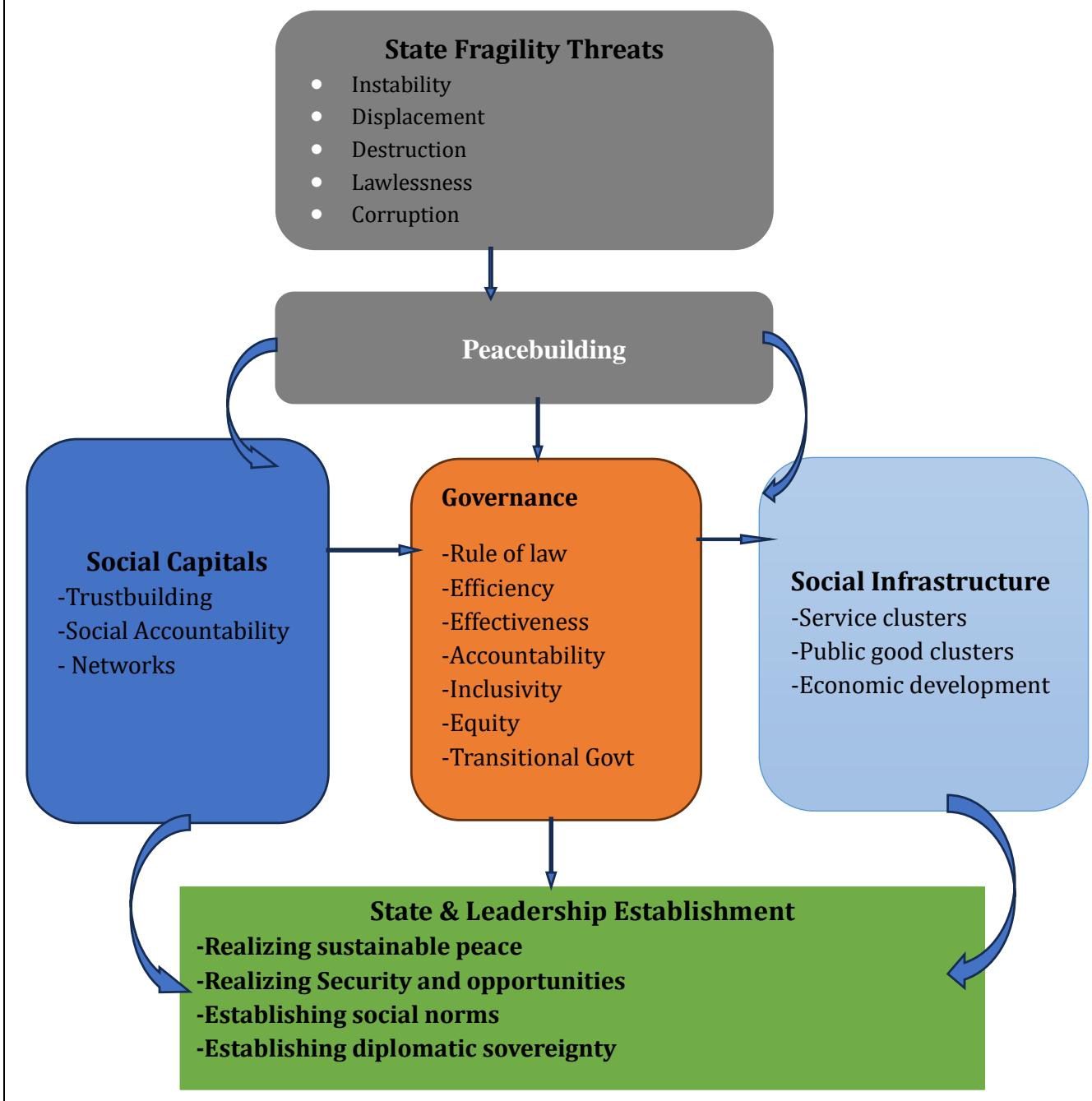 a) The Proposed Conceptual Framework
## i. Conceptual Framework Interrelations Explanation
Social capital, governance, social infrastructure, state establishment, and leadership interrelatedness have a philosophical and foundational dimension to transforming states from political instability to sustainable resilience. These interrelatedness dimensions encourage a holistic system that regulates state national identity and political legitimacy. The interrelated factors synergise the difference between a flourishing society and one that breaks down under the heavy weight of lawlessness, displacement, corruption, and destruction. For instance, this transformation's core is social capital, which comprises trust-building, social accountability, networks, and peacebuilding.
Fragile states' trust is often the first casualty of war, repression, or systemic neglect. Rebuilding trust is the most crucial step toward recovery, reconstruction, rehabilitation, and restoration of the public's political confidence in the state's ruling elites. According to the World Bank (2024), nearly $70\%$ of people in low-income, conflict-affected countries distrust their government, compared to less than $30\%$ in stable, high-income democracies. This distrust freezes civic engagement and weakens the state's legitimacy.
In reality, trust building is more than just a moral imperative—it is a strategic necessity. Building trust between political elites and ethnic affiliates fosters cooperation among citizens, encourages participation in government, and nurtures the belief that change is inevitable. Trustbuilding is linked to social accountability, enabling communities to monitor public spending, demand transparency, and hold leaders responsible for their actions (Brezzi et al., 2021). For instance, a randomised controlled experiment in Uganda found that community-based monitoring of health service providers led to a $33\%$ reduction in child mortality and significant improvements in service delivery (Health and Human Rights Journal, 2015). Such outcomes demonstrate how trust and social accountability create responsive governance.
Networks ranging from grassroots organisations to faith-based institutions serve as the conduit through which trust and accountability flow, connecting citizens to these institutions. For instance, in the conflict-affected state of the Central African Republic, local peace committees and civil society coalitions have played a fundamental role in mediating disputes and facilitating local governance where the state is absent (Brezzi et al., 2021). Social networks are indispensable to peace-building as they provide platforms for dialogue, reconciliation, and the reintegration of internally displaced populations; thus, without social networks, the social fragmentation that fuels cycles of violence cannot be repaired (Brezzi et al., 2021).
More importantly, the magnitudes of social capital are directly determined and shaped by the quality of governance. Good governance is not a luxury but a social infrastructure stabilising state politics. For example, a functioning rule of law safeguards justice and impartiality, ensuring that citizens, state elites, and officials are accountable. In addition, the judicial systems of fragile states are often weak, and impunity fuels corruption and violence. According to Transparency International, corruption levels are ten times higher in fragile states than in more stable ones, creating widespread mistrust and economic stagnation (Transparency International, 2025).
Therefore, effective governance requires efficiency and effectiveness in delivering services. The failure of a state government to provide basic public goods, such as education and healthcare, merely results in a political failure that antagonises citizens and deteriorates state legitimacy. When governance structures systematically exclude specific groups based on ethnicity, region, or gender, this creates an opportunity for insurgency and rebellion. For example, in Nigeria's northeast, decades of marginalisation and lack of investment were key drivers behind the rise of Boko Haram (Bukarti, 2021). Thus, inclusivity and equity are equally vital to resolving ethnic graphic conflict and marginalisation.
Moreover, in the event of state leadership transition, whether in post-conflict or post-authoritarian settings, transitional governments have an opportunity to reorganise the national agenda trajectory. However, their success should be centred on embodying inclusive governance, restoring public trust, and restructuring strong institutions (De'Nyok & Adea, 2024). For instance, transitional arrangements in countries like Tunisia, during the Arab Spring, featured the importance of a broad-based dialogue and constitutional reform in laying the groundwork for sustainable peace (Kefi, 2021).
In addition, governance becomes visible and tangible through social infrastructure—the most direct means citizens access the state's social capital dividends, such as schools, hospitals, and clean water systems. Access to social amenities is a symbol of political stability and an indicator of a government's commitment to its people. When social amenities are poorly managed, the state is perceived as either weak or illegitimate. For instance, according to UNDP, $80\%$ of conflicts in fragile states are driven by grievances related to misallocating service delivery and resources (UNDP, 2025).
Statistically, public goods such as transportation, energy, and sanitation stimulate economic activity and social interaction, breaking the isolation and fragility. Therefore, investments in economic development to empower youth employment and rural enterprise discourage circumstances that lead to militancy, crime, and mass migration. For instance, every $1\%$ increase in youth unemployment correlates with a $2\%$ increase in the likelihood of political violence in fragile settings (OECD, 2025). Thus, economic opportunity is not only a development issue but also a peace and security imperative.
A capable and visionary state and leadership establishment is paramount to coordinate and transform societies and their political governance. Socially contracted Leaders must prioritise realising sustainable peace through reconciliation, reparative justice, and inclusive policies. State leaders must work toward realising security and opportunities by not only ensuring the absence of conflict but also the presence of supportive livelihoods and decent dignity. This means that establishing social norms that discard violence and encourage civic responsibility is central to correcting the behaviour of both institutions and citizens for sustainable peace (Nelson et al., 2022).
Equally, establishing diplomatic sovereignty as a means for a state to negotiate, collaborate, and stand at an equal level in the international arena is vital. Fragile states usually depend heavily on external assistance. This external assistance must be complemented by internal sovereignty built on legitimacy and citizen participation. For example, a country like Rwanda has demonstrated how strong leadership and local ownership of development attract foreign investment while maintaining an independent domestic policy (Mugabekazi, 2024).
Therefore, the conceptual framework variables are intended to converge, tackling the core threats of fragility: instability, displacement, destruction, lawlessness, and corruption. To exemplify, a state with functioning institutions, engaged citizens, equitable services, and visionary leadership is inherently more resilient. The state absorbs shocks, resolves conflicts without violence, and offers hope instead of despair. In contrast, states that fail to integrate these components remain vulnerable to collapse. For example, Yemen's failure to establish inclusive governance and deliver essential services directly contributed to a civil war that displaced over 4.5 million people and plunged the country into one of the world's worst humanitarian crises (OECD, 2024).
Last but not least, the path from fragility and its vulnerability traps to political stability and good governance is neither linear nor straightforward, but it is achievable. Neutralising political fragility requires a robust, strategic, integrated paradigm shift approach, harnessing the power of social capital, strengthening governance, investing in physical infrastructures, and cultivating ethical and visionary leadership. These paradigm shifts and pragmatic approaches are sequentially built: trust builds accountability, accountability improves governance, governance enables service delivery, services reinforce peace, and leadership sustains the entire cycle. Finally, the proposed conceptual framework forms the foundation for a peaceful, equitable, and resilient state capable of overcoming the systemic threats of fragilities and its vulnerability traps.
## V. CONCLUSION
In conclusion, achieving permanent peace in Africa's fragile states requires a transformative shift in how peacebuilding, governance, and development are conceptualised and implemented. Historically, many peacebuilding efforts throughout the African continent have been fixated on shallow ceasefires, power-sharing agreements, and post-conflict elections at the expense of addressing the structural and systemic factors contributing to state fragility. These interventions, although they seem successful in halting immediate violence, have failed to address the root causes of conflict, including institutional weakness, exclusionary governance, socio-economic inequality, and the persistent failure of the state to meet the needs of its citizens.
Fragility in Africa is not merely the absence of peace but also the persistent ineptitude of the state, which abdicates its basic responsibilities to deliver critical services such as education, health, security, infrastructure, and justice. For instance, in many fragile states, public institutions exhibit weak governance or are overly politicised to function effectively. Citizens often perceive the state as disengaged or a predatory actor, rather than a reliable provider of services and protector of rights. This disengagement causes widespread disillusionment, undermines social cohesion, fuels recurring cycles of unrest, rebellion, and violent extremism, deepens divisions, and perpetuates fragility. Thus, governance and service delivery are fundamental instruments of building a fragile state. As public services become equitable, efficient, and inclusive, citizens and state elites are bonded together to safeguard security and social cohesion.
Finally, rethinking the pursuit of permanent peace in Africa's fragile states requires strategic paradigm shifts and a pragmatic approach from short-term stabilisation to sustainable transformation. This traditional peacebuilding approach requires reversing elite-driven political settlements with envisioned inclusive governance models prioritising local agency, citizen participation, and institutional resilience. Sustainable peace cannot be imposed from the top down or outside; it must be owned by the grassroots who grapple with the realities of African political fragility.
## VI. RECOMMENDATION
### a) Enhance Local Ownership and Inclusion
To achieve peace, the participation efforts of traditional leaders, grassroots movements, community-based organisations, youth, and women must be relentlessly sought, as they are the key architects of peacebuilding and the governance process. This means that bottom-up solutions must be locally driven, reflecting diverse perspectives and cultural contexts. Thus, building peace from the bottom up enhances legitimacy, ownership, and the likelihood of long-term success.
### b) Strengthen Public Institutions and Promote Accountability
Robust institutions are the foundation of peaceful and resilient states in which Fragile governments invest in solidifying administrative capacity, the rule of law, and transparency. This solidified administrative capacity includes permitting independent judiciaries, strengthening parliamentary oversight, and creating effective anti-corruption bodies. For instance, public service delivery should be professionalised, depoliticised, and monitored through citizen feedback mechanisms to ensure efficiency and equity. Political will is not just a matter of technical assistance; it is essential to drive these reforms.
### c) Enhance the Quality and Equity of Basic Service Delivery
- Access to primary services is mainly a development issue, central to peacebuilding, and disparities in education, healthcare, clean water, electricity, and transportation are usually mirrored in the socio-political divides that fuel conflict. In simple terms, governments and development partners must ensure that service delivery systems are inclusive, needs-based, and reach remote and marginalised populations; thus, investing in human capital and infrastructure encourages both a peace dividend and a development imperative.
d) Integrate Peacebuilding with Broader Development Strategies
- Peacebuilding must be mainstreamed into national development planning and budgeting processes by aligning peace efforts with poverty reduction strategies, infrastructure development, economic reforms, and job creation. In addition, root causes of state fragility, such as land disputes, identity-based exclusion, and intercommunal tensions, should be overtly tackled through long-term planning that balances immediate needs with structural transformation.
e) Strengthen Regional and Continental Cooperation
Conflict and fragility infrequently remain confined within national borders. According to the MENA Report (2024), the African Union (AU) and Regional Economic Communities (RECS) must strengthen their capacity for early warning, conflict prevention, and post-conflict reconstruction and recovery. A fragile state must encourage more robust implementation of the African Peer Review Mechanism (APRM) and the African Governance Architecture (AGA) to support democratic Accountability and governance reforms. Cross-border cooperation on issues like arms trafficking, migration, and natural resource management is critical in managing the adverse effects to minimise regional drivers of fragility.
f) Reform International Engagement and Peacebuilding Approaches
- The international community must recalibrate its engagement in fragile African states by providing long-term donor-driven projects through country-led strategies that support systemic reform and institutional capacity building. Foreign aid conditionalities should encourage inclusive governance and social Accountability rather than perpetuating state elite bargains. Moreover, tailored peacebuilding financing should be more flexible, predictable, and responsive to locally identified priorities.
g) Invest in Evidence, Data, and Adaptive Learning
Effective governance and peacebuilding need sound strategies and continuous learning. For instance,
National statistical agencies and research institutions must invest in producing disaggregated data that informs policy and monitors progress. International actors and governments must support adaptive programming that evolves in response to changing contexts and lessons learned. A strong knowledge base is essential for identifying what works, where, and why in fragile and conflict-affected settings.
Generating HTML Viewer...
References
32 Cites in Article
C Adam,S Dercon (2009). The political economy of development: an assessment.
R Bereketeab (2017). State Building and National Identity Reconstruction in the Horn of Africa.
G Bertocchi,A Guerzoni (2011). The Fragile Definition of State Fragility.
Martina Björkman,Jakob Svensson (2009). Power to the People: Evidence from a Randomized Field Experiment on Community-Based Monitoring in Uganda<sup>*</sup>.
M Brezzi (2021). An updated OECD framework on drivers of trust in public institutions to meet current and future challenges.
A Bukarti (2021). Violent Extremism in Sub-Saharan Africa: Lessons from the Rise of Boko Haram.
J Cilliers,T Sisk (2013). Assessing Long-Term State Fragility in Africa: Prospects for 26 "More Fragile" Countries.
T Claridge (2014). What are the different types of social capital? Social Capital Research.
T Claridge (2024). New Research Report on Social Capital in Guernsey Unveiled • Institute for Social Capital.
M De'nyok (2025). The Impacts of State Instability on Services Delivery in Post-Conflict South Sudan.
M De'nyok (2023). The Causality of a Political Fragility on Transitional Post-Conflict States in Africa’s Democratization Perspectives.
M De'nyok,M Adea (2024). The Roles of Service Leadership in South Sudan's Transitional Governance and Institutional Performances.
Karl Hughes,Claire Hutchings (2012). Can we obtain the required rigour without randomisation?.
J Frieden (2020). The Political Economy of Economic Policy.
A Kabir (2019). Research Design and Methodology.
Guo (2024). Local state leadership: Stateleading groups in governing urban China.
Tobin John,Barrett Damon (2015). s.One Norms and Principles, 3 The Right to Health and Health-Related Human Rights.
R Kéfi (2021). Tunisia: Civil Society, the Driving Force behind the Democratic Transition. Www.iemed.
J Koehler,M Lasker (2017). Unknown Title.
Y Lennox (2024). Unknown Title.
C Mcloughlin (2014). Social Development, Conflict and Humanitarian Knowledge Services.
(2024). Des Dcaf International Security Sector Advisory Team (issat).
Money Masterpiece (2023). Unknown Title.
G Mugabekazi,Nelson (2022). Social infrastructure as a proxy for social capital: A spatial exploration into model specification and measurement impacts in Los Angeles, California.
(2024). OECD Survey on Drivers of Trust in Public Institutions – 2024 Results.
(2025). States of Fragility 2025.
Patrícia Rosvadoski-Da-Silva,Ricardo Corrêa Gomes,Leonardo Pinheiro Deboçã (2021). Theoretical Approaches to the Fragility of States: Proposal for a Comprehensive Model from Political Legitimacy in Statehood Construct.
Seashore Louis (2008). State Leadership for School Improvement: An Analysis of Three States.
(2025). Index.
(2025). Figure 2.7. Transparency International Corruption Perceptions Index.
(2023). Unknown Title.
E Vivares (2020). The Routledge Handbook to Global Political Economy.
No ethics committee approval was required for this article type.
Data Availability
Not applicable for this article.
How to Cite This Article
Dr. Miyar Ezekiel De Nyok. 2026. \u201cRethinking the Search for Permanent Peace in Africa’s Fragile States: The Governance and Service Delivery Outlooks\u201d. Global Journal of Human-Social Science - F: Political Science GJHSS-F Volume 25 (GJHSS Volume 25 Issue F2): .
Explore published articles in an immersive Augmented Reality environment. Our platform converts research papers into interactive 3D books, allowing readers to view and interact with content using AR and VR compatible devices.
Your published article is automatically converted into a realistic 3D book. Flip through pages and read research papers in a more engaging and interactive format.
Our website is actively being updated, and changes may occur frequently. Please clear your browser cache if needed. For feedback or error reporting, please email [email protected]
Thank you for connecting with us. We will respond to you shortly.