Review:Distribution and Productivity of Dekoko (Pisum sativum var. abyssinicum) in Ethiopia

Berhane Gebreslassie
Bahir Dar University Bahir Dar University

Send Message

To: Author

Review:Distribution and Productivity of Dekoko (Pisum sativum var. abyssinicum) in Ethiopia

Article Fingerprint

ReserarchID

H61G7

Review:Distribution and Productivity of Dekoko (Pisum sativum var. abyssinicum) in Ethiopia Banner

AI TAKEAWAY

Connecting with the Eternal Ground
  • English
  • Afrikaans
  • Albanian
  • Amharic
  • Arabic
  • Armenian
  • Azerbaijani
  • Basque
  • Belarusian
  • Bengali
  • Bosnian
  • Bulgarian
  • Catalan
  • Cebuano
  • Chichewa
  • Chinese (Simplified)
  • Chinese (Traditional)
  • Corsican
  • Croatian
  • Czech
  • Danish
  • Dutch
  • Esperanto
  • Estonian
  • Filipino
  • Finnish
  • French
  • Frisian
  • Galician
  • Georgian
  • German
  • Greek
  • Gujarati
  • Haitian Creole
  • Hausa
  • Hawaiian
  • Hebrew
  • Hindi
  • Hmong
  • Hungarian
  • Icelandic
  • Igbo
  • Indonesian
  • Irish
  • Italian
  • Japanese
  • Javanese
  • Kannada
  • Kazakh
  • Khmer
  • Korean
  • Kurdish (Kurmanji)
  • Kyrgyz
  • Lao
  • Latin
  • Latvian
  • Lithuanian
  • Luxembourgish
  • Macedonian
  • Malagasy
  • Malay
  • Malayalam
  • Maltese
  • Maori
  • Marathi
  • Mongolian
  • Myanmar (Burmese)
  • Nepali
  • Norwegian
  • Pashto
  • Persian
  • Polish
  • Portuguese
  • Punjabi
  • Romanian
  • Russian
  • Samoan
  • Scots Gaelic
  • Serbian
  • Sesotho
  • Shona
  • Sindhi
  • Sinhala
  • Slovak
  • Slovenian
  • Somali
  • Spanish
  • Sundanese
  • Swahili
  • Swedish
  • Tajik
  • Tamil
  • Telugu
  • Thai
  • Turkish
  • Ukrainian
  • Urdu
  • Uzbek
  • Vietnamese
  • Welsh
  • Xhosa
  • Yiddish
  • Yoruba
  • Zulu
Font Type
Font Size
Font Size
Bedground

Abstract

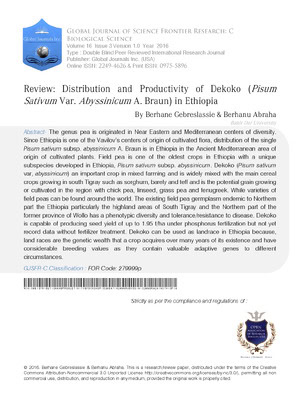
The genus pea is originated in Near Eastern and Mediterranean centers of diversity. Since Ethiopia is one of the Vavilov’s centers of origin of cultivated flora, distribution of the single Pisum sativum subsp. abyssinicum A. Braun is in Ethiopia in the Ancient Mediterranean area of origin of cultivated plants. Field pea is one of the oldest crops in Ethiopia with a unique subspecies developed in Ethiopia, Pisum sativum subsp. abyssinicum. Dekoko (Pisum sativum var, abyssinicum) an important crop in mixed farming and is widely mixed with the main cereal crops growing in south Tigray such as sorghum, barely and teff and is the potential grain growing or cultivated in the region with chick pea, linseed, grass pea and fenugreek. While varieties of field peas can be found around the world. The existing field pea germplasm endemic to Northern part the Ethiopia particularly the highland areas of South Tigray and the Northern part of the former province of Wollo has a phenotypic diversity and tolerance/resistance to disease. Dekoko is capable of producing seed yield of up to 1.95 t/ha under phosphorus fertilization but not yet record data without fertilizer treatment. Dekoko can be used as landrace in Ethiopia because, land races are the genetic wealth that a crop acquires over many years of its existence and have considerable breeding values as they contain valuable adaptive genes to different circumstances.

References

58 Cites in Article
  1. E Agbicodo,C Fatokun,S Muranaka,R Visser,C Linden Van Der (2009). Breeding drought tolerant cowpea: constraints, accomplishments, and future prospects.
  2. M Aslam,N Hussain,M Zubair,S Hussain,M Baloch (2010). Integration of organic & inorganic sources of phosphorus for increased productivity of mungbean (Vigna radiata).
  3. K Atta-Krah (2004). Natural resources management and genetic diversity: Two sides of coin for sustainable livelihoods and development. A Paper Presented to the African Highland Initiative Conference -Integrated Natural Resource Management in Practice: Enabling Communities to Improve Mountain Landscapes and Livelihoods.
  4. A Baranger,G Aubert,G Arnau,A Laine,G Deniot,J Potier,. Burstin,J (2004). Genetic diversity within Pisum sativum using protein-and PCR-based markers.
  5. M Baranyi,J Greilhuber (1995). Flow cytometric analysis of genome size variation in cultivated and wild Pisum sativum (Fabaceae).
  6. George Chemining'wa,J Vessey (2006). The abundance and efficacy of Rhizobium leguminosarum bv. viciae in cultivated soils of the eastern Canadian prairie.
  7. C Chen,P Miller,F Muehlbauer,K Neill,D Wichman,K Mcphee (2006). Winter pea and lentil response to seeding date and micro-and macro-environments.
  8. Cherinet Alem,Tazebachew Asres (2015). Adaptability of Field pea (Pisum sativum L.) Varieties Under Irrigation, Western Amhara Region, Ethiopia.
  9. A Clark (2007). Managing cover crops profitably. 3rd ed. Sustainable agriculture research and education program handbook series 9.
  10. Crozaty Corre-Helloug (2005). Agricultural sample survey: Report on area and production for major crops (private peasant holdings, meher season).
  11. T Cupic,M Tucak,S Popovic,S Bolaric,S Grljusic,V Kozumplik (2009). Genetic diversity of pea (Pisum sativum L.) genotypes assessed by pedigree, morphological and molecular data.
  12. M El-Desuki,M Magda,A Hafez,F Mahmoud,Abd El-Al (2010). Effect of organic and biofertilizers on the plant growth, green pod yield, quality of pea.
  13. M Elvira-Recuenco,J Bevan,J Taylor (2003). Differential responses to pea bacterial blight in stems, leaves and pods under glasshouse and field conditions.
  14. T Elzebroek,K Wind (2008). Guide to cultivated plants.
  15. J Esquinas-Alacazar (2005). Protecting crop genetic diversity for food security: political, ethical and technical challenges.
  16. M Farooq,A Wahid,N Kobayashi,D Fujita,S Basra (2009). Plant drought stress: effects, mechanisms and management.
  17. S Fondevilla,T Carver,M Moreno,D Rubiales (2007). Identification and characterization of sources of resistance to <i>Erysiphe pisi</i> Syd. in <i>Pisum</i> spp..
  18. S Fondevilla,D Rubiales,M Moreno,A Torres (2008). Identification and validation of RAPD and SCAR markers linked to the gene Er3 conferring resistance to Erysiphe pisi DC in pea.
  19. Gemechu Keneni,Fassil Assefa,M Imtiaz,Endashaw Bekele (2013). Genetic diversity for attributes of biological nitrogen fixation in Abyssinian field pea (Pisum sativum var. Abyssinicum) germplasm accessions.
  20. Girmay Tesfay,Girmay Gebresamuel,Alem Gebretsadik,Abrhaley Gebrelibanos,Yemane Gebremeskel,Tesfay Hagos (2014). Participatory Rural Appraisal Report: Raya-Azebo Woreda, Tigray Region.
  21. N Grünwald,V Coffman,J Kraft (2003). Sources of Partial Resistance to Fusarium Root Rot in the <i>Pisum</i> Core Collection.
  22. Věra Hadačová,Věra Turková,E Hadač,Eva Klozová (1980). Comparison of seed proteins of some representatives of the genusPisum from the point of view of their relationship comparison by disc electrophoresis.
  23. Haddis Yirga,Dargie Tsegay (2013). Characterization of Dekoko (Pisum sativum var. abyssinicum A.Bruan) accessions by qualitative traits in the highlands of Southern Tigray, Ethiopia.
  24. F Hassan (2002). Droughts, Food and Culture: Ecological Change and Food Security in Africa's Later Prehistory.
  25. (2007). Ethiopia: Country Report on the State of PGRTA to FAO.
  26. Abebe M. Aga,Demise Mulugeta,Atsbeha Gebreegziabxier,Jemal Mohammed,Anberber Alemu,Yewenshet Tesera,Frehiwot Mulugeta,Bedasa Gidisa,Jaleta Bulti,Gemechu Tadesse,Dereje Nigussei (2006). The Impact of Vaccination on RT-PCR Cycle Threshold Values for COVID-19: Insights for Future Pandemic Preparedness.
  27. M Jeuffroy,B Ney (1997). Crop physiology and productivity.
  28. T Kelley,P Parthasarathy Rao,H Grisko-Kelley (2000). The Pulse Economy in the Mid-1990s: A Review of Global and Regional Developments.
  29. Keneni Gemechu,Assefa Fassil,M Imtiaz,Bekele Endashaw (2013). Genetic diversity for attributes of biological nitrogen fixation in Abyssinian field pea (Pisum sativum var. abyssinicum) germplasm accessions.
  30. Kiros Wolday,Araya Alemie,Yemane Tsehaye (2015). Growth Response of Dekoko (Pisum sativum var. abyssinicum) to Nitrogen and Phosphorus Fertilizers at Enderta Woreda, Northern Ethiopia.
  31. Rajesh Manasi,V Kumar,Ask Rajesh,N (2014). Biosorption of cadmium using a novel bacterium isolated from an electronic industry effluent.
  32. A Martín-Sanz,J Palomo,M De La Vega,C Caminero (2011). Identification of pathovars and races of Pseudomonas syringae, the main causal agent of bacterial disease in pea in North-Central Spain, and the search for disease resistance.
  33. A Martín‐sanz,M Pérez De La Vega,C Caminero (2012). Resistance to <i>Pseudomonas syringae</i> in a collection of pea germplasm under field and controlled conditions.
  34. Nigel Maxted,Mike Ambrose (2001). Peas (Pisum L.).
  35. R Mcgee (2011). Unknown Title.
  36. C Messiaen,A Seif,M Jarso,G Keneni (2006). Pisum sativum L. Record from Prota-base.
  37. Aleksandar Mikić,Branko Ćupina,Vojislav Mihailović,Ðorđe Krstić,Vuk Đorđević,Vesna Perić,Mirjana Srebrić,Svetlana Antanasović,Ana Marjanović-Jeromela,Borislav Kobiljski (2012). Forage Legume Intercropping in Temperate Regions: Models and Ideotypes.
  38. A Mikić,V Mihailović,V Dimitrijević,S Petrović,B Ćupina,V Đorđević,. Milovac,Ž (2013). Evaluation of seed yield and seed yield components in red-yellow (Pisum fulvum) and Ethiopian (Pisum abyssinicum) peas.
  39. Aleksandar Mikic,Vojislav Mihailovic (2014). 10.5937/ratpov51-5072 = Significance of genetic resources of cool season annual legumes: II: Neglected and underutilised crops.
  40. Raghvendra Mishra,Baniekal Gangadhar,Akula Nookaraju,Sushil Kumar,Se Park (2012). Development of EST‐derived SSR markers in pea (<i>Pisum sativum</i>) and their potential utility for genetic mapping and transferability.
  41. J Mussa,W Tezera,K Gemechu (2006). Review of Field Pea (Pisum sativum L.) Genetics and Breeding Research in Ethiopia.
  42. A Sentayehu (2009). Assessment of Nutrient Contents of Different Field Pea Genotypes (Pisium Sativum L.) in South west Ethiopia.
  43. U Singh (1985). Nutritional quality of chickpea (Cicer arietinum L.): current status and future research needs.
  44. Petr Smýkal,Gregoire Aubert,Judith Burstin,Clarice Coyne,Noel Ellis,Andrew Flavell,Rebecca Ford,Miroslav Hýbl,Jiří Macas,Pavel Neumann,Kevin Mcphee,Robert Redden,Diego Rubiales,Jim Weller,Tom Warkentin (2012). Pea (Pisum sativum L.) in the Genomic Era.
  45. K Tanno,G Willcox (2006). The origins of cultivation of Cicer arietinum L. and Vicia faba L. Early finds from Tell el-Kerkh, north-west Syria, late 10th millennium B.P.
  46. Y Toğay,N Toğay,Y Doğan,V Ciftci (2005). Effects of nitrogen level and forms on the yield and yield components.
  47. A Vershinin,T Allnutt,M Knox,M Ambrose,N Ellis (2003). Transposable elements reveal the impact of introgression, rather than transposition, in Pisum diversity, evolution, and domestication.
  48. H Wang,T Ng (2007). An antifungal peptide from red lentil seeds.
  49. Norman Weeden,Ambrose Mj (2004). AN ISOZYME LINKAGE MAP FOR PISUM SATIVUM.
  50. N Weeden,R Murphy,V Lorenzi (2001). The gene responsible for serrate leaflets in P.sativum ssp. abyssinicum is on linkage group III tightly linked to an STS marker.
  51. N Weeden,B Wolko (2001). Pisum sativum (Garden Pea).
  52. W Wetterstrom (2006). Food, fuels, and fields: progress in African archaeobotany.
  53. A Yemane,A Skjelvåg (2002). The physicochemical features of Dekoko (Pisum sativum var. abyssinicum) seeds.
  54. A Yemane,A Skjelvåg (2003). Effects of Fertilizer Phosphorus on Yield Traits of Dekoko (<i>Pisum sativum</i> var. <i>abyssinicum</i>) Under Field Conditions.
  55. Asgedom Yemane,Arne Skjelvåg (2003). Physicochemical Traits of Dekoko (Pisum sativum var. abyssinicum) Seeds.
  56. Z Zdunczyk,I Godycka,R Amarowicz (1997). Chemical composition and antinutritional factors in Polish cultivars of pea.
  57. D Zohary,M Hopf,E Weiss (2012). Domestication of plants in the old world.
  58. X Zong,R Ford,R Redden,J Guan,S Wang (2009). Identification and analysis of genetic diversity structure within Pisum genus based on microsatellite markers.

Funding

No external funding was declared for this work.

Conflict of Interest

The authors declare no conflict of interest.

Ethical Approval

No ethics committee approval was required for this article type.

Data Availability

Not applicable for this article.

How to Cite This Article

Berhane Gebreslassie. 2016. \u201cReview:Distribution and Productivity of Dekoko (Pisum sativum var. abyssinicum) in Ethiopia\u201d. Global Journal of Science Frontier Research - C: Biological Science GJSFR-C Volume 16 (GJSFR Volume 16 Issue C3).
Download Citation

Journal Specifications

Crossref Journal DOI 10.17406/GJSFR

Print ISSN 0975-5896

e-ISSN 2249-4626

Keywords
Classification
GJSFR-C Classification FOR Code: 279999p
Version of record

v1.2

Issue date
August 24, 2016

Language
en
Experiance in AR

Explore published articles in an immersive Augmented Reality environment. Our platform converts research papers into interactive 3D books, allowing readers to view and interact with content using AR and VR compatible devices.

Read in 3D

Your published article is automatically converted into a realistic 3D book. Flip through pages and read research papers in a more engaging and interactive format.

Article Matrices
Total Views: 3685
Total Downloads: 1949
2026 Trends
Related Research
Our website is actively being updated, and changes may occur frequently. Please clear your browser cache if needed. For feedback or error reporting, please email [email protected]

Request Access

Please fill out the form below to request access to this research paper. Your request will be reviewed by the editorial or author team.
X

Quote and Order Details

Contact Person

Invoice Address

Notes or Comments

This is the heading

Lorem ipsum dolor sit amet, consectetur adipiscing elit. Ut elit tellus, luctus nec ullamcorper mattis, pulvinar dapibus leo.


High-quality academic research articles on global topics and journals.

Review:Distribution and Productivity of Dekoko (Pisum sativum var. abyssinicum) in Ethiopia

Berhane Gebreslassie
Berhane Gebreslassie <p>Bahir Dar University</p>

Research Journals