
I. INTRODUCTION
The choice of ideal method like MET or URS to treat lower ureteric calculi depends on the type of equipment available, type and size of stone, needs of the patient and skills of the surgeon [1]. The stone burden remains the primary factor in deciding the appropriate treatment for a patient with ureteric calculi [2].
Expectantly managed patients who develop recurrent pain, sepsis, or compromised renal function need drainage if necessary followed by stone clearance using endoscopy or extracorporeal shock wave lithotripsy [3].
The smooth muscle relaxant drug tamsulosin (an -adrenoceptor antagonist) is a possible agent, its use being termed medical expulsive therapy (MET)[4]. Meta-analyses of data from randomised controlled trials (RCTs) report a statistically significant benefit fortamsulosin over controls for the outcome of spontaneous stone passage [5,6].
Where a failed expectant treatment may well be complicated with hydro-nephrosis, deranged renal function or urosepsis. Interventional techniques are not always free of complications and failures. Most of the work of the efficacy of tamsulosin in lower ureteric calculi expulsion has been done in western affluent countries with variable results. The disease spectrum in a developing country like ours is different from that of developed countries, mainly because of delay in diagnosis, delay in investigations and lack of awareness that tend to modify outcome in case of ureteral stones or for that matter any disease. More so, advanced interventional facilities in this part of the world are not easily available. A prospective study was thus planned to compare the tamsulosin group with a control group in our setup to evaluate the efficacy of tamsulosin for lower ureteric calculi expulsion within a few days without the need for hospitalisation, common endoscopic treatment or shock wave lithotripsy.
II. METHODOLOGY
After taking clearance/permission from the ethical committee of our hospital we did a Prospective randomised control study from feb 2014 to feb 2017 including 600 subjects in age group of 20-50 years with unilateral ureteric calculi of size 4mm-10mm. Patients having acute renal failure, chronic renal failure, urinary tract infection, fever & who have recently undergone surgery for ureteric calculi were not included in the study. The study group was given cap Tamsulosin 0.4mg& tablet Dytor 10mg once daily for a maximum of 2 weeks or till the stone was passed (whichever was earlier). Analgesic (table tdiclofenac 100mg) was given as needed. The control group was given analgesic and diuretic tablets only for same period. During the study time a ultra sonography (KUB)was done on day 0 of starting tamsulosin treatment followed by on day 7, day 14 and day 17. Results were compared between the study group and the control group in terms of stone passage rate, time taken to pass the stone, pain score during the treatment period, number & frequency of colic episodes and need for surgical intervention. Data was entered into MS word & Microsoft excel data sheet. Data was analysed using MS Excel, SPSS version 22 (IBM SPSS Statistics, Somers NY, USA). SPSS 22 version software. Categorical data was represented in the form of frequencies and proportions. Chi-Square test was used as test of significance. Continuous data was represented as mean and standard deviation. Independent t test (student's t test) was used as test of significance to identify the mean difference between two groups.p value < 0.05 was considered as statistically significant. Patients were randomized by using computer generated randomization from web site Randomization.com http://www.randomization.com. Double blinding was followed during the study period.
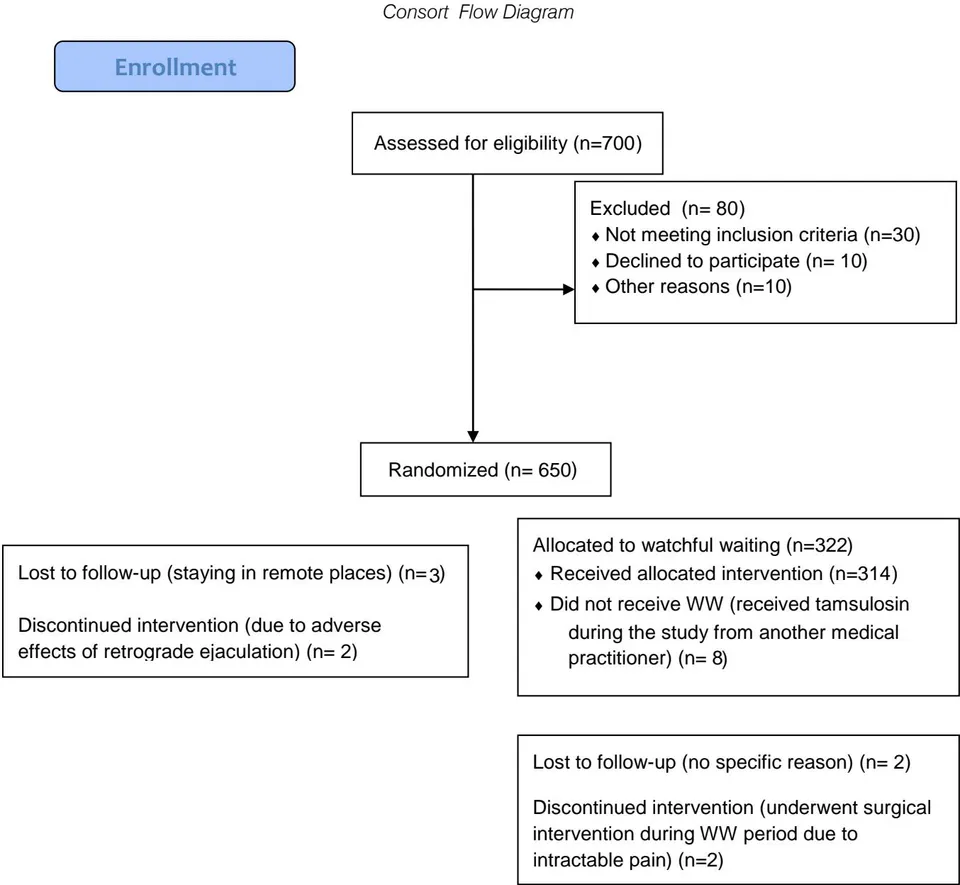
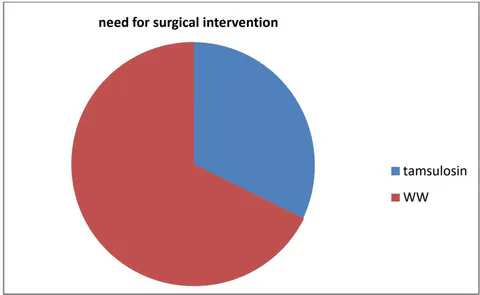
All patients in our study were between the age group of 20-50 years. In our study the incidence of ureteric calculi was found to be more in males (81.44%) as compared to females (18.54%). We found incidentally that more stones were on the right side (51.61%) as compared to the left side (48.38%). No patient in group 1 had pain score in the range of 8-10 whereas 3.22% of patients in group 2 had a pain score in the range of 8-10. 83.87% of stones in group 1 & 62.90% stones in group 2 passed out successfully. 17.74% of patients in group 1 & 37.09% of patients in group 2 needed surgical intervention. However the need for surgical intervention for stone size up to 6mm was same in both the groups.
| Mean age | Male | female | Left side stones | Right side stones | Mean stone size (USG) | ||
| Group | Tamsulosin | 35.6 ± 8.5 | 230(74.2%) | 80(25.8%) | 165 | 145 | 7.5 ± 1.5 mm |
| WW | 35.9 ± 8.1 | 275(88.7%) | 35(11.3%) | 135 | 175 | 7.7 ± 1.4mm | |
| p value | 0.697 | <0.001 | 0.016 | 0.132 | |||
| Passed calculi in <14 days (%) | Not passed calculi | Mean no. of colic episodes | Mean pain score | Need for hospitalisation during treatment | Need for surgical intervention | ||
| groups | Tamsulosin | 260 (83.87%) | 50 (16.12%) | 3 ± 1.7 | 4.1 ± 1.7 | 75 | 55 (17.74%) |
| WW | 195 (62.9%) | 115 (37.09%) | 4.2 ± 2.2 | 5.1 ± 1.8 | 135 | 115 (37.09%) | |
| p value | <0.001 | <0.001 | < 0.001 | < 0.001 | <0.001 | <0.001 | |
IV. DISCUSSION
Treatment modalities for ureteral stones have greatly changed during the last 20 years, especially following the introduction of minimally invasive procedures such as extra-corporeal shock wave lithotripsy and uretero-renoscopy. The advantage of the medical expulsive therapy is important, because the risks which are related to a surgical intervention are not trivial [7]. Studies have reported the overall complication rates after ureteroscopic lithotripsies to be 10–20%, with major complications such as ureteral perforations, avulsions and strictures occurring during 3–5% of the procedures [7]. Urinomas and sub capsular bleeds have been reported in 15–32% of the patients who are treated with shock wave lithotripsy [8]. Hollingsworth et al reported a 1.1% overall prevalence of MET use between 2000 and 2006 in emergency departments in the USA, with a missed opportunity of sparing approximately 260,000 individuals annually from stone surgery[9]. of urolithiasisare located in the lower third of the ureter. Determining factors for spontaneous passage of stones are their size, their configuration, and the smooth muscle activity of the ureters. In the transport of stones, the greatest obstacle is usually the terminal part of the ureters, mainly in the intramural 'detrusor tunnel. Antagonists of the alpha-1-adrenergic receptor, in particular, inhibit basal tone and decrease peristaltic frequency and amplitude with the consequences of increased fluid transport and decreased intra-ureteral pressure; they also block the conduction of visceral referred pain to the central nervous system, acting on C-fibres or sympathetic postganglionic neurons [10,11,12,13]. Both the European (EAU) and American Urological Associations (AUA) outline the role of alpha-blockers as a viable option in a select patient population who are comfortable with the approach and where there is no role for immediate surgical stone removal [14,15]. The role of alpha-blockersin MET has been well described[14-15]. The role of adrenergic receptors in the human ureter was first described in 1970 [16]. It was shown later, that the alpha-adrenergic receptors were classified into three different subtypes &the distribution in the human ureter was [17]. It was also shown that the alpha-adrenergic receptor agonists had a stimulatory effect on the ureteral smooth muscle, whereas the beta-adrenergic receptor agonists had an inhibitory effect [18]. They prevent the uncoordinated muscle activity which is seen in renal colic, while maintaining ureteral peristalsis, which might facilitate a spontaneous stone passage [19]. The treatment effect on the expulsion rate was partially lost, as the sizes of the stones decreased, because of the high spontaneous expulsion rate of the small stones [2,20]. Our study included only solitary ureteral calculi & located in the distal one third of the ureter. Current best practice guidelines recommend alpha-blockers for the expulsion of distal ureteral stones. Meta-analyses have demonstrated that patients treated with alpha-blockers are more likely to pass stones with fewer episodes of colic [8,21]. Two recent randomized controlled studies by Al-Ansari et al [22] and Kaneko et al [23] validated the efficacy of tamsulosin for distal ureteral calculi. However, a randomized control trial by Yilmaz et al demonstrated that tamsulosin, terazosin, and doxazosin were equally effective in distal stone expulsion in comparison to the control group [24]. There is no role of tamsulosin orwatchfulwaitingninstonesofrsizen≥n10mmr & Surgical intervention is the treatment of choice. In a recent study by Prof Robert Pickard et al [25] where they gave tamsulosin for 4 weeks they found that spontaneous stone passage, did not differ between groups. Comparing it with other studies we used tamsulosin maximum only for 2 weeks. In our study it was found that the use of tamsulosin increased the stone expulsion rate (83.87% in tamsulosin group compared to 62.9% in control group). We also found that the use of tamsulosin reduced pain and need for surgical intervention (17.74% in tamsulosin group compared to 37.09% in control group).
V. CONCLUSION
In our study incidence of ureteric calculi was found to be more in males in the age group of 31-40 years& on the right side.Use of tamsulosin in MET for lower ureteric calculi upto 9mm helps in expulsion of stone, reduces the need for hospital admission, reduces pain, reduces the need for oral analgesics and reduces the need for surgical intervention. There was no significant difference in number of days required for expulsion of stones between two groups. There was no significant difference in mean size of stone passed in two groups. The possibility of expulsion of ureteric calculi spontaneously or with tamsulosin reduces as the stone size increases (maximum possibility with 5mm and minimum possibility with 9mm). There is no role of tamsulosin/watchful waiting in ureteric calculusofrsizen≥n 10mm. Most common Complications associated with tamsulosin are giddiness, retrograde ejaculation. Tamsulosin therapy is not cost effective than watchful waiting but cost effective than surgical intervention. However our study had only two groups, one study group and one control group. Adding two more groups simultaneously, one with some other alpha blocker drug and one with no drugs given at all, may show us the exact efficacy of tamsulosin