This article explores the role of sacrificial rituals in ancient Greek religious practices, emphasizing their function as a means of establishing and maintaining communion between mortals and the divine. Sacrifices were integral to both individual and collective life, marking key transitions such as birth, initiation, warfare, and civic celebrations. Through an interdisciplinary approach combining literary, iconographic, and archaeological sources, this study examines the typologies of offerings, the material and symbolic significance of altars as the focal point of ritual activity, and the complex interplay between sacrificial practices and sociopolitical structures. Particular attention is given to the ideological and performative dimensions of blood sacrifices, as well as to the debated phenomenon of human sacrifice. By analyzing a broad spectrum of evidence, this article contributes to a nuanced understanding of how ritualized violence functioned as a mechanism of religious expression, social cohesion, and power negotiation in the ancient Greek world.
## I. INTRODUCTION
In Hesiod's Works and Days2, he advises his brother Perses to work diligently and to have Demeter as an ally so that his granaries may always be full and his life prosperous and plentiful. The gods, according to Hesiod, favor those who labor and disdain idleness. Among his many pieces of advice to his brother, Hesiod highlights the importance of maintaining a relationship with the gods, emphasizing that their first gift to humanity is sustenance:
According to your capability, make holy sacrifice to the immortal gods in a hallowed and pure manner, and burn splendid thigh-pieces on the altar; at other times, seek propitiation with libations and burnt offerings, both when you go to bed and when the holy light returns, so that their heart and spirit will be propitious to you, so that you may barter for other people's allotment, not someone else for yours.3
This passage from Hesiod underscores the central role of sacrifice in the maintenance of divine favor. By advising Perses to honor the gods with offerings at specific times, Hesiod highlights the reciprocal nature of human-divine relations in Greek thought – piety and ritual correctness ensure prosperity, while neglect invites misfortune.
Hesiod also provides one of the most comprehensive accounts of the Greek pantheon in his Theogony, detailing the birth of the gods, their hierarchical spheres, and the ideal relationship that mortals must uphold with the divine for their own wellbeing. Beyond describing the origins of the gods and their cosmic order, Hesiod's work also serves as a foundational text for understanding the religious education of the Greeks. Mythological narratives played a fundamental role in Greek education, shaping religious beliefs from an early age. The Hymn to Demeter, for instance, recounts the abduction of Persephone by Hades and the desperate search of her mother,
Demeter, through the dark land, culminating in a compromise that allows Persephone to spend part of the year with the Olympians. When the gods are appeased, the fields bloom, the earth is covered with greenery and fruit, and Demeter and Persephone bestow prosperity upon their faithful followers[^4].
The gods of epic literature observe all human affairs and frequently intervene in mortal lives. A striking example is the extensive list of benefits that Hecate offers to those devoted to her. Hesiod describes how she was greatly favored by the gods, from the Titans to Zeus, who bestowed upon her many privileges, making her a formidable deity. Even in Hesiod's own time, he asserts, any man who invokes Hecate with proper sacrifices and rituals could achieve glory and wealth. Hecate's sphere of influence is vast: she aids orators in courts and assemblies, grants kleros to warriors, ensures victory for athletes and cities, increases fishing yields, expands herds, and nurtures young women. However, her power is also ambivalent, capable of bestowing misfortune as well as favor[^5].
The gods, therefore, hold multiple functions and bear numerous epithets. Zeus, who established divine order by overcoming primordial forces and distributing authority among the Olympians, manifests in various domains: Zeus of Oaths, Zeus of Borders, Zeus Protector of Supplicants and Foreigners, Zeus of Rain, and Zeus of Lightning. From private life to public affairs, from birth to death, human destiny is intrinsically linked to the will of the gods. Given this reality, communion between mortals and the divine is essential at every stage of life. Religious rituals - expressions of the human-divine bond - accompany individuals from birth to death, marking moments of celebration, war, and even truces. Reciprocity defines this relationship: the gods determine human fortune, whether favorable or adverse, while mortals must honor and revere them through sacred observances. Sacrifices stand at the core of this exchange. According to Theophrastus, sacrifices to the gods are performed for three primary reasons: to honor them, to express gratitude for a favor received, or to request divine assistance[^6].
Greek cities maintained extensive calendars of public festivals, reinforcing the continual and enduring connection between the gods and the polis through numerous rituals, particularly sacrificial ones. These festivities also strengthened civic unity. In addition to major festivals, smaller community and family celebrations were held, alongside the four major Pan-Hellenic festivals, during which people and delegations from various poleis gathered. The Olympic and Nemean Games were dedicated to Zeus, the Pythian Games to Apollo at Delphi, and the Isthmian Games to Poseidon.
This study examines the nuances of the relationship between mortals and gods in ancient Greece, with particular focus on sacrifices involving bloodshed. It discusses both the rewards of a harmonious relationship with the divine and the consequences of neglecting such obligations. Additionally, it explores the types of offerings made, the process and circumstances of blood sacrifices, and the central role of the altar as the locus of ritual activity. Drawing on a wealth of literary and archaeological evidence, this analysis primarily engages with epic poetry, tragedy, and iconographic sources.
It is crucial to recognize that the ancient Greek world was neither monolithic nor static in time or space. In the Classical period (5th-4th centuries BCE), Greece extended from Phasis, a Greek colony on the Black Sea, through the coasts of Asia Minor, to Massalia, the southern Italian peninsula, and Sicily, encompassing numerous islands[^7]. This vast territory comprised more than a thousand autonomous cities, each with distinct political structures, economic systems, and social dynamics. While scholars debate the origins and defining elements of Hellenic identity[^8], one unifying factor is indisputable: religion. However, religious practices were not uniform across all poleis - differences in calendars, the prominence of specific deities, and local cultic traditions reflected regional diversity.
The ritual of animal sacrifice exemplifies this variation. As Bremmer observes[^9], sacrifices became more elaborate and specialized during the Archaic period, paralleling the rise of urbanization and economic prosperity. By the 5th and 4th centuries BCE, sacrificial ceremonies featured specialized attire for officiants and increasingly sophisticated rituals centered around the altar. Thus, sacrifice should not be viewed as an immutable practice but rather as a dynamic tradition that evolved in response to the shifting needs, beliefs, and socio-economic conditions of the Greek world.
# a) The Many Gifts to Gods
In the extensive list of gifts offered to the gods, we find objects of all kinds: buildings of worship, statues, artistic artifacts, garments, tools, and even slaves. Eteocles declares that if he defeats the invading army, he will dedicate the enemy's garments, torn by his spear, to the sacred abode of the gods[^10]. Similarly, in Ion, when the protagonist introduces himself to Creusa as a slave of the god, she asks him: "Are you a city's votive gift or were you sold by someone?"[^11].
In a white-ground lekythos from the Classical period, attributed to the Bowdoin Painter (Figure 1), a winged woman is depicted placing or, more likely, collecting offerings from an altar. This figure is presumably Niké, the personification of victory. According to Hesiod[^12], Niké – or Victoria in Latin tradition – is the daughter of Styx and the hybrid deity Pallas. Styx was the first immortal to present herself to Zeus alongside her four children, offering them in service to his cause against the Titans. As a reward, Zeus granted her many honors, including eternal proximity to the Olympians. Hesiod describes Victoria as having beautiful ankles, and she is consistently depicted with wings. In an alternate mythological tradition, she appears closely associated with Athena.
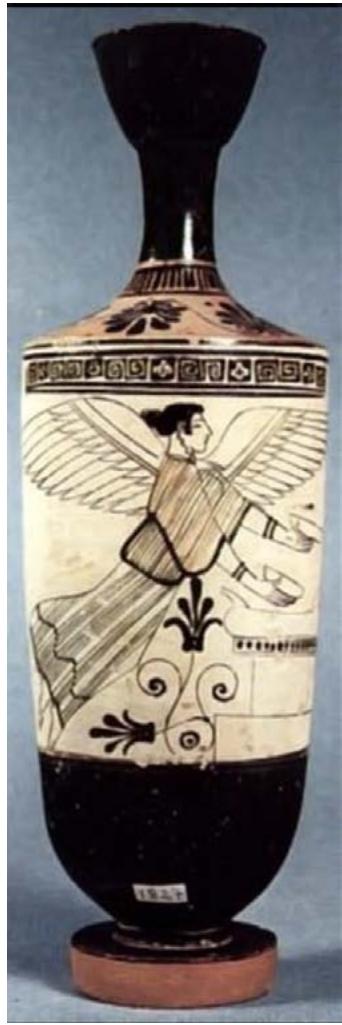 Source: Ribeiro Junior 2000. Fig. 1: Winged woman depositing (or removing) offerings at an altar. White-ground lekythos attributed to the Bowdoin Painter, dated 475-450 B.C. Athens, National Archaeological Museum.
Hesiod's Works and Days (2006b) outlines three principal ways of honoring the gods: animal sacrifices, offerings, and libations. Within this vast spectrum of devotional practices, firstfruits offerings (aparchai) hold a prominent place, particularly in the context of an agrarian and patriarchal society. This type of offering acknowledges the hierarchical order of the cosmos – those who are first (the gods) receive the first portion of human labor[^13]. It was common for a pious farmer to bring the first fruits of his harvest to the shrine. Other offerings could include the bounty of hunting, fishing, or household production, which were either deposited in sacred places for redistribution or entirely destroyed through incineration. In the latter case, the offering transcends into a sacrifice through its complete annihilation[^14].
Votive offerings (anathemata) functioned differently. In this form of devotion, a gift was dedicated to the deity in exchange for divine favor. The nature of the offering varied significantly, ranging from minor personal possessions to substantial donations requiring significant expense. These could include firstfruit offerings, enhanced sacrifices, enslaved individuals destined for temple service, tracts of land integrated into a temple's holdings, or even war spoils. Life's uncertainties – fear, illness, journeys, warfare – often prompted individuals or entire communities to vow gifts to the gods. These vows were made publicly, in the presence of witnesses, reinforcing the reciprocal nature of divine-human relations. Once a request was granted, fulfilling the promise became an obligatory act of piety[^15].
In Figures 2 and 3, we observe warriors cutting their hair in ritual offerings. In an Attic white-ground lekythos (Figure 2), the Nikon Painter depicts a warrior severing locks of his hair as a votive offering before battle. A similar scene appears in Figure 3, where a warrior – the fifth figure from the left – cuts his hair. Thanks to an inscription identifying him as Parthenopeus, this representation has been linked to Aeschylus's Seven Against Thebes. It is possible that the lekythos painting similarly references this tragedy[^16].
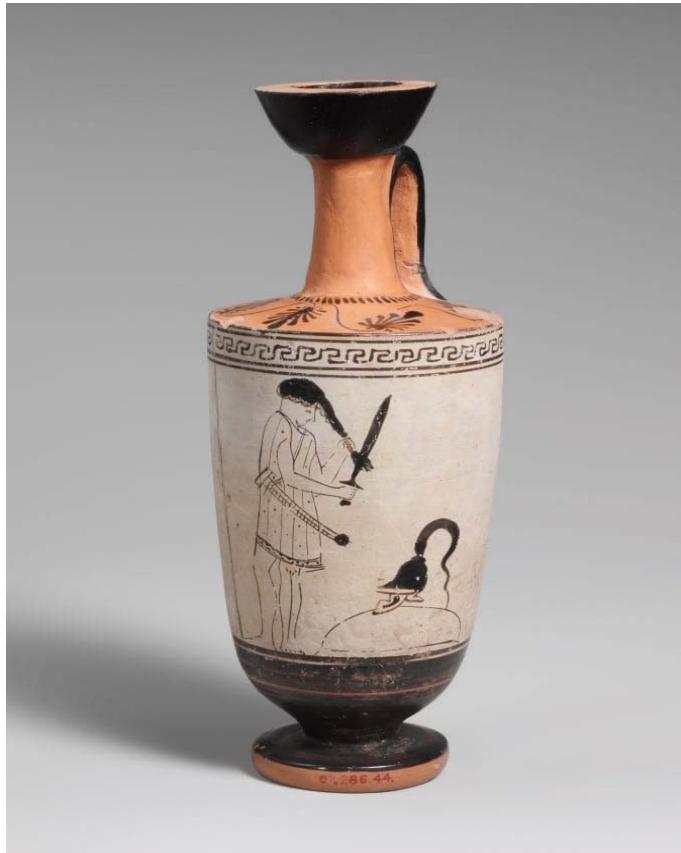 Source: Ribeiro Junior, 2002.
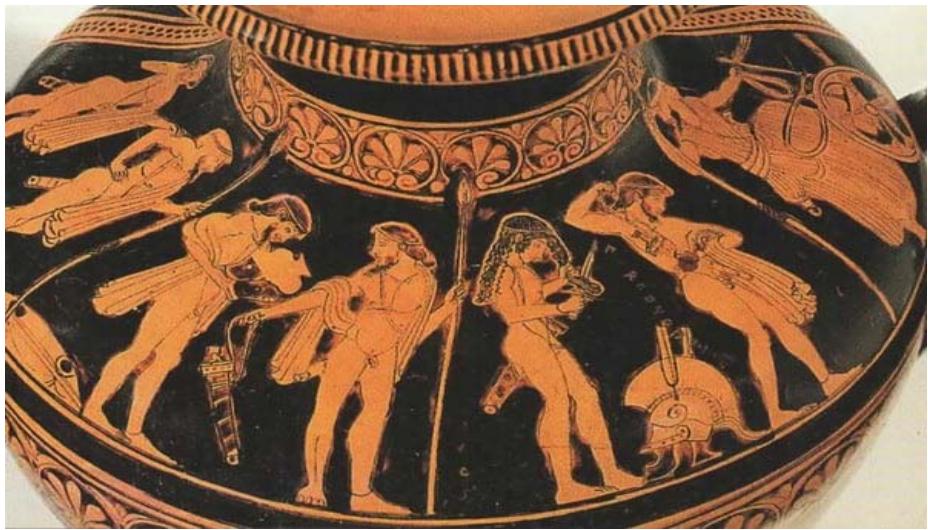 Fig. 2: Warrior cutting his hair. White-ground lekythos attributed to the Yale Painter, dated 470-460 B.C. New York, The Metropolitan Museum of Art. Photo: P. Chabot, 2000 (MET). Source: Ribeiro Junior 2003.
Shigaraki, Miho Museum. The scene depicts a group of warriors preparing for battle. One figure is cutting his hair, possibly as part of a pre-war ritual, while others handle weapons and armor. The composition emphasizes the solemnity of the moment before departure.
According to Aeschylus, Parthenopeus was one of the seven champions of the Argive army, assigned to the fifth gate of Thebes – Boreas. While the depicted warrior appears engaged in a religious act, Parthenopeus himself is described in the play as a youthful, nearly beardless fighter, with no mention of a hair sacrifice. Instead, his defining characteristics are his defiance and impiety. Bold and audacious, he swears by his spear rather than by any god, vowing to take Thebes regardless of Zeus's will. This overconfidence in personal martial prowess, placed above divine authority, is not unique to Parthenopeus; other warriors in Seven Against Thebes display similar arrogance. Capaneus, for instance, openly insults Zeus, boasting that he will raze Thebes with or without divine aid[^17]. Likewise, another Argive, Eteoclus, bears the inscription on his shield: "Not even Ares will cast me from these battlements"[^18]. The hydria (Figure 3) was cataloged in the Beazley Archive, with its decoration attributed to the Seven Against Thebes cycle[^19].
Walter Burkert[^20] observes that "by dedicating his hair, a man offers a part of himself to a higher power; a loss that must be recognized as painless and quickly replaced". While this perspective minimizes the gravity of the act, it is crucial to consider the religious significance of hair offerings. In the koureion, a rite of passage conducted during the Apatouria festival, a young man's entrance into his phratry (kinship group) is marked by an animal sacrifice performed by his father. The culmination of the ceremony occurs when the youth, now accepted into the community, offers a lock of hair to the deity of the phratry[^21]. Similarly, in funerary rites, presenting a lock of hair to the deceased was among the most sacred familial obligations.
In the Atrides saga, Orestes[^22], upon his return to Argos after years of exile, performs sacrifices and libations at his father's grave. His most significant act, however, is the dedication of his hair – a scene depicted in The Libation Bearers (Aeschylus), Electra (Euripides), and Electra (Sophocles). In Euripides's Orestes, Helen, fearing the resentment of the Argives, hesitates to go to Clytemnestra's tomb and instructs Electra to carry an offering of hair and libations. When Electra refuses, unable to face her mother's grave, the task is passed to Hermione.
In general, all deities received offerings, including chthonic ones. Offerings to underworld deities, however, followed rituals fundamentally different from those dedicated to Olympian gods. Chthonic rites took place at night, without an altar, and the sacrificial victim's flesh was entirely consumed in fire, leaving nothing for human feasting. In Gela, Sicily, chthonic deities possessed the largest number of sacred precincts, and their cult was among the most ancient[^23]. Some gods, such as Demeter and Poseidon, encompassed both chthonic and Olympian attributes[^24].
Despite the variety of offerings, the most prestigious was food - particularly animal sacrifice, which Burkert describes as "the sacred act par excellence."[^25] The nature of the bloody sacrifice varied according to the deity and the social context. The most noble victim was the cow (especially the bull), while the most common were sheep, followed by goats and pigs. Poultry such as chickens, geese, and pigeons, as well as fish, were also sacrificed[^26]. Jan N. Bremmer[^27] notes that the age of the sacrificial animal varied by region: in Didyma, adult animals were preferred, while in Kalapodi, younger ones were more commonly sacrificed. Gender and color also played a role; male animals were generally dedicated to gods, while female ones were offered to goddesses. Black animals were typically sacrificed to chthonic deities. Regardless of these variations, the sacrificial victim had to be in perfect condition. Sparta was an exception to this rule, performing small and inexpensive sacrifices, sometimes involving mutilated animals - possibly reflecting its distinctive ideology.
Certain deities had particular preferences: bulls were associated with Zeus and Poseidon; deer and goats with Artemis and Apollo; pigs with Demeter and Persephone. In chthonic rituals, pigs were cast into underground pits dedicated to Demeter and Persephone, their remains retrieved months later by women who then integrated them into agricultural rites to ensure abundant harvests[^28]. This form of sacrifice contrasts sharply with Olympian rituals, where a portion of the victim was retained for communal feasting.
Regardless of its nuances, at the root of sacrifice is the renunciation of precious food resources in the name of a good relationship with the god and the benefits that result from it. Hesiod, in his exhortation to Perses, makes it clear that the sacrifice must be limited to the means of the person making the offering. Bremmer recalls that sacrifice is a ritual obligation that involves an economic issue, as an animal entails a cost. Aegisthus was preparing a sumptuous sacrifice to the Nymphs on his farm when he was murdered by Orestes. Electra, on the other hand, could not afford the same ritual of purification for the supposed birth of her son – an elaborate ruse to lure her mother into a trap and commit matricide. The princess and her husband were very poor; when they received Orestes and his small entourage, they barely had enough to eat[^29]. Yet poverty was no excuse for neglecting divine rites. When Clytemnestra prepares to perform a ritual, usually conducted by a midwife, Electra ensures that the ritual basket and knife are ready. Unlike Electra, Xuthus organizes a grand feast at the Sanctuary of Apollo in Delphi to celebrate the newly discovered son he had long sought: "Let us inaugurate our life together by holding here, where I have found my son, a public banquet, and make the sacrifices omitted at your birth" [^30].
At its core, sacrifice entailed renouncing valuable food resources to maintain harmony with the gods and secure divine favor. Hesiod, in his exhortations to Perses, emphasizes that sacrifices should be proportional to the means of the offerer. Bremmer reminds us that sacrifice was both a religious obligation and an economic decision, as an animal represented a significant expense[^31].
### b) The Altar
While the temple is the abode of the god and a space for the exhibition of offerings[^32], the altar serves as the essential link between humanity and the divine – the locus par excellence of sacrifice. Euripides' Ion provides a vivid depiction of the altar, emphasizing not only its role in sacrificial rituals but also its sacred and inviolable nature, which renders it a place of asylum. Beyond being the focal point of sacrifices, the altar's sacrality also made it a place of divine protection, where supplicants could seek refuge. The orphan Ion, having been raised in the temple of Loxias at Delphi, is responsible for maintaining the temple's exterior, while selected Delphians oversee its interior. He welcomes and guides visitors, ensuring the cleanliness of the sanctuary. With a laurel broom, he dutifully sweeps the altar, and using golden vessels, he draws virgin water from the Castalian spring to sprinkle upon it. Ever vigilant, he wields a bow to drive away birds that threaten to desecrate the sanctuary with their nests and droppings. Ion's entire existence revolves around the temple and its altar, which serve as both his home and his source of sustenance. He eats from the offerings left at the altar[^33], dons the god's garments, and sleeps within the temple precincts[^34].
The altar also functions as a place of refuge for supplicants, as Aeschylus notes: "An altar is stronger than a towering wall; it is an unbreakable shield"35. In Ion, Creusa, upon being discovered attempting to murder her own son under the false belief that he is a bastard of her husband, is condemned by the law of Delphi. Desperate, she clings to the altar, just as she had done before, when she had previously sought divine intervention to conceive a child. Finding her in this position, Ion, though bound by sacred law to respect the sanctity of the altar, is tormented by the injustice of the situation:
O this is monstrous! The laws of god for men are not well made, their judgment is unwise. The unjust should not have the right of refuge at altars, but be driven away. For gods are soiled by the touch of wicked hands. The just, the injured party, should have this asylum. Instead, both good and bad alike all come, receiving equal treatment from the gods.[^36]
Violating the sacredness of the altar can provoke divine wrath. Priam's murder upon the household altar consecrated to Zeus, Ajax's brutal seizure of Cassandra from the altar of Athena, and Agamemnon's impious union with a consecrated maiden all incite Athena's fury. Formerly an ally of the Achaeans, the goddess shifts allegiance and proposes a blood pact with Poseidon, patron of the Trojans. This alliance unleashes calamity upon the victorious Greeks, as storms and divine retribution devastated their fleet during their return voyage[^37].
Maintaining favor with the gods required establishing firm and beneficial bonds, the most appropriate means being animal sacrifice. The altar (bomós) was the designated space where the sacrificial animal, adorned and ritually prepared, was led – supposedly voluntarily. Sacrifice days were festive occasions for the community, marked by ceremonial attire[^38]. Depictions on ceramic vases illustrate ephebes struggling to subdue sacrificial animals, restraining them by their feet or necks. In Euripides' Electra, country maidens learn of the festival of Hera and eagerly invite Electra to join: "The Argives proclaim at large a holy feast, when all the maidens will pass in procession up to the temple of Hera"[^39]. Electra, however, declines, lamenting her disheveled and impoverished state. Unlike the well-adorned Argive women, she disdains gold ornaments and fine attire. Even when her friends offer to lend her elegant robes and jewelry, she refuses. In Figure 4, a sacrificial procession is depicted, showing young women with elaborately styled hair, elegant garments, and crowned heads – contrasting sharply with the image of Electra, whose shaved head, ragged clothes, and utilitarian water vessel set her apart. Unlike the ritual vessels seen in Figure 4, her vessel serves a purely domestic function.
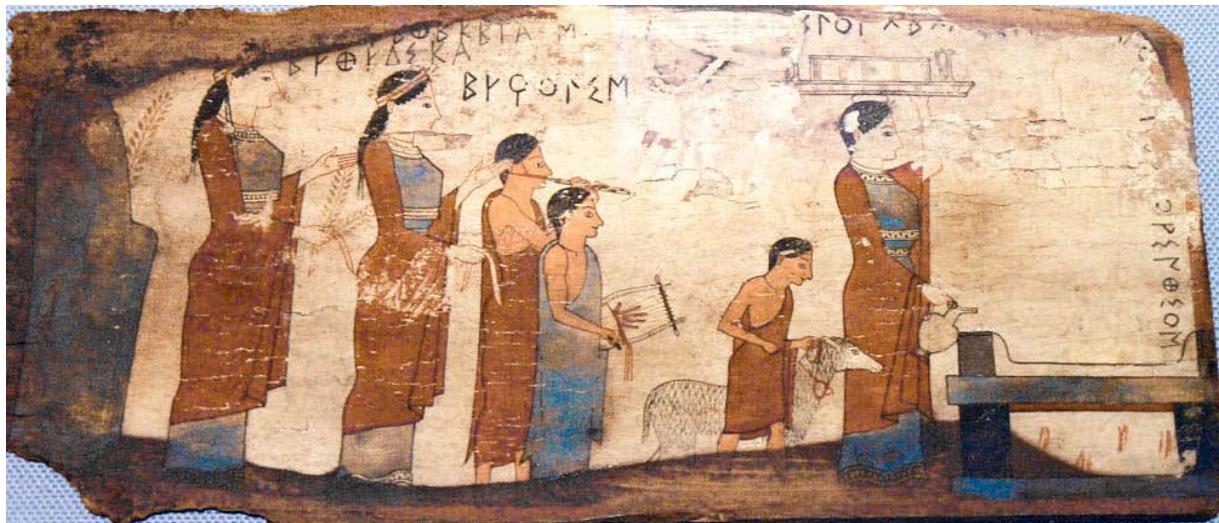 Source: Wikipedia Commons. Accessed April 12, 2022. Fig. 4: Sacrificial Procession. Painting on a wooden panel found in Pitsa Cave, dated to 540 B.C. Athens, National Archaeological Museum. Ekdotike Athenon S.A. Karouzou, National Museum, Athens, 1999.
As depicted in Figure 4, the sacrificial procession advances to the sound of the aulos and lyre, with all eyes fixed upon the altar. The sacrifice is dedicated to an Olympian deity, as indicated by the raised altar. A noble young woman, likely a virgin, pours a jar of lustrous water into another vessel. The fire is already lit, while a young man stands nearby, holding a tray and ritual implements. A boy calmly leads a ram, bound at the neck, towards the altar. Young women carry crowns and ribbons, possibly to adorn the altar and the sacrificial animal.
Bremmer $^{40}$ notes that sacrificial animals were adorned in various ways, depending on the wealth of the offering community - ranging from golden ornaments to more modest decorations such as ribbons and garlands adorning the neck and belly. The ritual depicted in Figure 4 is a collective action, with each participant playing a specific role. Though women dominate the scene, including one standing at the altar, this does not imply that she will conduct the sacrifice. The act of slaughtering the animal was reserved for men, while women traditionally performed the ritual cries (ololygmos) at the moment of the fatal blow $^{41}$.
Eteocles, in Seven Against Thebes, rebukes the chorus of women who despair at the advancing Argive army. To him, their excessive lamentations spread fear and weaken the resolve of Theban warriors. He commands them to remain silent and follow proper ritual protocol: "And when you have heard my prayers too, then raise the sacred chant for victory, with good heart, and follow the Greek custom of crying out over sacrifice, an encouragement for friends, releasing them from war's fear"42.
Any citizen could perform a sacrifice, provided they were ritually pure and free of miasma. Purity was a fundamental requirement, as demonstrated by Orestes, who became impure after committing matricide. Alongside this principle was the custom that only men could conduct the beheading of the sacrificial victim. Eteocles, addressing the Theban women's chorus, underscores the gendered division of roles: "Men's part is this, to offer the gods victims in sacrifice and for divination when testing their enemy; your part, however, is to be silent, and to stay inside the house."[^43]
The altar was the focal point of the sacrificial rite, but another space held great importance for the participants: the hestiatorion, or banquet hall. This communal dining area was used for feasting, drinking, and music following the sacrifice. Temporary huts and tents were erected for such occasions. Archaeological evidence across multiple sanctuaries has revealed remains of banquet halls capable of accommodating hundreds of people, as well as ceramic and faunal remains linked to ritual consumption[^44]. In Apollo's sanctuary, Xuthus, having just met his newly discovered son, Ion, requests that he construct a hestiatorion to celebrate:
Ion had the framework built in ritual form on upright poles without a wall, and paid attention to the sun, so that he might avoid its midday and its dying rays of flame, and measuring a square, its sides a hundred feet, so that he could invite all Delphi to the feast.[^45]
This passage underscores the centrality of the altar not only as a place of sacrifice but also as a communal gathering space, reinforcing religious and social cohesion. Whether through ritual slaughter, public festivals, or acts of supplication, the altar remained the principal site of divine-human interaction in the ancient Greek world.
### c) The Ritual[^46]
In the messenger's speech in Euripides' Electra, we find a vivid account of the ritual preparations leading up to the sacrificial beheading. Two aspects stand out: the participation of servants in the ritual and the cunning murder committed by the sacrificed at the altar. Aegisthus is on his farm, preparing a sacrificial rite to the Nymphs. Orestes encounters him in the garden, where Aegisthus is picking sprigs of myrtle to adorn his hair. Aegisthus warmly invites him to join the others in the feast, as he intends to sacrifice a bull to the Nymphs. The first step is the purification of the guests so they may approach the altar and partake in the ritual. Orestes assures Aegisthus that he and his companions have already purified themselves in the waters of a river and are thus ready.
The servants begin their preparations for the momentous occasion: "Now the king's bodyguard laid down their spears and sprang all hands to working. Some brought the lustral bowl, and others baskets of grain, some laid and lit the fire or around the hearth set up the sacred ewers – the whole roof rang with sound" $^{47}$. Aegisthus takes the barley grains and scatters them at the altar's base, pleading with the Nymphs of the rocks. He then retrieves the sacrificial knife from the ritual basket, trims a portion of the ox's hair, and places it upon the altar's fire with his right hand. The slaves lift the animal, while Aegisthus beheads it. Following this, he invites Orestes to carve up the animal. Orestes, displaying remarkable dexterity, skins the hide and exposes the flanks. Aegisthus proceeds to inspect the victim's entrails, a customary practice to determine divine approval of the sacrifice. However, he notices something ominous – part of the liver is missing, the very organ used for reading omens: "The liver lobe was missing. But the portal vein and gall sac showed disaster coming at him even as he looked" $^{48}$. In this perverted sacrifice, there will be no feast, as the host himself becomes the sacrificial victim at the foot of the altar.
Euripides presents this sacrificial ritual as a corrupted sacrifice. According to Froma Zeitlin[^49], corrupted sacrifices are inverted rituals in which "violent actions of bloodshed are portrayed not as murder, but as murder in sacramental garb, that is, a ritual slaughter"50. In such cases, the officiant is not a priest with religious authority but rather the head of the household in a private or familial ceremony.
At the origin of the sacrificial rite lies the deception of Prometheus. As recounted by Hesiod[^51], at a banquet in Mecone, when gods and mortals still dined together, Prometheus prepared an ox, dividing it into two portions to deceive Zeus. In the first portion, he hid the nourishing meat and entrails beneath the ox's stomach lining, making it appear unappealing. In the second, he placed the bones covered with gleaming fat, making it seem the more desirable choice. Although Zeus recognized the trick, he chose the less nourishing portion and was filled with rage against both humans and the Titan. Prometheus had unwittingly caused great harm to mortals, as his deception resulted in the necessity of sacrifices to honor the gods: "And ever since then the tribes of human beings upon the earth burn white bones upon smoking altars for the immortals"[^52].
Zeus' wrath extended to both humans and Prometheus. First, he deprived mortals of fire. Prometheus, in defiance, stole a spark and gifted it to humanity. In retaliation, Zeus devised an even greater punishment – he created woman. As for Prometheus, he was condemned to eternal torment, bound to a mountain range. This ruse disrupted the shared commensality between gods and mortals, forcing them into separate spheres. From that moment on, only the smoke and aroma of sacrifices belonged to the gods, while the consumption of meat was left to humans. The sacrificial ritual, a consequence of this cosmic rupture, does not restore the original harmony but serves to establish a structured relationship between mortals and deities. The gods accept sacrifices and take pleasure in them, while humans partake in consecrated meat through communal feasts[^53].
The sacrificial fire delineates the boundary between the divine and the mortal. However, unlike the eternal flame of the gods, human fire is artificial and requires constant maintenance. While it serves practical functions such as cooking, it also plays a symbolic role in bridging the gap between mortals and immortals, as its ascent toward the heavens mirrors the offering of sacrifices on the altar[^54].
Animal sacrifice, therefore, is foremost a religious rite involving the ritual slaughter of a domestic animal, following prescribed steps to honor a deity and establish a reciprocal bond between the sacrificer – whether an individual or a community – and the divine recipient. However, as Bremmer[^55] points out, beyond its religious significance, the ritual also carries economic, political, social, and cultural dimensions. It provides an opportunity to display physical strength and social status, reinforce group identity, and partake in communal feasting.
Naiden $^{56}$ further emphasizes that the smoke produced by sacrifices acts as a medium carrying offerings to the gods, reinforcing the intended connection. In Aegisthus' case, however, the smoke does not signify communion but rather foreshadows his downfall. His sacrifice, tainted by deception, becomes an inversion of the ritual's intended purpose, leading not to divine favor but to his demise.
### d) The Communion with the Sacred
The communion with the sacred ensures the proper order of both the community and the individual. Conversely, its rupture results in personal ruin and societal destabilization, endangering everyone. According to Burkert, Vernant, and Detienne, worshippers experienced mutual solidarity within ritualistic frameworks. Ancient sources support this perspective: Plato suggests that sacrifice should foster familiarity and cooperation among citizens, while Athenaeus describes sacrificial banquets as moments of collective enjoyment. However, solidarity is only part of the picture – what remains is communion. As Burkert states, "the solidarity of mortals before mortals" – the camaraderie among worshippers – does not exclude divine involvement. Rather, their unity depends on the god's response. They form a group with the deity, not apart from it. Without the god, they lack form[^57].
A fundamental division persists between sacrifices classified as common, communal, dedicatory, or ordinary and those considered piacular, expiatory, propitiatory, or atoning - an analytical framework stemming from early modern studies on sacrifice. Hubert and Mauss argued that these categories were interrelated, as they believed the sacrificial victim simultaneously embodied holiness - creating a connection with the divine - and carried away impurities. Similarly, Jay contended that both communion and atonement sacrifices served to reinforce collective identity. Conversely, Bell's framework posits that these practices are inherently different. She distinguishes between sacrifices as rites of exchange or communion and those meant to purge pollution or illness - rites of affliction. While the former seek to confirm and maintain the status quo, the latter aim to restore or transform. This distinction has led some scholars to view them as separate practices. For instance, Joseph Henninger explored these contrasts in his contributions on sacrifice and scapegoat in the first edition of the Encyclopedia of Religion[^58].
Literature frequently illustrates how the gods punish those who disrespect or fail to honor them. Aphrodite, for example, ruthlessly punishes Hippolytus because the young hunter devotes himself solely to Artemis, excluding the love goddess and scorning her domain. His hamartia – his fatal mistake – is believing that Artemis alone is sufficient, rejecting Aphrodite entirely. As a result, he meets an agonizing death, condemned by his father, Theseus, who falsely believes Phaedra's accusations against him. The entire plot is orchestrated by Aphrodite, who, at the beginning of the prologue, declares:
those who worship my power in all humility I exalt in honor. But those whose pride is stiff-necked against me I lay by the heels. There is joy in the heart of a god also when honored by men[^59].
Even Artemis, Hippolytus' protector, cannot alter his fate, acknowledging the divine hierarchy:
"For it was Cypris managed the thing this way to gratify her anger against Hippolytus. This is the settled custom of the gods: No one may fly in the face of another's wish"60.
Similarly, in The Bacchae, Euripides portrays the devastating consequences of failing to honor Dionysus. Pentheus and his family deny the god's worship in Thebes, prompting the deity to instigate madness among the Bacchic women. In their delirium, they mistake Pentheus for a lion and tear him apart, with his own mother, Agave, delivering the first fatal blow while entranced. Likewise, Ajax meets his downfall due to Athena's wrath. Before departing for Troy, his father advises him: "My son," he said, 'you should aspire to triumph in the field, but always with a god's support'61. However, Ajax, blinded by arrogance, dismisses the warning. He fails to grasp Hesiod's wisdom – that the wisest man is one who listens to good counsel:
The man who thinks of everything by himself, considering what will be better, later and in the end this man is the best of all. That man is fine too, the one who is persuaded by someone who speaks well[^62].
Ajax responds with hubris: "Even some nonentity might triumph, father, with the gods to help. I can, I trust, acquire the glory-crown without their aid"63. His defiance extends even to Athena herself. When the goddess urges him against his enemies, he scorns divine assistance. Later, when enraged at his companions over Achilles' armor, Athena deceives him, causing him to attack a herd of livestock, believing them to be his rivals. Once the illusion fades, he is left with no choice but to take his own life.
In The Iliad, Book I, Chryses, a priest of Apollo, seeks to ransom his daughter from the Achaians. Bearing sacred ribbons and the golden scepter, he entreats Agamemnon and the Greek commanders. Despite his appeal, Agamemnon refuses, scorning both the priest and the god's authority. Humiliated, Chryses prays to Apollo:
"Hear me, lord of the silver bow who set your power about Chryse and Killa the sacrosanct, who are lord in strength over Tenedos, Smintheus, if ever it pleased your heart that I built your temple, if ever it pleased you that I burned all the rich thigh pieces of bulls, of goats, then bring to pass this wish I pray for: let your arrows make the Danaans pay for my tears shed"64.
His prayer follows a structured formula: first, he invokes the god's name; second, he identifies the deity's sphere of influence; third, he recalls past acts of devotion; and finally, he presents his request. Apollo responds immediately, unleashing a plague upon the Achaians[^65]. Only a proper sacrificial ritual, including the return of Chryses' daughter and a sacred hecatomb, can restore order. Agamemnon, recognizing the gravity of the situation, concedes:
And they washed it away and threw the washings into the salt sea. Then they accomplished perfect hecatombs to Apollo, 31 5 of bulls and goats along the beach of the barren salt sea. The savour of the burning swept in circles up to the bright sky"66.
Upon reaching Chryse, Odysseus and his men dock their ship. Odysseus, representing Agamemnon, returns the girl and offers a sacred hecatomb. Again, the ritual follows a sequence: the altar is constructed, purification is performed, prayers are offered, barley grains are scattered[^67], the victim is sacrificed, and the meat is distributed in a communal feast accompanied by music and libations.
"And the men arranged the sacred hecatomb for the god in orderly fashion around the strong-founded altar. Next, they washed their hands and took up the scattering barley. Standing among them with lifted arms Chryses prayed in a great voice: 'Hear me, lord of the silver bow, who set your power about Chryse and Killa the sacrosanct, who are lord in strength over Tenedos; if once before you listened to my prayers and did me honour and smote strongly the host of the Achaians, so one more time bring to pass the wish that I pray for. Beat aside at last the shameful plague from the
Danaans.' So, he spoke in prayer, and Phoibos Apollo heard him. And when all had made prayer and flung down the scattering barley first, they drew back the victims' heads and slaughtered them and skinned them, and cut away the meat from the thighs and wrapped them in fat, making a double fold, and laid shreds of flesh upon them. The old man burned these on a cleft stick and poured the gleaming wine over, while the young men with forks in their hands stood about him. But when they had burned the thigh pieces and tasted the vitals, they cut all the remainder into pieces and spitted them and roasted all carefully and took off the pieces. Then after they had finished the work and got the feast ready they feasted, nor was any man's hunger denied a fair portion. But when they had put away their desire for eating and drinking, the young men filled the mixing bowls with pure wine, passing a portion to all, when they had offered drink in the goblets. All day long they propitiated the god with singing, chanting a splendid hymn to Apollo, these young Achaians, singing to the one who works from afar, who listened in gladness[^68].
Thus, respect for the gods is imperative for both individual and communal well-being. The Greeks' violation of sacred altars by enslaving Chryseis and rejecting the priest disrupted divine order. Only renewed communion through atonement restored their equilibrium. The concept of miasma - spiritual contamination - extends beyond legal and moral transgression, bringing divine vengeance upon the guilty and their descendants. As Vernant and Detienne note\[^69\]:
It is a guilt that transcends the limits of legal and moral order, bringing divine vengeance upon the culprit and spreading both in space - affecting the community that harbors it - and in time - relentlessly impacting the descendants of the tainted, as happened to the tragic families of the LabDACids and the Atreids. The idea of miasma likely has material origins, symbolizing the dirt, filth, and stain of those who live under or outside the norms imposed by their social community. It manifests, in a literal sense, in the blood-stained hands of the murderer and in the wounds of those who cover the body of one believed to suffer divine punishment.
Both the Iliad and the Odyssey, along with other tragedies, are replete with accounts of sacrifice. When Telemachus arrived early in the morning in Pylos in search of news about his father, Odysseus, the city was engaged in a grand sacrificial ritual dedicated to Poseidon. There were nine guilds of five hundred men seated, each with nine bulls prepared for sacrifice. A total of eighty-one animals had their viscera and thighs offered to the gods[^70]. Nestor and his sons, accompanied by many companions, presided over the feast, as some roasted the meat while others placed it on skewers. Upon seeing the foreign visitors, they promptly invited them to partake in the festivities.
Nestor's son served a cup of sweet wine and a plate of viscera to Mentor (Athena in disguise), who was to summon the host – the sovereign Poseidon. Mentor then directed the prayer to Poseidon, first invoking the god to grant glory to the king and the citizens before asking for blessings upon Telemachus and himself[^71]. As instructed by Nestor's son, Mentor then passed the two-winged libation cup to Telemachus, who, following his example, prayed in the same manner. This was followed by a sumptuous banquet where all present ate and drank freely. Only after the guests had been welcomed, their libations made, and food and drink served at will, did the time come for conversation.
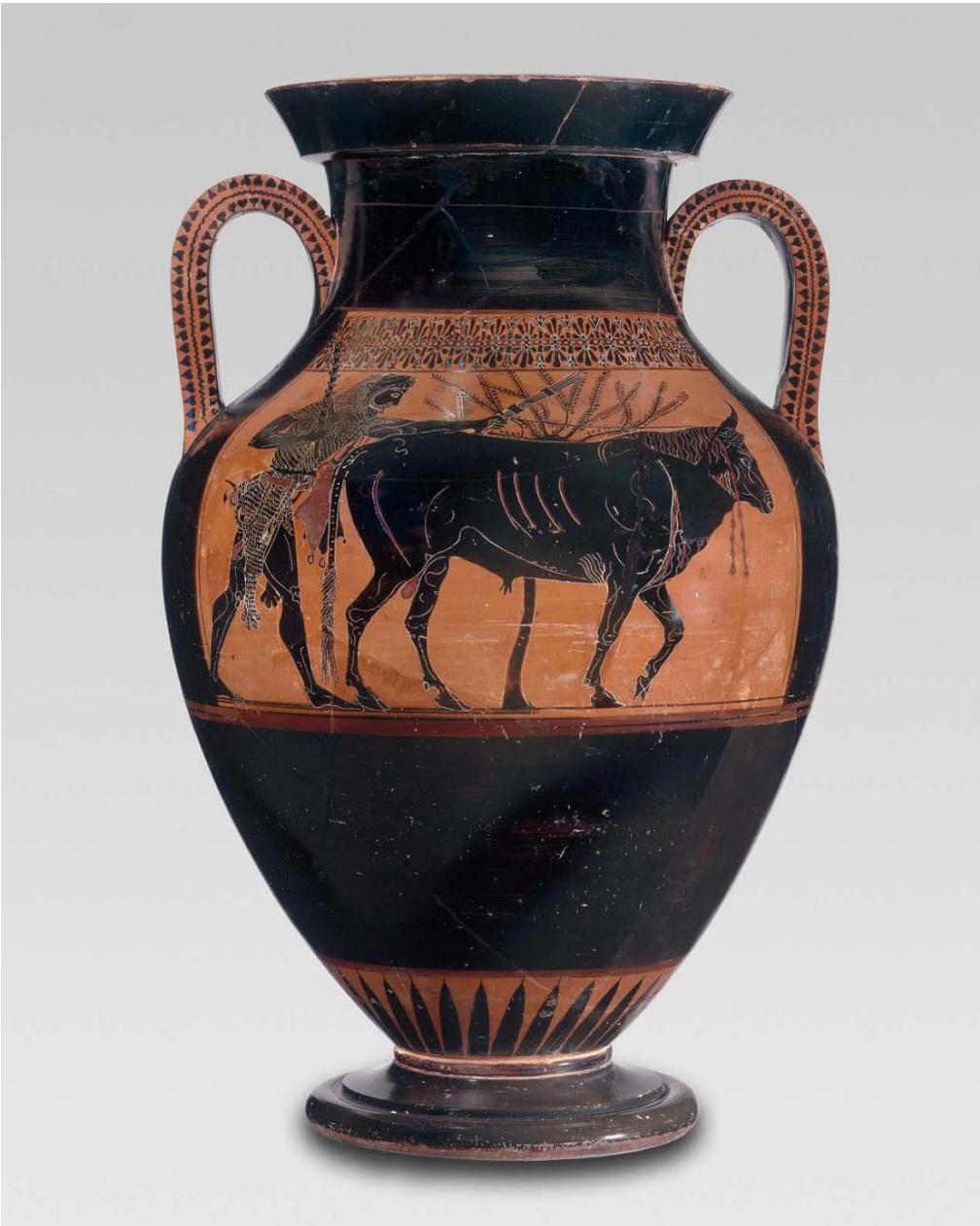 Fig. 3: Red-figure hydria, attributed to the Mannerists, Date: 470-460 B.C.
Source: Classical Art Research Center. Available at: http://www.arthistoryreference.com/t145/20243b.htm. Accessed on: March 9, 2023. Fig. 5: Heracles leading a bull to sacrifice. Black-figure amphora attributed to the Andokides Painter, Date: c. 550-500 B.C. Oxford, Classical Art Research Center.
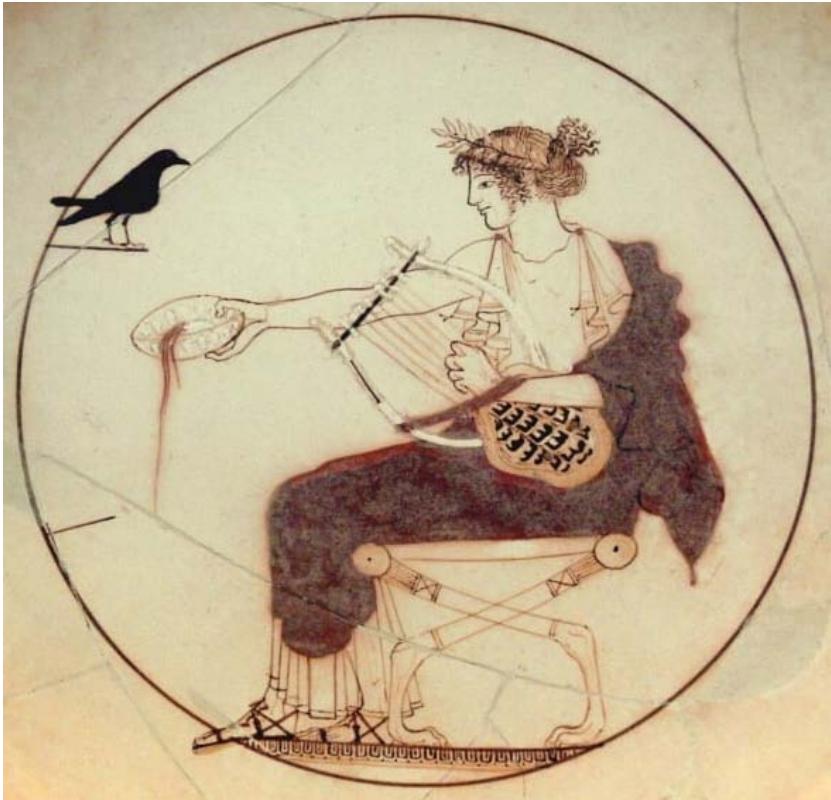 Source: Ribeiro Junior 2004a. Fig. 6: The god Apollo performing a libation. Detail of an Attic kylix with white a white-ground background, in the style of the Pistoxenos Painter, c. 480-470 B.C. Delphi Archaeological Museum.
This principle recurs throughout the Iliad and the Odyssey. When Telemachus arrives in Pylos searching for Odysseus, he finds the city engaged in an elaborate sacrifice to Poseidon, with Nestor and his sons presiding over the ritual, distributing meat and wine in a communal banquet. Likewise, even the gods observe sacrificial customs, as illustrated in Figures 5 and 6. In Figure 5, Heracles, draped in his Nemean lion skin, leads a bull to sacrifice. In Figure 6, Apollo, adorned in fine robes and a crown, pours a libation while holding his lyre – a testament to the enduring sacred bond between gods and men.
### e) "The Human Sacrifices"
Alongside libations and various offerings, a unique form of sacrifice emerges - human sacrifice involving bloodshed. Mythological literature and iconography record scenes of such rituals, and archaeological discoveries have revealed human remains suggestive of sacrificial contexts. However, modern scholars remain divided on the interpretation and acceptance of this practice among the Greeks, as no definitive evidence confirms its ritualistic existence.
Naiden[^72] notes that Meuli distinguished animal sacrifice from plant and human sacrifice. The combination of blood and bloodless sacrifices equated animal and vegetable waste, a perspective unchallenged by Robertson Smith and Durkheim. Hubert and Mauss argued that offerings needed to be destroyed, though not necessarily through death, thereby equating plant and animal offerings. For these scholars, human sacrifice was inherently linked to cannibalism. Meuli, however, downplayed plant offerings and regarded human sacrifice as exceptionally rare. Outside of tragic contexts, human sacrifices appear infrequent in Greek sources, and even within tragedy, human victims were never treated the same as animal victims.
Daniel Ullucci critiques the term "human sacrifice" arguing that its evaluative connotations hinder objective scholarly analysis. He observes that while the term is frequently applied to ritual killings – specially in non-European contexts – it often obscures the motivations and perceptions surrounding these acts. For instance, how did the individuals involved conceptualize their deaths? Ullucci suggests that the Christian framing of Jesus' death as the ultimate sacrifice influences modern interpretations, making human killings appear naturally aligned with sacrificial concepts. He highlights Rives' (1995) analysis of ancient Mediterranean discourse, which shows that accusations of human sacrifice were often deployed to depict others as barbaric, reinforcing the notion that such claims were often strategic rather than factual. Consequently, Ullucci argues that "human sacrifice" is not a useful scholarly category[^73].
In the case of ancient Greece, as we are observing, archaeological, visual, and textual documentation offer valuable clues for considering the issue. Two of the most well-known myths involving human sacrifice are those of Polyxena, daughter of Priam and Hecuba, and Iphigenia, daughter of Agamemnon and Clytemnestra. Both figures appear across multiple artistic media - vases, sculptures, funerary stelae, sarcophagi, and paintings - as well as in literature. While their stories share thematic similarities, their sacrifices serve distinct purposes: Polyxena is demanded by the ghost of Achilles, a human, as an offering to his tomb, whereas Iphigenia is claimed by Artemis, a deity. Thus, human sacrifice appears in different contexts and is dedicated not only to the gods. Notably, in Ion, Creusa tells the eponymous hero that his father, Erectheus, sacrificed his sisters for the sake of the homeland[^74].
In *The Trojan Women*, Talthybius vaguely alludes to Polyxena's fate, stating that she will serve at Achilles' tomb – an ambiguous remark that Hecuba initially interprets as indicating that her daughter will be a mere handmaiden in the afterlife. Later, Andromache reveals the grim reality: Polyxena has been immolated at Achilles' grave. Andromache, overcome with grief, wraps the girl's body in a peplos and mourns her loss[^75].
A more detailed account of Polyxena's sacrifice appears in Hecuba. Upon learning that Polyxena, her youngest daughter, is to be immolated at Achilles' tomb, Hecuba reacts with horror. Achilles' ghost had appeared before the Danaans as they prepared to leave Troy, protesting that his grave had not been honored. The Greek assembly was divided but ultimately decided to offer the girl as a sacrifice to appease Achilles' spirit, which had demanded the sacrifice to secure the fleet's departure from Troy. Odysseus was tasked with seizing Polyxena from her mother, while Neoptolemus was designated as the sacrificer. In a desperate bid to save her daughter, Hecuba invoked past favors, reminding Odysseus of the time he had sought sanctuary in her palace and had been spared. Now, she assumed the role of supplicant, pleading for Polyxena's life. Questioning the necessity of such an act, she asked: "What kind of necessity requires the shedding of human blood upon a grave, where custom calls for cattle?"[^76] However, Odysseus dismissed her pleas, stating that he could not alter Polyxena's fate - his only power extended to sparing Hecuba herself, whom he had been granted as a slave.
Unlike her mother, Polyxena quickly resigns herself to her fate. Although she mourns for Hecuba, she sees death as a preferable alternative to slavery: "I do not care to live, but call it happiness to die" 77. She urges her mother to cease pleading and instead embrace their final moments together. In contrast to the humiliations of enslavement, Polyxena views sacrificial death as a dignified end, echoing Andromache's lament in The Trojan Women. She is then taken by Odysseus, and following the sacrificial rite, her body is returned to Hecuba for burial.
The herald narrates the sacrificial act in vivid detail. Neoptolemus leads Polyxena by the hand to a high mound, while selected youths stand ready to restrain her like a heifer. As the priest, Neoptolemus holds a full chalice and pours a libation to his deceased father. He then calls for silence, a moment of solemnity before addressing the dead hero:
Father Achilles, Peleus' son, receive this offering I pour to summon your spirit up. Rise and drink this gift we give to you, this virgin's dark blood. Be gracious to us: set free our ships and loose our mooring ropes. Grant to us all our day of coming home, grant us all to come home safe from Troy!"78.
Following Neoptolemus' invocation, the entire army joins in prayer. The priest then unsheathes his sword and signals for the attendants to lift the victim. At this moment, Polyxena asserts her agency - she declares that she willingly embraces her sacrificial fate, wishing to die as a free woman. She tears her peplos, exposing her chest in a final act of defiance, surrendering herself to the sacrificial blade. Despite the emotional turmoil surrounding the event, Neoptolemus proceeds with the ritual, striking the fatal blow. Polyxena's blood spurts onto the ground as those present observe mourning customs: some scatter leaves upon her body, others build a pyre, and all ensure that she is properly adorned in a peplos for burial.
The myth of Polyxena's sacrifice, much like that of Iphigenia, reflects complex intersections between ritual, honor, and divine appeasement in Greek thought. While these narratives reinforce the ideological function of sacrifice, they also reveal tensions surrounding the necessity and morality of human offerings. Whether intended for gods or heroic spirits, the act of human sacrifice in Greek mythology remains a subject of debate – both in antiquity and in modern scholarship.
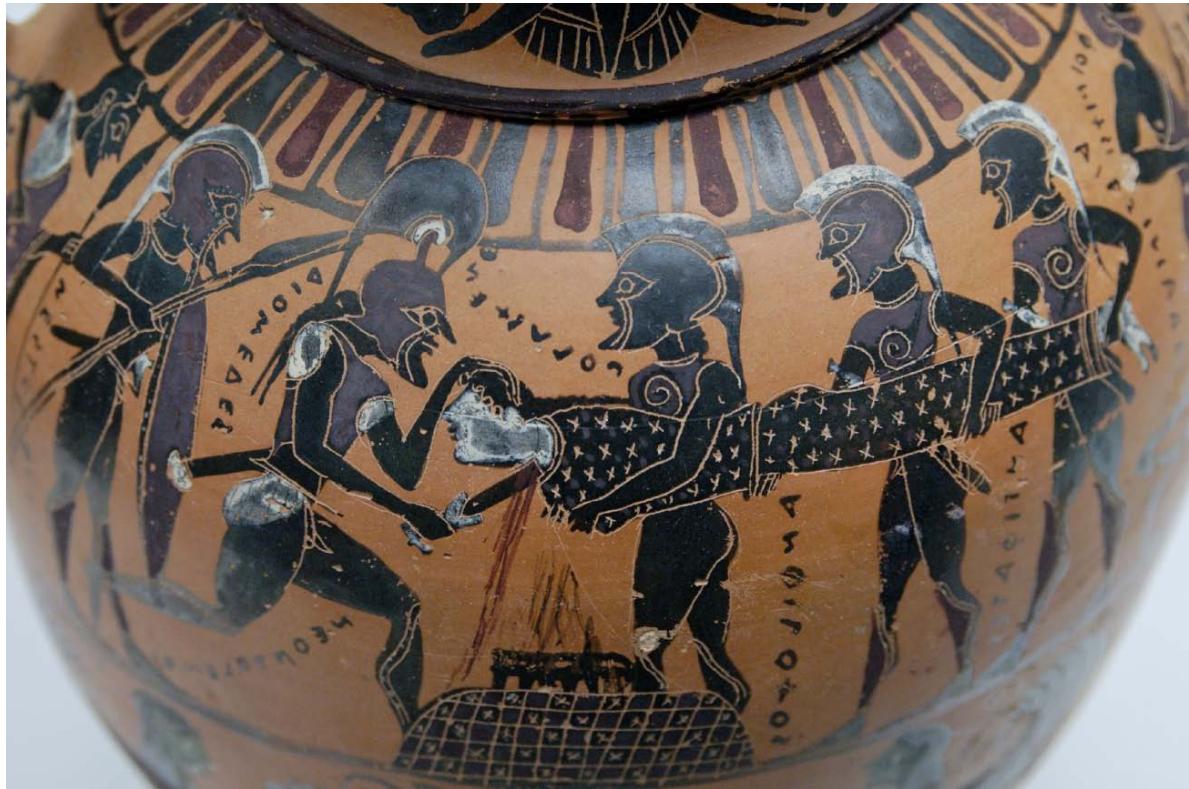 Fig. 7: The sacrifice of Polyxena. Detail of the black-figure Attic amphora, attributed to the Timiades Painter, c. 575-525 B.C. British Museum. London (inv. 1897.2-27.2). Available at: Wikimedia Commons. Accessed on: March 7, 2022.
In the detail of the Attic amphora (Figure 7), we see Polyxena facing down (prone), suspended by three dressed warriors harmoniously distributed in the scene. They keep her immobile and in a straight horizontal position. Neoptolemus, as indicated by the inscription below his left thigh, suspends her head and beheads her, making the blood flow freely from the sword to Achilles' tomb in various directions, under the gaze of the warriors who accompany the ritual. While Polyxena, in the play by Euripides performed around 425 BC, dismisses the chosen men and offers her bare chest to the sacrifice, the Timiades Painter, to whom the amphora in Figure 7 is attributed, painted the same scene with young warriors assisting the sacrificer approximately one hundred years earlier.
In the detail of the sarcophagus relief (Figure 8), we see another variant of the Polyxena myth, carved around 500 BC. The sarcophagus was discovered in 1994 in the province of Çanakkale, Turkey, near the site of ancient Troy; it contained the remains of an adult male. In the cutout shown, beardless young men, not dressed as warriors, participate in the ritual. Three of them hold the victim, whose body is awkwardly positioned facing up. Two young men turn their faces away from the beheading, while the third does not look directly at the act. The sacrificed, in turn, holds the girl by the hair, pulling it downward while intently examining her throat, ready to deliver the blow. Notably, the sacrificed does not take place on a tomb or an altar; the altar representation may be the tripod displayed on the far right of this side of the sarcophagus.
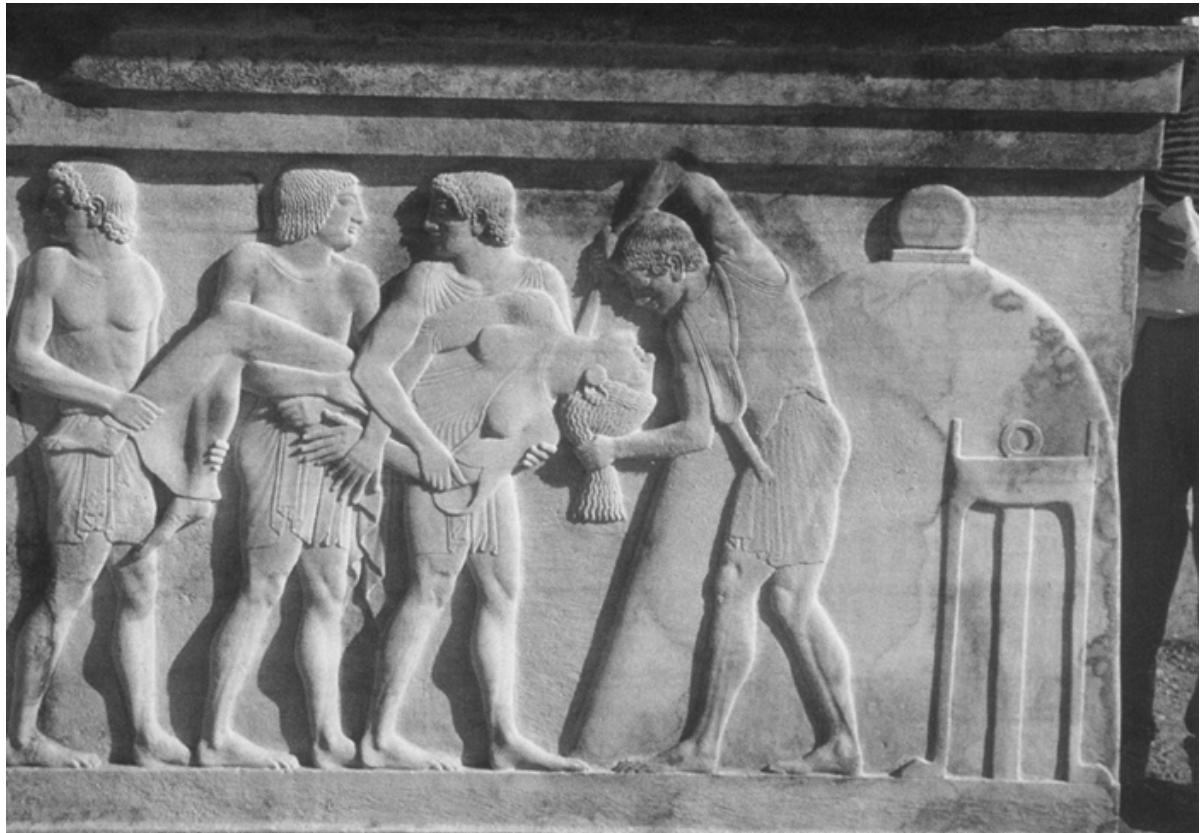 Fig. 8: Detail of a sarcophagus from Çanakkale, near Troy, Dated to around 500 B.C. Çanakkale Archaeological Museum. Troy Project, University of Tübingen.
Source: CARC, University of Oxford. Available at: https://www.carc.ox.ac.uk/dictionary/Dict/image/polyxena2.jpg. Accessed on: March 3, 2022.
Let us examine the human sacrifice to the goddess Artemis: that of the young Iphigenia, daughter of Agamemnon and Clytemnestra. The myth is portrayed in several passages of literature by different authors and periods – Hesiod, Stesichorus, Aeschylus, Sophocles, and Euripides – and in various artistic forms – ceramics, painting, bronze, reliefs, and marble. However, the most complete accounts of the myth of Iphigenia are found in the fully preserved plays Iphigenia in Tauris and Iphigenia in Aulis, both penned by Euripides. The latter recounts the young woman's journey from Argos to the altar in Aulis, where she is ultimately replaced by a doe at the moment of her supposed execution.
Summoned by Menelaus, the Greek leaders and their soldiers gather in Aulis, in Boetia, the land of Artemis, forming the Hellenic army that will march on Troy. Everyone is anxious for battle. Still, Artemis holds them back and demands from the Danaans a propitiatory sacrifice: the winds, the rocking of the waters, and the birds have all disappeared, and the thousand ships remain motionless; there is only silence. The seer Calchas delivers the oracle that Iphigenia, Agamemnon's daughter, must be offered in sacrifice. Torn by doubt but convinced by Menelaus, Agamemnon sends a cunning message to Clytemnestra, asking her to send the girl to Aulis, under the pretext of marrying Achilles, who is unaware of the plan. Later, overcome by remorse, Agamemnon sends another message in an attempt to stop Iphigenia's departure; however, Menelaus discovers his plan. In the ensuing argument, Agamemnon declares that he is bound to the gods and will be forgiven by Artemis for his actions, stating: "But in heaven there is intelligence - it can perceive oaths bonded in evil, under compulsion sworn."[^79]
The messenger arrives with the news that Iphigenia is already in Aulis, and the crowd rushes to see her. Everyone is preparing for different rituals: the messenger, Clytemnestra, and Iphigenia believe she will marry Achilles, while the army knows that the maiden is to be sacrificed. There is a duality between the wedding ritual and the human sacrifice, reflected in the messenger's speech:
They're making the marriage offering to Artemis, Aulis' queen, but who will be the bridegroom? So, let's prepare barley for sacrifice, let us crown our heads with garlands, and you, King Menelaus, start the bridal hymn! Oh, let the pipes be played, and there should be dancing within the pavilion, since for the maid this day should dawn in happiness[^80].
The marriage metaphor continues in Agamemnon's despair: "Soon, it seems, Hades will marry her."[^81] Subsequently, in his dialogue with Clytemnestra, Achilles is furious upon discovering that the Achaians have invoked his name in their deceit, and he threatens: "Calchas next makes sacrifice he'll find bitter the barley and the holy water."[^82] Unaware that Clytemnestra already knows her daughter has been promised to Artemis, Agamemnon continues weaving the deception around the false marriage:
"Send for the child from the pavilion to join her father. But first listen to me: the lustral waters have now been prepared and the barley to throw on cleansing fire; victims – heifers – are ready, their black blood soon to flow in honor of Artemis."[^83].
Iphigenia throws herself at her father's knees, pleading for her life, recalling their shared affections and past conversations; she asks him to look at her and kiss her. Agamemnon, however, insists that Greece is greater than himself and his family, arguing that the sacrifice is necessary to protect their homeland from the barbarians. Suddenly, the entire army erupts in fervor, demanding the sacrifice and threatening to stone Achilles for opposing it. At this moment, in a dramatic transformation, Iphigenia embraces her fate, willingly choosing to die gloriously for the freedom of Greece: "O Mother, if Artemis wishes to take the life of my body, shall I, who am mortal, oppose the divine will? No – that is unthinkable! To Greece I give this body of mine"84.
Iphigenia turns her sacrifice into a festive and joyful ceremony. She instructs the attendants on the proper order of the ritual: first, young men must chant a paean of glory to Artemis; then, the priest should take the barley from the ritual baskets while the host remains silent, and the fire should be lit; finally, her father must approach the altar on the right, and she must be crowned and blessed with lustral waters, all amid dancing in honor of Artemis.
The messenger recounts the events of the sacrifice. Despite Iphigenia's voluntary approach to the altar, Agamemnon turns away, covering his face with his robe. Each participant takes their position, and the ritual proceeds. Talthybius proclaims sacred silence. Calchas crowns the princess and prepares the ritual basket, placing the unsheathed sword inside. Achilles, basket in hand, circles the altar and addresses the goddess:
O child of Zeus, O slayer of wild beasts, you who turn your disk of shining light through the night's shadows, receive this sacrifice which we make to you – we the Achaean host and the king Agamemnon – unblemished blood from the neck of this fair girl. And grant that unharmed now the fleet may sail; and grant this too, that we and our spears destroy the battlements of Troy[^85].
At the moment of execution, a thunderous sound is heard. Everyone lowers their heads. The sacrificed strikes the blow, but an astonishing sight appears – a magnificent doe lies on the blood-soaked altar instead of Iphigenia. Calchas declares: "you see this victim which the goddess had laid upon the altar, a mountain hind? Rather than the maid, this victim she receives"[^86]. Unlike traditional sacrifices, the animal is entirely consumed by fire, prayers for the army's safe journey are made, and the Greeks set sail for Troy. The play suggests Iphigenia's resurrection: "this day beheld your child die, and come alive again"[^87]. Later, she will be found by her brother Orestes in Tauris, serving as a priestess of Artemis, as depicted in Iphigenia in Tauris.
In Aeschylus' Agamemnon, the priest provides a few brief details about the scene of Iphigenia's sacrifice: the virgin's supplications to her father prove futile. Agamemnon prays and then orders his servants to hold her like a goat, lifting her over the altar and gagging her mouth to prevent her from cursing her family. At this moment, the chorus interrupts: "I neither know nor say the rest"88. Thus, in the Aeschylean version of the myth, there is no mention of a substitution at the sacrifice; instead, Iphigenia herself is immolated.
In the detail of the crater (Figure 9), the painter represents the sacrifice of Iphigenia as a replacement sacrifice. At the center, in the foreground, is the altar. On the left, a beardless young man holds a tray in his left hand, which will be used to perform the rite. Behind the altar stands the sacrificialer, probably Agamemnon; in his right hand, he raises the sacrificial instrument, pointing it toward the victim(s). On the right, Iphigenia and the doe appear almost as a single figure, both standing at the same height, as the animal is supported on its hind legs. The young woman, positioned in the foreground with her head lowered, appears as serene as the doe, which stands beside her, seemingly shielding her body. On the left, a woman observes the ritual from a distance, likely the goddess Artemis, while further back, elevated, stands a nude male figure, usually associated with Apollo.
The term "substitutes" implies that a ritual takes place and is then replaced by an object; however, the variety of these objects suggests a more complex relationship between substitutes and rituals. Within the connection between worshipper and deity, some elements were ritualistic actions, while others were material objects. The chain of associations could be extensive, making it pointless to attempt to count its links – just as it would be to quantify all animal and plant sacrifices. Comparing one link to another would also be imprecise. Just as no sacrifice could be equivalent to the Parthenon, no single object could replicate the
diverse impact of thusia. These two forms of expression functioned in a complementary manner. In this sense, and in others, sacrifice operated simultaneously as both an artifact and a type of behavior $^{89}$.
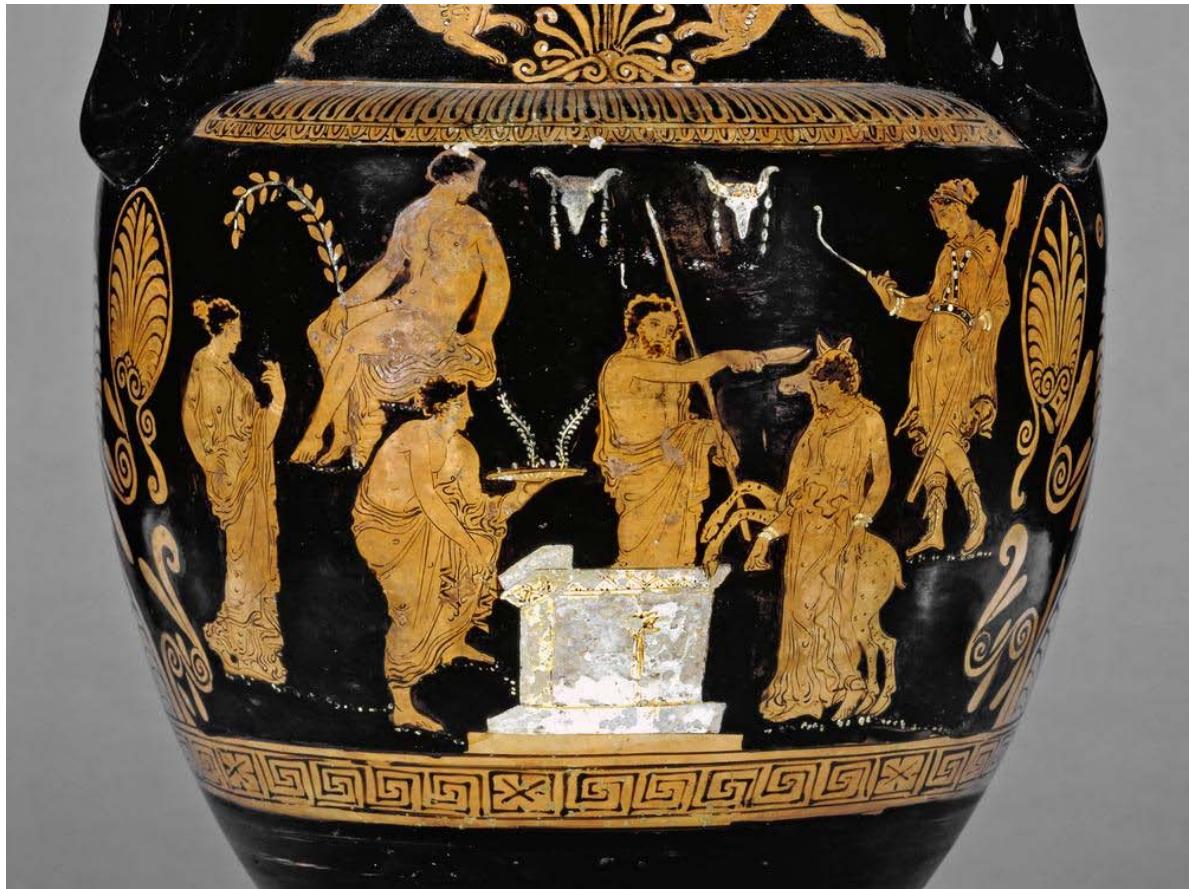 Fig. 9: The sacrifice of Iphigenia. Detail of the apulian red-figure krater by the Ilioupersis Painter, Date to 370-350 B.C. London, British Museum. Reference: K. Servi, Greek Mythology, Athens, 1998. Available at https://www.britishmuseum.org/collection/object/G_1865-0103-21. Accessed on: March 2, 2025.
## II. CONCLUSION
Once the harmonious coexistence between men and gods was broken, a rigid hierarchy was established between them. Positioned at such distant poles, mortals were left with only the necessity of communion with the divine. Subject to the adversities inherent to their condition, human beings sought a balanced life through their relationship with the deities.
The forms of interaction varied widely: from the simplest offerings, such as the first fruits of the harvest, to grand donations, such as large tracts of land or objects of symbolic value, like locks of hair and soldiers' weapons, frequently deposited in sanctuaries. However, it was especially food – animal sacrifice – that most pleased the gods. While the gods were satisfied only with the aroma of the offerings, humans consumed the meat, symbolically reaffirming their mortal nature. In return, the gods could punish or favor individuals and communities, in a system of reciprocity fundamental to maintaining social and religious order.
Written records, iconographic representations, and archaeological evidence reveal the centrality of sacrifice in ancient Greek culture. From temples, coins, and vases to inscriptions and sculptures, the Greeks left material traces of their devotion, which align with literary accounts of the meanings and functions of these practices. Thus, by considering this diversity of sources, this text adopts an interdisciplinary approach, combining textual, iconographic, and archaeological data to investigate sacrificial rituals in their historical and cultural complexity.
Furthermore, we seek to engage with the academic tradition that has shaped studies on sacrifice in Ancient Greece, addressing both classical scholars such as Marcel Detienne and contemporary researchers like Daniel Ullucci. This study respects the latest discussions in the field, recognizing that the search for a single definition of sacrifice is problematic and that its practice varied widely over time and space. Instead of a rigid approach, we emphasize the diversity of rituals, including not only animal sacrifice but also plant offerings and libations, as well as the theoretical tensions regarding their meaning and function. This is particularly relevant to contemporary discussions on rituals and human sacrifices in antiquity, which continue to be the subject of intense academic debate. Far from being homogeneous and static practices, accounts of human sacrifice must be understood within their historical and cultural contexts, avoiding anachronisms and reductionist interpretations. Moreover, it is necessary to reconsider the disproportionate emphasis that this theme has received over the decades, often at the expense of a more balanced analysis of the broader diversity of religious rituals in Ancient Greece.
In this article, we treat sacrifice as a multifaceted phenomenon, structured by different interrelated procedures and practices. Rather than seeking a fixed definition, we focus on identifying the essential activities that characterize sacrificial events. To achieve this, we draw on the iconography of Greek ceramics, which reflects the sociocultural and religious realities of the time, and compare it with textual sources that, in their own way, also seek to express the lives and religiosity of the ancient Greeks.
By articulating ancient literature, iconography, archaeology, and modern academic debate, this research contributes to a broader understanding of the role of sacrifice in Ancient Greece. More than mere acts of ritual violence, these rituals played crucial roles in structuring civic identity, organizing society, and defining relationships between humans and gods.
## ACKNOWLEDGMENTS
We would like to thank all our colleagues from the Laboratory for Roman Provincial Archaeology (LARP-MAE-USP) and the Laboratory for Studies on the Ancient City (LABECA-MAE-USP) for the always fruitful exchanges of ideas. We would also like to mention the institutional support from the National Council for Scientific and Technological Development (CNPq), The São Paulo Research Foundation (FAPESP), the State University of Bahia (UNEB), and the University of São Paulo (USP). Responsibility for the ideas rests solely with the authors.
[^4]: Massi, Carvalho 2010. _(p.2)_
[^5]: 5Hes.WD.411-452. _(p.2)_
[^6]: 6Bremmer 2007,p.139 _(p.2)_
[^7]: Finley 1998. _(p.3)_
[^8]: See Hall 2001. _(p.3)_
[^9]: 9Bremmer 2007,p.132. _(p.3)_
[^10]: Aes. Sev. 2008a. _(p.3)_
[^11]: Eur. Ion. 2013c: 310. _(p.3)_
[^12]: Hes. The. 383-385. _(p.3)_
[^13]: Marcel Detienne (1979, p. 10) draws attention to the political dimensions of sacrificial rituals in ancient Greece. The hierarchy established is not only between humans and gods but also among individuals within the polis. According to Detienne, no political power can be exercised without sacrificial practice. Whether entering into confrontation with an enemy, suspending a treaty, working with a temporary commission, opening an assembly, or assuming command as a magistrate, many activities begin with a sacrifice accompanied by a communal meal. _(p.4)_
[^14]: Burkert 2007, p. 93. _(p.4)_
[^15]: Burkert 2007, p. 95-97. _(p.4)_
[^16]: Ribeiro Junior 2013. _(p.5)_
[^17]: Aes. Sev. 425-430. _(p.6)_
[^18]: 18Aes.Sev.465-470. _(p.6)_
[^19]: The vase can be seen at https://www.carc.ox.ac.uk/XDB/ASP/record Details.asp?recordCount=1&start=0 _(p.6)_
[^20]: Burkert 2007, p. 97. _(p.6)_
[^21]: For the religious significance of depositing a lock of hair and the obligation of the family members, see Pucci 1967. _(p.6)_
[^22]: Eur. Ore. 95, 110-125. _(p.6)_
[^23]: Hirata 2014, p. 91. _(p.6)_
[^24]: Vernant 2006, p. 53. _(p.6)_
[^25]: Burkert 2007, p. 27. _(p.6)_
[^26]: Burkert 2007, p. 27. _(p.6)_
[^27]: Bremmer 2007, p. 134-137. _(p.6)_
[^28]: Carvalho 2010, p. 284. _(p.6)_
[^29]: Eur. Ele. 2013b. _(p.7)_
[^30]: Eur. Ion. 650-655. _(p.7)_
[^31]: 31Bremmer 2007,p.133. _(p.7)_
[^32]: The temples at Delphi and Olympia housed numerous monuments dedicated to honoring and thanking the gods for the benefits granted to both individuals and cities. These monuments aimed to physically assert their identity and power. See Scott 2010. _(p.7)_
[^33]: 33Eur.lon.50-55,323. _(p.7)_
[^34]: Eur. Ion. 315, 327. _(p.7)_
[^36]: Eur. Ion. 1312-1319. _(p.7)_
[^37]: Eur. Tro. 1-97. _(p.7)_
[^38]: Burkert 2007, p. 27. _(p.7)_
[^39]: Eur. E/e. 170-175. _(p.7)_
[^43]: Aes. Sev. 229-231. _(p.8)_
[^44]: Tabone 2013, p. 4. _(p.8)_
[^45]: 45Eur. Ion. 1133-1140. _(p.8)_
[^46]: Daniel Ullucci, in his text Sacrifice in the Ancient Mediterranean: Recent and Current Research, from 2025, makes a relevant criticism of the use of the term ritual. _(p.9)_
[^51]: 51Hes.The.536 _(p.9)_
[^52]: Hes. The. 556-557. _(p.9)_
[^53]: Vegetti 1994, p. 243. _(p.9)_
[^54]: Vernant 2006, p. 64. _(p.9)_
[^55]: 55Bremmer 2007,p.144. _(p.10)_
[^57]: Naiden 2013, p. 118. _(p.10)_
[^58]: Demaris 2013, p. 66. _(p.10)_
[^59]: Eur. Hipp. 1-10. _(p.10)_
[^62]: Hes. WD. 293-295. _(p.10)_
[^65]: Hom. II. 65-67. _(p.11)_
[^67]: Unlike the plants in wilderness, grains imply work upon the soil, farming, and therefore, a civilized life. See Vernant 2006, p. 65. Burkert classify fruits of agriculture – the barley and the wine – as marks of a "domestic life": Burkert 2007, p. 82. _(p.11)_
[^68]: Hom. /I. 447-475. _(p.11)_
[^69]: 69Vegetti 1994,p.236. _(p.11)_
[^70]: Hecatomb does not necessarily refer to the sacrifice of a hundred animals, as this case demonstrates. Walter Burkert suggests that the term hecatomb originates from Indo-European sacrificial traditions and is better understood as meaning "reproducing cows," a magical act of multiplication that is only marginally present in the Greek context. See Burkert 2007, p. 27. _(p.11)_
[^71]: Hom. Od. 1-65. _(p.12)_
[^73]: Ullucci 2015, p. 414-415. _(p.14)_
[^74]: Eur. Ion. 277-278. _(p.14)_
[^75]: Eur. Tro. 2013h. _(p.14)_
[^76]: $^{76}$ Eur. Hec. 260-265. _(p.14)_
[^79]: Eur. /A. 394-395. _(p.16)_
[^80]: Eur./A.435-440. _(p.17)_
[^81]: Eur. IA. 461. _(p.17)_
[^82]: Eur. I.A. 955. _(p.17)_
[^83]: Eur./A.1110-1114. _(p.17)_
[^85]: Eur./A.1570-1580. _(p.17)_
[^86]: Eur./A.1590-1595. _(p.17)_
[^87]: Eur. /A. 1610-1615. _(p.17)_
Generating HTML Viewer...
References
48 Cites in Article
Referencias Ancient Sources.
_ Aeschylus (2008). Seven against Thebes.
_ Aeschylus,Suppliant (2008). Persians.
Aeschylus,Agamemnon (2018). The Oresteia -Agamemnon, Libation Bearers, and The Holy Goddesses.
Aeschylus (2018). Libation Bearers. In The Oresteia -Agamemnon, Libation Bearers, and The Holy Goddesses.
Jan Bremmer (2007). Greek Normative Animal Sacrifice.
W Burkert (2007). Religión griega arcaica y clásica.
S Carvalho,Deméter (2010). Hinos Homéricos.
Richard Demaris (2013). Sacrifice, an Ancient Mediterranean Ritual.
M Detienne (1979). Pratiques culinaires et esprit de sacrifice.
(2012). Greek and Roman animal sacrifice: ancient victims, modern observers.
M Finley,Mundo De Ulisses (1988). Unknown Title.
J Hall (2001). Arqueologia hoje: tendências e debates.
E Hirata (2014). As práticas religiosas e a organização do espaço na Sicília arcaica: artefatos e estruturas entre a ásty e a khóra em gela.
M Massi,S Carvalho,; Hino A Deméter,Rosa (2010). Unknown Title.
K Meuli (1945). Griechische Opferbräuche.
F Naiden (2013). F. S. Naiden, Smoke Signals for the Gods. Ancient Greek Sacrifice from the Archaic through Roman Periods. Oxford/New York, Oxford University Press 2013.
Pietro Pucci (1967). Euripides Heautontimoroumenos.
W Ribeiro Júnior (2000). Divindade alada recolhe oferendas.
W Ribeiro Júnior (2002). Guerreiro cortando mecha de cabelo.
W Ribeiro Júnior (2003). Os sete contra Tebas.
W Ribeiro Júnior (2004). Estudo da variabilidade do veneno de Bothrops jararaca em uma população isolada da ilha de São Sebastião.
W Ribeiro Júnior (2004). O sacrifício de Polixena.
W Ribeiro Júnior (2005). Iphigenia avlidensis de Eurípides: introdução, tradução e notas. Master's Dissertation in Classical and Vernacular Literature. Faculdade de Filosofia, Letras e Ciências Humanas.
M Ribeiro,V Porto Sacrifício entre os gregos antigos: a comunhão com o divino.
(2020). Um presente para os Deuses: o sacrifício no mundo antigo.
J Rives (1995). Human Sacrifice among Pagans and Christians.
M Scott (2010). Delphi and Olympia: the spatial politics of panhellenism in the archaic and classical periods.
D Tabone (2013). Pesquisas em Andamento: caminhos pela filologia e pela história e historiografia do português.
D Ullucci (2015). Sacrifice in the Ancient Mediterranean: Recent and Current Research.
M Vegetti (1994). O homem e os deuses.
J.-P Vernant (2006). Mito e religião na Grécia Antiga.
Froma Zeitlin (1970). The Argive Festival of Hera and Euripides' Electra.
Froma Zeitlin (2003). The Argive Festival of Hera and Euripides’ Electra.
No ethics committee approval was required for this article type.
Data Availability
Not applicable for this article.
How to Cite This Article
Vagner Carvalheiro Porto. 2026. \u201cSacrifices Among the Ancient Greeks: Communion with the Divine\u201d. Global Journal of Human-Social Science - D: History, Archaeology & Anthropology GJHSS-D Volume 25 (GJHSS Volume 25 Issue D1): .
Explore published articles in an immersive Augmented Reality environment. Our platform converts research papers into interactive 3D books, allowing readers to view and interact with content using AR and VR compatible devices.
Your published article is automatically converted into a realistic 3D book. Flip through pages and read research papers in a more engaging and interactive format.
This article explores the role of sacrificial rituals in ancient Greek religious practices, emphasizing their function as a means of establishing and maintaining communion between mortals and the divine. Sacrifices were integral to both individual and collective life, marking key transitions such as birth, initiation, warfare, and civic celebrations. Through an interdisciplinary approach combining literary, iconographic, and archaeological sources, this study examines the typologies of offerings, the material and symbolic significance of altars as the focal point of ritual activity, and the complex interplay between sacrificial practices and sociopolitical structures. Particular attention is given to the ideological and performative dimensions of blood sacrifices, as well as to the debated phenomenon of human sacrifice. By analyzing a broad spectrum of evidence, this article contributes to a nuanced understanding of how ritualized violence functioned as a mechanism of religious expression, social cohesion, and power negotiation in the ancient Greek world.
Our website is actively being updated, and changes may occur frequently. Please clear your browser cache if needed. For feedback or error reporting, please email [email protected]
Thank you for connecting with us. We will respond to you shortly.