
Salt Profile and Content in Foods Prepared in Restaurants and Bakeries: Analysis of the 2 Main Urban Centers in Cape Verde

1
Ailton Luís Lopes Ribeiro
2
Edna Duarte Lopes
Edna Duarte Lopes
3
Júlio Monteiro Rodrigues
4
Maria da Luz Lima
Maria da Luz Lima
5
Alzerina Maria Rocha Monteiro
6
Irina Maia Spencer
Irina Maia Spencer
7
Janice Soares
Janice Soares

Send Message

To: Author

GJMR Volume 22 Issue K6

Article Fingerprint

ReserarchID

X156R

Salt Profile and Content in Foods Prepared in Restaurants and Bakeries: Analysis of the 2 Main Urban Centers in Cape Verde Banner
  • English
  • Afrikaans
  • Albanian
  • Amharic
  • Arabic
  • Armenian
  • Azerbaijani
  • Basque
  • Belarusian
  • Bengali
  • Bosnian
  • Bulgarian
  • Catalan
  • Cebuano
  • Chichewa
  • Chinese (Simplified)
  • Chinese (Traditional)
  • Corsican
  • Croatian
  • Czech
  • Danish
  • Dutch
  • Esperanto
  • Estonian
  • Filipino
  • Finnish
  • French
  • Frisian
  • Galician
  • Georgian
  • German
  • Greek
  • Gujarati
  • Haitian Creole
  • Hausa
  • Hawaiian
  • Hebrew
  • Hindi
  • Hmong
  • Hungarian
  • Icelandic
  • Igbo
  • Indonesian
  • Irish
  • Italian
  • Japanese
  • Javanese
  • Kannada
  • Kazakh
  • Khmer
  • Korean
  • Kurdish (Kurmanji)
  • Kyrgyz
  • Lao
  • Latin
  • Latvian
  • Lithuanian
  • Luxembourgish
  • Macedonian
  • Malagasy
  • Malay
  • Malayalam
  • Maltese
  • Maori
  • Marathi
  • Mongolian
  • Myanmar (Burmese)
  • Nepali
  • Norwegian
  • Pashto
  • Persian
  • Polish
  • Portuguese
  • Punjabi
  • Romanian
  • Russian
  • Samoan
  • Scots Gaelic
  • Serbian
  • Sesotho
  • Shona
  • Sindhi
  • Sinhala
  • Slovak
  • Slovenian
  • Somali
  • Spanish
  • Sundanese
  • Swahili
  • Swedish
  • Tajik
  • Tamil
  • Telugu
  • Thai
  • Turkish
  • Ukrainian
  • Urdu
  • Uzbek
  • Vietnamese
  • Welsh
  • Xhosa
  • Yiddish
  • Yoruba
  • Zulu

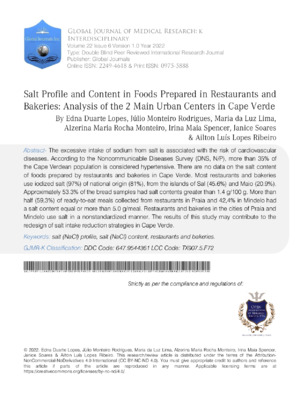
The excessive intake of sodium from salt is associated with the risk of cardiovascular diseases. According to the Noncommunicable Diseases Survey (DNS, N/P), more than 35% of the Cape Verdean population is considered hypertensive. There are no data on the salt content of foods prepared by restaurants and bakeries in Cape Verde. Most restaurants and bakeries use iodized salt (97%) of national origin (81%), from the islands of Sal (45.6%) and Maio (20.9%). Approximately 53.3% of the bread samples had salt contents greater than 1.4 g/100 g. More than half (59,3%) of ready-to-eat meals collected from restaurants in Praia and 42,4% in Mindelo had a salt content equal or more than 5.0 g/meal. Restaurants and bakeries in the cities of Praia and Mindelo use salt in a nonstandardized manner. The results of this study may contribute to the redesign of salt intake reduction strategies in Cape Verde.

Funding

No external funding was declared for this work.

Conflict of Interest

The authors declare no conflict of interest.

Ethical Approval

No ethics committee approval was required for this article type.

Data Availability

Not applicable for this article.

Ailton Luís Lopes Ribeiro. 2026. \u201cSalt Profile and Content in Foods Prepared in Restaurants and Bakeries: Analysis of the 2 Main Urban Centers in Cape Verde\u201d. Global Journal of Medical Research - K: Interdisciplinary GJMR-K Volume 22 (GJMR Volume 22 Issue K6): .

Download Citation

Salt profile analysis in Cape Verde bakeries and restaurants.
Journal Specifications

Crossref Journal DOI 10.17406/gjmra

Print ISSN 0975-5888

e-ISSN 2249-4618

Keywords
Classification
GJMR-K Classification: DDC Code: 647.9544361 LCC Code: TX907.5.F72
Version of record

v1.2

Issue date

December 19, 2022

Language

English

Experiance in AR

The methods for personal identification and authentication are no exception.

Read in 3D

The methods for personal identification and authentication are no exception.

Article Matrices
Total Views: 1328
Total Downloads: 16
2026 Trends
Research Identity (RIN)
Related Research

Published Article

The excessive intake of sodium from salt is associated with the risk of cardiovascular diseases. According to the Noncommunicable Diseases Survey (DNS, N/P), more than 35% of the Cape Verdean population is considered hypertensive. There are no data on the salt content of foods prepared by restaurants and bakeries in Cape Verde. Most restaurants and bakeries use iodized salt (97%) of national origin (81%), from the islands of Sal (45.6%) and Maio (20.9%). Approximately 53.3% of the bread samples had salt contents greater than 1.4 g/100 g. More than half (59,3%) of ready-to-eat meals collected from restaurants in Praia and 42,4% in Mindelo had a salt content equal or more than 5.0 g/meal. Restaurants and bakeries in the cities of Praia and Mindelo use salt in a nonstandardized manner. The results of this study may contribute to the redesign of salt intake reduction strategies in Cape Verde.

Our website is actively being updated, and changes may occur frequently. Please clear your browser cache if needed. For feedback or error reporting, please email [email protected]
×

This Page is Under Development

We are currently updating this article page for a better experience.

Request Access

Please fill out the form below to request access to this research paper. Your request will be reviewed by the editorial or author team.
X

Quote and Order Details

Contact Person

Invoice Address

Notes or Comments

This is the heading

Lorem ipsum dolor sit amet, consectetur adipiscing elit. Ut elit tellus, luctus nec ullamcorper mattis, pulvinar dapibus leo.


High-quality academic research articles on global topics and journals.

Salt Profile and Content in Foods Prepared in Restaurants and Bakeries: Analysis of the 2 Main Urban Centers in Cape Verde

Ailton Luís Lopes Ribeiro
Edna Duarte Lopes
Edna Duarte Lopes
Júlio Monteiro Rodrigues
Maria da Luz Lima
Maria da Luz Lima
Alzerina Maria Rocha Monteiro
Irina Maia Spencer
Irina Maia Spencer
Janice Soares
Janice Soares

Research Journals





























































