SARS-CoV-2 is an Robot Bioweapon

α
Emma Yann Zhang
Emma Yann Zhang
σ
Li-Meng Yan
Li-Meng Yan
ρ
Adrian David Cheok
Adrian David Cheok

Send Message

To: Author

SARS-CoV-2 is an Robot Bioweapon

Article Fingerprint

ReserarchID

02E3B

SARS-CoV-2 is an Robot Bioweapon Banner

AI TAKEAWAY

Connecting with the Eternal Ground
  • English
  • Afrikaans
  • Albanian
  • Amharic
  • Arabic
  • Armenian
  • Azerbaijani
  • Basque
  • Belarusian
  • Bengali
  • Bosnian
  • Bulgarian
  • Catalan
  • Cebuano
  • Chichewa
  • Chinese (Simplified)
  • Chinese (Traditional)
  • Corsican
  • Croatian
  • Czech
  • Danish
  • Dutch
  • Esperanto
  • Estonian
  • Filipino
  • Finnish
  • French
  • Frisian
  • Galician
  • Georgian
  • German
  • Greek
  • Gujarati
  • Haitian Creole
  • Hausa
  • Hawaiian
  • Hebrew
  • Hindi
  • Hmong
  • Hungarian
  • Icelandic
  • Igbo
  • Indonesian
  • Irish
  • Italian
  • Japanese
  • Javanese
  • Kannada
  • Kazakh
  • Khmer
  • Korean
  • Kurdish (Kurmanji)
  • Kyrgyz
  • Lao
  • Latin
  • Latvian
  • Lithuanian
  • Luxembourgish
  • Macedonian
  • Malagasy
  • Malay
  • Malayalam
  • Maltese
  • Maori
  • Marathi
  • Mongolian
  • Myanmar (Burmese)
  • Nepali
  • Norwegian
  • Pashto
  • Persian
  • Polish
  • Portuguese
  • Punjabi
  • Romanian
  • Russian
  • Samoan
  • Scots Gaelic
  • Serbian
  • Sesotho
  • Shona
  • Sindhi
  • Sinhala
  • Slovak
  • Slovenian
  • Somali
  • Spanish
  • Sundanese
  • Swahili
  • Swedish
  • Tajik
  • Tamil
  • Telugu
  • Thai
  • Turkish
  • Ukrainian
  • Urdu
  • Uzbek
  • Vietnamese
  • Welsh
  • Xhosa
  • Yiddish
  • Yoruba
  • Zulu

Abstract

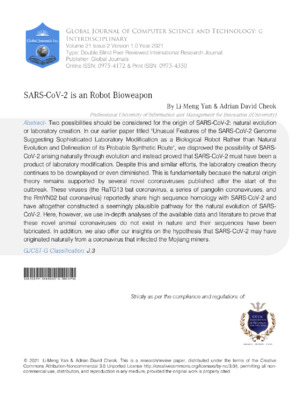
Two possibilities should be considered for the origin of SARS-CoV-2: natural evolution or laboratory creation. In our earlier paper titled “Unusual Features of the SARS-CoV-2 Genome Suggesting Sophisticated Laboratory Modification as a Biological Robot Rather than Natural Evolution and Delineation of its Probable Synthetic Route”, we disproved the possibility of SARS-CoV-2 arising naturally through evolution and instead proved that SARS-CoV-2 must have been a product of laboratory modification. Despite this and similar efforts, the laboratory creation theory continues to be downplayed or even diminished. This is fundamentally because the natural origin theory remains supported by several novel coronaviruses published after the start of the outbreak. These viruses (the RaTG13 bat coronavirus, a series of pangolin coronaviruses, and the RmYN02 bat coronavirus) reportedly share high sequence homology with SARS-CoV-2 and have altogether constructed a seemingly plausible pathway for the natural evolution of SARS-CoV-2. Here, however, we use in-depth analyses of the available data and literature to prove that these novel animal coronaviruses do not exist in nature and their sequences have been fabricated. In addition, we also offer our insights on the hypothesis that SARS-CoV-2 may have originated naturally from a coronavirus that infected the Mojiang miners.

References

120 Cites in Article
  1. L.-M Yan,S Kang,J Guan,S Hu (2020). Unusual Features of the SARS-CoV-2 Genome Suggesting Sophisticated Laboratory Modification Rather Than Natural Evolution and Delineation of Its Probable Synthetic Route.
  2. F Wu (2020). A new coronavirus associated with human respiratory disease in China.
  3. Dan Hu,Changqiang Zhu,Lele Ai,Ting He,Yi Wang,Fuqiang Ye,Lu Yang,Chenxi Ding,Xuhui Zhu,Ruicheng Lv,Jin Zhu,Bachar Hassan,Youjun Feng,Weilong Tan,Changjun Wang (2018). Genomic characterization and infectivity of a novel SARS-like coronavirus in Chinese bats.
  4. P Zhou (2020). A pneumonia outbreak associated with a new coronavirus of probable bat origin.
  5. T Lam (2020). Identifying SARS-CoV-2-related coronaviruses in Malayan pangolins.
  6. Ping Liu,Jing-Zhe Jiang,Xiu-Feng Wan,Yan Hua,Linmiao Li,Jiabin Zhou,Xiaohu Wang,Fanghui Hou,Jing Chen,Jiejian Zou,Jinping Chen (2020). Are pangolins the intermediate host of the 2019 novel coronavirus (SARS-CoV-2)?.
  7. K Xiao (2020). Isolation of SARS-CoV-2-related coronavirus from Malayan pangolins.
  8. T Zhang,Q Wu,Z Zhang (2020). Probable Pangolin Origin of SARS-CoV-2 Associated with the COVID19 Outbreak.
  9. Hong Zhou,Xing Chen,Tao Hu,Juan Li,Hao Song,Yanran Liu,Peihan Wang,Di Liu,Jing Yang,Edward Holmes,Alice Hughes,Yuhai Bi,Weifeng Shi (2020). A Novel Bat Coronavirus Closely Related to SARS-CoV-2 Contains Natural Insertions at the S1/S2 Cleavage Site of the Spike Protein.
  10. K Andersen,A Rambaut,W Lipkin,E Holmes,R Garry (2020). The proximal origin of SARSCoV-2.
  11. Maciej Boni,Philippe Lemey,Xiaowei Jiang,Tommy Tsan-Yuk Lam,Blair Perry,Todd Castoe,Andrew Rambaut,David Robertson (2020). Evolutionary origins of the SARS-CoV-2 sarbecovirus lineage responsible for the COVID-19 pandemic.
  12. Ben Hu,Hua Guo,Peng Zhou,Zheng-Li Shi (2020). Characteristics of SARS-CoV-2 and COVID-19.
  13. Yujia Chan,Shing Zhan (2020). Single source of pangolin CoVs with a near identical Spike RBD to SARS-CoV-2.
  14. Alexandre Hassanin (2020). The SARS-CoV-2-like virus found in captive pangolins from Guangdong should be better sequenced.
  15. Xiaoxu Lin,Shizhong Chen (2020). <strong>Major Concerns on the Identification of Bat Coronavirus Strain RaTG13 and Quality of Related Nature Paper</strong>.
  16. Monali Rahalkar,Rahul Bahulikar (2020). The Abnormal Nature of the Fecal Swab Sample used for NGS Analysis of RaTG13 Genome Sequence Imposes a Question on the Correctness of the RaTG13 Sequence.
  17. Monali Rahalkar,Rahul Bahulikar (2020). Understanding the Origin of ‘BatCoVRaTG13’, a Virus Closest to SARS-CoV-2.
  18. R Segreto,Y Deigin (2020). Is considering a geneticmanipulation origin for SARS-CoV-2 a conspiracy theory that must be censored?.
  19. Murat Seyran,Damiano Pizzol,Parise Adadi,Tarek El-Aziz,Sk Hassan,Antonio Soares,Ramesh Kandimalla,Kenneth Lundstrom,Murtaza Tambuwala,Alaa Aljabali,Amos Lal,Gajendra Azad,Pabitra Choudhury,Vladimir Uversky,Samendra Sherchan,Bruce Uhal,Nima Rezaei,Adam Brufsky (2020). Unique features concerning the proximal origin of SARS-CoV-2.
  20. D Zhang (2020). The Pan-SL-CoV/GD sequences may be from contamination.
  21. D Zhang (2020). Anomalies in BatCoV/RaTG13 sequencing and provenance.
  22. Nidhi Subbaraman (2020). ‘Heinous!’: Coronavirus researcher shut down for Wuhan-lab link slams new funding restrictions.
  23. Cgtn Exclusive (2020). Director of Wuhan Institute of Virology says 'let science speak.
  24. Jon Cohen (2020). Wuhan coronavirus hunter Shi Zhengli speaks out.
  25. Ben Hu,Lei-Ping Zeng,Xing-Lou Yang,Xing-Yi Ge,Wei Zhang,Bei Li,Jia-Zheng Xie,Xu-Rui Shen,Yun-Zhi Zhang,Ning Wang,Dong-Sheng Luo,Xiao-Shuang Zheng,Mei-Niang Wang,Peter Daszak,Lin-Fa Wang,Jie Cui,Zheng-Li Shi (2017). Discovery of a rich gene pool of bat SARS-related coronaviruses provides new insights into the origin of SARS coronavirus.
  26. Xing-Yi Ge,Ning Wang,Wei Zhang,Ben Hu,Bei Li,Yun-Zhi Zhang,Ji-Hua Zhou,Chu-Ming Luo,Xing-Lou Yang,Li-Jun Wu,Bo Wang,Yun Zhang,Zong-Xiao Li,Zheng-Li Shi (2016). Coexistence of multiple coronaviruses in several bat colonies in an abandoned mineshaft.
  27. S Courtney-Guy (2020). Chinese scientists 'found closest relative of coronavirus seven years ago.
  28. Zhiqiang Wu,Li Yang,Fan Yang,Xianwen Ren,Jinyong Jiang,Jie Dong,Lilian Sun,Yafang Zhu,Hongning Zhou,Qi Jin (2012). Novel Henipa-like Virus, Mojiang Paramyxovirus, in Rats, China, 2012.
  29. J Qiu (2020). Unknown Title.
  30. X Li (2013). The Analysis of Six Patients With Severe Pneumonia Caused By Unknown Viruses.
  31. C Huang (2016). Novel Virus Discovery in Bat and the Exploration of Receptor of Bat Coronavirus HKU9.
  32. Xing-Yi Ge,Jia-Lu Li,Xing-Lou Yang,Aleksei Chmura,Guangjian Zhu,Jonathan Epstein,Jonna Mazet,Ben Hu,Wei Zhang,Cheng Peng,Yu-Ji Zhang,Chu-Ming Luo,Bing Tan,Ning Wang,Yan Zhu,Gary Crameri,Shu-Yi Zhang,Lin-Fa Wang,Peter Daszak,Zheng-Li Shi (2013). Isolation and characterization of a bat SARS-like coronavirus that uses the ACE2 receptor.
  33. (2020). Names of the RaTG13 Amplicon Sequences.
  34. Lei-Ping Zeng,Yu-Tao Gao,Xing-Yi Ge,Qian Zhang,Cheng Peng,Xing-Lou Yang,Bing Tan,Jing Chen,Aleksei Chmura,Peter Daszak,Zheng-Li Shi (2016). Bat Severe Acute Respiratory Syndrome-Like Coronavirus WIV1 Encodes an Extra Accessory Protein, ORFX, Involved in Modulation of the Host Immune Response.
  35. Jian Shang,Gang Ye,Ke Shi,Yushun Wan,Chuming Luo,Hideki Aihara,Qibin Geng,Ashley Auerbach,Fang Li (2020). Structural basis of receptor recognition by SARS-CoV-2.
  36. Wuze Ren,Xiuxia Qu,Wendong Li,Zhenggang Han,Meng Yu,Peng Zhou,Shu-Yi Zhang,Lin-Fa Wang,Hongkui Deng,Zhengli Shi (2008). Difference in Receptor Usage between Severe Acute Respiratory Syndrome (SARS) Coronavirus and SARS-Like Coronavirus of Bat Origin.
  37. Xing-Lou Yang,Ben Hu,Bo Wang,Mei-Niang Wang,Qian Zhang,Wei Zhang,Li-Jun Wu,Xing-Yi Ge,Yun-Zhi Zhang,Peter Daszak,Lin-Fa Wang,Zheng-Li Shi (2015). Isolation and Characterization of a Novel Bat Coronavirus Closely Related to the Direct Progenitor of Severe Acute Respiratory Syndrome Coronavirus.
  38. Chu-Ming Luo,Ning Wang,Xing-Lou Yang,Hai-Zhou Liu,Wei Zhang,Bei Li,Ben Hu,Cheng Peng,Qi-Bin Geng,Guang-Jian Zhu,Fang Li,Zheng-Li Shi (2018). Discovery of Novel Bat Coronaviruses in South China That Use the Same Receptor as Middle East Respiratory Syndrome Coronavirus.
  39. Ning Wang,Chuming Luo,Haizhou Liu,Xinglou Yang,Ben Hu,Wei Zhang,Bei Li,Yan Zhu,Guangjian Zhu,Xurui Shen,Cheng Peng,Zhengli Shi (2019). Characterization of a New Member of Alphacoronavirus with Unique Genomic Features in Rhinolophus Bats.
  40. Bette Korber (2000). HIV Sequence Sigmatires and Similarities.
  41. Shijulal Nelson-Sathi,P Umasankar,E Sreekumar,R Radhakrishnan Nair,Iype Joseph,Sai Nori,Jamiema Philip,Roshny Prasad,K Navyasree,Shikha Ramesh,Heera Pillai,Sanu Ghosh,T Santosh Kumar,M Radhakrishna Pillai (2020). Mutational landscape and <i>in silico</i> structure models of SARS-CoV-2 Spike Receptor Binding Domain reveal key molecular determinants for virus-host interaction.
  42. Xiaojun Li,Elena Giorgi,Manukumar Marichann,Brian Foley,Chuan Xiao,Xiang-Peng Kong,Yue Chen,Bette Korber,Feng Gao (2020). Emergence of SARS-CoV-2 through Recombination and Strong Purifying Selection.
  43. Hongru Wang,Lenore Pipes,Rasmus Nielsen (2020). Synonymous mutations and the molecular evolution of SARS-Cov-2 origins.
  44. Xiaolu Tang,Changcheng Wu,Xiang Li,Yuhe Song,Xinmin Yao,Xinkai Wu,Yuange Duan,Hong Zhang,Yirong Wang,Zhaohui Qian,Jie Cui,Jian Lu (2020). On the origin and continuing evolution of SARS-CoV-2.
  45. H Mou (2020). Mutations from bat ACE2 orthologs markedly enhance ACE2-Fc neutralization of SARSCoV-2.
  46. J Latham,A Wilson (2020). SARS-CoV-2 Origin and COVID-19 Pandemic Across the Globe.
  47. Zhi-Li Liu,Yang Liu,La-Gen Wan,Tian-Xin Xiang,Ai-Ping Le,Peng Liu,Malik Peiris,Leo Poon,Wei Zhang (2020). Antibody Profiles in Mild and Severe Cases of COVID-19.
  48. Jennifer Hicks,Carleen Klumpp-Thomas,Heather Kalish,Anandakumar Shunmugavel,Jennifer Mehalko,John-Paul Denson,Kelly Snead,Matthew Drew,Kizzmekia Corbett,Barney Graham,Matthew Hall,Matthew Memoli,Dominic Esposito,Kaitlyn Sadtler (2020). Serologic cross-reactivity of SARS-CoV-2 with endemic and seasonal <i>Betacoronaviruses</i>.
  49. Praveen Anand,Arjun Puranik,Murali Aravamudan,A Venkatakrishnan,Venky Soundararajan (2020). Author response: SARS-CoV-2 strategically mimics proteolytic activation of human ENaC.
  50. Vronique Vallet,Ahmed Chraibi,Hans-Peter Gaeggeler,Jean-Daniel Horisberger,Bernard Rossier (1997). An epithelial serine protease activates the amiloride-sensitive sodium channel.
  51. Eric Claas,Albert Osterhaus,Ruud Van Beek,Jan De Jong,Guus Rimmelzwaan,Dennis Senne,Scott Krauss,Kennedy Shortridge,Robert Webster (1998). Human influenza A H5N1 virus related to a highly pathogenic avian influenza virus.
  52. Toshihiro Ito,Hideo Goto,Eiji Yamamoto,Hiroko Tanaka,Mutsuko Takeuchi,Masaru Kuwayama,Yoshihiro Kawaoka,Koichi Otsuki (2001). Generation of a Highly Pathogenic Avian Influenza A Virus from an Avirulent Field Isolate by Passaging in Chickens.
  53. Rie Watanabe,Shutoku Matsuyama,Kazuya Shirato,Masami Maejima,Shuetsu Fukushi,Shigeru Morikawa,Fumihiro Taguchi (2008). Entry from the Cell Surface of Severe Acute Respiratory Syndrome Coronavirus with Cleaved S Protein as Revealed by Pseudotype Virus Bearing Cleaved S Protein.
  54. Sandrine Belouzard,Victor Chu,Gary Whittaker (2009). Activation of the SARS coronavirus spike protein via sequential proteolytic cleavage at two distinct sites.
  55. Xiangjie Sun,Longping Tse,A Ferguson,Gary Whittaker (2010). Modifications to the Hemagglutinin Cleavage Site Control the Virulence of a Neurotropic H1N1 Influenza Virus.
  56. Hiroshi Kido,Yuushi Okumura,Etsuhisa Takahashi,Hai-Yan Pan,Siye Wang,Dengbing Yao,Min Yao,Junji Chida,Mihiro Yano (2012). Role of host cellular proteases in the pathogenesis of influenza and influenza-induced multiple organ failure.
  57. Jinlong Cheng,Ye Zhao,Gang Xu,Keran Zhang,Wenfeng Jia,Yali Sun,Jing Zhao,Jia Xue,Yanxin Hu,Guozhong Zhang (2019). The S2 Subunit of QX-type Infectious Bronchitis Coronavirus Spike Protein Is an Essential Determinant of Neurotropism.
  58. Markus Hoffmann,Hannah Kleine-Weber,Stefan Pöhlmann (2020). A Multibasic Cleavage Site in the Spike Protein of SARS-CoV-2 Is Essential for Infection of Human Lung Cells.
  59. Ping Liu,Wu Chen,Jin-Ping Chen (2019). Viral Metagenomics Revealed Sendai Virus and Coronavirus Infection of Malayan Pangolins (Manis javanica).
  60. Tommy Tsan-Yuk Lam,Marcus Ho-Hin Shum,Hua-Chen Zhu,Yi-Gang Tong,Xue-Bing Ni,Yun-Shi Liao,Wei Wei,William Yiu-Man Cheung,Wen-Juan Li,Lian-Feng Li,Gabriel Leung,Edward Holmes,Yan-Ling Hu,Yi Guan (2020). Identification of 2019-nCoV related coronaviruses in Malayan pangolins in southern China.
  61. S University (2020). 华南农大发现穿山甲为新型冠状 病 毒 潜 在 中 间 宿 主 (South China Agricultural University Found that Pangolins Are The Possible Intermediate Host of SARS-CoV-2).
  62. (2020). 调整商业模式,维系2019冠状病毒病 疫情期间的农业食品企业.
  63. J Kangpeng Xiao,Yaoyu Feng,Niu Zhou,Xu Zhang,Jie-Jian Zou,Na Li,Yaqiong Guo,Xiaobing Li,Xuejuan Shen,Zhipeng Zhang,Fanfan Shu,Wanyi Huang,Yu Li,Ziding Zhang,Rui-Ai Chen,Ya-Jiang Wu,Shi-Ming Peng,Mian Huang,Wei-Jun Xie,Qin-Hui Cai,Fang-Hui Hou,Yahong Liu,Wu Chen,Lihua Xiao,Yongyi Shen (2020). Isolation and Characterization of 2019-nCoV-like Coronavirus from Malayan Pangolins.
  64. S Bi (2003). Complete genome sequences of the SARS-CoV: the BJ Group (Isolates BJ01-BJ04).
  65. E Qin (2003). A genome sequence of novel SARS-CoV isolates: the genotype, GD-Ins29, leads to a hypothesis of viral transmission in South China.
  66. E'de Qin (2003). A complete sequence and comparative analysis of a SARS-associated virus (Isolate BJ01).
  67. X Zhu (2011). Genetic variation of the human alpha-2-Heremans-Schmid glycoprotein (AHSG) gene associated with the risk of SARS-CoV infection.
  68. Jimmy Lee,Tom Hughes,Mei-Ho Lee,Hume Field,Jeffrine Rovie-Ryan,Frankie Sitam,Symphorosa Sipangkui,Senthilvel Nathan,Diana Ramirez,Subbiah Kumar,Helen Lasimbang,Jonathan Epstein,Peter Daszak (2020). No evidence of coronaviruses or other potentially zoonotic viruses in Sunda pangolins ( <i>Manis javanica</i> ) entering the wildlife trade via Malaysia.
  69. Sakshi Piplani,Puneet Singh,David Winkler,Nikolai Petrovsky (2020). In silico comparison of SARS-CoV-2 spike protein-ACE2 binding affinities across species and implications for virus origin.
  70. Antoni Wrobel,Donald Benton,Pengqi Xu,Annabel Borg,Chloë Roustan,Stephen Martin,Peter Rosenthal,John Skehel,Steven Gamblin (2020). Structure and binding properties of Pangolin-CoV Spike glycoprotein inform the evolution of SARS-CoV-2..
  71. Jan Drexler,Florian Gloza-Rausch,Jörg Glende,Victor Corman,Doreen Muth,Matthias Goettsche,Antje Seebens,Matthias Niedrig,Susanne Pfefferle,Stoian Yordanov,Lyubomir Zhelyazkov,Uwe Hermanns,Peter Vallo,Alexander Lukashev,Marcel Müller,Hongkui Deng,Georg Herrler,Christian Drosten (2010). Genomic Characterization of Severe Acute Respiratory Syndrome-Related Coronavirus in European Bats and Classification of Coronaviruses Based on Partial RNA-Dependent RNA Polymerase Gene Sequences.
  72. Ying Tao,Suxiang Tong (2019). Complete Genome Sequence of a Severe Acute Respiratory Syndrome-Related Coronavirus from Kenyan Bats.
  73. Yixuan Hou,Kenichi Okuda,Caitlin Edwards,David Martinez,Takanori Asakura,Kenneth Dinnon,Takafumi Kato,Rhianna Lee,Boyd Yount,Teresa Mascenik,Gang Chen,Kenneth Olivier,Andrew Ghio,Longping Tse,Sarah Leist,Lisa Gralinski,Alexandra Schäfer,Hong Dang,Rodney Gilmore,Satoko Nakano,Ling Sun,M Fulcher,Alessandra Livraghi-Butrico,Nathan Nicely,Mark Cameron,Cheryl Cameron,David Kelvin,Aravinda De Silva,David Margolis,Alena Markmann,Luther Bartelt,Ross Zumwalt,Fernando Martinez,Steven Salvatore,Alain Borczuk,Purushothama Tata,Vishwaraj Sontake,Adam Kimple,Ilona Jaspers,Wanda O’neal,Scott Randell,Richard Boucher,Ralph Baric (2020). SARS-CoV-2 Reverse Genetics Reveals a Variable Infection Gradient in the Respiratory Tract.
  74. (2005). Article 8.33 Claims unfounded as a matter of law.
  75. China Cdc Weekly (2020). Protocol for the Management of Asymptomatic Persons Infected with COVID-19 Virus.
  76. Sin Sia,Li-Meng Yan,Alex Chin,Kevin Fung,Leo Poon,John Nicholls,Malik Peiris,Hui-Ling Yen (2020). Pathogenesis and transmission of SARS-CoV-2 virus in golden Syrian hamsters.
  77. Teklu Kuru,Daniel Asrat (2020). Brief Communication: Update on virological, epidemiological and diagnostic aspects of Sars-Corona Virus (SARS-CoV): A newly emerging virus.
  78. Ai Li (2020). Proceedings of the 19th International Conference on WWW/Internet.
  79. A Chin (2020). Stability of SARS-CoV-2 in different environmental conditions.
  80. Neeltje Van Doremalen,Trenton Bushmaker,Dylan Morris,Myndi Holbrook,Amandine Gamble,Brandi Williamson,Azaibi Tamin,Jennifer Harcourt,Natalie Thornburg,Susan Gerber,James Lloyd-Smith,Emmie De Wit,Vincent Munster (2020). Aerosol and Surface Stability of SARS-CoV-2 as Compared with SARS-CoV-1.
  81. Nikolai Eroshenko,Taylor Gill,Marianna Keaveney,George Church,Jose Trevejo,Hannu Rajaniemi (2020). Implications of antibody-dependent enhancement of infection for SARS-CoV-2 countermeasures.
  82. T Bowen (2020). Nevada State Public Health Lab-led team studying COVID-19 reinfection.
  83. Yiu Kam,François Kien,Anjeanette Roberts,Yan Cheung,Elaine Lamirande,Leatrice Vogel,Shui Chu,Jane Tse,Jeannette Guarner,Sherif Zaki,Kanta Subbarao,Malik Peiris,Béatrice Nal,Ralf Altmeyer (2007). Antibodies against trimeric S glycoprotein protect hamsters against SARS-CoV challenge despite their capacity to mediate FcγRII-dependent entry into B cells in vitro.
  84. Wuze Ren,Wendong Li,Meng Yu,Pei Hao,Yuan Zhang,Peng Zhou,Shuyi Zhang,Guoping Zhao,Yang Zhong,Shengyue Wang,Lin-Fa Wang,Zhengli Shi (2006). Full-length genome sequences of two SARS-like coronaviruses in horseshoe bats and genetic variation analysis.
  85. J Yuan,C-C Hon,Y Li,D Wang,G Xu,H Zhang,P Zhou,L Poon,Null- Lam,Null- Leung,Z Shi (2010). Intraspecies diversity of SARS-like coronaviruses in Rhinolophus sinicus and its implications for the origin of SARS coronaviruses in humans.
  86. X Ge (2017). Detection of alpha-and beta coronaviruses in rodents from Yunnan, China.
  87. Yun Luo,Bei Li,Ren-Di Jiang,Bing-Jie Hu,Dong-Sheng Luo,Guang-Jian Zhu,Ben Hu,Hai-Zhou Liu,Yun-Zhi Zhang,Xing-Lou Yang,Zheng-Li Shi (2018). Longitudinal Surveillance of Betacoronaviruses in Fruit Bats in Yunnan Province, China During 2009–2016.
  88. Y Wang (2017). Preliminary investigation of viruses carried by bats on the southeast coastal area (东南沿海地 区蝙蝠携带病毒的初步调查研究).
  89. Zhiqiang Wu,Jiang Du,Liang Lu,Li Yang,Jie Dong,Lilian Sun,Yafang Zhu,Qiyong Liu,Qi Jin (2018). Detection of Hantaviruses and Arenaviruzses in three-toed jerboas from the Inner Mongolia Autonomous Region, China.
  90. Vineet Menachery,Boyd Yount,Kari Debbink,Sudhakar Agnihothram,Lisa Gralinski,Jessica Plante,Rachel Graham,Trevor Scobey,Xing-Yi Ge,Eric Donaldson,Scott Randell,Antonio Lanzavecchia,Wayne Marasco,Zhengli-Li Shi,Ralph Baric (2015). A SARS-like cluster of circulating bat coronaviruses shows potential for human emergence.

  91. X Yang (2019). Characterization of a filovirus (Mengla virus) from Rousettus bats in China.

  92. Cecilia Waruhiu,Sheila Ommeh,Vincent Obanda,Bernard Agwanda,Francis Gakuya,Xing-Yi Ge,Xing-Lou Yang,Li-Jun Wu,Ali Zohaib,Ben Hu,Zheng-Li Shi (2017). Molecular detection of viruses in Kenyan bats and discovery of novel astroviruses, caliciviruses and rotaviruses.
  93. Xing-Yi Ge,Wei-Hong Yang,Hong Pan,Ji-Hua Zhou,Xi Han,Guang-Jian Zhu,James Desmond,Peter Daszak,Zheng-Li Shi,Yun-Zhi Zhang (2016). Fugong virus, a novel hantavirus harbored by the small oriental vole (Eothenomys eleusis) in China.
  94. Xing-Lou Yang,Bing Tan,Bo Wang,Wen Li,Ning Wang,Chu-Ming Luo,Mei-Niang Wang,Wei Zhang,Bei Li,Cheng Peng,Xing-Yi Ge,Li-Biao Zhang,Zheng-Li Shi (2015). Isolation and identification of bat viruses closely related to human, porcine and mink orthoreoviruses.
  95. Ben Hu,Aleksei Chmura,Jialu Li,Guangjian Zhu,James Desmond,Yunzhi Zhang,Wei Zhang,Jonathan Epstein,Peter Daszak,Zhengli Shi (2014). Detection of diverse novel astroviruses from small mammals in China.
  96. Xinglou Yang,Yunzhi Zhang,Xingyi Ge,Junfa Yuan,Zhengli Shi (2012). A novel totivirus-like virus isolated from bat guano.
  97. L Zhao (2019). Characterization of a Novel Tanay Virus Isolated from Anopheles sinensis Mosquitoes in Yunnan, China.
  98. Han Xia,Hong Liu,Lu Zhao,Evans Atoni,Yujuan Wang,Zhiming Yuan (2018). First Isolation and Characterization of a Group C Banna Virus (BAV) from Anopheles sinensis Mosquitoes in Hubei, China.
  99. Yujuan Wang,Han Xia,Bo Zhang,Xiaoyun Liu,Zhiming Yuan (2017). Isolation and characterization of a novel mesonivirus from Culex mosquitoes in China.
  100. Li-Li Li,Meng-Meng Liu,Shu Shen,Yu-Jiang Zhang,Ya-Long Xu,Hong-Yan Deng,Fei Deng,Zhao-Jun Duan (2019). Detection and characterization of a novel hepacivirus in long-tailed ground squirrels (Spermophilus undulatus) in China.
  101. Z Zhou Complete genome sequences of two crimean-congohemorrhagic Fever viruses isolated in china.
  102. Susanna Lau,Patrick Woo,Kenneth Lai,Yi Huang,Cyril Yip,Chung-Tong Shek,Paul Lee,Carol Lam,Kwok-Hung Chan,Kwok-Yung Yuen (2011). Complete Genome Analysis of Three Novel Picornaviruses from Diverse Bat Species.
  103. P Woo (2012). Discovery of seven novel Mammalian and avian coronaviruses in the genus delta coronavirus supports bat coronaviruses as the gene source of alpha coronavirus and beta coronavirus and avian coronaviruses as the gene source of gamma coronavirus and delta coronavirus.
  104. Shuqing Zuo,Qiumin Zhao,Xiaofang Guo,Hongning Zhou,Wuchun Cao,Jiusong Zhang (2014). Detection of Quang Binh virus from mosquitoes in China.
  105. B He Group A Rotaviruses in Chinese Bats: Genetic Composition, Serology, and Evidence for Batto-Human Transmission and Reassortment.
  106. Yun Feng,Shi-Hong Fu,Wei-Hong Yang,Yu-Zhen Zhang,Biao He,Chang-Chun Tu,Guo-Dong Liang,Hai-Lin Zhang (2015). Isolation and full-length genome analysis of mosquito-borne Manzanilla virus from Yunnan Province, China.
  107. Lin Xu,Jianmin Wu,Biao He,Shaomin Qin,Lele Xia,Minchao Qin,Nan Li,Changchun Tu (2015). Novel hantavirus identified in black-bearded tomb bats, China.
  108. Biao He,Quanshui Fan,Fanli Yang,Tingsong Hu,Wei Qiu,Ye Feng,Zuosheng Li,Yingying Li,Fuqiang Zhang,Huancheng Guo,Xiaohuan Zou,Changchun Tu (2013). Hepatitis Virus in Long-Fingered Bats, Myanmar.
  109. Hongchao Sun,Yiyin Wang,Yingguang Zhang,Wei Ge,Fuqiang Zhang,Biao He,Zuosheng Li,Quanshui Fan,Wei Wang,Changchun Tu,Jiping Li,Quan Liu (2013). Prevalence and Genetic Characterization of Toxoplasma gondii in Bats in Myanmar.
  110. R Yang,B (2012). Characterization of a novel G3P[3] rotavirus isolated from a lesser horseshoe bat: a distant relative of feline/canine rotaviruses.
  111. Biao He,Fuqiang Zhang,Lele Xia,Tingsong Hu,Gang Chen,Wei Qiu,Quanshui Fan,Ye Feng,Huancheng Guo,Changchun Tu (2015). Identification of a novel orthohepadnavirus in pomona roundleaf bats in China.
  112. Tingsong Hu,Wei Qiu,Biao He,Yan Zhang,Jing Yu,Xiu Liang,Wendong Zhang,Gang Chen,Yingguo Zhang,Yiyin Wang,Ying Zheng,Ziliang Feng,Yonghe Hu,Weiguo Zhou,Changchun Tu,Quanshui Fan,Fuqiang Zhang (2014). Characterization of a novel orthoreovirus isolated from fruit bat, China.
  113. Michelle Becker,Rachel Graham,Eric Donaldson,Barry Rockx,Amy Sims,Timothy Sheahan,Raymond Pickles,Davide Corti,Robert Johnston,Ralph Baric,Mark Denison (2008). Synthetic recombinant bat SARS-like coronavirus is infectious in cultured cells and in mice.
  114. Charles Calisher,Dennis Carroll,Rita Colwell,Ronald Corley,Peter Daszak,Christian Drosten,Luis Enjuanes,Jeremy Farrar,Hume Field,Josie Golding,Alexander Gorbalenya,Bart Haagmans,James Hughes,William Karesh,Gerald Keusch,Sai Lam,Juan Lubroth,John Mackenzie,Larry Madoff,Jonna Mazet,Peter Palese,Stanley Perlman,Leo Poon,Bernard Roizman,Linda Saif,Kanta Subbarao,Mike Turner (2020). Statement in support of the scientists, public health professionals, and medical professionals of China combatting COVID-19.
  115. Shan-Lu Liu,Linda Saif,Susan Weiss,Lishan Su (2020). No credible evidence supporting claims of the laboratory engineering of SARS-CoV-2.
  116. F Collins (2020). Genomic Study Points to Natural Origin of COVID-19.
  117. Who (2020). Report of the WHO-China Joint Mission on Coronavirus Disease 2019 (COVID-19.
  118. C Robinson (2020). Journals censor lab origin theory for SARS-CoV-2.
  119. Kelsey Warmbrod,Marc Trotochaud,Gigi Gronvall (2020). iGEM and the Biotechnology Workforce of the Future.
  120. Takahiko Koyama,A Lauring,R Gallo,M Reitz (2020). Review 1: "Unusual Features of the SARS-CoV-2 Genome Suggesting Sophisticated Laboratory Modification Rather Than Natural Evolution and Delineation of Its Probable Synthetic Route".

Funding

No external funding was declared for this work.

Conflict of Interest

The authors declare no conflict of interest.

Ethical Approval

No ethics committee approval was required for this article type.

Data Availability

Not applicable for this article.

How to Cite This Article

Emma Yann Zhang. 2021. \u201cSARS-CoV-2 is an Robot Bioweapon\u201d. Global Journal of Computer Science and Technology - G: Interdisciplinary GJCST-G Volume 21 (GJCST Volume 21 Issue G2): .

Download Citation

A detailed study on the potential use of SARS-CoV-2 as a robotic bioweapon and its implications in biosecurity and biotechnology.
Issue Cover
GJCST Volume 21 Issue G2
Pg. 69- 95
Journal Specifications

Crossref Journal DOI 10.17406/gjcst

Print ISSN 0975-4350

e-ISSN 0975-4172

Keywords
Classification
GJCST-G Classification: J.3
Version of record

v1.2

Issue date

August 20, 2021

Language
en
Experiance in AR

Explore published articles in an immersive Augmented Reality environment. Our platform converts research papers into interactive 3D books, allowing readers to view and interact with content using AR and VR compatible devices.

Read in 3D

Your published article is automatically converted into a realistic 3D book. Flip through pages and read research papers in a more engaging and interactive format.

Article Matrices
Total Views: 3726
Total Downloads: 985
2026 Trends
Related Research

Published Article

Two possibilities should be considered for the origin of SARS-CoV-2: natural evolution or laboratory creation. In our earlier paper titled “Unusual Features of the SARS-CoV-2 Genome Suggesting Sophisticated Laboratory Modification as a Biological Robot Rather than Natural Evolution and Delineation of its Probable Synthetic Route”, we disproved the possibility of SARS-CoV-2 arising naturally through evolution and instead proved that SARS-CoV-2 must have been a product of laboratory modification. Despite this and similar efforts, the laboratory creation theory continues to be downplayed or even diminished. This is fundamentally because the natural origin theory remains supported by several novel coronaviruses published after the start of the outbreak. These viruses (the RaTG13 bat coronavirus, a series of pangolin coronaviruses, and the RmYN02 bat coronavirus) reportedly share high sequence homology with SARS-CoV-2 and have altogether constructed a seemingly plausible pathway for the natural evolution of SARS-CoV-2. Here, however, we use in-depth analyses of the available data and literature to prove that these novel animal coronaviruses do not exist in nature and their sequences have been fabricated. In addition, we also offer our insights on the hypothesis that SARS-CoV-2 may have originated naturally from a coronavirus that infected the Mojiang miners.

Our website is actively being updated, and changes may occur frequently. Please clear your browser cache if needed. For feedback or error reporting, please email [email protected]

Request Access

Please fill out the form below to request access to this research paper. Your request will be reviewed by the editorial or author team.
X

Quote and Order Details

Contact Person

Invoice Address

Notes or Comments

This is the heading

Lorem ipsum dolor sit amet, consectetur adipiscing elit. Ut elit tellus, luctus nec ullamcorper mattis, pulvinar dapibus leo.

High-quality academic research articles on global topics and journals.

SARS-CoV-2 is an Robot Bioweapon

Li-Meng Yan
Li-Meng Yan
Adrian David Cheok
Adrian David Cheok

Research Journals