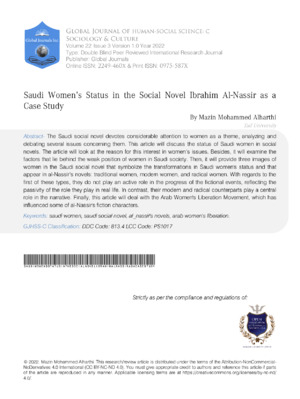
Saudi Women’s Status in the Social Novel Ibrahim Al-Nassir as a Case Study

α
Mazin Mohammed Alharthi
α Taif University

Send Message

To: Author

Saudi Women’s Status in the Social Novel Ibrahim Al-Nassir as a Case Study

Article Fingerprint

ReserarchID

62436

Saudi Women’s Status in the Social Novel Ibrahim Al-Nassir as a Case Study Banner

AI TAKEAWAY

Connecting with the Eternal Ground
  • English
  • Afrikaans
  • Albanian
  • Amharic
  • Arabic
  • Armenian
  • Azerbaijani
  • Basque
  • Belarusian
  • Bengali
  • Bosnian
  • Bulgarian
  • Catalan
  • Cebuano
  • Chichewa
  • Chinese (Simplified)
  • Chinese (Traditional)
  • Corsican
  • Croatian
  • Czech
  • Danish
  • Dutch
  • Esperanto
  • Estonian
  • Filipino
  • Finnish
  • French
  • Frisian
  • Galician
  • Georgian
  • German
  • Greek
  • Gujarati
  • Haitian Creole
  • Hausa
  • Hawaiian
  • Hebrew
  • Hindi
  • Hmong
  • Hungarian
  • Icelandic
  • Igbo
  • Indonesian
  • Irish
  • Italian
  • Japanese
  • Javanese
  • Kannada
  • Kazakh
  • Khmer
  • Korean
  • Kurdish (Kurmanji)
  • Kyrgyz
  • Lao
  • Latin
  • Latvian
  • Lithuanian
  • Luxembourgish
  • Macedonian
  • Malagasy
  • Malay
  • Malayalam
  • Maltese
  • Maori
  • Marathi
  • Mongolian
  • Myanmar (Burmese)
  • Nepali
  • Norwegian
  • Pashto
  • Persian
  • Polish
  • Portuguese
  • Punjabi
  • Romanian
  • Russian
  • Samoan
  • Scots Gaelic
  • Serbian
  • Sesotho
  • Shona
  • Sindhi
  • Sinhala
  • Slovak
  • Slovenian
  • Somali
  • Spanish
  • Sundanese
  • Swahili
  • Swedish
  • Tajik
  • Tamil
  • Telugu
  • Thai
  • Turkish
  • Ukrainian
  • Urdu
  • Uzbek
  • Vietnamese
  • Welsh
  • Xhosa
  • Yiddish
  • Yoruba
  • Zulu

Abstract

The Saudi social novel devotes considerable attention to women as a theme, analyzing and debating several issues concerning them. This article will discuss the status of Saudi women in social novels. The article will look at the reason for this interest in women’s issues. Besides, it will examine the factors that lie behind the weak position of women in Saudi society. Then, it will provide three images of women in the Saudi social novel that symbolize the transformations in Saudi women’s status and that appear in al-Nassir’s novels: traditional women, modern women, and radical women. With regards to the first of these types, they do not play an active role in the progress of the fictional events, reflecting the passivity of the role they play in real life. In contrast, their modern and radical counterparts play a central role in the narrative. Finally, this article will deal with the Arab Women’s Liberation Movement, which has influenced some of al-Nassir’s fiction characters.

References

24 Cites in Article
  1. I Al-Nassir (1961). Thuqbun fi Ridaʾ al-Layl.
  2. I Al-Nassir (1978). Unknown Title.
  3. I Al-Nassir (1989). Unknown Title.
  4. I Al-Nassir (1994). Raʿshat Al-Ẓil.
  5. I Al-Nassir (2001). LAYLAT al-BARĀʾA.
  6. I Al-Nassir (2004). Al, n..
  7. Peter Jones (2009). Oxford University Press.
  8. Al-Ḍabʿ,M Badawat Al-Marʾa Fi Al-Riwaya Al-ʿarabia (2007). Proceedings in Muʾtamar ʾIqlym al-Qahira al-Thaqafi al-Sabiʿ.
  9. Al-Ghaṯa,ʾa (2006). Jaridat al-Jarida.
  10. Al-Jazira (2013). Saudi women take seats in Shūra Council, Al-Jazir.
  11. Al-Mari,N (2006). Unknown Title.
  12. Al-Qaḫṯani,S (2009). Al-Riwaya fi al-Mamlaka al-ʿArabia al-Suʿūdiya: Nashʾatuha wa Taṯūruha.
  13. Al-Rubaiʿi (2013). Appendix 2: sample interview schedule, June–July 2013.
  14. Al-Shinṯi,M (2004). Al-Riwaya al-ʿArabiya: fi marḥ alat al-nuhuḍ wa al-tashakul : dirāsah naqdiah.
  15. Rania Hussein,Nariman Helal,Farah Derbala,Salma Naguib,Nouran Soliman,Hend Aburamadan,Hend Mostafa (2000). Introducing the New Product Alwan in the Egyptian Market.
  16. Bin,B Jumʿa (1999). ʾItijāhāt al-Riwaya fi al-Maghrib al-ʿArabi.
  17. M Dīb (1989). Dār al-Islām wa dār al-ḥarb.
  18. H Dodwell (1977). The founder of modern Egypt: a study of Muhammad \02BFAli.
  19. M Ḫusaīn (1993). Dār al-Islām wa dār al-ḥarb.
  20. M Najim (2012). Marāya al-Thāt: Ṣurat al-Marʾah fi Riwayat al-Kātibah al-Khalījiyya.
  21. Lee Plato,H Lane,M (2007). Lane, Sir Allen (Lane Williams), (21 Sept. 1902–7 July 1970), Hon. Fellow: Royal College of Art; Royal Institute of British Architects; Chairman, Penguin Publishing Co.; Chairman, Allen Lane The Penguin Press; Director: Penguin Books Inc. (America); Penguin Books Australia Ltd; City of London Board, Royal Insurance Co. Ltd.
  22. K Saʿīd (1991). al-Ḥusayn b. Saʿīd al-Ahwāzī.
  23. R Slamah (2008). Dār al-Islām and dār al-ḥarb.
  24. N Whittier (1995). Feminist generations: the persistence of the radical women's movement.

Funding

No external funding was declared for this work.

Conflict of Interest

The authors declare no conflict of interest.

Ethical Approval

No ethics committee approval was required for this article type.

Data Availability

Not applicable for this article.

How to Cite This Article

Mazin Mohammed Alharthi. 2026. \u201cSaudi Women’s Status in the Social Novel Ibrahim Al-Nassir as a Case Study\u201d. Unknown Journal GJHSS-C Volume 22 (GJHSS Volume 22 Issue C3): .

Download Citation

Detailed analysis of women's social status in Saudi Arabia and implications for social science research.
Issue Cover
GJHSS Volume 22 Issue C3
Pg. 35- 45
Journal Specifications
Keywords
Classification
GJHSS-C Classification: DDC Code: 813.4 LCC Code: PS1017
Version of record

v1.2

Issue date

June 23, 2022

Language
en
Experiance in AR

Explore published articles in an immersive Augmented Reality environment. Our platform converts research papers into interactive 3D books, allowing readers to view and interact with content using AR and VR compatible devices.

Read in 3D

Your published article is automatically converted into a realistic 3D book. Flip through pages and read research papers in a more engaging and interactive format.

Article Matrices
Total Views: 1752
Total Downloads: 47
2026 Trends
Related Research

Published Article

The Saudi social novel devotes considerable attention to women as a theme, analyzing and debating several issues concerning them. This article will discuss the status of Saudi women in social novels. The article will look at the reason for this interest in women’s issues. Besides, it will examine the factors that lie behind the weak position of women in Saudi society. Then, it will provide three images of women in the Saudi social novel that symbolize the transformations in Saudi women’s status and that appear in al-Nassir’s novels: traditional women, modern women, and radical women. With regards to the first of these types, they do not play an active role in the progress of the fictional events, reflecting the passivity of the role they play in real life. In contrast, their modern and radical counterparts play a central role in the narrative. Finally, this article will deal with the Arab Women’s Liberation Movement, which has influenced some of al-Nassir’s fiction characters.

Our website is actively being updated, and changes may occur frequently. Please clear your browser cache if needed. For feedback or error reporting, please email [email protected]

Request Access

Please fill out the form below to request access to this research paper. Your request will be reviewed by the editorial or author team.
X

Quote and Order Details

Contact Person

Invoice Address

Notes or Comments

This is the heading

Lorem ipsum dolor sit amet, consectetur adipiscing elit. Ut elit tellus, luctus nec ullamcorper mattis, pulvinar dapibus leo.

High-quality academic research articles on global topics and journals.

Saudi Women’s Status in the Social Novel Ibrahim Al-Nassir as a Case Study

Mazin Mohammed Alharthi
Mazin Mohammed Alharthi Taif University

Research Journals