I. INTRODUCTION
In the twentieth century Einstein dealt with space and time in the Theory of Relativity. The matter and energy were dealt in Quantum Mechanics by the Quantum physicists. This dealing was almost complete and as a result the material science has been enthroned at its highest peak. Einstein also connected matter and energy with his famous equation . Matter and space remained associated with each other till such space, which is empty of matter, the zero-point-energy (ZPE) state, which Einstein abandoned but described as a cosmological constant. Thermodynamics took care of the science of energy too, up till the boundary of the entropy barrier.
With such development, the physical science of matter energy space and time sets a horizon that is limited by the constancy of the velocity of light, Planck's constant and the constancy of the entropy barrier. Einstein's constant, the velocity of light, however, excludes simultaneity of events. Planck's constant excludes continuity of events. Entropy barrier excludes identity of events. There is no scope of investigating such events with the equations/relationships established by the twentieth century's science. Also, there is no room or even any symbol for "information" in any of such formulations in science.
Many quantum activists assume that quantum physics is all-encompassing, and every event of this universe could not only be explained, but could also be predicted by quantum physics. The argument against such a view also exists. Should quantum physics not have any natural limitation as a boundary, why there are findings regarding the existence of the quantum void and quantum holes (black hole, wormholes, and white hole), which raise questions like quo vadis quantum mechanics [1] and undevenis quantum mechanics? The "holes" could be described only in the context of a boundary of systems! Scientists, starting from Subrahmanyan Chandrasekhar in 1983 to Sir Roger Penrose in 2020, have been winning Nobel Prize for their work on such "holes" in the boundary.
Nature, it seems, does not end with the scope and horizon of quantum physics. Deeper to nature, where the laws of classical physics apply (nest I) there is nature where the laws of quantum physics hold good (nest II). Deeper to quantum nature, there are pre-quantum nature (nest III), and pre-prequantum nature (nest IV) before nature merges into unconditional consciousness (nest V). We are to investigate nature and consciousness with the framework of a Pentaune (Five-in-One) model of nature-consciousness .
Einstein had stopped at the space having no connection with the matter, i.e., at ZPE! The energy at ZPE is not the mundane energy which could be equated with the matter by his equation. It is non-observable energy, fluctuating at the gateway to the terrain of dark energy! Although called Einstein's cosmological constant, the value of this intangible near-zero energy is never constant and shows wide fluctuation, and the science must ask why? Is it that an unimaginably vast source of non-observable energy has been peeping through this ZPE? ZPE is omnipresent within the boundary of the universe and is proposed to be harnessed by the living cell during inter-conversion of various information-states within.
Every scientific formulation is a construction of a developed human mind! That is why mind is so important for physics too. Einstein has emphasized this on many occasions. The human mind sets the horizon for science according to cognitive limits . We have another way to go beyond this set limit, the way of imagination! Einstein also emphasized on the role of imagination beyond the mundane functions of mind. According to him, imagination was more important than knowledge. For spiritualists like Ramakrishna Paramahansa from India, enslavement or freedom of a man depends on his state of mind. Buddha's whole emphasis is on getting a clean active poised mind. Swami Sivananda of Rishikesh, India, said, "That which separates you from God is mind. The wall that stands between you and God is mind" . According to Sri Aurobindo, on the other hand, the mind is the vehicle of consciousness. Taking all such views into consideration, it may be stated that the mind functions as an organ of communication between the two conscious systems. Mind is the final common platform to connect consciousness with the material plane. In this sense, the mind is the organ that actively operates for interconversion of a signal in the physical plane and information in the conscious plane. Mind reports to the faculty of self in the cognitive organ.
There are also human states when the mind breaks down and the being does not mind about any event, phenomenon or situation but operates as a passive but conscious observer, as a "witness" of the event when many of the happenstances are noted to be continuous, simultaneous and identical. Sri Aurobindo describes several planes of higher-up mind such as overmind, illumined mind, intuitive mind, supermind and finally he describes the plane supervening on the mind, as "supramental" [6]. We envisage twenty first century's science to revolve around (i) science of information and its various states, (ii) different operations of the mind, and (iii) the biology of dark energy and dark matter. Three areas seem intertwined and connect the cognitive domain of consciousness, cosmology, and space time matter energy.
From the beginning of this century, a transdisciplinary science has been emerging in the name of cybersemiotics . With the first transcendence of the present domain of science from its positivistic base to a non-quantifiable domain, the discipline is engaged in sign, semiosis, communication, mode of understanding, phenomenology, hermeneutics and the systems but avoids the use of the subjective word "mind". On our way forward, we are yet to define two more transcendences for understanding the science of information in the context of the Multiversal Worldview.
The Multiversal Worldview has been propounded by the author since 1984-1985, which deals with the scientific revolution that follows triple transcendence [10]. While the first transcendence is from the quantitative positivistic domain of nature to the non-quantifiable domain, the second transcendence is directed from the non-quantifiable domain to the domain of the quality of nature. In the context of cosmology, the second transcendence is from ZPE to the boundary of the universe while the third transcendence is the transcendence of the boundary of the universe to get into the domain of the multiverse [11]. The third transcendence could be described as an over from the domain of the quality to the non-qualifiable domain of unconditional consciousness. The Essence from which several universe(s) have been originating and in which several universe(s) have been annihilating is non-qualifiable awareness in unconditional consciousness. In spiritual practice, non-qualifiable awareness is considered as "Brahman" that executes its operations through Mother Nature, the nature of all natures which operates as the executive front, the kinetic pole and the mobile facet of consciousness. The spectrum of cognitive organs extends deep into this unconditional consciousness and surfaces as the 'mind' superficially. In the domain between the mind and consciousness, there are two more faculties; the sentient entity, the faculty of self, and the homeostatic entity, the faculty of life. The mind is the event-making faculty while consciousness could be considered as the will-making faculty, and the event-manager. The faculty of life characteristically manages three homeostases; uncertainty-certainty homeostasis, asymmetry-symmetry homeostasis and dark energy-visible energy homeostasis. Four cognitive faculties namely consciousness, self, life, and mind, together with information, constitute the systems psyche [12].
A series of ontological reversal follow the third transcendence. For example, Multiverse determines the course of the universe. Cognition does not build up consciousness. Consciousness guides cognition. The source of consciousness is not the brain. Consciousness drives the brain for its manifestation. Genes do not drive information. Information drives the genes. Time does not guide information. Information generates its own time, etc., etc. In this sense the Multiversal Worldview following the third transcendence carries the Power of several new formations.
As the nineteenth century had been busy with classical physics and the twentieth century with quantum physics, so the twenty first century's science will revolve around various information states, the biology of dark matter and dark energy and the cognitive organ, its faculties, and operations. In the twenty second century, the "life" would be in sharp focus as the source of information. And, the twenty third century is the century for engagement with unconditional consciousness. We are, therefore, at the middle of the five century's science!
II. SCIENCE OF INFORMATION
A. Previous
The cloudy idea that information is an entity independent of space and time [3] was there in the author's mind since 2000, and got concretized in mid-2004 during a family tour in a sub-Himalayan hill station. It was noticed that with an ontological reversal, the "form" (space time) was generated from the substance of information through mind. The idea was presented in the World Congress of Psychotherapy in Buenos Aires in 2005 and was published in a Yoga and Psychotherapy book [13]. The idea was elaborated in greater detail [14] in the author's review of a book, Quo vadis Quantum Mechanics, published in Frontier Perspective journal. A full research paper on this radical view of information was published [15] in the same journal in 2008. The idea gained clarity over the years which could be found in an essay titled, "The Self and Its Memes and Genes: Genes, Memes, Self, Brain, Information and Consciousness" [16]. The paper on "Information Hologram" was published in 2012 [17]. In the annual conference, "Towards a Science of Consciousness" held in India in 2013 the author, as a plenary speaker, presented a paper titled, "Setting the Agenda for Science of Information" [18]. The elaborated version was also published as a chapter in the book, Brain Mind and Cosmos [19]. In 2019, the author published the structure of information-states as visualized [20]. The present paper is a short review of all such publications and other author's work in the context. It is meant for presenting the interwoven canvas of ideas on information in the Third person's perspectives using a common universal language.
B. What is Information?
The signal is not information. A signal is the space time energy construct of information. Information is the unit of communication between two conscious systems. The organ which could extract information out of signal has been called 'mind' by the linguistics. We have defined the mind as the organ of communication between two conscious systems. Information and mind are thus inextricably related. Information is not created in the physical or space time matter energy domain.
Information, however, reduces uncertainty in the space time domain. Information carries a specific content. Information is intentional too. The entity having a content, an intent and is capable of reducing uncertainty in the space time domain is information.
New Testament says, "In the beginning was the Word, and the Word was with God, and the Word was God." The Kabbalah paradigm echoes similarly on the beginning. In Mimamsa, one out of the six philosophical schools prevalent in Vedic Darshan, it has been said that the matter has come out of information {Padartha = Pada (word) + Artha (matter)}. In the last century, Swami Vivekananda thundered, "I am a Voice without form." The statement conveys, information is prior to "form".
Information has puzzled many scholars. We do not know what could be the relation between information and unus mundus of Carl Jung! We are reminded of Wheeler's persuasive argument [21,22] to learn about the world by looking at it in terms of information. Susan Oyama [23] in the book Ontogeny of Information, says, "Information is a prime commodity, and when it is used in biological theorizing it is granted a kind of atomistic autonomy as it moves from place to place, is gathered, stored, imprinted, and translated."
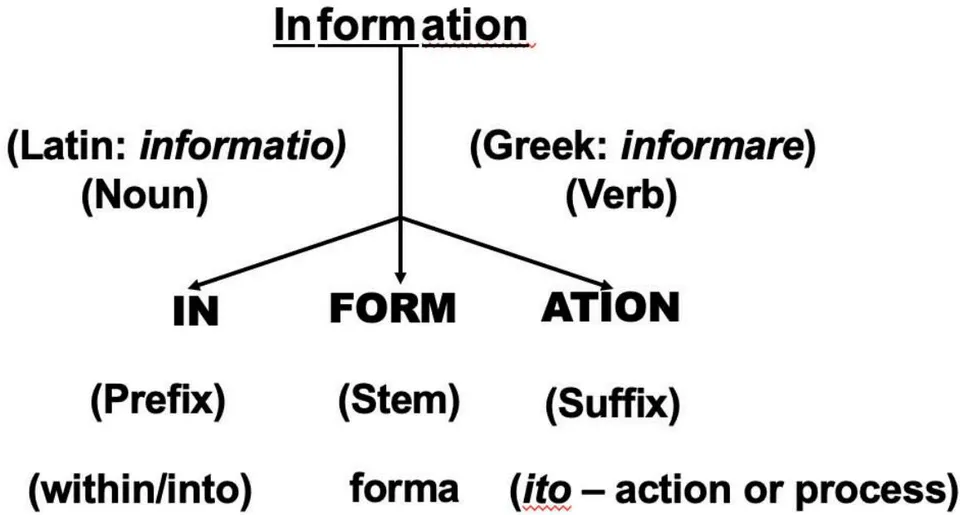
The linguistic analysis of the word information is shown in figure 1.
Information is that entity which connects the local domain (of space time matter energy) with the nonlocal domain (of mind self life and consciousness) of nature. Unlike consciousness, information could be a particulate entity in phase whose location, content, and context are addressable. Unlike any other particulate entity, information could be independent of energy and matter, space and time, and thereby can exist in a location-non-addressable, content-non-addressable, and context-non-addressable state.
Communication between conscious systems in both small and large scales happens with the information. The communication achieves accomplishment when the recipient understands what has been communicated. Since the mind has different states, which widely vary with the environment and the being, the issue of contingency is implicit in the meaning extraction. Information while in its original abode at pre-quantum nest of nature does not need to move anywhere for the purpose of communication. It is the receptivity of the systems that is important for such communication. Within the local domain of nature, information moves on the vehicle of matter/energy with a speed as achievable by them. In the web of communication, a single cell, human being, and the cosmos have been suggested to be connected [24]. With stars in the galaxy, and galaxies in the universe, and neurons inside the human brain, science has found some comparable data between cosmic web and neural network [25]. How the complex spatial information is communicated between the galaxies in patterning the web constructed by a unicellular slime mould [26], has raised profound questions for communication science.
C. Properties of Information
Information could be heard. Writing on the wall could be read and conveyed. However, information-as-such are not observable! What observed are data, signals, and facts! Information could not be measured since apparently small information can have huge impacts and a mountain of so-called information might turn out to be junk. What could be measured is the reduction of uncertainty following the appearance of information. Information could not be reduced, since the attempt of reduction might lead to the propping up of new information! What could be reduced is the content of information that might change again the information itself. Such a puzzling element, an irreducible fundamental, the universal connecting fabric has some astounding properties.
Any single information has the ability to be present simultaneously everywhere in the universe (a property of spatial nonlocality), also to be present at any and every point of time (a property of temporal nonlocality). The property of omnipresence is found to begin with an entity like information.
All information is present simultaneously and instantaneously at any given point of space and time and in every point of space and time.
Despite being originally pre-spatial and pre-temporal, it remains in the potential (waiting) phase for an opportune moment to become active for causal execution, creative emergence and a new creation in the space time domain.
D. What is the Domain of Nature where Information Operates?
Information is independent of space, time, and visible energy and the world constituted by space, time and visible energy! The nest of the nature where such independence of information is visible is in the pre-quantum or sub-quantum nest (nest III) of nature, where information exists as a nonlocal entity in-phase and operates as a particulate which is tinier than any known particle/wave package of energy in the quantum domain of nature. According to David Bohm [27], information is in the implicate order of nature. There is no information in the nest V of nature. Nest IV has the source of information. Nest III is the natural abode of information. In the nests II and I, information is carried on the vehicle of a quantum and a classical particle respectively.
E. How
Information comes down to the classical and the quantum nests of nature using the classical or quantum particle/energy as its vehicle. Information enters the quantum domain through the "quantum void"! Information can directly enter the classical domain of nature through the space empty of matter, i.e., zero-point-energy (ZPE), Einstein's cosmological constancy abandoned almost a century back (figure 2).
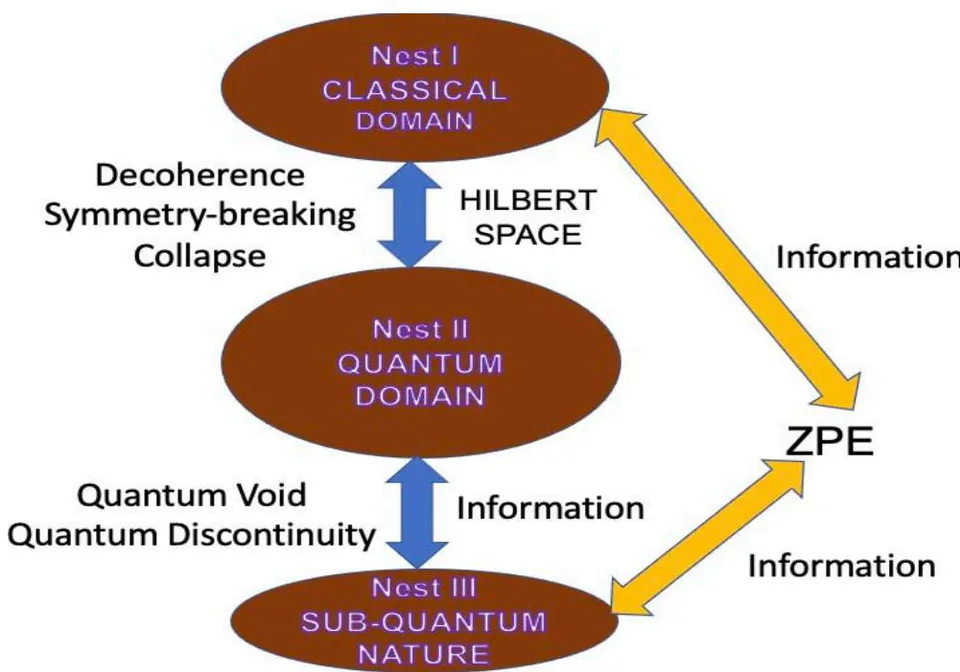
Within the quantum nest of nature, such transport of information could be the reason behind phenomena such as quantum puzzles and quantum paradoxes . Such information transport at the classical nest could account for occasionally-observed nonlocal behavior and even intentionality in the classical domain , although those phenomena are rejected quite often as anomalous phenomena of nature.
F. Role of Information in generation of Complexity
A complex system has multiple operators executing several operations. The operations are hierarchically structured. The details of operations and their exact relationship are not clearly known. No known force, field or visible energy is responsible for the element of wonderment in the complexity. The non-observable dark energy might have a role in creation of such puzzle! Here, information plays a role. Information flows between the operators for materialization of the desired outcome. Such a flow of conveyed information accounts for the dynamicity of systems. Intentionality of information might account for unaccounted propelling force. The flow of information is often labyrinthine which is difficult to simplify further for understanding with ordinary intelligence! Inter-conversion of different information states is made possible when the systems has an access to the dark energy domain through ZPE. Frequent silence of operating information offers some degree of uncertainty and unpredictability in the behavioural outcome of the systems.
This complexity is a subject of research in hard science, natural science, social science, deep science, psychology and behavior. The science of information holds the key to unlock what has been considered hither-to complex.
G. Time begins with Information-split phenomenon
Scientists differ in opinion when does the Time begin for any event. In the linguistic analysis we have shown that information has a "form" within its substance. 'Form' is a combination of space and time and the process of 'formation' is understood as organization of space and time. When the information splits into 'form' and energy, 'form' further breaks into space and time. The new time begins then! This is true in the context of formation of the universe in the cosmic scale and formation of a new cell structure in biology or development of a new function at small observable scale. Time begins with information-split phenomenon! The 'split' could also be considered as the demise of that particular information. Information does not 'die' in the universe. It is fragmented into space, time, and energy.
According to many philosophers and scientists, time is related to the mind (e.g., Benjamin Libet [29]). Event-making faculty in the cognitive organ is the mind. Time is then mind's creation! Mind is an information-hub. Incessantly, mind conceives information at tandem, in series. This fertility of mind comes from mind's connection with consciousness, while mind's property of infidelity is the result of its connection with the physical world. Consequent to conception of information, the mind delivers information's inside as 'form', along with energy. The energy is invisible and belongs to the category of dark energy. The 'form', following rearrangement, might go back to the mind to be processed as "thought", or it breaks down into space and time. In the relationship described, information plays the role of a father, the mind that of a mother while space, time, and energy (dark) could be considered as their three children (figure 3).
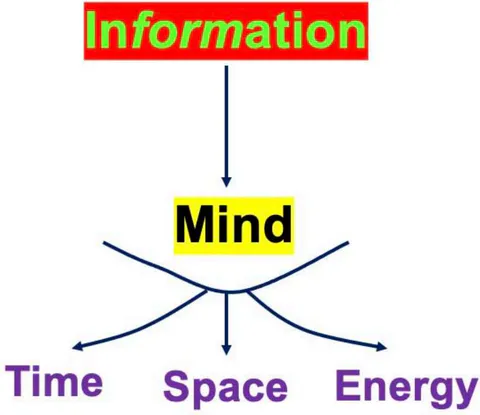
Fig. 3: Information impregnates the mind. The mind delivers space, time, and energy.
Science does not have any mathematical equation to connect information with energy, space and time. However, a relationship of five entities exists. All relationships could not be represented by mathematical equation or by interactive chemistry.
Let me express the happenstance poetically, which had been written in 2005, and published in 2012 [17].
"I was looking at my Mind!
Between Me and Infinity, Often distinct, often an ever-fading line!
It is my Mind!"
"Passively, on itself it winds. In action, it grows mighty wings. Between Finite and Infinite An amazing swing! It is my Mind."
"On one day Information approaches her, With passion, aggression and intense desire!
In his captivating charm, she submits to conceive. Through nonlocal communication she perceives
A command to deliver 'Form', Which is Information's inside!"
"The play of Love, Sex and Aggression,
It happens outside scientist's box of vision!
What one observes are only quantum fields!
The measurable entity, within scientist's skill."
"Born are Energy, Time and Space.
Visible children from Infinity's mess!"
"There are Fields and all the more.
Energy and matter, a gala furor!"
"Scientists get busy playing with them.
Conceals Infinity, how It so became!"
H. Information is enslaving
The burden of information is enormous. It is said, although not uncontested, that the information in all words spoken and written from the beginning of time to the year 1999 has been estimated to be 5 exabytes (one exabyte is one million terabytes, byte). In the year 2002 another 5 exabytes of information were produced, and by the year 2022 we will be producing 5 exabytes every ten minutes [30]. In addition to this quantitative burden, consider the qualitative and intentional aspect of those bytes! We are drowned in the ocean of information without knowing where we are drowned and what the consequences are!
Having conceived information, mind creates information's own space and time for its manifestations. A powerful information can stop a less powerful one, and captivates mind for its own manifestation. There are ample examples in day to day life when we observe competitive information overpowering our mind and getting event realized on priority. Unknowingly, unconsciously we all are enslaved in the process of manifestation of information. Information uses us for its own manifestation by space time formation. Our systems psyche is an information hub. In absence of information the systems psyche is silent, still, empty and appears as nothing. Consciousness, on the other hand, is the one that looks after what all have been happening in our faculty of mind, self and life in term of quality management of different information. Therefore, it is consciousness which could only make us free from such enslavement by information. It does so by its "will" with an intention for such clearance.
I. Existential Barrier for Information
Information-as-such has no barrier. "The wall has ears"! Whether information can pass across black hole or not is debated widely. Information as in digitized memory can be changed, erased and deleted. This surely cannot pass across the black hole. Nondigitized information loses its existence with information-split phenomenon. Information in episodic memory cannot cross the barrier of death, black hole or intergalactic space. Knock-out of information at the site of existential barrier is quite common.
Information in existential memory is difficult to dissolve and can occasionally cross the barrier of death, black hole or hyperspace (as we see in Ian Stevenson's work on reincarnation memory [31]). No information including information of existential memory has the access to the Essence of the Multiversity. This fact is of immense spiritual significance, especially in the context of third transcendence [11]. What is called Mantra in spiritual jargon is nothing but coded information on the Divine (Consciousness-Mother Nature). In the method of Akhanda Diksha (initiation by the Akhanda Sadguru) as followed in India, Sadguru accepts all disturbing memory from the newly initiated to make the disciple completely free of information, ushering a new birth in his life. This is not practically possible unless the Sadguru really dwells in the Essence of the Multiversity.
J. Information Mechanics
Does the information have independent operational mechanics? Of course, yes, since it is an intentional entity! The science of twenty first century is meant to get into this operational mechanics of information. The details of these mechanics are yet to be worked out.
Prigogine [32] has suggested that there is some irreversible dynamics underlying quantum theory. Gerard Hooft [33] observes determinism beneath quantum mechanics. Brukner and Zeilinger [34] see quantum physics as a science of information. When we examine the multi-revolutionary theory of consciousness proposed by Michael Lockwood, Colin McGinn, and Roger Penrose as analyzed by Robert Van Gullick [35], it becomes obvious that before one can solve the mind-matter problem two earlier revolutions are supposed to occur. One revolution is expected and necessary on the matter-side, another revolution on the mind-side, followed by a third evolution that will connect the two. According to the author, the mind-side revolution has started with the formulation of the systems psyche [12], matter-side revolution with the publication of the paper on the zero-point-energy state of the brain [36], and the central revolution has been going on with this science of information [13-20].
Three Revolutions
Matter-Side: Zero-Point Energy
Mind-Side: Systems Psyche Central Revolution: Information Science
K. How
In the scale of size, information is subtler than Planck's quantum of energy. As an identity-in-phase, information is smaller than that can be measured in Planck's scale.
Information is categorically a different substance as compared to energy.
Information, unlike energy, is neither generated nor emitted as quantum.
Information also does not behave as a 'quantum'.
Besides, information is an intentional unity. Information itself is causal.
L. What are the Characteristics of Information Mechanics?
Information mechanics is a mechanics of waiting. Information for its manifestation could wait for eons, for millions of years. Waiting is mostly attributed to inactivated form of information. Activation opens up its opportunistic property.
Information mechanics is a mechanics of opportunism.
Information is opportunistic. Imperatively, it is slow, patient, and intelligent. By the by, the process of evolution is also considered an opportunistic one; information mechanics is probably intertwined with the process of evolution.
- Information in opportune moments asserts for causal execution.
Information works as the causal executive. The system undergoes changes according to input or reassortment of information within. Informational link, therefore, represents the causal link. Information loss explains the break in the causality chain.
- Information mechanics is also responsible for creative emergence.
Information reorganizes space and time with emergence of new meaning, new context and new relevance.
- Finally, the mechanics of information is inextricably connected with new creation.
Information creates new "form," new space and new time, and their new organization!
In the pre-space, pre-time domain, information waits patiently and intelligently to get carried across the quantum void on the vehicle of a "quantum" of energy or across the ZPE enters the classical domain of nature and looks forward to getting accepted in a receptive system where it can perform causal execution or can bring about creative emergence. The most creative function of information is displayed when it takes the opportunity to impregnate a prepared and receptive mind, or any mind-like structure and process in nature. This results in delivery of new space, new time and new energy.
M. What activates inactive information?
Regarding activation of inactive information following possibilities are suggested.
(i) Spontaneous activation is a possibility, but rare.
(ii) Activations by quantum fields.
(iii) Activation by a specific state of mind/self/consciousness.
(iv) Activation by subtle part of life (life-principle or subtle processes of life).
(v) In a live self-organizing system, activation could happen when the faculty of 'self' is tossed in the existential terrain of a life-or-death situation.
N. Information
In the tour of information from pre-quantum domain of nature to the quantum and classical levels of nature, there are several stages of information loss that may partly explain the difference in content of same information in different nests of nature. Information loss accounts for the following phenomena.
Breakage in the chain of causality.
Breakage in continuity (in fact, there is an opinion proposed by Gerard 't Hooft that discrete character of the 'quantum' could be accounted by information loss).
The phenomena, which quantum scientists often try to ignore, or avoid, through a process known as "normalization". Classical physics rejects such events outright as anomalous!
O. Link of Information
There is no direct link between the information mechanics and Quantum Mechanics or the classical mechanics. Equations of classical or Quantum Mechanics do not have information as a determining factor anywhere. Even, no symbol exists for the information. However, information carried on the vehicle of quantum or classical particle could create anomalous phenomena in classical physics, and paradoxes and puzzles in quantum physics.
The indirect relation of information with the classical and quantum nest of nature could be better understood when we understand the relationship between the information and energy.
P. Information and Energy
We are to look into the relationship between information and visible energy, information and dark energy, dark energy and visible energy. The energy delivered during information-split is dark energy. This is different from matter-based visible energy, which could be quantized and is related to matter with Einstein's equation . How dark energy is converted into visible energy? It happens using "life" in its subtle form, as life-processes, or as life-principle. Subtle life-processes during conformational changes in the cellular proteins participate in this inter-conversion. The process of conformational change of the macromolecules in cell biology has been suggested to have access to the domain of dark energy through ZPE. Without presence of such "life" processes there is no possibility of such inter-conversion. In fact, the author has expressed the view that the purpose of creation of "life" is to tackle this dark energy issue in the cosmology of the multiverse [37].
Q. Nature of
Its various states, structure, and geometry While the signal is energy occupying unit of space per unit of time, expressed as frequencies (space per unit of time), information has been traditionally considered as bipolar with an objective and a subjective pole. Its objective pole is what is called signal but its subjective pole interacts with mind. Thus, information is like a bud or a spindle. However, according to the author, this is the structure of an inactive information. How an inactive information gets activated has been described. When activated, the information-bud opens up its three folia. The content folium interacts with the faculty of mind, intent-folium interacts with the faculty of self and measurable folium reduces uncertainty in the physical nest of nature (figure 4). Information, thus, binds matter, mind, and self.
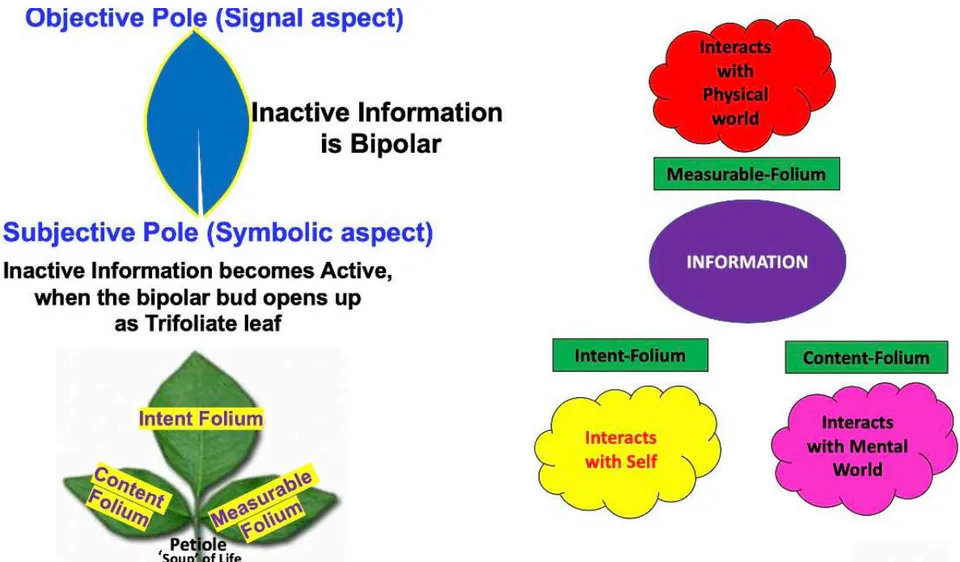
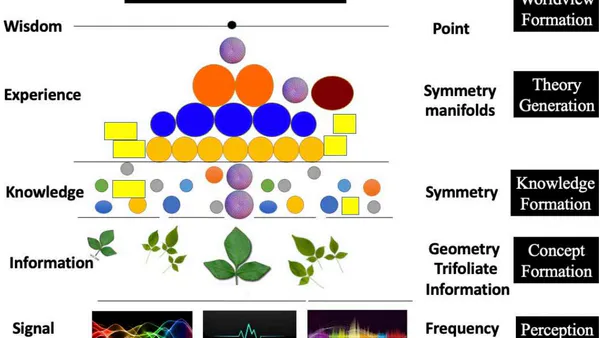
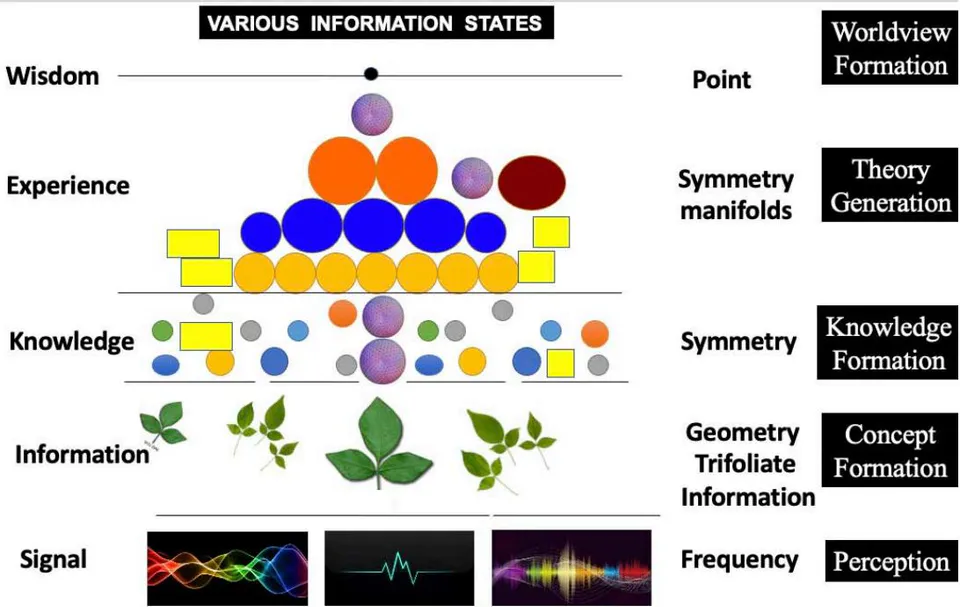
With this trifoliate structural geometry, information transits from the digitized state to the non-digitized state. Still, it is factorizable into content, intent, and a fraction that reduces uncertainty in the physical plane. Several such information related to each other in the non-physical plane come together to remain united in the form of knowledge. In simple language, information is packed in a box, rectangular, quadrangular, or otherwise or in any other shape including that of a sphere. This creates the invariant symmetry of knowledge. Knowledge is that ensemble of information which could be used without further deliberation. The symmetry of knowledge is, however, not unbreakable! Encounter with new information and as a consequence, symmetry-breaking and symmetry-making remain an incessant process in the life-systems to create what we call experience. The experience is reposited in the fabrics of life as the layers of information-manifolds. The experience, as information-manifolds, however, is systems-confined. The widespread concurrence of the experience of a large number of systems results in what we describe as wisdom. Wisdom is the crystallized information, where several spheres of knowledge and manifolds of experience are sublimed/condensed/reduced to the smallest minuscule of Point (figure 5).
R. Information and the Ladder of Cognition
The signal is a digitized form of information. Information itself is non-digitized but factorizable to content, intent, and the ability to reduce uncertainty. Knowledge is a package of related information which is non-factorizable and obviously cannot be digitized. Experience as information manifolds is distributed along the fabrics of life. Wisdom is information in crystal form.
It becomes obvious that information-states, as described, are inextricably intertwined with the ladder of cognition , which steps up from signal at the physical level to information at the level of faculty of mind, knowledge at the level of faculty of self, experience at the level of faculty of life and finally to wisdom at the level of faculty of consciousness (figure 6).
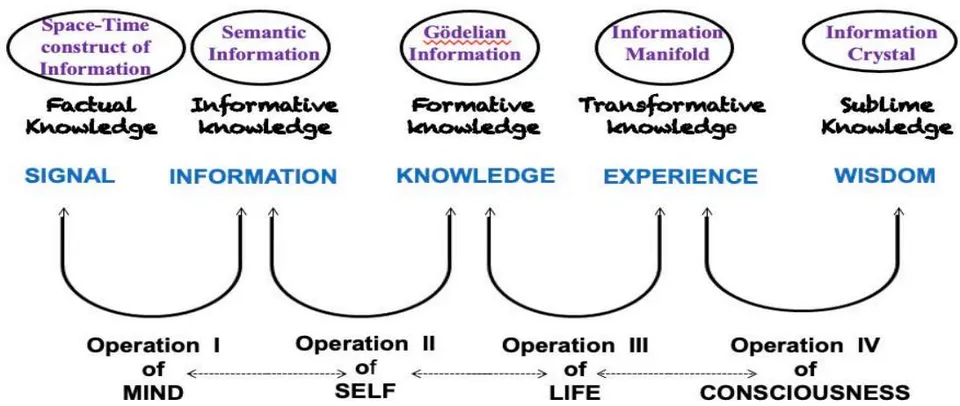
The faculty of the cognitive organs such as mind, self, life and consciousness are four operators in this ladder. Mind, the event-making faculty, is primarily involved in signal-information inter-conversion. Self, the sentient faculty gets engaged in inter-conversion of information and knowledge. Life, the homeostatic faculty of cognitive organ, actively participates in knowledge-experience inter-conversion. Consciousness, the willmaking faculty in the cognitive organs, is engaged directly in cognition during inter-conversion of experience and wisdom. The cognitive faculties do not operate by any force or energy or field. Their operations are based on intention and will. The "will" is a prerogative of consciousness. The intention is an elaboration on the purpose, and is therefore coupled with the will. The hierarchy of operative faculties in the cognitive organ is labyrinthine. The Pair of faculty of self and life maintain a tangled hierarchy.
The process of cognition following the ladder, as described, could happen only in a living system since the process of cognition entails utilization of visible energy during ascent from signal to wisdom, and utilization of dark energy during descent from wisdom to signal along the ladder.
S. More on Wisdom
In the ladder of cognition, wisdom is the sublime experience. In the language of information science, wisdom is the information crystal. The platform for assertion by wisdom is at the boundary of the systems. However, there is distributed wisdom in the fabrics of life throughout nature. The greatest wisdom could be located at the border of transition of nature into consciousness. Identity of the signal and the wisdom is supposed to happen at type IV Multiverse [39]. In the cognitive science, the identity of the signal and the wisdom is found in the revealed truth through an illumined mind. In a colloquial sense, the wisdom is an outcome of the process of intuition.
T. Uncertainty Faith Information and Evidence
Science is evidence-based. However, that does not make science faithless. The stimulus for scientific enquiry is an encounter with an uncertainty. In medicine, the situation of such ignorance and uncertainty is described as "idiopathic"; idiocy on the part of us and pathetic on the part of the patient. Faith is the drive to open such a knot. An active dynamic faith leads to several hunches to overcome this uncertainty. The success of such inquiry is not a chanced solution! Success comes in getting precise information. The correct information stands as evidence. Deeper the abyss, graver is the uncertainty, and more profound is the requirement of faith to get into the hunches. When success arrives, the science becomes richer in knowledge and stronger is the signal of evidence in the space-time world!
U. Source of Information
At the ground level, information is that which reduces uncertainty. The source of information is the uncertainty encountered between the masculine and feminine faculty of cognition. It originates following the principle of Simila similabus! Uncertainty following tension between consciousness and Mother Nature, uncertainty in the relationship between self and life, uncertainty in the relationship between life and its masculine materialistic processes opens up the generative source of information. According to the source, therefore, the information could be of different quality. Without going into details at this stage, the source of information remains "life". A non-living entity cannot generate information. Wherever there is any new information, one has to search hands of "life" in the process.
V. Information and Consciousness
Quality management of information within the faculty of self, life, and mind is the function of consciousness. No information is there in the unconditional consciousness. The presence of information in consciousness is characteristic of the conditioned consciousness. There are three competing theories about information in the science of consciousness, namely IIT of G. Tononi [40], Global Neural Workspace Theory of Bernard Barr [41], and Hameroff-Penrose's Microtubular Theory [42] of Consciousness. All of the three theories lose way when presupposes information as the source of consciousness, or when not clear about the layers leading information to consciousness. Their attempt, however, is one-step higher as compared to the neural network theory that supposes signal pattern as the source of consciousness. Crick's proposition of neural correlates of conscious experience, however, will remain here always.
Intentionality of information is a property borrowed from consciousness in general, and from the CEO (the "self") within the cell systems. Consciousness remains the source for all manifested entities including information.
W. Protein, Information, and Consciousness
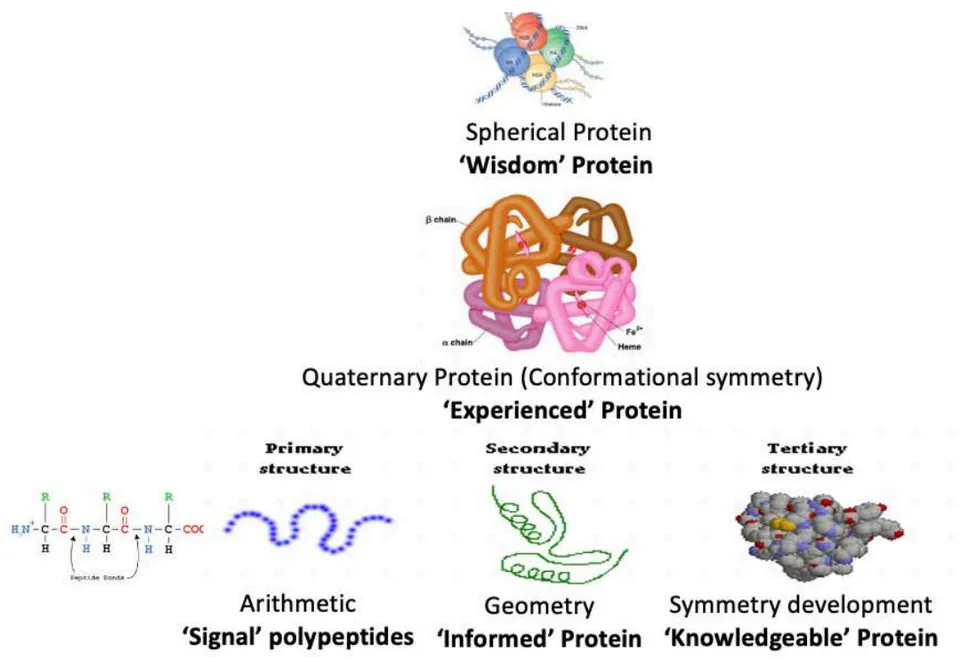
In the cell biology, signalosome, the supramolecular organizing center (SMOC), has been visualized by the author as the center for union of automated signalling of the molecular robots and the autonomy of the cognitive faculties of a cell. The configurational change of structure of protein molecules is suggested to have role in this connectivity. As shown in figure 7, the protein with its primary structure could be a signal molecule, a folded protein with secondary structure operates as informed protein (e.g., receptor protein). Protein in tertiary structure could work as knowledgeable protein (e.g., enzymes). Protein with its quaternary structure (e.g., perforin, DNA-repairing enzyme) is an experienced protein. Spherical protein (e.g., histone winding round DNA in the nucleus) could operate as wisdom protein [43].
X. Cell Biology, Information, and Dark Energy
Structural configuration change of macromolecules is complex and requires activity of conformational energy, which is suggested to be dark energy that accesses the source through the ZPE, and quantum holes (quantum void, black hole, wormhole and white hole). Interrelation of the science of information with the cell biology on one hand, and the cosmology on the other hand is shown in the figure 8.
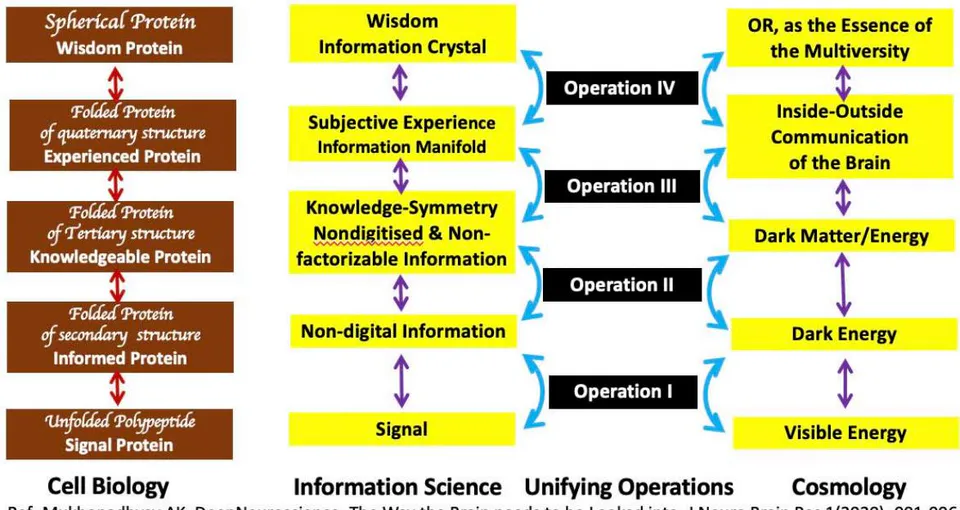
Fig. 8: Four bidirectional operations connect the science of information with the cell biology on one hand and the cosmology on the other hand. There is conversion of visible energy into dark energy during the ascent over the ladder. On the left side, different protein structures such as primary, secondary, tertiary, quaternary, and spherical are shown, which during conformational changes utilize dark energy.
Y. Different Hierarches in Science of Information
We encounter several forms of hierarchy while doing science of information. Consciousness cognition and behavior make a three-tier hierarchy. Bottom-up, when behavior forms the broad base for consciousness operating from the top, one gets a pyramidal hierarchy. Top-down, when consciousness is supposed to form the broad base for a focussed observable behavior, inverted pyramidal hierarchy is the outcome. Different cognitive faculties maintain a labyrinthine hierarchy. Tangled hierarchy is observed between the faculty pair of self and life within the cognitive organ. Tangled hierarchy is often observed between space and time as well. All consciousness cognition and behavior is within the nested hierarchy of nature-consciousness. Such a skeleton requires much flesh and blood to get into its final shape.
Z. Information Science is Transdisciplinary
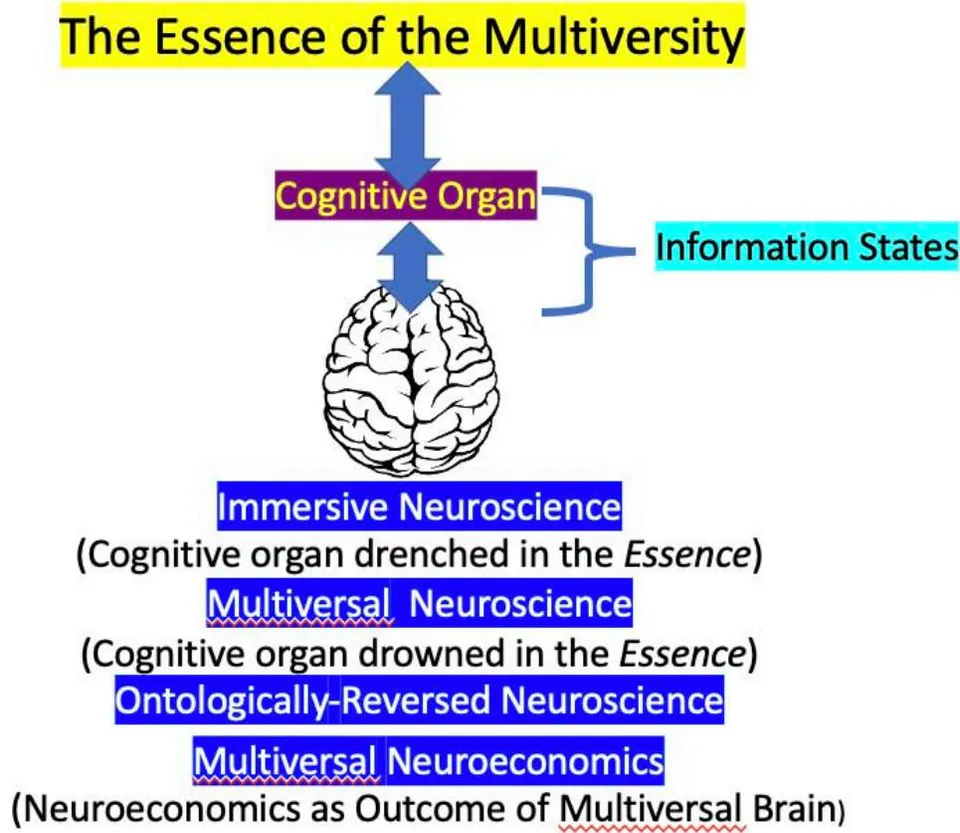
Information science is transdisciplinary but involves physics and psychology, cosmology and cell biology, cognitive science, and life science. It will have a profound impact on the neuroscience, in the form of immersive neuroscience, multiversal neuroscience, ontologically reversed neuroscience, and multiversal neuroeconomics (Fig 9).
III. CONCLUSION AND PERSPECTIVES
In this paper, we have developed the foundational framework for a science of information to complete the central revolution as required for developing a science for consciousness. The science of information is on how the cosmic free will rolls on the Newtonian wheel. There is no field of science which will not be illuminated by the development of a science of information. Humanities, social science and the spiritual science will also not be left out from its influence.
Once we build up the architecture of science of information to an optimum level, we could start investigating the source of information as "life", which would see much more fruition in the twenty-second century.
Connectivity is of crucial importance in science, humanity and spirit. Information is the connecting link between the domain of space time matter energy and the domain of consciousness self life and mind. Consciousness Cognition and Behavior form the central axis. The brain is neither the source of consciousness nor it is the organ of cognition! The brain is a well-developed organ for the expression of behavior. Cognitive faculty interacts with the brain through information. Final pathway of neural behavior is mediated through a signal. Handling of different information states is a function of the faculty of self, the faculty of life and the faculty of mind. The live neural network also includes a large number of astrocytes and their network. The web of life inside the brain is very complex and labyrinthine. Information-states lead us to Deep Science.
Deep Science is the science across ZPE and quantum void. From this paper we are led to dive into the depth of several frontier disciplines of science; a nested hierarchy of nature-consciousness, the deep Science for matter-correlates of conscious states, deep Neuroscience, deep Science of cosmoNeurology, neuroCardiology, and the Systems Psyche. The principle of simila similabus in genesis of information is expected to bring light in the mechanism of homeopathic medication.
The attempt to transcend the boundary and work at a higher (deeper) level of intersections of several existing disciplines of science have given birth to a new discipline, designated as cybersemiotics, pioneered by Søren Brier from International Semiotic Institute of the Kaunas University of Technology at Lithuania, who is also the co-founder of the International Association for Biosemiotic Studies. This is a transdisciplinary emerging branch of science, which with absolute naturalism, encompasses almost every facet of nature namely matter, energy, cosmic phenomena, information, life, genes, cognition, consciousness, social science and inter-subjectively agreed knowledge systems.
The science of information as described in this paper is a leaf from the Multiversal Worldview, which in spiritual and philosophical sense is also called the Akhanda Worldview. The Akhanda Worldview deals with the divisions of the Indivisible (A-Khanda=Un-Breakable). The systems of Multiverse deal with pluralism without compromising individualism, and retains individualism without any restriction on pluralism. The Multiversal Worldview acknowledges, as well as transcends cybersemiotics as described below.
Acknowledgements are found when it transcends the defined disciplines of science and humanities, in its absolute naturalism, systems approach, communication, evolutionary processes, phenomenology, and apparently almost-all-inclusiveness. The supersessions are as follows.
In the spectrum of naturalism cybersemiotics is still confined to one universe, The Multiversal worldview begins from the Essence of the Multiversity, the Essence, which is the Source of systems multiverse. In this sense, Multiversal Worldview is the largest intellectually comprehensible systems approach, truly top-down, and more profound in its origin and implications.
Cybersemiotics has not yet shown the ability to transform the existing disciplines in its favor by any new formation. The Multiversal Worldview, on the other hand, transcends and transforms several existing disciplines by means of new formation. This new formative Power, so characteristic of the Multiversal Worldview, comes following triple transcendence, in contrast to single level transcendence of cybersemiotics.
Despite having an absolute naturalistic and systems approach, cybersemiotics has not yet developed a systematic scheme for investigation of nature-consciousness which could be found in the Multiversal Worldview, in its Pentaune (Five-in-One) model of Nature-consciousness as nature's nest I, II, II and IV, before one dives finally into the nest V of unconditional consciousness.
Cybersemiotics is silent on the existence and operational aspects of cognitive faculty (ontology and epistemology of cognition). The Multiversal Worldview is locally vocal for the universal cognitive faculty with their specific operational mechanics. The labyrinthine decision-making process in the nature and in human being is thus systematized in the Multiversal Worldview.
Cybersemiotics is neutral to, and does not pursue for a response to any fundamental question. The Multiversal Worldview is naturally ready to enquire three fundamental questions raised since the time the cognitive brain achieved its maturity. The questions are, who am I? What is this world? What is that called God? In the pursuit of such questions, the Multiversal Worldview entangles the Humanity, the Science, and the Spirit.
With the foundational framework of science of information described in this paper, the humanity finds the appropriate way for its growth with spiritual science establishing the information-multiverse relationship, information-consciousness relationship, information-self relationship, information-life relationship, and information-mind relationship. We are confident that the experience of the Divine in the Essence of the Multiversity could be brought within the ambit of science. From such experience, the science could be enriched and the humanity is expected to be transformed in its evolutionary, transformative and new formative journey from Homo sapiens to Homo spiritualis .
Declaration
No funding agency has funded the work. There is no conflict of interest in publication of the work.