

Loading menu…

Scleractinian Corals of Loha Barrack Crocodile Sanctuary, Andaman and Nicobar Islands

§ Zoological Survey of India

Send Message

To: Author

Scleractinian Corals of Loha Barrack Crocodile Sanctuary, Andaman and Nicobar Islands

Article Fingerprint

ReserarchID

86TZI

Scleractinian Corals of Loha Barrack Crocodile Sanctuary, Andaman and Nicobar Islands Banner

Key Research Insights

Synthesized scholarly intelligence & interactive research assistant
  • English
  • Afrikaans
  • Albanian
  • Amharic
  • Arabic
  • Armenian
  • Azerbaijani
  • Basque
  • Belarusian
  • Bengali
  • Bosnian
  • Bulgarian
  • Catalan
  • Cebuano
  • Chichewa
  • Chinese (Simplified)
  • Chinese (Traditional)
  • Corsican
  • Croatian
  • Czech
  • Danish
  • Dutch
  • Esperanto
  • Estonian
  • Filipino
  • Finnish
  • French
  • Frisian
  • Galician
  • Georgian
  • German
  • Greek
  • Gujarati
  • Haitian Creole
  • Hausa
  • Hawaiian
  • Hebrew
  • Hindi
  • Hmong
  • Hungarian
  • Icelandic
  • Igbo
  • Indonesian
  • Irish
  • Italian
  • Japanese
  • Javanese
  • Kannada
  • Kazakh
  • Khmer
  • Korean
  • Kurdish (Kurmanji)
  • Kyrgyz
  • Lao
  • Latin
  • Latvian
  • Lithuanian
  • Luxembourgish
  • Macedonian
  • Malagasy
  • Malay
  • Malayalam
  • Maltese
  • Maori
  • Marathi
  • Mongolian
  • Myanmar (Burmese)
  • Nepali
  • Norwegian
  • Pashto
  • Persian
  • Polish
  • Portuguese
  • Punjabi
  • Romanian
  • Russian
  • Samoan
  • Scots Gaelic
  • Serbian
  • Sesotho
  • Shona
  • Sindhi
  • Sinhala
  • Slovak
  • Slovenian
  • Somali
  • Spanish
  • Sundanese
  • Swahili
  • Swedish
  • Tajik
  • Tamil
  • Telugu
  • Thai
  • Turkish
  • Ukrainian
  • Urdu
  • Uzbek
  • Vietnamese
  • Welsh
  • Xhosa
  • Yiddish
  • Yoruba
  • Zulu
Reading Preferences
Font Size
Line Spacing
Background
This converted HTML version may contain rendering inconsistencies. Please refer to the PDF for the authoritative version, or click here to provide feedback.

Abstract

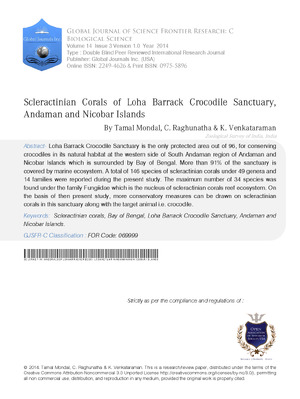
Loha Barrack Crocodile Sanctuary is the only protected area out of 96 for conserving crocodiles in its natural habitat at the western side of South Andaman region of Andaman and Nicobar Islands which is surrounded by Bay of Bengal. More than 91% of the sanctuary is covered by marine ecosystem. A total of 146 species of scleractinian corals under 49 genera and 14 families were reported during the present study. The maximum number of 34 species was found under the family Fungiidae which is the nucleus of scleractinian corals reef ecosystem. On the basis of then present study, more conservatory measures can be drawn on scleractinian corals in this sanctuary along with the target animal i.e. crocodile.

References

26 Cites in Article
  1. 1. Andaman and Nicobar Administration (Forest Department) (1983). Andaman and Nicobar Gazette No 233 Port Blair 3rd May 1983.
  2. 2. Clive Jones,John Lawton,Moshe Shachak (1994). Organisms as Ecosystem Engineers. Oikos, 69(3), 373.
  3. 3. Bret Danilowicz (1996). Choice of Coral Species by Naive and Field-Caught Damselfish. Copeia, 1996(3), 735.
  4. 4. Marcus Öhman,Philip Munday,Geoffrey Jones,M. Caley (1998). Settlement strategies and distribution patterns of coral-reef fishes. J Exp Mar Biol Ecol, 225(2), 219-238.
  5. 5. David Feary,Glenn Almany,Mark McCormick,Geoffrey Jones (2007). Habitat choice, recruitment and the response of coral reef fishes to coral degradation. Oecologia, 153(3), 727-737.
  6. 6. Mireille Harmelin-Vivien (1989). Implications of feeding specialization on the recruitment processes and community structure of butterflyfishes. Environmental Biology of Fishes, 25(1-3), 101-110.
  7. 7. Pratchett MS,Munday PL,Wilson SK,Graham NAJ,Cinner DR (2008). Effects Of Climate-Induced Coral Bleaching On Coral-Reef Fishes — Ecological And Economic Consequences. Oceanography and Marine Biology - An Annual Review, 46, 251-296.
  8. 8. Shaun Wilson,Martial Depczynski,Rebecca Fisher,Thomas Holmes,Rebecca O'leary,Paul Tinkler (2010). Habitat Associations of Juvenile Fish at Ningaloo Reef, Western Australia: The Importance of Coral and Algae. PLoS ONE, 5(12), e15185.
  9. 9. Joanne Beukers,Geoffrey Jones (1997). Habitat complexity modifies the impact of piscivores on a coral reef fish population. Oecologia, 114(1), 50-59.
  10. 10. Sally Holbrook,Russell Schmitt (2002). COMPETITION FOR SHELTER SPACE CAUSES DENSITY-DEPENDENT PREDATION MORTALITY IN DAMSELFISHES. Ecology, 83(10), 2855-2868.
  11. 11. Darren Coker,Morgan Pratchett,Philip Munday (2009). Coral bleaching and habitat degradation increase susceptibility to predation for coral-dwelling fishes. Behavioral Ecology, 20(6), 1204-1210.
  12. 12. A. Cole,M. Pratchett (2011). Effects of juvenile coral-feeding butterflyfishes on host corals. Coral Reefs, 30(3), 623-630.
  13. 13. TJ,R. Kenchinton,L. Zell (1982). Rapid, large area, reef resource surveys using a manta board. Proceedings of the Fourth International Coral Reef Symposium. Proceedings of the Fourth International Coral Reef Symposium, 2, 597-600.
  14. 14. R. Kenchinton (1984). Large area surveys of coral reefs. UNESCO Reports in Marine Science, 21, 92-103.
  15. 15. Jen Veron,Michel. Pichon (1976). Scleractinia of Eastern Australia /.
  16. 16. Jen Veron,Michel. Pichon (1979). Scleractinia of Eastern Australia /.
  17. 17. Jen Veron,Michel. Pichon (1982). Scleractinia of Eastern Australia /.
  18. 18. Jen Veron,Michel. Pichon,Maya. Wijsman-Best (1977). Scleractinia of Eastern Australia.
  19. 19. Jen Veron,Carden Wallace (1984). Scleractinia of eastern Australia. Part V /.
  20. 20. J. Veron (2000). Corals of the World. Australian Institute of Marine Science, 1-3.
  21. 21. Carden Wallace (1999). Staghorn Corals of the World. CSIRO Publications, Melbourne. 421pp, 421
  22. 22. K. Venkataraman,Satyanarayana Ch (2012). Coral Identification manual.
  23. 23. K. Venkataraman,Satyanarayan Ch,Jrb Alfred,J. Wolstenholme (2003). Handbook on Hard Corals of India.
  24. 24. Tamal Ramakrishna,Mondal,C. Raghunathan,R. Raghuraman,C. Sivaperuman (2010). New Records of Scleractinian Corals in Andaman and Nicobar Islands. Rec zool Surv India Occ Paper, 321, 1-144.
  25. 25. Tamal Mondal,C. Raghunathan,K. Venkataraman (2012). Diversity and Distribution of Corals in Andaman and Nicobar Islands. Jour Coast Env, 3(2), 101-110.
  26. 26. Sally Holbrook,Andrew Brooks,Russell Schmitt,Hannah Stewart (2008). Effects of sheltering fish on growth of their host corals. Mar Biol, 155(5), 521-530.

Funding

No external funding was declared for this work.

Conflict of Interest

The authors declare no conflict of interest.

Ethical Approval

No ethics committee approval was required for this article type.

Data Availability

Not applicable for this article.

How to Cite This Article

Tamal Mondal, C. Raghunathan, K. Venkataraman. 2014. "Scleractinian Corals of Loha Barrack Crocodile Sanctuary, Andaman and Nicobar Islands". Global Journal of Science Frontier Research - C: Biological Science GJSFR-C Volume 14 (GJSFR Volume 14 Issue 30 (C3)).
More Citation Formats

Download Citation

Issue Cover
GJSFR Volume 14 Issue 30 (C3)
Pg. 25-32
Journal Specifications

Crossref Journal DOI 10.17406/GJSFR

Print ISSN 0975-5896

e-ISSN 2249-4626

Keywords
Classification
GJSFR-C Classification FOR Code: 069999
Version of record
v1.2

Issue date
August 4, 2014

Language
English
Order Article Reprint
Experience in AR

Explore published articles in an immersive Augmented Reality environment. Our platform converts research papers into interactive 3D books, allowing readers to view and interact with content using AR and VR compatible devices.

Read in 3D

Your published article is automatically converted into a realistic 3D book. Flip through pages and read research papers in a more engaging and interactive format.

Article Matrices
Total Views: 1.9K
Total Downloads: 125
All Trends

This is the heading

Lorem ipsum dolor sit amet, consectetur adipiscing elit. Ut elit tellus, luctus nec ullamcorper mattis, pulvinar dapibus leo.


High-quality academic research articles on global topics and journals.

Scleractinian Corals of Loha Barrack Crocodile Sanctuary, Andaman and Nicobar Islands

Tamal Mondal
Tamal Mondal

Request Access

Please fill out the form below to request access to this research paper. Your request will be reviewed by the editorial or author team.
X
