Graphical Abstract
Introduction
Sitting represents one of the most dominant postures in contemporary life, especially within office environments, transportation systems, educational settings, and domestic contexts. Although widely practiced, extended periods of sitting have been associated with musculoskeletal strain, deterioration of spinal integrity, and diminished work efficiency (Lis et al., 2007; Beach et al., 2005; Kastelic et al., 2018). Epidemiological findings indicate that sustained seated exposure increases the likelihood of Low Back Pain (LBP), particularly when combined with constrained movement and suboptimal postural alignment (Lis et al., 2007; Roman-Liu et al., 2023). Biomechanically, prolonged sitting has been shown to induce viscoelastic creep in passive spinal tissues, alter lumbar curvature, and modify neuromuscular activation patterns, thereby affecting spinal stability (Beach et al., 2005; Claus et al., 2018).
Historically, ergonomic recommendations promoted static postural correction, commonly endorsing a 90° hip–knee configuration as the ideal seated position. This perspective was grounded in structural alignment principles that emphasized symmetry and neutral spinal positioning (Black et al., 1996; O’Sullivan et al., 2012). However, accumulating evidence challenges the appropriateness of maintaining a fixed 90° posture, demonstrating that sustained static sitting can elevate trunk stiffness, reduce spinal height, and increase perceived discomfort over time (Mörl & Bradl, 2013; Park & Srinivasan, 2021; Waongenngarm et al., 2015). Recent investigations suggest that postural variability and periodic movement may offer greater biomechanical protection than rigid adherence to a singular “optimal” sitting posture (Claus et al., 2018; Van Deursen et al., 1999).
The introduction of Mandal’s Homo Sedens framework represented a conceptual shift in seating ergonomics by framing sitting as a dynamic activity rather than a static alignment task (Mandal, 1981). Mandal contested the traditional 90° seated model and proposed forward-inclined seating with greater hip extension to better preserve lumbar lordosis. Contemporary biomechanical research aligns with this paradigm, emphasizing dynamic seating solutions, adaptive chair mechanisms, and individualized postural strategies to mitigate discomfort and mechanical strain (De Carvalho, 2015; De Carvalho & Callaghan, 2023; Cho et al., 2023).
Accordingly, this paper examines seating posture from a theoretical standpoint, integrating biomechanical principles with ergonomic design considerations and their implications for modern occupational environments.
Theoretical Background: The Homo Sedens Concept
The Homo Sedens concept portrays modern humans as a population that spends extensive periods in seated positions despite not being evolutionarily adapted to sustained static sitting (Mandal, 1981). Mandal proposed that conventional chair designs and commonly adopted sitting postures generate a typical mechanical stresses on the lumbar spine. In particular, posterior pelvic rotation during relaxed or slumped sitting reduces lumbar lordosis, thereby increasing strain on passive spinal structures and altering load distribution across intervertebral tissues (Mandal, 1981; Beach et al., 2005; Claus et al., 2018). This perspective disputes the traditional notion that sitting is a passive or restorative posture. Rather, it conceptualizes sitting as a biomechanically demanding position that necessitates ongoing neuromuscular regulation and periodic postural modification to maintain spinal integrity (O’Sullivan et al., 2012; Mörl & Bradl, 2013). The theoretical significance of Homo Sedens lies in its integration of spinal biomechanics with ergonomic design, emphasizing the importance of lumbar curvature preservation, postural variability, and dynamic interaction between the human body and seating systems (De Carvalho, 2015; Van Deursen et al., 1999). By reframing sitting as an active and adaptive process rather than a static alignment task, the Homo Sedens model continues to inform contemporary ergonomic research and seating innovation.
| Theoretical Aspect | Core Proposition (Mandal, 1981) | Ergonomic Significance | Critical Evaluation / Limitations | Reference |
|---|---|---|---|---|
| Concept of Homo Sedens | Humans are not biologically adapted to prolonged static sitting | Reframed sitting as a biomechanical stressor rather than a neutral posture | Largely conceptual; lacks evolutionary or longitudinal biological validation | Lis et al. (2007); Kastelic et al. (2018); Jochem et al. (2023) |
| Critique of 90° sitting posture | 90° hip–knee posture increases lumbar flexion and disc pressure | Challenged dominant ergonomic standards of the time | Disc pressure data were inferred from earlier studies, not directly measured in the paper | Black et al. (1996); De Carvalho et al. (2010); Roman-Liu et al. (2023) |
| Pelvic rotation and lumbar lordosis | Posterior pelvic tilt flattens lumbar lordosis, increasing spinal load | Established pelvic orientation as central to seating ergonomics | Individual variability (age, BMI, pathology) not sufficiently addressed | Misir et al. (2019); Claus et al. (2018); Saiklang et al. (2024) |
| Forward-inclined sitting | Hip angle >90° preserves lumbar curvature and reduces disc compression | Influenced modern dynamic and saddle seating designs | Forward tilt may increase knee loading and is task-dependent | De Carvalho (2015); Cho et al. (2023); Zhao et al. (2026) |
| Static vs dynamic sitting | Static postures accelerate fatigue and musculoskeletal strain | Introduced posture variability as a design principle | Movement frequency and optimal variability thresholds not quantified | Park & Srinivasan (2021); Van Deursen et al. (1999); Waongenngarm et al. (2015) |
| Seat–workstation interaction | Seating must be designed as part of a system (seat + desk + task) | Shifted focus from chair-only design to integrated ergonomics | Limited empirical workstation testing in real occupational environments | Azimuddin et al. (2017); Musa (2024); Bai et al. (2024) |
| Anthropometric adaptability | Fixed seating fails to accommodate human variability | Supported adjustable and customizable seating solutions | Population diversity (gender, ethnicity, disability) underrepresented | Lee (2019); Daniel (2024); Podrekar (2023) |
| Clinical relevance | Poor seating contributes to low back pain and discomfort | Linked ergonomics to occupational health outcomes | Causal relationships not experimentally established | De Carvalho et al. (2020); Alaca et al. (2025); Jung et al. (2020) |
Critical analysis of the Homo Sedens theoretical framework in seating ergonomics
Table 1 provides a critical synthesis of the theoretical foundations underlying the Homo Sedens concept (Mandal, 1981), outlining its key contributions to seating ergonomics while examining its methodological and contextual limitations within contemporary occupational settings. The framework’s principal contribution lies in redefining sitting as a biomechanically active posture rather than a passive resting position, emphasizing lumbar lordosis preservation, anterior pelvic orientation, and dynamic postural adaptation (Mandal, 1981; O’Sullivan et al., 2012). Subsequent biomechanical and experimental research has reinforced the importance of posture variability and movement during prolonged sitting (Claus et al., 2018; Van Deursen et al., 1999; Park & Srinivasan, 2021).
However, while the Homo Sedens model provided an important conceptual shift, it was developed prior to the availability of advanced measurement techniques such as electromyography, radiographic alignment analysis, and finite element modeling, which now offer more detailed insight into spinal loading and neuromuscular responses (De Carvalho et al., 2010; Cho et al., 2023; Mörl & Bradl, 2013). Additionally, contemporary evidence suggests that no single “optimal” sitting posture universally minimizes spinal stress, as inter-individual variability and task-specific demands significantly influence biomechanical outcomes (Claus et al., 2018; Waongenngarm et al., 2015; Roman-Liu et al., 2023). Accordingly, Table 1 situates Homo Sedens within the broader evolution of seating biomechanics, acknowledging its foundational theoretical value while recognizing the need for adaptive, movement-oriented, and evidence-based ergonomic strategies in modern occupational environments.
Biomechanics of Sitting Postures
Conventional Sitting Posture
In the conventional 90° seated configuration, the hips are flexed at approximately a right angle, a position frequently associated with posterior pelvic rotation and reduction of lumbar lordosis (Black et al., 1996; De Carvalho et al., 2010). This alignment alters normal spinopelvic mechanics and has been shown to increase mechanical loading on lumbar intervertebral discs while shifting stress toward passive spinal tissues (Beach et al., 2005; Roman-Liu et al., 2023). Sustained exposure to this posture may elevate trunk muscle stiffness and reduce spinal height, reflecting viscoelastic creep and neuromuscular adaptation during prolonged sitting (Mörl & Bradl, 2013; Waongenngarm et al., 2015). Over time, these biomechanical changes are associated with increased perceived discomfort, muscular fatigue, and heightened risk of low back pain (Lis et al., 2007; Jung et al., 2020).
| Aspect | Description | Ergonomic Limitation |
|---|---|---|
| Hip–knee angle | Approximately 90° flexion | Promotes posterior pelvic tilt |
| Pelvic orientation | Posterior rotation of pelvis | Reduces lumbar lordosis |
| Lumbar spine loading | Increased disc compression | Higher risk of low back pain |
| Muscle activity | Sustained static activation | Accelerated muscle fatigue |
| Posture variability | Minimal | Poor load redistribution |
| Task suitability | Historically standardized | Inflexible for diverse work tasks |
Key characteristics and ergonomic limitations of the conventional sitting posture
Conventional sitting postures characterised by a 90° hip–knee angle have been shown (Figure 2) to promote posterior pelvic rotation and increased lumbar disc loading, thereby contributing to musculoskeletal discomfort during prolonged sitting (Mandal, 1981).
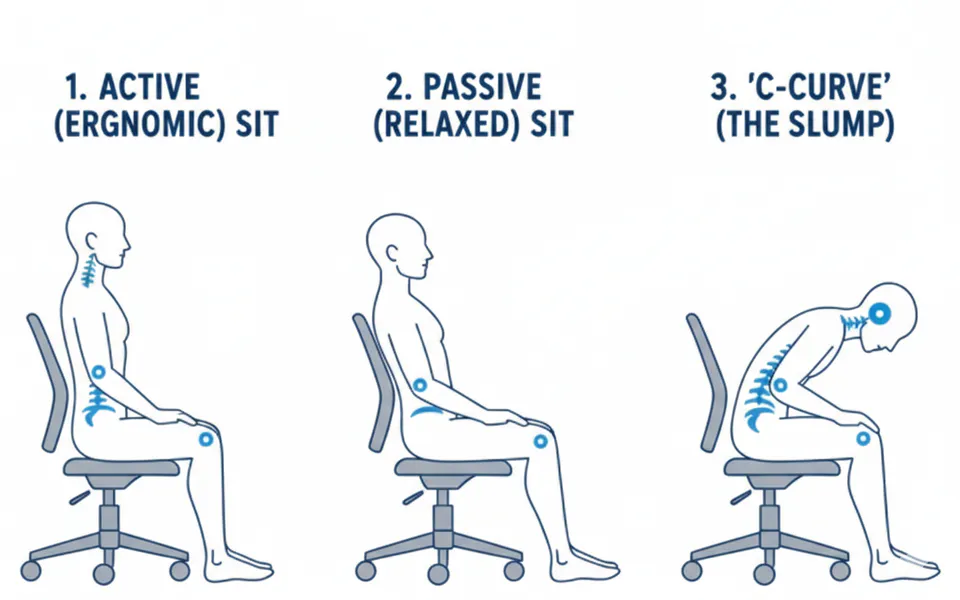
Comparative Analysis of Common Sitting Postures
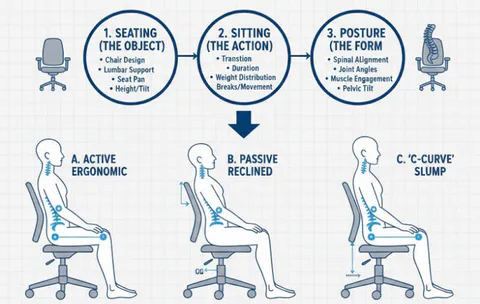
The figure presents a comparative representation of three principal seated postural configurations and their associated biomechanical consequences for spinal health. The Active Ergonomic Sit preserves a neutral, physiologically curved S-shaped spinal alignment, typically characterized by approximately 90° hip and knee flexion. When lumbar lordosis is maintained and pelvic positioning remains neutral, spinal loading is more evenly distributed across vertebral and muscular structures, potentially reducing excessive passive tissue strain (Black et al., 1996; De Carvalho et al., 2010; Mörl & Bradl, 2013).
The Passive Relaxed Sit involves a reclined trunk position, generally between 110° and 135° trunk–thigh inclination, often accompanied by posterior pelvic rotation. This configuration may reduce certain compressive forces on the lumbar discs through backrest support and redistribution of upper body mass; however, prolonged reliance on this posture can diminish active muscular engagement and alter spinopelvic alignment (Roman-Liu et al., 2023; Park & Srinivasan, 2021). Although reclined seating may temporarily decrease discomfort, static loading patterns remain a concern if posture variability is limited (Lis et al., 2007).
In contrast, the C-Curve Slump posture is characterized by thoracolumbar flexion, posterior pelvic tilt, rounded shoulders, and anterior head translation often referred to as “tech-neck.” This alignment reduces lumbar lordosis and increases strain on passive spinal tissues, contributing to altered neuromuscular activation and elevated spinal loading (Beach et al., 2005; Jung et al., 2020; Waongenngarm et al., 2015). Sustained flexed sitting has been associated with increased muscle fatigue, spinal creep, and heightened risk of discomfort and chronic low back pain (Claus et al., 2018; Lis et al., 2007).
Together, these postural comparisons highlight the importance of lumbar curvature preservation, movement variability, and appropriate seating design in mitigating the biomechanical risks associated with prolonged sitting.
Forward-Inclined Sitting
Mandal proposed that increasing the hip angle beyond the conventional 90° configurations typically achieved through a forward-tilted seat surface encourages anterior pelvic rotation and helps maintain physiological lumbar lordosis (Mandal, 1981). By reducing posterior pelvic tilt, this alignment supports more favorable lumbar curvature and may decrease excessive loading on passive spinal structures (De Carvalho et al., 2010; Roman-Liu et al., 2023). Preservation of lumbar lordosis has been associated with more balanced trunk muscle activation and improved postural control during seated tasks (Claus et al., 2018; Mörl & Bradl, 2013).
In addition to its spinal implications, forward-inclined sitting positions the trunk closer to the work surface, potentially reducing excessive thoracic flexion and forward head translation during visual and manual activities (Black et al., 1996; O’Sullivan et al., 2012). By promoting an upright yet dynamically engaged posture (Table 3), this seating configuration may enhance task efficiency while mitigating musculoskeletal strain during prolonged desk-based work (De Carvalho, 2015; Park & Srinivasan, 2021).
| Aspect | Description | Ergonomic Implication | Reference |
|---|---|---|---|
| Hip–knee angle | Greater than 90° | Opens hip joint, reduces pelvic constraint | Mandal (1981); De Carvalho (2015); Zhao et al. (2026) |
| Pelvic orientation | Anterior pelvic rotation | Preserves lumbar lordosis | De Carvalho et al. (2010); Misir et al. (2019); Claus et al. (2018) |
| Lumbar spine loading | Reduced disc compression | Lower risk of low back strain | Roman-Liu et al. (2023); Beach et al. (2005); Cho et al. (2023) |
| Muscle activity | More evenly distributed activation | Delays onset of fatigue | Mörl & Bradl (2013); Waongenngarm et al. (2015); Park & Srinivasan (2021) |
| Posture variability | Facilitates micro-movement | Supports dynamic sitting | Van Deursen et al. (1999); Gregory et al. (2006); Bai et al. (2024) |
| Task suitability | Precision and forward-reach tasks | Improves task efficiency and comfort | Black et al. (1996); Azimuddin et al. (2017); De Carvalho (2015) |
Ergonomic characteristics and implications of forward-inclined sitting posture
Static versus Dynamic Sitting
Prolonged static sitting, irrespective of whether the posture is considered ergonomically “correct,” has been associated with increased muscle fatigue, heightened trunk stiffness, and progressive discomfort (Waongenngarm et al., 2015; Mörl & Bradl, 2013). Sustained immobility may contribute to passive tissue creep and altered neuromuscular activation patterns, thereby compromising spinal stability over time (Beach et al., 2005; Claus et al., 2018). These physiological responses suggest that the detrimental effects of sitting are not solely dependent on posture quality, but also on the absence of movement variability (Lis et al., 2007).
In contrast, dynamic sitting defined by periodic postural adjustments and micro-movements facilitates redistribution of mechanical loads across spinal and muscular structures. Experimental evidence indicates that movement-based seating strategies, including alternating sit–stand patterns and dynamic stimuli, can reduce discomfort and improve trunk mechanical behavior during prolonged tasks (Van Deursen et al., 1999; Park & Srinivasan, 2021). This principle forms the foundation of contemporary ergonomic seating design, which increasingly emphasizes adaptive mechanisms and posture variability rather than rigid fixation in a single “ideal” alignment (De Carvalho, 2015; Cho et al., 2023).
| Aspect | Static Sitting | Dynamic Sitting | Reference |
|---|---|---|---|
| Posture pattern | Fixed or minimally changing posture | Continuous posture variation | O’Sullivan et al. (2012); Bai et al. (2024) |
| Muscle activity | Sustained isometric contraction | Alternating muscle activation | Mörl & Bradl (2013); Gregory et al. (2006) |
| Spinal loading | Concentrated and prolonged | Periodically redistributed | Beach et al. (2005); Van Deursen et al. (1999) |
| Circulation | Reduced blood flow over time | Improved circulation through movement | Park & Srinivasan (2021); Jochem et al. (2023) |
| Fatigue development | Rapid onset | Delayed onset | Waongenngarm et al. (2015); Claus et al. (2018) |
| Musculoskeletal risk | Higher risk of discomfort and low back pain | Lower cumulative strain | Lis et al. (2007); Jung et al. (2020) |
| Ergonomic suitability | Appropriate primarily for short-duration tasks | More suitable for prolonged seated work | De Carvalho et al. (2020); Bai et al. (2024) |
Comparison of static and dynamic sitting in seated work ergonomics
Ergonomic Design Implications
Seat Design and Geometry
Ergonomic seating systems should incorporate adjustable seat height, forward-tilt functionality, and appropriately contoured lumbar support to accommodate individual anatomical differences and task-specific demands. Anthropometric design research emphasizes that fixed furniture dimensions often fail to reflect population variability, leading to suboptimal posture and increased musculoskeletal strain (Lee, 2019; Daniel, 2024). In educational and occupational settings, poorly matched seating dimensions have been shown to compromise spinal alignment and contribute to discomfort during prolonged tasks (Podrekar, 2023; Cho, 2020).
Beyond static dimensional fit, seat height and inclination significantly influence lower-limb muscle activation and sit-to-stand mechanics, further underscoring the importance of adjustability (Zhao et al., 2026). Systematic reviews of seating ergonomics likewise highlight the limitations of one-size-fits-all designs and advocate for adaptable configurations that respond to both anthropometric diversity and movement patterns (Bai et al., 2024; Acharya et al., 2023). Even in specialized occupational contexts such as microsurgery or apparel manufacturing, adjustable seating features have demonstrated measurable benefits in load distribution and posture optimization (Oyama et al., 2022; Dillard & Frazier Schwager, 1997).
Mandal’s foundational argument that seating should conform to human anatomy rather than impose restrictive geometric constraints remains central to modern ergonomic theory (Mandal, 1981). Contemporary design approaches increasingly reflect this principle by integrating adaptive mechanisms, sensor-informed feedback, and user-centered evaluation frameworks into seating systems (Gustafsson & Lackner, 2024). Together, these findings reinforce the notion that ergonomic seating must be dynamic, adjustable, and anatomically responsive rather than dimensionally fixed.
Workstation Integration
Effective seating ergonomics cannot be considered independently of overall workstation configuration. Seat height, desk height, visual demands, and upper-limb task requirements function as an integrated biomechanical system, where misalignment in one component can compromise the effectiveness of the others (Musa, 2024; Azimuddin et al., 2017). In clinical and surgical contexts, mismatched relationships between seat and work surface height have been shown to alter trunk inclination and upper-body loading patterns, thereby increasing musculoskeletal strain despite the use of ergonomically designed chairs (Oyama et al., 2022; Azimuddin et al., 2017).
Anthropometric analyses further demonstrate that discrepancies between seated elbow height, eye level, and desk elevation contribute to compensatory cervical and lumbar postures (Lee, 2019; Daniel, 2024). In occupational environments, such mismatches may lead to sustained forward trunk flexion or shoulder elevation, negating the intended biomechanical advantages of lumbar-supportive seating (Bai et al., 2024). Even in educational settings, improperly coordinated furniture dimensions have been associated with maladaptive postural behaviors during prolonged seated tasks (Podrekar, 2023).
From a systems-design perspective, ergonomic interventions must therefore address the workstation holistically rather than focusing solely on chair features. Reviews of seated work exposures emphasize that task demands, duration, and environmental layout collectively influence musculoskeletal outcomes (De Carvalho et al., 2020; Alaca et al., 2025). Consequently, optimal ergonomic outcomes depend on coordinated adjustments across seating, work surfaces, and task configuration to ensure biomechanical coherence and minimize compensatory loading patterns.
Task-Dependent Postures
Different occupational tasks impose distinct biomechanical and postural demands. Precision-oriented activities that require fine motor control and close visual engagement may benefit from forward-inclined sitting, as this configuration promotes anterior pelvic rotation and facilitates proximity to the work surface (Mandal, 1981; De Carvalho, 2015). In contrast, prolonged computer-based tasks often involve sustained visual focus and repetitive upper-limb activity, conditions under which alternating between upright and moderately reclined postures may help redistribute spinal loading and reduce cumulative tissue strain (Park & Srinivasan, 2021; Van Deursen et al., 1999).
Empirical investigations demonstrate that muscle activation patterns and spinal stiffness vary depending on seated alignment and task exposure, indicating that no single posture consistently minimizes mechanical stress (Claus et al., 2018; Mörl & Bradl, 2013). Additionally, evidence suggests that prolonged maintenance of any fixed posture regardless of its ergonomic classification can contribute to discomfort and neuromuscular fatigue (Waongenngarm et al., 2015; Beach et al., 2005).
Accordingly, contemporary ergonomic theory increasingly emphasizes postural adaptability rather than adherence to a singular “ideal” sitting configuration (O’Sullivan et al., 2012; De Carvalho et al., 2020). Systematic reviews further support the view that task variability, exposure duration, and environmental context mediate the relationship between sitting posture and musculoskeletal outcomes (Bai et al., 2024; Lis et al., 2007). Together, these findings reinforce the principle that effective seating design should enable dynamic adjustment and task-specific alignment rather than impose rigid positional standards.
| Domain | Core Principle | Ergonomic Benefit | Critical Consideration |
|---|---|---|---|
| Seat design and geometry | Adjustable height, forward tilt, lumbar support | Accommodates anthropometric variability and spinal alignment | Effectiveness depends on correct adjustment and user awareness |
| Workstation integration | Seating and desk must function as a system | Prevents posture mismatch and compensatory strain | Limited flexibility in fixed or shared workstations |
| Task-dependent postures | Posture should vary with task demands | Enhances comfort, efficiency, and musculoskeletal health | Optimal posture-change frequency not clearly quantified |
| Overall ergonomic strategy | Adaptability over rigidity | Reduces cumulative spinal and muscular load | Requires user education and supportive design |
Analytical summary of seating ergonomics principles derived from Mandal’s framework
Table 5 synthesises the core ergonomic principles underlying seat design, workstation integration, and task-dependent posture, illustrating their combined role in promoting adaptable, biomechanically efficient, and health-supportive seated work environments. Contemporary evidence indicates that optimal seating outcomes depend not only on chair geometry but also on coordinated alignment between seat height, desk configuration, and task demands (Azimuddin et al., 2017; Musa, 2024). Adjustable seating parameters and anthropometric compatibility further enhance postural alignment and reduce compensatory spinal loading (Lee, 2019; Daniel, 2024).
Moreover, research emphasizing posture variability and dynamic sitting demonstrates that ergonomic effectiveness is maximized when seating systems facilitate movement and load redistribution rather than enforcing rigid alignment (Park & Srinivasan, 2021; Bai et al., 2024). By integrating these principles, Table 5 underscores the necessity of a systems-based ergonomic approach in which seating design, workstation configuration, and task requirements function synergistically to support musculoskeletal health and sustained occupational performance (De Carvalho et al., 2020; Lis et al., 2007).
Relevance to Contemporary Ergonomics
The principles articulated in Mandal’s Homo Sedens framework remain highly relevant within contemporary ergonomics research, particularly in the context of expanding sedentary occupations and technology-mediated work environments (Mandal, 1981). Mandal’s central proposition that prolonged static sitting is biomechanically incongruent with human spinal physiology has been reinforced by epidemiological and experimental evidence linking sustained seated exposure to low back pain, passive tissue creep, altered neuromuscular activation, and discomfort (Lis et al., 2007; Beach et al., 2005; Kastelic et al., 2018). Radiographic and biomechanical investigations further confirm that lumbar curvature and spinopelvic parameters change significantly in seated positions, particularly when posture is sustained without variability (De Carvalho et al., 2010; Misir et al., 2019).
Contemporary ergonomic interventions such as sit–stand workstations, dynamic seating systems, and movement-oriented task organization reflect a practical translation of the Homo Sedens emphasis on posture variability (Park & Srinivasan, 2021; Van Deursen et al., 1999). Experimental studies demonstrate that alternating postures and incorporating dynamic stimuli can reduce trunk stiffness and perceived discomfort compared to prolonged static sitting (Park & Srinivasan, 2021; Gregory et al., 2006). Similarly, lumbar support technologies and adaptive seating mechanisms have shown measurable benefits in redistributing mechanical load and improving comfort during extended seated tasks (Aota et al., 2007; Grondin et al., 2013). Importantly, the conceptual transition from posture “correction” toward posture “variation” aligns closely with Mandal’s critique of rigid 90° sitting standards and reflects a broader theoretical evolution in ergonomic science (O’Sullivan et al., 2012; De Carvalho, 2015).
Despite this progress, implementation challenges remain. Systematic reviews indicate that while reducing static exposure is beneficial, consensus regarding the optimal frequency, duration, and magnitude of posture change remains limited (Bai et al., 2024; De Carvalho et al., 2020). Moreover, biomechanical responses to seated postures vary considerably between individuals, particularly among those with chronic low back pain or altered neuromuscular control (Claus et al., 2018; Saiklang et al., 2024). Anthropometric variability, task specificity, and environmental constraints further complicate universal ergonomic prescriptions (Lee, 2019; Daniel, 2024). Evidence from occupational and educational settings also demonstrates that workstation configuration and behavioral compliance strongly influence the effectiveness of ergonomic interventions (Azimuddin et al., 2017; Podrekar, 2023). These findings suggest that ergonomic design alone cannot fully mitigate sedentary-related risks without considering organizational culture and user engagement.
Nevertheless, Homo Sedens continues to provide a robust theoretical framework for integrating biomechanics, occupational health, and human-centered design. Its relevance extends beyond chair geometry to encompass holistic workplace ergonomics, including adaptive systems, posture monitoring technologies, and evidence-informed environmental design strategies (Markova et al., 2024). As sedentary behaviour increases globally across professional and educational contexts (Jochem et al., 2023), Mandal’s theoretical insights remain foundational in guiding ergonomic strategies that prioritize adaptability, movement variability, and long-term musculoskeletal resilience.
Limitations of the Theoretical Framework
Although Mandal’s Homo Sedens framework offers influential conceptual and biomechanical perspectives on seated posture, it is not without limitations. A primary constraint concerns its methodological foundation, which relied largely on theoretical reasoning and observational interpretation rather than controlled experimental or longitudinal outcome data (Mandal, 1981). While its biomechanical propositions regarding pelvic orientation, lumbar lordosis preservation, and spinal loading patterns were logically grounded, they preceded the widespread use of radiographic alignment analysis, electromyography, and finite element modeling that now permit direct in vivo and simulation-based validation (De Carvalho et al., 2010; Cho et al., 2023). Contemporary systematic reviews further indicate that although prolonged sitting is associated with low back discomfort, causal relationships between specific seating configurations and long-term musculoskeletal outcomes remain complex and context-dependent (De Carvalho et al., 2020; Bai et al., 2024). Thus, many of the early causal inferences within Homo Sedens were theoretically compelling but not empirically verified at the time of publication.
Additionally, the framework was developed within the context of traditional desk-based occupational environments and does not explicitly address the biomechanical demands introduced by modern technology-driven work patterns. Current occupational behaviour frequently involve laptop use, handheld devices, and multi-surface task transitions, which are associated with sustained cervical flexion, altered thoracolumbar curvature, and asymmetrical upper-limb loading (Black et al., 1996; Markova et al., 2024). Epidemiological discussions of sedentary behaviour further demonstrate that sitting exposure today is embedded within broader behavioral and environmental contexts that extend beyond static desk posture (Jochem et al., 2023). These contemporary patterns introduce spinal loading dynamics that were not explicitly modeled within the original Homo Sedens construct.
Another limitation lies in the limited integration of population diversity variables. Differences in anthropometry, age, conditioning status, and existing musculoskeletal pathology influence spinal mechanics and neuromuscular responses to seated postures (Claus et al., 2018; Saiklang et al., 2024). Anthropometric analyses emphasise that variability in body dimensions significantly affects seated alignment and workstation fit, challenging universal design assumptions (Lee, 2019; Daniel, 2024). Consequently, recommendations such as forward-inclined seating may not produce uniform biomechanical outcomes across populations. Furthermore, contemporary ergonomic research recognises that psychosocial stressors, organisational culture, and task demands interact with physical posture to influence musculoskeletal risk, dimensions largely absent from early theoretical ergonomic models (Lis et al., 2007; Alaca et al., 2025).
Despite these limitations, the enduring value of Homo Sedens lies in its capacity to challenge static sitting paradigms and catalyse empirical investigation. Subsequent biomechanical experiments, intervention trials, and adaptive seating technologies can be viewed as extensions of Mandal’s original critique of rigid 90° seating standards (Park & Srinivasan, 2021). Rather than diminishing its relevance, the identified constraints delineate clear pathways for contemporary validation through advanced modelling techniques, wearable posture monitoring systems, and longitudinal occupational health research (Cho et al., 2023; De Carvalho et al., 2020). As sedentary exposure continues to increase globally, Homo Sedens remains a foundational theoretical reference one that evolves through integration with modern biomechanics, epidemiology, and human-centered design research.
Conclusion
Seating ergonomics should be conceptualised as a dynamic interaction among posture, biomechanics, and task demands rather than as a fixed prescription of spinal alignment. Accumulating biomechanical and occupational evidence demonstrates that static sitting regardless of whether it is considered “correct” can lead to altered spinal loading, neuromuscular adaptation, and discomfort over time (Beach et al., 2005; Claus et al., 2018). Consequently, ergonomic effectiveness depends not on enforcing a single ideal posture but on facilitating variability and task-responsive adjustment (O’Sullivan et al., 2012; Bai et al., 2024).
The Homo Sedens framework offers a robust theoretical foundation for understanding the biomechanical incompatibilities associated with prolonged static sitting and the importance of preserving lumbar curvature through dynamic adaptation (Mandal, 1981). Its emphasis on forward-inclined seating, movement-based posture regulation, and workstation integration aligns with contemporary findings supporting alternating sit–stand patterns and adaptive seating mechanisms as strategies to redistribute spinal loading and reduce sustained muscular activation (Park & Srinivasan, 2021; Van Deursen et al., 1999). In this regard, Mandal’s critique of rigid 90° seating standards remains highly influential within modern ergonomic design and occupational health practice.
Future research should extend these principles through advanced biomechanical modelling, wearable posture-monitoring technologies, and longitudinal occupational health investigations to better quantify optimal movement frequency, individualised seating responses, and long-term musculoskeletal outcomes (Cho et al., 2023; De Carvalho et al., 2020). By integrating empirical validation with human-centered design, contemporary ergonomics can further refine seated work environments to prioritize adaptability, spinal health, and sustainable occupational performance.