I. INTRODUCTION
There are many ways that seaweeds are like plants in that they are multicellular, they are photosynthetic, and they are important primary producers. But, the reason why seaweeds aren't plants is that they lack the vascular system of plants. They lack the structures of plants. The plants that everyone knows have to transport liquids internally and seaweeds just don't need to do that. Plants have different sides to their leaves. The top half is different from the bottom half and that's just not true for seaweeds. And the roots, while seaweeds have something that looks like roots, they function very differently. So seaweeds, are their own group. They are their own thing. Seaweeds are called marine algae or macroalgae, and this is to distinguish them from phytoplankton. They are eukaryotic and multicellular and have two important sections. There's the holdfast, which connects the seaweed to the seafloor in that area, and then the thallus, which is the part that is extended up above the holdfast. Now the thallus itself is made out of blades and stripes. So when a person looks at these different structures, the thallus is the main body of the seaweed, and the user has the holdfast, which again sort of look like roots, but behave very differently than roots. The whole purpose or goal of the holdfast is to simply hold the algae in place. It's not bringing anything up from the rocks below, it's not transporting liquid or moisture, things that roots of terrestrial plants would do. So it appears like a root but it doesn't function like a root. The leaf-like structures are called blades. Unlike earth plants, the blades of seaweed are not going to be different from one side that's the top, and to the other side, which is the bottom. These blades on these algae are just going to be swept back and forth by the seawater and so it's not known which side is going to be facing the sun to receive most of the solar input for photosynthesis. The stipe is going to be the body or the connecting portion of that algae. Now, the blades, the stipe, and in fact even the holdfast, all have chloroplasts, and they all have photosynthetic pigment and so really every surface of seaweed is able to photosynthesize. The primary seaweed is either in the haploid or the diploid generation [1-10].
![Figure 1: Seaweed structure general biology [9]](https://doc.globaljournals.org/aetk66_52845/ocr/images/derivatives/47/47b3ee2826ece26e24fe3d6f7f46c00d0434c5de98ba30c62cff99a0ae571fd5.webp)
Photosynthesis: Nutrients for the seaweed Oxygen for living persons.
Three Types of Seaweeds:
Overall there are 7000 assessed kelp, 4000 microalgae, and 50 seagrasses (Harbo, 1999). It falls into three general gatherings in view of pigmentation; brown, red, and green kelp [10].
1) Green seaweeds (Chlorophyta)
Typically radiant green in shading there is around 90 types of green kelp in the Pacific Northwest. They have sensitive-looking and clear-cutting edges going from wide to fine hair-like strands which commonly are not all the more than a cell or two thick. Green kelp is normally found in an assortment of territories going from new water streams and springs to saltwater tide pools. They can be open-minded toward a wide scope of water salinities and new water weakening [3].
![Figure 2: Green Seaweed (Ulva) [9]](https://doc.globaljournals.org/aetk66_52845/ocr/images/derivatives/02/0259f118fcc14796ce1636f8eb8679f8e37f4cffd0106f5e4d5bd4da110dabb7.webp)
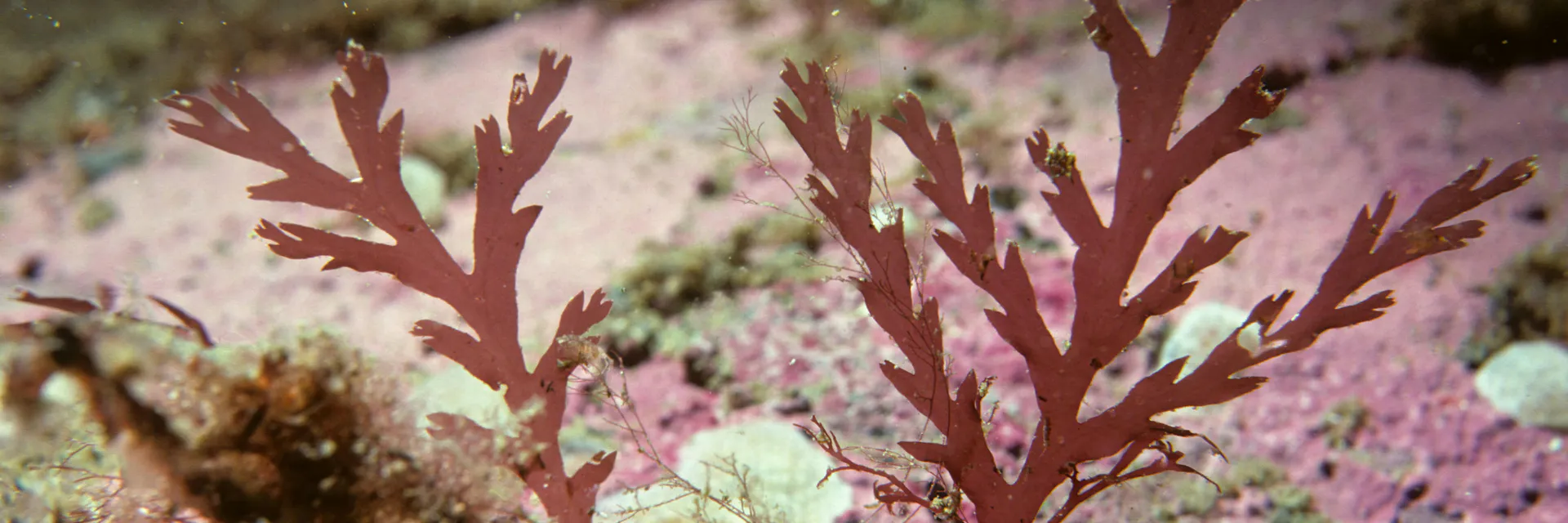
2) Red seaweeds (Rhodophyta)
Red Seaweeds can be in many tones including, yet not restricted to, dazzling red, pink, purple, dark red, dim, and dark. They are the most bountiful of the three divisions of kelp in our Pacific Northwest waters with around 265 species. They don't need as much light to develop as the green or earthy colored kelp so they are found from the intertidal regions to profundities of . Red kelp is regularly collected for its carrageenan, which is added to food to give it a smooth, velvety surface. Porphyra is collected for nori utilized in Asian foods [4].
![Figure 3: Red Seaweed (Mazzella) [9]](https://doc.globaljournals.org/aetk66_52845/ocr/images/derivatives/2e/2e681f4f4244843efeb961bbe4f9a60d8931431dee7e3a0dc44561904591f7d7.webp)
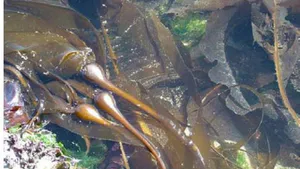
3) Brown seaweeds (Phaeophyta)
Typically gold, brown, olive green, or olive-brown in shading, there are around 140 types of earthy colored ocean growth in the Pacific Northwest. For the most part, they are the biggest and the quickest developing of the kelp however a couple of animal varieties stay little. Bull kelp, Nereocystis, can grow one to two feet each day, developing to be 100 feet in length in a season. Earthy colored kelp is found from the intertidal region to around profound relying upon sun infiltration in the water. Earthy colored kelp (kelps) structure the submerged timberlands of the seas giving an environment to a great many species. They are critical nourishment for some spineless creatures, and kelps have been utilized by local societies for apparatuses and food [5].
![Figure 4: Brown seaweed (Nereocystis) [9]](https://doc.globaljournals.org/aetk66_52845/ocr/images/derivatives/18/18aec51edb93246241db43886f4e3e9d3034ac8d4166c2e87f15676bddcddfde.webp)
II. LITERATURE REVIEW
Alejandro H. Buschmann et al., [11] reviewed a few parts of kelp creation, for example, a report on the volumes of ocean growth delivered universally by both extractions from normal beds and development. They examine utilizes, creation patterns, and financial examination. Significantly, the authors give a layout to future necessities in the expectation that phycologists all over the planet will adapt to the situation, with the end goal that the possibility to be gotten from ocean growth biomass turns into a reality.
Meenakshisundaram Ganesan et al., [12] momentarily assessed the momentum status of Indian kelp assets and their use, as well as improvements in ocean growth cultivating innovations, the situation with the kelp industry, and ongoing endeavors to change ocean weed cultivating into a social undertaking. It likewise features the difficulties experienced in mainstreaming these assets in order to advance into the marine industry.
Georgia M. Ward et al., [13] surveyed sicknesses that have been accounted for in the logical writing for types of red and earthy colored kelp. The authors have zeroed in on the significant ocean growth crops filled in Asia, where a lot of this creation is trotted. They likewise give data on sickness the executives and biosecurity and a few perceptions on future bearings.
With future increments expected in the force, span, and frequencies of MHWs, Straub SC et al., [14] hope to see more substitutions of enormous seemingly perpetual living space framing kelp with more modest transient ocean growth, lessening the environment structure and successful administrations ocean growth overwhelmed reefs can give.
Kelp is a sustainable marine asset and stands out in the field of scientific classification in India when contrasted with their earthly partners, basically because of the absence of attention to their financial potential. In the current correspondence, Vaibhav A. Mantri wt al., [15] expected to address the situation with kelp biodiversity in India alongside the holes, difficulties, and open doors.
J. L. Banach et al., [16] study planned to survey the accessible information on the presence of food handling dangers in kelp, including factors impacting their presence, and to focus on the perils that might represent a gamble to human wellbeing.
Through creating quality descriptors for both steamed and dried results of the objective species, Annelise S. Chapman et al., [17] concentrate on establishing the framework for future deliberate tactile examinations. Primer tests uncovered a solid effect of animal groups on tangible insight, with P. palmata having a tactile profile unmistakable from the kelp species.
Nicholas Paul et al., [18] described, "Information is realizing that kelp contains fiber, minerals, protein, and omega-3 oils. Astuteness is realizing kelp are not high in these"? Presumably we can all imagine many models where: "kelp shrewdness" (ethno-phycology) is a higher priority than information; culture development rates and biomass productivities come into view.
Yogesh Kumar et al., [19] presented features of the nourishing and bioactive mixtures happening in various classes of ocean growth while zeroing in on their helpful exercises including but not restricted to platelet conglomeration, antiviral, antitumor, mitigating, and anticancer properties. Their survey likewise investigates the current and possible use of ocean growth as a wellspring of regular cancer prevention agents in food items.
The motivation behind Sami F.J et al., 's [20] study was to decide the bioactivity profile of ocean growth remove Eucheuma cottoni, Sargassum polycystum, and Caulerpa racemosa with the goal that it very well may be created as a restorative unrefined substance. The three sorts of kelp were removed by maceration and bioactivity testing was completed as a cancer prevention agent utilizing the ABTS revolutionary decrease strategy and bioactivity testing as UV-security with the boundaries of the rate transmission of erythema, pigmentation, and Sun Protective Factor (SPF).
Abdul Bakrudeen Ali Ahmed et al., [21] in the long run, developing kelp was a high worth and futile work. Then, at that point, after the states discovered that this thought is a cash making, low-worth, and high-volume item, they begin to put resources into this industry, and imports and products were a lucrative issue. While the ascent of fish utilization on the planet, the development of fish turned into a significant piece of each industry. Fish cultivating and fish creation rely upon freshwater or lake refinement. Kelp helps these societies and increment the yield and quality by creating sustenance in their current circumstance.
Berna Kilinc et al., [22] clarified today China, Japan, and the Republic of Korea are the biggest buyers of kelp as food. Nonetheless, as nationals from these nations have moved to different regions of the planet, the interest in ocean growth for food has followed them, as, for instance, in certain pieces of the United States of America and South America. Expanding requests in the course of the most recent fifty years exceeded the capacity to supply necessities from normal (wild) stocks. Investigation into the existing patterns of these kelp has prompted the advancement of development enterprises that presently produce in excess of of the market's interest.
Cristina Garcia Sartal et al., [23] listed the utilization of alginate in the food business depends on its capacity to expand the thickness of watery arrangements and to frame gels that don't dissolve when warmed. Alginate is utilized as a stabilizer in frozen yogurt and other dairy items, in the brew to create foam, and in sodas. It is utilized as a thickener in beverages and cleansers, as an explaining specialist in wines and juice, and to expand the consistency of organic product juices and mustard (Gonzalez et al., 1998).
Pranav Nakhate et al., [24] expressed ocean growth's ability and likely usefulness to help the biobased economy are efficiently talked about. The conceivable bioprocessing plant draws near, alongside its natural and financial parts of supportability, which are additionally managed. At last, the formative interaction, side-effect advancement, monetary help, and social acknowledgment approach are summed up, which is fundamental while considering kelp-based items' possibility.
Eduarda M. Cabral et al., [25] expect to give an outline of the overall strategies and novel mixtures with antimicrobial properties as of late disconnected and portrayed from macroalgae, accentuating the subatomic pathways of their antimicrobial systems of activity. The current logical proof of the utilization of macroalgae or macroalgal concentrates to expand the timeframe of realistic usability of food varieties and forestall the advancement of foodborne microorganisms in genuine food items and their impact on the tangible properties of different food varieties (i.e., meat, dairy, refreshments, fish, and pastry shop items) will likewise be examined, along with the fundamental difficulties and future patterns of the utilization of marine normal items as antimicrobials.
Adriana Leandro et al., [26] focal point of their review is in the presentation of kelp as a likely other option and as a protected food source. Here portrayed are the health benefit and concerns connecting with ocean growth utilization, and furthermore how kelp inferred compounds are now financially investigated and accessible in the food business, and the use limitations to shield them as protected food added substances for human utilization.
Simone E. M. Olsthoorn et al., [27] deliberate survey sums up data on the effect of earthy colored kelp or parts on aggravation, and irritation-related pathologies, for example, sensitivities, diabetes mellitus, and heftiness. They center on oral supplementation hence meaning the utilization of earthy colored ocean growth as food added substances.
Joao Cotas et al., [28] concentrate on features of the three polymers, alongside their known limits, at which they can have positive as well as bad wellbeing impacts. Such information is critical to perceiving the worldview administering their effective sending and related valuable applications in people.
Maria Eggertsen et al., [29] give a synopsis of the flow of logical information on potential immediate and roundabout negative ecological impacts connected to eucheumatoid ocean growth cultivating, for example, modifications of benthic macrophyte natural surroundings and loss of local biodiversity. Moreover, we feature information holes that are of significance to address sooner rather than later, e.g., enormous scope environment impacts and ranches as likely vectors of microorganisms. We additionally give various possible administration suggestions to be executed for the proceeded with the improvement of the earth's reasonable ocean growth by cultivating rehearses in the WIO area.
A biorefinery approach Gabriela S. Matos et al., [30] shows an important thought of tackling financial and natural disadvantages, empowering fewer deposits creation near the much suggested zero-squander framework. The point of this work is to report on the recently evolved techniques for ocean growth extractions and the likely utilization of the parts extricated.
Kelp's recorded use in everyday food diet, partnered to explore discoveries, showed that macroalgae are a wellspring of supplements and bioactive mixtures with nutraceutical properties. The principle objective of Diana Pacheco et al., [31] review is to assess the records of NIS ocean growth in the Iberian Peninsula and basically investigate the capability of intrusive kelp application in the food business.
Aroa Lopez-Santamarina et al., [32] review offers a true point of view of the ebb and flows information encompassing the effects of kelp and their inferred polysaccharides on the human microbiome and the significant requirement for additional inside and out examinations concerning this subject. Creature tests and in vitro colonic-mimicking preliminaries researching the impacts of kelp ingestion on human stomach microbiota are talked about.
Ghislain Moussavou et al., [33] review centers around colorectal and bosom diseases, which are significant reasons for malignant growth-related mortality in people. It likewise depicts different mixtures separated from a scope of kelp that has been displayed to annihilate or slow the movement of malignant growth. Fucoidan removed from the earthy colored green growth Fucus has shown movement against both colorectal and bosom diseases. Moreover, we audit the instruments through which these mixtures can instigate apoptosis in vitro and in vivo.
Bahare Salehi et al., [34] present audit gives the most exceptional bits of knowledge into ocean growth research, explicitly tending to its substance synthesis, phytopharmacology, and corrective applications. Kelp is an everyday term for perceptible, multicellular benthic marine green growth. Kelp is probably the biggest maker of biomass in the marine climate and establish a significant piece of the eating routine and conventional medication in many pieces of Asia since ancient times.
Diane Purcell-Meyerink et al., [35] foresee the ocean growth industry requires huge amounts and great kelp unrefined substance that applies tension on the current normal kelp assets. Hydroponics development of ocean growth has developed impressively starting around 2009 to fulfill item needs and to safeguard wild kelp beds that are as yet in danger from over-abuse and environmental change, which has caused expansions in seawater temperatures.
Bruno Moreira Leiteet al., [36] predicted Kelp are notable for their health benefit. As of now, youth weight is an overall developing general medical issue. Three of the central point that adds to this pandemic are unfortunate dietary patterns/inactive, the absence of data on the sustenance worth of food, and the accessibility of caloric thick food with poor healthful substance. In this unique circumstance, well-being advancement through dietary instruction for young kids is of significant importance. The target of this review was to assess the effect of instruction put together mediation with respect to food naming in offspring of five distinct schools in the district of Lisbon.
III. APPLICATIONS AND METHODS OF SEAWEED CULTIVATION
All through mankind's set of experiences, kelp has been utilized as food, people cures, colors, and mineral-rich composts. Anti-pathogenic activity by green seaweeds, seaweed chocolate, animal food, fertilizers, biotechnology, beauty care products, drug industry, and health benefits is accountable information. Many the women in coastal areas are benefited from seaweed-based cultivation [37-41]. The green growth innovation wipes out difficulties related to existing carbon catch techniques.
![Figure 5: Bamboo raft method [42].](https://doc.globaljournals.org/aetk66_52845/ocr/images/derivatives/53/53bbb40c6a967d52d248535a424bbbbbc28584ffd6d7eaedae78c314da7e5651.webp)
![Figure 6: Bamboo raft method seaweeds for harvesting [42]. Figure 5 and Figure 6 show the bamboo raft method of seaweed cultivation.](https://doc.globaljournals.org/aetk66_52845/ocr/images/derivatives/36/3637b2ed9e50098d4f81550d3951cd12cafe8f287a123fbe798bad7beb8343d1.webp)
IV. CONCLUSION
This paper presented seaweed applications and their cultivation methods. Minority people, economic growth depends on seaweed harvesting in coastal areas like Ramanathapuram district. Women empowerment, self-employment, development, and many foods, medicine, and cosmetic products are manufactured from seaweeds. In the future, seaweed image color detection and classification are planned to be introduced.