Security requirement engineering for Intentional Software Product Line

§ National School of Computer Sciences University

Send Message

To: Author

Security requirement engineering for Intentional Software Product Line

Article Fingerprint

ReserarchID

CST0ZLV6

Security requirement engineering for Intentional Software Product Line Banner

AI TAKEAWAY

Connecting with the Eternal Ground
  • English
  • Afrikaans
  • Albanian
  • Amharic
  • Arabic
  • Armenian
  • Azerbaijani
  • Basque
  • Belarusian
  • Bengali
  • Bosnian
  • Bulgarian
  • Catalan
  • Cebuano
  • Chichewa
  • Chinese (Simplified)
  • Chinese (Traditional)
  • Corsican
  • Croatian
  • Czech
  • Danish
  • Dutch
  • Esperanto
  • Estonian
  • Filipino
  • Finnish
  • French
  • Frisian
  • Galician
  • Georgian
  • German
  • Greek
  • Gujarati
  • Haitian Creole
  • Hausa
  • Hawaiian
  • Hebrew
  • Hindi
  • Hmong
  • Hungarian
  • Icelandic
  • Igbo
  • Indonesian
  • Irish
  • Italian
  • Japanese
  • Javanese
  • Kannada
  • Kazakh
  • Khmer
  • Korean
  • Kurdish (Kurmanji)
  • Kyrgyz
  • Lao
  • Latin
  • Latvian
  • Lithuanian
  • Luxembourgish
  • Macedonian
  • Malagasy
  • Malay
  • Malayalam
  • Maltese
  • Maori
  • Marathi
  • Mongolian
  • Myanmar (Burmese)
  • Nepali
  • Norwegian
  • Pashto
  • Persian
  • Polish
  • Portuguese
  • Punjabi
  • Romanian
  • Russian
  • Samoan
  • Scots Gaelic
  • Serbian
  • Sesotho
  • Shona
  • Sindhi
  • Sinhala
  • Slovak
  • Slovenian
  • Somali
  • Spanish
  • Sundanese
  • Swahili
  • Swedish
  • Tajik
  • Tamil
  • Telugu
  • Thai
  • Turkish
  • Ukrainian
  • Urdu
  • Uzbek
  • Vietnamese
  • Welsh
  • Xhosa
  • Yiddish
  • Yoruba
  • Zulu
Font Type
Font Size
Font Size
Bedground

Abstract

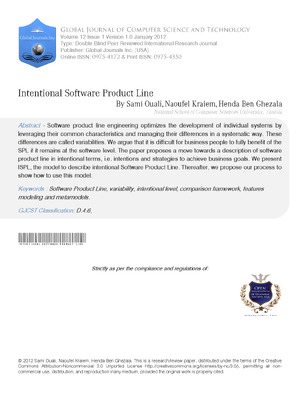
Software product line engineering optimizes the development of individual systems by leveraging their common characteristics and managing their differences in a systematic way. These differences are called variabilities. We argue that it is difficult for business people to fully benefit of the SPL if it remains at the software level. The paper proposes a move towards a description of software product line in intentional terms, i.e. intentions and strategies to achieve business goals. We present ISPL, the model to describe intentional Software Product Line. Thereafter, we propose our process to show how to use this model.

References

15 Cites in Article
  1. P Clements,L Northrop (2001). Software Product Lines: Practices and Patterns.
  2. Mikael Svahnberg,Jilles Van Gurp,Jan Bosch (2005). A taxonomy of variability realization techniques.
  3. J Coplien,D Hoffman,D Weiss (1998). Commonality and variability in software engineering.
  4. K Pohl,G Böckle,F Van Der Linden (2005). Software Product Line Engineering: Foundations, Principles and Techniques.
  5. K Kang,Jaejoon Lee,P Donohoe (2002). Feature-oriented product line engineering.
  6. S Woodfield (1997). The Impedance Mismatch between Conceptual Models and Implementation Environments.
  7. R Kaabi (2007). Une Approche Méthodologique pour la Modélisation Intentionnelle des Services et leur Opérationnalisation.
  8. Sami Ouali,Naoufel Kraiem,Henda Ben Ghezala (2011). Toward a Comprehension View of Software Product Line.
  9. C Rolland (1998). A Comprehensive View of Process Engineering.
  10. Matthias Jarke,Klaus Pohl,Stephan Jacobs,Janis Bubenko,Petia Assenova,Peter Holm,Benkt Wangler,Colette Rolland,Veronique Plihon,Jean -Roch Schmitt,Alistair Sutcliffe,Sara Jones,Neil Maiden,David Till,Yannis Vassiliou,Panos Constantopoulos,Giorgios Spanoudakis (1993). Requirements engineering: An integrated view of representation, process, and domain.
  11. J Bosch (2000). Design & Use of Software Architectures, Adopting and Evolving a product-line approach.
  12. J Van Grup (2000). Variability in Software Systems, the key to software reuse.
  13. Krzysztof Czarnecki,Ulrich Eisenecker,Robert Glück,David Vandevoorde,Todd Veldhuizen (2000). Generative Programming and Active Libraries.
  14. C Rolland,N Prakash,A Benjamen (1999). A Multi-Model View of Process Modelling.
  15. P Soffer,C Rolland (2005). Combining Intention-Oriented and State-Based Process Modelling.

Funding

No external funding was declared for this work.

Conflict of Interest

The authors declare no conflict of interest.

Ethical Approval

No ethics committee approval was required for this article type.

Data Availability

Not applicable for this article.

How to Cite This Article

Dr. OUALI, Naoufel KRAIEM, Henda GHEZALA. . "Security requirement engineering for Intentional Software Product Line". Global Journal of Computer Science and Technology GJCST Volume 12 (GJCST Volume 12 Issue 1).

Download Citation

Journal Specifications

Crossref Journal DOI 10.17406/gjcst

Print ISSN 0975-4350

e-ISSN 0975-4172

Keywords
Classification
GJCST Classification D.4.6
K.6.5
H.2.7
Version of record

v1.2

Issue date
January 15, 2012

Language
English
Experiance in AR

Explore published articles in an immersive Augmented Reality environment. Our platform converts research papers into interactive 3D books, allowing readers to view and interact with content using AR and VR compatible devices.

Read in 3D

Your published article is automatically converted into a realistic 3D book. Flip through pages and read research papers in a more engaging and interactive format.

Article Matrices
Total Views: 6.8K
Total Downloads: 499
All Trends

Request Access

Please fill out the form below to request access to this research paper. Your request will be reviewed by the editorial or author team.
X

This is the heading

Lorem ipsum dolor sit amet, consectetur adipiscing elit. Ut elit tellus, luctus nec ullamcorper mattis, pulvinar dapibus leo.


High-quality academic research articles on global topics and journals.

Security requirement engineering for Intentional Software Product Line

Dr. OUALI
Dr. OUALI National School of Computer Sciences University
Naoufel KRAIEM
Naoufel KRAIEM
Henda GHEZALA
Henda GHEZALA