Selection and Precise Varietal Recommender System

α
Rajnish Singh
Rajnish Singh
σ
Shri Niwas Singh

Shri Niwas Singh

Send Message

To: Author

Selection and Precise Varietal Recommender System

Article Fingerprint

ReserarchID

GDD64

Selection and Precise Varietal Recommender System Banner

AI TAKEAWAY

Connecting with the Eternal Ground
  • English
  • Afrikaans
  • Albanian
  • Amharic
  • Arabic
  • Armenian
  • Azerbaijani
  • Basque
  • Belarusian
  • Bengali
  • Bosnian
  • Bulgarian
  • Catalan
  • Cebuano
  • Chichewa
  • Chinese (Simplified)
  • Chinese (Traditional)
  • Corsican
  • Croatian
  • Czech
  • Danish
  • Dutch
  • Esperanto
  • Estonian
  • Filipino
  • Finnish
  • French
  • Frisian
  • Galician
  • Georgian
  • German
  • Greek
  • Gujarati
  • Haitian Creole
  • Hausa
  • Hawaiian
  • Hebrew
  • Hindi
  • Hmong
  • Hungarian
  • Icelandic
  • Igbo
  • Indonesian
  • Irish
  • Italian
  • Japanese
  • Javanese
  • Kannada
  • Kazakh
  • Khmer
  • Korean
  • Kurdish (Kurmanji)
  • Kyrgyz
  • Lao
  • Latin
  • Latvian
  • Lithuanian
  • Luxembourgish
  • Macedonian
  • Malagasy
  • Malay
  • Malayalam
  • Maltese
  • Maori
  • Marathi
  • Mongolian
  • Myanmar (Burmese)
  • Nepali
  • Norwegian
  • Pashto
  • Persian
  • Polish
  • Portuguese
  • Punjabi
  • Romanian
  • Russian
  • Samoan
  • Scots Gaelic
  • Serbian
  • Sesotho
  • Shona
  • Sindhi
  • Sinhala
  • Slovak
  • Slovenian
  • Somali
  • Spanish
  • Sundanese
  • Swahili
  • Swedish
  • Tajik
  • Tamil
  • Telugu
  • Thai
  • Turkish
  • Ukrainian
  • Urdu
  • Uzbek
  • Vietnamese
  • Welsh
  • Xhosa
  • Yiddish
  • Yoruba
  • Zulu

Abstract

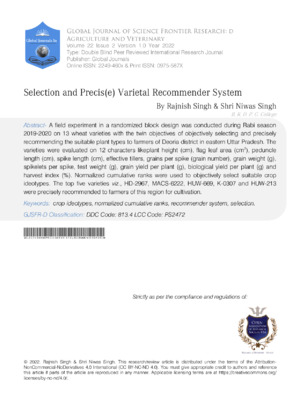
A field experiment in a randomized block design was conducted during Rabi season 2019-2020 on 13 wheat varieties with the twin objectives of objectively selecting and precisely recommending the suitable plant types to farmers of Deoria district in eastern Uttar Pradesh. The varieties were evaluated on 12 characters likeplant height (cm), flag leaf area (cm 2 ), peduncle length (cm), spike length (cm), effective tillers, grains per spike (grain number), grain weight (g), spikelets per spike, test weight (g), grain yield per plant (g), biological yield per plant (g) and harvest index (%). Normalized cumulative ranks were used to objectively select suitable crop ideotypes. The top five varieties viz., HD-2967, MACS-6222, HUW-669, K-0307 and HUW-213 were precisely recommended to farmers of this region for cultivation.

References

5 Cites in Article
  1. C Donald (1968). The breeding of crop ideotypes.
  2. S Gaur,S Singh,S Chand (2010). Evaluation of Newly Released Soybean Varieties (Glycine max.) under Smallholder Farmers’ Condition in Western Ethiopia.
  3. S Singh (2017). Normalized Cumulative Ranks for Plant Breeding: An Example.
  4. S Singh,R Sahu,Tarkeshwar (2018). Selection from quinoa (Chenopodium quinoaWilld.) accessions through normalized cumulative ranks.
  5. M Yadav,S Singh,Tarkeshwar,R Sahu,K Kumar,P Yadav (2020). Selecting suitable wheat (Triticum aestivumL.) variety for Gorakhpur and Deoria region through normalized cumulative ranks.

Funding

No external funding was declared for this work.

Conflict of Interest

The authors declare no conflict of interest.

Ethical Approval

No ethics committee approval was required for this article type.

Data Availability

Not applicable for this article.

How to Cite This Article

Rajnish Singh. 2026. \u201cSelection and Precise Varietal Recommender System\u201d. Global Journal of Science Frontier Research - D: Agriculture & Veterinary GJSFR-D Volume 22 (GJSFR Volume 22 Issue D2): .

Download Citation

Alt: Academic research journal cover on selection and evaluation methods for research publication process.
Issue Cover
GJSFR Volume 22 Issue D2
Pg. 13- 17
Journal Specifications

Crossref Journal DOI 10.17406/GJSFR

Print ISSN 0975-5896

e-ISSN 2249-4626

Keywords
Classification
GJSFR-D Classification: DDC Code: 813.4 LCC Code: PS2472
Version of record

v1.2

Issue date

June 30, 2022

Language
en
Experiance in AR

Explore published articles in an immersive Augmented Reality environment. Our platform converts research papers into interactive 3D books, allowing readers to view and interact with content using AR and VR compatible devices.

Read in 3D

Your published article is automatically converted into a realistic 3D book. Flip through pages and read research papers in a more engaging and interactive format.

Article Matrices
Total Views: 1526
Total Downloads: 56
2026 Trends
Related Research

Published Article

A field experiment in a randomized block design was conducted during Rabi season 2019-2020 on 13 wheat varieties with the twin objectives of objectively selecting and precisely recommending the suitable plant types to farmers of Deoria district in eastern Uttar Pradesh. The varieties were evaluated on 12 characters likeplant height (cm), flag leaf area (cm 2 ), peduncle length (cm), spike length (cm), effective tillers, grains per spike (grain number), grain weight (g), spikelets per spike, test weight (g), grain yield per plant (g), biological yield per plant (g) and harvest index (%). Normalized cumulative ranks were used to objectively select suitable crop ideotypes. The top five varieties viz., HD-2967, MACS-6222, HUW-669, K-0307 and HUW-213 were precisely recommended to farmers of this region for cultivation.

Our website is actively being updated, and changes may occur frequently. Please clear your browser cache if needed. For feedback or error reporting, please email [email protected]

Request Access

Please fill out the form below to request access to this research paper. Your request will be reviewed by the editorial or author team.
X

Quote and Order Details

Contact Person

Invoice Address

Notes or Comments

This is the heading

Lorem ipsum dolor sit amet, consectetur adipiscing elit. Ut elit tellus, luctus nec ullamcorper mattis, pulvinar dapibus leo.

High-quality academic research articles on global topics and journals.

Selection and Precise Varietal Recommender System

Rajnish Singh
Rajnish Singh
Shri Niwas Singh
Shri Niwas Singh

Research Journals