Israel Bispo dos Santos $^\alpha$, Everton Adriano de Morais $^\sigma$, Gloria Ravazzi $^\rho$, Flávio Magno Gonçalves $^\omega$, Cristiano Miranda de Araújo $^\yen$, Adriana Lacerda $^\S$ & Ana Cristina Guarinello $^\chi$
## I. INTRODUCTION
The decade between 2021-2030 is considered by the United Nations as the era of healthy aging, precisely because promoting health and care for the elderly and their needs is a major global challenge, since the lack of resources and assistance to the elderly has been a constant in several countries around the world. Moreover, the increase in this population has raised numerous questions about the quality of life (QoL) and social participation of those who age (WHO, 2021). At the same time, study shows that the aging of the global population is the most important medical and social problem worldwide (MUIS et al, 2020).
It should be noted that the number of people over 60 is growing exponentially all over the world, because in recent decades there has been an increase in QoL in general, so that projections for the future indicate that the number of elderly people will increase dramatically by 2050, when it could reach $38\%$ of the total population. Through this prospection it is possible to say that in the year 2050 there will be a greater number of elderly people aged 60 years or more, than there will be adolescents aged 10 to 24 years (2.1 billion against 2.0 billion).
The WHO shows that in underdeveloped countries, the increase in the elderly population may reveal serious problems, as there are fewer financial and health resources for this population, thus it is projected that $80\%$ of elderly people will live in these places with minimal financial resources and with few conditions to afford their needs (WHO, 2018).
The document *World Population Prospects* (WPP, 2019) indicates that, especially in countries with great financial difficulties, the elderly may reach an older age, but with many economic difficulties, which will cause many to just "survive." It also highlights the importance of appropriate public policies that take into account the aging process and its various challenges (WPP, 2019).
In addition to the financial and resource challenge, it is estimated that the elderly will also have problems in their physical condition, which may result in sensory limitations, typical of aging, such as hearing impairment. This can progressively lead the elderly person to present a worsening in social performance and relationships that may become increasingly limited (NOREAU et al. 2002; LANE & CLARK, 2016).
It is understood that hearing is the sense that allows people to perceive sounds around them, and interact in their social environment. Globally, more than 1.5 billion people experience some decline in hearing ability during their lifetime, of which at least 430 million require care (WHO, 2021; WHO, 2018) with a tendency to increase in the coming years. It is estimated that one in four people will live with some degree of hearing loss by 2050 and more than 700 million will require rehabilitation (WHO, 2021).
Hearing loss requires appropriate interventions, and when not identified or treated early it can cause lifelong consequences, negatively affecting social interactions, causing social isolation, dependence and frustration, affecting memory, psychosocial well-being, QoL, and economic independence of these people (NORDVIK et al. 2018; CONVERY et al. 2019; BULGURCU et al. 2020).
Social participation refers to a person's involvement in activities that provide interaction with others in society or the community. Most definitions state that to participate socially, a person must be involved in an activity and be in contact with others. Among the elderly, social participation is a reliable indicator of their health status, well-being, and QoL. It can be stated that social participation is a key determinant of successful healthy aging and is an important intervention goal for healthcare professionals (POLKU et al.2018).
Among several instruments used to verify the participation restrictions imposed by hearing impairment (hearing needs), one of the most used is the HHIE; This instrument is present in the review although some authors used others as evaluation protocol in this review. Thus, the studies on social participation restriction have grown and demonstrated a significant measurement of the self-perception of the elderly assessed (LOFT et al, 2009).
Therefore, understanding the self-perception of social participation restrictions and how the use of hearing aids can affect the lives of adults and the elderly is fundamental to minimize the consequences of these losses. It is conceived that understanding this problem can be a facilitator both for the realization of public policies and for the discussion about the rights of the elderly to a life with more quality, protagonistism and social participation in society (WHO, 2018; WWP, 2019; WHO, 2021).
In view of this, the objective of this systematic review was to analyze the studies related to self-perception of social participation restriction in adults and elderly with hearing loss users of Individual Sound Amplification Device (ISAD). The research question was what are the effects of ISAD on social participation of adults with hearing loss?
## II. MATERIALS AND METHODS
### a) Protocol and registration
This systematic review was registered on the PROSPERO website (International prospective register of systematic review - Centre for Reviews and Dissemination University of York) under number CRD42021249091 and was performed according to the Preferred Reporting Items for Systematic Reviews and Meta-Analyses(PRISMA, 2021).
## III. ELIGIBILITY CRITERIA
The Population, Exposure, Comparator, Outcome, and Study Characteristics (PECOS) strategy was used to delimit the scope of the review, given the importance of a well-formulated research question. This mnemonic assists in building the structure of the review by delineating the population, exposure, comparator, and outcome of interest, as well as stipulating possible study designs that might answer the research question. Studies that met the following criteria based on the acronym "PECOS" were considered eligible for this systematic review:
- $P =$ population (adults and elderly with hearing loss);
- E = exposure (participants with hearing loss using ISADs);
- C = comparator (not comparable) Comparison - Adults and older adults with hearing loss not using a hearing aid or comparison in a "before and after" format and for risk of bias the Joanna Briggs Institute (JBI) instrument was used;
- $O =$ outcome (effects of ISAD on social participation of adults with hearing loss);
- $S =$ study design (cross-sectional, cohort, case-control).
## IV. INFORMATION SOURCES AND SEARCH
### STRATEGY
The appropriate word combinations and truncations were selected and adapted specifically for each electronic database, i.e. PubMed/Medline, Scopus, Web of Science, Embase, PsycInfo, and Latin American and Caribbean Health Sciences Literature. Specific search strategies were used for each electronic database. Specific strategies were used in Google Scholar, Proquest, and OpenGrey, i.e., the gray literature. To avoid the likelihood of publication bias, a Latin American database was added to the search. Similarly, the EMBASE database, which is a repository of several journals not available in PUBMED/MEDLINE, mainly of European origin, was searched. In addition, the OpenGrey website, which promotes open access to 700,000 bibliographic references of grey literature produced in the European continent was also used to search for grey literature (MORGAN et al., 2018).
References cited in the included studies were searched manually and appropriate software was used to manage and remove duplicate references (EndNote® X7, Thomson Reuters, Philadelphia, PA, USA).
Electronic searches of the databases and gray literature were conducted on August 20, 2019 and updated in September 2020, then again the search was redone in October 2021. A researcher with expertise in the subject was consulted to assess the indication of any relevant articles on the topic to check for any relevant articles to be evaluated for inclusion in this review.
## V. SELECTION PROCESS
The articles were selected in two phases. During phase 1, four reviewers in two pairs independently reviewed the titles and abstracts of all references. Articles that did not meet the inclusion criteria were excluded. During phase 2, two reviewers independently read the selected articles in their entirety. If disagreement could not be resolved through discussion between the first and second reviewers, a third reviewer was involved in the final decision.
### a) Inclusion criteria
The studies included in this review were: 1. studies published as articles, dissertations or theses with no language or publication time restrictions;
2. studies whose sample included adults and elderly individuals with hearing loss, with no gender restrictions; and 3. studies that presented a diagnosis of hearing loss by audiological screening, which evaluated the impact of social participation restriction associated with hearing loss in individuals whose hearing loss was diagnosed by audiological screening and use of hearing aids.
### b) Exclusion criteria
The exclusion criteria were as follows: 1. studies including children and adolescents;
2. the study sample included individuals with syndromes and/or diseases related to hearing loss, in addition to those with visual impairment and cognitive problems;
3. studies that also included participants with normal hearing, but failed to present the results of participants with hearing and hearing loss separately;
4. studies whose participants were not diagnosed by audiological screening;
5. studies with missing or incomplete data;
6. reviews, reviews, letters, conference abstracts, expert opinions, case reports, and case-control studies and/or case-control studies. Studies whose participants were not diagnosed by audiological screening;
5. Studies with
missing or incomplete data;
6. Reviews, letters, conference abstracts, expert opinions, case reports, and case-control studies and/or ethnographic studies;
7. Studies that did not assess the outcomes of interest; and 8. Non-accessiblestudies.
## VI. DATA COLLECTION PROCESS AND DATA ITEMS
Two reviewers independently collected and discussed the information extracted from the included studies. Data were collected on study characteristics (authors, year of publication, country of origin, study design - quantitative and qualitative), population profile (sample size, sex and age), evaluation characteristics (questionnaires or interviews), outcome characteristics (results presented in relation to the outcome) and main conclusions.
Attempts were made to contact the authors to obtain pertinent unpublished information in the case of missing or incomplete data. Three contact attempts were made with the first author, corresponding author, and last author of the article, with a one-week interval. If there was no response, the study was excluded with an appropriate justification. All studies that did not meet the inclusion criteria were consensually excluded by both reviewers.
### a) Reporting Bias Assessment
The methodology of the selected quantitative observational studies was assessed using the risk of bias tool of the Statistics Assessment and Review Instrument and the JBI critical appraisal tool for qualitative research. The risk of bias (methodological quality) was rated as "high" when the study obtained a "yes" response of less than $49\%$, "moderate" when the study obtained $50 - 69\%$ "yes" responses, and "low" when the study obtained more than $70\%$ "yes" responses on the risk of bias questionnaires.
### b) Synthesis Methods
#### Population (P)
Studies in which the sample consisted of patients over 18 years of age with hearing loss were included. Studies in which the population consisted only of people without hearing loss, or studies in which the study population did not consist of adults (< 18 years) were excluded. Studies in which hearing loss was associated with mental disorder or disability, Alzheimer's disease, or dementia were also excluded. There was no exclusion based on gender or ethnicity of the population.
#### Intervention (I)
Studies in which the sample was an ISAD user were included. Studies in which users had undergone cochlear implant surgery were excluded. Studies in which ISAD was associated with another form of intervention were also excluded.
Comparison (C)
Studies in which comparisons were made between at least two moments in time regarding ISAD use were included: comparisons between before and after ISAD fitting, and/or comparison between a group of adults and elderly that were not ISAD users. Studies in which the evaluation was done in only one moment, or studies that did not have a control group, were excluded.
#### Outcomes (O)
Only studies that assessed the degree of social participation of adults and older adults using validated instruments as the outcome of interest were included. Studies that did not use validated instruments or did not assess the outcome of interest were excluded.
Study design (S)
Randomized, pseudo-randomized, non-randomized, cohort, cross-sectional, and case-control clinical trials were included. Descriptive studies such as reviews, letters to the editor, case reports, case series, expert opinions, guidelines were excluded. Studies by publication date or language were not excluded.
### c) Reporting Bias Assessment and Effect Measures and Certainty Assessment
To blind the reviewers in reading the references and to guarantee independence and confidentiality in both phases, the Rayyan website (http://rayyan.qcri.org) was used. The reviewers were blinded in all evaluations and one staff member (F.M.G), who did not participate in the selection, acted as moderator.
## i. Data collection process
Three independent reviewers (I.B.S/E.A.M/G.R) collected information from the included studies, this information was discussed with two other team members (A.C.G/A.L). Data analysis initially consisted of characterizing the studies (author, year of publication, country, title, and study design), and when data were incomplete, attempts were made to contact the authors to obtain pertinent unpublished information.
Thus, the two reviewers independently collected and discussed the information extracted from the included studies. Data were collected on study characteristics (authors, year of publication, country of origin, study design; quantitative and qualitative studies were selected), population profile (sample size, sex and age), evaluation characteristics (questionnaires or interviews), outcome characteristics (results presented in relation to the outcome) and main conclusions.
Thus, attempts were made to contact the authors to obtain pertinent unpublished information in the case of missing or incomplete data. Three contact attempts were made with the first author, corresponding author, and last author of the article, one week apart. If there was no response, the study was excluded with an appropriate justification. All studies that did not meet the inclusion criteria were consensually excluded by both reviewers.
## VII. RESULTS
### a) Study Selection
A total of 1424 references were retrieved by the search strategy. Of these, 113 articles were selected in phase 01 for full reading, leaving 15 articles included for qualitative synthesis, after a more thorough analysis in phase 02, only 08 articles met all the criteria of this research.
### b) Study Characteristics
The 08 articles included in this systematic review were published in the period from 2013 to 2020, with 04 selected studies being cross-sectional studies that separated adults with hearing loss who used hearing aids from those who did not yet use hearing aids, and 04 studies were cohort studies with comparison of groups of hearing aid users and non-users. All studies were related to social participation and its relation to hearing loss in adults and the elderly.
The selected studies investigated the main social participation instruments used in adults and elderly with hearing loss, both hearing aid users and non-users. Among the instruments mentioned, eleven (11) were identified: (HHIE-S), (NHANES), (HHIE), (HHQ), (MARS-HA), (SOCACT), (LISPE), (IOI-HA), (HHIA), (ALDQ) and (SAC).
This variety of questionnaire use did not allow us to systematize the results in a quantitative analysis with meta-analysis, but it can be noted some trends in the eight selected articles. These were divided into two groups, in the first group we found four articles with cross-sectional studies that separated adults with hearing loss who used ISADs from those who did not yet use ISADs (MEYER et al. 2014; POLKU et al. 2018; CAMARGO et al. 2018; WELLS et al. 2020). The second group found four articles with cohort studies that analyzed the before and after the use of ISADs (MIZUTARI et al. 2013; PICININI et al. 2017; KWAK et al. 2020; SPRECKLEY et al. 2020).
All of the articles mentioned present studies that aimed to understand hearing loss its socio-determinant factors, and the effects of hearing aid use on the QoL and satisfaction of elderly and adult users. Some of these articles also discuss issues related to poverty and access to hearing health care in developing countries.
All articles highlight the importance of hearing health on the QoL and well-being of adults and older adults, as well as the need for access to effective and affordable hearing health care (MIZUTARI et al. 2013; MEYER et al. 2014; PICININI et al. 2017; POLKU et al. 2018; CAMARGO et al. 2018; WELLS et al. 2020; KWAK et al. 2020; SPRECKLEY et al. 2020).
### c) Risk of Bias in Studies
As for the risk of bias, the 08 articles chosen were classified as "low" risk of bias, 04 cross-sectional studies and 04 cohort studies. The methodological flaws identified concerned the shielding of outcome assessment and incomplete outcome data.
### d) Results of Individual Studies
The following is a summary of the results of each article starting with the cross-sectional studies evaluating trends:
Meyer et al's (2014) article "On the investigation of factors that influence help-seeking for hearing impairment in older adults" investigated the factors that influence help-seeking for hearing loss in older adults. Participants in the study included 307 individuals aged 60 years and older who had uni- or bilateral hearing loss. ISAD users were assigned to either a group of users who had not sought hearing help $(n = 55)$ or a group of users who were already seeking hearing help $(n = 92)$; while new ISAD users were assigned to either the unsuccessful ISAD user group $(n = 75)$ or a successful ISAD user group $(n = 85)$.
The Health Belief Model (HBM) results show that many of the participants were delayed in seeking help for their hearing loss, with an average of seven years from initial awareness of the problem to seeking professional help. Reasons for the delay included lack of awareness about the severity of the problem, the perception that hearing loss was a normal part of aging, and the fear of using hearing aids.
Participants also reported having difficulty finding information about hearing health services and often turned to family and friends for help. The authors conclude that more information about the benefits of hearing care and available resources is needed to help older adults seek help sooner and improve their quality of life (MEYER et al. 2014).
The article by POLKU et al. (2018) entitled "Perceived benefit from hearing aid use and life-space mobility among community-dwelling older adults" investigated the use of hearing aids and the spatial mobility of community-dwelling older adults. Individual interviews were conducted with 702 Finnish older adults with a mean age of 78, of whom 180 reported using hearing aids.
The results of the Life-Space Assessment (LSA) questionnaire showed that the elderly who wore hearing aids reported greater perceived benefits from their use, such as improved communication with others and the ability to participate in social activities.
In addition, participants who wore hearing aids showed greater spatial mobility compared to those who did not, meaning that they moved around in a larger space and had an easier time participating in activities outside the home. The authors conclude that the use of hearing aids can improve the perceived benefits of
ISADs and spatial mobility in older adults, and that it is important to encourage the use of these devices to improve QoL and social participation (POLKU et al. 2018).
The article "Perception of the elderly about participation restriction related to hearing loss" by Camargo et al. (2018) investigated the perception of the elderly about their social participation restriction due to hearing loss. The sample consisted of 46 individuals, with $43.48\%$ $(n = 20)$ female and $56.52\%$ $(n = 26)$ male. The mean age was 74.78 years, with a standard deviation of 7.96 years. The Hearing Handicap Inventory for the Elderly (HHIE) questionnaire was used to investigate hearing-related social participation, and the results indicated that the elderly perceived limitations in their social participation, such as difficulty following conversations in groups and in noisy environments, besides feeling embarrassed and isolated.
We noticed that the results of the reduced version of the Hearing Handicap Inventory for the Elderly (HHIE), participants who did not use hearing aids had greater restrictions in social participation and affected their self-esteem and emotional well-being. Overall, such restriction was greater in males. The authors conclude that hearing loss can lead to social exclusion and that support and resources need to be provided to help older adults cope with the consequences of hearing loss and maintain their social participation.
The last cross-sectional article by Wells et al. (2020) entitled "Characteristics and health outcomes associated with hearing loss and hearing aid use among older adults" investigated the characteristics and health outcomes associated with hearing loss and hearing aid use in older adults. The survey data was used to categorize 20,244 participants into five groups: no hearing loss, mild hearing loss without aid, mild hearing loss with aid, severe hearing loss without aid, and severe hearing loss with aid. The results showed that seniors with hearing loss were more likely to have other health conditions, such as diabetes and hypertension, compared to seniors without hearing loss.
So the National Health and Nutrition Examination Survey (NHANES) results used in the research showed that seniors who wore hearing aids showed improvements in physical and mental health compared to those who did not. These improvements included lower risk of depression, better quality of life, higher life satisfaction, and lower risk of falls. The authors concluded that hearing loss in the elderly is associated with worse health outcomes, but the use of hearing aids can help improve the health and quality of life of these individuals.
Regarding the four cohort study articles, it can be observed in the study conducted by Mizutari et al. (2013) entitled "Age-related hearing loss and the factors that determine the continued use of hearing aids among community-dwelling elderly" that an investigation was conducted about the factors that affect the continued use of hearing aids in community-dwelling elderly individuals suffering from age-related hearing loss.
After the primary screening, ISADs were loaned to 68 participants (4.8%) who did not already have them, 38 of whom (60.3% of users, representing 2.7% of the total elderly population) started using the ISAD continuously. The HHIE score was significantly high among these 38 participants.
In the same study, another group was formed with 110 participants, with a mean age of 78.7 years, who had been using hearing aids for at least 6 months. The results of the reduced version of the Hearing Handicap Inventory for the Elderly (HHIE), indicated that the average time of use of the devices was 6.7 years and that $68.2\%$ of the participants reported the continuous use of the devices.
The factors that influenced the continued use of hearing aids were: the intensity of hearing loss, satisfaction with the devices, improvement in communication, and the presence of social support. In addition, it was observed that age and time of hearing loss were not significant factors in determining continued use of the devices.
The authors concluded that continued use of hearing aids in community-dwelling elderly may be influenced by factors such as hearing loss severity, satisfaction with the devices, improvement in communication, and social support, highlighting the importance of adequate support and good fitting of hearing devices.
The article by Picinini et al. (2017), "Restriction in social participation and satisfaction with hearing aids - a study on post-fitting" investigated the relationship between restriction in social participation and satisfaction with the use of hearing aids after fitting. Of the 42 participating individuals, $64.3\%$ were elderly. Evaluation was carried out using validated follow-ups to measure restriction in social participation and satisfaction with hearing aids.
The results of the reduced version of the Hearing Handicap Inventory for the Elderly (HHIE-S) in the elderly was 10 points (P25 and P75: 6-16), and in adults, the HHIA score was 30 points (P25 and P75: 4-60). The emotional domain of the HHIA was 16 points (P25 and P75: 0-26) and the social domain was 14 points (P25 and P75: 2-26). The results indicated that $47.2\%$ of the participants had restricted social participation, and the main factors associated with this restriction were the perception of their own hearing, self-esteem, and lack of social support.
Satisfaction with the hearing aids was also evaluated, and $66\%$ of the participants were satisfied with the devices. The factors that positively influenced this level of satisfaction were the ease of use and comfort of the devices, while the restriction in social participation was a negative factor. The authors concluded that the restriction in social participation is a common problem in users of hearing aids and that can affect the satisfaction with the devices. They also highlighted the importance of evaluating the restriction in social participation and the adaptation of hearing aids to improve the quality of life of users.
In the article Kwak et al. (2020), "Evaluation of objective audiometry to predict subjective satisfaction in patients with hearing aids" investigated how objective audiometry could predict subjective satisfaction in patients who have worn hearing aids. The research included 40 patients who had previously worn hearing aids and were admitted to objective audiological estimates such as speech recognition threshold measurements, otoacoustic emissions testing, and tonal threshold audiometry.
In this Korean version of the HHIE (K-HHIE) we can note that the results show that no significant results were found between objective audiometry and subjective patient satisfaction, indicating that the subjective assessment of patient satisfaction is important and should be considered when evaluating the effectiveness of hearing aids. In addition, it was noted that age and duration of use of hearing aids were not factors described to determine satisfaction with the devices.
And finally in the article Spreckley et al. (2020), The article "Impact of hearing aids on poverty, quality of life and mental health in Guatemala: results of a before and after study" aims to investigate the impact of hearing aids on poverty, social participation and QL and mental health in a population in Guatemala. The authors interviewed 135 cases and 89 comparison subjects at baseline and follow-up who were assessed before and after hearing aid fitting. The participants were evaluated and checked for poverty, mental health, social life before and after fitting the hearing aids the WHOQOL-BREF, Questionnaire was used and they noted that as Quality of life significantly improved income after fitting the hearing aids, and an improvement in quality of life as well as social relationships and work performance. There was also a significant improvement in the mental health of the participants.
The authors concluded that hearing aid fitting can be an effective intervention in reducing poverty, improving social life and mental health for low-income, hearing-impaired adults and seniors. They highlighted the importance of access to hearing health care for populations in developing countries.
The studies also highlight the importance of personalized device adjustments to increase user satisfaction, in addition, they evaluated the effectiveness of hearing rehabilitation programs in device users and others explored the relationship between device use and cognition in the elderly providing important information for healthcare professionals working with elderly and adult hearing aid users (MEYER et al. 2014; POLKU et al. 2018; CAMARGO et al. 2018)
The eight articles, in general, highlight the benefits of using these devices and the need for personalized adjustments to meet the individual needs of each user and the significant improvement in their social participation, although using different questionnaires we found no ill effects of using ISADs, although complaints about noise and poor adaptations only, but mostly showing the benefits of ISADs in the autonomy and greater socialization of the adults and elderly surveyed (MIZUTARI et al. 2013; MEYER et al. 2014; PICININI et al. 2017; POLKU et al. 2018; CAMARGO et al. 2018; WELLS et al. 2020; KWAK et al.2020; SPRECKLEY et al.2020).
## VIII. DISCUSSION
The main goal of this systematic review was to investigate and analyze, based on the national and international literature, the self-perception about the effects of using hearing aids on the social participation of adults and elderly with hearing loss using and not using ISADs. Despite the scarcity of articles found, it can be inferred from their reading and analysis that there is evidence that the use of ISADs can contribute significantly to the communication of the elderly and improvement of their social participation (WITTICH et al. 2015; CHANG et al. 2018; ZENG et al. 2018; LAWRENCE et al. 2019).
Regarding hearing loss and family living together, no consensus was found in this review. In some studies, family members are more affected by the disability than the hearing impaired themselves and in others, hearing impaired people have lower satisfaction scores than their family members (WELLS et AL 2020; MIZUTARI et al.2013).
It was realized that the most frequent complaint of family members and adults and seniors with hearing loss was related to difficulty understanding speech and these researches have made it explicit that ISADs, in addition to alleviating hearing loss, can also improve the QL of those who use them by reducing caregiver and family stress, depressive symptoms, as well as the emotional and mental burden of those involved, resulting in a significant improvement in social participation as well (PICININI et al. 2017; KWAK et al.2020).
The study by Polku et al. (2018) and Camargo et al. (2018) showed the perceived benefit of using ISADs is associated with greater mobility within social space, having more safety to move around in the community.
Despite this, future studies are needed to examine whether appropriate ISAD use can promote greater mobility among those with hearing difficulties.
Spreckley et al.(2020) and Picininiet al.(2017), show that over the past 30 years, there have been many advances regarding technology and care for adults and older adults with hearing loss, ranging from improvements in cognitive performance, as cited in the study, to improvements in working memory performance and autonomy in middle-aged adults and older people who use ISADs.
In addition to these technologies the articles by Bulgurcu et al. (2020) and Spreckley et al. (2020) - have in common a focus on evaluating the effectiveness and satisfaction of hearing aid users with wireless technology. Both studies demonstrate that the use of hearing aids that allow connectivity with electronic devices such as smartphones can improve users' social participation by increasing ease of communication and facilitating speech understanding in noisy environments. Both Levasseur et al.'s (2020) and Picinini et al.'s (2017) studies have in common a focus on evaluating the effectiveness of auditory rehabilitation programs in hearing aid users seeking to improve speech perception in noisy environments. Levasseur et al. (2020) developed a game-based auditory training program for hearing aid users and evaluated its effectiveness in improving speech perception in noisy environments giving an aging with more QL actively within their families, neighborhoods, and civil society, as well as providing ample opportunities for elderly people with hearing loss to participate in the community (LEVASSEUR et al., 2020, 2017).
From this review it can be concluded that hearing loss is still a recurring health problem among the elderly, which affects most aspects of their lives, especially cognitive function, mental health, and wellbeing. The use of hearing aids can improve the lives of these individuals not only from the improvement of hearing, but also social interactions, mood, and cognitive functioning (CAMARGO et al. 2018; PICININI et al. 2017).
From this review one can understand the importance of guiding professionals who work with the elderly, especially those of speech therapy, in assisting with ISAD users during their adaptation of the devices and awareness of the best ways and actions to minimize the restrictions of social participation, which can result in a QL and decrease social isolation of these individuals (MIZUTARI et al.2020; KWAK et al. 2020; WELLS et al. 2020).
Chang, et al.(2018) The article investigated the risk of hospital readmission for elderly patients with self-reported hearing loss and communication problems. The study was treated based on a retrospective review of electronic medical records of elderly patients admitted to an academic hospital in New York City. The results appreciated that patients with hearing loss and communication problems have a higher risk of hospital readmission than those without these problems. The authors conclude that identifying and treating these problems may be important in reducing the risk of hospital readmission in elderly patients.
The article by Convery et al. (2019) investigates the factors that initiated for a successful setup of a self-adjusting ISAD (Individual Sound Amplification Device) and the need for personalized support. The authors followed up a study of 42 adults with mild to moderate hearing loss and concluded that age, time of device use, and hearing self-efficacy are associated with successful ISAD setup. The results suggest that older individuals and those with lower hearing self-efficacy may benefit from personalized support in ISAD fitting.
In Nordvik, et al (2018) review of generic quality of life in people with hearing loss, the results show that hearing has a significant impact on quality of life and that hearing aid use was associated with an improvement in overall quality of life. The authors conclude that early identification of hearing loss and effective treatment, such as the use of hearing aids, can improve the quality of life and social participation of these people.
In this systematic review, it was noted that adults and the elderly showed in their self-assessment a satisfaction with hearing aids, but as the degree of hearing loss increases, the self-perception of hearing decreases. The individuals who perceived more benefits from using hearing aids were those with less restricted social participation.
The evidence found suggests that hearing aid use may mitigate some of the adverse consequences of hearing loss, but further studies exploring hearing loss and its relationship to social participation are needed and may help to encourage hearing aid use to promote healthy aging.
It is important to mention that ISAD may favor the social participation of the elderly and improve their interactions with other people. Despite this, it is important to note that ISAD is not the only solution and depends on other factors such as level of education, professional occupation, financial resources among others, which may influence social participation during the process of more active aging (SANTOS I.2022).
It is suggested that further research be developed, especially in Brazil, where there is a shortage of material produced around this topic, which may contribute to the development of instruments that assess the social participation of adults and elderly individuals, specifically individuals with hearing loss of all degrees, users or non-users of hearing aids.
## IX. LIMITATIONS
Among the limitations found in this study, we highlight the lack of literature related to the social participation of adults and elderly individuals with hearing loss. It is understood that more studies about this topic are necessary, with broader results and deeper discussions
Moreover, we noticed a great variety of questionnaires that evaluate social participation, but few focused on socialization, and many of the articles found focused on general health or mental health. There is a need for more studies in the area using validated instruments that assess adult social participation and specifically the elderly with hearing loss.
## X. CONCLUSION
The results show that elderly people with hearing loss who use hearing aids have better resources, are better off financially, and show better performance in communication, understanding and listening for a more pleasant communication and social life with less isolation and more autonomy in social life. Research question that analyzed the effects of ISAD on the social participation of adults with hearing loss, showed that the effect was very positive for adults and older adults with hearing loss
Other Information
Conflict of interest: The authors declare no conflict of interest.
Funding: CAPES Brasil PROSUP/ CAPES 2020-2022 Scholarships.
Ethical approval: This article contains no studies with human or animal participants conducted by any of the authors.
Informed consent: For this type of study, formal consent is not required.
## Appendix 5 A - Database Search Strategy.
<table><tr><td>Database</td><td>Search</td><td></td></tr><tr><td>Lilacs</td><td>("Social Participation" OR "Social Engagement" OR "Social Citizenship" OR "Participation social" OR "Compromise social" OR "Ciudadania social" OR "Participation social" OR "Engagement social" OR "Cidadonia social" AND "Hearing Aids" OR "Hearing Aid" OR "Ear Molds" OR "Ear Mold" OR "Hearing Loss" OR "Hearing Loss" OR "Hypoacusis" OR "Hypoacuses" OR "Hearing impairment" OR "Persons with hearing impairments" OR "Persons with hearing impairments" OR "Hearing impaired persons" OR "Hearing disabled persons" OR "Hearing disabled person" OR "Hearing disorders" OR "Hearing disorders" OR "Hearing disorder" OR "Dysacusis" OR "Presbycus" OR "Presbycus" OR "Presents" OR "Age related hearing impairment" OR "Age related hearing impairment" OR "Aparellosauditivos" OR "Aparellosauditivo" OR "Moldes auriculares" OR "Molde auricular" OR "Perdaisaudiva" OR "Perda de audação" OR "Hipoacusia" OR "Hipoacus" OR "Deficiência auditiva" OR "Pessoas com deficiênciaauditiva" OR "Distúrios da audiência" OR "Disacusia" OR "Presbiacusia" OR "Deficiência auditivarelacionada à idade" OR "Audifonos" OR "Moldes para losóculos" OR "Pérdidauditiva" OR "Pérdida auditiva" OR "Hypodias" OR "Hypodias" OR "Hypoacuses" OR "Hypoacuses" OR "Hypoacuses" OR "Hypoacusia" OR "Hypoacusia" OR "Hypoacusia" OR "Hypoacusia" OR "Hypoacusia" OR "Hypoacusia" OR "Hypoacusia" OR "Hypoacusia" OR "Hypoacusia" OR "Hypoacusia" OR "Hypoacusia" OR "Hypoacusia" OR "Hypoacusia" OR "Présbucus" OR "Présbucus" OR "Présbucus" OR "Présbucus" OR "Présbucus" OR "Présbucus" OR "Présbucus" OR "Présbucus" OR "Présbucus" OR "Présbucus" OR "Présbucus" OR "Présbucus" OR "Présbucus" OR "Hypoplasia" OR "Hypoplasia" OR "Hypoplasia" OR "Hypoplasia" OR "Hypoplasia" OR "Hypoplasia" OR "Hypoplasia" OR "Hypoplasia" OR "Hypoplasia" OR "Hypoplasia" OR "Hypoplasia" OR "Hypoplasia" OR "Hypoplasia" OR "Hypospasmia" OR "Hypospasmia" OR "Hypospasmia" OR "Hypospasmia" OR "Hypospasmia" OR "Hypospasmia" OR "Hypospasmia" OR "Hypospasmia" OR "Hypospasmia" OR "Hypospasmia" OR "Hypospasmia" OR "Hypospasmia" OR "Hypospasmia" OR "Hypoplasia" OR "Hypoplasia" OR "Hypoplasia" OR "Hypoplasia" OR "Hypoplasia" OR "Hypoplasia" OR "Hypoplasia" OR "Hypoplasia" OR "Hypoplasia" OR "Hypoplasia" OR "Hypoplasia" OR "Hypoplasia" OR "Hypoplasia" OR "Hypoacuses" OR "Hypoacuses" OR "Hypoacuses" OR "Hypoacuses" OR "Hypoacuses" OR "Hypoacuses" OR "Hypoacuses" OR "Hypoacuses" OR "Hypoacuses" OR "Hypoacuses" OR "Hypoacuses" OR "Hypoacuses" OR "Hypoacuses" OR "Hypoacuses" OR "Hypoacuses"OR "Hypoacuses" OR "Hypoacuses" OR "Hypoacuses" OR "Hypoacuses" OR "Hypoacuses" OR "Hypoacuses" OR "Hypoacuses" OR "Hypoacuses" OR "Hypoacuses" OR "Hypoacuses" OR "Hypoacuses" OR "Hypoacuses" OR "Hypoacuses" OR "Hypoacuses" OR "Hypospasmia" OR "Hypospasmia" OR "Hypospasmia" OR "Hypospasmia" OR "Hypospasmia" OR "Hypospasmia" OR "Hypospasmia" OR "Hypospasmia" OR "Hypospasmia" OR "Hypospasmia" OR "Hypospasmia" OR "Hypospasmia" OR "Hypoplasia" OR "Hypoplasia" OR "Hypoplasia" OR "Hypoplasia" OR "Hypoplasia" OR "Hypoplasia" OR "Hypoplasia" OR "Hypoplasia" OR "Hypoplasia" OR "Hypoplasia" OR "Hypoplasia" OR "Hypoplasia" OR "Hypoplasia" OR "Hypoplasia" OR "Hypoplasia" OR "Hypoplasia" OR "Hypoplasia" OR "Hypoplasia" OR "Hypoplasia" OR "Hypoplasia" OR "Hypoplasia" OR "Hypoplasia" OR "Hypoplasia" OR "Hypoplasia" OR "Hypoplesis" OR "Hypoplasia" OR "Hypoplasia" OR "Hypoplasia" OR "Hypoplasia" OR "Hypoplasia" OR "Hypoplasia" OR "Hypoplasia" OR "Hypoplasia" OR "Hypoplasia" OR "Hypoplasia" OR "Hypoplasia" OR "Hypoplasia" OR "HYPOPSIS" OR "HYPOPSIS" OR "HYPOPSIS" OR "HYPOPSIS" OR "HYPOPSIS" OR "HYPOPSIS" OR "HYPOPSIS" OR "HYPOPSIS" OR "HYPOPSIS" OR "HYPOPSIS" OR "HYPOPSIS" OR "HYPOPSIS" OR "HYPOPSIS" OR "HYPOPSIS" OR "HYPOPSIS"OR "HYPOPSIS" OR "HYPOPSIS" OR "HYPOPSIS" OR "HYPOPSIS" OR "HYPOPSIS" OR "HYPOPSIS" OR "HYPOPSIS" OR "HYPOPSIS" OR "HYPOPSIS" OR "HYPOPSIS" OR "HYPOPSIS" OR "HYPOPSIS" OR "HYPOPSIS" OR "HYPOPSIS" OR "Hypoplasia" OR "Hypoplasia" OR "Hypoplasia" OR "Hypoplasia" OR "Hypoplasia" OR "Hypoplasia" OR "Hypoplasia" OR "Hypoplasia" OR "Hypoplasia" OR "Hypoplasia" OR "Hypoplasia" OR "Hypoplasia" OR "Hyperpolaris" OR "Hyperpolaris" OR "Hyperpolaris" OR "Hyperpolaris" OR "Hyperpolaris" OR "Hyperpolaris" OR "Hyperpolaris" OR "Hyperpolaris" OR "Hyperpolaris" OR "Hyperpolaris" OR "Hyperpolaris" OR "Hyperpolaris" OR "Hyperpolaris" OR "Hyperpolaris" OR "Hyperpolaris"OR "Hyperpolaris" OR "Hyperpolaris" OR "Hyperpolaris" OR "Hyperpolaris" OR "Hyperpolaris" OR "Hyperpolaris" OR "Hyperpolaris" OR "Hyperpolaris" OR "Hyperpolaris" OR "Hyperpolaris" OR "Hyperpolaris" OR "Hyperpolaris" OR "Hyperpolaris" OR "Hyperpolaris" OR "hyperpolaris" OR "hyperpolaris" OR "hyperpolaris" OR "hyperpolaris" OR "hyperpolaris" OR "hyperpolaris" OR "hyperpolaris" OR "hyperpolaris" OR "hyperpolaris" OR "hyperpolaris" OR "hyperpolaris" OR "hyperpolaris" OR "hyperpolaris" OR "hyperpolaris" OR "hyperpilaris" OR "hyperpilaris" OR "hyperpilaris" OR "hyperpilaris" OR "hyperpilaris" OR "hyperpilaris" OR "hyperpilaris" OR "hyperpilaris" OR "hyperpilaris" OR "hyperpilaris" OR "hyperpilaris" OR "hyperpilaris" OR "hyperpilaris" OR "hyperpilaris" OR "hyperpilaris'or"hyperpilaris"OR "hyperpilaris"OR "hyperpilaris"OR "hyperpilaris"OR "hyperpilaris"OR "hyperpilaris"OR "hyperpilaris"OR "hyperpilaris"OR "hyperpilaris"OR "hyperpilaris"OR "hyperpilaris"OR "hyperpilaris"OR "hyperpilaris"OR "hyperpilaris"OR "hyperpilaris"OR "hyper pilaris"OR "hyperpilaris"OR "hyperpilaris"OR "hyperpilaris"OR "hyperpilaris"OR "hyperpilaris"OR "hyperpilaris"OR "hyperpilaris"OR "hyperpilaris"OR "hyperpilaris"OR "hyperpilaris"OR "hyperpilaris"OR "hyperpilaris"OR "hyperpilaris"OR "hyperpilar is"or"hyperpilaris"OR "hyperpilaris"OR "hyperpilaris"OR "hyperpilaris"OR "hyperpilaris"OR "hyperpilaris"OR "hyperpilaris"OR "hyperpilaris"OR "hyperpilaris"OR "hyperpilaris"OR "hyperpilaris"OR "hyperpilaris"OR "hyperpilaris"OR "hyperpilaris"OR "hyperpilaris"OR "hyperpilaris"OR "hyperpilaris"OR "hyperpilaris"OR "hyperpilaris"OR "hyperpilaris"OR "hyperpilaris"OR "hyperpilaris"OR "hyperpilaris"OR "hyperpilaris"OR "hyperpilaris"OR "hyperpilaris"OR "hyperpilaris"OR "hyperpilaris"OR "hyperplasia"OR "hyperplasia"OR "hyperplasia"OR "hyperplasia"OR "hyperplasia"OR "hyperplasia"OR "hyperplasia"OR "hyperplasia"OR "hyperplasia"OR "hyperplasia"OR "hyperplasia"OR "hyperplasia"OR "hyperplasia"OR "hyperplasia"OR "hyperplasia"OR "hyperplasia"OR "hyperplasia"OR " hyperplasia"OR "hyperplasia"OR "hyperplasia"OR "hyperplasia"OR "hyperplasia"OR "hyperplasia"OR "hyperplasia"OR "hyperplasia"OR "hyperplasia"OR "hyperplasia"OR "hyperplasia"OR "hyperplasia"OR "hyperplasia"OR "hyperplasia"OR "hyperplasia"OR "hyperplasia"OR "hyperplasia" OR "hyperplasia"OR "hyperplasia"OR "hyperplasia"OR "hyperplasia"OR "hyperplasia"OR "hyperplasia"OR "hyperplasia"OR "hyperplasia"OR "hyperplasia"OR "hyperplasia"OR "hyperplasia"OR "hyperplasia"OR "hyperplasia"OR "hyperplasia"OR "hyperplasia"OR "hyperplasia"OR "hyperpl Asia"OR "hyperplasia"OR "hyperplasia"OR "hyperplasia"OR "hyperplasia"OR "hyperplasia"OR "hyperplasia"OR "hyperplasia"OR "hyperplasia"OR "hyperplasia"OR "hyperplasia"OR "hyperplasia"OR "hyperplasia"OR "hyperplasia"OR "hyperplasia"OR "hyperplasia"OR "hyperplasia"OR "Hyperplasia"OR "Hyperplasia"OR "Hyperplasia"OR "Hyperplasia"OR "Hyperplasia"OR "Hyperplasia"OR "Hyperplasia"OR "Hyperplasia"OR "Hyperplasia"OR "Hyperplasia"OR "Hyperplasia"OR "Hyperplasia"OR "Hyperplasia"OR "Hyperplasia"OR "Hyperplasia"OR "Hyperplasia"OR "Hyperplasia" OR "Hyperplasia"OR "Hyperplasia"OR "Hyperplasia"OR "Hyperplasia"OR "Hyperplasia"OR "Hyperplasia"OR "Hyperplasia"OR "Hyperplasia"OR "Hyperplasia"OR "Hyperplasia"OR "Hyperplasia"OR "Hyperplasia"OR "Hyperplasia"OR "Hyperplasia"OR "Hyperplasia"OR "Hyperplasia"OR "Hyperpl Asia"OR "hyperplasia"OR "hyperplasia"OR "hyperplasia"OR "hyperplasia"OR "hyperplasia"OR "hyperplasia"OR "hyperplasia"OR "hyperplasia"OR "hyperplasia"OR "hyperplasia"OR "hyperplasia"OR "hyperplasia"OR "hyperplasia"OR "hyperplasia"OR "hyperplasia"OR "hyperplasia" OR "hypospasmia"OR "hypospasmia"OR "hypospasmia"OR "hypospasmia"OR "hypospasmia"OR "hypospasmia"OR "hypospasmia"OR "hypospasmia"OR "hypospasmia"OR "hypospasmia"OR "hypospasmia"OR "hypospasmia"OR "hypospasmia"OR "hyposplasia"OR "hyposplasia"OR "hyposplasia"OR "hyposplasia"OR "hyposplasia"OR "hyposplasia"OR "hyposplasia"OR "hyposplasia"OR "hyposplasia"OR "hyposplasia"OR "hyposplasia"OR "hyposplasia"OR "hyposplasia"OR "hyposplasia"OR "hyposplasia" OR "hyposplasia"OR "hyposplasia"OR "hyposplasia"OR "hyposplasia"OR "hyposplasia"OR "hyposplasia"OR "hyposplasia"OR "hyposplasia"OR "hyposplasia"OR "hyposplasia"OR "hyposplasia"OR "hyposplasia"OR "hyposplasia"OR "hyposplasia"OR "HYPOPSIS" OR "HYPOPSIS" OR "HYPOPSIS" OR "HYPOPSIS" OR "HYPOPSIS" OR "HYPOPSIS" OR "HYPOPSIS" OR "HYPOPSIS" OR "HYPOPSIS" OR "HYPOPSIS" OR "HYPOPSIS" OR "HYPOPSIS" OR "HYPOPSIS" OR "HYPOPSIS"OR "hypospasmia"OR "hypospasmia"OR "hypospasmia"OR "hypospasmia"OR "hypospasmia"OR "hypospasmia"OR "hypospasmia"OR "hypospasmia"OR "hypospasmia"OR "hypospasmia"OR "hypospasmia"OR "hypospasmia"OR "HYPOPSIS" OR "HYPOPSIS" OR "HYPOPSIS" OR "HYPOPSIS" OR "HYPOPSIS" OR "HYPOPSIS" OR "HYPOPSIS" OR "HYPOPSIS" OR "HYPOPSIS" OR "HYPOPSIS" OR "HYPOPSIS" OR "HYPOPSIS"OR "HYPOPSIS"OR "HYPOPSIS"OR "HYPOPSIS"OR "HYPOPSIS"OR "HYPOPSIS"OR "HYPOPSIS"OR "HYPOPSIS"OR "HYPOPSIS"OR "HYPOPSIS"OR "HYPOPSIS"OR "HYPOPSIS"OR "HYPOPSIS"OR "HYPOPSIS"OR "HYPOPSIS"OR " HYPOPSIS"OR "HYPOPSIS"OR "HYPOPSIS"OR "HYPOPSIS"OR "HYPOPSIS"OR "HYPOPSIS"OR "HYPOPSIS"OR "HYPOPSIS"OR "HYPOPSIS"OR "HYPOPSIS"OR "HYPOPSIS"OR "HYPOPSIS"OR "HYPOPSIS"OR "HYPOPSIS"OR "HYPOPLASIA" OR "HYPOPLASIA" OR "HYPOPLASIA" OR "HYPOPLASIA" OR "HYPOPLASIA" OR "HYPOPLASIA" OR "HYPOPLASIA" OR "HYPOPLASIA" OR "HYPOPLASIA" OR "HYPOPLASIA" OR "HYPOPLASIA" OR "HYPOPLASIA" OR "HYPOPLASIA" OR "HYPOPOLASIA" OR "HYPOPOLASIA" OR "HYPOPOLASIA" OR "HYPOPOLASIA" OR "HYPOPOLASIA" OR "HYPOPOLASIA" OR "HYPOPOLASIA" OR "HYPOPOLASIA" OR "HYPOPOLASIA" OR "HYPOPOLASIA" OR "HYPOPOLASIA" OR "HYPOPOLASIA" OR "HYPOPOLASIA"OR "HYPOPOLASIA" OR "HYPOPOLASIA" OR "HYPOPOLASIA" OR "HYPOPOLASIA" OR "HYPOPOLASIA" OR "HYPOPOLASIA" OR "HYPOPOLASIA" OR "HYPOPOLASIA" OR "HYPOPOLASIA" OR "HYPOPOLASIA" OR "HYPOPOLASIA" OR "HYPOPOLASIA" OR "HYPO POLASIA" OR "HYPOPOLASIA" OR "HYPOPOLASIA" OR "HYPOPOLASIA" OR "HYPOPOLASIA" OR "HYPOPOLASIA" OR "HYPOPOLASIA" OR "HYPOPOLASIA" OR "HYPOPOLASIA" OR "HYPOPOLASIA" OR "HYPOPOLASIA" OR "HYPOPOLASIA" OR "HYPOPOLASIA"</td><td></td></tr><tr><td>PubMed</td><td>1. ("Social Participation" OR "Social Participation" OR "Social Participation"[All Fields] OR "Social Participation"[All Fields]) AND 2. ("Hearing Aids"[All Fields] OR "Hearing aids"[All Fields] OR "Hearing aids"[All Fields] OR "Hearing aids"[All Fields] OR "Hearing aids"[All Fields] OR "Hearing aids"[All Fields] OR "Hearing aids"[All Fields] OR "Hearing aids"[All Fields] OR "Hearing aids"[All Fields] OR "Hearing aids"[All Fields] OR "Hearing aids"[All Fields] OR "Hearing aids"[All Fields] OR "Hearing aids'[All Fields] OR "Hearing aids"[All Fields] OR "Hearing aids"[All Fields] OR "Hearing aids"[All Fields] OR "Hearing aids"[All Fields] OR "Hearing aids"[All Fields] OR "Hearing aids"[All Fields] OR "Hearing aids"[All Fields] OR "Hearing aids"[All Fields] OR "Hearing aids"[All Fields] OR "Hearing aids"[All Fields] OR "Hearing aids"[ALL Fields] OR "Hearing aids"[ALL Fields] OR "Hearing aids"[ALL Fields] OR "Hearing aids"[ALL Fields] OR "Hearing aids"[ALL Fields] OR "Hearing aids"[ALL Fields] OR "Hearing aids"[ALL Fields] OR "Hearing aids"[ALL Fields] OR "Hearing aids"[ALL Fields] OR "Hearing aids"[ALL Fields] OR "Hearing aids"[ALL Fields] OR "Hearing aids"[ALLIELDS] OR "Hearing aids"[ALLIELDS] OR "Hearing aids"[ALLIELDS] OR "Hearing aids"[ALLIELDS] OR "Hearing aids"[ALLIELDS] OR "Hearing aids"[ALLIELDS] OR "Hearing aids"[ALLIELDS] OR "Hearing aids"[ALLIELDS] OR "Hearing aids"[ALLIELDS] OR "Hearing aids"[ALLIELDS] OR "Hearing aids"[ALLIELDS] OR "Hearing aids"[ALLIELDS]" OR "Hyperplasia"(All Fields) OR "Hyperplasia"(All Fields) OR "Hyperplasia"(All Fields) OR "Hyperplasia"(All Fields) OR "Hyperplasia"(All Fields) OR "Hyperplasia"(All Fields) OR "Hyperplasia"(All Fields) OR "Hyperplasia"(All Fields) OR "Hyperplasia"(All Fields) OR "Hyperplasia"(All Fields) OR "Hyperplasia"(All Fields) OR "Hyperplasia"(All Fields)OR "Hyperplasia"(All Fields) OR "Hyperplasia"(All Fields) OR "Hyperplasia"(All Fields) OR "Hyperplasia"(All Fields) OR "Hyperplasia"(All Fields) OR "Hyperplasia"(All Fields) OR "Hyperplasia"(All Fields) OR "Hyperplasia"(All Fields) OR "Hyperplasia"(All Fields) OR "Hyperplasia"(All Fields) OR "Hyperplasia"(All Fields) OR "Hyperplasia"(All Fields) OR "Hyperplasia"(All Fields) OR "Hyperplasia"(All Fields) OR "Hyperplasia"(All Fields) OR "Hyperplasia"(All Fields) OR "Hyperplasia"(All Fields) OR "Hyperplasia"(All Fields) OR "Hyperplasia"(All Fields) OR "Hyperplasia"(All Fields) OR "Hyperplasia"(All Fields) OR "Hyperplasia"(All Fields) OR "hyperplasia"(All Fields) OR "hyperplasia"(All Fields) OR "hyperplasia"(All Fields) OR "hyperplasia"(All Fields) OR "hyperplasia"(All Fields) OR "hyperplasia"(All Fields) OR "hyperplasia"(All Fields) OR "hyperplasia"(All Fields) OR "hyperplasia"(All Fields) OR "hyperplasia"(All Fields) OR "hyperplasia"(All Fields) OR "hyperpralpsia"(All Fields) OR "hyperpralpsia"(All Fields) OR "hyperpralpsia"(All Fields) OR "hyperpralpsia"(All Fields) OR "hyperpralpsia"(All Fields) OR "hyperpralpsia"(All Fields) OR "hyperpralpsia"(All Fields) OR "hyperpralpsia"(All Fields) OR "hyperpralpsia"(All Fields) OR "hyperpralpsia'(All Fields) OR "hyperpralpsia"(All Fields) OR "hyperpralpsia"(All Fields) OR "hyperpralpsia"(All Fields) OR "hyperpralpsia"(All Fields) OR "hyperpralpsia"(All Fields) OR "hyperpralpsia"(All Fields) OR "hyperpralpsia"(All Fields) OR "hyperpralpsia"(All Fields) OR "hyperpralpsia"(ALLIELDS) OR "Hyperplasia"(ALLIELDS) OR "Hyperplasia"(ALLIELDS) OR "Hyperplasia"(ALLIELDS) OR "Hyperplasia"(ALLIELDS) OR "Hyperplasia"(ALLIELDS) OR "Hyperplasia"(ALLIELDS) OR "Hyperplasia"(ALLIELDS) OR "Hyperplasia"(ALLIELDS) OR "Hyperplasia"(ALLIELDS) OR "Hyperplasia"(ALLIELDS) OR "Hyperplasia"(ALLIELDS) OR "Hyperplasia (ALLIELDS) OR "Hyperplasia"(ALLIELDS) OR "Hyperplasia"(ALLIELDS) OR "Hyperplasia"(ALLIELDS) OR "Hyperplasia"(ALLIELDS) OR "Hyperplasia"(ALLIELDS) OR "Hyperplasia"(ALLIELDS) OR "Hyperplasia"(ALLIELDS) OR "Hyperplasia"(ALLIELDS) OR "Hyperplasia"(ALLIELDS) OR "Hyperplasia"(ALLIELDS) OR "Hyperplasia"(ALLIELDS) OR "Hyperplasia"(ALLIELDS) OR "Hyperplasia"(ALLIELDS) OR "Hyperplasia"(ALLIELDS) OR "Hyperplasia"(ALLIELDS) OR "Hyperplasia"(ALLIELDS) OR "Hyperplasia"(ALLIELDS) OR "Hyperplasia"(ALLIELDS) OR "Hyperplasia"(ALLIELDS) OR "Hyperplasia"(ALLIELDS) OR "Hyperplasia"(ALLIELDS) OR "Hyperplasia"(ALLields) OR "Hyperplasia"(ALLields) OR "Hyperplasia"(ALLields) OR "Hyperplasia"(ALLields) OR "Hyperplasia"(ALLields) OR "Hyperplasia"(ALLields) OR "Hyperplasia"(ALLields) OR "Hyperplasia"(ALLields) OR "Hyperplasia"(ALLields) OR "Hyperplasia"(ALLields) OR "Hyperplasia"(ALLields) OR "Hyperplasia"(ALLields)\(\text{}^{\prime \prime} \text{}^{\prime \prime} \text{}^{\prime \prime} \text{}^{\prime \prime} \text{}^{\prime \prime} \text{}^{\prime \prime} \text{}^{\prime \prime} \text{}^{\prime \prime} \text{}^{\prime \prime} \text{}^{\prime \prime} \text{}^{\prime \prime}\text{}^{\prime \prime} \text{}^{\prime \prime} \text{}^{\prime \prime} \text{}^{\prime \prime} \text{}^{\prime \prime} \text{}^{\prime \prime} \text{}^{\prime \prime} \text{}^{\prime \prime} \text{}^{\prime \prime} \text{}^{\prime \prime} \\\)</td><td>3. #1 AND #2</td></tr><tr><td>Embase</td><td>("Social Participation" OR "Social Participation"[All Fields] OR "Social Participation"[All Fields]) AND 2. ("Hearing Aids"[All Fields] OR "Hearing aids"[All Fields] OR "Hearing aids"[All Fields] OR "Hearing aids"[All Fields] OR "Hearing aids"[All Fields] OR "Hearing aids"[All Fields] OR "Hearing aids"[All Fields] OR "Hearing aids"[All Fields] OR "Hearing aidsaudiva"(All Fields) OR "Hyperplasia"(All Fields) OR "Hyperplasia"(All Fields) OR "Hyperplasia"(All Fields) OR "Hyperplasia"(All Fields) OR "Hyperplasia"(All Fields) OR "Hyperplasia"(ALLIELDS) OR "Hyperplasia"(ALLIELDS) OR "Hyperplasia"(ALLIELDS) OR "Hyperplasia"(ALLIELDS) OR "Hyperplasia"(ALLIELDS) OR "Hyperplasia"(ALLIELDS) OR "Hyperplasia"(ALLIELDS) OR "Hyperplasia"(ALLIELDS) OR "Hyperplasia"(ALLIELDS) OR "Hyperplasia"(ALLIELDS) OR "Hyperplasia"(ALLIELDS)\(\text{}^{\prime \prime} \text{}^{\prime \prime} \text{}^{\prime \prime} \text{}^{\prime \prime} \text{}^{\prime \prime} \text{}^{\prime \prime} \text{}^{\prime \prime} \text{}^{\prime \prime} \text{}^{\prime \prime} \text{}^{\prime\prime} \text{}^{\prime\prime} \text{}^{\prime\prime} \text{}^{\prime\prime} \text{}^{\prime\prime} \text{}^{\prime\prime} \text{}^{\prime\prime} \text{}^{\prime\prime} \text{}^{\prime\prime} \text{}^{\prime\prime} \text{}^{\prime \prime} \text{}^{\prime\prime} \text{}^{\prime\prime} \text{}^{\prime\prime} \text{}^{\prime\prime} \text{}^{\prime\prime} \text{}^{\prime\prime} \text{}^{\prime\prime} \text{}^{\prime\prime} \text{}^{\prime \prime} \text{}^{\prime \prime} \text{}^{\prime\prime} \text{}^{\prime\prime} \text{}^{\prime\prime} \text{}^{\prime\prime} \text{}^{\prime\prime} \text{}^{\prime\prime} \text{}^{\prime\prime} \text{}^{\prime \prime} \text{}^{\prime\prime} \text{}^{\prime \prime} \text{}^{\prime\prime} \text{}^{\prime\prime} \text{}^{\prime\prime} \text{}^{\prime\prime} \text{}^{\prime\prime} \text{}^{\prime\prime} \text{}^{\prime\prime} \text{}^{\prime \prime} \text{}^{\prime \prime} \text{}^{\prime \prime} \text{}^{\prime\prime} \text{}^{\prime\prime} \text{}^{\prime\prime} \text{}^{\prime\prime} \text{}^{\prime\prime} \text{}^{\prime\prime} \text{}^{\prime \prime} \text{}^{\prime\prime} \text{}^{\prime\prime} \text{}^{\prime \prime} \text{}^{\prime\prime} \text{}^{\prime\prime} \text{}^{\prime\prime} \text{}^{\prime\prime} \text{}^{\prime\prime} \text{}^{\prime\prime} \text{}^{\prime \prime} \text{}^{\prime\prime} \text{}^{\prime \prime} \text{}^{\prime \prime} \text{}^{\prime\prime} \text{}^{\prime\prime} \text{}^{\prime\prime} \text{}^{\prime\prime} \text{}^{\prime\prime} \text{}^{\prime\prime} \text{}^{\prime \prime} \text{}^{\prime \prime} \text{}^{\prime\prime} \text{}^{\prime \prime} \text{}^{\prime\prime} \text{}^{\prime\prime} \text{}^{\prime\prime} \text{}^{\prime\prime} \text{}^{\prime\prime} \text{}^{\prime\prime} \text{}^{\prime \prime} \text{}^{\prime \prime} \text{}^{\prime \prime} \text{}^{\prime \prime} \text{}^{\prime\prime} \text{}^{\prime\prime} \text{}^{\prime\prime} \text{}^{\prime\prime} \text{}^{\prime\prime} \text{}^{\prime \prime} \text{}^{\prime\prime} \text{}^{\prime\prime} \text{}^{\prime\prime} \text{}^{\prime \prime} \text{}^{\prime\prime} \text{}^{\prime\prime} \text{}^{\prime\prime} \text{}^{\prime\prime} \text{}^{\prime\prime} \text{}^{\prime \prime} \text{}^{\prime\prime} \text{}^{\prime\prime} \text{}^{\prime \prime} \text{}^{\prime \prime} \text{}^{\prime\prime} \text{}^{\prime\prime} \text{}^{\prime\prime} \text{}^{\prime\prime} \text{}^{\prime\prime} \text{}^{\prime \prime} \text{}^{\prime\prime} \text{}^{\prime \prime} \text{}^{\prime\prime} \text{}^{\prime \prime} \text{}^{\prime\prime} \text{}^{\prime\prime} \text{}^{\prime\prime} \text{}^{\prime\prime} \text{}^{\prime\prime} \text{}^{\prime \prime} \text{}^{\prime\prime} \text{}^{\prime \prime} \text{}^{\prime \prime} \text{}^{\prime \prime} \text{}^{\prime\prime} \text{}^{\prime\prime} \text{}^{\prime\prime} \text{}^{\prime\prime} \text{}^{\prime\prime} \text{}^{\prime \prime} \text{}^{\prime \prime} \text{}^{\prime\prime} \text{}^{\prime\prime} \text{}^{\prime \prime} \text{}^{\prime\prime} \text{}^{\prime\prime} \text{}^{\prime\prime} \text{}^{\prime\prime} \text{}^{\prime\prime} \text{}^{\prime \prime} \text{}^{\prime \prime} \text{}^{\prime\prime} \text{}^{\prime \prime} \text{}^{\prime \prime} \text{}^{\prime\prime} \text{}^{\prime\prime} \text{}^{\prime\prime} \text{}^{\prime\prime} \text{}^{\prime\prime} \text{}^{\prime \prime} \text{}^{\prime \prime} \text{}^{\prime \prime} \text{}^{\prime\prime} \text{}^{\prime \prime} \text{}^{\prime\prime} \text{}^{\prime\prime} \text{}^{\prime\prime} \text{}^{\prime\prime} \text{}^{\prime\prime} \text{}^{\prime \prime} \text{}^{\prime \prime} \text{}^{\prime \prime} \text{}^{\prime \prime} \text{}^{\prime \prime} \text{}^{\prime\prime} \text{}^{\prime\prime} \text{}^{\prime\prime} \text{}^{\prime\prime} \text{}^{\prime \prime} \text{}^{\prime\prime} \text{}^{\prime\prime} \text{}^{\prime\prime} \text{}^{\prime\prime} \text{}^{\prime \prime} \text{}^{\prime\prime} \text{}^{\prime\prime} \text{}^{\prime\prime} \text{}^{\prime \prime} \text{}^{\prime \prime} \text{}^{\prime\prime} \text{}^{\prime\prime} \text{}^{\prime\prime} \text{}^{\prime\prime} \text{}^{\prime \prime} \text{}^{\prime\prime} \text{}^{\prime\prime} \text{}^{\prime \prime} \text{}^{\prime\prime} \text{}^{\prime \prime} \text{}^{\prime\prime} \text{}^{\prime\prime} \text{}^{\prime\prime} \text{}^{\prime\prime} \text{}^{\prime \prime} \text{}^{\prime\prime} \text{}^{\prime\prime} \text{}^{\prime \prime} \text{}^{\prime \prime} \text{}^{\prime \prime} \text{}^{\prime\prime} \text{}^{\prime\prime} \text{}^{\prime\prime} \text{}^{\prime\prime} \text{}^{\prime \prime} \text{}^{\prime\prime} \text{}^{\prime \prime} \text{}^{\prime\prime} \text{}^{\prime\prime} \text{}^{\prime \prime} \text{}^{\prime\prime} \text{}^{\prime\prime} \text{}^{\prime\prime} \text{}^{\prime\prime} \text{}^{\prime \prime} \text{}^{\prime\prime} \text{}^{\prime \prime} \text{}^{\prime\prime} \text{}^{\prime \prime} \text{}^{\prime \prime} \text{}^{\prime\prime} \text{}^{\prime\prime} \text{}^{\prime\prime} \text{}^{\prime\prime} \text{}^{\prime \prime} \text{}^{\prime\prime} \text{}^{\prime \prime} \text{}^{\prime \prime} \text{}^{\prime\prime} \text{}^{\prime \prime} \text{}^{\prime\prime} \text{}^{\prime\prime} \text{}^{\prime\prime} \text{}^{\prime\prime} \text{}^{\prime \prime} \text{}^{\prime\prime} \text{}^{\prime \prime} \text{}^{\prime \prime} \text{}^{\prime \prime} \text{}^{\prime \prime} \text{}^{\prime\prime} \text{}^{\prime\prime} \text{}^{\prime\prime} \text{}^{\prime\prime} \text{}^{\prime \prime} \text{}^{\prime \prime} \text{}^{\prime\prime} \text{}^{\prime\prime} \text{}^{\prime\prime} \text{}^{\prime \prime} \text{}^{\prime\prime} \text{}^{\prime\prime} \text{}^{\prime\prime} \text{}^{\prime\prime} \text{}^{\prime \prime} \text{}^{\prime \prime} \text{}^{\prime\prime} \text{}^{\prime\prime} \text{}^{\prime \prime} \text{}^{\prime \prime} \text{}^{\prime\prime} \text{}^{\prime\prime} \text{}^{\prime\prime} \text{}^{\prime\prime} \text{}^{\prime \prime} \text{}^{\prime \prime} \text{}^{\prime\prime} \text{}^{\prime \prime} \text{}^{\prime\prime} \text{}^{\prime \prime} \text{}^{\prime\prime} \text{}^{\prime\prime} \text{}^{\prime\prime} \text{}^{\prime\prime} \text{}^{\prime \prime} \text{}^{\prime \prime} \text{}^{\prime\prime} \text{}^{\prime \prime} \text{}^{\prime \prime} \text{}^{\prime \prime} \text{}^{\prime\prime} \text{}^{\prime\prime} \text{}^{\prime\prime} \text{}^{\prime\prime} \text{}^{\prime \prime} \text{}^{\prime \prime} \text{}^{\prime \prime} \text{}^{\prime\prime} \text{}^{\prime\prime} \text{}^{\prime \prime} \text{}^{\prime\prime} \text{}^{\prime\prime} \text{}^{\prime\prime} \text{}^{\prime\prime} \text{}^{\prime \prime} \text{}^{\prime \prime} \text{}^{\prime \prime} \text{}^{\prime\prime} \text{}^{\prime \prime} \text{}^{\prime \prime} \text{}^{\prime\prime} \text{}^{\prime\prime} \text{}^{\prime\prime} \text{}^{\prime\prime} \text{}^{\prime \prime} \text{}^{\prime \prime} \text{}^{\prime \prime} \text{}^{\prime \prime} \text{}^{\prime\prime} \text{}^{\prime \prime} \text{}^{\prime\prime} \text{}^{\prime\prime} \text{}^{\prime\prime} \text{}^{\prime\prime} \text{}^{\prime \prime} \text{}^{\prime \prime} \text{}^{\prime \prime} \text{}^{\prime \prime} \text{}^{\prime \prime} \text{}^{\prime \prime} \text{}^{\prime\prime} \text{}^{\prime\prime} \text{}^{\prime\prime} \text{}^{\prime \prime} \text{}^{\prime\prime} \text{}^{\prime\prime} \text{}^{\prime\prime} \text{}^{\prime \prime} \text{}^{\prime\prime} \text{}^{\prime \prime} \text{}^{\prime\prime} \text{}^{\prime\prime} \text{}^{\prime\prime} \text{}^{\prime \prime} \text{}^{\prime\prime} \text{}^{\prime\prime} \text{}^{\prime\prime} \text{}^{\prime \prime} \text{}^{\prime \prime} \text{}^{\prime \prime} \text{}^{\prime\prime} \text{}^{\prime\prime} \text{}^{\prime\prime} \text{}^{\prime \prime} \text{}^{\prime\prime} \text{}^{\prime\prime} \text{}^{\prime \prime} \text{}^{\prime\prime} \text{}^{\prime\prime} \text{}^{\prime \prime} \text{}^{\prime\prime} \text{}^{\prime\prime} \text{}^{\prime\prime} \text{}^{\prime \prime} \text{}^{\prime\prime} \text{}^{\prime\prime} \text{}^{\prime \prime} \text{}^{\prime\prime} \text{}^{\prime \prime} \text{}^{\prime \prime} \text{}^{\prime\prime} \text{}^{\prime\prime} \text{}^{\prime\prime} \text{}^{\prime \prime} \text{}^{\prime\prime} \text{}^{\prime\prime} \text{}^{\prime \prime} \text{}^{\prime \prime} \text{}^{\prime\prime} \text{}^{\prime \prime} \text{}^{\prime\prime} \text{}^{\prime\prime} \text{}^{\prime\prime} \text{}^{\prime \prime} \text{}^{\prime\prime} \text{}^{\prime\prime} \text{}^{\prime \prime} \text{}^{\prime \prime} \text{}^{\prime \prime} \text{}^{\prime \prime} \text{}^{\prime\prime} \text{}^{\prime\prime} \text{}^{\prime\prime} \text{}^{\prime \prime} \text{}^{\prime\prime} \text{}^{\prime \prime} \text{}^{\prime\prime} \text{}^{\prime\prime} \text{}^{\prime \prime} \text{}^{\prime \prime} \text{}^{\prime\prime} \text{}^{\prime\prime} \text{}^{\prime\prime} \text{}^{\prime \prime} \text{}^{\prime\prime} \text{}^{\prime \prime} \text{}^{\prime\prime} \text{}^{\prime \prime} \text{}^{\prime\prime} \text{}^{\prime \prime} \text{}^{\prime\prime} \text{}^{\prime\prime} \text{}^{\prime\prime} \text{}^{\prime \prime} \text{}^{\prime\prime} \text{}^{\prime \prime} \text{}^{\prime\prime} \text{}^{\prime \prime} \text{}^{\prime \prime} \text{}^{\prime \prime} \text{}^{\prime\prime} \text{}^{\prime\prime} \text{}^{\prime\prime} \text{}^{\prime \prime} \text{}^{\prime\prime} \text{}^{\prime \prime} \text{}^{\prime \prime} \text{}^{\prime\prime} \text{}^{\prime\prime} \text{}^{\prime \prime} \text{}^{\prime\prime} \text{}^{\prime\prime} \text{}^{\prime\prime} \text{}^{\prime \prime} \text{}^{\prime\prime} \text{}^{\prime \prime} \text{}^{\prime \prime} \text{}^{\prime\prime} \text{}^{\prime \prime} \text{}^{\prime \prime} \text{}^{\prime\prime} \text{}^{\prime\prime} \text{}^{\prime\prime} \text{}^{\prime \prime} \text{}^{\prime\prime} \text{}^{\prime \prime} \text{}^{\prime \prime} \text{}^{\prime \prime} \text{}^{\prime\prime} \text{}^{\prime \prime} \text{}^{\prime\prime} \text{}^{\prime\prime} \text{}^{\prime\prime} \text{}^{\prime \prime} \text{}^{\prime\prime} \text{}^{\prime \prime} \text{}^{\prime \prime} \text{}^{\prime \prime} \text{}^{\prime \prime} \text{}^{\prime \prime} \text{}^{\prime\prime} \text{}^{\prime\prime} \text{}^{\prime\prime} \text{}^{\prime \prime} \text{}^{\prime \prime} \text{}^{\prime\prime} \text{}^{\prime\prime} \text{}^{\prime\prime} \text{}^{\prime \prime} \text{}^{\prime \prime} \text{}^{\prime\prime} \text{}^{\prime\prime} \text{}^{\prime \prime} \text{}^{\prime\prime} \text{}^{\prime \prime} \text{}^{\prime\prime} \text{}^{\prime\prime} \text{}^{\prime\prime} \text{}^{\prime \prime} \text{}^{\prime \prime} \text{}^{\prime\prime} \text{}^{\prime\prime} \text{}^{\prime \prime} \text{}^{\prime \prime} \text{}^{\prime \prime} \text{}^{\prime\prime} \text{}^{\prime\prime} \text{}^{\prime\prime} \text{}^{\prime \prime} \text{}^{\prime \prime} \text{}^{\prime\prime} \text{}^{\prime \prime} \text{}^{\prime\prime} \text{}^{\prime\prime} \text{}^{\prime \prime} \text{}^{\prime\prime} \text{}^{\prime\prime} \text{}^{\prime\prime} \text{}^{\prime \prime} \text{}^{\prime \prime} \text{}^{\prime\prime} \text{}^{\prime \prime} \text{}^{\prime\prime} \text{}^{\prime \prime} \text{}^{\prime \prime} \text{}^{\prime\prime} \text{}^{\prime\prime} \text{}^{\prime\prime} \text{}^{\prime \prime} \text{}^{\prime \prime} \text{}^{\prime\prime} \text{}^{\prime \prime} \text{}^{\prime \prime} \text{}^{\prime\prime} \text{}^{\prime \prime} \text{}^{\prime\prime} \text{}^{\prime\prime} \text{}^{\prime\prime} \text{}^{\prime \prime} \text{}^{\prime \prime} \text{}^{\prime\prime} \text{}^{\prime \prime} \text{}^{\prime \prime} \text{}^{\prime \prime} \text{}^{\prime \prime} \text{}^{\prime\prime} \text{}^{\prime\prime} \text{}^{\prime\prime} \text{}^{\prime \prime} \text{}^{\prime \prime} \text{}^{\prime \prime} \text{}^{\prime\prime} \text{}^{\prime\prime} \text{}^{\prime \prime} \text{}^{\prime \prime} \text{}^{\prime\prime} \text{}^{\prime\prime} \text{}^{\prime\prime} \text{}^{\prime \prime} \text{}^{\prime \prime} \text{}^{\prime \prime} \text{}^{\prime\prime} \text{}^{\prime \prime} \text{}^{\prime\prime} \text{}^{\prime \prime} \text{}^{\prime\prime} \text{}^{\prime\prime} \text{}^{\prime\prime} \text{}^{\prime \prime} \text{}^{\prime \prime} \text{}^{\prime \prime} \text{}^{\prime\prime} \text{}^{\prime \prime} \text{}^{\prime \prime} \text{}^{\prime \prime} \text{}^{\prime\prime} \text{}^{\prime\prime} \text{}^{\prime\prime} \text{}^{\prime \prime} \text{}^{\prime \prime} \text{}^{\prime \prime} \text{}^{\prime \prime} \text{}^{\prime\prime} \text{}^{\prime\prime} \text{}^{\prime \prime} \text{}^{\prime\prime} \text{}^{\prime\prime} \text{}^{\prime\prime} \text{}^{\prime \prime} \text{}^{\prime \prime} \text{}^{\prime \prime} \text{}^{\prime \prime} \text{}^{\prime\prime} \text{}^{\prime \prime} \text{}^{\prime \prime} \text{}^{\prime\prime} \text{}^{\prime\prime} \text{}^{\prime\prime} \text{}^{\prime \prime} \text{}^{\prime \prime} \text{}^{\prime \prime} \text{}^{\prime \prime} \text{}^{\prime \prime} \text{}^{\prime\prime} \text{}^{\prime \prime} \text{}^{\prime\prime} \text{}^{\prime\prime} \text{}^{\prime\prime} \text{}^{\prime \prime} \text{}^{\prime \prime} \text{}^{\prime \prime} \text{}^{\prime \prime} \text{}^{\prime \prime} \text{}^{\prime \prime} \text{}^{\prime \prime} \text{}^{\prime\prime} \text{}^{\prime\prime} \text{}^{\prime \prime} \text{}^{\prime\prime} \text{}^{\prime\prime} \text{}^{\prime \prime} \text{}^{\prime\prime} \text{}^{\prime\prime} \text{}^{\prime \prime} \text{}^{\prime \prime} \text{}^{\prime\prime} \text{}^{\prime\prime} \text{}^{\prime \prime} \text{}^{\prime\prime} \text{}^{\prime\prime} \text{}^{\prime \prime} \text{}^{\prime\prime} \text{}^{\prime \prime} \text{}^{\prime\prime} \text{}^{\prime \prime} \text{}^{\prime\prime} \text{}^{\prime\prime} \text{}^{\prime \prime} \text{}^{\prime\prime} \text{}^{\prime\prime} \text{}^{\prime \prime} \text{}^{\prime\prime} \text{}^{\prime \prime} \text{}^{\prime \prime} \text{}^{\prime \prime} \text{}^{\prime\prime} \text{}^{\prime\prime} \text{}^{\prime \prime} \text{}^{\prime\prime} \text{}^{\prime\prime} \text{}^{\prime \prime} \text{}^{\prime \prime} \text{}^{\prime\prime} \text{}^{\prime \prime} \text{}^{\prime \prime} \text{}^{\prime\prime} \text{}^{\prime\prime} \text{}^{\prime \prime} \text{}^{\prime\prime} \text{}^{\prime\prime} \text{}^{\prime \prime} \text{}^{\prime \prime} \text{}^{\prime \prime} \text{}^{\prime\prime} \text{}^{\prime \prime} \text{}^{\prime\prime} \text{}^{\prime\prime} \text{}^{\prime \prime} \text{}^{\prime\prime} \text{}^{\prime\prime} \text{}^{\prime \prime} \text{}^{\prime \prime} \text{}^{\prime \prime} \text{}^{\prime \prime} \text{}^{\prime \prime} \text{}^{\prime\prime} \text{}^{\prime\prime} \text{}^{\prime \prime} \text{}^{\prime\prime} \text{}^{\prime \prime} \text{}^{\prime\prime} \text{}^{\prime\prime} \text{}^{\prime \prime} \text{}^{\prime\prime} \text{}^{\prime \prime} \text{}^{\prime\prime} \text{}^{\prime\prime} \text{}^{\prime \prime} \text{}^{\prime \prime} \text{}^{\prime \prime} \text{}^{\prime\prime} \text{}^{\prime\prime} \text{}^{\prime \prime} \text{}^{\prime\prime} \text{}^{\prime \prime} \text{}^{\prime\prime} \text{}^{\prime \prime} \text{}^{\prime\prime} \text{}^{\prime \prime} \text{}^{\prime \prime} \text{}^{\prime\prime} \text{}^{\prime\prime} \text{}^{\prime \prime} \text{}^{\prime\prime} \text{}^{\prime \prime} \text{}^{\prime\prime} \text{}^{\prime \prime} \text{}^{\prime \prime} \text{}^{\prime\prime} \text{}^{\prime \prime} \text{}^{\prime\prime} \text{}^{\prime\prime} \text{}^{\prime \prime} \text{}^{\prime\prime} \text{}^{\prime \prime} \text{}^{\prime\prime} \text{}^{\prime \prime} \text{}^{\prime \prime} \text{}^{\prime \prime} \text{}^{\prime \prime} \text{}^{\prime\prime} \text{}^{\prime\prime} \text{}^{\prime \prime} \text{}^{\prime\prime} \text{}^{\prime \prime} \text{}^{\prime \prime} \text{}^{\prime\prime} \text{}^{\prime\prime} \text{}^{\prime \prime} \text{}^{\prime \prime} \text{}^{\prime\prime} \text{}^{\prime\prime} \text{}^{\prime \prime} \text{}^{\prime\prime} \text{}^{\prime \prime} \text{}^{\prime \prime} \text{}^{\prime\prime} \text{}^{\prime \prime} \text{}^{\prime\prime} \text{}^{\prime \prime} \text{}^{\prime\prime} \text{}^{\prime\prime} \text{}^{\prime \prime} \text{}^{\prime\prime} \text{}^{\prime \prime} \text{}^{\prime \prime} \text{}^{\prime\prime} \text{}^{\prime \prime} \text{}^{\prime \prime} \text{}^{\prime \prime} \text{}^{\prime\prime} \text{}^{\prime\prime} \text{}^{\prime \prime} \text{}^{\prime\prime} \text{}^{\prime \prime} \text{}^{\prime \prime} \text{}^{\prime \prime} \text{}^{\prime\prime} \text{}^{\prime \prime} \text{}^{\prime \prime} \text{}^{\prime\prime} \text{}^{\prime\prime} \text{}^{\prime \prime} \text{}^{\prime\prime} \text{}^{\prime \prime} \text{}^{\prime \prime} \text{}^{\prime \prime} \text{}^{\prime \prime} \text{}^{\prime\prime} \text{}^{\prime \prime} \text{}^{\prime\prime} \text{}^{\prime\prime} \text{}^{\prime \prime} \text{}^{\prime\prime} \text{}^{\prime \prime} \text{}^{\prime \prime} \text{}^{\prime \prime} \text{}^{\prime \prime} \text{}^{\prime \prime} \text{}^{\prime \prime} \text{}^{\prime\prime} \text{}^{\prime\prime} \text{}^{\prime \prime} \text{}^{\prime \prime} \text{}^{\prime\prime} \text{}^{\prime\prime} \text{}^{\prime \prime} \text{}^{\prime \prime} \text{}^{\prime\prime} \text{}^{\prime \prime} \text{}^{\prime\prime} \text{}^{\prime\prime} \text{}^{\prime \prime} \text{}^{\prime \prime} \text{}^{\prime\prime} \text{}^{\prime\prime} \text{}^{\prime \prime} \text{}^{\prime \prime} \text{}^{\prime \prime} \text{}^{\prime \prime} \text{}^{\prime\prime} \text{}^{\prime\prime} \text{}^{\prime \prime} \text{}^{\prime \prime} \text{}^{\prime\prime} \text{}^{\prime \prime} \text{}^{\prime\prime} \text{}^{\prime \prime} \text{}^{\prime\prime} \text{}^{\prime \prime} \text{}^{\prime\prime} \text{}^{\prime\prime} \text{}^{\prime \prime} \text{}^{\prime \prime} \text{}^{\prime</td><td></td></tr></table>
<table><tr><td>LIVIVO</td><td>TI=("Social Participation" OR "Social Participation" OR "Social Engagement" OR "Social Citizenship") AND TI=("Hearing Aids" OR "hearing aids" OR "Hearing Aid" OR "Ear Molds" OR "Ear Mold" OR "Hearing Loss" OR "Hearing Loss" OR "Hypoacusis" OR "Hypoacuses" OR "Hearing impairment" OR "Persons with hearing impairments" OR "Persons with hearing impairments" OR "Hearing impaired persons" OR "Hearing impaired person" OR "Hearing disabled persons" OR "Hearing disabled person" OR "Hearing disorders" OR "Hearing disorders" OR "Presbyacusis" OR "Presbyacusis" OR "Presbycuses" OR "Age related hearing impairment" OR "Age related hearing impairment")</td></tr><tr><td>Cochrane Library</td><td>("Social Participation" OR "Social Participation" OR "Social Engagement" OR "Social Citizenship" AND "Hearing Aids" OR "hearing aids" OR "Hearing Aid" OR "Ear Molds" OR "Hearing Loss" OR "Hearing Loss" OR "Hypoacusis" OR "Hypoacuses" OR "Hearing impairment" OR "Persons with hearing impairments" OR "Persons with hearing impairments" OR "Hearing impaired persons" OR "Hearing impaired person" OR "Hearing disabled persons" OR "Hearing disabled person" OR "Hearing disorders" OR "Hearing disorders" OR "Hearing disorder" OR "Dysacusis" OR "Presbycusis" OR "Presbycuses" OR "Presbycuses" OR "Age related hearing impairment")</td></tr><tr><td>Google Scholar</td><td>("Social Participation" AND "Hearing Aids" OR "Hearing Loss" OR "Persons with hearing impairments" OR "Hearing disorders" OR "Presbycusis" OR "Age related hearing impairment")</td></tr><tr><td>Open Grey</td><td>("Social Participation" AND "Hearing Aids" OR "Hearing Loss" OR "Persons with hearing impairments" OR "Hearing disorders" OR "Presbycusis" OR "Age related hearing impairment")</td></tr><tr><td>ProQuest</td><td>("Social Participation" OR "Social Participation" OR "Social Engagement" OR "Social Citizenship" AND "Hearing Aids" OR "hearing aids" OR "Hearing Aid" OR "Ear Molds" OR "Hearing Loss" OR "Hearing Loss" OR "Hypoacusis" OR "Hypoacuses" OR "Hearing impairment" OR "Persons with hearing impairments" OR "Persons with hearing impairments" OR "Hearing impaired person" OR "Hearing impaired person" OR "Hearing disabled persons" OR "Hearing disabled person" OR "Hearing disorders" OR "Hearing disorders" OR "Hearing disorder" OR "Dysacusis" OR "Presbycusis" OR "Presbycuses" OR "Presbycuses" OR "Age related hearing impairment" OR "Age related hearing impairment")</td></tr><tr><td>PubMed</td><td>5. ("Social Participation"[MeSH Terms] OR "Social Participation"[All Fields] OR "Social Engagement"[All Fields] OR "Social Citizenship"[All Fields])6. ("Hearing Aids"[MeSH Terms] OR "hearing aids"[All Fields] OR "Hearing Aid"[All Fields] OR "Ear Molds"[All Fields] OR "Hearing Loss"[MeSH Terms] OR "Hearing Loss"[All Fields] OR "Hypoacusis"[All Fields] OR "Hypoacuses"[All Fields] OR "Hearing impairment"[All Fields] OR "Persons with hearing impairments"[MeSH Terms] OR "Persons with hearing impairments"[All Fields] OR "Hearing impaired persons"[All Fields] OR "Hearing disabled persons"[All Fields] OR "Hearing disorders"[MeSH Terms] OR "Hearing disorders"[All Fields] OR "Presbycusis"[All Fields] OR "Presbycuses"[All Fields] OR "Age related hearing impairment"[MeSH Terms] OR "Age related hearing impairment"[All Fields])7. #1 AND #2</td></tr><tr><td>SCOPUS</td><td>("Social Participation" OR "Social Participation" OR "Social Engagement" OR "Social Citizenship" AND "Hearing Aids" OR "hearing aids" OR "Hearing Aid" OR "Ear Molds" OR "Ear Mold" OR "Hearing Loss" OR "Hearing Loss" OR "Hypoacusis" OR "Hypoacuses" OR "Hearing impairment" OR "Persons with hearing impairments" OR "Persons with hearing impairments" OR "Hearing impaired persons" OR "Hearing impaired person" OR "Hearing disabled persons" OR "Hearing disabled person" OR "Hearing disorders" OR "Hearing disorders" OR "Hearing disorders" OR "Hearing disorder" OR "Dysacusis" OR "Presbycusis" OR "Presbycuses" OR "Presbycuses" OR "Presbycuses" OR "Age related hearing impairment" OR "Age related hearing impairment")</td></tr><tr><td>Web of Science</td><td>4. TS=("Social Participation" OR "Social Participation" OR "Social Engagement" OR "Social Citizenship")5. TS=("Hearing Aids" OR "hearing aids" OR "Hearing Aid" OR "Ear Molds" OR "Ear Mold" OR "Hearing Loss" OR "Hearing Loss" OR "Hypoacusis" OR "Hypoacuses" OR "Hearing impairment" OR "Persons with hearing impairments" OR "Persons with hearing impairments" OR "Hearing impaired persons" OR "Hearing impaired person" OR "Hearing disabled persons" OR "Hearing disabled person" OR "Hearing disorders" OR "Hearing disorders" OR "Hearing disorder" OR "Dysacusis" OR "Presbycusis" OR "Presbycuses" OR "Presbycuses" OR "Presbycuses" OR "Age related hearing impairment" OR "Age related hearing impairment")</td></tr><tr><td></td><td>6. #1 AND #2</td></tr><tr><td>Embase</td><td>("Social Participation" OR "Social Participation" OR "Social Engagement" OR "Social Citizenship" AND "Hearing Aids" OR "hearing aids" OR "Hearing Aid" OR "Ear Molds" OR "Ear Mold" OR "Hearing Loss" OR "Hearing Loss" OR "Hypoacusis" OR "Hypoacuses" OR "Hearing impairment" OR "Persons with hearing impairments" OR "Persons with hearing impairments" OR "Hearing impaired persons" OR "Hearing impaired person" OR "hearing disabled persons" OR "Hearing disabled person" OR "Hearing disorders" OR "Hearing disorders" OR "Hearing disorder" OR "Dysacusis" OR "Presbycuseis" OR "Presbycuseis" OR "Presbycuses" OR "Age related hearing impairment")</td></tr><tr><td>LIVIVO</td><td>TI=("Social Participation" OR "Social Participation" OR "Social Engagement" OR "Social Citizenship" AND TI=("Hearing Aids" OR "hearing aids" OR "Hearing Aid" OR "Ear Molds" OR "Ear Mold" OR "Hearing Loss" OR "Hearing Loss" OR "Hypoacusis" OR "Hypoacuses" OR "Hearing impairment" OR "Persons with hearing impairments" OR "Persons with hearing impairments" OR "Persons with hearing impairments" OR "Hearing impaired persons" OR "Hearing impaired person" OR "hearing disabled persons" OR "Hearing disabled person" OR "Hearing disorder" OR "Presbycuseis" OR "Presbycuseis" OR "Presbycuseis" OR "Presbycuses" OR "Age related hearing impairment" OR "Age related hearing impairment")</td></tr><tr><td>Cochrane Library</td><td>("Social Participation" OR "Social Participation" OR "Social Engagement" OR "Social Citizenship" AND "Hearing Aids" OR "hearing aids" OR "Hearing Aid" OR "Ear Molds" OR "Ear Mold" OR "Hearing Loss" OR "Hearing Loss" OR "Hypoacusis" OR "Hypoacuses" OR "Hearing impairment" OR "Persons with hearing impairments" OR "Persons with hearing impairments"OR "Hearing impaired person" OR "Hearing impaired person" OR "hearing disabled persons" OR "Hearing disabled person" OR "Hearing disorders" OR "Hearing disorders" OR "Hearing disorder" OR "Dysacusis" OR "Presbycuseis" OR "Presbycuseis" OR "Presbycuses" OR "Age related hearing impairment" OR "Age related hearing impairment")</td></tr><tr><td>Google Scholar</td><td>("Social Participation" AND "Hearing Aids" OR "Hearing Loss" OR "Persons with hearing impairments" OR "Hearing disorders" OR "Presbycuseis" OR "Age related hearing impairment")</td></tr><tr><td>Open Grey</td><td>("Social Participation" AND "Hearing Aids" OR "Hearing Loss" OR "Persons with hearing impairments" OR "Hearing disorders" OR "Presbycuseis" OR "Age related hearing impairment")</td></tr><tr><td>ProQuest</td><td>("Social Participation" OR "Social Participation" OR "Social Engagement" OR "Social Citizenship" AND "Hearing Aids" OR "hearing aids" OR "Hearing Aid" OR "Ear Molds" OR "Ear Mold" OR "Hearing Loss" OR "Hearing Loss" OR "Hypoacusis" OR "Hypoacuses" OR "Hearing impairment" OR "Persons with hearing impairments" OR "Persons with hearing impairments"or "Hearing impaired person" OR "Hearing impaired person" OR "hearing disabled persons" OR "Hearing disabled person" OR "Dysacusis" OR "Presbycuseis" OR "Presbycuseis" OR "Presbycuses" OR "Age related hearing impairment" OR "Age related hearing impairment")</td></tr></table>
PRISMA 2020 flow diagram for new systematic reviews which included searches of databases, registers and other sources
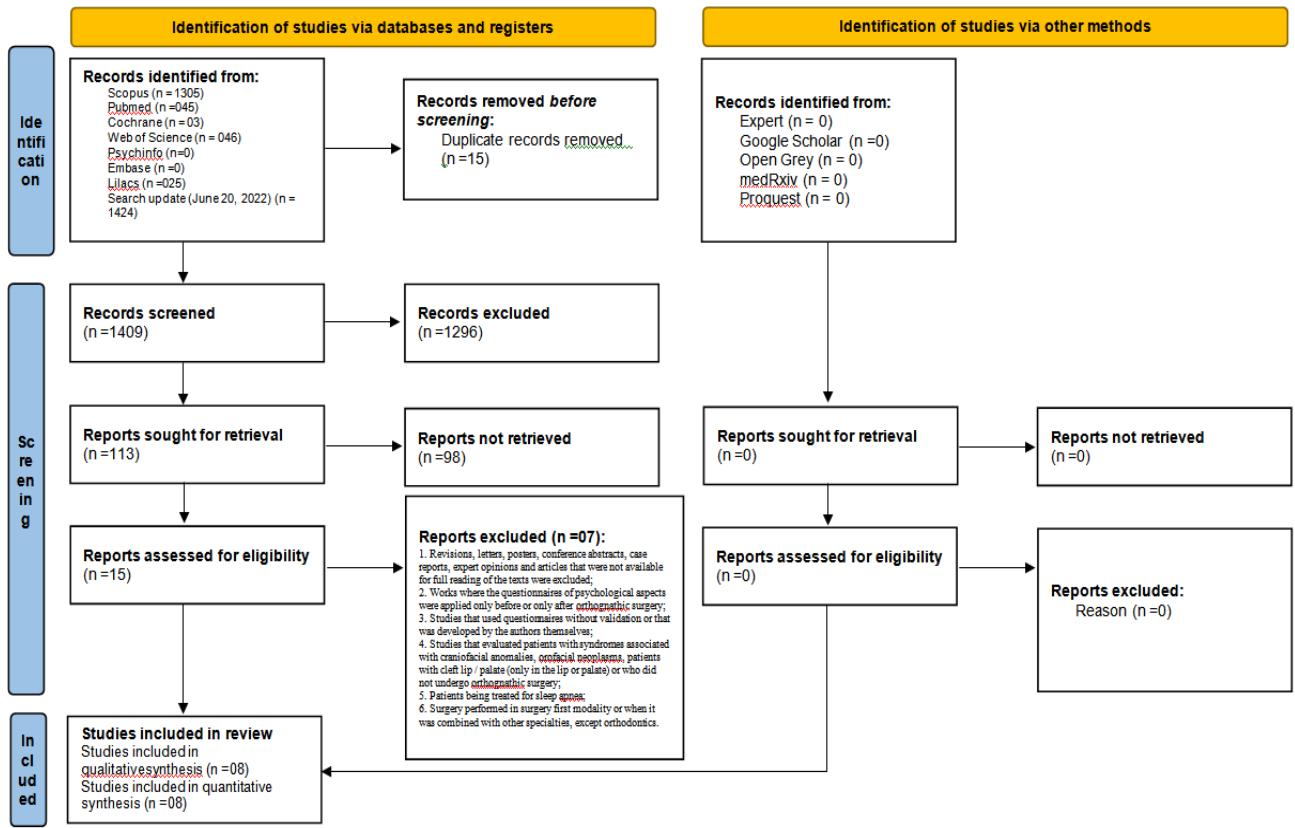
From: Page MJ, McKenzie JE, Bossuyt PM, Boutron I, Hoffmann TC, Mulrow CD, et al. The PRISMA 2020 statement: an updated guideline for reporting systematic reviews. BMJ 2021;372:n71. doi: 10.1136/bmj.n71. For more information, visit http://www.prisma-statement.org/
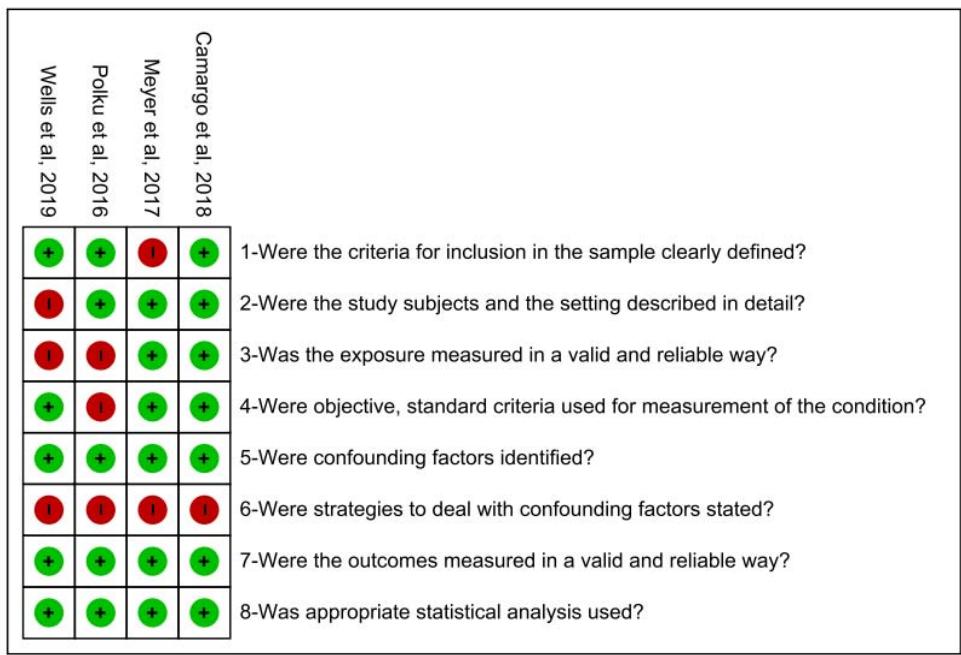
Figures 01 Figure 2: Risk of Trend Assessment Cross-Sectional Studies
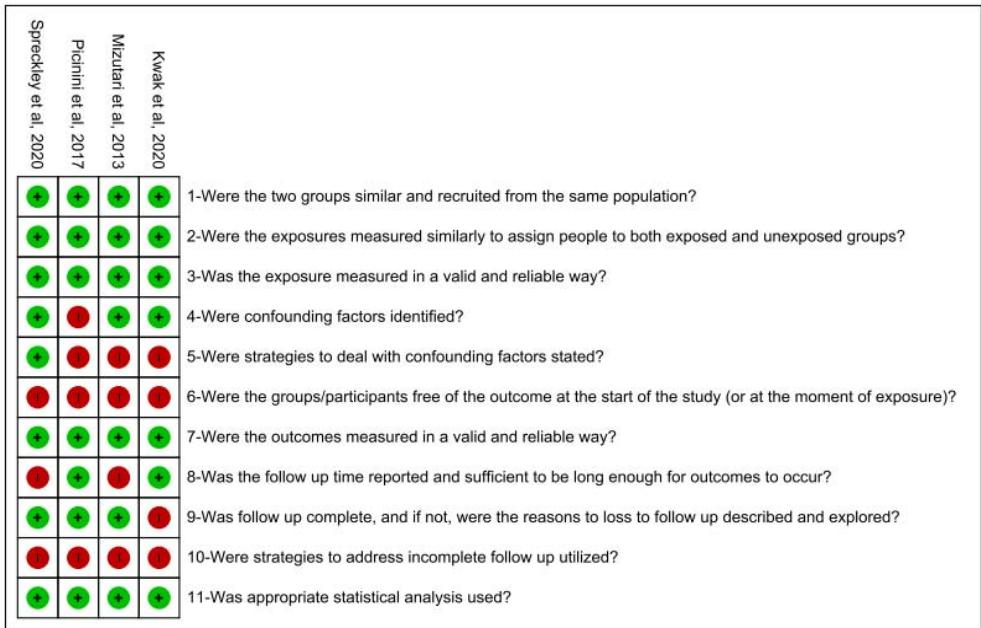 Figure 3: Assessment of the Risk of Biased Cohort Studies
04 Appendix 01 - Bias
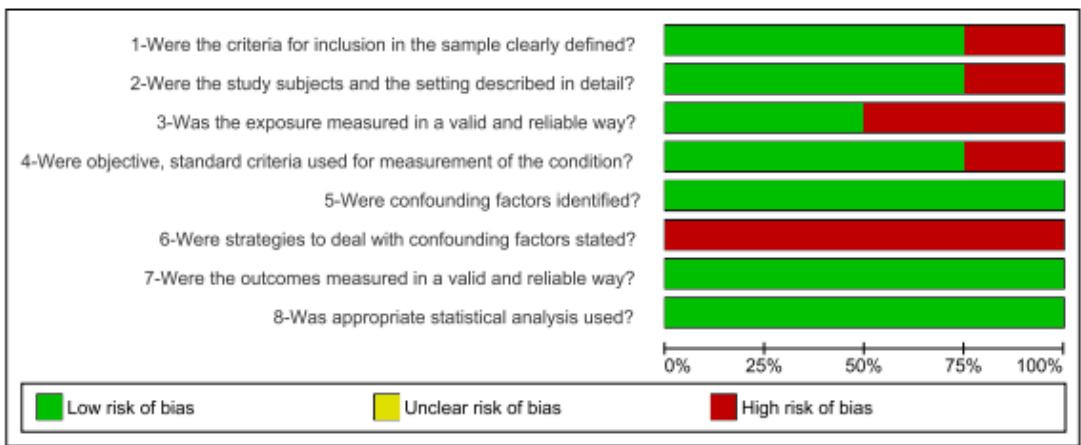
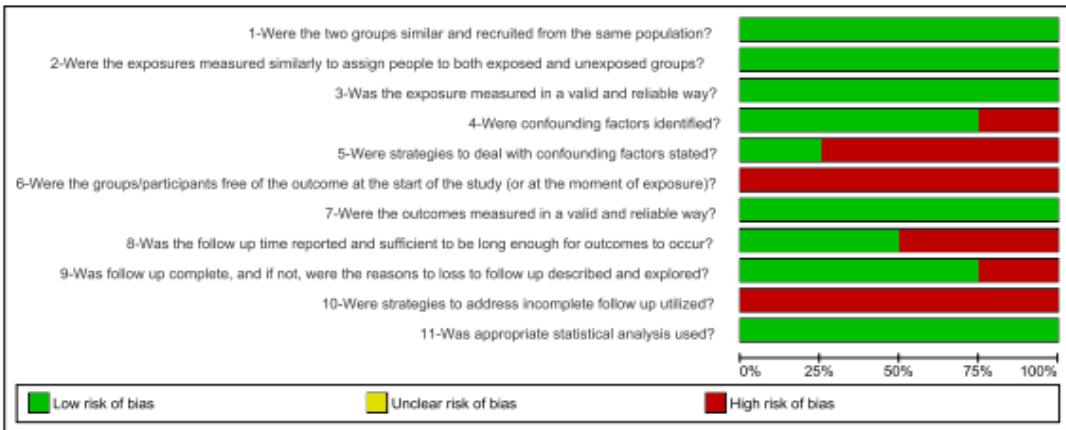
Camargo et al, 2018
Meyer et al, 2017
Polku et al, 2016
Wells et al, 2019
<table><tr><td>+</td><td>+</td><td>+</td><td>+</td><td>+</td><td>-</td><td>+</td><td>+</td></tr><tr><td>-</td><td>+</td><td>+</td><td>+</td><td>+</td><td>-</td><td>+</td><td>+</td></tr><tr><td>+</td><td>+</td><td>-</td><td>-</td><td>+</td><td>-</td><td>+</td><td>+</td></tr><tr><td>+</td><td>-</td><td>-</td><td>+</td><td>+</td><td>-</td><td>+</td><td>+</td></tr></table>
1-Were the criteria for inclusion in the sample clearly defined?
2-Were the study subjects and the setting described in detail?
3-Was the exposure measured in a valid and reliable way?
4-Were objective, standard criteria used for measurement of the condition?
5-Were confounding factors identified?
6-Were strategies to deal with confounding factors stated?
7-Were the outcomes measured in a valid and reliable way?
8-Was appropriate statistical analysis used?
<table><tr><td>+</td><td>+</td><td>+</td><td>+</td></tr><tr><td>+</td><td>+</td><td>+</td><td>+</td></tr><tr><td>+</td><td>+</td><td>+</td><td>+</td></tr><tr><td>+</td><td>+</td><td>+</td><td>+</td></tr><tr><td>+</td><td>+</td><td>+</td><td>+</td></tr><tr><td>+</td><td>+</td><td>+</td><td>+</td></tr><tr><td>+</td><td>+</td><td>+</td><td>+</td></tr><tr><td>+</td><td>+</td><td>+</td><td>+</td></tr><tr><td>+</td><td>+</td><td>+</td><td>+</td></tr></table>
Generating HTML Viewer...
References
29 Cites in Article
Suphi Bulğurcu,Irmak Uçak,Ayşegül Yönem,Evren Erkul,Engin Çekin (2020). Hearing Aid Problems in Elderly Populations.
Camille Camargo,Adriana Lacerda,Jussara Sampaio,Débora Lüders,Giselle Massi,Jair Marques (2018). Percepção de idosos sobre a restrição da participação relacionada à perda auditiva.
Ji Chang,Barbara Weinstein,Joshua Chodosh,Jan Blustein (2018). Hospital Readmission Risk for Patients with Self‐Reported Hearing Loss and Communication Trouble.
Elizabeth Convery,Gitte Keidser,Louise Hickson,Carly Meyer (2019). Factors Associated With Successful Setup of a Self-Fitting Hearing Aid and the Need for Personalized Support.
Rita Villas Boas,Denise Silva (2018). O curso de desenvolvimento de habilidades em pesquisa do ibge.
Atul Jaiswal,Sarah Fraser,Walter Wittich (2020). Barriers and Facilitators That Influence Social Participation in Older Adults With Dual Sensory Impairment.
Min Kwak,Woo Choi,Jun Park,Eun Hwang,Yeo Ha,Jong Chung,Woo Kang (2019). Assessment of Objective Audiometry to Predict Subjective Satisfaction in Patients With Hearing Aids.
Kari Lane,M Clark (2014). Assisting Older Persons With Adjusting to Hearing Aids.
Blake Lawrence,Dona Jayakody,Rebecca Bennett,Robert Eikelboom,Natalie Gasson,Peter Friedland (2019). Hearing Loss and Depression in Older Adults: A Systematic Review and Meta-analysis.
Y Loft,S Mehrkian,A Moossavi,Faghuh-Zadeli S (2009). Quality of life improvement in hearingimpaired elderly people after wearing a hearing aid.
Mélanie Levasseur,Marie-France Dubois,Mélissa Généreux,Verena Menec,Parminder Raina,Mathieu Roy,Catherine Gabaude,Yves Couturier,Catherine St-Pierre (2017). Capturing how age-friendly communities foster positive health, social participation and health equity: a study protocol of key components and processes that promote population health in aging Canadians.
Mélanie Levasseur,Daniel Naud,Jean-François Bruneau,Mélissa Généreux (2020). Environmental Characteristics Associated with Older Adults’ Social Participation: The Contribution of Sociodemography and Transportation in Metropolitan, Urban, and Rural Areas.
C Meyer,L Hickson,K Lovelock,M Lampert,A Khan (2014). An investigation of factors that influence help-seeking for hearing impairment in older adults.
K Mizutari,T Michikawa,H Saito,Y Okamoto,C Enomoto,T Takebayashi,. Nishiwaki,Y (2013). Age-related hearing loss and the factors determining continued usage of hearing aids among elderly community-dwelling residents.
Øyvind Nordvik,Peder Laugen Heggdal,Jonas Brännström,Flemming Vassbotn,Anne Aarstad,Hans Aarstad (2018). Generic quality of life in persons with hearing loss: a systematic literature review.
Luc Noreau,Patrick Fougeyrollas,Claude Vincent (2002). The LIFE-H: Assessment of the quality of social participation.
Oms (2021). OMS estima que 1 em cada 4 pessoas terão problemas auditivos até 2050.
Organização Mundial Da Saúde (2018). Estatísticas mundiais de saúde 2018: Monitoramento da saúde para os Objetivos de Desenvolvimento Sustentável (ODS).
Taís Picinini,Liese Weigert,Camila Neves,Adriane Teixeira (2017). Restrição de participação social e satisfação com o uso de aparelho de amplificação sonora individual - um estudo pós-adaptação.
H Polku,T Mikkola,J Gagné,M Rantakokko,E Portegijs,T Rantanen,A Viljanen (2018). Perceived benefit from hearing aid use and life-space mobility among community-dwelling older adults.
Prisma (2021). PRISMA STATEMENT EXTENSIONS AND SEARCHING.
Mark Spreckley,David Macleod,Brenda González Trampe,Andrew Smith,Hannah Kuper (2020). Impact of Hearing Aids on Poverty, Quality of Life and Mental Health in Guatemala: Results of a before and after Study.
Israel Santos,Everton Morais,Adriana Lacerda,Ana Guarinello (2022). Fatores que interferem na participação social de idosos com perda auditiva.
Ira Ventry,Barbara Weinstein (1982). The Hearing Handicap Inventory for the Elderly.
Timothy Wells,Lorraine Nickels,Steven Rush,Shirley Musich,Lizi Wu,Gandhi Bhattarai,Charlotte Yeh (2020). Characteristics and Health Outcomes Associated With Hearing Loss and Hearing Aid Use Among Older Adults.
Who (2021). WHO fact sheet on infertility.
Wittich,E Barstow,J Jarry,A Thomas (2015). Screening for sensory impairment in older adults: Training and practice of occupational therapists in quebec.
Wwp (2019). wpp2019: World Population Prospects 2019.
Y Zeng,J Peng,L Zhao (2018). Investigation of the acoustical environment of the elderly's living place.
No ethics committee approval was required for this article type.
Data Availability
Not applicable for this article.
How to Cite This Article
Dr. Israel Bispo dos Santos. 2026. \u201cSelf-Perception of Social Participation Restrictions in Adults and Older Adults with Hearing Loss: A Systematic Review\u201d. Global Journal of Medical Research - F: Diseases GJMR-F Volume 23 (GJMR Volume 23 Issue F5): .
Explore published articles in an immersive Augmented Reality environment. Our platform converts research papers into interactive 3D books, allowing readers to view and interact with content using AR and VR compatible devices.
Your published article is automatically converted into a realistic 3D book. Flip through pages and read research papers in a more engaging and interactive format.
Subject: Global Journal of Medical Research - F: Diseases
Authors:
Israel Bispo dos Santos, Everton Adriano de Morais, Gloria Ravazzi, Flávio Magno Gonçalves, Cristiano Miranda de Araújo, Adriana Lacerda, Ana Cristina Guarinello, Ana Cristina Guarinello (PhD/Dr. count: 0)
Our website is actively being updated, and changes may occur frequently. Please clear your browser cache if needed. For feedback or error reporting, please email [email protected]
Thank you for connecting with us. We will respond to you shortly.