Self-Reporting of Youth Delinquency in the Balkans and Beyond: Results of the ISRD3 International Self-Reporting Study of Delinquency in the Context of Violence, Victimization, and Substance Abuse in Comparative Aspects
This article publications on the first results of the third International Self-Publikation Study of Delinquency (ISRD-3), a large international collaborative study of delinquency and victimization of 14-to 18-year-old students. The analysis is based on a sub-sample of the data set: 2060 respondents from 4 cities in the Republic of Kosovo. The prevalence rate of the main categories of delinquency in comparison to individual countries participating in ISRD3, as well as for 6 groups of countries, are presented as well as data on experiences of victimization (theft and robbery/extortion). Using different measures, we have compared the data with our country where there are significant differences in the level and type of offense found between groups of countries such as Europe, America and other countries. In this article, we compare the rates of offending and victimization found by ISRD-3 with other main sources of national statistics available in the Republic of Kosovo based on the police and the prosecutor. The article concludes with implications and suggestions for further research.
## I. INTRODUCTION
As in other areas, the delinquency of minors has become problematic in every country and the comparison of measures against them is more necessary (I. Marshall, M. Killias, D, Ezman ISRD2, 2010). For researchers, this research increases the possibilities for theory testing, while for policymakers, it allows the evaluation of their policies through 'benchmarking'. In criminology, two types of readily available data are used to place a country's particular "crime problem" in the wider international context: First, international organizations provide their evidence (Interpol, the United Nations provides data officially recorded crime for a large number of countries i.e. crime publicationed to the police, arrests, prosecutions, convictions, Aebi et al., 2006).
A second important source of comparative delinquency data is that obtained between ISRD3 and the International Crime Victimization Survey (ICVS) (van Dijk et al., 2007a, 2007b, Aebi et al. 2002; Robert, 2009; Zauberman, 2009).[^2]
Here we present the Third International Self-Publikationed Delinquency Study (ISRD-3), Self-publikation surveys of delinquency have been a mainstay of delinquency research for more than half a century, these studies have typically been limited to a, or at most, in a small proportion of countries (Wikström and Svensson, 2008, focus on Sweden and England). At the European level, there are few comparative studies focusing on young people; an example is the European School Study Project on Alcohol and Other Drugs (ESPAD) (see Hibell et al., 2004). Another example is the Program for International Student Assessment (PISA) and this has been a very interesting case in the Republic of Kosovo, whereas a project we think is targeted, but during the implementation, there are errors in taking the sample, (internationally standardized of 15-year-olds in schools, implemented in 62 countries of the world in 2009). The WHO Publication on Health Behavior in School-Aged Children (HBSC) contains international self-publikation data on the use and abuse of cannabis (Currie et al., 2008).[^3]
Until now, the first International Self-Publikational Delinquency Study (ISRD-1; Junger-Tas et al., 1994) was conducted in 1992, focusing explicitly on youth delinquency and victimization for 13 countries in the same time continues with the second study of this type and, compared to ISRD-1, it has expanded greatly in scope and in the number of participating countries (Junger-Tas et al., 2010) and finally, ISRD3 has received an international expansion and reputation.
In this article, we present the first descriptive results of the extent of self-publicationed delinquency (12-month prevalence rates), as well as youth victimization experiences in our country Kosovo, comparing some data with countries in the region such as Serbia, Macedonia, Bosnia, and Herzegovina. These preliminary comparisons will test the validity of delinquency prevalence rates derived from different sources.
## II. ISRD3 IN KOSOVO
About 27 international countries participated in the ISRD3 project and their data are available, presenting findings on self-pUBLICATIONed offending and victimization as the participation of 62,636 young people in cities or regions of Armenia, Austria, Belgium, Bosnia-Herzegovina., Croatia, Czech Republic, Denmark, Estonia, Finland, France, Germany, India, Indonesia, Italy, Kosovo, Lithuania, Macedonia, Netherlands, Serbia, Switzerland, Ukraine, United Kingdom, United States and Venezuela.
The main goal of the ISRD project is theory testing and research mechanisms that explain delinquency in a way that enables us to factor in national differences and contextual sources of influence. Second, the project produces information that provides local stakeholders with information about specifics patterns of youth crime in their areas.[^4] In addition to these aims, the project enables the comparison of delinquency patterns in different areas and cities - that is the focus of the current publication.
However, we aim to do more than simply present models of delinquency different areas and cities around the world. We also want to highlight – from the perspective of social indicators – the problem of relying on official police data such as better measurement of dimensions of youth crime and victimization. In the same time, from a methodological point of view, we want to emphasize the limits of self-publikationing delinquency surveys, especially in a comparative context. And finally, we love place more firmly a number of problems related to crime and victimization of young people on countries' policy agendas – such as the use of violence by parents against their children.
## III. METHODOLOGY AND SAMPLE DESCRIPTION
The ISRD has two distinctive features as a comparative study of youth crime and victimization: the large number and cultural diversity of participants in our country Kosovo and explicitly comparative design. How to overcome the many challenges or how to get the data in time or early warning.[5]
An integral part of comparative survey research has been a preoccupation of a long tradition of researchers in the field of cultural anthropology, sociology, political science, and criminology, with few clear solutions (Allardt 1990; Armer & Grimshaw 1973; Bennett 2009; Plaku, 1976; Howard et al. 2000; Kohn, 1987; Karstedt 2001; Marshall & Marshall 1983; Nelken 2009; Prezworski & Teune 2010). 1970; Ragin, 1987; Rokkan 1968; Smelser, 1976; 2003; Van de Vijver & Tanzer 2004). During the implementation of ISRD3 there are many challenges and problems such as technical, human and logistical, but awareness of these problems is the best weapon against oversimplification or misinterpretation of the results (Marshall & Enzmann 2012, 21).
### a) Sampling
The data collection models of the ISRD3 project are according to the research protocol, samples should be city-based, covering students from grades 7 to 9, corresponding to the age categories 12-14, 13-15 and 14-16 in our case, we have two cities in two regions, that of Prishtina as the capital and that of Prizren as the second city in the country.[6]
Data in two cities were sampled from 2500 minor respondents in the 7th, 8th, 9th, 10th and 11th grades, so the minimum sample was 1800, the size and types of cities differ in different countries and some countries have chosen more samples. broad or national. Therefore, due to the heterogeneity of the sample, we should refrain from overgeneralizing the findings across countries. The survey should not be considered representative of the entire youth population in these countries, but instead of students in grades 7 through 11 in the cities or regions in which the data were collected.
### b) Description of the sample
The publication is based on a total sample of 3,737 students in 49 schools classes gathered in two cities in Kosovo (Prishtina and Prizren), the biggest cities in our country and as cities where, since 1999, there has been a lot of migration towards them from rural areas. (Sample sizes across countries range from 647 in Serbia, 796 in Armenia and 1,080 inches Kosovo to 3,737 in Estonia, 4,072 in Switzerland and 6,492 in Austria; 11 13 of 27 countries have samples between 1,600 and 2,400 cases. India and Austria, The average sample size is 2230 cases.)[^7]
## IV. SOCIAL BACKGROUND OF THE RESPONDENTS
The ISRD-3 questionnaire includes questions on the social background of the respondents. In the first part of this chapter, we will present basic demographic information about our sample, i.e. about variables that include age, gender, place of birth, ethnicity (belonging to national groups), religion and its importance, living arrangement and family status. Key demographic characteristics are presented only for the five countries
sampled. In the second part, we will present the basic findings about delinquency, victimization and substance use, their basic relationships with independent variables of social background, such as social well-being, ethnicity, religion, family constellation, etc. $^{8}$
<table><tr><td></td><td>Armenia</td><td>Bosnia and Herzegovina</td><td>Kosovo</td><td>Macedonia</td><td>Serbia</td><td>Ukraine</td><td>Switzerland9</td></tr><tr><td>female</td><td>61.0%</td><td>51.4%</td><td>49.0%</td><td>49.2%</td><td>48.1%</td><td>50.8%</td><td>51.3%</td></tr><tr><td>male</td><td>39.0%</td><td>48.6%</td><td>51.0%</td><td>50.8%</td><td>51.9%</td><td>49.2%</td><td>48.7%</td></tr><tr><td>N=</td><td>962</td><td>3063</td><td>1078</td><td>1239</td><td>886</td><td>1651</td><td>4158</td></tr></table>
This informs about the distribution of male and female respondents In Bosnia-Herzegovina, Kosovo, Macedonia and Ukraine the students of the $7-9^{\text{th}}$ grades participated in the survey. In Armenia, juveniles also from the $10^{\text{th}}$ grade were taken into the sample. It can be explained by the age of students. In accordance with the research plan, the age of ISRD-3 respondents should be from 12 till 16 years old regardless the grade. In Serbia there are also juveniles from the $10^{\text{th}} - 12^{\text{th}}$ grades. It can be explained by conducting the survey also in the higher grades, among older students. But for the purpose of this publication, only the students of the needed age were taken, regardless their school grade. The following table shows the age distribution.[^10]
<table><tr><td></td><td>Armenia</td><td>Bosnia and Herzegovina</td><td>Kosovo</td><td>Macedonia</td><td>Serbia</td><td>Ukraine</td><td>Switzerland11</td></tr><tr><td>10-12</td><td>14.1%</td><td>13.3%</td><td>31.5%</td><td>5.4%</td><td>4.9%</td><td>28.1%</td><td></td></tr><tr><td>13</td><td>30.7%</td><td>32.8%</td><td>34.7%</td><td>29.4%</td><td>23.7%</td><td>30.4%</td><td>24.8%</td></tr><tr><td>14</td><td>33.8%</td><td>36.5%</td><td>28.3%</td><td>34.0%</td><td>20.4%</td><td>30.6%</td><td>24.7%</td></tr><tr><td>15-17</td><td>21.4%</td><td>17.5%</td><td>5.5%</td><td>31.1%</td><td>22.9%</td><td>10.9%</td><td>50.6%</td></tr><tr><td>N=</td><td>957</td><td>3056</td><td>1078</td><td>1237</td><td>886</td><td>1651</td><td>4158</td></tr></table>
This table shows the distribution of the age among respondents in all five countries. Less than five respondents in each country identified themselves as 18-20 years old. They were recoded as missed answers to allow the comparison of these countries with other ISRD-3 results. More detailed age distribution of Swiss respondents can be seen in the Swiss National Publication, Table 1.2, where respondents of 13, 14, 15, and 16 years old are presented as a quarter for each group.
a) Birthplace of respondents, their parents; belonging to minority/majority groups; and religion
The following group of tables and figures shows the main demographic characteristics of juveniles in Armenia, Bosnia-Herzegovina, Kosovo, Macedonia, Ukraine, and Switzerland.
Countries of Ex-Yugoslavia are among the largest sources of immigrants to Switzerland, but in comparison with the previous years, fewer amounts of people came to Switzerland from this region. For instance, the number of immigrants with Serbian nationality decreased from 90.7 (in 2013) till 78.1 (in 2014) thousand $^{12}$ (Results of ISRD-3 in Serbia is not presented in this Publication). It became $\sim$ $4.7\%$ in 2013 and $3.9\%$ in 2013 from the total population of the foreign permanent residents in Switzerland. More information about the countries that participated in ISRD-3 is in the following Figure and Table.
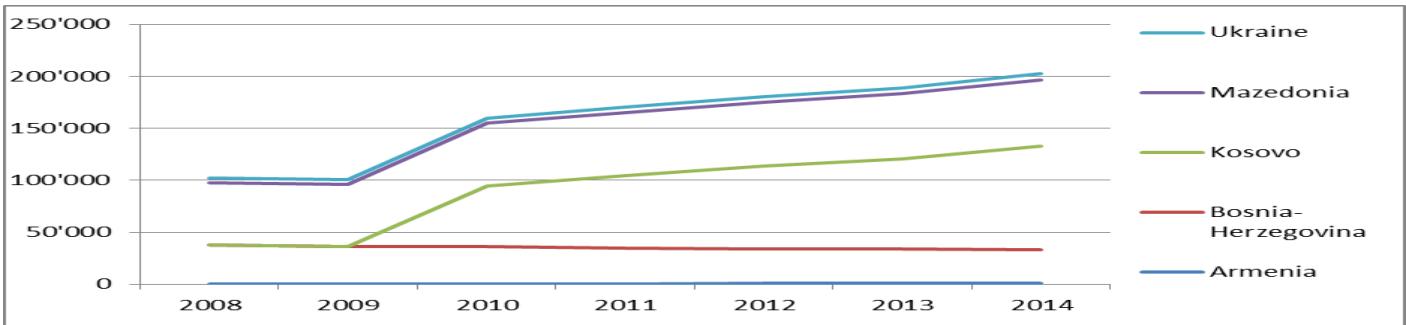
Minority/majority status and origin of parents, in%
<table><tr><td></td><td>Armenia</td><td>Bosnia-Herzegovina</td><td>Kosovo</td><td>Macedonia</td><td>Serbia</td><td>Ukraine</td><td>Switzerland13</td></tr><tr><td>Born in this country</td><td>90.1</td><td>92.0</td><td>84.5</td><td>96.0</td><td>96.6</td><td>95.8</td><td>86.2</td></tr><tr><td>Born in other countries</td><td>9.9</td><td>8.0</td><td>15.5</td><td>4.0</td><td>3.4</td><td>4.2</td><td>13.8</td></tr><tr><td>N=</td><td>962</td><td>3063</td><td>1078</td><td>1239</td><td>882</td><td>1651</td><td>4158</td></tr></table>
The highest percentage of juveniles born in this country is in Macedonia, Serbia and Ukraine (96.0%, 96.6%, and 95.8%). The lowest number of students who were born not in the native country is in Kosovo and Switzerland (85.5% and 86.2%). Some students also wrote their native country in the answer "other countries". But the number of such respondents is no more than one percent.
### b) Data about the religion in 5 countries provided by Nation Master and other sources
This table represents the official data of religion in each country. Armenia is a relatively homogenous country. More than $90\%$ of the population affiliate the Armenian Apostolic religion that is the part of Oriental Orthodoxy[^14]. In Bosnia-Herzegovina $40\%$ of the population affiliate Islam and one third identify themselves as Orthodox. More than $90\%$ of people in Kosovo are Muslim. Two thirds of the Macedonian population is Eastern Orthodox and one third is Muslim. In Ukraine more than two thirds of people are Orthodox. There are also a lot of other Christian confessions. Serbia is a multi-religious country. The dominant religion is Orthodox Christianity (notably the Serbian Orthodox Church), but there are also some adherents of Islam (living mostly in the southwestern part of Serbia in the region of Sandžak or Raška, in the municipalities of Preševo and Bujanovac in southern Serbia), and Catholic Christianity (living mostly in northern part of Vojvodina province), as well as adherents of other religious groups such as Protestant Christians, Jews, and others.
<table><tr><td>Armenia 15</td><td>Bosnia-Herzegovina 16</td><td>Kosovo (Wagnsonner, 2004) 17</td><td>Macedonia 18</td><td>Serbia 19</td><td>Ukraine</td><td>Switzerland 20</td></tr><tr><td>Armenian Apostolic (94.7%)</td><td>Muslim (40%)</td><td>Muslim (>90%)</td><td>Eastern Orthodox (64.8%)</td><td>Orthodox Christian (81.1%)</td><td>Orthodox (76.5%)</td><td>Roman Catholic (38.2%)</td></tr><tr><td>Other Christian (4%)</td><td>Orthodox (31%)</td><td>Orthodox (~7.0%)</td><td>Muslim (33.3%)</td><td>Catholic (4.8%)</td><td>Ukrainian Greek Catholic (8%)</td><td>Protestant Reformed (26.9%)</td></tr><tr><td>Yezidi (monotheist with elements of nature worship, 1.3%)</td><td>Roman Catholic (15%)</td><td>Catholic (3%, 2004)</td><td>Roman catholic (0.3%)</td><td>Protestant and other Christian (1.0%)</td><td>Ukrainian Autocephalous Orthodox (7.2%)</td><td>Muslim and Islamic communities (5.0%)</td></tr><tr><td></td><td></td><td></td><td></td><td>Muslim (3.0%)</td><td>Roman Catholic (2.2%)</td><td></td></tr><tr><td></td><td></td><td></td><td></td><td></td><td>Protestant (2.2%)</td><td></td></tr><tr><td></td><td></td><td></td><td></td><td></td><td>Jewish (0.6%)</td><td></td></tr><tr><td></td><td>other(14%)</td><td></td><td>other (1.6%)</td><td>Other, I do not know, not religious (10.2)</td><td>other(3.2%)</td><td>Other, Unknown, non-denominational (29.9%)</td></tr></table>
This table represents the official data of religion in each country. Armenia is a relatively homogenous country. More than $90\%$ of the population affiliate the Armenian Apostolic religion that is the part of Oriental Orthodoxy[^21]. In Bosnia-Herzegovina $40\%$ of the population affiliate Islam and one third identify themselves as Orthodox. More than $90\%$ of people in Kosovo are Muslim. Two thirds of the Macedonian population is Eastern Orthodox and one third is Muslim. In Ukraine more than two thirds of people are Orthodox. There are also a lot of other Christian confessions.
Serbia is a multi-religious country. The dominant religion is Orthodox Christianity (notably the Serbian Orthodox Church), but there are also some adherents of Islam (living mostly in the southwestern part of Serbia in the region of Sandžak or Raška, in the municipalities of Preševo and Bujanovac in southern Serbia), and Catholic Christianity (living mostly in northern part of Vojvodina province), as well as adherents of other religious groups such as Protestant Christians, Jews, and others.
c) Working status of parents, family well-off and amount of pocket money in comparison with others
This part of the publication shows the results of the ISRD-3 in five countries and Switzerland, as well as statistical data of unemployment rates and poverty in these countries.
Statistics of population below poverty and unemployment rate among the selected countries, in%
<table><tr><td></td><td>Armenia (2014)</td><td>Bosnia-Herzegovina (2014)</td><td>Kosovo (2014)</td><td>Macedonia (2014)</td><td>Serbia</td><td>Ukraine (2014)</td><td>Switzerland (2014)</td></tr><tr><td>Population below poverty line 22</td><td>35.8%</td><td>18.6%</td><td>30%</td><td>30.4%</td><td>9.2% (2013)</td><td>24.1%</td><td>7.6%</td></tr><tr><td>Unemployment rate 23</td><td>17.3%</td><td>44.3%</td><td>30.9%</td><td>28.6%</td><td>19.7% (2014)</td><td>8.0%</td><td>3.2%</td></tr></table>
In Armenia, Kosovo, and Macedonia, one third of the population is below poverty line. Nevertheless only $20\%$ of the population of Bosnia-Herzegovina has this index, $44\%$ of the population is unemployed. The lowest unemployment rate after Switzerland is in Ukraine, but in the last country almost every fourth person is under the poverty line.
Percentage of the population below poverty in Switzerland is 2.5-3 times less than in Bosnia-Herzegovina and in Ukraine, four-five times less than in Armenia, Kosovo, and Macedonia.
Jugoslavia (Bosnia-Herzegovina, Kosovo, Macedonia and Serbia) \*\*\* ine\*
ia
$$
edonia\*\*\*
$$
VO
$$
ia-Herzegovina\*\*\*
$$
ania
10-12
13
14
15-17
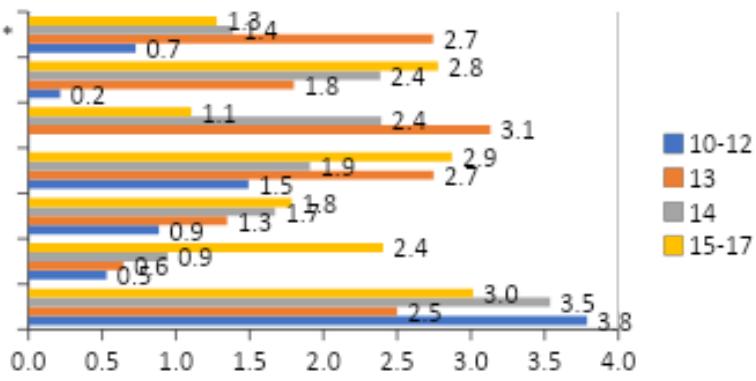
Delinquency (last year prevalence) by gender, Minor offences $^{24}$ by age of respondents, in%, In Ukraine, Bosnia-Herzegovina and Macedonia, juveniles commit more offences by increasing of their age. Respondents in the age of 14 and 15-17 are several times more likely to publication about this group of offences. Students from Kosovo publicationd about Minor offences more often in the age of 13 and 14. This association for Armenia is not significant Violent offences $^{25}$ by age of respondents, in% bsnia-Herzegovina, Kosovo, Macedonia and Serbia) \*\*\*
 ina
The same as in the previous figure, Ukrainian students publication about violent offences more often when they become older. Only a few of 10-12 years children publicationd assault and/or robbery. Fourteen years old juveniles from Bosnia-Herzegovina publicationd about violent offences twice less frequent than their older colleagues. Younger children publicationd it even less. This association is significant only for these two countries.
Juveniles from Kosovo in the age of 15-17 publicationd about property offences four times more often than their 13 and 14 years old colleagues. The same is in Bosnia-Herzegovina and Macedonia. Older respondents commit property offences more often. This association is not significant for Armenia, Ukraine and Serbia.
### d) Delinquency (last year prevalence) by gender
The difference between boys and girls who committed robbery and/or assault is relatively big in all countries. Males are more likely to publication about violent offences. It is especially visible in Kosovo and Armenia. This association is highly significant in all countries.
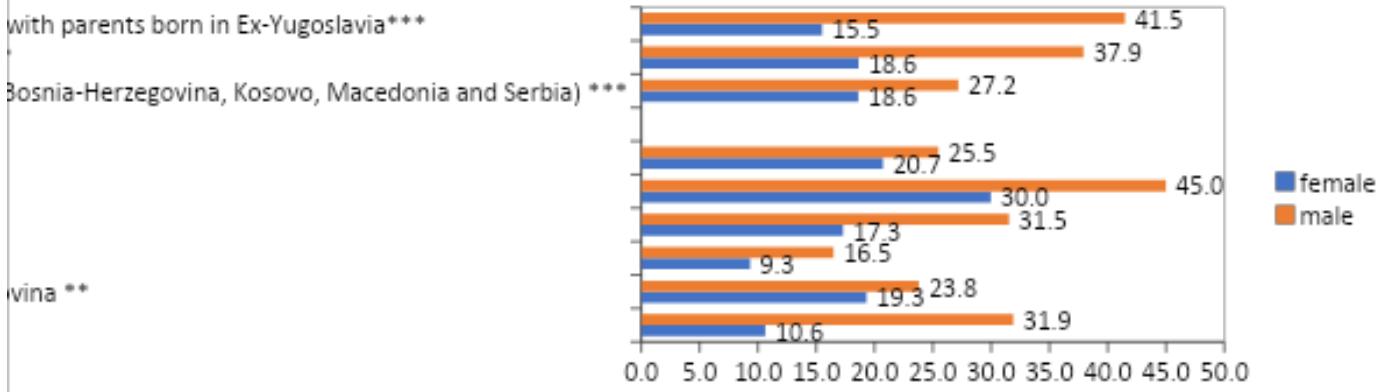
Males are more likely to commit property offences than females. This difference is especially visible among Armenian juveniles: boys publicationd about this group of betrayrations seventeen times more often. Swiss boys with parent(s) born in Ex-Yugoslavia publication about property offences three times more often than females. In all other countries and their groups, males publication about property betrayrations two-three times more often than females. This association is not significant in Serbia and Kosovo.
### e) Delinquency (last year prevalence) by grade
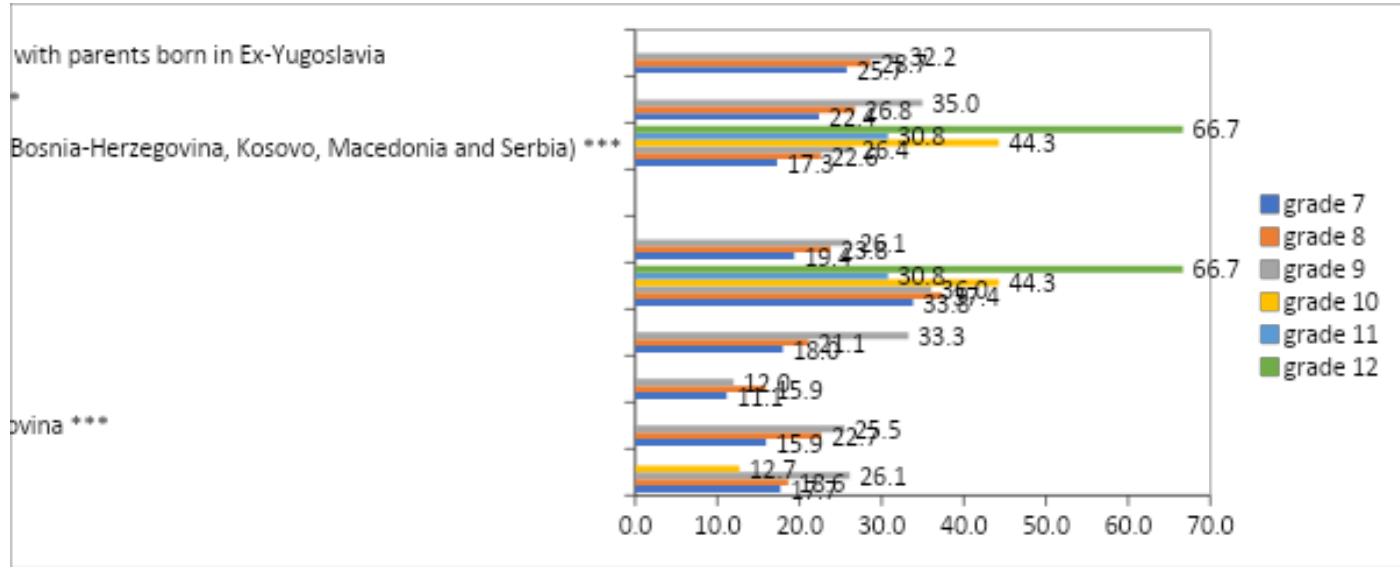
This association is significant only for respondents from Ukraine and Switzerland. Students from the $9^{\text{th}}$ grade are two-three times more likely to publication about violent offences than their colleagues from the $7^{\text{th}}$ or the $8^{\text{th}}$ grades.
 Violent offences
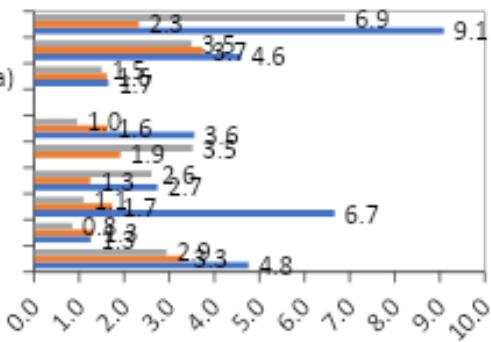
$^{26}$ by importance of religion, in $\%$ In comparison with the previous figure, the association between violent offences and importance of religion is mostly not significant. The exception is the results in Ukraine and among Swiss students with parent(s) from Ex-Yugoslavia.
Ukrainian less religious students are more likely to commit robbery and/or assault. Swiss students with parent(s) born in Ex-Yugoslavia, for whom religion is (very) important and (very) unimportant, perpetrated more violent offences than their peers with neutral attitude to religion. Such distribution can be explained by a small number of respondents in this group (e.g. $9.1\%$ of not-religious respondents publicationd about violent offences, $N = 4$ ).
ts born in Ex-Yugoslavia\* zegovina, Kosovo, Macedonia and Serbia)
(very) unimportant a bit important, a buit unimportant (very) important
Minor offences ${}^{27}$ by personal money in comparison with others, in%
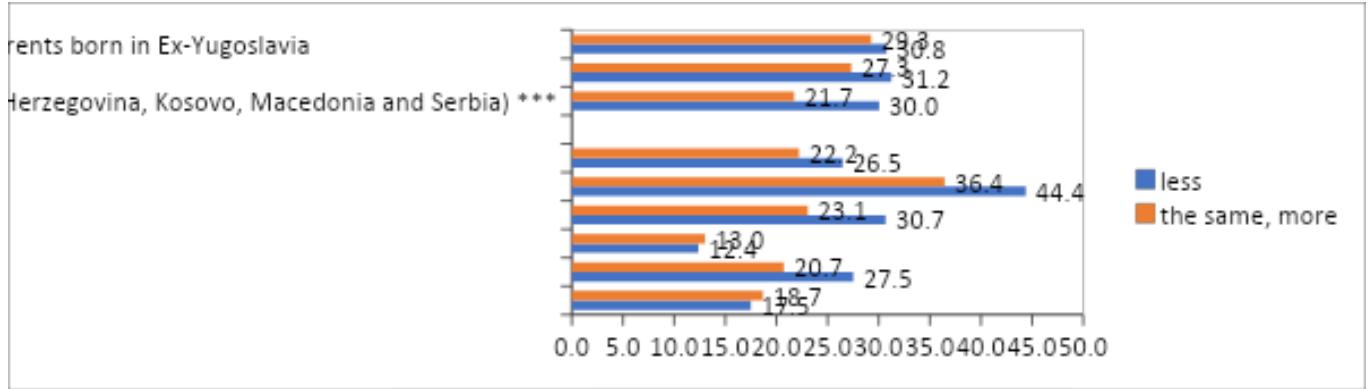
Students with less amount of pocket money are more likely to commit minor offences. This association is significant only for Bosnia-Herzegovina, Macedonia,
Switzerland and the group of the selected Ex-Yugoslavian countries
Property offences $^{28}$ by personal money in comparison with others, in%.
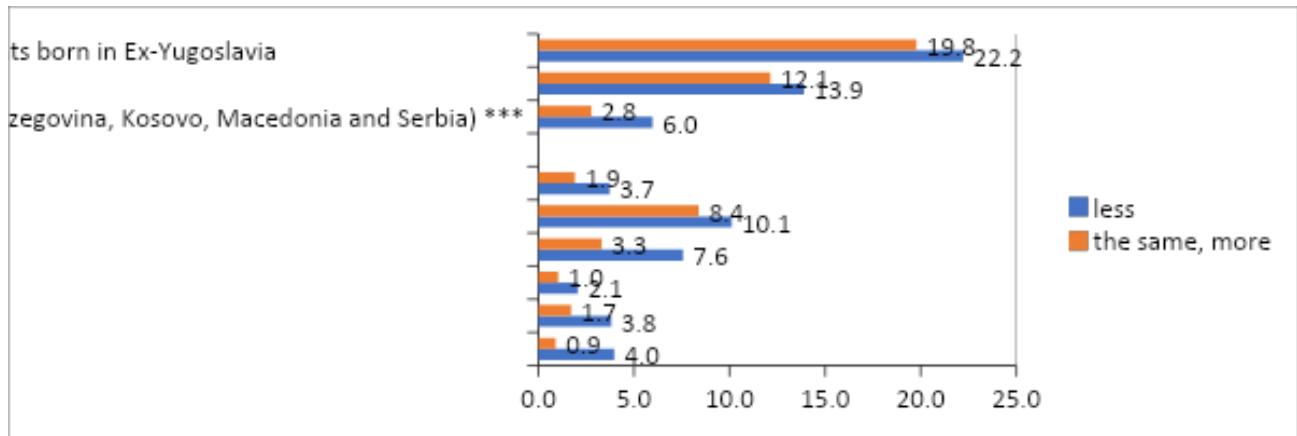
Students with less pocket money in comparison with others are more likely to commit property offences. It is especially visible among Armenian juveniles. This association is significant for all countries except Serbia, Switzerland and Kosovo.
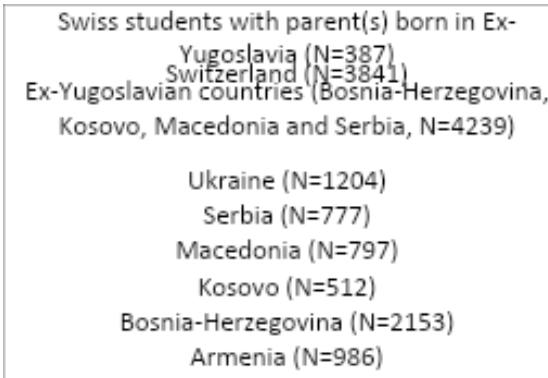
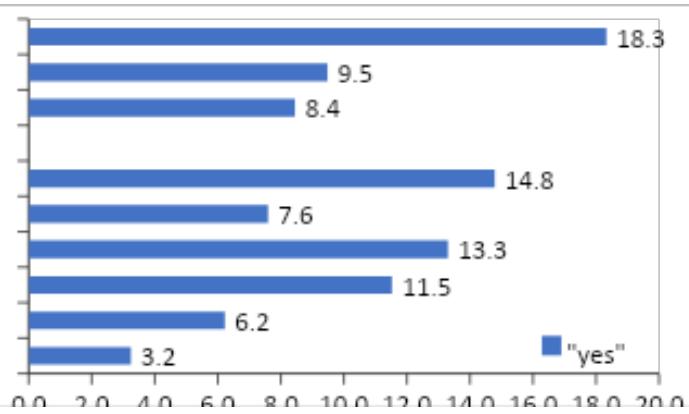
More than $90\%$ of respondents from Serbia and Ukraine publication about having friends to spend time with. It is the highest percentage among the selected countries and their groups. This percentage is the lowest in Armenia, Kosovo and Macedonia. Only two thirds of juveniles have such friends there. This percentage among Swiss juveniles with parents born in Ex-Yugoslavia, on the Swiss national level among juveniles from Ex-Yugoslavian country cluster is very similar: from 74 to $78\%$. The ISRD-3 questionnaire included the question "How many of your friends have at least one parent of foreign origin?" Among the answers were "None at all", "A few" "Many of them", "All of them". The variable was dichotomized to you it for the bivariate and multivariate analysis. This table shows the frequency of students, who have many/all friends with parents of foreign origin. Armenia has the most homogenous society: only two percent of juveniles have a lot/all of such friends. This prevalence in Kosovo and Macedonia is not very high; it is twice lower than in Bosnia-Herzegovina and Ukraine. Such prevalence in Serbia is a bit lower than in Ukraine and Bosnia-Herzegovina. This percentage is the highest in the Switzerland on the national level and among Swiss students with parents born in Ex-Yugoslavia. One third and two thirds of the respondents publicationd about
many/all of such friends. It is understandable, because Switzerland is one of the largest destinations of immigrants in the world; and Swiss students, who have parents immigrated from Ex-Yugoslavia, communicate mostly with peers with similar origin.
Ukrainian students consider their group of friends as a gang almost five times more often than their peers in Armenia. This percentage among the taken Ex-Yugoslavian countries is the highest in Macedonia and Kosovo, and it is the lowest in Bosnia-Herzegovina and Serbia. Respondents from Switzerland and Ex-Yugoslavian country cluster publicationd about it almost equally. It is twice lower than among Swiss students with parent(s) born in Ex-Yugoslavia.
 Over
$90\%$ of juveniles from all selected countries except Serbia and Switzerland do not have friends who have ever tried drugs. More than $40\%$ of students from Switzerland and Swiss students with parents from Ex-Yugoslavia have friends who have already consumed drugs. It can be explained by a "highly permissive" character of Swiss society (Killias, Maljevic, Lucia, 2010, P. 188). This prevalence is also relatively high in Switzerland: each fourth respondent publikationed about it. Respondents from Ex-Yugoslavian country cluster publikationed about having friends committed shoplifting twice less frequent than their peers in Switzerland. Swiss students with parent(s) born in Ex-Yugoslavia have such friends a bit more often than Swiss juveniles on the national level, of this publication, where the prevalence of shoplifting is also higher among this group of respondents. We suggest that it can be explained by an influence of a "bad company" and strongly associated with own perpetration of minor offences, including shoplifting (Figure 3.38). Each third Serbian student publication about it.
Among the taken Ex-Yugoslavian countries, juveniles from Bosnia-Herzegovina and Macedonia have such friends 2.5 times more often than their peers in Kosovo. This prevalence is the highest among adolescents from Serbia. Juveniles in Armenia have friends who have committed shoplifting three times less often than their peers in Ukraine.
The same as in the previous figure, Swiss students on the national level and Swiss students with parent(s) born in Ex-Yugoslavia publication about having friends committed burglary eight times more often than their peers in the chosen Ex-Yugoslavian countries (cluster).
Among the selected Balkan countries, Kosovo has the lowest prevalence of such friends; it is the highest among Serbian juveniles. Armenian adolescents have also friends committed burglary five times less often than students from Ukraine.
It is hard to compare these results with the prevalence of burglary because the low number of respondents who committed this offence, the prevalence of burglary among Swiss respondents on the national level and Swiss students with parents born in Ex-Yugoslavia is higher than among juveniles from other countries and their clusters.
Having friends, who committed robbery, in%
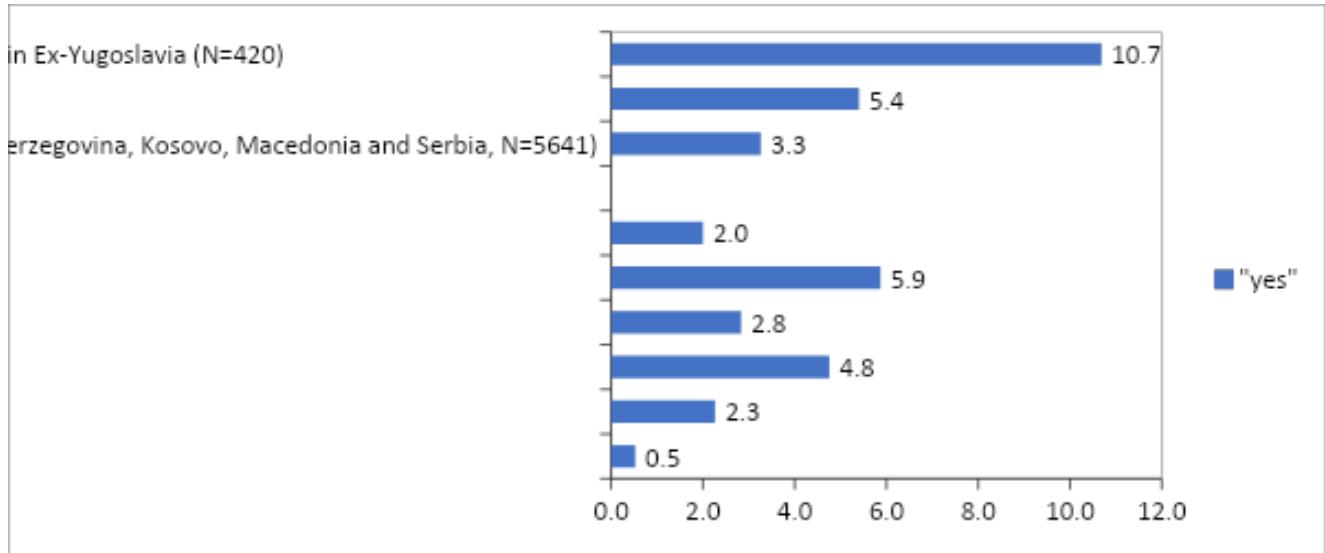 Violent offences
$^{29}$ (last year prevalence) by cannabis use (life time prevalence), in%
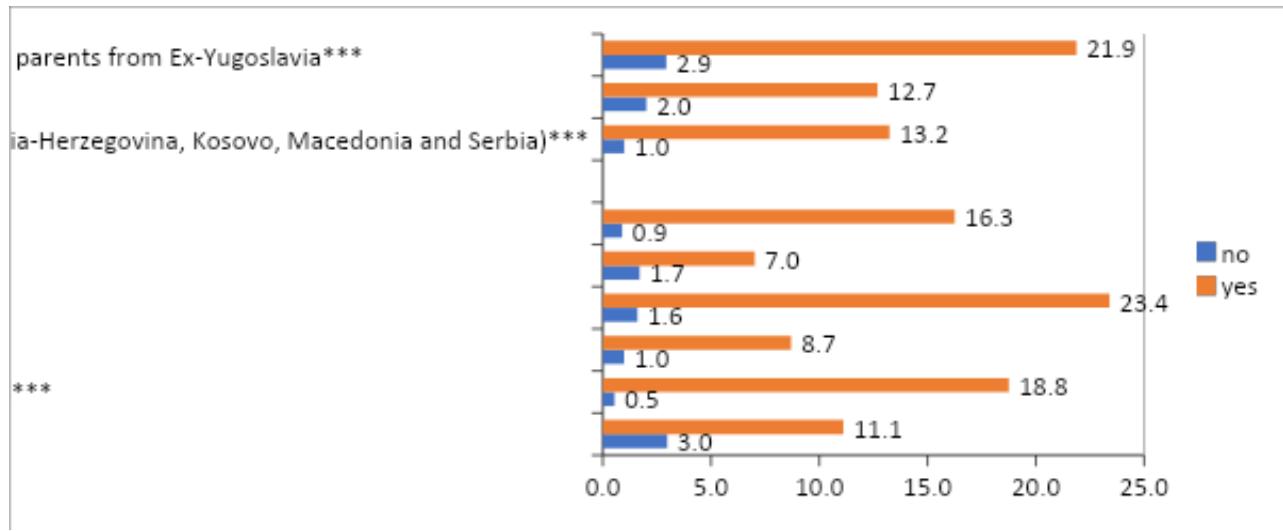
Respondents, who have already consumed cannabis, are 4-18-37 times more likely to commit a violent offence than those who have never tried cannabis. This likelihood is the highest in Ukraine, Macedonia (18 times) and Bosnia-Herzegovina (37 times). This is the lowest in Serbia, Armenia and Switzerland. This association is significant and highly significant in all taken countries and their groups. Comparison of the results of bivariate analysis shows that cannabis use has a stronger influence on violent offences than on minor offences perpetration.
Minor offences $^{26}$ (last year prevalence) by binge drinking (last month prevalence), in%
Respondents, who have five or more alcohol drinks on one occasion during last 30 days, are 2-4 times more likely to commit a minor offence. This association is highly significant for all countries.
## V. ANALISE
- The highest prevalence of alcohol use is in Serbia and Switzerland. It is also relatively high in Ukraine, Macedonia and Armenia. This percentage is the lowest in Kosovo. Each third respondent from the Ex-Yugoslavian country cluster has already tried alcohol.
- We suggest that such differences can be explained by cultural and traditional issues of a country, spending leisure time by respondents. The first argument is described more detailed in the following table with the statistics of wine consumption, provided by the Wine Institute, California. The distribution of wine and alcohol consumption per capita in different countries is corresponding mostly to our results and presented in the following figure.
- In accordance with ISRD-3 results, students from Armenia and Serbia reported the highest prevalence of drinking wine in comparison with other types of alcohol. All other countries and their groups used to consume beers more often than wine and spirits.
- Students from Kosovo and Bosnia-Herzegovina reported about binge drinking the least frequent. This percentage is the highest among students from Serbia and Armenia. Juveniles from the selected Ex-Yugoslavian country cluster consume five or more drinks on one occasion almost twice less frequent than their peers from Switzerland regardless the parents' origin.
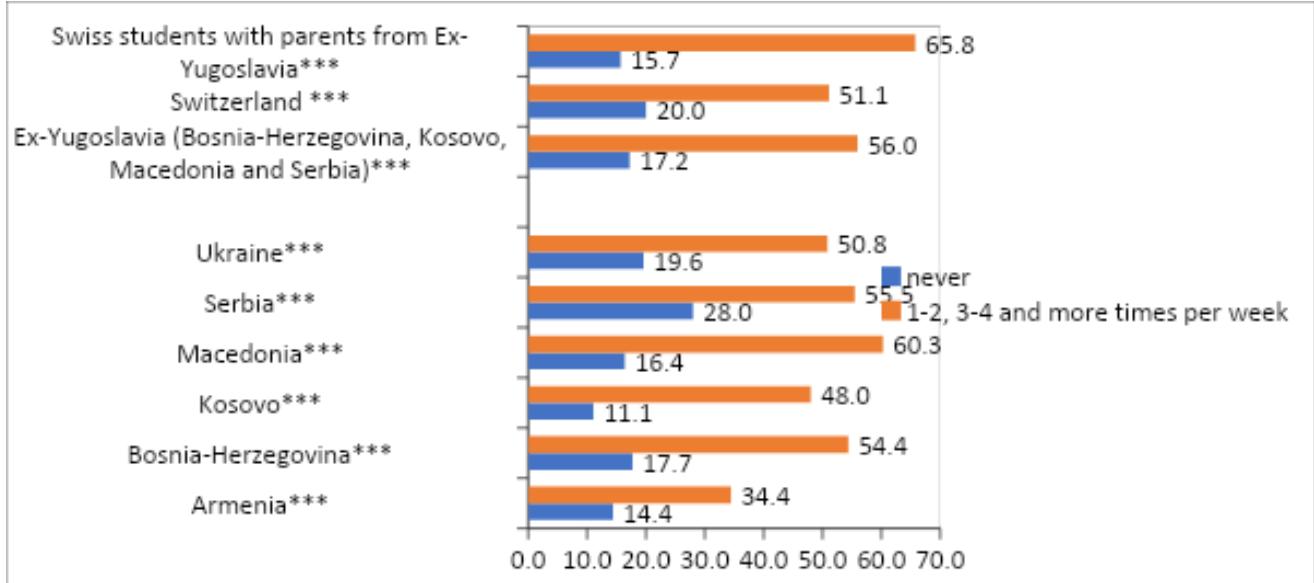
- Our respondents in all countries are more likely to consume alcohol when they go out. This association is similar in Serbia, but the distinguishing feature is having more than half of respondents have already tried alcohol if they never go out.
- In all countries and their groups, students who spend most of their time with their families, are less likely to consume alcohol.
- Cannabis use is strongly associated with an active night life. Students, who go out more often than three times per week, are more likely to consume this substance. It is not significant for Serbia and Macedonia.
- The same as with alcohol, students who spend most of their time with family are less likely to consume cannabis.
- Respondents, who go out more than three times per week, are three-five times more likely to report about binge drinking than those who never go out in all taken countries and their groups. This association is highly significant.
- Respondents, who consume cannabis, are more likely to commit an offence.
- Cannabis use has a stronger influence on violent offences than on minor offences perpetration.
- Students, who have five or more alcoholic drinks on one occasion, report about violent offences perpetration 3-12 times more often than their peers who do not do binge drinking. The influence of binge drinking is stronger on the perpetration of violent offences than on the perpetration of property offences.
## VI. DISCUSSION
Preliminary analyzes reflect strong findings regarding national, regional and international delinquency differences and similarities in levels of offending and victimization experiences among 14-18 year olds. Due to the high degree of methodological standardization of ISRD-3, and the large number of countries represented, ISRD-3 data promise to make an important contribution - both substantively and methodologically - to international comparative knowledge, especially the countries we have case studies Macedonia, BiH, Serbia, Armenia, Ukraine and Switzerland.
A similar picture appears when the skill of offense is used, with the Balkan countries but also in Ukraine.
Our preliminary findings suggest that country groupings based on theoretical and policy-related criteria (rather than region) offer a promising method to present and interpret the large amount of international data (Smit et al., 2008) that have been also successfully applied to the analysis of the results of the First International Delinquency Self-Report Study (Junger-Tas et al., 2003). Although there is considerable variation within clusters, the observed differences between clusters support our belief that this approach is more promising and worthy of continued exploration.
Third, the partially contradictory trends in self-reported offending and victimization that emerged in the ISRD-3 data are striking. In former socialist countries, tighter social control over school children than in Western countries may prevent them from committing more crimes, while older juveniles may be less controlled and, occasionally, to victimize younger minors. The willingness to honestly report on one's behavior may also vary across countries. This is supported by a European study of alcohol and drugs. Hibell et al. (2004) showed that the rate of respondents who said they would never report hashish use varied between $2\%$ (Finland) and $12\%$ (Lithuania). The differential validity hypothesis should become a routine empirical dimension for comparative criminological studies of self-report (see also Pauwels and Svensson, 2008).
Fourth, our attempts to compare ISRD-3, ICVS and ESB data for three specific offenses (robbery/ extortion, assault and theft) illustrate, once again, the great challenges associated with trying to disentangle – at the level international – (possible) convergence of different measures of crime. Previous research (Aebi et al., 2002) has shown that police and ICVS data are highly correlated after adjustments are made to match these sources (with respect to offense definitions and counting rules), as in the case of ESB. If ICVS and ISRD data on robbery, assault and theft victimization are moderately or not at all correlated (in the case of assault), this may be due to the fact that ISRD and ICVS data relate to different age groups (14-15 vs 16-19) and levels (city vs nations). Furthermore, ICVS data may be more controversial when it comes to estimating rates of victimization among adolescents given the small sample sizes and chronic underrepresentation of this age group in population surveys. More encouraging is the finding of a moderate and consistent correlation between police data on known offenders (PSO) and ISRD data on self-reported offenses (for robbery, assault and theft).[^31]
Despite all the measurement problems, the ISRD-3 data allow analysis of the causes of crime and to assess the extent to which theories on the causation of crime hold up across nations. Therefore, information about lifestyle, social connectedness and control, neighborhood contexts, and other risk factors is essential when one wishes to examine the causes of delinquency (Junger-Tas and Marshall, 1999). A forthcoming publication, based on the analysis of the pooled international data set, will focus on the social response to delinquent behavior, the meaning of the family, the influence of schools and school systems, the meaning of lifestyles and the influence of the neighborhood. on delinquency and victimization.
## VII. CONCLUSION
### Kosovo
- Before the starting of ISRD-3, this country in terms of research was more a kind of black box. The level of delinquency among Swiss juveniles with Kosovar origin is relatively high (not presented in this research), but its comparison with the prevalence of betrayrations in their own country, brings the opposite results. Thus, respondents from Kosovo reported the lowest percentage of minor and property offences and the second lowest in the violent betrayrations. Juveniles from this country are also better controlled by parents and have the lowest percentage of respondents, who have tried alcohol in their life.[32]
#### Bosnia-Herzegovina
- The same as among the taken Ex-Yugoslavian countries, except Kosovo, Bosnia-Herzegovina has a relatively higher prevalence of graffiti. The percentage of violent offences is the lowest.
- The same as Armenia, Bosnia-Herzegovina participated in ISRD-2 in 2006. In 2015 (ISRD-3) there is a significant decreasing of vandalism, group fight and assault. The opposite tendency is with cannabis use (Itp) and shoplifting and burglary.
#### Macedonia
- Macedonia participated in ISRD-3 for the first time. The same a Bosnia-Herzegovina, there is relatively high prevalence of graffiti. Macedonian respondents reported one of the highest levels of minor and property offences and the second highest level of violent offences after Armenia. The percentage of substance use is not the highest.
#### Serbia
- The percentage of graffiti, shoplifting, assault and theft is also among the highest. There is no juvenile who have committed burglary (lyp) among out respondents. The minor offences (index) were reported in Serbia more often than in the other countries. The level of property offences is the second highest than in Switzerland.
#### Ukraine
- This is the second post-soviet country that participated in ISRD-3. In comparison with Armenia, Ukraine took part in this study for the first time. Juveniles from this country, together with some others, reported relatively often about graffiti. The prevalence of shoplifting and group fight is relatively high; the prevalence of caring weapon is the highest, animal cruelty is the lowest. Ukraine has the second highest prevalence of minor, violent and property betrayments, as well as alcohol consumption (Itp), and the highest level of cannabis use (Itp).
Swiss students with parents from Ex-Yugoslavia and Ex-Yugoslavian country cluster.
- Respondents from Ex-Yugoslavia (cluster) and Swiss students with parent(s) born in Ex-Yugoslavia reported about graffiti more often than their peers in Switzerland on the national level. We suggest that it is the part of the habits that immanent the behaviour in some countries and it is present in Swiss families with parent(s) born in Ex-Yugoslavia.
- In contrast to graffiti, vandalism is not immanent much to the taken Ex-Yugoslavian countries, but present in Swiss families with parent(s) born in Ex-Yugoslavia. We suggest that it can be explained by the difficulties of socialization in Switzerland. There is a similar distribution of caring weapon, group fight and animal cruelty, robbery and assault.
#### Switzerland
- Swiss juveniles on the national level reported a lower prevalence of minor offences than their Swiss peers with parents born in Ex-Yugoslavia, and a higher prevalence than their peers in the Ex-Yugoslavian country cluster. The only exception is graffiti. This offence was reported by Ex-Yugoslavian respondents twice more often than by their Swiss students on the national level.
- Juveniles from Switzerland reported about violent offences 2-3 times more often than juveniles in Ex-Yugoslavian countries. Serious property offences were reported differently in comparison with the selected countries and their groups. For instance, bicycle theft was perpetrated by Swiss juveniles nine times more often than by their peers in Ex-Yugoslavia. It can be explained by more developed culture of bicycle use in Switzerland than in the
taken country cluster. Theft also was reported almost four times more often.
- The index of minor offences was reported by Swiss juveniles almost similarly to Swiss students with parents from Ex-Yugoslavia and a bit higher than juveniles from Ex-Yugoslavia. Juveniles from Switzerland reported the highest percentage of respondents who committed a violent offence. It is twice higher than their Ex-Yugoslavian peers. Similar results are with property offences. Swiss juveniles reported one of the highest prevalences of these perpetrated, four times higher than in all Ex-Yugoslavian countries.
[^2]: countries is European, it is important to keep in mind that there are also countries from the American continent involved: Canada, USA, Venezuela, Aruba, Netherlands Antilles, and Suriname. _(p.1)_
[^3]: I. Marshall, D. Ezman, M. Killias, Self-publication youth delinquency in Europe and beyond: First results of the Second International Self-Publication Delinquency Study in the context of police and victimization data ISRD2, 2010 _(p.1)_
[^4]: At the time of writing there were 33 ISRD3 participants who had signed the collaboration agreement; _(p.2)_
[^7]: https://www.researchgate.net/publication/320085714_Introduction_to_the_International_Self-Publikation_Delinquency_Study_ISRD3 _(p.2)_
[^10]: M. Killias, A. Lukash, M. Ademi, The Third International Self-publikation Study of Delinquency among Juveniles in Armenia, Bosnia-Herzegovina, Kosovo, Macedonia, Serbia, Ukraine, and Switzerland _(p.3)_
[^14]: Papazian, M. The Armenian Church.Churchhistory. The Armenian Prelacy. http://www.armenianprelacy.org/church-history/church-history _(p.4)_
[^21]: Papazian, M. The Armenian Church.Churchhistory.The Armenian Prelacy. http://www.armenianprelacy.org/church-history/church-history _(p.5)_
[^31]: Junger-Tas J, Marshall IH, and Ribeaud D (2003) Delinquency in an international perspective: The International Self-Reported Delinquency Study (ISRD). The Hague: Kugler. Junger-Tas J, Terlouw GJ and Klein _(p.12)_
[^1]: For an overview of the methodological issues related to the self-publikation method, see Junger-Tas and Marshall (1999). _(p.1)_
[^8]: The Third International Self-publication Study of Delinquency among Juveniles in Armenia, Bosnia-Herzegovina, Kosovo, Macedonia, Serbia, Ukraine, and Switzerland Publication to the Jacobs Foundation (Project N 2012-1026), Swiss Federal Office of Migration (04.04.2012) Swiss National Science Foundation (Project 10001C_162816) _(p.3)_
[^9]: Weighted data _(p.3)_
[^11]: Foreign permanent resident population by nationality. The Swiss Statistics Web site. Federal Statistical Office (FSO) http://www.bfs.ad min.ch/bfs/portal/en/index/themen/01/07/blank/key/01/01.html _(p.3)_
[^12]: Weighted data _(p.3)_
[^13]: Weighted data _(p.4)_
[^15]: http://www.nationmaster.com/country-info/stats/Religion/Religions _(p.5)_
[^16]: http://www.nationmaster.com/country-info/stats/Religion/Religions _(p.5)_
[^18]: http://www.stat.gov.mk/publikaci/jknigaX.pdf _(p.5)_
[^23]: Unemployment rate.: This entry contains the percent of the labor force that is without jobs. Substantial underemployment might be noted. https://www.cia.gov/library/publications/the-world-factbook/ _(p.5)_
[^24]: Minor offences = graffiti, vandalism, shoplifting, group fight, caring weapon, and animal cruelty _(p.6)_
[^25]: Violent offences = robbery and assault _(p.6)_
[^26]: had finished data collection and supplied a technical publication by early 2017. The US data should be considered preliminary and incomplete, since data collection in the United States was still ongoing at the time of writing - For a more detailed explanation of the basic ISRD research and methodology, see Marshall and Enzmann (2012, 21-65) _(p.2)_
[^27]: Minor offences = graffiti, vandalism, shoplifting, group fight, caring weapon, and animal cruelty _(p.8)_
[^28]: Serious property offences = burglary, motorbike/car theft, car break, bicycle theft, personal theft _(p.8)_
[^29]: Violent offences = robbery and assault _(p.10)_
[^30]: Minor offences = graffiti, vandalism, shoplifting, group fight, caring weapon, and animal cruelty _(p.10)_
Generating HTML Viewer...
References
8 Cites in Article
M Aebi,K Aromaa,Aubussom De Cavarlay,B (2006). European Sourcebook of Crime and Criminal justice Statistics.
M Aebi,M Killias,C Tavares (2002). Sourcebook of Criminal Justice Statistics.
D Baier,C Pfeiffer,J Simonson,S Rabold (2009). Jugendliche in Deutschland als Opfer und Täter von Gewalt: Erster Forschungsbericht zum gemeinsamen Forschungsprojekt des Bundesministeriums des Innern und des KFN.
Jens Puschke (2006). Bundesministerium des Inneren/Bundesministerium der Justiz (Hrsg), Zweiter Periodischer Sicherheitsbericht 2006.
C Currie (2008). Inequalities in Young People's Health.
Frieder Dünkel,Dirk Gebauer,Claudia Kestermann (2007). Mare-Balticum-Youth- Survey. Selbstberichtete Delinquenz Und Gewalterfahrungen Von Jugendlichen Im Ostseeraum.
G Esping-Andersen (1990). The Three Worlds of Welfare Capitalism.
B Hibell (2004). The Espad Report 2003. Alcohol and Other Drug Use Among Students in 35.
No ethics committee approval was required for this article type.
Data Availability
Not applicable for this article.
How to Cite This Article
Mensut Ademi. 2026. \u201cSelf-Reporting of Youth Delinquency in the Balkans and Beyond: Results of the ISRD3 International Self-Reporting Study of Delinquency in the Context of Violence, Victimization, and Substance Abuse in Comparative Aspects\u201d. Unknown Journal GJHSS-C Volume 23 (GJHSS Volume 23 Issue C2): .
Explore published articles in an immersive Augmented Reality environment. Our platform converts research papers into interactive 3D books, allowing readers to view and interact with content using AR and VR compatible devices.
Your published article is automatically converted into a realistic 3D book. Flip through pages and read research papers in a more engaging and interactive format.
This article publications on the first results of the third International Self-Publikation Study of Delinquency (ISRD-3), a large international collaborative study of delinquency and victimization of 14-to 18-year-old students. The analysis is based on a sub-sample of the data set: 2060 respondents from 4 cities in the Republic of Kosovo. The prevalence rate of the main categories of delinquency in comparison to individual countries participating in ISRD3, as well as for 6 groups of countries, are presented as well as data on experiences of victimization (theft and robbery/extortion). Using different measures, we have compared the data with our country where there are significant differences in the level and type of offense found between groups of countries such as Europe, America and other countries. In this article, we compare the rates of offending and victimization found by ISRD-3 with other main sources of national statistics available in the Republic of Kosovo based on the police and the prosecutor. The article concludes with implications and suggestions for further research.
Our website is actively being updated, and changes may occur frequently. Please clear your browser cache if needed. For feedback or error reporting, please email [email protected]
Thank you for connecting with us. We will respond to you shortly.
Lorem ipsum dolor sit amet, consectetur adipiscing elit. Ut elit tellus, luctus nec ullamcorper mattis, pulvinar dapibus leo.
Self-Reporting of Youth Delinquency in the Balkans and Beyond: Results of the ISRD3 International Self-Reporting Study of Delinquency in the Context of Violence, Victimization, and Substance Abuse in Comparative Aspects