
I. INTRODUCTION
In the hospitality arena, specifically in the hotel industry offering a home away from home means, providing the best experience possible. The hospitality and tourism industry is a vast sector, one of the economic drivers in some countries, in Mexico between 2013 y 2019 tourism share in the GDP range between 8.5 and 8.7 of the national GDP (INEGI, 2019), in 2020 the tourism was 1.5 billion Mexican pesos. Hotel businesses in Mexico are a mixture of independent brands, and national and international chains. The last two decades resulted in a significant expansion of the local hotel market, as well as of operations of international hotel chains. According to information from the Ministry of Tourism, at the end of 2021 there were 836,300 hotel rooms in 23,699 establishments. Establishments with a category of one to five stars constitute of the total and have of the available rooms (Secretaria de Turismo, 2021).
Over time, the presence of hotel chains has been strengthened in the country. According to the information available, in 1994 there were only 59 operating chains and by 2021 the volume increased reaching 120 hotel chains. (Secretaria de Turismo, 2021). The average annual growth rate of establishments that operate in chains is greater than that of the total number of establishments in the country vs. (Flores, F., 2021). The Top 10 hotel chains concentrate of the total identified establishments. This includes both new players in the industry, as well as consolidated leaders. Most of the mother brands present in the country have their origin in Mexico. The remaining percentage comes mainly from countries and territories located in America, Europe and finally from Asia (Flores, F., 2021).
In order to succeed in this fierce market, hotel chains in search to stand out and differentiate from the competition, have developed branding strategies in order to gain a better position in the market García et al., (2018) acknowledge the importance of the hotel industry, recognizing "the hotel" as a fundamental provider for tourists' psychological well-being (García et al., 2018).
Experiences are generally evaluated on both cognitive and emotional levels, (Serra -Cantallops et al., 2018) established that in the case of tourist's, that are travelling for pleasure, this process of evaluating the experience is predominantly emotional. In this regard chain hotel brands must generate a unique, emotional and unforgettable experience, that will elicit desirable consumer behaviors such as purchase intention, word of mouth or loyalty (Kang, Kang, 2015; Khan and Rahman, 2015; Sukhu et al., 2018). Brands play an important role for firms' visibility on the market, it is important to recognize, and understand the factors that affect the creation of consumer behavior.
One very distinctive Mexican hotel chain, that at their request the brand name will remain anonymous. It is a leading hotel company in Mexico with a history of solid growth since the opening of its first hotel in the seventies. With an aggressive development plan in recent years, almost one hotel per month and an additional 100 hotels operating within the next 5 years. This hotel chain operates more than 150 hotels and more than 24,000 rooms under its 7 brands, achieving efficient centralized management and high-level economy of scale (Grupo Posadas, 2019). Geographical coverage is vast, offering different brands, each brand appointed to a different market segment. The negative impact of Covid-19 in the hotel industry growth was affected. Worldwide, the impact on the tourism industry was devastated. It also had a negative impact on Mexican hotel chains.
The World Tourism Organization in its 2021 annual report indicated that more than 100,000,000 million jobs had been lost worldwide. The hotels had to stop operations. But the hotel industry resurface, hotel chains in México implemented strategies directed specifically to make sure guests feel confident to travel again. Hand in hand with the government authorities (Plan de Regreso Seguro reapertura de activités hoteleras, 2020) they develop a safety protocol. This protocol included deep sanitizing actions, fogging of rooms and common areas, safety handling of food both in restaurants and in room service, QR menus, minimizing personal contact, as well as social distancing and protective measures, the use of face masks by both guests and employees among other safety actions. Modifying some of the high contact services offered by the hotel.
At the beginning of the year 2022, Torruco Marques, Minister of Tourism, affirmed that in "Mexico the tourism industry remains in the process of clear recovery, with figures that are encouraging".
Among the data that supported this affirmation was: the arrival of 31 million international tourists, 28.1 percent more than in 2020 and 46.1 percent less than in 2019; and 18 thousand 428 million dollars of economic benefit, 67.6 percent higher than 2020 and 55.3 percent less than in 2019. (Marques, 2022).
Nonetheless, visitors were still afraid to resume their tourist activities for fear of COVID; others have resume their travelling, knowing hotels have established a safety protocol that meant modify services offer from the hotel, with this in place, they felt confident and start travelling. In this sense, word of mouth recommendation WOM in the hotel industry, is very useful in promoting communications to attract customer traffic (Delgado Ballester & Fernandez, 2011). Because of its informal and noncommercial nature, WOM has high credibility and persuasive power. Positive experience of guests staying at the hotel chain during Covid-19, from now on refer as "Mexican hotel chain"; translates in positive perception and affects the behavior to recommend it to others or return again and again. In this sense, brand experience can favor the generation of WOM. A positive brand experience is directly associated with a positive influence on WOM recommendations. Unforgettable experiences, can promote the existence of free promoters of the hotel chain. (Serra-Cantallops et al., 2018). Service quality and brand experience have a positive and significant effect on word of mouth (Gómez-Suárez. and Veloso., 2020; Prabowo, Astuti, and Respati, 2020). Furthermore, previous research has demonstrated that a positive perception of the service quality increases repurchase intention. (Haryono, Suharyono, Achmad, Fauzi, and Dan -Iman, 2015).
Increasing competition, and the fact that recovery in the hotel industry has been slow, to try to understand the implications that service quality, and brand experience have on WOM and repurchase intention is vital. The aim of this research is to examine the relation between brand experience and WOM recommendations (Gómez-Suárez; M. and Veloso, M., 2020). Secondly, examine the relationship between service quality and WOM, as well as to analyze the role of WOM in the repurchase intention in "Mexican Chain hotels", during the Covid-19 pandemic, and the reopening of the hotel sector in Mexico. We feel that studying these variables develop from prior research (Gómez-Suárez. and Veloso, 2020; Prabowo, Astuti, and Respati, 2020), can make a significant contribution to our academic understanding of WOM, repurchase intention and its relationship with service quality and brand experience. Our study is also relevant from a managerial perspective, it provides insight to hotel chains, and helps them understand customer's intentions during Covid-19.
II. LITERATURE REVIEW
Service quality and word of mouth. Service quality (SQ) plays a central role for organizational growth with focus on influencing success which is also a significant strategic matter for management (Sahney, S., Banwet, D. K., & Karunes, S., 2006). According to Zeithaml & Bitner (2006) service quality is a comparison of what customers feel a service provider should offer (expectations) and what really was provided (perceptions). Therefore, when a service is evaluated positively, it has a direct impact on WOM, and repurchase intention (Kim et al., 2009; Cantallops & Salvi 2014; Liu & Lee, 2016). Word of Mouth has a positive effect on repurchase intention (Delgado Ballester and Fernandez, 2011), in a sense those hotel guests who perceive the service quality performance of the Mexican hotel chain, exceeded their expectations will have a tendency to spread their experience and positive impression and ultimately recommend services to other prospective hosts. Positive impressions of the service are not only beneficial to other potential guests, but to themselves because they also have influence on their future repurchase intentions The most widely accepted framework for measuring service quality is SERVQUAL (Schiffman and Kanuk, 2010). Parasuraman (1985) developed SERVQUAL model, it is used as an instrument for measuring service quality. Prior research, provided support that perceived service value is likely to be the best determinant of visitors' behavioral intentions (Chang and Wildt 1994; Jayanti and Ghosh 1996; Petrick 2002; Subha, N., 2020; Boon-itt and Rompo,
- 2012). Servqual has five dimensions to measure service quality they are: tangibility, reliability, responsiveness, assurance and empathy. We hypothesize:
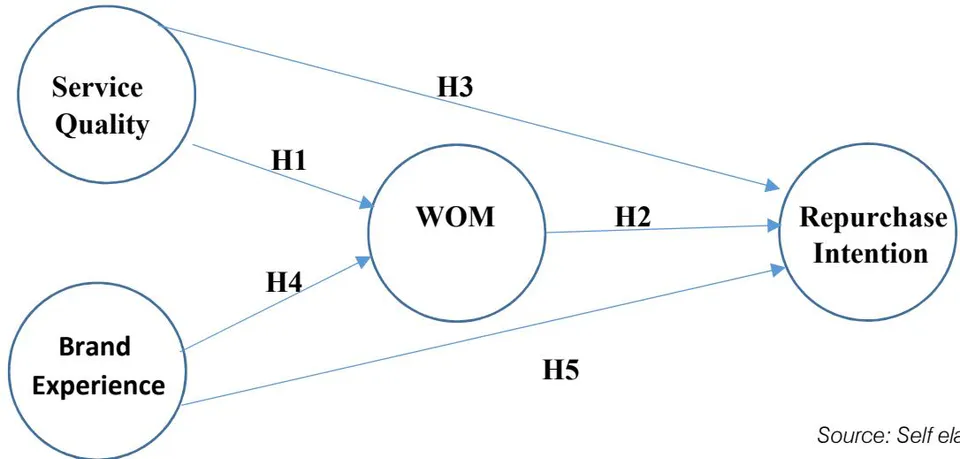
- H1: A positive evaluation on service quality of the hotel chain has a direct and positive influence on word of mouth.
- H2: Service quality and brand experience has a direct and positive influence on repurchase intention, through word of mouth.
a) Service quality and repurchase intention
The literature reviews incorporated sources that assess and found empirical evidence that service quality is related to consumer post-purchase intention, known as repurchase intention; this means costumers' choose services from the same hotel chain (McDougall & Levesque, 2000). Therefore, repurchase intention depends on the evaluation of the service quality they received at the service, in this case the hotel chain (Kumar, 2002; Zhang et al., 2011; Liu & Lee, 2016; Urbashi, Ravi, Ash, 2017; Tijhin, Rayhaan, & Pasaribu, 2021). It could be argued that Perceived quality is one of the best predictors of customers' purchase intention (Azize, Cermal, & Hakal, 2012; Li, 2017; Suhud & Willson, 2019; Zahid & Dastane, 2016; Suhud, Allan, Rahayo & Prinhandono, 2022). If the evaluation of service quality exceeds consumer expectations, then the consumer will repurchase the services, otherwise if the evaluation of service quality is lower than consumer expectation it will give the opposite effect. Repurchase intention is a very important factor for hotel chains given the complexity of travelling during Covid. The consumer's decision to keep using the same hotel chain service will provide assurance to the company for business sustainability and ensure that consumers do not switch to other hotel chains, this means a regular influx of travelers. Overall, a positive evaluation of the service quality will increase repurchase intention. We hypothesize:
H3: A positive evaluation on service quality of the hotel chain has a direct and positive influence on repurchase intention
b) Brand Experience and repurchase intention
In the 1980's, the concept of consumer experience emerged (Holbrook & Hirschman, 1982) looking to overcome limitations generated by traditional consumer behavior theories. Brand experience was defined by Brakus (2009) "as consumers' internal subjective and behavioral responses induced at different levels of interaction, both direct and indirect, with brand-related stimuli "(Brakus et al., 2009; Meyer & Schwager, 2007). As Brakus (2009) establish, sensations, feelings, cognitions, and behavioral responses evoked by stimuli that comes from the brand are a result of a brand's design and identity, packaging, communications, and environments (Brakus et al., 2009). Experience with a brand related stimuli, should be understood as subjective and internal responses at each point of interaction during the service delivery process. Consider that the contact with de brand experience can occur directly or indirectly during the purchase process. (Ramirez and Merunka, 2019). In this sense, all consumer responses to the symbolic, aesthetic, imaginative and fantasy meanings of the hotel chain brand, are a result of multi-sensory experience aspects (Addis & Holbrook, 2001; Hansen, 2005; Holbrook & Hirschman, 1982, 1989; Tsai, 2005). Repurchase intention had to do with the positive evaluation of the brand experience (Addis & Holbrook, 2001). We hypothesize that:
H4: A positive evaluation of brand experience of the hotel chain has a direct positive influence on repurchase intention.
c) Brand experience and Word of mouth
Brand experience is defined as "consumer's internal subjective and behavioral responses induced at different levels of interaction, both direct and indirect, with brand-related stimuli" (Brakus et al., 2009; Meyer & Schwager, 2007). Brand experience is a different related concept from other brand constructs. In a sense, brand experience differs from evaluative, affective, and associative constructs, such as brand attitudes, brand involvement, and brand attachment also customer delight, and brand personality (Brakus, Schmidtt, Zarantonello, 2009; Azize, Cemal & Hakal, 2012. Brand experience captures the sensorial, emotional, intellectual, behavioral (Brakus et al., 2009), social (Chang & Chieng, 2006; Schmitt, 1999). Brand experience can favor the generation of WOM. Consumption situations that are highly emotional such as an interaction with the hotel services, producing tensions to hotel guests, can be relieve through WOM communication (Delgado Ballester and Fernandez, 2011). Word of mouth (WOM) is known as the process of telling people about a product or service, with the intention to encourage them to try the service. Previous empirical literature has shown that a positive WOM is associated with repurchase intention, WOM are informal communications about an object, brand or service with the characteristic of having high credibility and persuasive power. It is a means to attract traffic especially those that are service-oriented, such as hotel chains (Delgado Ballester and Fernandez, 2011). In this sense, hotels that are capable of providing a unique and unforgettable brand experiences, can obtain brand promoters and co-creators of value through positive recommendations (Serra-Cantallops et al., 2018). With this in mind, we propose:
H5: A positive brand experience in the hotel chain has a direct and positive influence on WOM.
III. METHODOLOGY
days of the week during summer break 2021. In order to be included, guests should be travelling for pleasure. The population of the study was guests staying at one of three locations of the hotel chain. Using a convenience sample, knowing the implications, but considered the most appropriate, the total usable sample attained was 351.
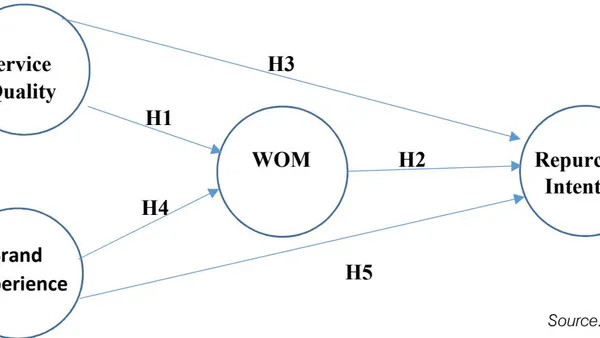
Questionnaire: The questionnaire consisted of four scales, measuring service quality, using Servqual (Parasuraman et al., 1988) the original statements were used and rephrased the items in order to be relevant to the context, and ensuring content validity. Using a seven-point scale where totally disagree and totally agree. The brand experience, and word of mouth, measures were adopted from Khan and Ranham (2017), seven-point scale where totally disagree and totally agree. Finally, repurchase intention was measured, by three items from a scale developed by Hellier, Heusen y Cal (2003) where totally disagree and totally agree. The last part of the questionnaire seeks to measure demographics. Figure 1. Presents the proposed research model.
IV. ANALYSIS AND RESULTS
Of the 351 usable questionnaires, the sample shows that all were travelling for pleasure, 65 per cent (228) were men, with an age years, and 35 percent were women with an age years; 69 per cent were men and women from families travelling with children under 18 years of age; 31 per cent were young couples. The length of stay at the hotel chain was nights.
Exploratory factor analysis (EFA) was used with principal component analysis (PCA) and VARIMAX orthogonal rotation for item reduction. The items with low commonality of less than 0.5 or loads on two or more factors with values exceeding 0.4 were candidates for deletion (Field, 2005). The results show the load of items being scales from prior research loaded on their respective factors, which account for of the total variance. These factors represent service quality (tangibles, reliability, responsiveness, assurance, empathy) brand experience (staff, location, web, ambiance) Wom and repurchase intentions (e.g. Brakus et al., 2009; Kim, Magnini, & Singal, 2011). Accordingly, service quality was measured by the average of the items loading together as one factor.
a) Measurement
We tested our hypotheses with structural equation modeling procedures using AMOS 17. SEM approach was used using AMOS software, the proposed model achieved adequate fit indicators, with (chi-square at 531.4 and 319 degrees of freedom, significant the level of . The other fit indices were within the acceptable range ( , GFI =
0.91, AGFI = 0.83, IFI = 0.89, CFI = 0.89, RMSEA = 0.047). The composite reliability indicators were greater than 0.7, as Hair, (2006) proposed. Of the 5 hypotheses, all were supported results are shown on. Table 3 summarizing the results of the hypotheses testing. In table 1, the composite reliability of constructs is shown, all of which were above the threshold of 0.7 (Hair et al., 2010), indicating a good reliability, as shown in Table 1. The value of each indicator was above 0.50, indicating this were the variables to study.
| Constructs | Factor loadings |
| Service Quality | |
| Tangibles | 0.721 |
| Reliability | 0.719 |
| Responsiveness | 0.711 |
| Assurance | 0.709 |
| Empathy | 0.705 |
| Brand Experience | |
| Staff | 0.702 |
| Location | 0.766 |
| Web | 0.734 |
| Ambiance | 0.717 |
| WOM | |
| Recommendation of the hotel chain | 0.732 |
| Advising to stay in the hotel chain | 0.701 |
| Telling positive things about the hotel chain | 0.728 |
| Repurchase Intention | |
| value | 0.733 |
| Believing it is worthwhile to stay in the future at the hotel chain | 0.746 |
| Will stay in a hotel from the hotel chain in the next stay | 0.796 |
Source: Self elaborated
The results confirmed all hypotheses, table 2 presents the results for hypotheses testing, also provides the results associated with the various hypothesized paths. H1 suggests that when guests perceived a higher service quality, guests are more susceptible to make word of mouth recommendations. The standardized path between service quality and word of mouth is statistically significant, therefore supporting H1(0.389; C.R. = 2.363, ); H2, which indicated that there should be a positive relationship between word of mouth and repurchase intention was also supported H2(0.487; C.R.3.121, ); H3, that stated: "A positive evaluation on service quality of the hotel chain has a direct and positive influence on repurchase intention" was also supported, H3(0.301; C.R. 1.969, ); H4, suggested that: "A positive evaluation of brand experience of the hotel chain has a direct an positive influence on repurchase intention" was supported, H4(0.312; C.R.2.253, ) finally H5 that stated: "A positive brand experience in the hotel chain has a direct and positive influence on WOM" was statistically significant H5(0.468; C.R.2.943; ).
| Research Variable | Standardized Regression Weight | C.R | p-value | |
| H1 | Service Quality → Word of Mouth | 0.389 | 2.363 | 0.016 |
| H2 | Word of Mouth → Repurchase Intention | 0.487 | 3.121 | 0.002 |
| H3 | Service Quality → Repurchase Intention | 0.301 | 1.969 | 0.049 |
| H4 | Brand Experience → Repurchase Intention | 0.312 | 2.253 | 0.230 |
| H5 | Brand Experience → Word of Mouth | 0.468 | 2.943 | 0.048 |
Source: Self elaborated fFt indicators, with (chi-square at 531.4 and 319 degrees of freedom, significant the level of . The other fit indices were within the acceptable range ( , , , , , )
Table 3 presents the results that analyze the direct and indirect effect that service quality has on repurchase intention through word of mouth, the direct effect was (0.293 direct effect, while the indirect effect was =0.142, and the total effect=0.435, p≤ 0.05) and brand experience on repurchase intention through Word of mouth, presented a (0.290 direct effect, while the indirect effect was=0.225, and the total effect=0.15, ). Concluding that the hypotheses H2 was accepted.
| Variable | Direct Effect | Indirect Effect | Total Effect |
| Service Quality on repurchase Intention through Word of mouth | 0.293 | 0.142 | 0.453 |
| Brand Experience on repurchase Intention through Word of Mouth | 0.290 | 0.225 | 0.515 |
V. DISCUSSION
This study contributes to the existing body of literature by investigating the relationships among service quality, brand experience; repurchase intentions through word of mouth, in a Mexican hotel chain during the pandemic, Covid-19. First the results highlight the critical role of the evaluation of the service quality offered by the hotel during the pandemic. In particular, tangibles and reliability are useful to determine purchase intention through word of mouth example of this is, guests take into consideration (the appearance of physical facilities, equipment, personnel and communication materials as well as the ability to perform the promised service dependably and accurately no matter the conditions of the pandemic) in order to recommend the hotel, and to have future intentions of revisit. Similar results found by (Kumar, 2002; Zhang et al., 2011; Liu & Lee, 2016; Urbashi, Ravi, Ash, 2017; Prabowo, Astuti & Respati, 2020; Tjhin, Rayhaan, & Pasaribu, 2021). Secondly, service quality and brand experience had a positive and significant effect on word of mouth at the Mexican hotel chain, where service quality was the dominant factor affecting word of mouth.
Third, another purpose of this research was to examine the relation between brand experience and WOM recommendations (Gómez-Suárez; M. and Veloso, M., 2020) comparing the results to the above authors, it concurs with their findings, that brand experience in a hotel setting differs from that of products, Khan and Rahm, (2017). Consumers are more likely to make a WOM about the Mexican hotel chain when they have develop emotional ties. These emotional ties can be a result of having experiences that have been impregnated in their memory, which were very intense. (Gómez-Suárez; M. and Veloso, M., 2020).
VI. MANAGERIAL IMPLICATIONS
In order to fully recover, before pandemic demand, hotel managers from the Mexican Hotel Chain should provide a superb service quality and offer strong good experiences to last long in the memory of the hotel guests. Regardless, the sanitary protocol in place during the Covid-19 pandemic, which have severe repercussions in maintaining quality standards, because among other things it restricted the offering of some activities. Findings in this research have shown that, service quality is the factor that has the power to provoke WOM as well as repurchase intention, therefore hotel physical facilities and environment, as well as to fulfill what they promise to do timely is of the utmost importance.
Because of the implementation of the safety protocol, all personnel within the hotel should be aware that it is possible, that problems are certainly to arise, and they should show sincere interest in solving the problem as quickly as possible. Low scores were obtain in this matter. Highlighting the importance of the hotel staff in managing incidents, and creating good experiences, means the need to incorporate courses that develop new abilities to manage difficult situations during the pandemic. (Gómez-Suárez; M. and Veloso, M., 2020). Hotels must work directing their efforts towards the creation of daily experiences, translated on their web pages, facilitating the process of search and purchase, first contact, first impression, all of this constitute the starting point to create a great experience (Brakus et al., 2009)
VII. LIMITATIONS AND FUTURE RESEARCH
Our conclusion should be considered in light of certain limitations. First, the use of a convenience sample, and only sampling 3 hotels in the Pacific Coast of the total number of different locations and different classes of service provided by the Mexican hotel chain.
Second, aspects of the reasons of why the guests choose this hotel chain, besides the location may be related to other variables not addressed in this study, variables such as price, reputation, etc.
Third, we focused on service quality, brand experience, repurchase intention through WOM, future research should explore not only the above variables, but include variables such as attachment, brand reputation, brand image, for example, also should include and compare data from different hotels including beach, city, historical etc., from different class services provided by the hotel chain. Future research can also explore variables such as country of origin, because some guests from the sample indicated that they choose the Mexican hotel chain because it was a Mexican company.