Seva and Institution Building in Hindu Inspired Faith Movements

§ Tata Institute of Social Sciences

Send Message

To: Author

Seva and Institution Building in Hindu Inspired Faith Movements

Article Fingerprint

ReserarchID

517SX

Seva and Institution Building in Hindu Inspired Faith Movements Banner

AI TAKEAWAY

Connecting with the Eternal Ground
  • English
  • Afrikaans
  • Albanian
  • Amharic
  • Arabic
  • Armenian
  • Azerbaijani
  • Basque
  • Belarusian
  • Bengali
  • Bosnian
  • Bulgarian
  • Catalan
  • Cebuano
  • Chichewa
  • Chinese (Simplified)
  • Chinese (Traditional)
  • Corsican
  • Croatian
  • Czech
  • Danish
  • Dutch
  • Esperanto
  • Estonian
  • Filipino
  • Finnish
  • French
  • Frisian
  • Galician
  • Georgian
  • German
  • Greek
  • Gujarati
  • Haitian Creole
  • Hausa
  • Hawaiian
  • Hebrew
  • Hindi
  • Hmong
  • Hungarian
  • Icelandic
  • Igbo
  • Indonesian
  • Irish
  • Italian
  • Japanese
  • Javanese
  • Kannada
  • Kazakh
  • Khmer
  • Korean
  • Kurdish (Kurmanji)
  • Kyrgyz
  • Lao
  • Latin
  • Latvian
  • Lithuanian
  • Luxembourgish
  • Macedonian
  • Malagasy
  • Malay
  • Malayalam
  • Maltese
  • Maori
  • Marathi
  • Mongolian
  • Myanmar (Burmese)
  • Nepali
  • Norwegian
  • Pashto
  • Persian
  • Polish
  • Portuguese
  • Punjabi
  • Romanian
  • Russian
  • Samoan
  • Scots Gaelic
  • Serbian
  • Sesotho
  • Shona
  • Sindhi
  • Sinhala
  • Slovak
  • Slovenian
  • Somali
  • Spanish
  • Sundanese
  • Swahili
  • Swedish
  • Tajik
  • Tamil
  • Telugu
  • Thai
  • Turkish
  • Ukrainian
  • Urdu
  • Uzbek
  • Vietnamese
  • Welsh
  • Xhosa
  • Yiddish
  • Yoruba
  • Zulu
Font Type
Font Size
Font Size
Bedground

Abstract

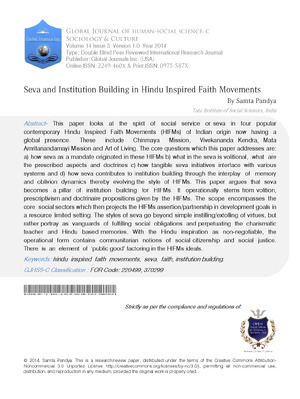
This paper looks at the spirit of social service or seva in four popular contemporary Hindu Inspired Faith Movements (HIFMs) of Indian origin now having a global presence. These include Chinmaya Mission, Vivekananda Kendra, Mata Amritanandamayi Mission and Art of Living. The core questions which this paper addresses are: a) how seva as a mandate originated in these HIFMs b) what in the seva is volitional, what are the prescribed aspects and doctrines c) how tangible seva initiatives interface with various systems and d) how seva contributes to institution building through the interplay of memory and oblivion dynamics thereby evolving the style of HIFMs. This paper argues that seva becomes a pillar of institution building for HIFMs. It operationally stems from volition, prescriptivism and doctrinaire propositions given by the HIFMs. The scope encompasses the core social sectors which then projects the HIFMs assertion/partnership in development goals in a resource limited setting. The styles of seva go beyond simple instilling/extolling of virtues, but rather portray as vanguards of fulfilling social obligations and perpetuating the charismatic teacher and Hindu based memories. With the Hindu inspiration as non-negotiable, the operational form contains communitarian notions of social citizenship and social justice. There is an element of ‘public good’ factoring in the HIFMs ideals.

References

82 Cites in Article
  1. Amritaswarupananda Puri,Swami (1988). Mata Amritanandamayi: A Biography.
  2. Y Arif (2008). Religion and Rehabilitation: Humanitarian Biopolitics, City Spaces and Acts of Religion.
  3. L Babb (1986). Redemptive Encounters. Three Modern Styles in the Hindu Tradition.
  4. Gwilym Beckerlegge (1995). VIVEKANANDA AND HIS ORGANIZATIONAL LEGACY WITH PARTICULAR REFERENCE TO SEVA WITHIN THE RAMAKRISHNA MATH AND MISSION.
  5. Gwilym Beckerlegge (1998). VIVEKANANDA AND HIS ORGANIZATIONAL LEGACY WITH PARTICULAR REFERENCE TO SEVA WITHIN THE RAMAKRISHNA MATH AND MISSION.
  6. G Beckerlegge (2000). Swami Akhandananda's Seva Vrata (vow of service) and the earliest expression of Service to Humanity in the Ramakrishna Math and Mission.
  7. G Beckerlegge (2000). The Ramakrishna Mission: The making of a Modern Hindu Movement.
  8. G Beckerlegge (2003). Saffron and Seva: The Rashtriya Swayamsevak Sangh's Appropriation of Swami Vivekananda.
  9. Julia Berger (2003). Religious Nongovernmental Organizations: An Exploratory Analysis.
  10. C Brooks (1989). The Hare Krishnas in India.
  11. J Carroll,W (2006). God's Potters: Pastoral Leadership and the Shaping of Congregations.
  12. M Chaves,W Tsitsos (2001). Congregations and social services: What they do, how they do it, and with whom.
  13. Lawrence Cohen (2012). The gay guru.
  14. Jacob Copeman,Aya Ikegame (2012). The Guru in South Asia.
  15. (2012). The guru in South Asia: New interdisciplinary perspectives.
  16. A Copley (2000). Gurus and their Followers.
  17. (2003). Hinduism in public and private: Reform, Hindutva, gender, and sampraday.
  18. A Crnic (2009). Cult versus Church religiosity: Comparative Study of Hare Krishna Devotees and Catholics in Slovenia.
  19. V Dalmia,H Steitencron,Von (1995). Representing Hinduism.
  20. A Dinham,V Lowndes (2008). Religion, Resources and Representation: Three Narratives of Faith-Engagement in British Urban Governance.
  21. C Fuller (1992). The Attempted Reform of South Indian temple Hinduism In Davis, J.
  22. F Gautier (2010). Sri Sri Ravi Shankar, The Art Of Living, And The International Association For Human Values.
  23. Mel Gray,Terence Lovat (2008). Practical Mysticism, Habermas, and Social Work Praxis.
  24. S Guerrlero (2000). L'ISKCON an Bresil: la transformation occidentale d'une religion vedique et l' incorporation de ses caracteristiques culturelles a la societe locale.
  25. Krishna Gupta (1973). Religious evolution and social change in India: a study of the Ramakrishna Mission movement.
  26. L Guzy (2003). Mahima Dharma Ascetics: A Case Study on Popular Ascetism and its Patronage Structure in Rural Orissa in.
  27. Dana Hamplova,Nespor,R Zdenek (2009). Invisible Religion in a Non-Believing Country: The Case of a Czech Republic.
  28. P Heehs (2003). The Centre of the Religious Life of the World: Spiritual Universalism and Cultural Nationalism in the Works of Sri Aurobindo in.
  29. T Hefferan (2007). Finding Faith in Development: Religious Non-governmental Organizations (NGOs) in Argentina and Zimbabwe.
  30. V Hodgkinson,M Weitzman (1993). Radioactive and other environmental threats to the United States and the Arctic resulting from past Soviet activities.
  31. J Isaac (2003). Faith-Based Initiatives: A Civil Society Approach.
  32. C Jaffrelot (1993). The Hindu Nationalist Movement and Indian Politics: 1925-1990s.
  33. Lina Jamoul,Jane Wills (2008). Faith in Politics.
  34. Timothy Jenkins (2010). The Life of Property.
  35. D Johnston,C Sampson (1994). Religion, the Missing Dimension of Statecraft.
  36. M Juergensmeyer (1991). Radhasaomi Reality: The Logic of Modern Faith.
  37. Malavika Kasturi (2010). ‘All gifting is sacred’.
  38. M Kennedy (1925). The Chaitanya Movement.
  39. S Kennedy,W Bielefeld (2006). Charitable Choice at Work: Evaluating Faith-Based Job Programs in the States.
  40. T Kochuyt (2009). God, Gifts and Poor People: On Charity in Islam.
  41. D Kopf (1979). The Brahmo Samaj and the Shaping of the Modern Indian Mind.
  42. J Landres,R Bolger (2007). Emerging Patterns of Inter Religious Conversation: The Christian Jewish Experiment.
  43. F Lebelley (2010). I Want to Bring Peace to Sri Lanka: Sri Sri Ravi Shankar.
  44. William Lockhart (2005). Building Bridges and Bonds: Generating Social Capital in Secular and Faith-Based Poverty-to-Work Programs.
  45. R Locklin,J Lauwers (2009). Rewriting the Sacred Geography of Advaita: Swami Chinmayananda and Sankara Dig Vijaya.
  46. Finn Madsen (2000). Asrama, yukta vairagya et structure d'organisation de l'ISKCON.
  47. G Mahajan (1998). Democracy, Difference and Social Justice.
  48. (2010). Mata Amritanandamayi Mission Trust and Embracing The World.
  49. F Neubert (2008). Indicating Commitment: The Notion of Depense in the Study of Religion and Ritual.
  50. T Oomen (2004). Nation, Civil Society and Social Movements.
  51. P Pimpley,S Sharma (1983). Arya Samaj and the Untouchables of Punjab.
  52. P Pipes,H Ebaugh (2002). Faith-Based Coalitions, Social Service and Government Funding.
  53. I Printz (1998). Urban Development and Social Capital: Lessons from Kathmandu.
  54. Ramakrishnanada Puri,Swami (2006). Mata Amritanandamayi Mission Trust and Embracing The World.
  55. H Rustau (2003). The Hindu Woman's Right to Samnyasa: Religious Movement and the Gender Question: The Sri Sarada Math and the Ramakrishna Sarada Mission.
  56. C Sapp (2011). Obama's Interfaith Service Challenge: A Call for a New Theology of Service in American Higher Education.
  57. A Saran (1969). Hinduism in contemporary India.
  58. C Silverman (2000). Faith-Based Communities and Welfare Reform: California Religious Community Capacity Study, Quantitative Findings and Conclusion.
  59. Y Singh (1973). Modernisation of Indian Tradition: A Systematic Study of Social Change.
  60. H Slessarer-Janir (2004). Exploring the Attraction of Local Congregations to Community Organizing.
  61. F Squarcini (2000). In Search of Identity within the Hare Krishna Movement: Memory Oblivion and Thought Style.
  62. F Squarcini (2002). Power of Mysticsim" and "Mysticism of Power": Understanding the sociopolitical history of a neo Hindu movement.
  63. (2005). I Want to Bring Peace to Sri Lanka: Sri Sri Ravi Shankar.
  64. M Srinivas (1966). Social Change in Modern India.
  65. S Srinivas (2008). the presence of Sai Baba: body, city and memory in a global religious movement.
  66. Tulasi Srinivas (2010). Winged Faith.
  67. B Sullivan (1975). The Place of the Spiritual Master: A study of the International society of Krishna Consciousness.
  68. B Sullivan (1987). Purifying the Earthly Body of God: Religion and Ecology in Hindu India.
  69. A Thapan (2005). The Penguin Swami Chinmayananda Reader.
  70. Eric Twombly (2002). Religious Versus Secular Human Service Organizations: Implications for Public Policy.
  71. C Venugopal (2004). Foreword.
  72. Vyakti Vikas,Kendra (2005). Source of Life: A Compilation of Talks by H.H. Sri Sri Ravi Shankar.
  73. Antonin Wagner (2008). Religion and Civil Society.
  74. John Walliss (2007). The Brahmakumaris as a Reflexive Tradition: Responding to Late Modernity.
  75. M Warrier (2003). Mata Amritanandamayi Mission Trust and Embracing The World.
  76. L White (1992). The Sāi Bābā Movement: Approaches to the Study of Indian Saints.
  77. R Williams (1984). A New Face of Hinduism: the Swaminarayan Religion.
  78. E Wilson (2011). Much to be Proud of, Much to be Done: Faith-based Organisations and the Politics of Asylum in Australia.
  79. D Winchester (2008). Embodying the Faith: Religious Practice and the Making of Muslim Moral Habitus.
  80. Robert Wineburg (1992). Local Human Services Provision by Religious Congregations: A Community Analysis.
  81. J Zavos (2000). The Emergence of Hindu Nationalism in India.
  82. John Zavos (2012). Hinduism and Public Space in Europe.

Funding

No external funding was declared for this work.

Conflict of Interest

The authors declare no conflict of interest.

Ethical Approval

No ethics committee approval was required for this article type.

Data Availability

Not applicable for this article.

How to Cite This Article

Samta Pandya. 2014. "Seva and Institution Building in Hindu Inspired Faith Movements". Global Journal of Human-Social Science, Global Journal of Human-Social Science - C: Sociology & Culture GJHSS-C Volume 14 (GJHSS Volume 14 Issue C3).
Download Citation

Journal Specifications

Crossref Journal DOI 10.17406/GJHSS

Print ISSN 0975-587X

e-ISSN 2249-460X

Keywords
Classification
GJHSS-C Classification FOR Code: 220499
370299
Version of record

v1.2

Issue date
July 11, 2014

Language
English
Experiance in AR

Explore published articles in an immersive Augmented Reality environment. Our platform converts research papers into interactive 3D books, allowing readers to view and interact with content using AR and VR compatible devices.

Read in 3D

Your published article is automatically converted into a realistic 3D book. Flip through pages and read research papers in a more engaging and interactive format.

Article Matrices
Total Views: 1.7K
Total Downloads: 84
All Trends

Request Access

Please fill out the form below to request access to this research paper. Your request will be reviewed by the editorial or author team.
X

This is the heading

Lorem ipsum dolor sit amet, consectetur adipiscing elit. Ut elit tellus, luctus nec ullamcorper mattis, pulvinar dapibus leo.


High-quality academic research articles on global topics and journals.

Seva and Institution Building in Hindu Inspired Faith Movements

Samta Pandya
Samta Pandya Tata Institute of Social Sciences