This article is the result of a 2019 1 survey done in the capital of Mato Grosso do Sul with the participants of the “18 th LGBT Citizenship Parade” of Campo Grande. The aim of the text is to discuss the issues of violence against the LGBTQIA+ population. As a result of the reserach, we have the centrality of sexuality as the main marker used to consider the situation of vulnerability of the LGBTQIA+ population that participated in the Parade. In analytical terms, at first, we present statistical data that show how sexuality and violence go hand in hand with regard to the vulnerability experiences of Campo Grande’s LGBTQIA+ population. In a second moment, from an intersectional and post-structuralist perspective, we examine the social conditions that place LGBTQIA+ people in situations of inequality when compared to the heterosexual population.
## I. INTRODUCTION
"It is also in the field of what does not have a name and is unthinkable that homophobia, as a mechanism that the product and producer of sexual hierarchies (RUBIN, 1984),
of violence and of the naturalization of gender norms (BUTLER, 2006), dwell and is upheld. Without a name because its description is difficult to apprehend and unthinkable because it is not reflected by the subjects and by the institutions."
(PRADO, 2010, p. 9)
The "18th LGBT Citizenship Parade" of Campo Grande took place on September $28^{\text{th}}$, 2019, on the Radio Club square, in the city center. As usual, the Association of Transvestites and Transexuals of Mato Grosso do Sul (ATMS) was the main group in charge of putting up the event2. In 2019, the theme of the Parade was "LGBTphobia is a crime". Such choice happened due to the development of the Federal Supreme Court's ruling of June $13^{\text{th}}$, 2019, which "criminalized LGBTphobia", turning it equivalent to the crime of racism. According to the event's organizers, that same year 30,000 people took part in the action.
At that time, the Study Group Néstor Perlongher (NENP/UFMS) applied 303 questionnaires. The initial concept was to get to know the people who participated in the Parade and highlight the most recurring social markers of difference in the inquiries to outline a sociological profile of participants. These early results were published by Passamani, Vasconcelos, Rosa e Ishii (2020)[^3] $^{3}$ and in this article the same data was applied to discuss the aspects of violence according to the Parade's participants.
We focus on identifying the types of violence already incurred/noticed by the respondents, divided in two axes: discrimination and aggression. Such axes, respectively characterized by a symbolic violence (discrimination) or by some physical violence (aggression), therefore, apparently different, are intertwined to the assumption. That is, it is understanding that both of them work as the manifest face of a latent heteronormative intelligibility. In other words, it is possible to say that both discrimination and aggression are expressions of the violence against LGBTQIA+ people.
Parker (2012), in his genealogy of the category discrimination, taking as starting point the moral panics[^4] around the first cases of death caused by Aids along the 1980's, defines the term:
Discrimination has been seen as a kind of behavioral response caused by these negative attitudes – or as a form of enacted stigma or enacted prejudice. A sharp distinction has thus been made between ideas, attitudes, or ideologies, and their behavioral consequences in discriminatory actions (Parker, 2012, p. 165).
That is, according to the author, it is possible to say there is a close correlation between prejudice and stigma. Also, both of them may be characterized as negative attitudes directed to certain people or collectives with the deliberate intention of discriminating them based on socially established – therefore, arbitrary - normative patterns.
In this context, as results from power relations, some individuals or collectives may be discriminated due to the color of their skin, their sexual orientation, their age, disabilities, body aspects etc., based on the idea that they are holders of characteristics or forms of expression of "lesser" moral worth. This aspect challenges us not understanding the category violence as an analytical a priori. Quite conversely, we notice intertwined symbolical, material, psychological, cultural, moral, legal and political terms that make certain people and/or groups become private, in different ways, "of rights, autonomy, recognition and participation" (FERREIRA; BONAN, 2020, p. 1774, our translation). The violence become designed (and just can be properly understood) from the specific social-political-narrative contexts.
Therefore, our understanding of violence comes of the idea that it, beyond of being multiple and plural, is linked to certain moralities that are articulated to turn on concrete and real its different manifestations. Thinking about this that Cardoso de Oliveira (2008) says that the moral dimension compose the reading/experience of the violence. After all, the fact of a man being railed of "faggy" has direct relationships with the practicing of physical violence, like a way of "masculinity's remediation".
Cardoso de Oliveira (2008) as like Díaz-Benítez (2015) understand that violence is complex and it's seen when the first one asks until where we can talk about violence when this is legalized in a context. Díaz-Benítez shows us that violence, when associated to erotic practices, can become a libidinal tensioner. She gives examples of movies that promotes the spectacularization of the violence for the purpose of people's erotic market that consume and feel pleasure with such productions.
Efrem Filho (2017a) takes up the question about morality when it shows us the "brutality's pictures". According to him, the many narratives that explain the violence make speeches on gender and sexuality and produce relationships of power that are in race. There different scenarios and multiple violations that designed together with another subjects, like family, union, activism, woman, maternity, police, politics, and others, just like the author's case analyzed.
From all of these link's categories that made the morality's violence, it is important to know the distinction between difference and inequality. Brah (2006) is clear on the criticism of the understanding of difference as a watertight and always oppositional question. She proposes the difference as an analytical category. Not all difference, depending on its intersection, can result as an inequality. She's efficient when saying that "the experience does not reflect on the seamless way of a pre-determined reality" (BRAH, 2006, p. 360, our translation). First of it, experience is cultural construction's outcome. As she says, "the same context can produce many collective different 'stories', differentiating and linking biographies from contingent specificities (BRAH. 2006, p. 362, our translation".
Thus, what we are pointing out are the processes of difference's ranking that, sometimes, show their selves as a form of physical or moral violence. In latter case, swearings are more often and commum. At first, emphasis on punches, kicks, pitfalls, stonethrowings, that, sometimes, can follow in the victim's death.
It's important to highlight that, according to the perspective of social markers of difference, that we defend on this article, is not possible to assert that different individuals experience in the same way and in the same intensity the oppression systems. Quite conversely, we believe that it's needed considering the relational and interactional complex contexts (and games). Seen in theses terms, markers as class, race/ethnicity, gender, sexuality, generation, religion, nationality, ant other, can, depending on the context, outcome in bigger or smaller conditions of vulnerability.
To think this process of constitution of many differences that can or can not turn the difference to an inequality, it seems patent an intellectual employing to reflect on these categories of articulation that, when acted - in our research problem - together with sexuality, commit LGBTQIA+ community in inequality's position when compared to heterosexual people, for example. Problematizing the intersection between different categories is more than work with notion of sexual difference or even the relationships and contact points between, for example, gender and other categories, like race and class. Noticing how they form themselves in relation (PISCITELLI, 2008).
Thus, our article is divided in two parts. In the first part, we present the statistical data which shows how the relationship between sexuality and violence against LGBTQIA+ people based on the results obtained in the "18<sup>th</sup> LGBT Citizenship Parade" in Campo Grande. Right after that, we analyze the data in a more systematically way, from an intersectional and post-structuralist perspective.
## II. DISCRIMINATION AND AGGRESSION AGAINST LGBTQIA+ PEOPLE: PERCEPTIONS OF VIOLENCE IN THE $18^{\text{TH}}$ PARADE
At first, a methodological note is important to be clarified. It is not easy to apply a questionnaire during a Parade, first because of the people who are in "another mood" than the one that concerns a talk between researcher and interlocutors. After, because we were in a public space, with such a large crowding of people and many background noises made it difficult. Finally, the people were waling. Moving over the place. Stopping and answering the research could mean "get lost" from their group. Our strategy was to apply the questionnaire during the concentration of the event, when many of these matters, we believed, could be controlled. It's known that the research's context and its form had impact during de data's production. However, the important outputs were produced during these contexts.
For this article, we concentrated in 14 questions as a survey, with answers "yes" or "not" (Table 1). This way, this studying is understood as quantitative and qualitative, once that, according to Souza and Kerbauy (2017, p. 37, our translation), "[...] the reality is multifaceted and, like that, is not shallow to assert that produced data by different method can be added, helping to understand the many faces of reality".
In qualitative terms, to Günter (2006), it's important having a base of comprehension of social reality as something that is always moving itself, dynamic and procedurally. Because of this, the weights must be near of the concrete reality analyzed, intending to use properly the senses and meanings expressed there, however, not generalizing its outputs. The reflexive reading, however, may develop the complexities and links with the theoretical references used during the research.
In the specific case of the data obtained along the research, it was possible to find that color/race, income (associated with the social class), generation, religion, and education have had a place of lesser highlight (or lesser impact) in the various responses given by participants in the question on violence (either discrimination or aggression), when compared to the marker of sexuality. That is, being LGBTQIA+, per se, was already enough for a condition of greater social vulnerability. Such data confirms the outcome of other recent studies conducted in Brazil and which emphasize that the country is in the ranking of the most lethal nations for LGBTQIA+ people (OLIVEIRA; ARAUJO, 2020; PINTO et al, 2020; MENDES, SILVA, 2020).
Particularly, thinking on the researches that had emphasis on LGBTQIA+ Parades, we can highline some works. Dutra and Miranda (2013) investigated the power relations seen in the "LGBT Parade" from Juiz de Fora (MG) and concluded that the abada's wearing defined the boundaries of the places where the audience had access. Here, the main social marker of difference was social class, because the ones who did not buy were more distant from the electric trios. About the violence's theme, they mentioned that some rival groups of young people took the opportunity of crowd to arrange dates and fight spaces, where a young man died. According to theses authors, these acts of violence are not linked properly with the Parade.
Moreira and Maia (2017) investigated the Goiânia's (GO) "LGBT Parade", among their outputs, we detach two of them. The first tells about exclusions done by the LGBTQIA+ people themselves, for still exists discrimination against girly, and/or transgender, and/or older people. The second point, the strategy of some of the participants who stayed near the City Guard and/or the police to avoid possible acts of violence were not a guarantee of non-violence. Somewhat, these conclusions get closer by Dutra and Miranda's found outputs (2013) when the said that the police had beaten the participants of Juiz de Fora's Parade.
Ribeiro and Arantes (2017) made a research about the "LGBT Parade" in São Paulo (SP). The authors analyzed the media speeches about this event and highlighted the generic use referring to participants as people and/or activists. The criticism is properly the erasure of gender and sexuality's markers to identify politically the LGBTQIA+ community. Even the violence was not the main focus, the researchers related a case of a resident who threw a bomb at the people who were making noise near the place he lives. Differently from Dutra and Miranda (2013), Ribeiro and Arantes (2017) understood that the violence's scene integrates a part of the Parade, even when it happens not too close to the event.
Mota (2016) still researched the "LGBT Pride's Parade" in São Paulo and, even without quantitative data, affirms that in the Paulista avenue all LGBTQIA+ people had suffered some kind of violence. The main ideal to this author is that the Parade, even when exhibits binarisms and stereotypes committed by the own LGBTQIA+ participants, turns up on fight territory against heteronormativity, just like defended in Moreira and Maia's work (2017).
Beyond these factors, we can consider that the political act's context of a Parada, by itself, already would put sexuality in the spotlight. Violence linked to the sexuality is important to the design of a speech that puts LGBTQIA+ as violence's victims. This way, there, into the militancy's spot, it would be politically expected that discrimination and aggression against such sexuality's expression were understood as important, for this is a strategy to guarantee rights and criminalization of these kinds of violence and even the recognition of these people as subjects[^5].
However, it's needed to say that, working with a survey, there was no opportunities to the survey respondents qualify the kinds of violence committed according to the context and the form. In addition, the data was produced from the "said", once, for the limited time, we did not focus on the "lived", although saying is a way of living.
Table 1: Questionnaire Items
<table><tr><td>Axe</td><td>Item</td><td>Item's Description</td></tr><tr><td rowspan="9">DISCRIMINATION</td><td>DISCR_TRAB</td><td>due to your sexuality, have you ever faced not being admitted for or being fired from a job?</td></tr><tr><td>DISCR_COM</td><td>due to your sexuality, have you ever faced receiving a different treatment or stopped from entering a business /place of entertainment?</td></tr><tr><td>DISCR_SAUDE</td><td>due to your sexuality, have you ever faced getting terrible service in health facilities or from health professionals?</td></tr><tr><td>DISCR_EDUC</td><td>due to your sexuality, have you ever faced being marginalized by teachers or classmates at school/college?</td></tr><tr><td>DISCR_COMUN</td><td>due to your sexuality, have you ever faced being excluded or marginalized from groups of friends or neighbors?</td></tr><tr><td>DISCR_FAM</td><td>due to your sexuality, have you ever faced being excluded or marginalized in the family environment?</td></tr><tr><td>DISCR_RELIG</td><td>due to your sexuality, have you ever faced being excluded or marginalized in a religious environment?</td></tr><tr><td>DISCR_SANGUE</td><td>due to your sexuality, have you ever faced being stopped from donating blood?</td></tr><tr><td>DISCR_DELEG</td><td>due to your sexuality, have you ever faced being abused by police officers or being mistreated in a police station?</td></tr><tr><td rowspan="5">AGGRESSION</td><td>AGRES_FIS</td><td>due to your sexuality, have you ever suffered physical aggression?</td></tr><tr><td>AGRES.VerB</td><td>due to your sexuality, have you ever suffered verbal aggression/threat of aggression?</td></tr><tr><td>AGRES_CIND</td><td>due to your sexuality, have you ever suffered "boa noite cinderela"(roofie)?</td></tr><tr><td>AGRES_SEX</td><td>due to your sexuality, have you ever suffered sexual violence?</td></tr><tr><td>AGRESS_EXT</td><td>due to your sexuality, have you ever suffered blackmail or extortion?</td></tr></table>
Now we present the analysis of the data found:
Principal Component Analysis (PCA) is a statistical technique for multi-varied verification that was utilized for an exploratory reading of the responses. The conclusion based on the graphical analysis of Figure 1 is that, as the first factor appears highlighted, the instrument is unidimensional, that is, the 14 items related to violence measure a single construct which, in this case, is how exposed someone is to violence. It is a declivity diagram, plotted with the aid of the SPSS computer program, with the number of factorial components extracted.
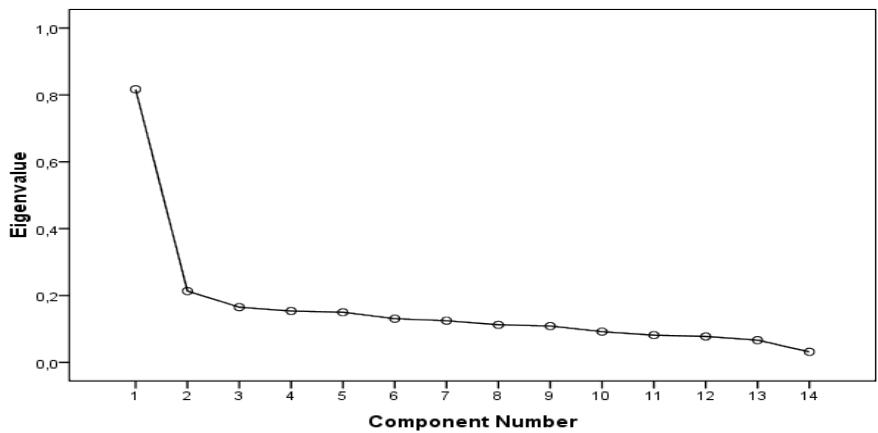 Figure 1: Principal Component Analysis
Source: produced by the authors
Kaiser-Meyer-Olkin (KMO) test indicates the proportion of variance of data that may be assigned to a common factor. The test resulted in a KMO of 0.860 and values close to 1 indicate that the sample is adequate for factorial analysis (DEVORE, 2015).
To measure the test's reliability, Cronbach's alpha was utilized, an indicator of the internal consistency of the test or, in other words, how much the questionnaire items are correlated. For the research's case, Cronbach's alpha was 0.767 and this value corresponds to the average of correlations among the instrument's items and may vary between 0 and 1, with an acceptable result for values close to or higher than 0.60 (HAIR; ANDERSON; TATHAM, 2009).
The grades 0 through 14 are the sum of the positive responses for the 9 questions about discrimination and the 5 questions about aggression and it is a score of the violence suffered/perceived by the subjects. A scale going from VERY LOW to VERY HIGH was arbitrated in compliance with the indicator of violence and Table 2 contains the tabulated results.
Table 2: Main results tabulated
<table><tr><td rowspan="2" colspan="3"></td><td colspan="3">Very low</td><td colspan="3">Low</td><td colspan="3">Medium</td><td colspan="3">High</td><td colspan="3">Very high</td><td rowspan="2">TOTAL</td></tr><tr><td>0</td><td>1</td><td>2</td><td>3</td><td>4</td><td>5</td><td>6</td><td>7</td><td>8</td><td>9</td><td>10</td><td>11</td><td>12</td><td>13</td><td>14</td></tr><tr><td rowspan="4">Age bracket</td><td rowspan="2">Heterosexual</td><td>30 years or less</td><td>32</td><td>5</td><td>2</td><td></td><td></td><td>1</td><td></td><td>1</td><td></td><td></td><td></td><td></td><td></td><td></td><td></td><td>41</td></tr><tr><td>over 30 years</td><td>15</td><td>1</td><td>1</td><td></td><td></td><td>1</td><td></td><td></td><td></td><td></td><td></td><td></td><td></td><td></td><td></td><td>18</td></tr><tr><td rowspan="2">LGBTQIA+</td><td>30 years or less</td><td>29</td><td>14</td><td>12</td><td>26</td><td>30</td><td>21</td><td>14</td><td>22</td><td>8</td><td>10</td><td>4</td><td>1</td><td></td><td>1</td><td></td><td>192</td></tr><tr><td>over 30 years</td><td>12</td><td>4</td><td>2</td><td>2</td><td>7</td><td>3</td><td>2</td><td>1</td><td>4</td><td>1</td><td>2</td><td>2</td><td></td><td></td><td></td><td>42</td></tr><tr><td rowspan="4">Color (IBGE)</td><td rowspan="2">Heterossexual</td><td>white</td><td>18</td><td>3</td><td>1</td><td></td><td></td><td></td><td></td><td>1</td><td></td><td></td><td></td><td></td><td></td><td></td><td></td><td>23</td></tr><tr><td>non-white</td><td>29</td><td>3</td><td>2</td><td></td><td></td><td>2</td><td></td><td></td><td></td><td></td><td></td><td></td><td></td><td></td><td></td><td>36</td></tr><tr><td rowspan="2">LGBTQIA+</td><td>white</td><td>20</td><td>8</td><td>6</td><td>10</td><td>19</td><td>9</td><td>6</td><td>10</td><td>4</td><td>8</td><td>3</td><td>1</td><td></td><td>1</td><td></td><td>105</td></tr><tr><td>non-white</td><td>21</td><td>10</td><td>8</td><td>18</td><td>18</td><td>15</td><td>10</td><td>13</td><td>8</td><td>3</td><td>3</td><td>2</td><td></td><td></td><td></td><td>129</td></tr><tr><td rowspan="4">Religion</td><td rowspan="2">Heterosexual</td><td>Religious</td><td>18</td><td>2</td><td>1</td><td></td><td></td><td>2</td><td></td><td></td><td></td><td></td><td></td><td></td><td></td><td></td><td></td><td>23</td></tr><tr><td>not religious</td><td>29</td><td>4</td><td>2</td><td></td><td></td><td></td><td></td><td>1</td><td></td><td></td><td></td><td></td><td></td><td></td><td></td><td>36</td></tr><tr><td rowspan="2">LGBTQIA+</td><td>religious</td><td>16</td><td>8</td><td>3</td><td>5</td><td>18</td><td>5</td><td>8</td><td>7</td><td>8</td><td>3</td><td>2</td><td>1</td><td></td><td>1</td><td></td><td>85</td></tr><tr><td>not religious</td><td>25</td><td>10</td><td>11</td><td>23</td><td>19</td><td>19</td><td>8</td><td>16</td><td>4</td><td>8</td><td>4</td><td>2</td><td></td><td></td><td></td><td>149</td></tr><tr><td rowspan="3">Education</td><td rowspan="2">Heterosexual</td><td>High-school or lower</td><td>18</td><td>3</td><td>1</td><td></td><td></td><td>1</td><td></td><td>1</td><td></td><td></td><td></td><td></td><td></td><td></td><td></td><td>24</td></tr><tr><td>Higher-education</td><td>29</td><td>3</td><td>2</td><td></td><td></td><td>1</td><td></td><td></td><td></td><td></td><td></td><td></td><td></td><td></td><td></td><td>35</td></tr><tr><td>LGBTQIA+</td><td>High-school or lower</td><td>23</td><td>11</td><td>8</td><td>19</td><td>18</td><td>11</td><td>8</td><td>9</td><td>2</td><td>3</td><td>2</td><td></td><td></td><td>1</td><td></td><td>115</td></tr><tr><td></td><td></td><td>Higher-education</td><td>18</td><td>7</td><td>6</td><td>9</td><td>19</td><td>13</td><td>8</td><td>14</td><td>10</td><td>8</td><td>4</td><td>3</td><td></td><td></td><td></td><td>119</td></tr><tr><td rowspan="4">Payment</td><td rowspan="2">Heterosexual</td><td>has a paid job</td><td>28</td><td>2</td><td>2</td><td></td><td></td><td>1</td><td></td><td>1</td><td></td><td></td><td></td><td></td><td></td><td></td><td></td><td>34</td></tr><tr><td>no paid job</td><td>19</td><td>4</td><td>1</td><td></td><td></td><td>1</td><td></td><td></td><td></td><td></td><td></td><td></td><td></td><td></td><td></td><td>25</td></tr><tr><td rowspan="2">LGBTQIA+</td><td>has a paid job</td><td>31</td><td>11</td><td>10</td><td>11</td><td>24</td><td>12</td><td>8</td><td>13</td><td>7</td><td>7</td><td>4</td><td>2</td><td></td><td>1</td><td></td><td>141</td></tr><tr><td>no paid job</td><td>10</td><td>7</td><td>4</td><td>17</td><td>13</td><td>12</td><td>8</td><td>10</td><td>5</td><td>4</td><td>2</td><td>1</td><td></td><td></td><td></td><td>93</td></tr></table>
The types of violence most reported by respondents are, in decreasing order, verbal aggression, discrimination in the family, discrimination in the school, discrimination in the religious environment, and discrimination in the community, representing almost 60 percent of the responses to the questionnaire (Figure 2). According to ABGLT (2016), 73 percent of LGBTQIA+ students have already suffered verbal aggression due to their sexual orientation and 68 percent due to their gender identity. For Prado (2010), In Brazilian society, we still have lack of knowledge of homophobia. Yes, we do know it exists both from empirical
data, from researches, and from the logic of experience. However, we are facing a quite contradictory moment: we know homophobia exists, but we know very little about how it works and what are its dynamics when combined with other forms of treating someone as inferior. Understanding how homophobia operates, especially when it is obvious that the prejudice is not only in the individuals only, but it is also articulated in the culture and in the institutions, it is fundamental to improve the forms of confronting and deconstructing its violent and silent practices (PRADO, 2010, p. 9).
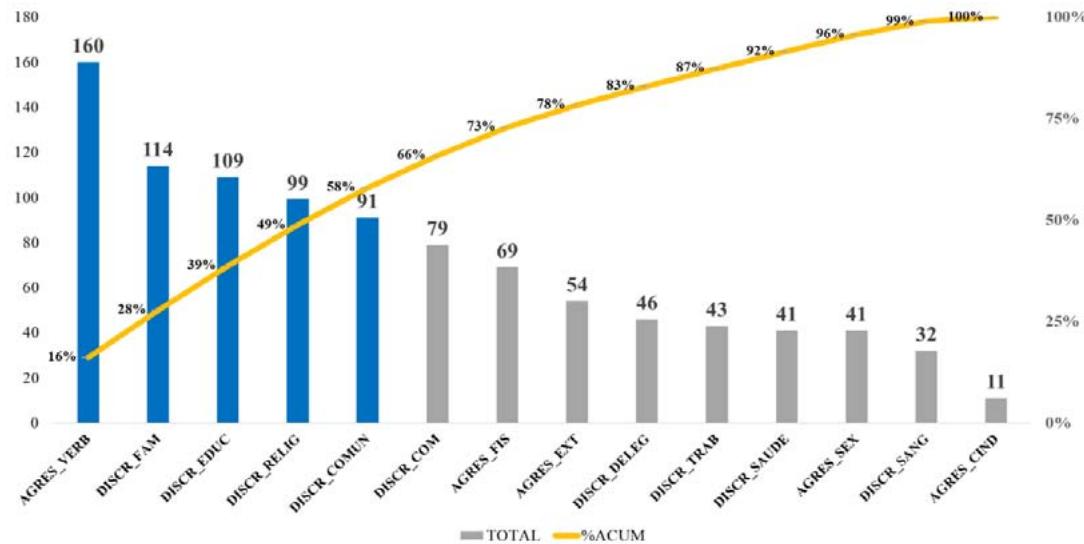 Figure 2: Types of violence indicated by respondents
It was concluded that, in the sample, 94.9 percent of heterosexuals have a score of violence between 0 and 2, that is, they say they have suffered no more than two aggressions or discriminations among those listed in the survey, and 79.7 percent in this group show a null score. Among LGBTQIA+, the situation is different, as 31.2 percent have a violence score between 0 and 2, and only 17.5 percent have a null score, that is, they have suffered no violence at all. Figure 3 shows graphically the concentration of lower scores for the heterosexual population.
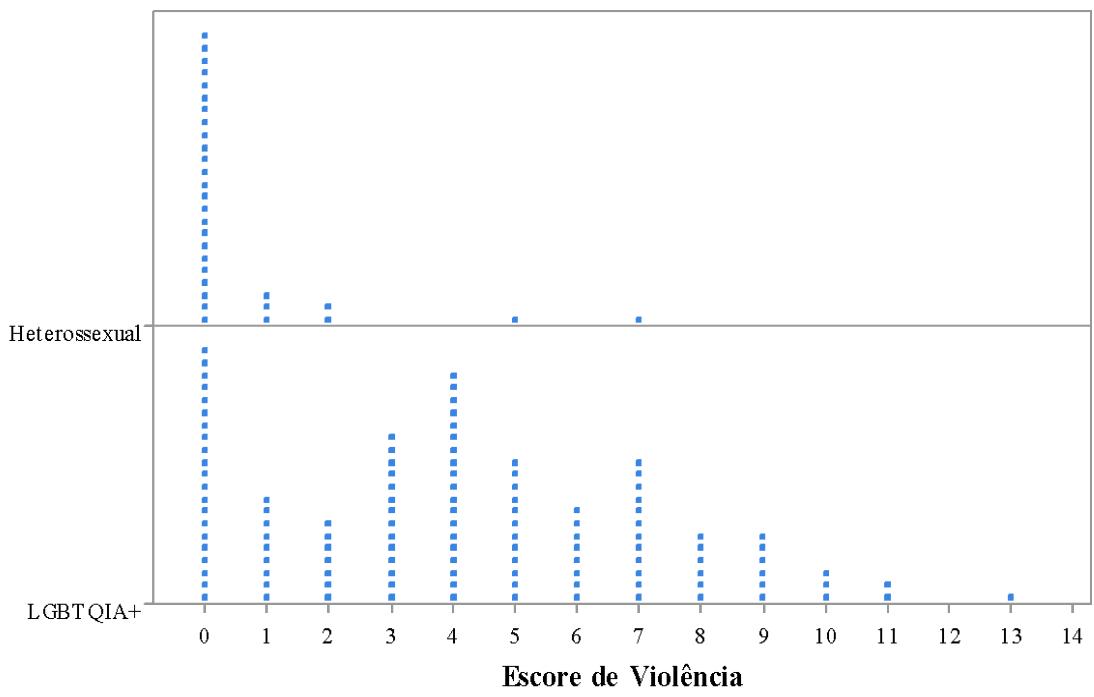 Figure 3: Graphic of the distribution of violence scores by category
Cada simbolo representa até 3 observações.
Sexual orientation is the prevailing factor to predispose or not the individual to suffer violence, that is, regardless of being or not in a relationship, of living alone or with someone, of being young or not, of being white or not, of being religious or not, of their education, of having a paid job or not, a subject from the LGBTQIA+ population in the context investigated will suffer more violence than their heterosexual counterpart. As Colling and Leopoldo (2016) put it,
[...] the homosexual desire (not necessarily a homosexual's desire) may un-structure a phallocratic society. And this is one of the reasons of the anti-homosexual paranoia, of the anti-homosexual panic which, quite often, transmutes into aggression, into macho terrorism – the dark atmosphere of fear – and, in a most obscene way, into murder, into the physical elimination of the other (2016, p. 14).
Table 3 shows the reliability intervals (RI) of the violence scores which affirm this statement. In all cases, LGBTQIA+ people have violence scores statistically higher than heterosexual people, as proved by the One-Way Anova test, with p-value equal to zero in all tests, regardless of the social marker.
Table 3: Reliability Intervals by Social Marker of Difference
<table><tr><td>Social Markers of Difference</td><td>Assumptions (95% of reliability)</td><td>Factor</td><td>RI</td></tr><tr><td rowspan="4">Generation</td><td rowspan="4">H0: Age influences the difference of the violence score between the LGBTQIA+ population and the heterosexual one.H1: Age does not influence the difference of the violence score between the LGBTQIA+ population and the heterosexual one.</td><td>Heterosexual 30 years old or over</td><td>(-0.337; 1.361)</td></tr><tr><td>Heterosexual 30 years old or over</td><td>(-0.837; 1.726)</td></tr><tr><td>LGBTQIA+ 30 years old or less</td><td>(3.759; 4.543)</td></tr><tr><td>LGBTQIA+ 30 years old or less</td><td>(2.947; 4.624)</td></tr><tr><td rowspan="4">Race/Color (IBGE)</td><td rowspan="4">H0: Race/color influences the difference of the violence score between the LGBTQIA+ population and the heterosexual one.H1: Race/color does not influence the difference of the violence score between the LGBTQIA+ population and the heterosexual one.</td><td>White heterosexual</td><td>(-0.613; 1.656)</td></tr><tr><td>White heterossexual</td><td>(-0.435; 1.379)</td></tr><tr><td>White LGBTQIA+</td><td>(3.612; 4.674)</td></tr><tr><td>Non-white LGBTQIA+</td><td>(3.560; 4.518)</td></tr><tr><td rowspan="4">Religion</td><td rowspan="4">H0: Religion influences the difference of the violence score between the LGBTQIA+ population and the heterosexual one.
H1: Religion does not influence the difference of the violence score between the LGBTQIA+ population and the heterosexual one.</td><td>Religious heterosexual</td><td>(-0.525; 1.743)</td></tr><tr><td>Non-religious heterosexual</td><td>(-0.490; 1.323)</td></tr><tr><td>Religious LGBTQIA+</td><td>(3.622; 4.802)</td></tr><tr><td>Non-religious LGBTQIA+</td><td>(3.568; 4.459)</td></tr><tr><td rowspan="4">Education</td><td rowspan="4">H0: Education influences the difference of the violence score between the LGBTQIA+ population and the heterosexual one.
H1: Education does not influence the difference of the violence score between the LGBTQIA+ population and the heterosexual one.</td><td>Heterosexual who went to high-school or less</td><td>(-0.380; 1.796)</td></tr><tr><td>Heterosexual who went to college</td><td>(-0.558; 1.244)</td></tr><tr><td>LGBTQIA+ who went to high-school or less</td><td>(2.964; 3.958)</td></tr><tr><td>LGBTQIA+ who went to college</td><td>(4.201; 5.178)</td></tr><tr><td rowspan="4">Income</td><td rowspan="4">H0: Salary influences the difference of the violence score between the LGBTQIA+ population and the heterosexual one.
H1: Salary does not influence the difference of the violence score between the LGBTQIA+ population and the heterosexual one.</td><td>Heterosexual without a paid job</td><td>(-0.646; 1.526)</td></tr><tr><td>HerosSexual with a paid job</td><td>(-0.402; 1.461)</td></tr><tr><td>LGBTQIA+ without a paid job</td><td>(3.770; 4.896)</td></tr><tr><td>LGBTQIA+ with a paid job</td><td>(3.465; 4.379)</td></tr></table>
Thus, even if hypothetically participants in the "18th LGBT Citizen Parade" of Campo Grande/MS can pass through violence's situation in relation to generation (older people), race/color (black people and/or natives), religion (non-Christian people), education (people with no higher-education), social class (poor people) and territoriality (people who live in the periphery), our data points that sexuality can be, depending on the context, factor of a bigger condition of LGBTQIA+ 's vulnerability. Such data is extremely crucial concerning the political and social role of continuing with the LGBT Parades both in Campo Grande/MS and in other parts of Brazil and world. After all, such events have the purpose of raising awareness the whole society the importance of enforcing the human rights of LGBTQIA+ people, in terms of leading a visible life.
From a general point of view, even if visually one may infer from Figure 3 that the LGBTQIA+ population reports the violence more frequently suffered, we have utilized inferential statistics to validate such statement. Parametric one-way Anova test was used to evince if there is significant statistical difference in violence when the heterosexual and the LGBTQIA+ populations are compared based on the respondent sample.
Although the values do not follow a normal distribution, the One-Way Anova test is statistically more powerful than a non-parametric test, considering that data come from two groups with 15 values each one. The test was based on the following assumptions:
$H_{0}$: Violence scores are the same for the LGBTQIA+ population and heterosexual people.
$H_{1}$: Violence scores are different for the LGBTQIA+ population and the heterosexual people.
One-Way Anova test, with $95\%$ of reliability, applied generally in relation to sexuality, yields to a RI for the heterosexuals equal to (-0.214; 1.197) and for the LGBTQIA+ population to (3.731; 4.440), with p-value=0,000, that is, the null assumption is rejected, once the violence's score perceived by the LGBTQIA+ population is higher than for heterosexuals. This difference can be easily watched in the graphical representation shown in Figure 4.
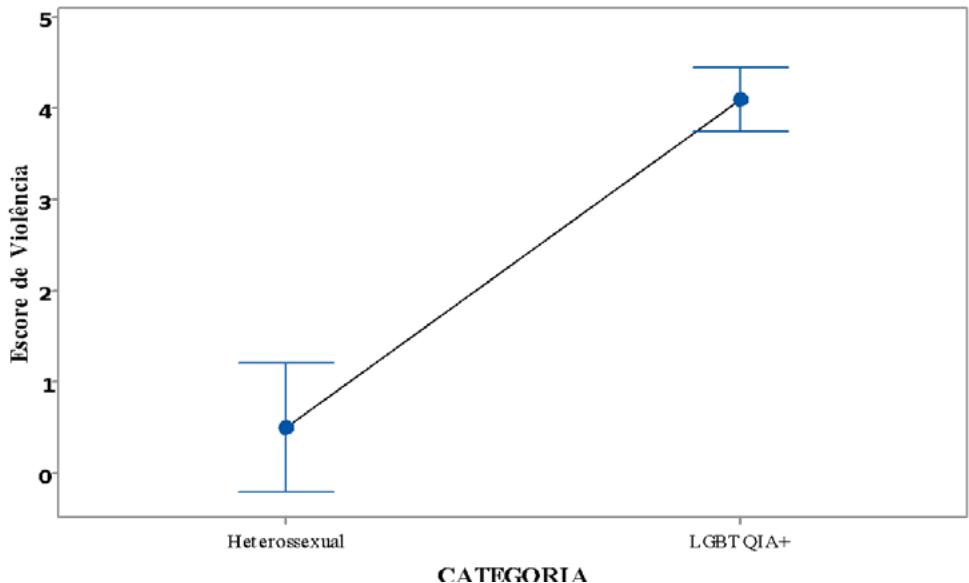 Figure 4: Graph with reliability intervals of the violence score
An approximation of the probabilities' distribution towards the violence score as a discreet variable with a Poisson distribution allows estimating that the probability of a LGBTQIA+ individual to suffer at least one of the two types of violence shown in the questionnaire is $98.32\%$. When the same analysis is done for the heterosexual public, the percentage drops to $38.86\%$.
This data allows us to say that there is both sexism (especially concerning gender) and heterosexism (considering that heterosexuality is established as a normative standard of desires). Welzer-Lang (2001) finds what he calls "the naturalistic paradigm". According to him, in sexism prevails a pseudo (we would rather say, allegedly) superior nature of men, while in heterosexism, for Welzer-Lang, homophobia would be the major "symptom", where heterosexuality takes a central position to the detriment of homosexuality. In his own words, the double naturalistic paradigm which defines, on one hand, the masculine superiority over women and, on the other hand, normalizes what male sexuality must be, produces an androcentric and homophobic political norm that inform us about what a true man should be, the normal man (WALZER-LAGN, 2001, p. 468, our translation).
That is, there is a continuous and repeated control of bodies and subjectivities which permanently undergoes a learning process by institutions and their respective grammar-codes. Thus, thinking heterosexuality requires, according to Butler (2003), to conceive it as a production that transcends both nature and culture, that is, as heterosexuality is not "essentialized" nor in a biological origin nor in a cultural transmission, its manufacturing is constantly implied in processes of destruction and violence.
This allows us to say that homosexuality, as a historical device (FOUCAULT, 1999), has been a privileged target in the production of difference which, often, turns on inequality. It is no coincidence that Foucault, in his genealogical endeavor, says that:
If it is true that 'sexuality' is the set of effects produced in the bodies, in the behaviors, in the social relations, by a given device belonging to a complex political technology, it must be acknowledged that this device does not work symmetrically here and there, and it does not produce, therefore, the same effects (FOUCAULT, 1999, p. 120).
In this perspective, LGBTQIA+ people are produced both as an ontological truth as abject bodies. This difference, understood as a synonym of inequality, will be used as a sufficient reason to "justify" that the lives of LGBTQIA+ people are killable and not susceptible to grief (Butler, 2015). In a recent study on data about violence against lesbians, gay men, bisexuals, transvestites, and transsexuals in Mato Grosso do Sul, Oliveira and Araujo (2020) point out that the rates are extremely high and, almost always, are accompanied by physical violence and may lead to death. In this regard, say the authors:
First, it is not possible to ignore the degree of violence that is oriented against bodies that are considered incomprehensible: there are countless piercings, blows, stone-throwings. Second, the acts reach parts of the body which demonstrate that the victims could not defend themselves (generally, in the back). Third, the aggressions are done in areas of the body that are symbolically constitutive of 'humanization': the face, the countenance (OLIVEIRA; ARAUJO, 2020, p. 302).
The authors show that many crimes against LGBTQIA+ people are not "common crimes". The cruelty associated with the deaths of LGBTQIA+ people configure such facts as "hate crimes", because it is not enough to kill, it is necessary to do it in an exemplary, stunning way (FOUCAULT, 2004). Usually, death is the unfolding of extremely violent torture, together with extreme violence. It is visible, in this kind of action, the attempt not to murder an individual, but the whole "species". Such issues appeared in Carrara's investigation (2004) on the homicides of homosexuals in the 1990's in Rio de Janeiro and in the recent work by Efrem Filho (2017) about the murder of LGBTQIA+ people in the states of Paraíba and Pernambuco. That is, spectacular death is recurrent in this kind of research.
## III. SEXUALITY AND VIOLENCE: (IM)PERTINENT INTERSECTIONS
For this analysis, seven social markers of difference were applied (sexuality, generation, race/ color, religion, education, income [in reference to social class] and territoriality), drawing from the concept that such social markers "interact, contextually and circumstantially, in order to promote potential scenarios of social inequalities and hierarchisations" (HENNING, 2015, p. 100, our translation). However, Henning expands this conception based on the idea of intersectional agency, pointing out possible processes of resistance produced by the subjects marked by differences, that is:
In other words, a highlight is given to the importance of paying attention to the ways the individuals potentially utilize their own intersectional identity marks (as well as in the relation with intersectional identity traits of other people) in order to deal with the creation, the questioning, and the social deconstruction of inequalities (HENNING, 2015, p. 117, our translation).
Given that conception, it is important to emphasize that we did not intend to "prove" that the violence experienced by LGBTQIA+ subjects in the LGBT Parade would be explained by the summation of two or more social markers of difference. However, it is possible to see in Table 3 that only sexuality appears as the outstanding marker of difference, as we have said previously. This is because we believe that an intersectional reading should not establish, a priori, which markers are decisive to understand such theme.
According to Henning (2015), an intersectional analysis does not have the obligation of starting a specific marker of difference, but paying attention to the social configurations based on their historical and cultural context. The author says that there is fragility when these differentiations are multiplied, as they may cause some limitation. Thus, he problematizes the use of the "nature of unlimited openness" of intersectional field" (HENNING, 2015, p. 111, our translation) and projects that intersectionality must be guided by the most relevant markers.
In this study, sexuality turned up the primary marker to understand the different processes of violence and aggression experienced by LGBTQIA+ people. Based on Foucault's notion that sexuality produces effects of power that goes beyond the field of desire, or, said in other way, it goes beyond the individual's sexual orientation, the comprehensiveness of sexuality takes place in accord with other dimensions including the economic, social, educational, cultural and others.
At this moment, we highlight an important concept to understand such process through which heterosexuality is constructed which, according to Dos Reis and Pinho (2016), is the heteronormative matrix or heteronormativity. For these authors, such matrix is conceived in a binary mode, with the presence of two well-defined poles (man/penis that desires woman/vagina), also capturing those who do not construct themselves based on this gender/sex/desire system. Dos Reis and Pinho also add that who does not match with what is conveyed by heteronormativity is exposed to different kinds of violence, which may cause death. That is, in a heteronormative regimen, in order to lead a visible life, it is necessary to seek the exact correspondence between sex, gender, and desire – as if that were possible for everyone (BUTLER, 2008).
It is by chance, as Saéz and Carrascosa say, that 'being a man' is based on 'not being' other things: not being a woman, not being homosexual. It is an identity generated by opposition, by denial, or by the repetition of aesthetic or behavior gestures that lack originality. It is a notion without a precise content. The men power, the patriarchal and macho power, is constructed, on one hand, by means of this contempt against women and, on the other hand, by the hatred against men deemed as less masculine, gay men (2016, p. 127).
In this regard, Carvalho and Pocahy (2020) associate the idea of privilege with people who manage to perform such norm, and consequently, exercise their citizenship. Such privileged ones are also able to disqualify and make inferior those ones who do not comply with the heterosexual norm. Here one finds the permission to exterminate the differences.
As a counterpoint, the criticism by Favero (2019) to the idea of privilege. According to the author, the causal conception that I am heterosexual, therefore I benefit myself the privilege in relation to other sexual identities, does not consider that the heterosexual individual is also constructed by other social markers of difference, such as race, generation, social class, gender etc. It is the intersection of such markers that would allow for a deeper analysis of how these "privileges" are configured. Thus, it is not enough to be heterosexual to lead a visible life, one has to be white, wealthy, Christian, with no disability, young, among others.
Miskolci (2005) points out historically the conditions under which the deviant subject emerges, the individual who does not comply with the norm. At the same time, he problematizes the concept of difference which, designed from the queer theory, see the subject marked by difference not necessarily based on the idea of oppression, but highlighting processes of resistance and agency.
Thereby, by bringing closer Miskolci's contributions to the light of our research data, originated by the "18<sup>th</sup> LGBT Citizenship Parade" of Campo Grande, we argue that, although the social conditions of existence for the sexual and gender minorities are sometimes adverse, it does not result in being impossible to establish processes of identity construction or to fight for recognition. Quite conversely, when we highlight the visible discrepancy of the vulnerable situations experienced by LGBTQIA+ people in contrast with the heterosexual population, we wish to evince the importance of contemporary struggles and mobilizations, and concomitantly we foster the awareness about the arbitrariness of the heterosexual truth regimes underpinning such situations.
## IV. CLOSING REMARKS
Along the survey conducted during the "18<sup>th</sup> LGBT Citizenship Parade" of Campo Grande in 2019, a great deal of data was obtained. The difficulty to gather them all in a single analysis has provided the opportunity for analytical developments about such data (PASSAMANI; VASCONCELOS; ROSA; ISHII, 2020). In the analyses here presented, we have sought to problematize specifically the issue of violence against the LGBTQIA+ people who participated in the Parade. Through this analytical effort, we have evinced the faces of physical and symbolic violence that define the processes of discrimination and aggression.
In our itinerary, both the intersectional and post-structuralist perspective was fundamental to understand how the social markers of difference are articulated to produce a place of vulnerability for LGBTQIA+ individuals. No by chance, the data tabulation led us to find out that, when the issue is sexual dissidence, it is sexuality that outstands during processes of violence and inequality. Thereby, based on the data surveyed, it is possible to say that being a LGBTQIA+ person is already a "sufficient reason" to make someone target of discriminatory and/or violent practices.
Hence, our conclusion is not that other intertwining categories are not relevant to think violence against the LGBTQIA+ community. We only can say that the variations of these categories, based on the specific local context which the research survey was conducted, are not statistically significant in relation to sexuality.
In this regard, our data shows that the great difference in terms of violence results from being or not being LGBTQIA+. Being white or black, poor or rich, educated or not, young or not, does not add statistical difference in terms of violence. We say it again: all of this in the specific context where the survey was produced. The participation of other research subjects, other contexts and events may point (or not) to the prevalence of other markers, once these markers, in an intersectional analytical perspective, are not drawn from an a priori assumption regarding which social marker(s) is (are) used in the investigated situation. In other words, the field is the strength to understand which social markers of difference effectively make a difference.
Among the data analyzed, drawn from the universe of experienced violence, the higher recurrence is the verbal violence, followed by discrimination in the family, in the school, in the religious environment, in the community at large. In this way, it can be noticed that, starting with primary socialization, with the institutions someone most commonly has to live with and/or within, being LGBTQIA+ is a dangerous condition in terms of violence. For that matter, it is not unusual that swear words and humiliation are experienced since early age by LGBTQIA+ people who, in many cases, will have to learn to live with that for the rest of their lives.
Our data shows that such violent situations and contexts are not experienced the same by heterosexuals and LGBTQIA+ people. There is no doubt that that black, poor, non-educated, disabled and (or) older LGBTQIA+ people may have their itineraries even more aggravated. However, inside the Parade's context, where we did the research, sexuality gained more relevance into its participants' perspective on their own violence experiences. Surely, the "larger relevance" can be near the political-narrative context that designs these kind of events.
By all means, such research's data leads us to conclude that heterosexuality, even when it is not combined with another social marker of difference, is already a privileged place. This place may be possibly incremented if there is intersection with other categories. Anyway, being heterosexual is enough to provide the experience of a safer family and social ambience social, in contrast to the experience of LGBTQIA+ people. Based on this reasoning, someone will be hardly assaulted, violated, killed due to the fact of being heterosexual. The same cannot be said about the LGBTQIA+ community. Being and/or being recognized as LGBTQIA+ is already sufficient reason to be included in a spectrum of "killable life" (BUTLER, 2015).
When we look at the data in an intersectional perspective, we realize that sexuality is a marker of difference that makes the difference in the context faced by respondents to survey conducted at the $18^{\text{th}}$ LGBT Citizenship Parade of Campo Grande in 2019. Such subjects maybe do not comply with the norm based on other features other than sexuality, but the statistical data reveals that the violence perpetrated against them occurs due to the fact of being LGBTQIA+. Such result is not given by chance. Quite conversely, it is necessary to say once again that, historically, heterosexuality was established under the status of a norm. Under this heteronormative regimen, sex, gender, and desire must be performed as coherent and inseparable. This makes that all those whose identity becomes unintelligible according to the heterosexual standards, this last being reiterated as "genuine" and "authentic", become easy and immediate targets of several types of violence.
Finally, we can not end this article without insisting on the importance of the collective agency. In this regard, the data obtained from the responses of the LGBT Parade's participants also reveals how important and actual are the struggles and strategies for recognition and to confront the situations of inequality. If sexuality is still a reason for someone and/or a group to become a target of any type of violence, it is urgent to foster actions, research, and policies that contribute to increase visibility and to de-naturalize the social processes of subalternity, discrimination, and murder.
Therefore, it is urgent (and necessary) that heteronormativity, under its underpinning matrix of intelligibility, be questioned and de-naturalized in order to disclose its arbitrary, ghostly and fictional nature – which reveals what heterosexuality actually is: "an empty place" (SÁEZ; CARRASCOSA, 2016).
BIBLIOGRAPHICAL REFERENCES
1. ABGLT. Associacao Brasileira de Lésbicas, Gays, Bissemuals, Travestis e Transexuals. Pesquisa "Juventudes na Escola, Sentidos e Buscas: Por que frequentam?".
2016\. Disponível em: https://static.congressoemfoco.uol.com.br/2016/08/IAE-Brasil-Web3-1.pdf. Acesso em: 28 set.
2021.
2. BRAH, Avtar. Diferência, diversidade, diferenciação. Cadernos Pagu (26), Campinas, n. 26, p. 329-376, 2006.
3. BUTLER, Judith. Quadros de guerra: quando a vida é passível de luto? Rio de Janeiro, RJ: Civilização Brasileira, 2015.
4. BUTLER, Judith. Problemas de filosó: Feminismo e subversão da identidade. 2a. ed. Rio de Janeiro: Civilização Brasileira, 2008.
5. BUTLER, Judith. O parentesco é sempre tão como heterossexual? Cadernos Pagu, Campinas, n. 21, p. 219-260, 2003.
6. CARDOSO DE OLIVEIRA, Luís Roberto. Existe violência sem agressão moral? Revista Brasileira de Ciências Sociais - RBCS, São Paulo, v. 23, n. 67, p. 135-146, 2008.
7. CARRARA, Sérgio. As vittimas do desejo: os tribunais cariocas e a homossexualidade nos anos 1980. In: PISCITELLI, Adriana; GREGORI, Maria Filomena; CARRARA, Sérgio (org.). Sexualidades e saberes: convenções e fronteiras. Rio de Janeiro, Garamond, p. 365-383, 2004.
8. CARRARA, Sérgio. Politica, direitos, violência e homossexualidade. Pesquisa. 9a Parada do Orgulho GLBT - São Paulo 2005 Rio de Janeiro: CEPESC, 2006.
9. CARRARA, Sérgio. Moralidades, razonidas e políticas sexuales no Brasil contemporâneo. Revista Mana, Rio de Janeiro, v. 8, n. 2, p. 47-66, 2020.
10. CARVALHO, Felipe da Silva Ponte de; POCAHY, Fernando. Odiados pela nação: Como ensinamos e aprendemos a odiar aDIFFERENCE? Interfaces Científicas, Aracaju, v. 8, n. 2, p. 47-66, 2020.
11. COHEN, Stanley. *Folk Devils and Moral Panics: The Creation of Mods and Rockers*. London: MacGibbon & Kee, 1972.
12. COLLING, Leandro; LEOPOLDO, Rafael. Por uma ética da passividade. In: SÁEZ, Javier; CARRASCOSA, Sejo. Pelo Cu: Políticas Anais. Belo Horizonte: Letramento, p. 9-17, 2016.
13. DEVORE, Jay L. Probability and Statistics for Engineering and the Sciences. 9 ed., Stamford: Cengage Learning, 2015.
14. DIAS-BENITEZ, Maria Elvira. O espetáculo da humilhação, fissuras e limites da sexualidade. Revista Mana, Rio de Janeiro, v. 21, n. 1, p. 65-90, 2015.
15. DOS REIS, Neilton; PINHO, Raquel. Génores não binários: identidas, expresses e Educação. Reflexão e Ação, Santa Cruz do Sul, v. 24, p. 7-25, 2016.
16. DUTRA, Raphaela Granato; MIRANDA, Lais Ximenes. Territorialidades na parada LGBT de Juiz de Fora - MG. Caderno Prudentino de Geografia, Presidente Prudente, n. 35, n-esp., p. 136-153, 2013.
17. EFREM FILHO, Roberto. A reivindicação da violência: gênero, sexualidade e a constituição da vitima. Cadernos Pagu, Campinas, n. 50, p. 1-54, 2017a.
18. EFREM FILHO, Roberto. Mata-mata: reciprocidades constitutivas entre classe,@genero, sexualidade e territorio. Tese (Doutorado em Ciências Sociais), Instituto de Filosofia e Ciências Humanas, Universidade Estadual de Campinas, 2017b.
19. FAVERO, Sofia. Cisgeneridades precarias: Raça,[gênero e sexualidade na contramão dapoliticaldo relato. Bagoas - Estudos gays: gêneros esexualidades, Natal, v. 13, n. 20, jan-jun., p. 170-197, 2019.
20. FERREIRA,reno de Oliveria;BONAN,Cláudia. Abrindo os armários do acesso e da qualida: uma revisão integrativa sobre assistencia a saude das populacoes LGBTT.Ciência &Saude Coletiva, Rio de Janeiro,v.25,n.5,p.1765-1777,2020.
21. FOUCAULT, Michel. Vigiare punir: História da violência nas prisões. 29a. ed. Petrópolis: Vozes, 2004.
22. FOUCAULT, Michel. História da sexualidade I: a vontade de saber. 13 ed., Rio de Janeiro: Graal, 1999.
23. GUNTHER, Hartmut. Pesquisa qualitativa versus pesquisa quantitativa:essa é a question? Psicologia:Teoria e Pesquisa, Brasília,v.22,n.2,p. 201-10,2006.
24. HAIR, Joseph F.; ANDERSON, Rolph E.; TATHAM, Ronald L.; BLACK, William C.; BABIN, Barry J. Analise Multivariada de Dados. 6<sup>a</sup> ed. Porto Alegre: Bookman.
2009.
25. HENNING, Carlos Eduardo. Interseccionalidade e pensamento feminista: As contribuções historicas e os debates contemporâneos acerca do entrelascimento de marcadores sociais da mesma. Mediações, Londrina, v. 20, n. 2, p. 97-128, jul./dez., 2015.
26. KRISTENSEN, Christian Haag et al. Fatores etiológicos da agressão'sfísica: uma revisão teórica. Estudos de Psicologia, 8(1), p. 175-184, 2003.
27. LOWENKRON, Laura. Consentimento e vulnerability: algunos cruzamentos entre o abuso sexual infantil e o tráfico de pessoas para fim de exploração sexual. Cadernos Pagu, Campinas, s. v., n. 45, p. 225-258, 2015.
28. MENDES, Wallace Góes; SILVA, Cosme Marcelo Furtado Passos da. Homicídios da Popuição de Lésbicas, Gays, Bissexuais, Travestis, Transexuais ou Transgéneros (LGBT) no Brasil: uma Análise Espacial. Ciência. saúde coletiva, 25 (5), p. 1709-1722, 2020.
29. MISKOLCI, Richard. Do desvio às diferencças. Teoria & Pesquisa, São Carlos, v. 1, n. 47, jul-dez, p. 9-41, 2005.
30. MISKOLCI, Richard. Pânicos morais e controle social - reflexões sobre o casamento gay. Cadernos Pagu, Campinas, SP, n. 28, p. 101-128, 2007.
31. MOREIRA, Jorgeanny de Fátima R.; MAIA, Carlos Eduardo Santos. Estrategias espaciais na parada LGBT em Goiânia, Goiás. Boletim Goiano de Geografia (Online). Goiânia, v. 37, n. 2, p. 265-281, maio/ago., 2017.
32. MOTA, Murilo Peixoto da. Do espetáculo da diversidade sexual à performatividade do corpo identário: olhares sobre a XX Parada do Orgulho LGBT de São Paulo. Revista Bagoas, Natal, v. 10, n. 15, p. 59-74, 2016
33. OLIVEIRA, Esmael Alves de; ARAUJO, Joalisson Oliveira. Marcas necropolíticas sobre corpos dissidentes em Mato Grosso do Sul (MS). Perspectivas em Dialogo: Revista de Educação e Sociedade, v. 7, p. 295-306, 2020.
34. PARKER, Richard. Stigma, prejudice and discrimination in global public health. Cad. Saude Pócula, Rio de Janeiro, 28(1):164-169, jan, 2012.
35. PASSAMANI, Guilherme Rodrigues; VASCONCELOS, Alexandre Meira de; ROSA, Marcelo Victor da; ISHIL, Renato Porfirio. Pobres,
- Pretos/as, Periféricos/as, Jovens e em Escolarização: A Constituição dos Sujeiços da $18^{\text{a}}$ Parada da Cidadania LGBT de Campo Grande/MS. Revista Latino-Americana de Geografia e Gênero, Ponta Grossa, v. 11, n. 2, p. 57-81, 2020.
36. PINTO, Isabella Vitral et al. Perfil das notifications de violências em lésbicas, gays, bisexuals, travestis e transexuais registradas no Sistema de Informação de Agrivos de Notification, Brasil, 2015 a 2017. Rev. bras. Epidemiol, 23 (Suppl 01), 2020.
37. PISCITELLI, Adriana. Interseccionalidades, categorias de articulacao e experiencias de migrantes brasiliras. In. Sociedade e Cultura: Goiânia, v. 11, n. 2, 2008.
38. PRADO, Marco Aurélio Maximo. Homofobia: Muitois fenômos sob o mesmo nome. In: BORRILLO, Daniel. Homofobia: História e critica de um preconceito. Belo Horizonte: Autência, 2010. p. 7-11.
39. RIBEIRO, Victor Augusto Menezes; ARANTES, Poliana Coeli Costa. Aqui se faza, ali so se dança:criacao de fronteirasdiscursivas entre participantes da Parada LGBT de Sao Paulo na mdia jornalistica brasileira. Revista Moara, Belém, s. v., n. 47, p. 31-52, 2017.
40. SÁEZ, Javier; CARRASCOSA, Sejo. Pelo Cu: Políticas Anais. Belo Horizonte: Letramento, 2016.
41. SOUZA, Kellcia Rezende; KERBAUY, Maria Teresa Miceli. Abordagem quanto-qualitativa: superação daDICOTOAMIA quantitativa-qualitativa na pesquisa em educateducação. *Educao e Filosofia*, Uberlândia, v. 31, n. 61, p. 21-44, 2017.
42. WELZER-LANG, Daniel. A construção do masculino: dominação dasMulheres e homofobia. Rev. Estud. Fem, Florianópolis, n. 9, v.2, p. 460-482, 2001.
[^4]: According to Miskolci, moral panic was a concept created by Cohen (1972) to explain "the process of social sensitization in which a type of behavior and a category of 'deviants' are identified so that small deviations from the norm are judged and get a strong collective reaction" (2007, p.111). Also, according to Miskolci, Cohen had created such concept to "characterize how the media, the public opinion, and the agents of social control react to certain disruptions of the normative standards" (Idem). For further details, see Cohen (1972). _(p.2)_
[^1]: "This work was conducted with the support from the Higher-Education Personnel Improvement Coordination- Brazil (CAPES) - Funding code 001". _(p.1)_
[^2]: The event had the support of Campo Grande's City Hall by means of its offices, under-offices and coordinating bodies. In addition, the State Government of Mato Grosso do Sul also supported it by means of its offices, foundations, udner-offices and coordinating bodies. It is also necessary to highlight the partnership with several movements of civil society and a variety of sponsorships. _(p.1)_
[^3]: The questions in the form followed the model utilized by Carrara (2006) in his research of the "9 th LGBT Parade of São Paulo" in 2005, and was adapted to the local context. _(p.2)_
Generating HTML Viewer...
References
43 Cites in Article
Abglt (2016). Associação Brasileira de Lésbicas, Gays, Bissexuais, Travestis e Transexuais. Pesquisa "Juventudes na Escola, Sentidos e Buscas: Por que frequentam?.
Judith Butler (2015). Quadros de guerra: quando a vida é passível de luto? Rio de Janeiro.
Judith Butler (2008). Problemas de gênero: Feminismo e subversão da identidade.
Judith Butler (2003). O parentesco é sempre tido como heterossexual?<A NAME="suptitulo"></A>.
Luís Cardoso De Oliveira,Roberto (2008). Existe violência sem agressão moral?.
Sérgio Carrara (2004). As vítimas do desejo: os tribunais cariocas e a homossexualidade nos anos 1980.
Regina Facchini (2005). Convenções de gênero, sexualidade e violência: pesquisa com participantes de eventos do Orgulho LGBT de São Paulo – 2009.
Sérgio Carrara (2020). Moralidades, racionalidades e políticas sexuais no Brasil contemporâneo.
Felipe Carvalho,Fernando Pocahy (2020). ODIADOS PELA NAÇÃO: COMO ENSINAMOS E APRENDEMOS A ODIAR A DIFERENÇA?.
Stanley Cohen (1972). Folk Devils and Moral Panics: The Creation of Mods and Rockers.
Leandro Colling,Rafael Leopoldo Por uma ética da passividade.
Sejo Carrascosa,Cú (2016). Políticas Anais.
Jay Devore (2015). Probability and Statistics for Engineering and the Sciences.
Maria Días-Benitez,Elvira (2015). O ESPETÁCULO DA HUMILHAÇÃO, FISSURAS E LIMITES DA SEXUALIDADE.
Reis,; Neilton,Raquel Pinho (2016). Gêneros nãobinários: identidades, expressões e educação. Reflexão e Ação.
Raphaela Dutra,; Granato,Laís Miranda,Ximenes (2013). Territorialidades na parada LGBT de Juiz de Fora -MG.
Efrem Filho,Roberto (2017). A reivindicação da violência: gênero, sexualidade e a constituição da vítima.
Efrem Filho,Roberto (2017). Unknown Title.
Sofia Favero (2019). Cisgeneridades precárias: Raça, gênero e sexualidade na contramão da política do relato.
Breno Ferreira,Cláudia Bonan (2020). Abrindo os armários do acesso e da qualidade: uma revisão integrativa sobre assistência à saúde das populações LGBTT.
Michel Foucault (2004). Vigiar e punir: História da violência nas prisões.
Michel Foucault (1999). História da sexualidade I: a vontade de saber.
(2006). Unknown Title.
Joseph Hair,Rolph Anderson,Ronald Tatham,William Black,Barry Babin (2009). Análise Multivariada de Dados.
Carlos Henning,Eduardo (2015). Interseccionalidade e pensamento feminista: as contribuições históricas e os debates contemporâneos acerca do entrelaçamento de marcadores sociais da diferença.
Christian Kristensen,Juliane Lima,Mirela Ferlin,Renato Flores,Patrícia Hackmann (2003). Fatores etiológicos da agressão física: uma revisão teórica.
Laura Lowenkron (2015). Consentimento e vulnerabilidade: alguns cruzamentos entre o abuso sexual infantil e o tráfico de pessoas para fim de exploração sexual.
Wallace Mendes,Cosme Silva (2020). Homicídios da População de Lésbicas, Gays, Bissexuais, Travestis, Transexuais ou Transgêneros (LGBT) no Brasil: uma Análise Espacial.
Richard Miskolci (2005). Do desvio às diferenças.
Richard Miskolci (2007). Pânicos morais e controle social: reflexões sobre o casamento gay.
Jorgeanny Moreira,R De Fátima,Carlos Maia,Santos (2017). Estratégias espaciais na parada LGBT em Goiânia, Goiás.
Murilo Mota,Peixoto Da (2016). Do espetáculo da diversidade sexual à performatividade do corpo identitário: olhares sobre a XX Parada do Orgulho LGBT de São Paulo.
Esmael Oliveira,; Alves De,Joalisson Araujo,Oliveira (2020). Marcas necropolíticas sobre corpos dissidentes em Mato Grosso do Sul (MS).
Richard Parker (2012). Stigma, prejudice and discrimination in global public health.
Guilherme Passamani,; Rodrigues,Alexandre Vasconcelos,; Meira De,Marcelo Rosa,; Victor Da,Renato Ishii,Porfirio,Pretos Pobres (2020). /as, Periféricos/as, Jovens e em Escolarização: A Constituição dos Sujeitos da 18ª Parada da Cidadania LGBT de Campo Grande/MS.
Isabella Pinto,Silvânia Andrade,Leandra Rodrigues,Maria Santos,Marina Marinho,Luana Benício,Renata Correia,Maurício Polidoro,Daniel Canavese (2020). Perfil das notificações de violências em lésbicas, gays, bissexuais, travestis e transexuais registradas no Sistema de Informação de Agravos de Notificação, Brasil, 2015 a 2017.
Adriana Piscitelli (2008). Interseccionalidades, categorias de articulação e experiências de migrantes brasileiras.
Marco Prado,Máximo (2010). Homofobia: Muitos fenômenos sob o mesmo nome.
Victor Ribeiro,Poliana Arantes (2017). Aqui se faz política, ali só se dança: criação de fronteiras discursivas entre participantes da Parada LGBT de São Paulo na mídia jornalística brasileira.
Javier Sáez,Sejo Carrascosa,Cú (2016). Políticas Anais.
Kellcia Souza,; Rezende,Maria Kerbauy,Teresa Miceli (2017). Abordagem quanti-qualitativa: superação da dicotoamia quantitativa-qualitativa na pesquisa em educação.
Daniel Welzer-Lang (2001). A construção do masculino: dominação das mulheres e homofobia.
No ethics committee approval was required for this article type.
Data Availability
Not applicable for this article.
How to Cite This Article
Josafá Barros Camargo Borges. 2026. \u201cSexuality and Violence: Analysis of a LGBT Citizenship Parade in Campo Grande- MS\u201d. Unknown Journal GJHSS-C Volume 23 (GJHSS Volume 23 Issue C2): .
Explore published articles in an immersive Augmented Reality environment. Our platform converts research papers into interactive 3D books, allowing readers to view and interact with content using AR and VR compatible devices.
Your published article is automatically converted into a realistic 3D book. Flip through pages and read research papers in a more engaging and interactive format.
Authors:
Josafá Barros Camargo Borges, Marcelo Victor da Rosa, Alexandre Meira de Vasconcelos, Esmael Alves de Oliveira, Guilherme Rodrigues Passamani (PhD/Dr. count: 0)
This article is the result of a 2019 1 survey done in the capital of Mato Grosso do Sul with the participants of the “18 th LGBT Citizenship Parade” of Campo Grande. The aim of the text is to discuss the issues of violence against the LGBTQIA+ population. As a result of the reserach, we have the centrality of sexuality as the main marker used to consider the situation of vulnerability of the LGBTQIA+ population that participated in the Parade. In analytical terms, at first, we present statistical data that show how sexuality and violence go hand in hand with regard to the vulnerability experiences of Campo Grande’s LGBTQIA+ population. In a second moment, from an intersectional and post-structuralist perspective, we examine the social conditions that place LGBTQIA+ people in situations of inequality when compared to the heterosexual population.
Our website is actively being updated, and changes may occur frequently. Please clear your browser cache if needed. For feedback or error reporting, please email [email protected]
Thank you for connecting with us. We will respond to you shortly.