
INTRODUCTION
n 2020, a very powerful web-server predictor has been established for identifying the subcellular localization of human proteins based on the sequence information alone [1], in which a same protein may occur or move between two or more location sites and hence needs to be marked with the multi-label approach [2].
The web-server predictor is called "pLoc_Deep-mGpos", where "Deep" means the web-server has been further improved by the "Deep Learning" technique , and "m" means the capacity able to deal with the multi-label systems. To learn how the web-server is working, please do the following.
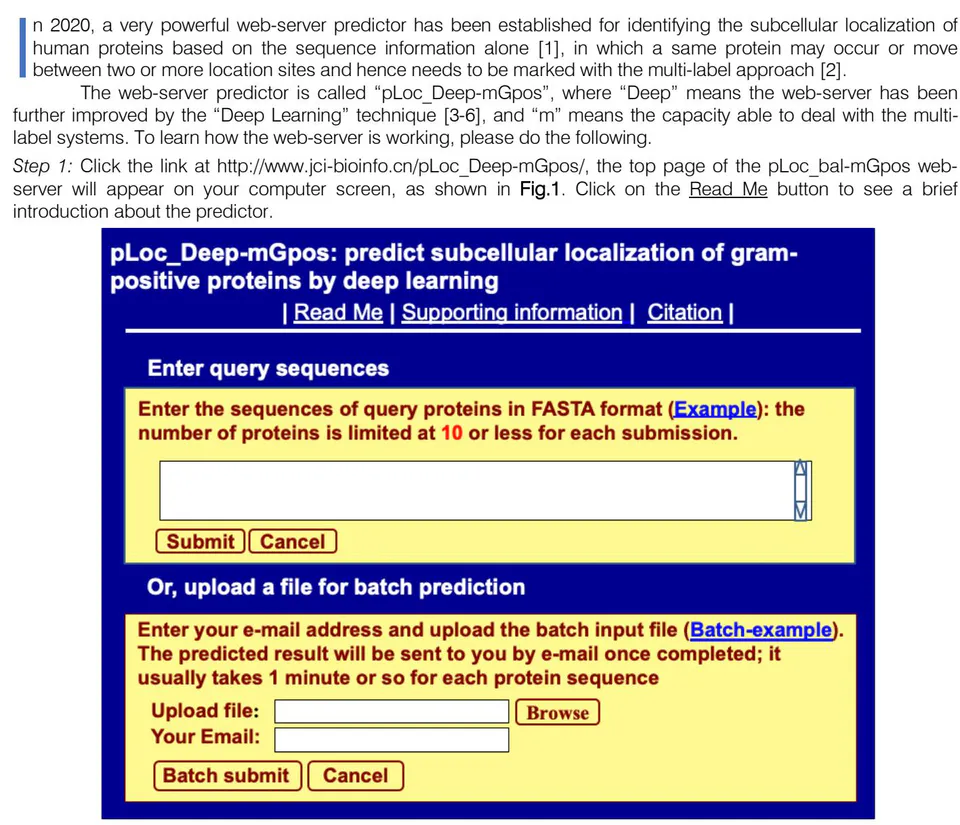
Step 1: Click the link at http://www.jci-bioinfo.cn/pLoc_Deep-mGpos/, the top page of the pLoc_bal-mGpos web-server will appear on your computer screen, as shown in Fig.1. Click on the Read_Me button to see a brief introduction about the predictor.
pLoc-Deep-mGpos: predict subcellular localization of gram-positive proteins by deep learning | Read Me | Supporting information | Citation | Context Before: Step 1: Click the link at http://www.jci-bioinfo.cn/pLoc_Deep-mGpos/, the top page of the pLoc_bal-mGpos web-server will appear on your computer screen, as shown in Fig.1. Click on the Read_Me button to see a brief introduction about the predictor. Context After: Enter query sequences
Enter query sequences
Enter the sequences of query proteins in FASTA format (Example): the number of proteins is limited at 10 or less for each submission.
Submit Cancel
Or, upload a file for batch prediction
Browse
Batch submit Cancel
Figure 1
Step 2: Either type or copy/paste the sequences of query human proteins into the input box at the center of Fig.1. The input sequence should be in the FASTA format. For the examples of sequences in FASTA format, click the Example button right above the input box.
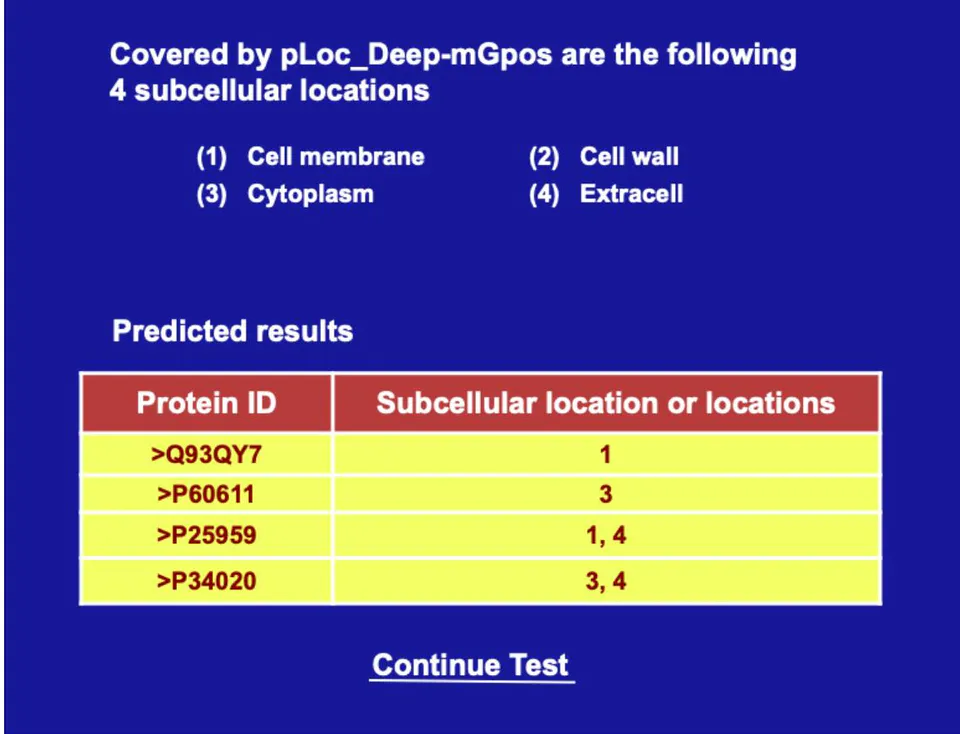
Step 3: Click on the Submit button to see the predicted result. For instance, if you use the four protein sequences in the Example window as the input, after 10 seconds or so, you will see a new screen (Fig.2) occurring. On its upper part are listed the names of the subcellular locations numbered from (1) to (8) covered by the current predictor. On its lower part are the predicted results: the query protein P22340 of example-1 corresponds to "2," meaning it belongs to "Cell outer membrane" only; the query protein P04032 of example-2 corresponds to "8" meaning it belongs to "Periplasm"; the query protein P04825 of example-3 corresponds to "1, 3", meaning it belongs to "Cell inner membrane" and "Cytoplasm"; the query protein P22251 of example 4 corresponds to "4, 6", meaning it belongs to "Extracellular" and "Flagellum". All these results are perfectly consistent with experimental observations.
Step 5: Click on the Citation button to find the papers that have played the key role in developing the current predictor of pLoc_Deep-mGpos.
Step 6: Click the Supporting Information button to download the Supporting Informations mentioned in this paper.