Smart Agronomy of Wheat Cultivation in Riverbed of Betawa through Natural And Organic Farming under Changing Climate

α
R.A. Singh
R.A. Singh
σ
M.K. Singh
M.K. Singh
ρ
V.B. Jaiswal
V.B. Jaiswal
Ѡ
Jitendra Singh
Jitendra Singh
¥
I.P. Singh
I.P. Singh
α Chandra Shekhar Azad University of Agriculture and Technology

Send Message

To: Author

Smart Agronomy of Wheat Cultivation in Riverbed of Betawa through Natural And  Organic Farming under Changing Climate

Article Fingerprint

ReserarchID

814U4

Smart Agronomy of Wheat Cultivation in Riverbed of Betawa through Natural And  Organic Farming under Changing Climate Banner

AI TAKEAWAY

Connecting with the Eternal Ground
  • English
  • Afrikaans

  • Albanian
  • Amharic
  • Arabic
  • Armenian
  • Azerbaijani
  • Basque
  • Belarusian
  • Bengali
  • Bosnian
  • Bulgarian
  • Catalan
  • Cebuano
  • Chichewa
  • Chinese (Simplified)
  • Chinese (Traditional)
  • Corsican
  • Croatian
  • Czech
  • Danish
  • Dutch
  • Esperanto
  • Estonian
  • Filipino
  • Finnish
  • French
  • Frisian
  • Galician
  • Georgian
  • German
  • Greek
  • Gujarati
  • Haitian Creole
  • Hausa
  • Hawaiian
  • Hebrew
  • Hindi
  • Hmong
  • Hungarian
  • Icelandic
  • Igbo
  • Indonesian
  • Irish
  • Italian
  • Japanese
  • Javanese
  • Kannada
  • Kazakh
  • Khmer
  • Korean
  • Kurdish (Kurmanji)
  • Kyrgyz
  • Lao
  • Latin
  • Latvian
  • Lithuanian
  • Luxembourgish
  • Macedonian
  • Malagasy
  • Malay
  • Malayalam
  • Maltese
  • Maori
  • Marathi
  • Mongolian
  • Myanmar (Burmese)
  • Nepali
  • Norwegian
  • Pashto
  • Persian
  • Polish
  • Portuguese
  • Punjabi
  • Romanian
  • Russian
  • Samoan
  • Scots Gaelic
  • Serbian
  • Sesotho
  • Shona
  • Sindhi
  • Sinhala
  • Slovak
  • Slovenian
  • Somali
  • Spanish
  • Sundanese
  • Swahili
  • Swedish
  • Tajik
  • Tamil
  • Telugu
  • Thai
  • Turkish
  • Ukrainian
  • Urdu
  • Uzbek
  • Vietnamese
  • Welsh
  • Xhosa
  • Yiddish
  • Yoruba
  • Zulu

Abstract

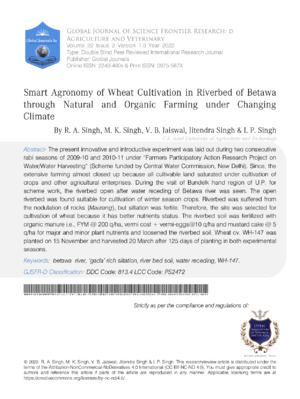
The present innovative and introductive experiment was laid out during two consecutive rabi seasons of 2009-10 and 2010-11 under “Farmers Participatory Action Research Project on Water/Water Harvesting” (Scheme funded by Central Water Commission, New Delhi). Since, the extensive farming almost closed up because all cultivable land saturated under cultivation of crops and other agricultural enterprises. During the visit of Bundelk hand region of U.P. for scheme work, the riverbed open after water receding of Betawa river was seen. The open riverbed was found suitable for cultivation of winter season crops. Riverbed was suffered from the nodulation of rocks (Maurang), but siltation was fertile. Therefore, the site was selected for cultivation of wheat because it has better nutrients status. The riverbed soil was fertilized with organic manure i.e., FYM @ 200 q/ha, vermi cost + vermi-eggs@10 q/ha and mustard cake @ 5 q/ha for major and minor plant nutrients and loosened the riverbed soil. Wheat cv. WH-147 was planted on 15 November and harvested 20 March after 125 days of planting in both experimental seasons.

References

6 Cites in Article
  1. N Datta,M Khera,T Saini (1962). A rapid colorimetric procedure for the determination of organic carbon in soils.
  2. S Olsen,F Watanabe,C Cole (1954). EFFECT OF SODIUM BICARBONATE ON THE SOLUBILITY OF PHOSPHORUS IN CALCAREOUS SOILS.
  3. C Piper (1950). Soil and Plant Analysis.
  4. R Singh (1999). Integrated input management in groundnut (Arachis hypogaea)-wheat (Triticum aestivum) cropping system under draught prone area of semi arid regions.
  5. R Singh (2006). Response of short duration vanities of groundnut (Aruchis hypogaea)-wheat (Triticum aestivum) -summer groundnut cropping system.
  6. T Singh (1971). A laboratory manual for soil fertility and fertilizer.

Funding

No external funding was declared for this work.

Conflict of Interest

The authors declare no conflict of interest.

Ethical Approval

No ethics committee approval was required for this article type.

Data Availability

Not applicable for this article.

How to Cite This Article

R.A. Singh. 2026. \u201cSmart Agronomy of Wheat Cultivation in Riverbed of Betawa through Natural And Organic Farming under Changing Climate\u201d. Global Journal of Science Frontier Research - D: Agriculture & Veterinary GJSFR-D Volume 22 (GJSFR Volume 22 Issue D2): .

Download Citation

Optimizing wheat crop in Betwa River basin.
Issue Cover
GJSFR Volume 22 Issue D2
Pg. 19- 21
Journal Specifications

Crossref Journal DOI 10.17406/GJSFR

Print ISSN 0975-5896

e-ISSN 2249-4626

Keywords
Classification
GJSFR-D Classification: DDC Code: 813.4 LCC Code: PS2472
Version of record

v1.2

Issue date

June 30, 2022

Language
en
Experiance in AR

Explore published articles in an immersive Augmented Reality environment. Our platform converts research papers into interactive 3D books, allowing readers to view and interact with content using AR and VR compatible devices.

Read in 3D

Your published article is automatically converted into a realistic 3D book. Flip through pages and read research papers in a more engaging and interactive format.

Article Matrices
Total Views: 1551
Total Downloads: 44
2026 Trends
Related Research

Published Article

The present innovative and introductive experiment was laid out during two consecutive rabi seasons of 2009-10 and 2010-11 under “Farmers Participatory Action Research Project on Water/Water Harvesting” (Scheme funded by Central Water Commission, New Delhi). Since, the extensive farming almost closed up because all cultivable land saturated under cultivation of crops and other agricultural enterprises. During the visit of Bundelk hand region of U.P. for scheme work, the riverbed open after water receding of Betawa river was seen. The open riverbed was found suitable for cultivation of winter season crops. Riverbed was suffered from the nodulation of rocks (Maurang), but siltation was fertile. Therefore, the site was selected for cultivation of wheat because it has better nutrients status. The riverbed soil was fertilized with organic manure i.e., FYM @ 200 q/ha, vermi cost + vermi-eggs@10 q/ha and mustard cake @ 5 q/ha for major and minor plant nutrients and loosened the riverbed soil. Wheat cv. WH-147 was planted on 15 November and harvested 20 March after 125 days of planting in both experimental seasons.

Our website is actively being updated, and changes may occur frequently. Please clear your browser cache if needed. For feedback or error reporting, please email [email protected]

Request Access

Please fill out the form below to request access to this research paper. Your request will be reviewed by the editorial or author team.
X

Quote and Order Details

Contact Person

Invoice Address

Notes or Comments

This is the heading

Lorem ipsum dolor sit amet, consectetur adipiscing elit. Ut elit tellus, luctus nec ullamcorper mattis, pulvinar dapibus leo.

High-quality academic research articles on global topics and journals.

Smart Agronomy of Wheat Cultivation in Riverbed of Betawa through Natural And Organic Farming under Changing Climate

R.A. Singh
R.A. Singh Chandra Shekhar Azad University of Agriculture and Technology
M.K. Singh
M.K. Singh
V.B. Jaiswal
V.B. Jaiswal
Jitendra Singh
Jitendra Singh
I.P. Singh
I.P. Singh

Research Journals