
I. INTRODUCTION
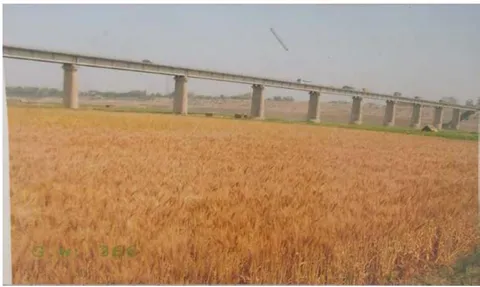
Ravines are networking of gullies. Bundelkhand part of Uttar Pradesh is having 4.92 lakh hectares of ravine lands. Very extensive degradation of land has occurred along with rivers Yamuna, Chambal, Ken, Dhashan, Pahuj, Betawa and their tributaries, which form deep gullies. The 1.29 lakh hectares land available in Hamirpur district of Bundelkhand, which suffer from the ravines, hillocks, valleys etc. These subjected areas are an indication of very bad management of land resources. Erratic, short duration and high intensity rainfall, uneven terrain, faulty agricultural practices, illicitly cutting of tree and over grazing have combined to aggravate the gullies formation in Hamirpur distract of Bundelkhand. Therefore, Hamirpur district of Bundelkhand which is edaphically socially quite different from other districts of Bundelkhand zone of Uttar Pradesh. Characterized by semi arid climate, undulating topography, residual soil of erodible nature, deep water stata underlain with impermeable rocks, poor crop husbandry, including low plant nutrients use and irrigation. During rainy season, the residual nature of soil and rocks reduced infiltration rate and consequently leads to high runoff. The management of this ravine affected area and expansion of wheat cultivation on the basis of conservation production system are the pin points for improving the life style of farm families and their food security. The eroded soil transported through gullies during rainy season and deposited in river bed near to banks. This siltation is most fertile because it contain the various plant nutrients. After receding of river water during winter season, river bed is open. The farming majority use this land for grazing of animals and vegetables cultivation tibi-tite. The production of wheat on deposited siltation of riverbed is the subject matter of this manuscript.
II. MATERIALS AND METHODS
experimental field as suggested by Singh (2006). FYM applied in the experimental field contained N, and . Similarly, vermicast and vermicast eggs used as a inoculants was comprised organic matter , total nitrogen , phosphorus , potassium , sodium , calcium , copper , iron , zinc and sulphur (Singh, 2006). The fine powder of mustard cake@5 q/ha was also applied with irrigational water at the time of second irrigation. The applications of FYM, vermin cost and vermin cost eggs and mustard cake powder have loosened the siltation soil of riverbed. The applied all organic matter loosened the siltation of riverbed. The applied organic matter was fullfiled all the major and minor plant nutrients specially N-110.88 kg, 51.50 kg and 96.68 kg/ha. Wheat WH 147 was seeded in rows at the distance of 30 cm using 100 kg seed/ha. The wheat was planted on 15 November and harvested after 125 days on 20 March in both the years. The conservation agronomical practices were followed for raising of wheat crop, planted in riverbed. The protective irrigations were given to crop as and when required with diesel driven pump set. No incidence of insects, pest and diseases was seen in experimental crop.
III. RESULTS AND DISCUSSION
The pooled data of two years of grains yield, growth parameters and yield traits of experimental crop recorded and presented in Table-1 and discussed here under appropriate heads.
Since it was innovative and introductory experiment on cv. WH 147 which was grown in the riverbed of Betawa was also compared to the wheat crop grown under normal soil in the vicinity of river bank of Betawa. The collected data of conventional practice sown wheat are also given in Table -1.
- Effect on growth and yield traits: The main shoot height and tillers/plant were found similar to the
wheat grown on normal soil with chemical fertilizers. The spike/plant display that wheat grown under two conditions indicated not much difference but normal sown condition wheat showed superiority over riverbed sown wheat. The at par grain weight/plant and 1000-grain weight were observed in both condition sown wheat. The equal uptake of plant nutrients under both the condition by wheat plants was responsible for similar growth and yield contributing characters (Table-1)
- Effect on wheat yield (q/ha): The grain yield of wheat grown in riverbed gave 40.10 q/ha, which was in comparison to wheat yield of normal soil sown condition. The yield recorded from normal soil was 42.35 q/ha, which gave only 2.25 q/ha more grain yield in comparison to riverbed wheat grain yield. The residue of chemical fertilizers available in the normal soil was responsible for slightly superior grain yield. The superiority of spike/plant, grain weight/plant and 1000-grain weight were responsible to slightly superior yield of wheat under normal soil conditions.
The riverbed soil have the granules of rocks (Morang), which hinder to the production of tillers/plant, therefore, low tillers production in riverbed soil was responsible for low yield of wheat (q/ha).
The progressive and positive effect of earthworm base organic matter application on wheat yield has also been reported by Singh (1999) and Singh (2006).
IV. CONCLUSION AND RECOMMENDATION
Nutrients rich riverbed soil gave wheat yield , which is almost similar to the normal soil sown wheat yield, the farming majority residing in vicinity of rivers may be advocated for sowing of wheat in nutrients rich riverbed under extensive cultivation with natural and organic farming.