In India the smart cities projects were implemented by Indian government. In Tamil Nadu many states are selected to convert cities into smart cities. TUFIDCO is providing financial assistance to smart cities projects. The digital Transformation is the vital part in smart cities projects. The main aim of Tamil Nadu Urban Finance and Infrastructure Development Corporation Limited mission is to provide financial assistance and guidance to Local Bodies, Corporations, Boards, Authorities, and parastatal agencies for their development projects. An intelligent city refers that provides all the facilities a city needs, such as education, electricity, transportation, green environments, good governance and information technologies. To put it simply, smart cities improve the quality of life. The selected Smart Cities are Chennai, Coimbatore, Madurai, Thanjavur, Salem, Vellore, Tiruppur, Thoothukudi, Tirunelveli, Tiruchirappalli and Erode in Tamil Nadu. Researchers obtain data from secondary sources. In order to carry out this research, the researcher should analyze the
## I. INTRODUCTION
The Government of India launched the Smart Cities Mission on the 25th of June, 2015. As per the aspirations and needs of citizens, the purpose of the Smart Cities Mission is to create world-class cities. In Tamil Nadu, TUFIDCO is the mission directorate for implementing the Smart Cities Mission. 100 cities in India have been selected by the Indian Government to be developed as "Smart Cities" by upgrading their infrastructures and implementing smart applications. With regards to economic, social, and environmental aspects, it enhances the quality of life, improves the efficiency of urban operations and meets the needs of present and future generations. A total of 11 Tamil Nadu cities have been selected to be developed as 'Smart Cities. These are the cities that are selected as smart cities: Chennai, Coimbatore, Madurai, Thanjavur, Salem, Vellore, Tiruppur, Thoothukudi, Tirunelveli, Tiruchirappalli and Erode. Currently, the implementation of the Smart City project is being done by a Special Purpose Vehicle (SPV) formed at the local level. In conjunction with this
Mission, each city will get Rs. 500 Cr as Central assistance and Rs. 500 Cr as State grant in order to implement various smart city projects. Smart cities are an integral part of developing the nation. Utilizing the economic share capital, reserves and surplus of TUFIDCO, along with bank borrowings and the mobilization of public deposits, extends support for infrastructure development in the state.
## II. OBJECTIVE OF THE STUDY
- > In order to examine TUFIDCO financial assistance provided to smart cities projects in cities of Tamil Nadu.
- To determine the relationship between project quantity and construction cost.
- To examine the digital transformation is change the life style of the peoples.
## III. RESEARCH METHODOLOGY
In this study, data was obtained from Primary and secondary sources of data. The primary data was collected from the well-structured questioner. The secondary data collected for the purpose of this study were form standard text books, leading journals, magazines, and official websites.
### a) Sampling Techniques
## i. Clustered Sampling
Hypothesis
- $\diamond$ $H_{0_1}$ - There is no relation between smart cities project construction quantity and Cost of the Project.
- $\diamond$ $H_{o_2}$ - There is no relationship between digital Transformation and Life style.
## IV. CONCEPT OF SMARTCITIES
In smart cities, residents focus on the most pressing needs and the most effective opportunities to improve their lives. They use a range of strategies to solve problems, including digital and information technologies, urban planning best practices, public-private partnerships, and policy change. In the Smart Cities Mission, the aim is to promote cities that provide core infrastructure and give decent quality of life to their citizens, a clean and sustainable environment, and provide 'Smart' solutions. A replicable model will act as a lighthouse for other aspiring cities to develop in a sustainable and inclusive way. The goal is to place the focus on sustainable and inclusive development. As part of the Smart Cities Mission, smart cities will serve as
examples that can be replicated both within and outside the Smart City, leading to similar Smart Cities being built in various parts of the country.
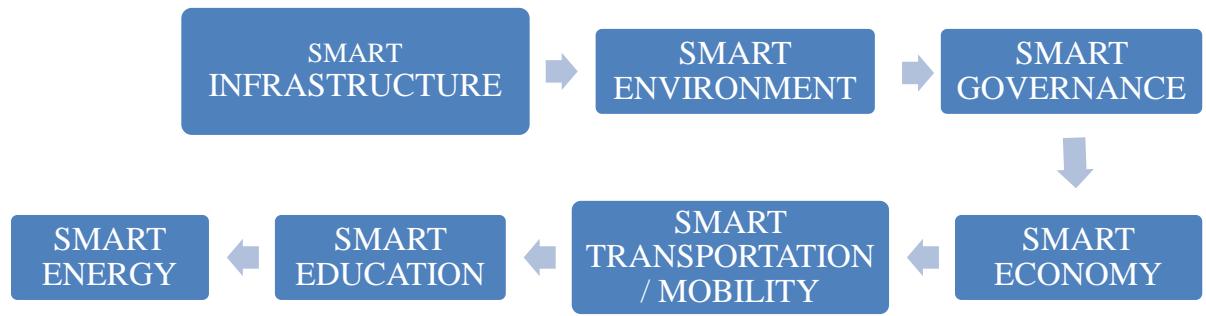
SAMRT CITIES VISION Figure - 1
## V. SMART CITIES CORE INFRASTRUCTURE ELEMENTS
Infrastructure plays a vital role in construction. Smart cities core Infrastructure includes a) Adequate water supply' b) robust IT connectivity and digitalization c) Assured electricity supply d) Affordable housing especially for the poor e) Sustainable environment f) Safety and security of citizens, particularly women, children and the elderly, and health and education g) Sanitation, including solid waste management h) Good governance especially e-Governance and citizen participation i) Efficient urban mobility and public transport.
## VI. SMART CITIES MISSION
A Smart Cities Mission is an urban renewal and retrofitting program being run by the Government of India with the goal of developing citizen-friendly and sustainable cities throughout the country. Implementation of the mission is the responsibility of the Union Ministry of Urban Development and state governments of the respective cities. The Smart Cities Mission aims to improve the quality of life for people as well as drive economic growth and enable localized development by leveraging technology, especially technology that facilitates Smart decisions. The "100 Smart Cities Mission" was launched by PM Narendra Modi on 25 June 2015.

Ministry of Housing and Urban Affairs Government of India
Under the Housing and Urban Finance Ministry, the Smart Cities mission is governed. The Indian Cabinet approved the development of 100 smart cities and the revitalization of 500 others with a total of 98,000 crores (US$13 billion).
## VII. THE MISSION STRATEGY FOR SMART CITIES
1. Pan-city initiative in which at least one Smart Solution is applied city-wide
2. Develop areas step-by-step – three models of area-based developments
3. Retrofitting
4. Redevelopment
5. Greenfield
Smart City MISSION TRANSFORM-NATION
## VIII. THE FINANCING OF SMART CITIES BY FEDERAL GOVERNMENT
Smart City Mission will be run by the Central Government as a federally-sponsored scheme (CSS), and the Central Government proposes to fund the project. The finance plays the vital role for construct the smart cities objectives. So, the central government plans to provide the financial assistance towards the smart cities project. The following table shows how much the federal government provides financial assistance to CSS.
Table - 1: Central Government Offers Financial Support to CSS
<table><tr><td></td><td>YEARS</td><td>AMOUNT (in Crores)</td></tr><tr><td>Proposed</td><td>5</td><td>48,000</td></tr><tr><td>In Average</td><td>1</td><td>100</td></tr></table>
## IX. SMART CITY CHALLENGE: LIST OF CITIES NOMINATED BY STATES
According to a plan developed by the Ministry of Urban Development (MoUD), cities were selected for funding based on a competition-based method. Cities competed in state-level competitions with other cities in the state. At the national level, the state-level winner competed in the Smart City Challenge. Cities achieving the highest marks in a particular round were chosen for the mission. According to the proposal, state governments were asked to nominate potential cities based on state-level competition, with 100 cities across
India to choose from. As of August 2015, the Ministry of Urban Development published the list of 98 nominees submitted by state governments. West Bengal's participating cities (New Town, Kolkata, Bidhannagar, Durgapur, and Haldia) have all withdrawn from the Smart Cities Mission. As a result of the Smart Cities Mission, Mumbai and Navi Mumbai from Maharashtra have also been withdrawn.
Listed below are the Cities that have been Nominated by States for the Smart City Challenge in Tamil Nadu:
There are 12 cities in Tamil Nadu that have been nominated for smart city transformation. The nominated cities are listed below the given table.
Table - 2: Nominated Cities by Tamilnadu for Smart Cities Transformation
<table><tr><td>Name of the State</td><td>No. Cities nominated for Smart Cities</td><td>Name of the Cities</td></tr><tr><td>Tamil Nadu</td><td>12</td><td>Chennai
Coimbatore
Dindigul
Erode
Madurai
Salem
Thanjavur
Thoothukudi Tiruchirappalli
Tirunelveli
Tiruppur
Vellore</td></tr></table>
## X. CITIES SELECTED FOR SAMRT CITIES TRANSFORMATION IN TAMIL NADU
There is no single round of selection for the 11 cities. A total of five rounds are conducted in this mission. Two cities from Tamil Nadu were selected in
the first round. During the second round, no cities were chosen to transform into smart cities. Four cities were selected in the third round. Four cities in the fourth round were selected, while one city was selected in the last round.
Table - 3: Smart Cities List
<table><tr><td>Round</td><td>No. of Selected Cities in India</td><td>No. of Cities Selected in Tamil Nadu</td><td>Name of the Cities</td></tr><tr><td>1</td><td>20</td><td>2</td><td>Coimbatore
Chennai</td></tr><tr><td>2</td><td>13</td><td>Nil</td><td>Nil</td></tr><tr><td>3</td><td>27</td><td>4</td><td>Vellor
Madurai
Thanjavur
Selam</td></tr><tr><td>4</td><td>30</td><td>4</td><td>Thoothukudi
Trichy
Tirunelveli
Tirupur</td></tr><tr><td>5</td><td>10</td><td>1</td><td>Erode.</td></tr><tr><td>TOTAL</td><td>100</td><td>11</td><td></td></tr></table>
## XI. TAMIL NADU URBAN FINANCE AND INFRASTRUCTURE DEVELOPMENT CORPORATION LIMITED (TUFIDCO)
The Tamil Nadu Urban Finance and Infrastructure Development Corporation (TUFIDCO) was incorporated under the Companies Act, 1956 on 21-03-1990. As part of its primary objective, the corporation offers financial assistance and advice to Local Bodies, Corporations, Boards, Authorities and parastatal agencies for their development schemes. It also serves
as the Nodal Agency for Government schemes and programmes in the state. Its Corporate Identification Number (CIN) is "U65191TN1990SGC018909".
## XII. SOURCES OF FUND FOR LENDING
TUFIDCO extends funding support to infrastructure development projects in the state by borrowing from banks and mobilising public deposits as well as equity capital, reserves, and surpluses.
Table - 4: Share Capital of Tufidco
<table><tr><td colspan="2">Share Capital of Tufidco</td></tr><tr><td>Authorized share capital</td><td>Rs.50 Crs.</td></tr><tr><td>Issue and paid Up</td><td>Rs. 32 Crs.</td></tr></table>
Table - 5: Share Holders of Tufidco
<table><tr><td>Sl. No.</td><td>Shareholders category</td><td>Amount of paid up share capital (Rs. In lakh)</td><td>Share Holding in percentage</td></tr><tr><td>1.</td><td>Government of Tamil Nadu</td><td>3102.00</td><td>96.9375%</td></tr><tr><td>2.</td><td>Urban Local Bodies.</td><td>78.00</td><td>2.4375%</td></tr><tr><td>3.</td><td>Housing and Urban Development Corporation Ltd.</td><td>20.00</td><td>0.6250%</td></tr><tr><td></td><td>Total</td><td>3200.00</td><td>100%</td></tr></table>
## XIII. TUFIDCO FUNDED TO VARIOUS SCHEMES
Here is a list of projects for which financial assistance can be extended under this scheme.
- Construction of Commercial/Shopping complex.
- Construction of an Office Complex.
- Bus Terminals.
- Water Supply Schemes.
- Drainage Schemes.
- Sites and Services Schemes.
- Development of Truck Terminals.
- Street Lighting for major roads.
- Traffic improvement programme.
- Social amenities.
- Provision of Tourist facilities.
- Construction/improvement of major roads, important roads including ring, arterial, by-pass, link road, small bridges, Culverts etc.
- Construction/Upgradation of storm water drains.
- Crematorium project.
- Warehouse/Godowns
- Infrastructure for Housing scheme.
- Housing and Sites & Service schemes
- Any other projects which is/are in the nature of infrastructure development.
## XIV. TAMIL NADU URBAN INFRASTRUCTURE DEVELOPMENT AND RENEWAL FUND (TNUIDRF)
In June 2015, the Indian government launched the Smart Cities Mission. Smart Cities Mission aims to create world-class cities based on the aspirations and needs of Indian citizens. TUFIDCO is Tamil Nadu's Mission Directorate for the Smart Cities Mission. The Government of India has selected 100 cities for upgrading infrastructure and smart applications to develop as 'Smart Cities'. Besides improving quality of life and efficiency of urban operations, it will meet the needs of present and future generations in terms of economic, social, and environmental aspects. Across Tamil Nadu, 11 cities have been selected for the development of 'Smart Cities. TUFIDO provided financial assistant to state government for the smart cities projects under Tamil Nadu Urban Infrastructure Development and Renewal Fund (TNUIDRF). The project is being carried out by a Special Purpose Vehicle (SPV), which was formed at city-level. Tamil Nadu has created the Tamil Nadu Urban Infrastructure Development and Renewal Fund with effect from 1.4.2006, via G.O.Ms.No.49 dated 30.03.2007 of the Municipal Administration and Water Supply Department. Fund operations will be undertaken by the Chairman
and Managing Director of TUFIDCO, an officer on special duty at MA & WS department. They provided financial assistant to smart cities projects.
Table - 6: Tufidco Funded to Tamil Nadu for Smart Cities Projects
<table><tr><td>S.NO.</td><td>PROJECT</td><td>COST IN (Crs)</td><td>STATUS</td></tr><tr><td>1.</td><td>63</td><td>248.09</td><td>Completed</td></tr><tr><td>2.</td><td>199</td><td>5,502.40</td><td>Execution</td></tr><tr><td>3.</td><td>116</td><td>4,628.65</td><td>Various stages of Implementation</td></tr><tr><td>Total</td><td>378</td><td>10,379.14</td><td></td></tr></table>
The above table shows that, the TUFIDCO provide financial assistant to Tamilnadu government totally 378 projects at the cost of Rs.10,379.14/-. 63 projects at a cost of Rs.248.09 Cr have been completed, 199 projects at a cost of Rs.5502.40 Cr. are under execution and 116 projects are under various stages of implementation. The table value was created based on TUFIDCO's data. According to this table there is no relationship between quantity of the project and Cost of the project.
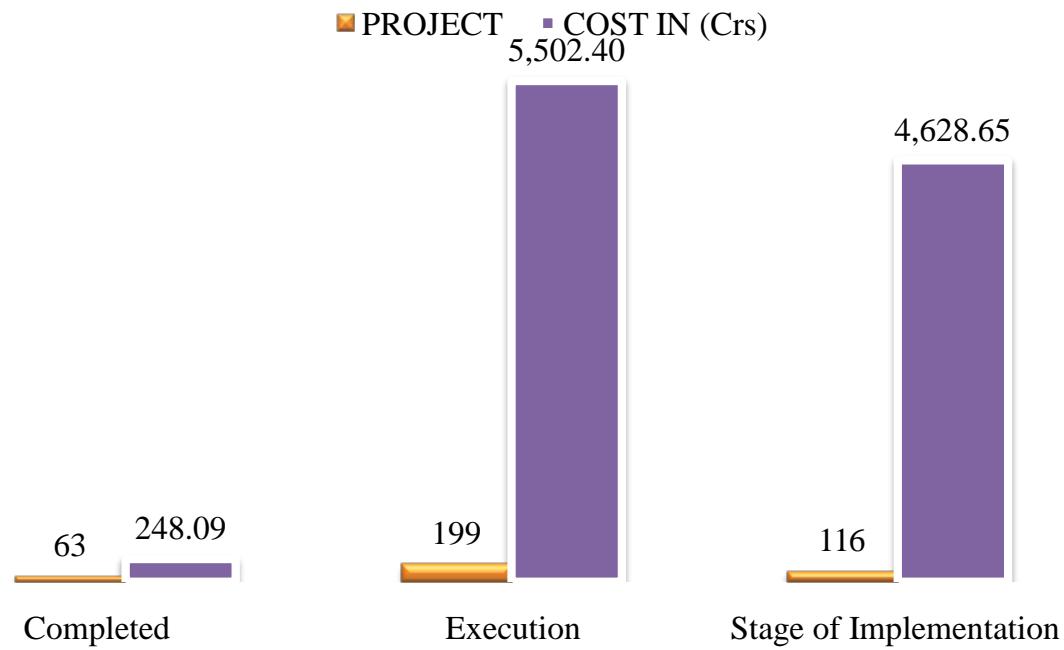
The TUFIDCO Funded to Tamil Nadu for Smart cities project construction Figure - 2
### a) Analysis and Interpretation
Ho2- There is no relationship between digital Transformation and Life style.
Hoa- There is a relationship between digital Transformation and Life style.
Table - 7: One-Way ANOVA
<table><tr><td colspan="9">One-Way ANOVA (Welch's)</td></tr><tr><td colspan="2"></td><td colspan="2">F</td><td colspan="2">df1</td><td colspan="2">df2</td><td>p</td></tr><tr><td>digital Transformation Needed to change the lifestyle</td><td></td><td>1.82</td><td></td><td>4</td><td></td><td>39.6</td><td></td><td>0.144</td></tr><tr><td colspan="9"></td></tr></table>
Interpretation
ANOVA Welch's test table shows that the P value of this analysis 0.144 and its significance value is 0.015. So, the P value is greater than the significant
value is 0.005. As $0.144 > 0.005$ the null hypothesis was accepted. So, there is no association between digital transformation needed to change the lifestyle.
Table - 8
<table><tr><td colspan="9">Homogeneity of Variances Test (Levene's)</td></tr><tr><td colspan="2"></td><td>F</td><td>df1</td><td>df2</td><td colspan="4">p</td></tr><tr><td>Digital Transformation Needed to change the lifestyle</td><td></td><td>13.0</td><td>4</td><td>114</td><td></td><td><.001</td><td></td><td></td></tr></table>
## Interpretation
Homogeneity of variance Test (Levene's) table shows that the P value got as 0.001 and the significant value is 0.005. (ie) The P value is lower than the significant value is lower than the significant value. So, the interpretation of the model would violation of normality.
### b) Findings
- TUFIDCO provides financial assistant to smart cities projects from the source of equality share capital, reserves and surplus, bank borrowings and mobilisation of public deposits, extend funding support to infrastructure development projects in the State.
- TUFIDCO provides financial assistant to various construction projects too.
- Research findings suggest that project quantity does not necessarily correlate with project costs.
- Table - 7 One-Way ANOVA (Welch's) interpret that there is no association between digital transformation needed to change the lifestyle.
- Table - 8 Homogeneity of Variances Test (Levene's) interpret that The P value is lower than the significant value is lower than the significant value. So, the interpretation of the model would violation of normality.
### c) Suggestion
- This study shows that the quantity of the project is not related to the cost which has been spent. Due to the fact that the cost of construction varied from city to city. A building of 200 square feet in Madurai had a higher cost of construction than a building in Chennai with the same square footage.
- As per the analysis technology transformation is not mandatory for the lifestyle.
## XV. CONCLUSION
Due to the ever increasing population levels and sudden population explosion in the cities, the urban challenges they face have become unprecedented. As such, pollution levels, resource scarcity, traffic congestion, and many more are expected to continue to rise. To provide sustainable prosperity to their citizens, cities today face new economic, political, and technological responsibilities. The citizens need to develop their life style. It's essential to act fast as the need to provide a sustainable development of smart cities project. In order to foster the growth of the smart cities projects, TUFICO provides financial assistance. The company lends funds to a diverse range of projects at varying costs. In this study the researcher should concluded that the construction cost was not correlate to the quantity of project. Since each city cost of living is differs. The researcher should focus on the source of fund provided by the company to the government. Lifestyle is not depend on the technology transformation.
Generating HTML Viewer...
References
9 Cites in Article
S Malanga (2004). The Curse of the Creative Class.
Björn Johnson (2008). Cities, systems of innovation and economic development.
J Borja (2007). Universitat Oberta de Catalunya (UOC).
J Marceau (2008). Introduction: Innovation in the city and innovative cities.
D Toppeta (2010). The Smart City Vision: How Innovation and ICT Can Build Smart.
W Mitchell (2000). Digital Cities.
Nicos Komninos (2008). Intelligent Cities and Globalisation of Innovation Networks.
(2012). World Urbanization Prospects 2018: Highlights.
Zelda Bronstein (2009). Industry and the smart city.
No ethics committee approval was required for this article type.
Data Availability
Not applicable for this article.
How to Cite This Article
Dr. K. Karthick. 2026. \u201cSmart Cities Digital Transformation: Funded by Tufidco in Tamil Nadu\u201d. Global Journal of Management and Business Research - B: Economic & Commerce GJMBR-B Volume 23 (GJMBR Volume 23 Issue B3): .
Explore published articles in an immersive Augmented Reality environment. Our platform converts research papers into interactive 3D books, allowing readers to view and interact with content using AR and VR compatible devices.
Your published article is automatically converted into a realistic 3D book. Flip through pages and read research papers in a more engaging and interactive format.
In India the smart cities projects were implemented by Indian government. In Tamil Nadu many states are selected to convert cities into smart cities. TUFIDCO is providing financial assistance to smart cities projects. The digital Transformation is the vital part in smart cities projects. The main aim of Tamil Nadu Urban Finance and Infrastructure Development Corporation Limited mission is to provide financial assistance and guidance to Local Bodies, Corporations, Boards, Authorities, and parastatal agencies for their development projects. An intelligent city refers that provides all the facilities a city needs, such as education, electricity, transportation, green environments, good governance and information technologies. To put it simply, smart cities improve the quality of life. The selected Smart Cities are Chennai, Coimbatore, Madurai, Thanjavur, Salem, Vellore, Tiruppur, Thoothukudi, Tirunelveli, Tiruchirappalli and Erode in Tamil Nadu. Researchers obtain data from secondary sources. In order to carry out this research, the researcher should analyze the
Our website is actively being updated, and changes may occur frequently. Please clear your browser cache if needed. For feedback or error reporting, please email [email protected]
Thank you for connecting with us. We will respond to you shortly.