I. INTRODUCTION
Moose (Alces alces Linnaeus, 1758) is one of the largest animals of the terrestrial fauna of Eurasia and North America. It is the largest member of the deer family (Cervidae), morphologically isolated from other species of the family and is represented by one monotypic genus Alces in the modern fauna Gray, 1821 [1–3]. Currently, the moose lives in Scandinavia, Finland, Eastern Europe, Western Siberia, the Far East (including the northern Chinese territories), and North America (Alaska, Canada, the northern regions of the United States of America) [4].
In English, German, French, Norwegian, Latin and Old Russian, the name of an moose sounds very similar: elk, elch, elan, elg, alces and ellen, respectively, indicating the existence of a common ancient Indo-European name for this animal. The word moose, which is now called elk in North America, is Native American [5].
Moose has a significant body weight – up to 500 kg, precociousness, multiple births, unpretentiousness, the ability to feed on coarse vegetative fodder and large-growth forest grass. It is possible to get various products from elk such as dietary meat, skin, pantocrinum (lossekrin), pantohematogen and horns. Milk, which can only be obtained from moose cows grown under human supervision, is a special product of moose breeding [6].
Attempts at domestication and artificial breeding of moose were made by man repeatedly [7–11]. The attractiveness of introducing this kind of ungulates into livestock is associated with its peaceful nature, high value of carcasses, large size and extraordinary ecological plasticity.
Moose has a number of positive biological qualities favorable for its artificial breeding. Among them are the following: the hierarchy of social organization, the tendency to create groups, the presence of males in the group structure, low level of intraspecific aggression, maturity of newborns, ease of separation of moose calves from cows, ease of domestication, short safety distance, low sensitivity to changes in the environment, low fear, lack of personal space, the absence of the need for special shelters and tolerance for fellow herd members .
II. HISTORY OF MOOSE DOMESTICATION BEFORE THE XX CENTURY
The first written information about the domestication and use of moose abroad refers to Sweden. In the XV century, moose were used in the army [13, 14]; in the XVII century – for the transportation of couriers in sleighs [8], and in the second half of the XIX century in Sweden and the USA – as working (trailing) animals. At the same time, some moose bred successfully in captivity [15].
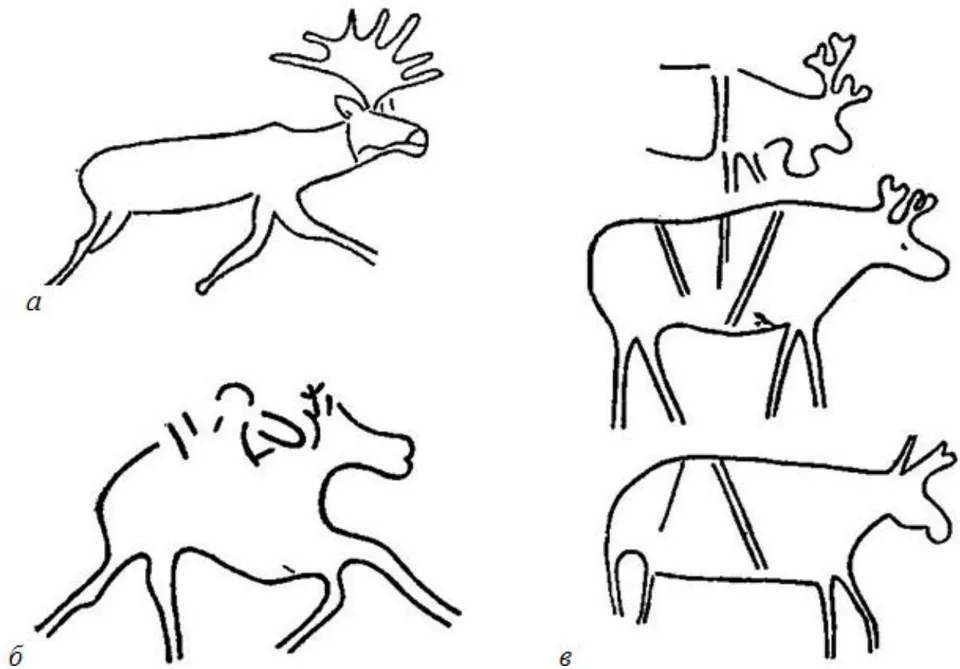
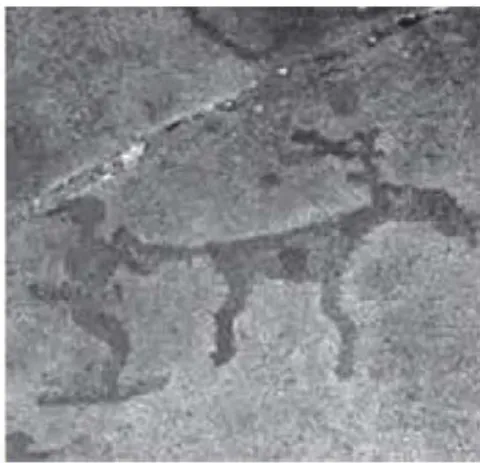
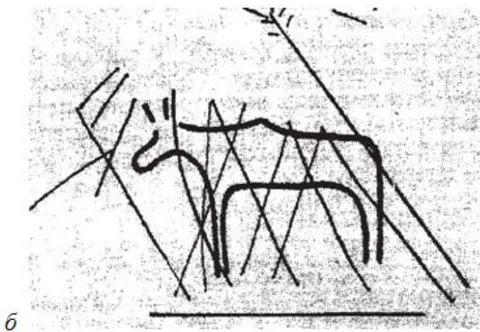
However, in Russia, moose breeding was practiced much earlier: at the end of the stone – the beginning of the Iron Age [9]. This is confirmed by the numerous cave paintings (Fig. 1, 2) found in the Lena, Angara and Yenisei river basins, as well as in Karelia, depicting moose which people graze, lead in halters on the lead, use to ride in sled teams and keep in pens [16].
III. EXPERIENCE IN DOMESTICATION OF MOOSE IN THE XX CENTURY
The resumption of experiments on the domestication of moose was started only in the 20th century, taking into account some features of the mooses lifestyle [20, 21]. The first All-Russian Congress on nature conservation, which was held in Moscow on 01.25.1933 [17], served as the basis for the development of elk farming in Russia. In 1934, the Committee on reserves under the Presidium of the USSR CEC decided to organize moose nurseries in reserves and national parks, where it was supposed to breed and domesticate moose based on the following prerequisites:
by that time, numerous facts of pasturing of moose in the past were already known [13, 22];
the distribution of the moose in swampy and forested areas and its feeding habits made it possible to compete a little with other wild and domestic ungulates;
– confidence that a domestic animal is always more productive than a wild one;
- the idea of being domesticated is to make a wild animal the same as a domestic animal [20].
In 1934, the RSFSR CEC decided to organize moose nurseries in nature reserves. Nurseries are organized in the «Buzuluksky Forest» Reserve and in Western Siberia on the Demyanka River [17]. In 1935, research began to be conducted at the Yakutsk Agricultural Experimental Station, where conditions for the domestication, raising, dressing and breeding of moose in captivity were studied for subsequent transfer of experience to the collective farms. On these moose, the Institute of Polar Agriculture conducted a series of observations, experiments and tests during February-March 1937 [23].
At the same time, in 1936, the Vyskinichsky hunting farm was organized, which was later transformed into the Moose Scientific Experimental Hunting Farm (now the federal nature reserve of the Tarusa State Complex), with the organization of an elk farm. Initially, the farm was part of the Soviet Union People's Commissariat of land management, and in May 1941 it was transferred to the Moscow Fur Institute. The farm was a member of the All-Union Exhibition of Agriculture. It had a staff of 20 people, the necessary buildings and equipment. The number of tame mooses reached 40, of which 20 went in harness [17].
A year later, an moose nursery was established in Serpukhov experimental hunting farm of the Moscow region (Fig. 3), where by 1941 there were 24 moose kept, which were tested for use in teams, under saddle and packs. The farm was adjacent to the Vyskinichsky district (Zhukovsky). It is believed that the Serpukhov experimental hunting farm began to engage in moosebreeding since 1937, and the Vyskinichi farm since 1936. Prof. P.A. Manteifel, Head of the Department of Bio-technique of Moscow Fur Institute, led the work in both farms [24]. During the Great Patriotic War, the German invaders destroyed the farm, shot moose, and burned out buildings [17].
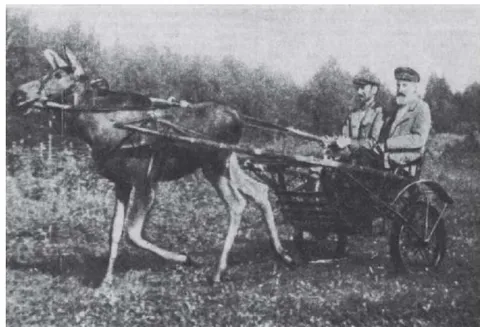
In 1937–1941 moose domestication was carried out in the Buzuluksky Forest Reserve, an island pine forest on the border of the Samara and Orenburg regions. The experimental herd were started from 12 moose calves, caught in nature and raised at the farm. In the reserve, moose were used not only for sledding, but also for horseback riding. However, in contrast to the experience of Serpukhov moose farm animals were kept on the free-grazing [25, 26].
In 1949, by order of the Council of Ministers of the RSFSR, the first experimental moose farm was created in the Pechora-Ilychsky Reserve [19]. Its ultimate goal was to breed for the taiga landscape zone the same specialized domestic animal as the reindeer is for the tundra, yak for the highlands, and camel for the desert. Artificial breeding of moose on a farm in the Pechora-Ilych Reserve began with the acquisition of an experimental herd. For this purpose, the moose calves were caught at a very early age, since the older the calves, the shyer they are of a person and the harder it is to tame them. For this purpose, the most suitable were moose calves aged no more than three days.
The main tasks that were solved by the researchers were to clarify the specific features of the biology of moose, necessary for feeding, keeping and raising animals caught in the taiga. The method of work was simple: year-round observations were conducted in nature; annual and daily cycles of wild moose kept in large pens in conditions close to natural ones where wild caught mooses were tamed and raised.
After the biology of moose was studied and the mode of feeding, keeping and raising animals in artificial conditions was developed, the researchers began to solve the next block of problems. The main tasks were to achieve the viability and normal breeding of mooses while keeping them in an open-air cage, to clarify the prospects for the economic use of domesticated mooses and to justify the profitability of moose breeding. At the moose farm, a system of manual feeding of moose calves was established. Also, they studied questions of moose physiology, feeding and behavior of moose. They began to milk the moose cows, and studied the milk production and the quality of moose milk. In addition, moose began to be used as a transport animal .
In 1949–1951, the moose population was staffed mainly by wild moose calves. Since 1949, the first tame moose cows began to breed. By 1952, there were 29 moose on the farm. Since 1960, the moose farm began to carry out breeding work, the purpose of which was to obtain meat and dairy, as well as working animals (Fig. 4).
During the existence of the moose farm, 174 moose were obtained and reared, of which 61 were caught in nature and 113 brought tame moose cows. As a result of the activity of the moose farm, some aspects of moose biology were studied and clarified, which were still unclear, the main economic qualities of the moose were established, as well as the possibilities and ways of its practical use. For the twenty-year period, among the moose raised there were already individuals of the fourth generation.
The meat productivity of animals was also studied there, which supplemented the data obtained by employees in the areas directly adjacent to the Pechorallychsky Reserve. About 7–8 months old moose grown on the farm reached 140–180 kg of live weight. The mass of adult females was 350–467 kg. Adult males weighed 480 kg. One male castrate reached record weight, with a relatively small size its mass reached 500 kg. The slaughter yield of moose carcasses, depending on age, sex and time of slaughter, was 50–70% of live weight. Adult animals, shot before the rut and in its beginning, had higher than average fatness. Males lost 20% of their weight over the rut period and had low fatness by winter. Castrated males maintained high fatness throughout the winter.
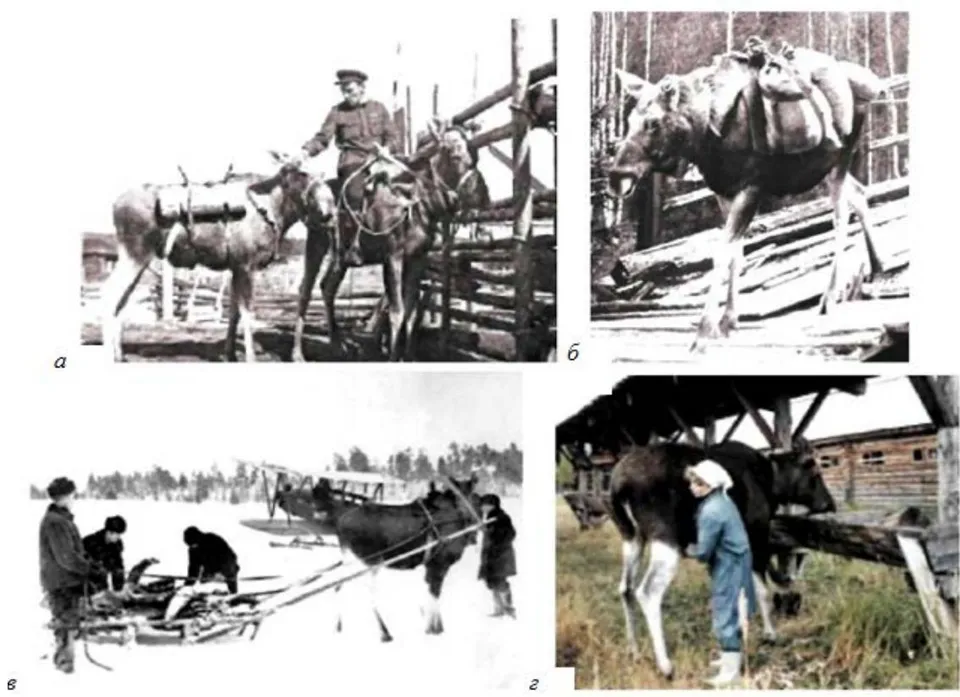
On the farm, milk was received from moose cows. Milk productivity was tested in 13 cows, some of which gave milk for eight seasons. Moose calves were collected immediately after birth and fed moose or cow's milk, and moose cows were transferred to manual milking. The maximum milk yield for lactation (milk yield from calving to rut) in moose cows that gave birth for the first time reached 52–78 kg, and in elder moose – up to 203.84 kg. The maximum daily yield reached 3.12 kg. An increase in the multiplicity of milking increased the amount of milk produced to 288.08 kg for heifers and to 447.2 kg for elder moose cows.
At the elk farm, all the moose calves in the first and second year of life underwent training: standing on a leash, walking about, in harness and under the saddle. From the number of neutered moose, individuals were obtained that are not inferior to the average horse in the work of transporting cargo by pack, on sleds and under a saddle. In the sleigh cart, elk transported 400–500 kg, under a pack – 80–120 kg.
In 1963–1965, an experimental moose farm was established at the Kostroma SAES [32]. In 1968, five heads of young stock were brought from the Pechorallychsky Reserve and in 1972 the first managed group of moose calves was established. Scientific management was carried out by a specially created laboratory of moose breeding (Smirnov, 2015), which was eliminated in 1992 [26]. In parallel, several moose farms were established near Gorky, Yaroslavl, Vologda, Leningrad and in a number of other places, but then they were disappeared.
Since 1974, on the instructions of SCST USSR, the Kostroma SAES began research work on the topic, «Development technology for keeping, feeding, domestication of moose and the use the moose products in national economy». Scientists from more than 20 scientific organizations were involved in this work. The main stages of taming the moose were: artificial rearing of young stock, group domestication and the formation of herds with the subsequent management of their grazing and zootechnical work. Bred moose grazed year-round on forest pastures, which alternated. Up to 45 individual animals grazed on
200 hectares of forest. Animals used low-value food species: willow, mountain ash, aspen, while the landing of spruce and pine were protected.
Subsequently, the Kostroma moose farm was transformed into the «Moose Complex», which included an moose farm with a protected zone, a special hunting farm and a forestry. N.V. Sokolov and the head of the laboratory A.P. Mikhailov [34] managed the complex.
Currently, the number of moose on the Kostroma moose farm is calculated in April before the beginning of the period of delivery. The average annual population from 1966 to 2004 was 24.8 [35]. Since 1976, the number of mature females on the farm has fluctuated around an average of about 16 individuals, and these fluctuations correlate with changes in the total number of mooses in Russia (the correlation coefficient is 0.57) and changes in their numbers in the Kostroma region (the correlation coefficient is 0.47) [36]. The average fertility rates of moose cows at this farm exceed the average for Russia [37].
By the beginning of the XXI century, ration and mode of moose keeping were developed, as well as a system of preventive measures that ensured the survival of 85 to of moose calves in the first year of life [38]. The practical significance of modern moose-breeding is that without the domestication of moose, the existence of this industry is impossible. Only domestication allows milk obtaining [39]. On average, one moose cow can give up to of milk per lactation, or more than 5 tons per life [40].
Thanks to the research of V.M. Dzhurovich, moose milk has found its application in medicine . It is used in the treatment of gastric ulcer, duodenal ulcer and gastritis, contributes to the treatment of dysbacteriosis, Hodgkin's disease, leukemia and other neoplastic diseases . In the near future, the possibility of using moose milk as baby food and food for people working in extreme conditions is considered .
To date, cost-effective technology has been developed for the maintenance, breeding and reproduction of moose in semi-wilderness conditions . The system of comprehensive assessment of breeding and productive qualities of domesticated moose allows for a more objective and effective selection of animals with given parameters and forming a herd capable of obtaining healthy moose calves with their increased survivability, increase the milk production of moose cows with a high content of milk fat, protein and lysozyme .
IV. CURRENT STATUS OF THE QUESTION
However, it should be noted that the domestication of moose has so far proceeded without any understanding of the essence of this process [20]. In their work, researchers were guided only by the principle of similarity, calling domesticated animals that are not afraid of man, come to the place where they were raised, allow themselves to be milked and harness. In fact, such moose differ from wild animals only by their changed ontogenesis behavior [48].
Tame moose are fed, protected from predators, kept at a higher density than wild, and faced strong stimuli. In principle, these changes in the environment could be enough for the manifestation and selection of certain features of behavior and physiology, especially the rhythms and seasonality of reproduction. The work is mainly devoted to the development of methods for mastering these animals, obtaining products from them, managing their ecology and behavior as one of the initial stages of domestication .
At the level of Academician D.K. Belyaev research, the problem of domestication of moose has not been posed or even discussed. Therefore, in 2007, the authors began a study of the biological characteristics of animals from the Kostroma elk farm (the moose farm of the Sumarokovsky State Nature Reserve), taking into account the basic principles of the theory of destabilizing selection [49].
In the course of the research, it was found that moose with pedigrees of 15–20 generations of breeding under the control of man show altered forms of behavior characteristic of domesticated animals. These include: an active-positive reaction to a person outside the aviary and outside visitors to the moose farm, the moose cow's tendency to be in a group, and the phenomenon of the constant presence of one adult male in a group of cows outside the rut period [48, 50, 51].
An increase in the average fecundity of moose cow families from 0.94 to 1.99 calves per female was established, as well as increase in the number of triplets. This is probably due to abundant feeding and artificial selection for fertility [51]. The average lactation duration of moose cows increased slightly (from 130 to 135 days). Moose cows with an increased level of milk production (over 200 kg of milk per lactation) were identified. Their share was 17% of the total number of dairy cows [48].
A polymorphism of coat color was detected in individual animals (four types). The most numerous abberants had pale ticks on wool with a diameter of up to 1.5–2.0 cm on the front of the head, shoulders and rump, dark (larger diameter) spotting – in the knees of the hind legs and clarified throughout the frontal part of the head (Fig. 5) [53].
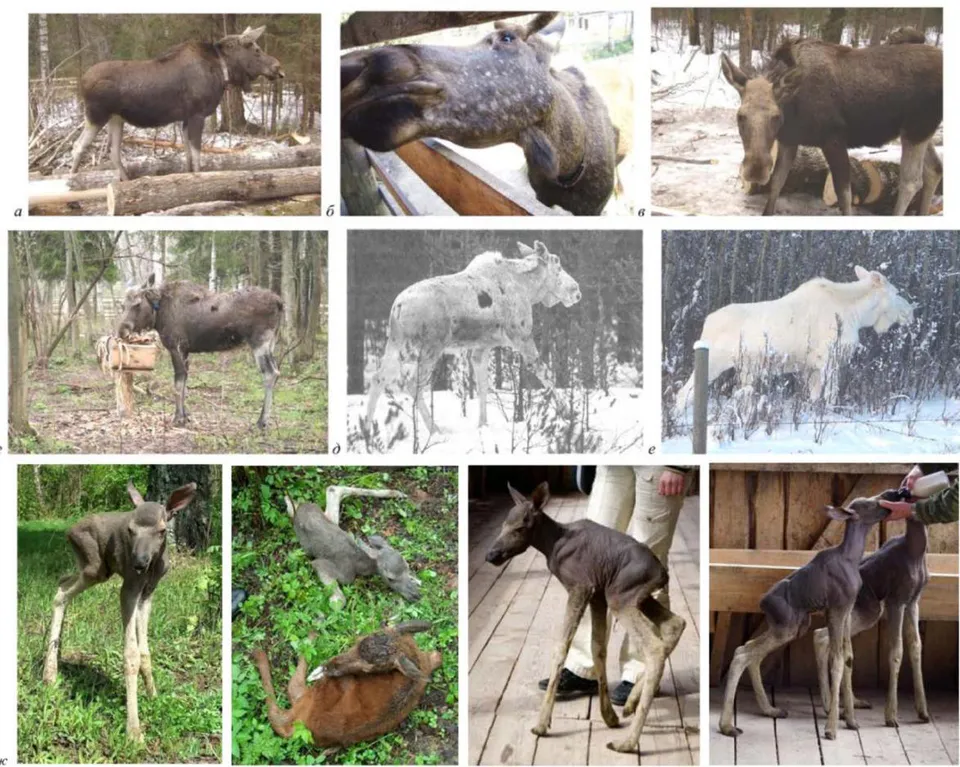
The connection of new phenotypes with the live weight indicators of moose calves at birth, reproductive ability and milk productivity (p<0.05) was established. The average reproductive capacity of moose with piebald wool was about 2 times higher than those with the wild-type wool. The annual milk production of piebald lactating cows was also more than 2 times higher [48, 54].
Among moose with spotted coat color, prevailed (75%) animals with a calmly alert reaction to personnel, and among moose with other types of coloring, there was an active positive reaction to visitors outside the farm enclosure. Probably, new phenotypes are an external manifestation of positively related traits fixed by artificial selection.
The allele pool of 6 loci of microsatellites derived from moose DNA was also studied. The genetic diversity of the breeding population on the Sumarokovsky State Nature Reserve moose farm was determined by the level of heterozygosity of each locus, and the overall level of population diversity was shown [55] and features views of evolution in Eurasia [56].
V. CONCLUSION
Thus, in mooses, as a result of prolonged semi-captive breeding over 15–20 generations, there was a change in behavioral and morphophysiological traits that distinguish them from wild animals. Establishing a breeding control system using modern methods of genodiagnostics and population-genetic analysis is a necessary tool for controlling domestic signs in artificially bred moose groups.
Over time, when breeding for an active-positive reaction to humans, polymorphism of color and high fecundity, controlled by means of genodiagnostics, it is hoped that Russian scientists will be able to obtain a group of moose that will meet the requirements for its inclusion in the State Register of Domesticated Animal Species.
List of Abbreviations CEC– Central Executive Committee; USSR – Union of Soviet Socialist Republics; RSFSR– Russian Soviet Federative Socialist Republic; MA – Ministry of Agriculture; SAES – State Agricultural Experiment Station; SCST USSR – State Committee on Science and Technology of USSR.