



I. INTRODUCTION
In Discover's April 1992 issue story, Time Travel Redux by David H. Freedman,[1] Yakir Aharonov related his theoretical idea for a time machine that would marry quantum measurements with general relativity via the operation of a huge balloon with the capability of rapid inflation and deflation. To quote Freedman, "Aharonov determined that once in a very great while the simultaneous tiny distortions of time can add up to one enormous distortion in one direction or the other. Any two particular sizes for the balloon, determined by two observations of the particle, are like the two possible paths for the electron in the two-slit experiment...Quantum mechanically they affect each other."
Essentially, the observation of the quantum measurements would affect the balloon's rate and amount of deflation and inflation, thus affecting the flow of time inside the balloon. The back and forth would basically create resonance effects with extreme peaks and troughs until a super trough would correspond to time running backward and a superpeak would be like being flung into the future.
Admittedly, Aharonov saw this as just theoretical although Freedman noted that "Aharonov says it's not all that unlikely that someone might think of a way to construct a small, simplified version of the time-translation experiment that would send particles into their own future or past."
A version of this experiment has actually been done, removing the previously incorporated aspects of general relativity, and relying solely on the quantum measurement aspect along with some inspiration that didn't appear until three years after Aharonov's idea. Reported on in New Scientist magazine by John Gribbin in 1995[2] and later published in the journal Foundations of Physics in 1997[3], German astrophysicist Rainer Plaga proposed an experiment to prove the many-worlds interpretation of quantum mechanics by Hugh Everett, known properly as the Relative State interpretation of quantum mechanics[4]. Ostensibly in the experiment, the result would be an effect without cause - "a polarised photon is sent through a polarising filter in such a way that there is a 50:50 chance that it will be transmitted. In the "many worlds" interpretation, the experiment creates two parallel universes, "one in which the photon is detected on the other side of the filter, and one in which it is not."
According to Gribbin, Plaga suggests, "if the photon is detected, a laser pulse would automatically be fired into an ion stored in a magnetic trap. This will excite the ion into an energetic state. But according to the many worlds interpretation, there is a finite chance that within a few seconds of the experiment beginning, the counterpart to the ion in the version of reality where the photon did not pass through the filter – and so did not trigger the laser pulse – will be excited by its quantum entanglement with the other version of reality."
So an experimenter could find the ion excited even though no photon was detected due to the laser triggered in the "world next door."
No one ever performed Plaga's experiment, so for years it was just a curious thought until my research into resolving issues in the nature of time - stemming from Wheeler style delayed choice experiments and inherent temporal paradoxes looked over in assumptions of the many-worlds interpretation applied to time travel. That problem had to do with the idea that time travel to the past puts you in the past of a parallel universe, which has been assumed to avoid paradoxes. But temporal mechanics rules that out because it just creates a new paradox due to the fact you weren't in the past of that universe either.
Simultaneously, with delayed choice experiments there is a paradox which is oftentimes glossed over because the which-way-path selection is said to change the past of the particle in question which was launched along a different path whose detector it never arrived at.
However, that interpretation violates the Copenhagen interpretation which holds there is only one outcome per measurement. Knowing which path a photon takes qualifies as a measurement and changing the path after it's already gone, could be seen as changing the past unless you see it as changing the present into a new one with a different past.
As Freedman stated, "Aharonov's balloon is more than just an exotic version of Schrödinger's cat" and in that example the cat is both dead and alive until it's observed and with the many-worlds version, the cat's state is split into two alternate worlds, one per state. My reinterpretation of the delayed choice does the same with decoherence taking place as a result of the observation of the which-way-path split. Raising the process to the macroscopic level and using laser pulses, I was able to record the same type of discontinuous results as predicted by Plaga.
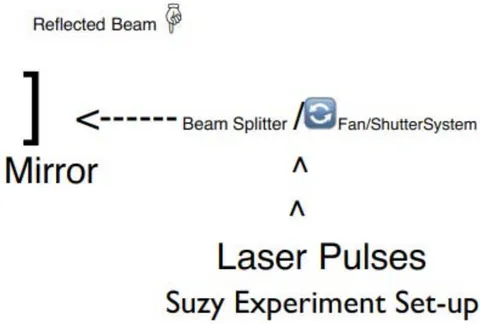
Below is a diagram showing the basic configuration for what I have been calling a "RetroWorldality" experiment, to differentiate from the typical retrocausality or which-way-path set-up. It includes a laser pointer as the laser source, which is easy to pulse, a beam splitter, a fan used as a which-way-path shutter system and a MacBook Pro camera using the Photobooth program that makes a recording of the experiment that is not editable - providing a frame by frame analysis as well as proof of originality.
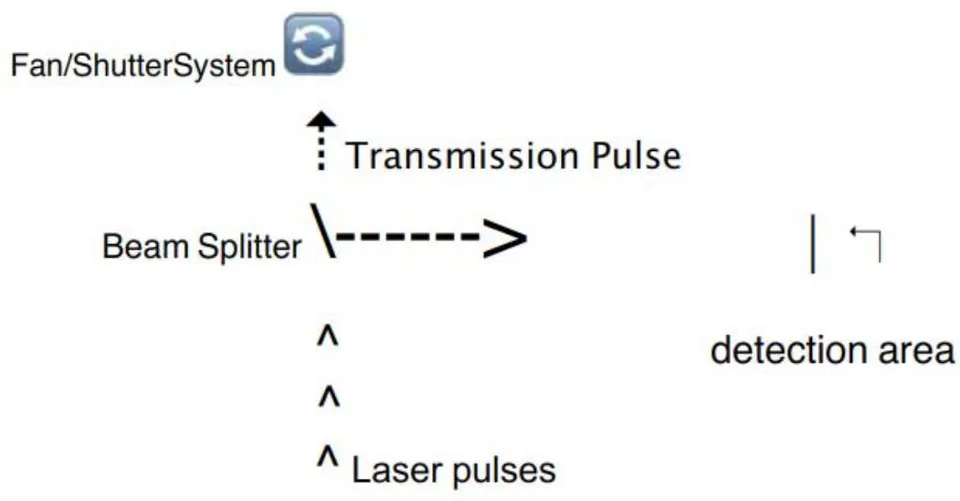
Rachel RetroWorldality Test Set-Up
Fig. 1: Diagram shows the flow path of laser pulses to beam splitter where reflected pulses go right to the detection area and transmitted pulses head on to the fan/shutter system providing which-way-path change
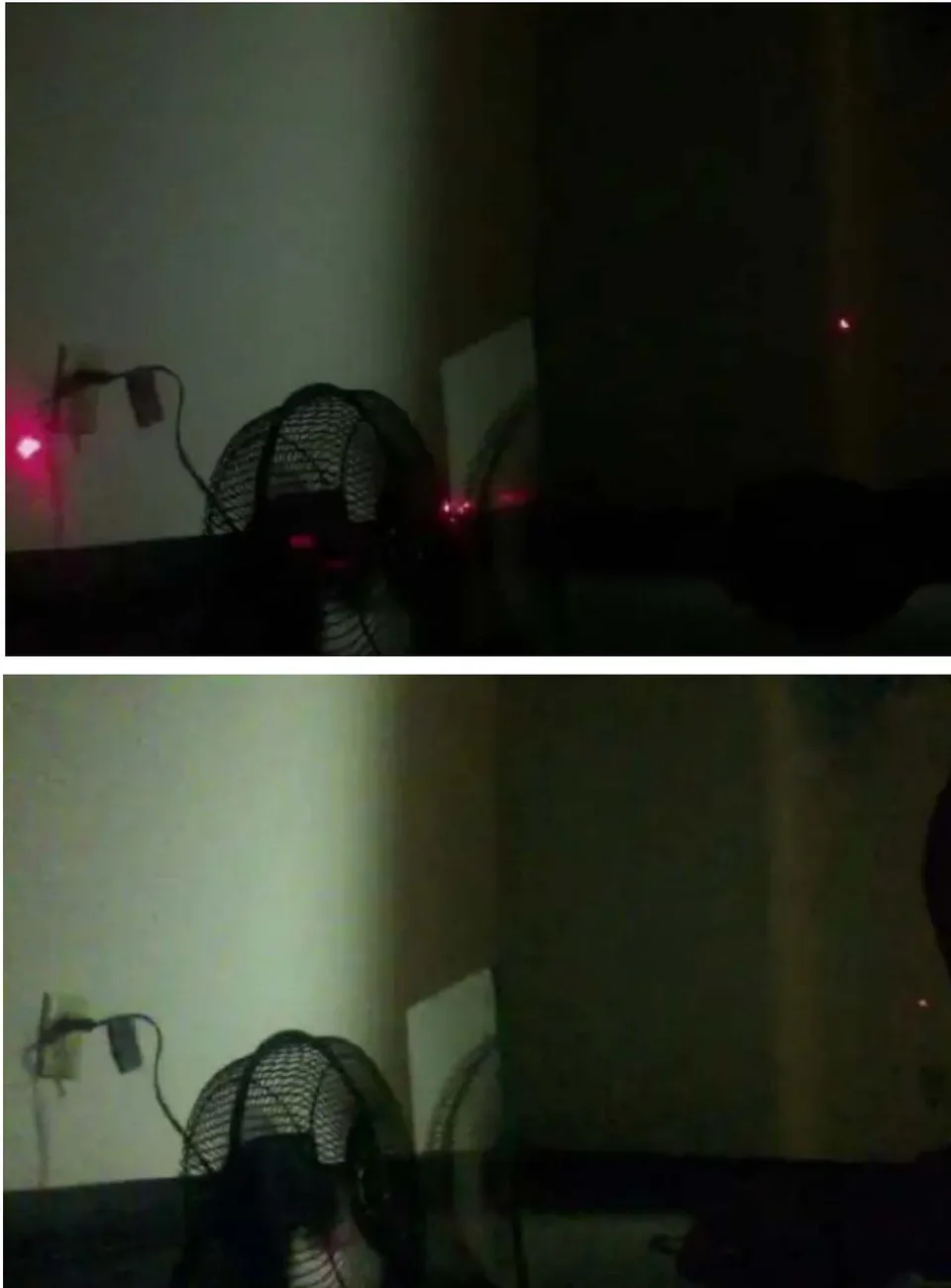
Furthermore, by filming the experiment as required, in order to analyze the results frame by frame, a key element from Wheeler has emerged - evidence for the Participatory Universe model. Repeatedly, in discussing his model of the universe as a whole, Wheeler saw it as aware on some level and able to respond to what he called questions or interrogations. As in Discover's Tim Folger article, Does the Universe Exist If We Aren't Looking?[5], "Wheeler's hunch is that the universe is built like an enormous feedback loop, a loop in which we contribute to the ongoing creation of not just the present and the future but the past as well."
In all versions of the experiment, when the anomalous laser hits occur, there is no pulse that appears from nowhere, there is just a hit. In other words, not only is there no laser being fired as per Plaga's prediction, but there is no laser pulse that appears for nowhere - just a hit. A special experiment was devised to determine what was happening, called Suzy. So, as if responding to the question, 'what happens if we attempt to change the past', we get the answer - the new result is at the detection area in a new parallel universe copy of the present.
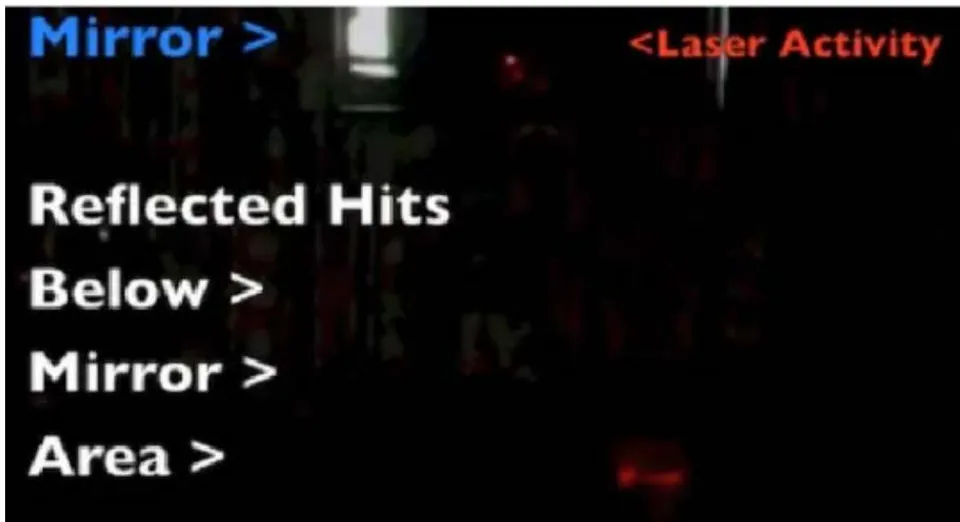
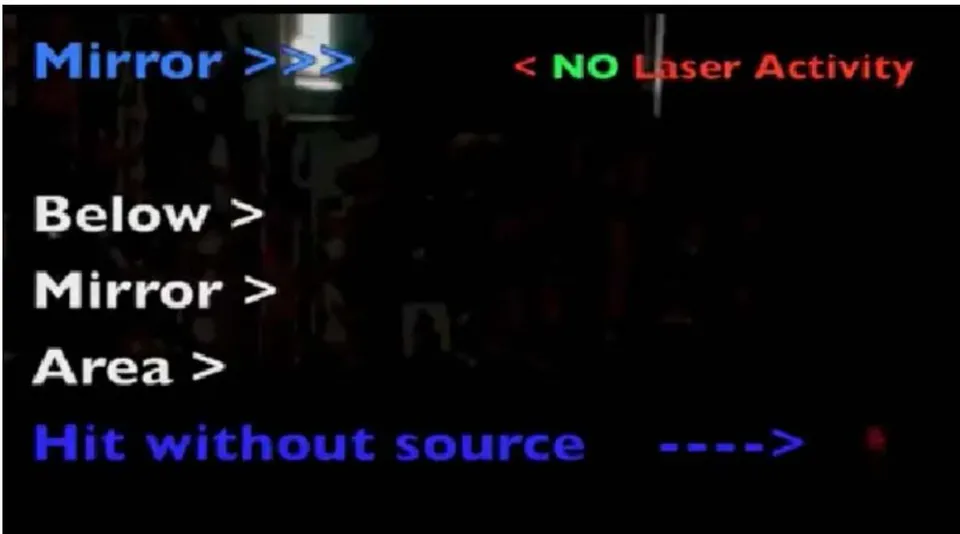
The linkage here is clear. In regards to a galactic version of Wheeler's delayed choice experiment, where scientists play with detecting photons that have reached them via gravitational lensing around a quasar, Folger wrote, "In one case the astronomers create a past in which a photon took both possible routes from the quasar to Earth." Emphasis on "astronomers create a past".
Although due to the uncertainty inherent in using the fan/shutter system - because it's impossible to know when a pulse will pass through with the right timing to trigger the retrocausal effect (and I've yet to see that written in any paper on it) it does happen, which produces its own probability cloud. But to perform an experiment that would be a specific test of the many-worlds by producing a set number of possible outcomes, I invented the Aharonov Optical Manifold as a tool to use to produce quantum measurements as Aharonov visualized using his theoretical time machine. The AOM is any device that will produce multiple hits when a laser is fired through it but will allow the laser to pass on.
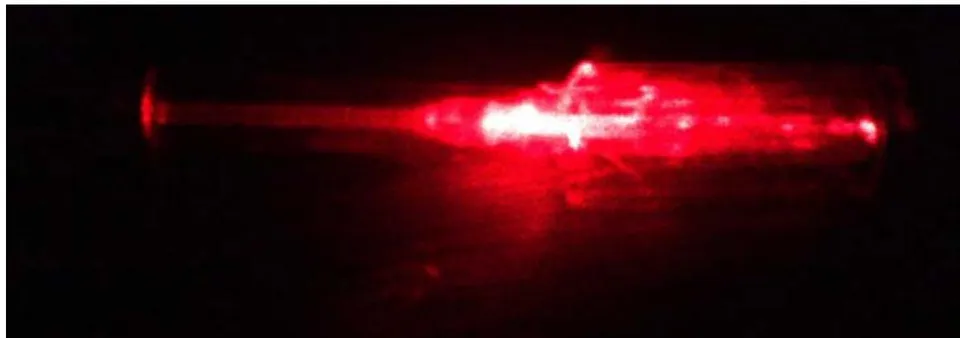
So an elaborate experiment was conducted that not only would test the many-worlds interpretation but the idea posited by less than a handful of rank amatuer physicists, that shutter roll was producing the anomalous results. Strobe lights were set so their muted flashes would show-up on camera within the same frame as the laser action. Positive results would be one anomalous hit within the AOM at a time and not in the same place each time, indicating that hits that weren't observed were being seen in other worlds "next door". That's what happened every time.
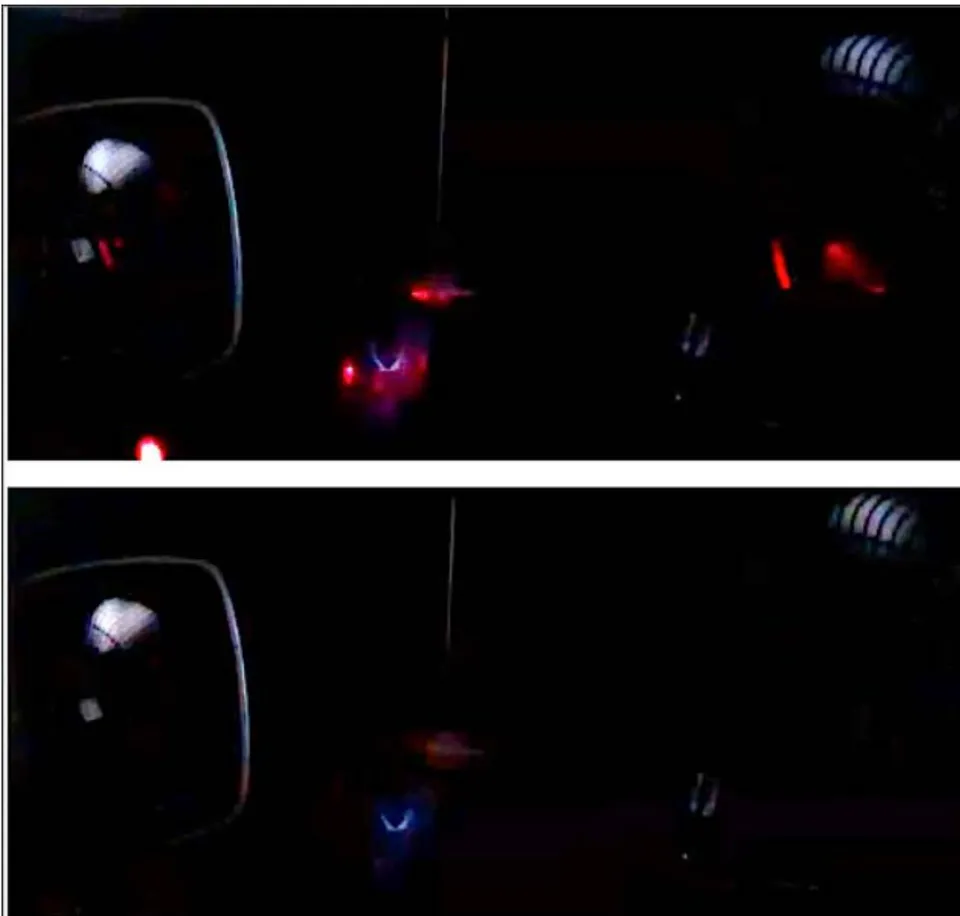
So there is no question about the many-worlds being the truth because as Cern's Mir Faizal said, since there was no possible experiment to prove it, it was just philosophy and not physics[6], but that's no longer the case. There is now a more demonstrable understanding of it and how it fits demonstrably with other concepts from the cutting edge of physics. The next move is finding the links between this world and others so that the difference becomes more dramatic and can be moved in terms of what constitutes those results, knowing that eventually the goal is not to change the past for a new present but change the present for a specific target, as Aharonov visualized for his quantum balloon and the person inside, into a copy of the past.
As Wheeler believed, everything is information - 'it from bit' which can be manipulated via quantum mechanics. Those astronomers changing the past of how a photon got here from billions of years ago, instead executing the juxtaposition of where they are now with the past of some target. That resultant will be the first functioning example of time travel as predicted by Neil Turok of Canada's Perimeter Institute[7].
II. CONCLUSION
By creating an Aharonov Optical Manifold as an ignition source, and incorporated into a yet to be determined configuration using decoherence a la Plaga's experiment idea is assured. The key is to observe a different outcome, aside from the laser hits. By linking the alternative outcome to a different reality or, on the most advanced level - a copy of a different time, then the next leap will have been accomplished in the expansion of the frontiers of physics and the implied outcomes that await.


