
I. INTRODUCTION
In recent years glasses are receiving significant attention due to their unique properties like hardness, good strength, transparency, excellent corrosion resistance. Hence much attention has been paid in research to oxide glasses doped with transition metal ions due to their technological importance in the development of tunable solid-state lasers and new luminescence materials.
The glass composition is doped with different concentrations of TiO2 Among the oxide glasses, borosilicate glasses are especially attractive because they have many and diverse applications. They generally have lower thermal expansion values, chemical resistance, high dielectric strength, high softening temperatures than other commercial glasses. For this reason, they are used as glassware and also used in industrial piping, bulbs or hot lamps. Thus, they are having a wide range of applicability. Recent studies prove that they can also take a role in the immobilization of nuclear waste to perform bioactivity . is considered as a basic glass former because it has a lower heat of fusion, cation size, higher bond strength. In general, the high bond strength of B-O bonds in leads to the high field strength of and make these borates as very stable glasses. Boron is recognized as it has more than one stable configuration i.e., boron triangles and tetrahedrally coordinated in the glass matrix [3, 4]. On the other hand, silica attracts attention due to its long infrared cutoff along with higher chemical and thermal stability as compared to the containing glasses [5]. Vitreous has a higher glass transition temperature ( ) and softening temperature ( ) due to higher network connectivity and hence higher amount of bridging oxygen [6]. is a common flux, reduces the dispensation temperature and changes the properties of glass. On the other hand, PbO addition to its glass composition ensures an improvement of the chemical durability and enhances the resistance against diversification [7]. The presence of in the glass matrix makes the glasses more resistant to attack by alkali metal ions like and . is entering into the glass network with structural units that crosslink the neighboring borate and silicate chains. is often used to modify the glass structure, which improves chemical stability and physical properties. The ions not only affect thermo-mechanical properties, but also laser properties. mixed borosilicate glasses are being widely used in industrial applications as sealing materials, separators in batteries, precession mirror-blanks for space, microwave cavities, and dental cement components on the whole, the glass properties are related to its inter-atomic forces and as well as the potential of the local structure. Therefore, the addition of modifier and intermediate oxides can introduce change in the local structure and as well as the energy band gap. Variation in optical absorption and its relationship with structure is one of the important parameters for glasses.
Borosilicate glasses have been widely used in many applications such as semiconductor technology, optical communications and other areas of electronics [8-10]. The properties of borosilicate glasses include chemical and thermal resistance in various fields such as electronic displays, house hold glasses and optoelectronics, sealing glasses to nuclear waste immobilization and also as a construction material. Moreover, these materials have excellent optical clarity, low electrical conductivity, low thermal expansion coefficient, good UV transparency and low susceptibility.
Hence these glasses are used as lenses in high-quality flash lights and astronomical reflecting telescope [11].
Oxide glasses containing transition metal ions (TMI) [12, 13] are of interest because of their applicability in memory switching, electrical threshold, and optical switching devices, etc.,[14]. The nature of these glasses is due to the presence of two valence states of the transition metal ions [12, 13, 15]. By altering the chemical composition of glass by incorporating the transition metal (TM) ions into the network can change its local environment leading to in-homogeneities in the crystal field around the transition metal ion. These structural modifications may be well reflected in the EPR and optical absorption spectra of the TM ions.
Glasses containing titanium have gained much importance in recent years due to their possible applications in non-linear optical devices such as ultra-fastswitch and power limiter 100 [16, 17]. Titanium oxide is considered as a nucleating agent of crystallization in the amorphous materials. However, the presence of small quantities of in the glass matrix is observed to enhance the glass-forming ability and chemical durability of the glasses [18]. In general, the ions of titanium exist in the glass network states in state and participate in the glass network forming with , and sometimes (comprising of trigonal bi-pyramids) structural units [19, 20]. However, there reports suggesting that these ions may also exist in state in some of the glass networks [16]. The empty or unfilled d-shells of titanium ions contribute more strongly to the non-linear polarizabilities. Usually, the d-orbital contribution to non-linear polarizability is found to be more for bond lengths less than [17]. The bond length of Ti-O is estimated to be . Aliterature survey on the glasses containing indicates that these glasses possess a negative non-linear refractive index that induces a self-focusing radiation beam in the material; as a result, the devices can be operated at a smaller input power [21]. Further, the investigation on the coordinate chemistry of ions in alkali alumino borosilicate glass network is of interest in itself because these ions are expected to influence the physical properties of the glasses to a large extent. EPR spectroscopy can be used to determine the ratio of different valence states in these glass systems [22]. Optical absorption studies of glasses give rise to ligand field absorption energies, which sensitively reflect the distortion of the cubic, octahedral, tetrahedral coordination. The spectroscopic investigation of titanium bearing glasses taken with a view to understand the site symmetry of the metal ion, oxidation state and splitting of energy levels. In the present matrix, four samples of composition with and (mol%) were prepared and their specific spectroscopic properties were studied. The details of the composition are as follows:
II. MATERIALS AND METHODS
a) Glass preparation
The glass samples are prepared by conventional melt quenching method using analar grade chemicals of , PbO, , , and as starting materials with 99.9% purity. The raw materials are thoroughly mixed in an agate mortar and the homogenized mixture was transferred into a silica crucible. The compositions of the materials are melting in the air in silica crucibles in an electric furnace at temperature for 20 min until a bubble-free liquid is formed. At the end of the melting process in order to obtain homogeneous glass, the melts are poured on brass mold and subsequently annealed at for 8hrs and cooled slowly to release the thermal stress. The glass matrix obtained is transparent and colorless. The samples are then ground and optically polished.
b) Measurements
The amorphous nature of the prepared glass was confirmed by an X-ray powder diffractometer (XRD) on XRD-6100 SHIMADZU X-Ray diffract meter in the scanning range of 10-80° (2θ) using Cu Kα radiation having a wavelength of 1.5406 Å at room temperature. The Optical absorption spectra of glass samples are recorded using JASCO V-670 UV-vis-Spectrophotomètrein the wavelength region of 200-1200 nm. The EPR spectra are recorded for all glass samples at the X-band using JOEL JES-FA200 EPR Spectrometer with 100 KHz field modulation at room temperature. The Fourier transform infrared transmission spectra of different prepared glasses are measured using the KBr pellet method on SHIMADZU-IR Affinity-1S FT-IR spectrophotometer in the region of 4000-400 cm−1 wave number range. The density of the samples was determined to an accuracy of ± 0.001 by standard Archimedes' principle by using O-xylene (99.99% pure) as a buoyant liquid with VIBRA HT density measurement kit and some other physical parameters are also evaluated.
III. RESULTS AND DISCUSSION
a) Physical parameters
Fig. 1 shows the variation of density (d) and molar volume of these glasses as a function of content. It is clear from this Fig. 1 that, with increasing , density increases and molar volume decreases. The physical parameters shows that, the variation of density (d) and calculated average molecular weight, various physical parameters such as titanium ion concentration ( ), molar volume ( ), mean titanium ion separation ( ) and polaron radius ( ) are evaluated using conventional formulae and the values obtained are listed in Table 1.
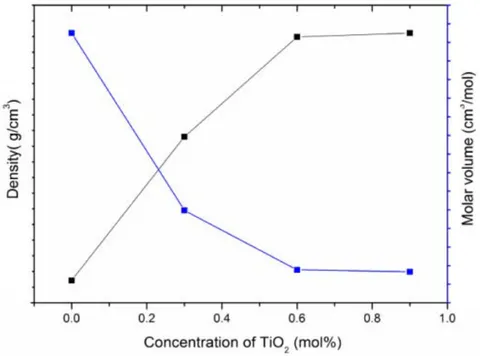
Density is an influential property capable of exploring the changes in the glasses. Density is affected by the softening/compactness, change in geometrical configuration, coordination number, cross-link density and dimensions of interstitial spaces of the glass. Thus, the addition of any transition metal ions to the glass leads to a linear or nonlinear variation, i.e., either increase or decrease in the density with changing composition [23]. It is clear from this figure that, with increasing , density increases and molar volume decreases with additions. The sample exhibited a higher density 3.022 than the sample of density 2.997 g/cm . This slight decrease in the density of the sample when compared to the sample may be attributed to the volume expansion due to the formation of the octahedral structural unit in the glass network. This could further be confirmed through FT -IR measurements of the glasses [24].
| Parameters | Pure | |||
| Density (g/cm3) | 2.960 | 2.987 | 2.997 | 3.022 |
| Molar volume | 29.854 | 29.562 | 29.440 | 29.175 |
| Ion.Conc (Ni)x | - | 0.6112 | 1.2277 | 1.858 |
| Inter ionic distance (Å) | - | 0.2306 | 0.1725 | 0.1510 |
| Refractive index | 1.653 | 1.654 | 1.655 | 1.656 |
| Polaron radius (Å) | - | 0.1043 | 0.0822 | 0.0715 |
| Optical Basicity | 0.4296 | 0.4298 | 0.4299 | 0.4300 |
b) X-ray diffraction (XRD) studies
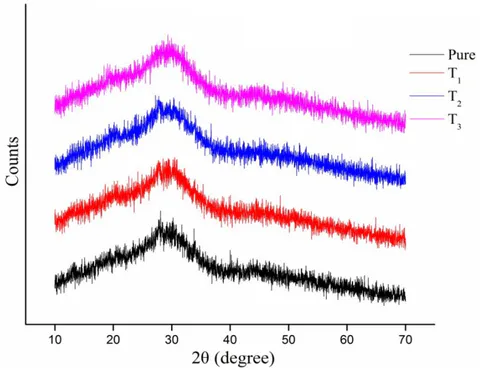
The powdered XRD patterns for the prepared glass samples are presented in Fig. 2. These patterns confirmed the glassy nature of the samples with broad peaks at values around and are free from any detectable crystalline phases [25].
c) Fourier transform infrared (FT-IR) spectroscopy
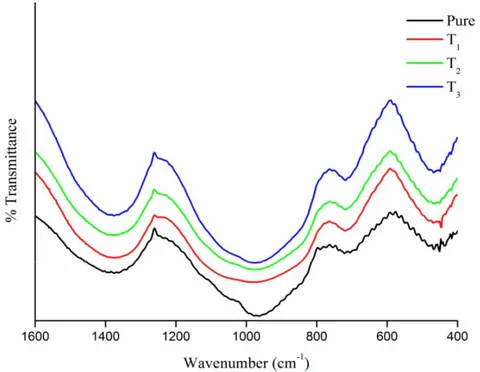
From Fig. 3, the FT-IR spectra of free glass show four visible bands. The band at about is due to Si-O-Si asymmetric vibration and the small shoulder at is attributed to bending vibration of B-O-B in triangles [26, 27] is observed. The main intense band at is due to the combined stretching vibrations of Si-O-Si and B-O-B network of tetrahedral structural units [28]. Here the distinguished feature of glass samples is the shift of the broad band at , indicating that exists in octahedral coordination. A strong absorption band at is attributed to the B-O stretching vibration of triangles (characteristic for group) [29]. With the addition of content, the frequency of the band between 850 and 1100 cm exhibits a shift to lower wave number and the width becomes wide by decreasing content. While the frequency of the band at around 1375 cm does not have any changes with the decreasing content. It may be worth mentioning here that the earlier studies on the IR spectra of various other glasses containing indicate the presence of a vibration band at about 769 cm due to vibrations groups. Hence, there is a possibility for the formation of single boron-oxygen-titanium framework in the glass network. In addition, the spectrum of glass exhibited a single well-resolved band at 710 cm due to B-O-Ti linkages. The summary of the data on the position of various band head in the doped NPABS glasses are presented in Table 2.
| Pure | Assignment | |||
| 453 | 454 | 459 | 463 | Asymmetric Vibration of Si-O-Si |
| 714 | 716 | 718 | 720 | Bending Vibration of B-O-Bin [ ] triangles |
| - | - | 765 | - | B-O-Ti groups |
| - | - | - | 787 | groups |
| 969 | 976 | 981 | 982 | Combined Stretching Vibrations of Si-O-Si and B-O-B |
| 1380 | 1383 | 1385 | 1385 | Stretching Vibrations of [ ] |
d) Differential thermal analysis (DTA)
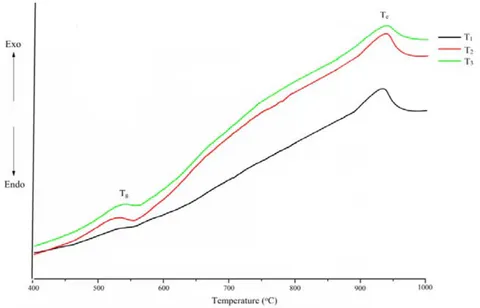
In the Fig. 4 DTA scans for title glasses doped with different concentrations of are presented, all the traces exhibited typical glass transition with the inflection point between due to glass transition, it is interesting that the glass transition temperature is increasing with the increase of content [30]. In the region, , an endothermic peak due to crystallization is observed in the trace of all the glasses [31]. The parameter , a measure of thermal stability of glass against diversification, increases with the increase of concentration. Such trend indicates the decrease of augmented cross-link density of various structural groups in the network and closeness of packing.
e) Optical absorption studies
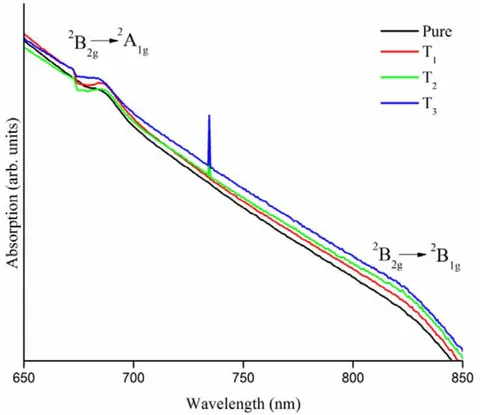
Fig. 5 shows the optical absorption spectra of the sodium lead alumino borosilicate glass samples with different amount of recorded at room temperature in the wavelength region , the absorption edge is observed at for the pure glass. It is also observed that the position of the fundamental absorption edge and cut-off wavelength shift towards red as the content of increases. It appears that a part of is responsible for the increase in the absorption of non-bridging oxygen (NBO) due to which this shift is obtained [32]. The spectrum of all the prepared glass samples exhibited two resolved absorption bands at about and . The bands are attributed due to (691 nm) and (830 nm) transitions of electron of the ions in tetragonal distorted octahedral sites respectively. Normally, under ordinary conditions of melting, it is difficult to get in glasses as Ti ion tends to achieve its higher valence state (Ti ). The Ti ion does not show any absorption in the visible range of the spectrum as it has an electronic configuration 3d . Thus, it can be concluded that Ti ions in these glasses are present as Ti ions [33].
f) Band gap and Urbach energy analysis
The optical band gap and Urbach energies are obtained from their ultraviolet absorption edges. The optical band gap in the amorphous system is closely related to the energy gap between valence and conduction bands[34, 35]. In glasses, the conduction band is influenced by the glass-forming anions; the cations play an indirect but significant role [34, 36]. The Urbach energy gives the width of the tails of localized states within the optical band gap. At the absorption edge, random internal electric fields will dominate the broadening of the excitation levels due to lack of long-range order or presence of defects [34, 37]. The least , i.e. sharp absorption edge, suggests that defects are minimum facilitating long range order.
The absorption coefficient (v) can be determined near the edge using the formula:
where A is the absorbance factor at frequency v and 'd' is the thickness of the sample.
The absorption coefficient (v) as a function of the photon energy (hv) for direct and indirect transitions according to Mott and Davis [38] is given by
where B is the energy-independent constant [72] and the index takes different values depending on the mechanism of inter band transitions, i.e., n = 2 and n = 1/2 for allowed direct and indirect transitions.
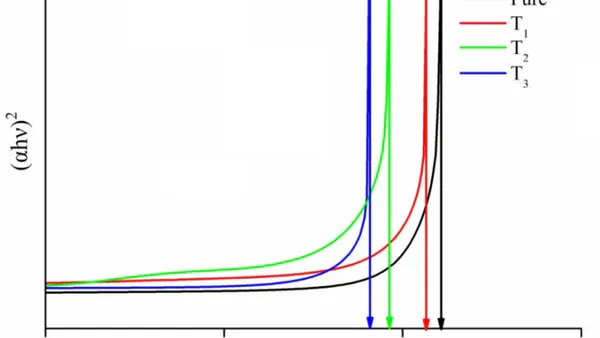
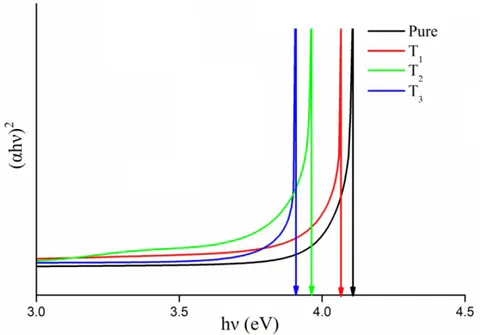
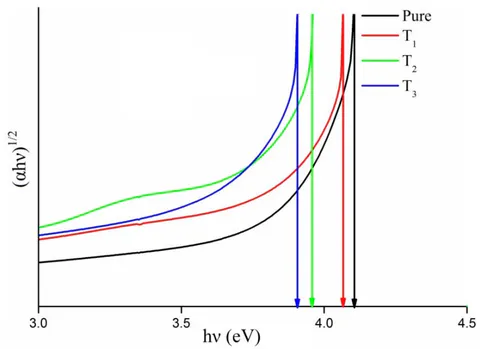
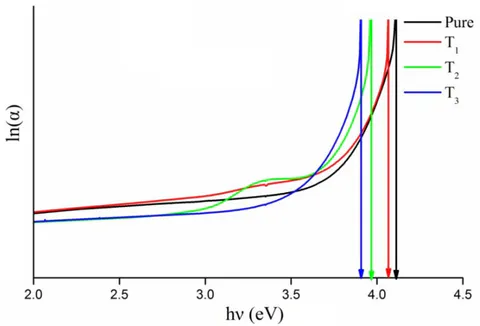
From Eqs 1 and 2 and by plotting and as a function of photon energy , the optical band gaps for indirect and direct transitions can be estimated respectively. The values of indirect and direct band gap energy can be obtained by extrapolating the absorption coefficient to zero absorption in vs hv and vs hv plot and is shown in Fig's. 6 and 7. Plots are also drawn between and hv (Fig. 8) and the Urbach energy value ( ) is calculated by taking the reciprocal of the slopes of linear portion in the lower photon energy region of the curve as stated with following relation [40].
The optical band gaps for direct, indirect transitions and Urbach energies obtained in the present work are listed in Table 3.
| Sample code | Cutoff wavelength (nm) | Energy band gap ( ) eV | Urbach energy | ||
| Calculated | Direct | Indirect | |||
| Pure | 305 | 4.073 | 4.005 | 4.003 | 0.252 |
| 310 | 4.007 | 3.973 | 3.971 | 0.254 | |
| 313 | 3.969 | 3.878 | 3.842 | 0.264 | |
| 317.5 | 3.912 | 3.842 | 3.764 | 0.269 | |
The optical band gap energies shown in Table 3, revealed that the optical band for indirect transition values varies from 4.003 to 3.764 eV and for direct transitions, whose values vary from 4.005 to 3.842 eV. The optical band gap energies decrease with the increase of titanium ion concentration. Also, Urbach energy values increase from 0.252 to 0.269 eV with the increase of titanium ion concentration.
g) Electron paramagnetic resonance (EPR) spectra
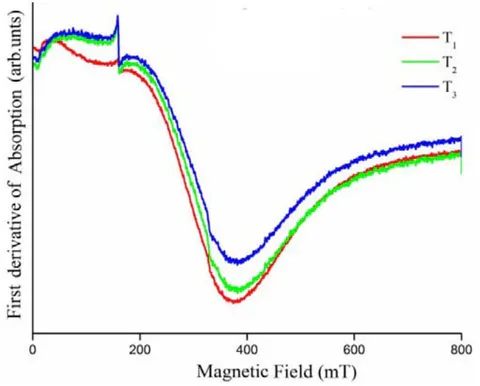
EPR spectra of title glasses with different concentrations of recorded at room temperature are shown in Fig. 9. In the pure glass no EPR signal was detected. When ions are introducing into the titled glasses, all the samples exhibit absorption lines. The EPR spectrum exhibits broad unresolved spectrum due to and its g value is 1.9532. The broadness arises due to the dipolar-dipolar interaction of Ti ions. The resonance signal observed in this spectrum with = 1.9532 is due to distorted octahedral sites of \mathrm{Ti}^{3+} ions with |x y| > ground state. The presence of large concentration of such ions may distort the glass network more and induce bonding defects. The near absence of such signal in the spectra of glass T_{3} indicates the low concentration of such ions in this glass network. The g-value a little less than 2.002 is typically due to \mathrm{Ti}^{3+} ions and agrees well with the reported values for \mathrm{Ti}^{3+} [41]. Except for the variation in signal intensity no important modifications are observed while increasing the dopant concentrations (Fig. 9). A slight shift in the resonance signals is also observed when modifying the starting glass composition.
IV. CONCLUSION
The physical parameters, spectroscopic properties and FT-IR studies on the network structure of titled glasses doped with reveals the following conclusions:
The XRD pattern confirms the amorphous structure of the glasses studied. The physical properties like density, average molecular weight (M), titanium ion concentration ( ), molar volume ( ), mean titanium ion separation ( ) and the polaron radius ( ) are evaluated for the glasses studied in the present work varies linearly with x mol% except for density values. From the DTA curve, the thermal stability of the glass matrix is confirmed by the difference between glass transition and crystallization temperatures. The IR spectral investigations indicate the ions exist in octahedral positions and also form B-O-Ti linkages. The optical absorption spectra of the present glass system are attributable to ions, which contains two broad, intense bands analyzed on the based on axially elongated octahedral coordination. The band gap of glasses varies from 4.005 to 3.842 eV and 4.003 to
3.764 eV (direct and indirect) and 0.252 to 0.269 eV (Urbach)depending on the chemical nature of intermediate oxide. Urbach energy values suggest that defects can increase due to the increase in Urbach energy with titanium content.