## I. INTRODUCTION
In a world described as pessimistic and characterized by the deterioration of moral values, the opportunity to raise the bar of personal integrity and to positively contribute to the lives of others is possible when individuals choose to "find their voice" and help those around them to find theirs as well (Bennis, 2009). The challenge to discover one's unique significance by finding one's voice was often the theme of management guru, Stephen R. Covey who passed away in 2012 but his message and its profound importance continue to resound as an invitation to young men and women to become the best version of themselves and to help others to grow and to flourish (Covey, 2005).
The purpose of this paper is to build on the great significance of Covey's insights and their application to spiritual intelligence, the capacity to activate the higher dimensions of intelligence in enriching one's own life and in guiding the three other intelligences: physical intelligence, mental intelligence, and emotional intelligence. We begin this paper by defining the four intelligences that Covey cited as the foundation of each person's life and identifying their importance in a world that Covey suggested has become knowledge-, information-, and wisdom-dependent.
After that brief introduction, we offer a Muslim perspective about each of those intelligences and suggest eight propositions about the significance of spiritual intelligence as applied to college-age young men and women in the sultanate of Oman - but applicable to other young men and women throughout the world as well. We then identify five contributions of the paper to the literature about leadership and its applications for young men and women of the $21^{\text{st}}$ century. We conclude the paper with a challenge to readers to examine the practical value of spiritual intelligence and its relationship to flourishing in a world where moral values and spiritual intelligence are often overlooked.
## II. THE FOUR INTELLIGENCES
The quest to understand the human mind and its application of knowledge has been a topic of interest to philosophers and scholars since the time of the
Ancient Greeks (Thagard, 2023). Although there are differences of opinion about the nature of intelligence, Garcia (2012) suggests that human intelligence is the practical ability to acquire knowledge and to utilize that information to solve problems and maintain relationships.
Although as many as twelve different types of intelligence have been described by psychologists (Gardner, 2011), the focus of this paper is on the four intelligences identified by Stephen R. Covey - including physical, mental, emotional, and spiritual intelligence. Those four intelligences have been the subject of numerous articles and, while a case can be made for including other intelligences, Covey's framework is the basis for this paper. Each of those four intelligences is described below.
### a) Physical Intelligence
According to Stephen R. Covey (2005), human Physical Intelligence (PQ) includes a broad range of capabilities – ranging from 1) the capacity to read, hear, walk, talk, and other skills requiring coordination; 2) the refinement of any of a broad number of physical skills or abilities that require effort, practice, and learning; and 3) the multitude of physical actions involved maintain health, resisting disease, increasing one's physical strength, or improving one's physical health. In writing about PQ, Judith Fischer (2023) described it as follows:
"Physical Intelligence is the set of physical capacities that allows us to learn and to express our thoughts and feelings. These capacities are located in our physical bodies. They provide us with information through sensory channels, and this information then becomes the foundation for our cognitive and emotional development."
We marvel at the refined PQ skills developed by concert musicians, world-class athletes, operatic singers, and surgeons who perform complex operations, but PQ is a basic and fundamental part of every individual's life. Tony Buzan (2003) has noted that PQ also includes all aspects of physical fitness, balance, agility and coordination, anticipation, reaction time, strength, flexibility and aerobic capacity.
In writing about the natural functioning of PQ in every person's life, Clement Ugoani (2017) explained that PQ integrates all of the complex organ processes in the human body - literally coordinating billions of intricately related biological and physiological systems that enable each person to maintain their equilibrium and good health, in most cases entirely on an involuntary basis – functioning with a complexity far beyond that of the most advanced computer. PQ is enhanced by self-discipline, self-control, and extensive effort in the pursuit of personal self-mastery (Dhiman & Dhiman, 2017) and the commitment to excellence can lead the persevering person to the achievement of results that can far exceed one's expectations (Duckworth, 2018).
### b) Mental Intelligence
Mental Intelligence (IQ) includes the broad range of capabilities of the mind that enable individuals to acquire knowledge, categorize information, draw inferences, solve problems, and create new opportunities (Sternberg, 2018). As a cognitive process, IQ is typically measured by the administration of standardized tests. IQ is a score obtained by dividing a person's mental age score derived from an intelligence test that measures knowledge and problem-solving by the person's chronological age (Van der Maas, Kaan & Borsboom, 2014). When people think of cognitive intelligence, they frequently consider it to be the ability to analyze, to reason, to think both concretely and
### c) Emotional Intelligence
In his classic research about Emotional Intelligence (EQ), Daniel Goleman (2005) defined it as the capacity to integrate self-knowledge and self-control with an understanding of the needs of others and the ability to craft the best possible response to help others to achieve their best possible outcome. EQ consists of five related qualities.
#### Self-Awareness
Self-awareness is a thorough knowledge of oneself and one's predictable responses – both emotionally and cognitively – in dealing with situations (Carver, 2012). Covey (2005) explained that for every person there is a space between stimulus and response in which everyone can assess how (s)he will choose to act. Understanding oneself includes the ability to gauge how one is going to respond to a stimulus and to recognize how those tendencies will play out as specific actions (Morin, 2011).
### Self-Control
The power of self-mastery in controlling one's responses enables a person to resist the emotional hijacking that can often occur and is a higher-level example of self-discipline that demands maturity, a commitment to values, and life experience (Dhiman & Dhiman, 2017). The capacity to control oneself is fraught with moral implications and reflects the ability to understand the implications of one's actions from a rational perspective - even when one is under the pressure of the moment (Baxley, 2014).
Empathy
Recognizing and understanding others' situations and being able to feel what they feel are the essence of empathy and empathy has been described as the most important relationship-building skill (King, 2023). Empathy rises above sympathy and is best manifested as compassion -- the added quality of using that understanding of others' situation to then craft the response that best serves that party's needs (Singer & Klimecki, 2014).
#### Motivation
Motivation in EQ is the desire to make a meaningful difference in actually bettering another party's situation, coupled with the willingness to take the required actions and then assist that party. Motivation puts the recognition of another's situation into action (Deckers, 2022). Motivation may be rooted in a broad range of complex personal intentions, but regardless of the underlying reason, the demonstrated positive outcome of EQ is dependent upon whether a person takes the appropriate action to help another party (Goleman, 2005).
Interpersonal Skills
There is a broad range of appropriate interpersonal skills that can be called upon to assist another party (Engleberg & Sjoberg, 2005). A person with high EQ recognizes that her/his ability to assist another party may require a broad range of capabilities and selects the most effective response from that array of possible choices. Interpersonal skills in EQ are ultimately situational and require the person possessing those skills to not only know when and how to take action but to translate that knowledge into behaviors that best serve others (Hughes & Terrell, 2011).
Each of these five elements is essential in the process of helping others and each of the five elements contributes to an individual's EQ and their ability to serve others.
### d) Spiritual Intelligence
Spiritual Intelligence (SQ) was defined by Stephen R. Covey (2005) as the guiding factor that directs each of the three other intelligences in each person's quest to become a better and more effective leader. It adopts the wisdom attributed to Pierre Teilhard de Chardin that "We are not human beings having a spiritual experience. We are spiritual beings having a human experience."
Danah Zohar (1997), an American-British author and scholar identified twelve principles that incorporate the foundations of spiritual intelligence and enable leaders to not only be more effective but enable them to inspire others and create organizations that enrich others. A summary of Zohar's twelve principles of SQ is provided here.
Self-awareness - Being clear about one's beliefs and values.
Spontaneity - Living in the moment and appreciating its opportunities.
Values- and Vision-Led - Acting from principles and living accordingly.
Holism - Seeing one's place in larger patterns and being connected.
Compassion - Having the quality of "feeling with" others.
Celebration of Diversity - Valuing others for their differences.
Independence - Standing against the crowd when necessary.
Humility - Understanding one's true place in the world.
Curiosity – Needing to understand things and asking "Why?"
Context - Ability to see the bigger picture and keep perspective.
Perseverance - Growing from setbacks and learning from them.
Purpose - Honoring one's personal calling and mission in life
Incorporating these twelve principles, SQ becomes the central focus of all the intelligences and represents the pursuit of meaning and connection in life. Defining self-transcendence as the essence of self- fulfillment, Abraham Maslow (1994) equated the achievement of the ultimate experiences in life to achieving harmony in life and alignment with the divine in achieving what is the essence of SQ.
In providing a visual portrayal of the relationship between SQ and the other three intelligences, Covey suggested that Diagram 1 (bellow) accurately reflected this relationship.
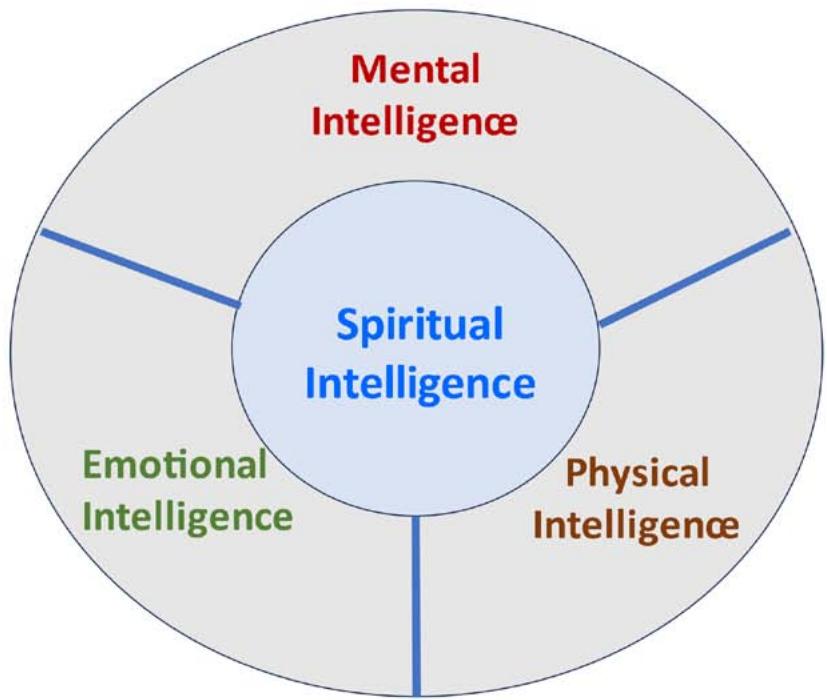
Diagram 1
Spiritual Intelligence provides guidance by understanding the importance of the purposes of creating relationships that enrich the lives of others, enabling others to grow and flourish, and empowering individuals to magnify their highest potential (Covey, 2005)
## III. THE MUSLIM PERSPECTIVE
Muslim scholars have offered powerful insights about each of the four intelligences, with Islamic doctrine reflecting the greatest emphasis on the spiritual, emotional, and mental intelligences that impact daily life. In this section, we incorporate insights from Muslim scholars, religious leaders, and philosophers to clarify how the intelligences dominate Islamic thought and daily living. In summarizing the Muslim perceptions of these four intelligences, we also present eight propositions related to these intelligences.
### a) Muslims and PQ
Islam sees men and women as both physical and spiritual beings created by Allah to live a life connected to divine principles (Sayilgan, 2021). Virtuousness and chaste conduct are fundamental elements of Islam and limit social and romantic relationships among highly devout Muslim young men and women (Masgood & Masgood, 1995). Muslims believe that to achieve exalted status in their faith, the physical and the metaphysical, or that which is the "true reality," must align (Dogan, 2014). Traditional Muslim women cover themselves modestly from head to toe and the Muslim woman is known for her modest dress and demeanor. (Bucar, 2017). This linking of the spiritual and the physical in the Muslim faith is readily apparent in the dress and conduct of Muslim women (Gray, 2019).
Islam views the physical aspects of human life to be as important as the spiritual and prescribes laws of health, dietary restrictions, proper hygiene, and moderation in all aspects of life in the quest to maintain good health (Shaikh & Shaikh, 2021). Muslims view the body as a gift from Allah that should be taken care of, maintained in proper health, and used for righteous purposes (Mahdi, Rahman & Schimmel, 2023). Muslims seek to maintain good hygiene, obtain proper nutrition, balance both physical and spiritual needs, and pursue harmony and moderation in all aspects of life (Koenig & Al Shohaib, 2014).
Consistent with this review of the Muslim role of PQ, we offer our first two propositions.
$P_{1}$; Muslims view Physical Intelligence primarily as maintaining proper physical health in the same way as individuals of other faiths.
$P_{2}$: The Muslim perspective of Physical Intelligence is more influenced by beliefs about personal virtuousness, modesty, and chaste behavior than individuals of other faiths.
### b) Muslims and IQ
Education in Islam emphasizes both acquiring intellectual knowledge through the application of reason and logic and developing spiritual knowledge from personal spiritual experience and divine revelation (Majdi & Kommarudin, 2022). In Arabic three terms are used for education. The term $\text{ta}$ / $\text{im}$, from the root 'alima, which means knowing, perceiving, learning, and being aware; Tarbiyah from the root of raba, refers to spiritual and moral growth aligned with the will of Allah; the third term is $\text{Ta}$ / $\text{d}$ / $\text{ib}$ from the root aduba which refers to being cultured and appropriate in social behavior (Halstead, 2004).
Muslim philosophers have long valued the quest for knowledge as a divine command and part of the obligation of Muslims to pursue intellectual knowledge and metaphysical truth (N'Daw, 2014). At the heart of the Muslim perspective has been the work delineated by Aristotle and Plato in the journey to obtain ultimate truth (Ivy, 2012). The enlightened Muslim perspective of education has begun to provide women with the opportunity to obtain formal education - an opportunity that was not fully available for many Muslim women for centuries and that continues to be a restriction in many rural Muslim communities today (Abukari, 2014).
IQ and enhancing knowledge for Muslims encompasses far more than simply the acquiring of secular wisdom and experience – although Islam fully endorses its followers' responsibility to live productively and wisely in the world. For Muslims, their secular knowledge integrates with their spiritual life perspective in the pursuit of learning.
Consistent with Islam's commitment to integrating religious knowledge with other types of intellectual knowledge, we offer two more propositions.
$P_{3}$: Muslims view Mental Intelligence with a greater emphasis on religious beliefs and the integration of secular and spiritual truths more than individuals of other faiths.
$P_{4}$: The Muslim perspective of Mental Intelligence provides fewer opportunities for the education of women in secular areas of knowledge than other faiths.
### c) Muslims and Emotional Intelligence
Consistent with Islam's emphasis on the spiritual elements of life, Muslim skill sets associated with EQ were found by one study to be aligned with transcendental awareness, an emphasis on understanding the meaning of life, the acquisition of patience, and the importance of forgiveness in relationships (Anwar, Gani & Rahman, 2020). In writing about Islam and the importance of emotional balance, El-Nadi (2023) observed that Islam advocated a low-key expression of emotions of all types in the quest for personal balance and inner peace.
In writing about the historical and religious applications of EQ, Smith (2019) cited the importance of understanding context and history in responding to situations and acting in ways that treated all individuals with respect and great personal regard as key EQ components. The relationship between the Arabic concepts of taqwa, or God consciousness, and syunkr, or gratitude to God, were found to increase the personal awareness of EQ and understanding one's own emotional responses (Wahab, Masron & Kana, 2022). A study by Kessi and colleagues (2022) found a correlation between EQ, spiritual leadership, and employee performance within a Muslim work context.
Integrating the Muslim view of EQ with the secular definition, Islam's focus is on acquiring personal inner balance and self-understanding. EQ is then intended to be applied to specific contexts in serving others and being a responsible member of society – but always within a spiritual framework as well.
Related to this summary of Muslim perspectives about EQ, we suggest two more propositions.
$P_{5}$: Muslims view Emotional Intelligence through the lens of their religious beliefs and the integration of secular and spiritual truths more than individuals of other faiths.
$P_{6}$: The Muslim perspective of Emotional Intelligence emphasizes emotional moderation related to problem solving more than individuals of other faiths.
### d) Muslims and Spiritual Intelligence
SQ is the driving force in Islam and includes a deep and focused commitment to serving Allah and blessing others on the earth (Winter & Williams, 2002). Islam literally means the personal commitment in which a Muslim submits her or his life to the will of Allah. In explaining SQ, Toto Tasmara (2001) stated that in Islam there are four spiritual domains of al-ruh (spirit), al-qalb (heart), al-nafs (soul) and al-aql (sense) - closely paralleling EQ and IQ and impacting PQ.
Based upon the writing of the Qu'ran, Islam emphasizes the spiritual pre-disposition of man 1) rooted in the belief in Allah, 2) constantly internalizing faith, 3) engaging in inner reflection to seek self-awareness, 4) committing to a lifestyle of worship, and
5) adhering to the highest standards of personal morality (Bensaid, Machouce & Grine, 2015). SQ for the faithful Muslim includes the pursuit of inner peace, the maintenance of healthy wellness, and sustaining the driving motivation for good (Bahuruddin & Ismail, 2015). SQ is correlated not only with a Muslim's personal self-esteem but is a fundamental part of his or her moral identity (Boudlaie, et al., 2022).
For Muslims, SQ is closely aligned with the secular concept that the spiritual priorities of life should give direction to the other three intelligences. SQ affirms the importance of keeping in mind one's primary life purpose, which for Muslims is clearly to serve Allah and to be a positive benefit in the lives of other sojourners in the world.
Based upon this review of Muslim's perspectives about SQ, we offer our seventh and eight propositions.
$P_{7}$: The Muslim view of Spiritual Intelligence as the driving force for the other three intelligences reflects a stronger commitment for followers of Islam than the commitment expressed by members of other faiths.
$P_{\mathrm{g}}$: The Muslim perspective of Spiritual Intelligence is more closely aligned with the Muslims' view of the other three intelligences than the alignment between SQ, IQ, EQ, and PQ of members of other faiths.
## IV. CONTRIBUTIONS OF THE PAPER
In a world that is often conflicted with negative images about those who are different, the study of other faiths and cultures provides an opportunity for greater understanding, closer unity, reduced social and cultural bias, more effective organizations, and better relationships (Livingston, 2021). Because members of all religious faiths, ethnicities, and cultural backgrounds can benefit from this greater awareness, this paper's study of SQ has great practical value. We suggest that this paper makes five significant contributions.
1. We affirm the importance of studying Spiritual Intelligence and its important impact on human behaviors. As the framework for guiding all other intelligences, recognizing the powerful role of spiritual intelligence enables individuals to more holistically guide their lives (Ahmed, et al., 2016).
2. We provide insights into the dedicated commitment of Muslims and their reliance upon Spiritual Intelligence in their own lives. Appreciating the value that Muslims place on their religious commitment can help others to appreciate Islam and its commitment to divine principles and the pursuit of excellence (Bensaid, Machouce & Grine, 2015).
3. We provide eight testable propositions about Muslim beliefs related to the four intelligences that can enable members of other faiths to compare their own life view with the beliefs of Islam. Recognizing the
uplifting underlying principles of the Muslim faith can enable others to appreciate this important sector of the world more fully (Baharuddin & Ismail, 2015).
4. We provide a forum for much greater discussion of religious beliefs and the importance of the role of Spiritual Intelligence. The importance of Spiritual Intelligence in individual lives is widely acknowledged as a foundation for better living and is a topic worthy of extensive discussion by scholars and individuals (Sirvastava, 2016).
5. We identify the similarities between the Muslim perspectives of the four intelligences and the secular perspectives of widely respected scholars. As noted in this paper, the Muslim perspective about the guiding role of SQ is similar in many ways to the role of SQ as advocated by Stephen R. Covey (2005).
## V. A CHALLENGE TO READERS
It is not news that the modern world is challenged in its ability to establish healthy relationships – both in organizations (Clifton & Harter, 2019) and in inter-personal associations (Edelman, 2023). Recognizing the importance of the spiritual side of life and its very practical applications is often viewed as applicable from a religious perspective but not relevant to the real world.
We unequivocally challenge that basic assumption. We invite readers to reflect upon their own values, commitments, and purpose. We challenge the readers of this paper to reflect upon their own moral identities. We encourage those who are unfamiliar with the principles of Islam to try to understand the many good and true principles espoused by this faith and to come to respect to a greater degree the many outstanding individuals who have adopted Muslim precepts - especially those associated with Spiritual Intelligence.
Generating HTML Viewer...
References
53 Cites in Article
Abdulai Abukari (2014). Education of Women in Islam: A Critical Islamic Interpretation of the Quran.
A Ahmed,M Arshad,A Mahmood,S Akhtar (2016). Spiritual Intelligence (SQ): A Holistic Framework for Human Resource Development.
Md. Anwar,Aahad Gani,Muhammad Rahman (2020). Effects of spiritual intelligence from Islamic perspective on emotional intelligence.
Elmi Baharuddin,Zainab Ismail (2015). 7 Domains of Spiritual Intelligence from Islamic Perspective.
A Baxley (2015). Virtue, Self-Mastery, and the Autocracy of Practical Reason.
Warren Bennis (2009). Crises reveal the quality of leadership.
Benaouda Bensaid,Salah Machouche,Fadila Grine (2014). A Qur’anic Framework for Spiritual Intelligence.
Hasan Boudlaie,Albert Boghosian,Israr Ahmad,Hussam Mohammed Wafqan,Ismail Suardi Wekke,Aziza Makhmudova (2022). Investigating the mediating role of moral identity on the relationship between spiritual intelligence and Muslims’ self-esteem.
Elizabeth Bucar (2017). Pious Fashion.
T Buzan (2003). The Power of Physical Intelligence: 10 Ways to Tap Into Your Physical Genius.
C Caldwell,M Beverage,P Converse (2018). Selecting for Flair Factors: Improving the Selection Process.
J Cardillo (2017). 2. Exercise Your Way to a Healthy Heart and Body.
J Collins (2001). Good to Great: Why Some Companies Make the Leap.
S R Covey (2005). The 8 th Habit: From Effectiveness to Greatness.
Lambert Deckers (2018). Motivation.
Satinder Dhiman,Satinder Dhiman (2017). Self-Mastery: Mastering the “Me” in Leadership.
R Dogan (2014). Nature of Man in Islam.
A Duckworth (2018). GRIT: The Power of Passion and Perseverance.
Edelman (2023). Edelman Trust Barometer.
S El-Nadi (2023). What Does Islam Teach about Emotions?.
E Engelberg,L Sjöberg (2005). Emotional Intelligence and Interpersonal Skills.
J Fischer (2023). What is Physical Intelligence?.
J Garcia (2012). Leadership Intelligence: The Four Intelligences of a Leader.
H Gardner (2011). Frames of mind: The theory of multiple intelligences, by Howard Gardner. New York: Basic Books, 1983, 440 pp. Price: $23.00 cloth.
D Goleman (2005). Emotional Intelligence: Why It Can Matter More than IQ.
Linda Gottfredson (1998). g, Jobs and Life.
T Gray (2023). Courage and Commitment: The Femininity of Muslim Women.
M Hughes,J Terrell (2011). Emotional Intelligence in Action: Training and Coaching Activities for Leaders, Managers, and Teams.
A Ivry (2012). Arabic and Islamic Psychology and Philosophy of Mind.
A Kessi,W Suwardi,A Mukhtar,A Asmawiyah,D Ar (2022). Islamic Leadership, Emotional Intelligence, and Spiritual Intelligence on Passion of Work and Performance.
P King (2023). Cultivate Key Beliefs.
H Koenig,S Al Shohaib (2014). Health and Well-being in Islamic Societies.
R Livingston (2021). The Conversation: How Seeking and Speaking the Truth about Racism Can Radically Transform Individuals and Organizations.
M Mahdi,F Rahman,A Schimmel (2023). Encyclopedia.
Ahmad Majdi,Koko Komaruddin (2022). The Dialectic of Paradigms Between Islam and the West Regarding the Pursuit of Knowledge.
R Maqsood,R Maqsood (1995). The Muslim Marriage Guide.
A Maslow (1994). Religions, Values, and Peak-Experiences.
L Moldenhauer,C Londt (2018). Leadership, Artificial Intelligence and the Need to Redefine Future Skills Development.
Alain Morin (2011). Self‐Awareness Part 1: Definition, Measures, Effects, Functions, and Antecedents.
S N'daw (2014). The Quest for truth.
S Sayilgan (2021). Exploring Islam: Theology and Spiritual Practice in America.
Smith (2019). Emotional Intelligence: A Tool for Change.
R Sternberg (2018). The Nature of Human Intelligence.
R Sternberg (2022). Encyclopedia.
Paul Thagard (2023). Cognitive Science.
Carmen Tanner,Markus Christen (2013). Moral Intelligence – A Framework for Understanding Moral Competences.
Toto Tasmara (2001). KecerdasanRohaniah (Transcendental Intelligence).
C Ugoani (2017). Chapter Summary: The 8 th Habit by Stephen Covey.
Han Van Der Maas,Kees-Jan Kan,Denny Borsboom (2014). Intelligence Is What the Intelligence Test Measures. Seriously.
Mastura Wahab,Tajul Masron,Noorliza Karia (2022). Do<i>taqwa</i>and<i>syukr</i>predict Muslims’ proclivity to emotional intelligence? An empirical analysis.
D Zohar (1997). Re-wiring the Corporate Brain: Using the New Science to Rethink How We Structure and Lead Organizations.
No ethics committee approval was required for this article type.
Data Availability
Not applicable for this article.
How to Cite This Article
Cam Caldwell. 2026. \u201cSpiritual Intelligence and its Practical Importance – Insights from Oman\u201d. Global Journal of Management and Business Research - A: Administration & Management GJMBR-A Volume 23 (GJMBR Volume 23 Issue A9).
Explore published articles in an immersive Augmented Reality environment. Our platform converts research papers into interactive 3D books, allowing readers to view and interact with content using AR and VR compatible devices.
Your published article is automatically converted into a realistic 3D book. Flip through pages and read research papers in a more engaging and interactive format.
Our website is actively being updated, and changes may occur frequently. Please clear your browser cache if needed. For feedback or error reporting, please email [email protected]
Thank you for connecting with us. We will respond to you shortly.