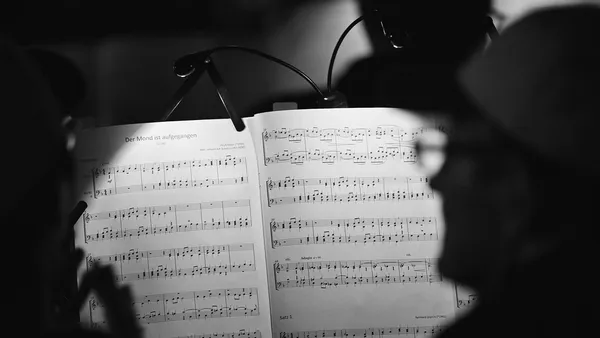

Jules Combarieu, who described the mystery as "a drama in which there is music", defined the music part as an essential genre attribute of the mystery. In 1912, Abbé Brun from the Schola Cantorum in Paris composed the stage music for the first version of The tidings brought to Mary at Claudel's request. Then, in 1932 and 1942, Darius Milhaud created two scores for the mystery (the second one was lost). Claudel and Milhaud met in 1912 shortly before the premiere of The tidings brought to Mary. Joint creative work and communication between the playwright and the composer lasted more than forty years. Researcher E. M. Kokoreva noted: "Obviously, this communication was beneficial to both of them. Claudel concluded about the need for music in his plays, and Milhaud got valuable texts at his disposal" (Kokoreva, 2022).
In 1937, at the request of director Charles Dullin, who was preparing The tidings brought to Mary for production at the Comédie Française, Claudel altered the text of the mystery; the second version of the work was created in 1938. The third "final stage version" appeared in 1948. A new score of the stage music for The tidings brought to Mary was composed and published by the daughter of Claudel, Rosalie Szibor-Rylska (a singer), and composer Louise Wetsch (who performed under the pseudonym "Maria Szibor").
In The Improvised Memoirs, Claudel characterized the structure of The tidings brought to Mary in its final form: "When I look at it with a builder's eye, I find that it is one of my plays that is better constructed and better able to impress the audience than others. It does, however, have some length to it. I think the lyrical part is still too extended, especially in the prologue and in the first act (Amrouche 2001, 259). The remark about the "lyrical part" might refer to the fragments of stage music integrated into the mystery. Claudel studied the problem of stage music for several decades. Abbé Brun, Darius Milhaud, and Maria Scibor translated Claudel's ideas about the dramaturgical interaction of the mystery's aspects in various ways; in 1931, for example, Claudel and Milhaud discussed the possibility of creating an "entirely musical drama" from The tidings brought to Mary (Claudel 1961, 173). However, the composer ended up by creating an individual artistic conception of stage music for the Mystery.
stage in the evolution of French Symbolism, was also quite interested in Wagner's ideas. Wagner's idea of the synthesis of arts seemed to his contemporaries the most suitable for "revealing a certain quintessence, the essence of art" (French symbolism. Dramaturgy and theater 2000). Through the prism of religious and philosophical ideas of Wagner's Parsifal (1882), Claudel approached the problem of developing interactions between elements of mystery drama and stage music.
The fundamentals of Christianity, in particular the doctrine of Catholicism, were central to Claudel's life and work. In a lecture entitled "Religion and Poetry" given in English to members of the Catholic associations in Baltimore in November 1927, Claudel argued for the universal significance of the Catholic poet's spiritually charged work. In this lecture, Claudel interpreted the drama of life. Claudel believes that religion provides the artist with a profound understanding of drama: "Only thanks to the Christian revelation, thanks to the tremendous, grandiose ideas of Heaven and the Underworld are a man's deeds and destiny invested with the greatest meaning" (Claudel 1965, 65). In his poetic work, in the Mystery of The tidings brought to Mary, and in his plays, Claudel realized the idea of the synthesis of time and eternity, an idea peculiar to Christianity.
A new understanding of the problem of the interaction between elements of drama and music was formed during Claudel's stay as a major statesman on a diplomatic mission to Japan (1921-1927): "The long hours I spent at the Imperial Theater became for me a professional school for the skill of a dramatist" (Claudel 1965, 148). Claudel analyzed the functions of stage music in traditional Chinese theater and found out that, in Chinese drama, music conveyed the passage of and duration of time. This discovery presumably prompted Claudel to approach the problem of stage music in The tidings brought to Mary within the framework of a specific dramaturgical strategy.
The result of translating his own theoretical development into artistic creation was vividly conveyed by Claudel in the text of his essay "On Music" (1942) (dedicated to Arthur Honegger). As Claudel explained, 'the sounding breath' is a means of expressing both poetic and musical phrase: "Supported by the necessity to develop this phrase to its fullest at any cost, we fly on the wings of rhythm, clinging to the mane of the distraught soul, as if separated from the body and attracted by its purpose; now rising and now falling, eager, free, in chains, now slow, now frisky, now suddenly freezing in place, without any support except hearing and the sense of time, it explores in all dimensions the universe it has discovered" (Klodel 2006, 290-291).
Between 1912 and 1929, Claudel worked further on integrating drama and stage music, and he staged his mystery play in France and abroad (Germany, Belgium, Holland, Luxembourg, and Russia). In Russia The Tidings brought to Mary was staged in an abridged form (the first three acts) by Alexander Tairov's Chamber Theater in Moscow on November 16, 1920 (the role of Violaine was performed by Alice Koonen).
As one might assume, the idea of a 1929-1932 "musical" project of The Tidings brought to Mary arose from the vocal-dramatic culmination of the Mystery created by Claudel in 1912. Claudel's methods of updating the sound space as well as the dramaturgical functions of the liturgical choirs in the first version of The Tidings are discussed separately in our article (2022) (Azarova 2022).
Claudel's teaching on the types and techniques of stage speech includes a strategy of speech modulations related to the rhythm of breathing, during which the phonetic elements perform the main function by determining the structure of this or that phrase. The famous writer André Maurois described Claudel's prosody as follows: "A French phrase consists of a sequence of phonetics, with the voice intensifying on the last syllable . There are natural rhythms of language, they are the rhythm of the heartbeat and of breathing, and it is natural if the rhythm of verse is tuned to breathing, instead of following the strict rules of prosody (Morua 2021, 427).
As a musical parameter of expression, the timbre of the performer's (actor's) voice dominated Claudel's system of theatrical and dramaturgical strategies. Claudel was interested in the distributing the main roles among the performers of The Tidings, and he focused on the timbre of each actor's voice. In the 1929-1932 production of The Tidings brought to Mary, Claudel used this method of voice. Claudel also used the methods of Symbolist theater, which consisted in replacing scenery with words and words with a pause.
Martin Kučera, author of the study "Performances of Paul Claudel's Plays in France and abroad, 1912-2012", summed up information about the stage life of The Tidings. Kučera did not seem to care about Claudel's solution to the problem of the interaction between stage speech and stage music during the many theatrical productions of the mystery, but he gathered valuable reviews of the modern press on the productions of the play. The central section of his book contains repertoires of European theaters, on the basis of which the author drew conclusions about "the main performances of Paul Claudel's works" (Kučera 2013, 16).
In her monograph 'Darius Milhaud. Life and Creation" (1985), E. M. Kokoreva makes a remarkable judgment of Milhaud which echoes some Claudel's ideas: "There is nothing falser than the intrusion of musical phrases when actors continue pronouncing the text; the text cannot be heard, because spoken phrases and music are mixed on two incompatible levels. It was necessary to translate the words into singing to emphasize the sublime lyricism of individual dialogues" (Kokoreva 1985, 308). As early as 1912, during a tour of the CEuvre Theater company in Hellerau, Germany, Claudel pointed out that the sudden appearance of musical fragments in unfolding dramatic action of The Tidings violates the unity of the work as it reveals a discrepancy between poetic language and vocal-poetic forms.
For many years, Claudel was immersed in the world of ancient images and the archaic vocal and speech forms of Aeschylus' tragedies. So, when it comes to the musical nature of his lyricism, the musicologist Paul Collaer noted some special techniques of speech intonation common in archaic cultures that Claudel was well aware of as a translator of Aeschylus. For instance, an imperceptible transition from speech to singing was usually accompanied by a change in tempo. Paul Collaer interpreted the above phenomenon of dramaturgical crescendo as "a universal psychological necessity of using different kinds of speech which create a colorful and image-rich form of expression" (Lécroart, 1976, 2). The principle of combining the rhythm and intonation elements of verse speech and dynamic amplification (crescendo - forte) explored by Claudel thus revealed a new kind of interaction between the elements of stage speech and music related to the dramaturgy of sound. Paul Collaer noted that Claudel's translation of The Orestea conveys the spirit and atmosphere of the original. Above all, Claudel preserved the rhythm of the text, which was of paramount importance" (Collaer 1988, 106).
The writer André Maurois characterized the nature of Claudelian verse associated with symbolism, which "is a much more difficult convention than a regular verse, but extremely convenient for the voice and breathing when read" (Morua 2021, 428). In the linguistic section of his theory of the fundamental iambus, Claudel considered a characteristic pulsation of the stage metre associated with ancient Greek and Latin versification which is based on the combination of short and long feet. In order to emphasize the sound of syllables containing consonant sounds or to reveal the expression of vowels, Claudel used the technique of shifting the stress in words to initial syllables in stage speech. Poems with an alternation of short and long feet, in which the violation of the iambic "course" occurs in the last foot, were called "limping iambes" (choliambs) in Late Antiquity. As a connoisseur of antique rhythmic melodic poetry (melopoeia), Claudel thought the orientation of the translated text toward stage speech to be crucial. The concept of spatial-sound/musical development of the drama was creatively implemented in the project of staging The Tidings brought to Many with stage music by Darius Milhaud. It is noteworthy that the composer distinguished in Claudel's prosody "a firmly measured pulsation of language" (Miio 2016, 110). Regarding versification techniques, Claudel's use of new rhythm and intonation formulas probably had a direct impact on the formation of his idea about different types of stage music depending on their rhythm and intonation, and timbre and rhythmic expression.
Modulations of the chorus were the subject of Claudel's particular attention during the drafting of The Tidings brought to Mary (1929-1932). By systematizing the principles of speech technique during the performance of the choral parts in the libretto of the Oresteia, which was based on translations from Aeschylus' trilogy, Claudel noted in a letter to Milhaud dated November 10, 1927: "The music of choirs is a world yet to be conquered" (Claudel 1961, 84). The function of discovering spiritual meaning in Claudel's mystery is performed by the declamatory and recitative part of the liturgical choir that sings in Latin. Instead of a chorus, Milhaud included in the 1932 score a cast of performers as a vocal ensemble (soprano, alto, tenor, and bass).
As for the development of the dramaturgy in the libretto and the dramaturgy of the music and theater work, a distinctly new interpretation of the choral part was created during Claudel and Milhaud's collaboration on the opera 'Le Livre de Christophe Colomb' (1927-1929).
Claude's ultimate understanding of the theoretical substantiation of stage speech techniques and at the pinnacle of the evolution of sound (poetic) language gave Claudel a system of dramaturgical strategies that employed in the period 1929-1932. In addition to the general plans of stage speech and stage music, this system included the musical (sound) aspect of rhythm-intonation and timbre-rhythmic expression, as well as the aspect of dynamics as a means of sound language. The named parameters of expression took part in the formation of new types of Claudel's system of dramaturgical strategies.
"Parallel Music" as a variant of Claudel's dramaturgical strategy and its realization in the 1929-1932 Project of the Mystery "The Tidings brought to Mary"
Claudel's creative reinterpretation of dramatic productions in the traditional theater of China and Japan led to the formation of the author's form of theatricality, defined as "parallel music". Stage music, which precedes words in performances of traditional Oriental theater, does not fulfill the functions of supporting or emphasizing a verbal sequence: "The word evokes feelings in us, draws a phrase, leaving us to take care of completing this phrase Thus music fulfills its tasks, acting in parallel with us" (Claudel 1965, 150). Claudel's work in prose called "The Bunraku Theater" contains a poetic description of a performance with music of the traditional Osaka puppet theater, which became the basis of the modern kabuki drama. Claudel interpreted the meaning of the interacting elements of music and the conventional language of acting with puppets: "What happens here is something that breaks away from the book and appropriates its language The second chorister holds a Japanese guitar with a long neck, a samisen, covered in white leather, from which he occasionally extracts with an ivory pick a few sounds, doubtless similar to those of an antique lyre. But all the more completely he alone performs the function of the whole closed-mouth choir" (Claudel 1965, 1182). Claudel's wide range of ideas about the possibilities of sound language was creatively implemented in the system of interacting elements of stage speech and sound, defined by the playwright as "parallel music".
Claudel implemented the dramaturgical strategy of "parallel music" in his 1929-1932 production of the mystery The Tidings brought to Mary by including a children's song sung off stage in the episode of Anne Vercors' farewell to his household (a monologue from scene 4 of Act I): "The oriole sings, / pecking cherries, / And gives us the seeds!" (Klodel' 2006, 88). Claudel's use of "parallel music" has a dramaturgical justification: the introduction of the vocal fragment has no influence on the pace of the action. Claudel has rethought the dramaturgical function of the musical episode: the content of the children's song has no direct relation to the on-stage event of Anne Vercors' departure for a journey. The chorus does not comment on the character's words. The interaction of the rhythm and intonation elements of Anne Vercors' speech and the vocal intonations (of the children's chorus) takes place in the field of "parallel music"; the dramaturgical function of the musical fragment is to discover the overall meaning of the mystery. At the same time, the "parallel music" from Act I scene 4 forms the atmosphere of lyricism in the mystery and semantic unity with the episode of the tragic and luminous death of the main character Violaine (the finale of the mystery).
In Act I Scene 4, Ann Vercors' line ("The oriole whistles - golden on the rose tree!") and the children's chorus part ("O Violaine, cruel Violaine, desirable to my soul, you have betrayed me!" form a semantic counterpoint. The seemingly "extraneous" vocal speech of the chorus refers to the sorrowful remarks of Jacques Hury (the main character's former fiancé) from the final scene of the mystery (Klodel' 2006, 88, 478).
In The Tidings brought to Mary, Claudel shows the development of a Christian idea of time and eternity synthesized. The space-time continuum, which is created in the mystery by the presence of music, underscores the importance of connection between the present and the past. "Parallel music" conveys the meaning of temporal duration the duration of the action in the mystery. The authors of the mystery expressed the meaning of time and eternity synthesized through the interaction of elements of verbal and musical language.
"Music in the Incipient State" and its fulfillment in the 1929-1932 production project of "The Tidings brought to Mary" Mystery
Claudel applied the definition of "music in an incipient state" to the compositional sections of instrumental stage music included in the 1929-1932 draft of "The Tidings brought to Mary". As a dramaturgical strategy, "music in an incipient state" takes part in scene 1 of Act III of "The Tidings brought to Mary". The events of said scene take place in the winter woods on Christmas Eve. Minor characters take part in the mass scene: the workers paving the way in the woods for the passage of the royal cortege to Reims, the apprentice, the clergyman, the women, the mayor, the old woman. Voices, laughter, shouts, and the sound of a wooden ratchet alternate with the priest's recitation of Latin Scripture. Sound imitations, noise elements, and trumpet, horn, and bell voices from the outlying villages constitute a multivoiced soundscape.
An instrument for discovering the meaning of what is happening is the author's commentary accompanying the action: "On either side of the stage there are two huge figures made of bundles of twigs, wearing robes of harsh canvas with red crosses painted on their chests; their heads are replaced by barrels with teeth cut on top, representing crowns; their faces are roughly painted in red paint; a long pipe is inserted into the hole of each barrel, which is supported in the manner of a pole arm" (Klodel' 2006, 146). The attributes of the stage design of the action reflect similar details in the masks and symbolic images of traditional Japanese Bunraku puppet theater, where the puppet is "a radiant star, inaccessible to any contact" (6, 1181).
The silent figures of the giants in the forest in Act III scene 1 of The Tidings brought to Mary are "superb and most dignified individuals" (Klodel' 2006, 148). By creating allegorical images (of Gog and Magog or "the great emperor of Abyssinia and his consort Bellona"), the giant figures, as Claudel suggested, perform the role of the "chorus". This role is fundamentally significant for the application of Claudel's dramaturgical strategy of "music in an incipient state". While the "chorus" visually represents elements of reality from the Hundred Years' War (the arrival of Charles VII accompanied by Joan of Arc for his coronation in Reims), the fragment of "pure music" (without words) reveals the meaning of what is happening. The musical fragment thus represents the plan for the inner workings of the mystery.
"Verbal music" as a strategy for moving into the realm of Claudel's sound language. Discovering the principles of the dramaturgy of sound
Attention to the dramaturgy of sound characterizes the evolution of Claudel's sound language par excellence. On the borders of the transition from spoken speech to declamation, and from declamation to prosody with elements of intonation, and from this to singing or an instrumental fragment of stage music, in the area of combining elements of stage speech and music, "verbal music" ("opéra de parole") takes part in the dramatic development of the mystery as a strategy of transition into the area of Claudel's sound language and the discovery of principles of sound dramaturgy. Given the theatrical and dramatic strategy of Claudel's "verbal music," Milhaud expressed the music rhythm-intonation and theatrical imagery: the above features of the composer's musical language are vividly characterized in a fragment of the score "Part III-1." "Giants" (Milhaud 1932, 28). In the Giants section, as in the overall fragmentary composition of stage music for The Tidings brought to Mary, Milhaud took into account the subtleties of Claudel's dramaturgical strategies.
G. T. Filenko, the author of a multi-faceted study on Milhaud, which is included in her book "French Music of the First Half of the 20th Century", described the professional responsibility of Milhaud in fulfilling the creative tasks that arose during the cooperation between the composer and the author of the literary text: "Milhaud always very flexibly and precisely meets the conditions (or order) that generated this or that composition, relating his ideas to the recipient, which does not reduce the artistic and professional level of his solutions at all" (Filenko 1983, 122). The above statement fully applies to the principles of musical interpretation of the ideas of Claudel's Mystery "The Tidings brought to Mary" presented in Milhaud's score of stage music.
In letters addressed to Milhaud in 1931, Claudel noted that stage speech was not the leading component of the performance as a whole, but that music "proceeding from the text" was the main carrier of the spiritual meaning of "The Tidings brought to Mary". Claudel expounded on the logic of "opéra de parole" as the art of the organic interaction between elements of stage speech and stage music as follows: "Music, which comes from the text rather than accompanies it, passes imperceptibly from the realm of the senses into the realm of sound." (Claudel 1961, 191). It is essentially a technique of gradual modulations that leads to a new quality of interaction between speech expression, as a principle of the dramaturgy of Claudel's sound language, and the intoned meaning of Milhaud's music.
The study of the complex interacting elements of stage music, stage speech, and the dramaturgy of sound led Claudel to attempt to solve the problem of creating a performance dominated by musical dramaturgy. The strategy of "verbal music" derived from the practice-proven principle of the probable coincidence of the rhythm-intonation and timbre elements of spoken speech (declamation, prosody), and the parameters of musical language. The intonational and rhythmic elements of "verbal music," as Claudel believed, were intended to be a tool of transition from stage speech to stage music.
In interaction with the principle of Claudel's sound drama detection strategy, the structures of Milhaud's musical syntax form areas of juxtaposition and divergence. The sound dramaturgy detection strategy proved to be a new step in the evolution of Claudel's sound language. The playwright developed the idea that, while an actor needs a perfect mastery of the technique of transitions from one type of stage speech to another, it is no less important for a musician to master the art of dramatic play. Thus, in the process of the evolution of Claudel's sound language, a strategy was formed and established which revealed the dramaturgy of sound - "verbal music" ("opéra de parole") or "sound speech". Claudel believed that this strategy was a means of dynamizing the action of the mystery.
The dramaturgy of Claudel's musical language is clearly detectable in the sections of the Mystery containing the author's poetic commentary on the action. In giving symbolic meaning to this or that acoustic phenomenon or external noise, Claudel provided the composer in letters with explanations for each of the comments included in the text of "The Tidings brought to Mary".
The lyrical intonation of the author's voice gives the action of the mystery drama expressive shades of meaning. According to Claudel's conception, The Tidings brought to Mary, played on the evening before Christmas, communicates to the audience a joyful experience of the miracle which is the birth of the infant Jesus.
Noteworthy is the technique of replacing the real sound of sound signals (trumpet, horn, ringing of bells) with the remarks of one of the characters in "The Tidings brought to Mary", noted by Claudel in the productions of the traditional Japanese drama theater Noh and applied in the play. According to Claudel's thought, the replacement of a fragment of stage music with a verbal replica of one or another character is based on the strategy of "verbal music". This is about imperceptible transitions (from stage speech to recitation; from recitation to prosody with elements of intonation; from prosody to singing or performing a fragment of stage music). Claudel's focus on the problem of the sound language of the mystery drama was not unreasonably viewed by his contemporaries as "the temptation of opera".
Claudel's creative practice, which remained within the Christian tradition (Catholicism), was in the cultural space of the intellectual dialogue of the French Symbolist theater of the 1890s and 1900s.
Claudel's development of the problem of stage music in his 1929-1932 production of Good News of Mary led to the emergence of certain dramaturgical strategies, which Claudel later employed in certain productions of his own plays, such as The Story of Tobias and Sarah (1938).
By interpreting aspects of sound language and the principles of the dramaturgy of sound, Claudel, who deeply understood the nature of music as an immanent art of intoned meaning, approached the problem of the interaction between the rhythm-intonation elements of the verbal series and the syntax of melodic phrases of stage music.
The premiere at the Pigalle Theater of a new version of the mystery drama "The Tidings brought to Mary", with stage music by Milhaud, which never took place, is a unique example of Claudel's creative practice, which has developed a new concept of the interaction between music and drama.
Recognizing the role of music as the leading one in the 1929-1932 Mystery production project, Claudel developed a doctrine of stage speech and went the way of the evolution of sound language, comprehending the principles of the dramaturgy of sound.
The 1929-1932 project "The Tidings brought to Mary" contained a set of dramaturgical strategies by Claudel related to the compositional features of stage music. The playwright differentiated new forms of musical and theatrical expression, defining them as "parallel music," "music in an incipient state," and "verbal music" (opéra de parole).
Claudel's theoretical studies are an integral part of the creative project under consideration, especially the correspondence between the playwright and the composer D. Milhaud, as well as "Works in Prose" and
"Improvised Memoirs". These materials represent a valuable contribution by Claudel to the history of research on twentieth-century culture.
The novelty and originality of the idea of staging the Mystery "The Tidings brought to Mary" in the period 1929-1932 allow us to consider this project a bright culmination on the way of the evolution of Claudel's theatrical and dramatic system, which made a significant creative contribution to the theatrical and dramatic art of the twentieth century.