
I. INTRODUCTION
SMEs are known as the backbone of any developing nation in the world as it generates employment opportunities and economic growth [1]. In Sri Lanka according to [2, 3] SME effecting significantly in county economy. In it accounts for more than 75 percent of the total number of enterprises, provides 45 percent of the employment and contributes to 52 percent of the Gross Domestic Production (GDP)[4]. To improve the SME's performance, information technology adoption playing a vital role in SME development [5, 6]. According to [7] E-commerce adoption has a significant, positive relationship between SME's average sales growth rate and therefore adopters of e-commerce technology have significantly higher average sales growth rate than non-adopters. Adoption of Ecommerce and technologies strengthening the SMEs [8, 9]. According to [6]in Sri Lanka there is a positive relationship between E-commerce adoption and organization performance in manufacturing sector SMEs. Further according to [10] has proposed a model which shows that the relationship of E-commerce adoption and organizations performance is moderated by Information technology governance. Therefore, according to literature study main research question is compiled as determine the Information technology governance moderating effect to the relationship of E-commerce adoption and organizational performance.
A questionnaire-based survey is conducted and modeled in Structural Equation Modeling (SEM). In the following section under methodology data collection and analysis part will be discussed in detail.
II. LITERATURE REVIEW
In SMEs, adoption to Ecommerce like advanced technologies in ICT gives lot of gains for businesses. The majority of the business and business professionals have become interested to uncover the multiple benefits business will be able to harness by implementing appropriate ICT solutions based on the internet . There is enough empirical evidence indicated that Ecommerce adoption and SME performance is positively correlated. According to done a study to find the contribution to the literature found that there is a positive relationship between E-commerce adoption and organization performance. According to done a study to investigate whether information and communication technologies (ICT) resources, including investment and use of specific types of ICT as well as innovative work practices, have a positive impact on several dimensions of firm performance. In a study done in Kenya for organization performance by ICT usage concluded that it has positive effect .
For better performance for business, Ecommerce adoption plays a vital role in SMEs. Ecommerce as a technology provide many opportunities for an organization to improve the business process and communication. But still the adoption is well below the expectation in developing countries . Taking maximum advantage of the technology when implementation is done also should be considerable factor to analyze. Therefore, implementing a holistic IT governance model is not just IT delivery but improve the business confident also. Most of the SMEs implementing technology usage in the business but they need to understand whether the investment is worth and deliver real value to the business. Adopting to Ecommerce is part of the IT implementation.
A research study done to explore the relationship between IT governance practice and business/IT alignment, by creating business/IT alignment maturity benchmark and comparing the use of IT governance practices in different cases via qualitative approach. As results they found that the maturity level should be 2 (out of 5 the have defined in the research) to positive influence the alignment between IT and business. Further they have identified 11 different IT governance practices [15]. Those are: included with IT governance, IT performance measures, Knowledge management etc.
With the purpose of developing a framework to examine the effectiveness of IT governance, a study conducted which draws on extant literature in IT governance, strategic information systems planning, strategic alignment maturity, information systems security, business and IT alignment, international organization for standardization in information systems, and organizational performance. The purpose of the study is to identify determining factors for IT governance effectiveness, IT governance effectiveness factors and organizational performance. As results they found that there are five factors which can make groups. Those are external environment characteristics, information intensity, organization culture, organizational demographics, linking organization practices with strategy .
A comprehensive study done in manufacturing SMEs in India in IT governance. In India a massive investment done in IT infrastructure and planning to do further. Therefore, they wanted to analyze the effectiveness of those and whether the investment is worthwhile. Out of the list of results found, they found that IT governance ensure the effective audibility and scalability of business functions and IT governance save the time via standardization of processes. Which ultimately improve the business performance .
A study found that there is a moderate effect on IT governance to the relationship of Ecommerce adoption and organizational performance. The testable framework is developed as a conceptual model. Figure 1 illustrate the model.
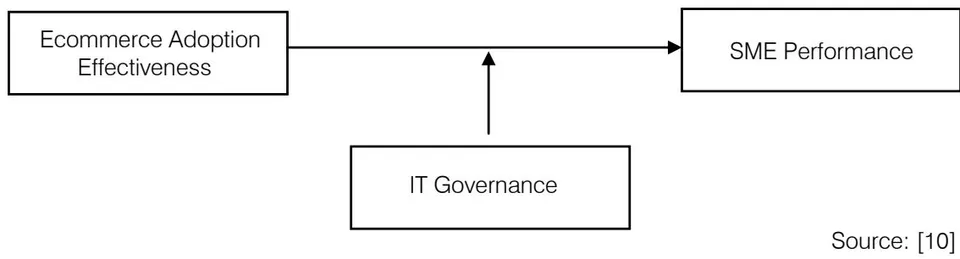
According to [10] IT governance has discussed under following topics. IT value delivery, strategic alignment, risk management, resource management.
III. METHODOLOGY
To test the governance effect to the relationship of the E-commerce adoption and Organizations performance testable model is developed as shown in figure 01. To measure the constructs in the testable model 254 data collected from organizations and measured and interpreted the results. For this study data is collected from Small and Medium Scale organizations in manufacturing sector in Sri Lanka. According to the Industrial Development Board (IDB) of Sri Lanka currently there are 950 organizations in western province registered and IDB is the main SME manufacturing sector government organization in the county. To test the model in this study AMOS used as a tool for Structural Equation Modeling (SEM) analysis. Before applying SEM, data is cleaned, and reliability and validity of the data is checked and achieved the goodness of data and contracts under Exploratory Factor Analysis (EFA). Then Confirmatory Factor Analysis (CFA) is executing to check the model goodness of fit.
a) Structural Equation Modeling (SEM)
SEM is a collection of statistical techniques that can be used to confirm a theory hypothesized on a phenomenon . To confirm a theory. SEM is developing and validates a set of models consisting interrelated structural relationship among theoretical contracts and indicator variables . The theoretical contracts refer to unobservable factors that are used to describe the phenomenon explained by the theory. Those theoretical contracts are represented by observable indicator variables . In this study initially, Exploratory Factor Analysis (EFA) has been conducted and followed with Confirmatory Factor Analysis (CFA).
b) Exploratory Factor Analysis (EFA)
In this model there are three constructs been identified as E-commerce adoption [11, 14, 20-24], organization performance[7, 10, 13, 25-28] and Information Technology governance[10, 17]. Each construct is measured using questionnaire items three, three and four respectively. The acceptance of data for the analysis is presented in table 01. Items covered in the questions in adoption including maintain sales, supplier, procurement process and non-financial transactions online. Under organization performance in this study tested for customer satisfaction, internal process efficiency and supplier's integration process efficiency. In IT governance distinguish process among customers, continues quality improvement, enter to new markets and efficiency in production process. This has been explained in the discussion section with the results obtained in detail.
| Construct | No of Items | AVE | CR | Cronbach's Alpha |
| Organization Performance | 3 | 0.69 | 0.869 | 0.867 |
| Ecommerce Adoption | 3 | 0.535 | 0.774 | 0.767 |
| IT Governance | 4 | 0.433 | 0.751 | 0.745 |
To access reliability of the instrument, the internal consistency is checked. Internal consistency of the measurement model refers the degree to which all the indicators appointed to measure the same constructs are interrelated [29]. In this study, the internal consistency accessed using Cronbach's Alpha [30] and Composite reliability [31]. Further, indicator reliability was accessed using indicator loading [18]. Its measures how much of the indicator variance is explained by the corresponding latent variable. According to [18, 32, 33] the values in the measurement model was not acceptable for IT governance which has less than 0.5 for Average VarianceExtracted (AVE). However, according to [32], if the AVE value is less than 0.5 and composite reliability (CR) is higher than 0.6 still the converged validity is adequate. For E-commerce adoption and organization performance AVE is acceptable and for all the variables Cronbach's alpha is acceptable when it is higher than 0.7[18]. With the confirmation of EFA study continued with CFA.
c) Confirmatory Factor Analysis
The model is developed in AMOS and testes according to the SEM techniques.
Moderating variable moderates the effects of an independent variable on its dependent variable. The social science researchers define moderator as the variable that "interfere" in the relationship between an independent variable and its corresponding dependent variable . According to the which integrates findings literature regarding the impact of corporate governance on firm performance, they have found that external governance has a moderating effect on firm performance. Therefore, in this study reaches investigate that in the aspect of IT governance and check the moderating effect for organizational performance. According to [36] there are few steps involved in analyzing the multi-group CFA when analyzing the moderating effect in AMOS. Here in this study moderator is analyzing with respect to low and high governance.
Both high and low level of governance is measured with constrained and unconstrained models. Then obtained the difference in chi-square value between constrained and unconstrained model for both high and low level of governance. According to [36]both constrained and unconstrained models are been developed. Figure 02 shows the model developed to test the effect.
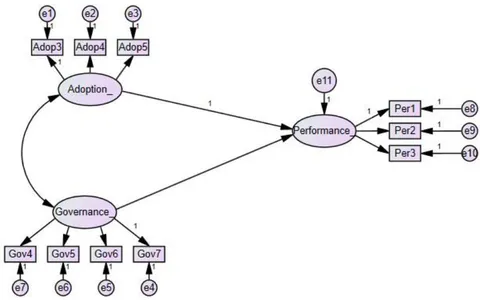
According to the analysis the chi-square value and degree of freedom is reported in table 01.
| Multi-level | Model | Constrained | Unconstrained | Chi-square & DF Difference | Results on Moderation |
| Low Governance | Chi-square | 45.801 | 40.543 | 5.258 | Significant |
| DF | 33 | 32 | 1 | ||
| High Governance | Chi-square | 86.862 | 28.938 | 57.924 | Significant |
| DF | 33 | 32 | 1 |
According to the table 02: Chi-square value is 5.258 (45.801- 40.543) in low governance between constrained and unconstrained model. While the Degree of Freedom is 33-32 =1. For the test to be significant, the difference in chi-square value should be higher than the value of Chi-square with 1 degree of Freedom, which is 3.84. Therefore, both the low and high level of governance is moderating the relationship of E-commerce adoption and Organizational performance.
IV. DISCUSSION
In the study moderating effect is measured for both high level and low level of adoption. This is evident through past studies as well . Furthermore, this finding provides an extended justification for a proposed theoretical model for SME development in Malaysia . In a study done in Malaysia for SME in ICT adoption state that proper utilization of ICT significantly affect the organization performance . Therefore, it can conclude that organization performance is increasing with proper IT governance in SMEs.
According to the questionnaire items filtered in EFA and results obtained in CFA this study shows that when organizations experience uniqueness of the products through Ecommerce solutions organizational performance will be enhanced. Even organizations adopted to Ecommerce but not provided with unique features and functionalities performance improvement is not so significant. Further results in the study shows if Ecommerce solution provide more quality to the products, performance will be improved. This can be achieved through tactics which will ultimately improve the organization performance. Quality is measured as customer satisfaction, therefore maintain high customer satisfaction through online purchase would be significant for business improvement . After adopting to the Ecommerce solutions, Industries should be able to find new markets. Hence, Ecommerce solution should be able to do market analysis and find opportunities. This is back-end operations in the Ecommerce platform. Artificial intelligence, Big data, Machine leaning and deep leaning like data analysis techniques should can be apply . Therefore, embedded Ecommerce solution to the systems organizations will be achieve higher organizational performance. Now a day's social media data is used to understand the real demand for product and find new markets . This would improve process efficiency and cost advantage with minimum inventory. According to finding if the production efficiency is improved after adopting to Ecommerce organization performance will be improved. This means Ecommerce should be able to streamline the production lines and make maximum production efficiency. If the organization can predict the real demand of the customer and economy of scale (EOS) organization will be able to achieve maximum cost benefit to improve organization performance. This is evident through past literature by using advance data analysis techniques, production systems will improve their operations [42, 43].
V. FUTURE STUDIES
This study is conducted with the intention to contribute literature in manufacturing sector organizations in the small and medium sector in Sri Lanka. According to Industrial Development Board of Sri Lanka, this study is important to conduct to other sectors in the country as many organizations use technology below the expectation and not exercising the real time use of technology for better business performance. Therefore, there is a clear gap between existing use of the technology and governance in other sectors of the country. Furthermore, the IT governance perspective should be moderated according to the industry which the studies in the future to be conducted. When it comes to larger scale organizations there is a high possibility of applying more advance tool and techniques used in the Information Technology industry for data analysis for better business forecasting, advance data communication methods for wider bandwidth to access remote data centers and conduct business operations entirely online. According to in the qualitative analysis of the study conducted found that concern for cyber security is a significant factor to be considered therefore information technology governance should be embedded with proper use of the security measures to protect the network and build the trust among users in the domain.