
I. INTRODUCTION
According to data from the Superintendence of Secondary and Vocational Education of Minas Gerais, among the main causes of student dropout are those related to the student's socioeconomic context, which force the student to choose between work or study. This result is corroborated by research such as carried out by Fiorotti and da Rosa (2022), who also detected the difficulty of reconciling study and work and financial problems as causes of dropout. However, a large part of the dropouts were classified as Dropout-Without justification (Minas Gerais, 2009), which shows the need for a better categorization of the causes, and a greater detail of these.
Thus, this study seeks to fill a theoretical gap, including the analysis of individual, institutional and social variables, both in their particularities and in the interrelationships that occur and generate dropout (Dore & Luscher, 2011). As a theoretical basis for the analysis of interrelationships, this essay makes use of the premises of Service Dominant Logic - SD-L, proposed by Vargo and Lusch (2006). Despite being a proposal for analysis of exchanges between actors present in a value ecosystem, it is argued in this study that the concepts of value co-creation, resource integration and value proposition can fit into the existing exchange between educational institution and student.
For the premises and axioms of the SD-L to be applicable to the context of this study, some assumptions are necessary: (i) the educational institution offers a value proposition, in the form of a vocational course; (ii) the value perceived by the student results from the integration between their resources, the resources of the educational institution and the resources of other actors participating in the value ecosystem; (iii) the value is phenomenologically determined by the student; (iv) the current institutional environment (norms and behaviors repeated over time), which coordinates the integration of resources, influences the co-created value; (v) the higher the co-created value, the lower the propensity to drop out.
This study then seeks to analyze, from the point of view of the premises of the SD-L, the problem of school dropout, including the interrelationships that occur during the process of integrating individual and social resources, mediated by the current institutional environment. This essay uses a literature review to survey the main causes of dropout, and, through reflection, tries to propose a way to maximize the co-creation of value by the student, so that the dropout propensity is reduced. The essay begins by placing the concepts related to student dropout, then the premises and axioms of Service-dominated Logic are exposed, and finally, a discussion and reflection is made on how the phenomenon studied can be minimized using solutions based on the theoretical body presented.
II. STUDENT DROPOUT: CONCEPT AND CAUSES IDENTIFIED IN THE LITERATURE
School dropout is associated with the dismissal of students from the educational institution, regardless of the reason, except in cases of completion or graduation of the course. This phenomenon reflects on multiple losses for the institution, whether due to the investment of resources with the students, or for the development of the country's society and culture (Fritsch et al., 2015).
Fialho (2014) defines student dropout as a macro-social phenomena that reach international scales and that causes negative impacts on individuals, society and directly on educational management. Baggi and Lopes (2011) list the existence of multiple factors that lead to school dropout in educational institutions, which may be related to social, cultural, political and economic contexts. They affirm the need to carry out a systematic reflection on the evaluation methodologies of institutions with dropout.
The Special Commission for Studies on Dropout in Brazilian Public Universities characterizes school dropout in:
Course Dropout: In this category, the student withdraws from the higher education course, considering multiple reasons: dropout, in which the student fails to enroll; giving up, officially; course transfer or re-option; exclusion by institutional rule;
Dropout from the Institution: Occurs when the student leaves the institution in which he has a bond;
Dropping out of the System: In this case, the student leaves higher education permanently or for a period of time.
This characterization can be extended to educational institutions of all levels, from basic to higher education. In addition, this educational phenomenon brings with it an expenditure of resources for both public and private sector institutions. The side of social loss is also highlighted, in which a citizen who would add to local and country development fails to form (Baggi & Lopes, 2011).
The search for factors that lead to school dropout in educational institutions has generated several studies in order to contribute to reducing this problem, which, as mentioned, affects all levels of education. Table 1 below illustrates the results of studies on the topic:
| Authors | Causes |
| (Gomes & Bastos, 2016) | Family influence, dissatisfaction with school, need to work to help support the household, lack of information about the course when starting it. |
| (Rosa & Aquino, 2019) | The lack of identity of vocational technical education has contributed to young people giving up their courses. |
| (Dore & Luscher, 2011) | The abandonment of the course due to employment/work; abandonment without any justification. |
| (Oliveira & Volpato, 2017) | The cultural capital of students in subsequent courses, in relation to prior knowledge of the course area; symbolic violence on the part of their colleagues, teachers and the curricular structure of the courses. |
| (Lambiase & Conceicao, 2021) | Course duration, strikes and stops in the academic year and the New Corona Virus Pandemic. |
| (Fiorotti & Da Rosa, 2022) | The main causes of school dropout are of an extra-school nature, above all, difficulties in reconciling school activities. work with studies, financial, personal and/or health problems. The most prominent intra-school causes were low motivating classes and the mismatch between course requirements and the repertoire of knowledge accumulated by students in previous stages of their schooling. |
| (Saccaro & Franca, 2020) | Legal nature of the educational institution prior to high school, public or private, with more frequent dropout by students from public legal institutions. |
| (Santos & Corseuil, 2022) | A higher incidence of participants in the Bolsa Família Program is not associated with a smaller difference in dropout rates between mother and non-mother students. |
| Rosa et al., 2022) | More time in school (full-time) increases grade point averages in languages and math, and reduces retention and dropout. |
| (Glewwe & Kassouf, 2012) | The government's Bolsa Escola/Família program increased enrollments by 5.5% and reduced dropout rates by 0.5 percentage point. |
| (Salinas & Jorquera-Samter, 2021) | In Chile, teenage pregnancy favors student dropout. |
| (Yi et al., 2015) | In China, the poorest areas have a dropout rate of 22%, while areas with better socioeconomic indicators have a rate of 10.7%. |
| (Linke et al., 2017) | The main motivation for dropping out of school is the lack of social inclusion, which makes the student feel outside the stimulus in relation to his social condition, and inferior to the others. The way in which the teacher prepares the pedagogical plan, that is, the way in which he will teach classes also influences the dropout rate. |
| (Rizzotto & França, 2022) | The school's institutional climate, represented by relationships with other students, is a predictor of student performance. Better performances favor permanence and reduce dropout. |
Making a synthesis of the causes presented in the studies above, we can see the incidence of factors inherent to: (i) students, such as financial problems, teenage pregnancy, difficulty in reconciling study and work; (ii) the social context, such as lack of social inclusion, institutional climate of the school, lack of social capital and suffering from symbolic violence; (iii) the school and educational context, such as classes that are not very motivating, mismatch between the requirements of the course and the repertoire of knowledge accumulated by students in previous stages of their schooling, and the pedagogical plan adopted by some teachers.
It can be seen that such factors can occur concomitantly, requiring that the actions to combat evasion present a harmony so that a synergy between these actions is generated. One way to make this tuning possible is through the application of a theoretical body that coordinates actions in order to maximize the value co-created by the student during classes. Thus, this study suggests the application of the premises of Service Dominated Logic, whose characteristics are discussed in the following section.
III. PREMISES AND AXIOMS OF SERVICE-DOMINANT LOGIC
Service-dominated Logic - SD-L, represents a proposal for a paradigm shift, from the currently current Product-dominated Logic, to a Service-dominated Logic, in which service means the application of knowledge, skills and other resources in actions that benefit the other part and/or himself (Vargo, 2011).
According to Vargo and Lusch (2006), the SD-L rejects the premise that only the producing organization can create value at the time of producing products or services. According to the authors, any product, tangible or not, is only part of the offer of a service. That is, what is really exchanged is always service for service, whose emerging value in the exchange context is co-created by the actors involved in the service ecosystem, at the moment when the resources of these actors are integrated. Thus, in the educational context, the educational institution does not create value by offering a certain course. This is determined by the beneficiary, in this case the student, when he/she integrates his/her resources with those of the educational institution, taking advantage of the service offered.
The theoretical body of the LDS, according to Vargo and Lusch (2016), can be expressed through the following fundamental (or foundational) premises:
- (P1): Service is the fundamental basis of exchange;
- (P2): Indirect exchanges cover the fundamental basis of exchange of service for service;
- (P3): Goods are service distribution mechanisms;
- (P4): Operating resources are the fundamental sources of strategic benefit;
- (P5): All economies are service economies;
- (P6): Value is co-created by multiple actors, always including the beneficiary;
- (P7): Actors do not guarantee the delivery of value, but rather participate in creating and offering value propositions;
- (P8): A service-centric view is inherently beneficiary-oriented and relational;
- (P9): All actors, social and economic, are resource integrators;
- (P10): Value is uniquely and phenomenologically determined by the beneficiary;
- (P11): Value co-creation is coordinated through institutions generated by actors and institutional logic.
These foundational premises provide a framework to enable a new perspective of analysis of the exchange process and its role in society (Vargo & Lusch, 2016). It can be seen that according to premises P6, P7 and P10, despite different actors proposing value, the result is determined by the beneficiary, which has implications for the way companies approach the market and for the way they should offer your products and services. In LDS, the consumer moves from passive recipients of messages to active participants in the creation of experiences (Baron et al., 2010). The point is the organization understanding of its role as an enhancer of value creation, with an emphasis on understanding the potential for co-creation present in the experiences lived in service encounters (Payne et al., 2008). Therefore, the offer of courses needs to go beyond the notion of value transferred to the customer (student), to a notion in which value is created jointly with customers (beneficiaries) in the context of use.
In short, the argument presented by SD-L is that one must overcome the traditional supplier-consumer view (in the case of this study, the educational institution-student view), for a systemic approach of networks of actors interacting in an ecosystem of service. Therefore, it is necessary to conceptualize important elements in the LDS, such as ecosystem (and context), value (and value proposition), resource (and integration of resources) and institutional logic (and institutions).
With regard to value, in the traditional view of Product-dominant Logic, value is created only by the organization that produces the good or service, and the customer is responsible for destroying this value (Bettencourt et al., 2014). But if the product or service is not consumed, will it still have value? Or does value manifest itself only in the presence of a consumer? For Vargo and Lusch (2014), the organization, with its resources, offers a value proposition, which, when experienced by a beneficiary, integrating its resources with those of the organization and other actors (government, family, other organizations), leads to the co-creation of value by that beneficiary.
Regarding resources, the fact that individual and firm resources are considered to be integrated during the application of a service refers to Bourdieu's (1989) concepts of social, cultural and economic capital. Social capital refers to skills and knowledge related to social interactions and networks. Cultural capital, on the other hand, refers to particular combinations of skills and knowledge, which combined with economic and social capital serve as the basis for social configurations called habitus (Bourdieu, 1984). Depending on the current context, actors have greater or lesser facility to integrate resources.
In LDS, resources can be classified as operant and operand. Operant resources are mainly represented by people, with their skills and knowledge. Operand resources, in turn, are represented by raw materials and tools. To generate benefits, knowledge and skills are needed to "find, extract, cultivate, invent, manufacture and use operated resources, that is, the benefits derive from the application of operating resources in operated resources" (Vargo & Lusch, 2006, p. 45).
Regarding institutional logics, Maglio and Spohrer (2008) state that both service and value co-creation result from the integration of resources (operant and operand) from multiple actors, which requires communication and coordination. The co-creation of value is necessarily a joint activity, which depends on the establishment of mutual understanding (instructions) for different entities to achieve common goals. On the other hand, mutual understanding is also co-created, because it is achieved through shared institutional logics, such as experiences, context and information, as well as other shared resources such as, for example, a language created specifically by a group that facilitates connection among members (Maglio & Spohrer, 2008).
In short, bringing the above arguments to the educational context, it is clear that if the ecosystem presents gaps, such as the lack of actors that offer values (and value propositions) more aligned with the student's need, or the lack of resources (and integration of resources) by the actors (students, teachers, managers of educational institutions, government and legislators) for the co-creation of a greater value, or coordination lead by wrong institutional logic (and institutions), probably the student's motivation to their permanence is reduced, favoring an increase in the dropout rate.
Thus, in the following chapter, reflection and discussion are made about the applicability of the theoretical body of the SD-L in the phenomenon of student dropout.
IV. DISCUSSION ON SD-L AND STUDENT DROPOUT
In the case of the value proposition by the educational institution, it is difficult to find a basis for quantifying it. It cannot be measured in monetary terms, as the teaching and learning process encompasses many aspects in addition to financial ones. Thus, the proposal of this work is that the co-created value cannot and need not be measurable in monetary terms, as Achrol and Kotler (2006) mention, this is a phenomenon influenced by individual and social aspects. According to McColl-Kennedy et al. (2012), the co-created value can be expressed in the form of perceived benefits, such as, for example, improvement in professional qualification, which in turn can lead to an improvement in quality of life.
The search for professional qualification, however, is not always successful. Despite the efforts of actors such as the government, civil society, educational institutions and the students themselves, the latter are not always able to complete the qualification courses (Dore & Luscher, 2011). From the point of view of the SD-L, it can be inferred that the value is not being co-created by the beneficiary, and it is even possible for the co-destruction of value to occur. Co-destruction is defined as "a process of interaction between service systems that results in a decline in at least one of the welfare systems (which, given the nature of a service system, may be individual or organizational)" (Plé & Chumpitaz Cáceres, 2010, p. 431).
According to a plan issued by the Federal Audit Court in 2011, the government has a target of for the completion rate (and therefore, of dropout and retention) provided for in the Draft Law of the National Education Plan 2011- 2020 However, according to data available on the Ministry of Education portal for 2019, in 2018 the annual dropout rate of vocational technical education in Brazil was , with an advance in reducing the problem, compared to the previous year, in which had , values much higher than the stipulated for the target.
Thus, it is clear that actions are necessary to reduce the dropout rate so that the completion rate reaches the desired level. To this end, this study suggests approaching the phenomenon of value disintegration (instead of integration) from the point of view of SD-L (Bidar et al., 2022; Laud et al., 2019). The diagram in Figure 1 illustrates how the elements present in the value ecosystem of technical education are related from the perspective of LDS. It can be seen that the integration of resources is influenced by the resources of the actors involved and by the institutional logic that coordinate the integration (Bettencourt et al., 2014).
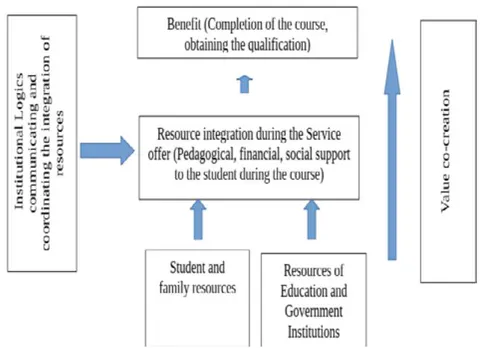
Given the information in Figure 1, it is possible to typify the factors that make it difficult to integrate resources and can lead to the co-destruction of value (Laud et al., 2019):
- Lack of resources to integrate (lack of social capital and financial resources of students)
- Access to integration blocked (symbolic violence suffered by students)
- Unwillingness to integrate resources (disinterest in studying)
- Incomprehension about how to integrate resources (actors with lack of information about the course)
- Disagreement on how to integrate resources (lack of alignment between public policies, government assistance programs and projects, pedagogical projects and social context)
- Misleading resource integrations (corruption in government programs and projects)
- Negligent resource integrations (apathy and lack of involvement of actors in actions against evasion)
- Inability to integrate resources (lack of qualification of managers and teachers)
- Excessive integration of resources (anxiety to obtain positive results)
- Coercive resource integration (institutional logic based on threats and pressures)
Articulating the types of causes and types of factors that hinder the integration of resources and the co-creation of value on the part of students, suggestions were made, based on the literature, to address the causes of dropout.
V. SUGGESTIONS FOR DEALING WITH THE CAUSES OF DROPOUT FROM THE POINT OF VIEW OF THE SD-L
To elaborate the suggestions, the causes were analyzed by type (personal, social, pedagogical/school) and by factor that can lead to the disintegration of resources and co-destruction of value. In relation to the confrontation of the causes related to personal issues, such as financial problems, teenage pregnancy, difficulty reconciling study and work (Dore & Luscher, 2011; Fiorotti & Da Rosa, 2022; Gomes & Bastos, 2016; Salinas & Jorquera-Samter, 2021), these can be linked to the type 1 factor - lack of resources to integrate, in this case, mainly financial resources.
The suggestion of this study is the offer of scholarships that allow the student to attend classes without having to carry out work activities to earn income. Melo Filho (2019) cites as an example the scholarships modality PET - Tutorial Education Program, offered to higher education courses, which could be adapted for high school and vocational education. The offer of programs, such as Bolsa Família, in isolation, does not seem to reduce dropout rates, for example, among student mothers (Santos & Corseuil, 2022), so it is assumed that the actions must have an attractive and complementary to the course curriculum.
Although the vast majority of students have the need to reconcile work and study, public policies and Brazilian legislation do not address the particularity of this condition, making it difficult for the student-worker and the worker-student to remain in their courses (Vargas & Paula, 2013). It would be convenient to change the labor legislation, which contemplates the possibility of flexible working hours to facilitate class attendance (Vargas & Paula, 2013). The inversely proportional relationship between income and evasion can be verified in the study by Yi et al. (2015) when they find that in the poorest areas of China, dropout rates double in relation to the richest areas.
Thus, actors with resources that allow the alteration of legislation, the creation of public policies and educational programs would be the main ones involved in facing the causes related to the students' personal issues.
Regarding the confrontation of causes related to social issues, such as lack of social inclusion, institutional climate of the school, lack of social capital and suffering from symbolic violence, which refer to factor type 2 - blocked access to integration, the suggestions address external and internal aspects to the school. The suggestion regarding the first is the promotion of public policies of financial support to students, which are accessible and effective (Vargas & Paula, 2013). At this point, for the first time, appears the need to coordinate the efforts of actors through institutional logic that make policies effective, without disintegrating resources and co-destruction of value.
Regarding the intra-school aspect, the way in which the student with little social capital is treated and the way that each teacher acts in the classroom can alleviate or intensify the reproduction of social inequalities, and consequently the symbolic violence, leading the student to believe that their culture is inferior to the dominant culture (Oliveira & Volpato, 2017). Thus, measures are needed that, coordinated and aligned with financial support policies and tutorial education programs, increase students' social capital, allowing them to perceive the school as a place where their culture is valued.
Finally, regarding the confrontation of causes related to pedagogical/school issues, these can be linked to factors 3- unwillingness to integrate resources, 4- misunderstanding about how to integrate resources, 5- disagreement about how to integrate resources and 8- inability to integrate resources. Factor 4 addresses issues such as the lack of information about the chosen course (Gomes & Bastos, 2016), which can lead to a lack of identity with it (Rosa & Aquino, 2019).
To face the inability to integrate resources (Factor 8), training in educational management is suggested, as well as continuing pedagogical teacher qualification, which allows managers and teachers to develop solutions in line with local problems (Ikeshoji & Terçariol, 2015). This training may include, for example, training in resources such as digital communication and information technologies, which would increase the chance of success in integrating resources and, consequently, in dealing with these causes of evasion.
The problem of low motivating classes and the student's lack of interest in co-creating value (Factor 3) may have its origin in the poorly didactic pedagogical plan adopted by some teachers, as well as the discouragement generated by the perception that the course is too long, and that strikes and pandemics increase their duration (Lambiase & Conceicao, 2021), which refers to factor 5 (disagreement about how to integrate the school's pedagogical resources with its own resources).
To facilitate the integration between the school's didactic and pedagogical resources and the students' own resources, the literature on the subject suggests the adoption of active teaching methodologies, such as project-based learning, maker approach and inverted classroom, where the student becomes the protagonist of their learning, and the teacher takes on the role of mediator and guide of the actions resulting from the internal motivation of the students (Evaristo & Terçariol, 2019; Terçariol & Afecto, 2021).
In addition to the adoption of active methodologies, a longer time in contact with the teaching and learning process also favors the reduction of retention and dropout (Rosa et al., 2022). However, this would be an action that would demand, as previously mentioned, an institutional logic that favors the reproduction of behaviors aimed at the elaboration of pedagogical proposals that promote innovation and creativity. Based on the premises of the LDS, such proposals would be more attractive, increasing student engagement and reducing the chance of dropout.
To summarize the discussion on suggestions to reduce dropout, Table 2 below summarizes the causes, suggestions and actors involved.
| Cause | Suggestion for the Confrontation | Actors Involved |
| (i) Personal: Financial problems, teenage pregnancy, difficulty in reconciling study and work; | - Offer of scholarships and tutorial education programs - PET (similar to those in higher education) seeking to provide students, under the guidance of | - Governmental legislators and executors, Managers of Educational Institutions, Teachers |
| a tutor, with conditions for carrying out extracurricular activities (Melo Filho, 2019). Labor legislation that contemplates the possibility of flexible working hours to facilitate class attendance (Vargas & Paula, 2013). | ||
| (ii) Social: Lack of social inclusion, institutional climate of the school, lack of social capital and suffering from symbolic violence; | Promotion of public policies for the social inclusion of disadvantaged students (Vargas & Paula, 2013) Creation of student support programs that address the issue of symbolic violence (Oliveira & Volpato, 2017) Alteration of the current institutional logic, to one that is inclusive and enables social ascension. | - Families, Governmental Powers, legislators and executors, Managers of Educational Institutions, Teachers. |
| (iii) Pedagogical/school: Lack of information about the course started, classes with little motivation, mismatch between course requirements and the repertoire of knowledge accumulated by students in previous stages of their schooling, and the pedagogical plan adopted by some teachers. | Adoption of active teaching methodologies (Evaristo & Terçariol, 2019; Terçariol & Afecto, 2021). Adoption of full-time study when possible (Rosa et al., 2022). Alignment between training programs for educational management and continuing pedagogical teacher qualification to local problems (Ikeshoji & Terçariol, 2015; Terçariol et al., 2016). Alteration of the current institutional logic for one that consolidates the habit of creativity and innovation in teaching methodologies. | - Managers of Educational Institutions, Teachers. |
It is worth emphasizing here once again the importance of coordinating actions, guided by an institutional logic, as shown in Figure 1, which minimizes the possibility of disintegration of resources and the co-destruction of value.
VI. CONCLUSIONS
In a scenario where efforts to combat student dropout are necessary, this theoretical essay sought to analyze the problem from the perspective of Service Dominated Logic - LDS. As a result of this reflective analytical process, suggestions for actions to face dropout emerged, as well as the suggestion of changing the current institutional logic, to a logic that favors the adoption of inclusive routines and that consolidate the habit of seeking teaching methodologies that are more attractive to students.
From the SD-L point of view, isolated actions where the beneficiary is not the focus do not allow the integration of resources, and therefore, the co-creation of value. Joint actions are needed, carried out by all the actors involved in the value ecosystem, and coordinated by an institutional logic that favors the integration of resources and the co-creation of value. Without such coordination, the possibility of disintegration of resources and co-destruction of value is high.