Student relationship in Higher Education using Data Mining Techniques

§ Nizwa University

Send Message

To: Author

Student relationship in Higher Education using Data Mining Techniques

Article Fingerprint

ReserarchID

CST1190Z

Student relationship in Higher Education using Data Mining Techniques Banner

AI TAKEAWAY

Connecting with the Eternal Ground
  • English
  • Afrikaans
  • Albanian
  • Amharic
  • Arabic
  • Armenian
  • Azerbaijani
  • Basque
  • Belarusian
  • Bengali
  • Bosnian
  • Bulgarian
  • Catalan
  • Cebuano
  • Chichewa
  • Chinese (Simplified)
  • Chinese (Traditional)
  • Corsican
  • Croatian
  • Czech
  • Danish
  • Dutch
  • Esperanto
  • Estonian
  • Filipino
  • Finnish
  • French
  • Frisian
  • Galician
  • Georgian
  • German
  • Greek
  • Gujarati
  • Haitian Creole
  • Hausa
  • Hawaiian
  • Hebrew
  • Hindi
  • Hmong
  • Hungarian
  • Icelandic
  • Igbo
  • Indonesian
  • Irish
  • Italian
  • Japanese
  • Javanese
  • Kannada
  • Kazakh
  • Khmer
  • Korean
  • Kurdish (Kurmanji)
  • Kyrgyz
  • Lao
  • Latin
  • Latvian
  • Lithuanian
  • Luxembourgish
  • Macedonian
  • Malagasy
  • Malay
  • Malayalam
  • Maltese
  • Maori
  • Marathi
  • Mongolian
  • Myanmar (Burmese)
  • Nepali
  • Norwegian
  • Pashto
  • Persian
  • Polish
  • Portuguese
  • Punjabi
  • Romanian
  • Russian
  • Samoan
  • Scots Gaelic
  • Serbian
  • Sesotho
  • Shona
  • Sindhi
  • Sinhala
  • Slovak
  • Slovenian
  • Somali
  • Spanish
  • Sundanese
  • Swahili
  • Swedish
  • Tajik
  • Tamil
  • Telugu
  • Thai
  • Turkish
  • Ukrainian
  • Urdu
  • Uzbek
  • Vietnamese
  • Welsh
  • Xhosa
  • Yiddish
  • Yoruba
  • Zulu
Font Type
Font Size
Font Size
Bedground

Abstract

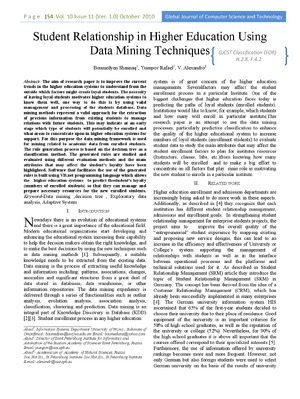
The aim of research paper is to improve the current trends in the higher education systems to understand from the outside which factors might create loyal students. The necessity of having loyal students motivates higher education systems to know them well, one way to do this is by using valid management and processing of the students database. Data mining methods represent a valid approach for the extraction of precious information from existing students to manage relations with future students. This may indicate at an early stage which type of students will potentially be enrolled and what areas to concentrate upon in higher education systems for support. For this purpose the data mining framework is used for mining related to academic data from enrolled students. The rule generation process is based on the decision tree as a classification method. The generated rules are studied and evaluated using different evaluation methods and the main attributes that may affect the student’s loyalty have been highlighted. Software that facilitates the use of the generated rules is built using VB.net programming language which allows the higher education systems to predict thestudent’s loyalty (numbers of enrolled students) so that they can manage and prepare necessary resources for the new enrolled students.

References

14 Cites in Article
  1. J Han,M Kamber (2001). Data Mining-Concepts and Techniques.
  2. J Luan (2002). Data Mining and Its Applications in Higher Education.
  3. Nigel Culkin norbert morawetz, university of hertfordshire, centre for innovation and enterprise.
  4. De Hilbert,Andreas,Schnbrunn,Karoline,Sophie Schmode (2007). Student Relationship Management In Germany -Foundations And Opportunities.
  5. N Delavari,M Shirazi,M Beikzadeh (2004). A new model for using data mining technology in higher educational systems.
  6. Keir Mierle,Kevin Laven,Sam Roweis,Greg Wilson (2004). Mining student CVS repositories for performance indicators.
  7. P Varapron (2003). Using Rough Set theory for Automatic Data Analysis.
  8. (1999). Introduction to Data Mining and Knowledge Discovery, Two Crows Corporation.
  9. J Han,M Kamber (2001). Data Mining Concepts and Techniques.
  10. M Mehta,R Agrawal,J Rissanen (1996). SLIQ: A Fast Scalable Classifier for Data Mining in proc.
  11. K Murthy (1998). Automatic Construction of Decision Trees from Data: A Multi-Disciplinary Survey.
  12. W Peng,J Chen,H Zhou An Implementation of ID-Decision Tree Learning Algorithem.
  13. F Esposito,D Malerba,G Semeraro (1997). A Comparative Analysis of Methods for Pruning Decision Trees.
  14. P Chapman,J Clinton,R Kerber,T Khabaza,T Reinartz,C Shearer,R Wirth,M Hall (1998). Correlation-based Feature Subset Selection for Machine Learning.

Funding

No external funding was declared for this work.

Conflict of Interest

The authors declare no conflict of interest.

Ethical Approval

No ethics committee approval was required for this article type.

Data Availability

Not applicable for this article.

How to Cite This Article

Dr. Shannaq. 1970. "Student relationship in Higher Education using Data Mining Techniques". Global Journal of Computer Science and Technology GJCST Volume 10 (GJCST Volume 10 Issue 11).

Download Citation

Journal Specifications

Crossref Journal DOI 10.17406/gjcst

Print ISSN 0975-4350

e-ISSN 0975-4172

Keywords
Version of record

v1.2

Issue date
October 10, 2010

Language
English
Experiance in AR

Explore published articles in an immersive Augmented Reality environment. Our platform converts research papers into interactive 3D books, allowing readers to view and interact with content using AR and VR compatible devices.

Read in 3D

Your published article is automatically converted into a realistic 3D book. Flip through pages and read research papers in a more engaging and interactive format.

Article Matrices
Total Views: 4.4K
Total Downloads: 275
All Trends

Request Access

Please fill out the form below to request access to this research paper. Your request will be reviewed by the editorial or author team.
X

This is the heading

Lorem ipsum dolor sit amet, consectetur adipiscing elit. Ut elit tellus, luctus nec ullamcorper mattis, pulvinar dapibus leo.


High-quality academic research articles on global topics and journals.

Student relationship in Higher Education using Data Mining Techniques

Dr. Shannaq
Dr. Shannaq Nizwa University